Page 261 of 363
The air cleaner element should be
cleaned or replaced according to the
time and distance recommendations
in the maintenance schedule.
Clean the air cleaner element by
blowing compressed air through it in
the opposite direction to normal air
f low. If you do not have access to
compressed air (such as a service
station), ask your Honda dealer to do
this service.
Follow the replacement procedure
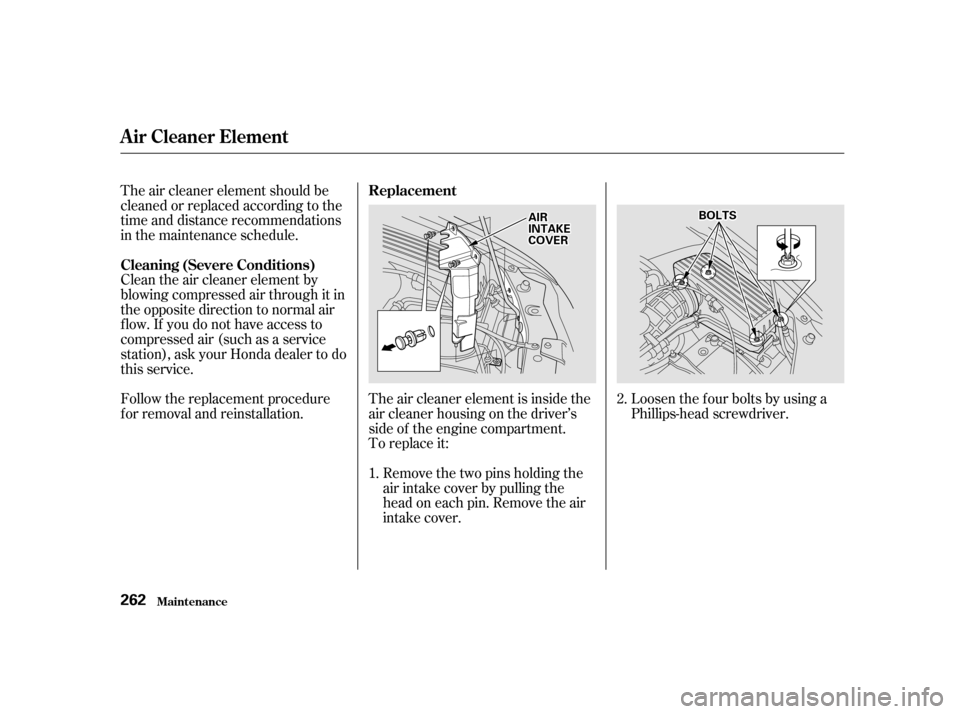
for removal and reinstallation.To replace it:Remove the two pins holding the
air intake cover by pulling the
head on each pin. Remove the air
intake cover.
The air cleaner element is inside the
air cleaner housing on the driver’s
side of the engine compartment.
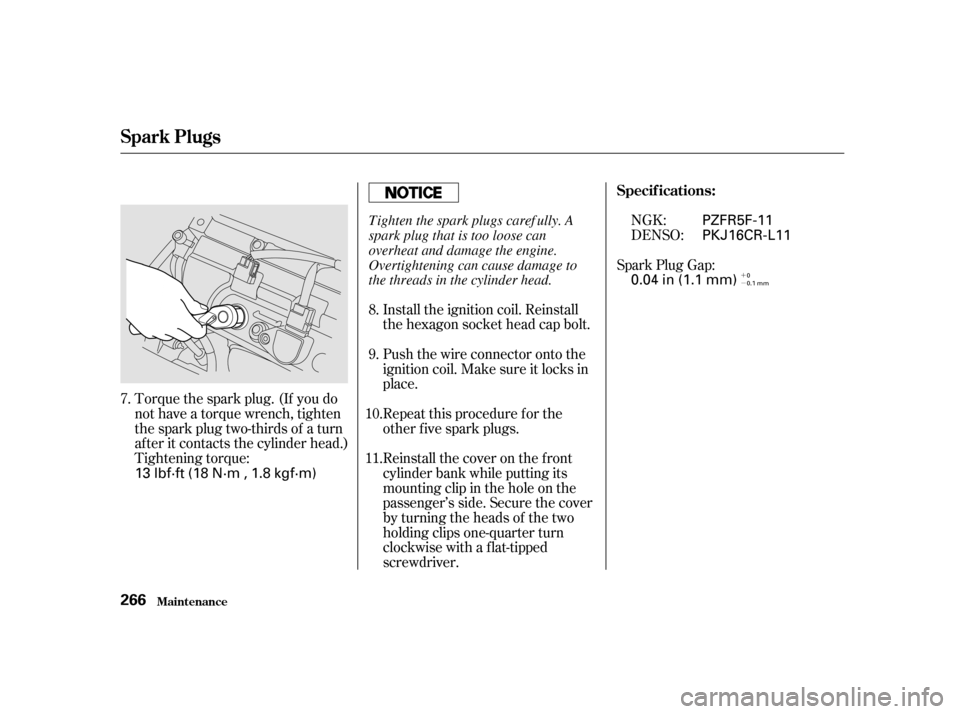
Loosen the f our bolts by using a
Phillips-head screwdriver.
1. 2.
A ir Cleaner Element
Maint enance
Cleaning (Severe Conditions)
Replacement
262
AAIIRRIINNTTAAKKEECCOOVVEERR
BBOOLLTTSS
Page 265 of 363
�´ �µ
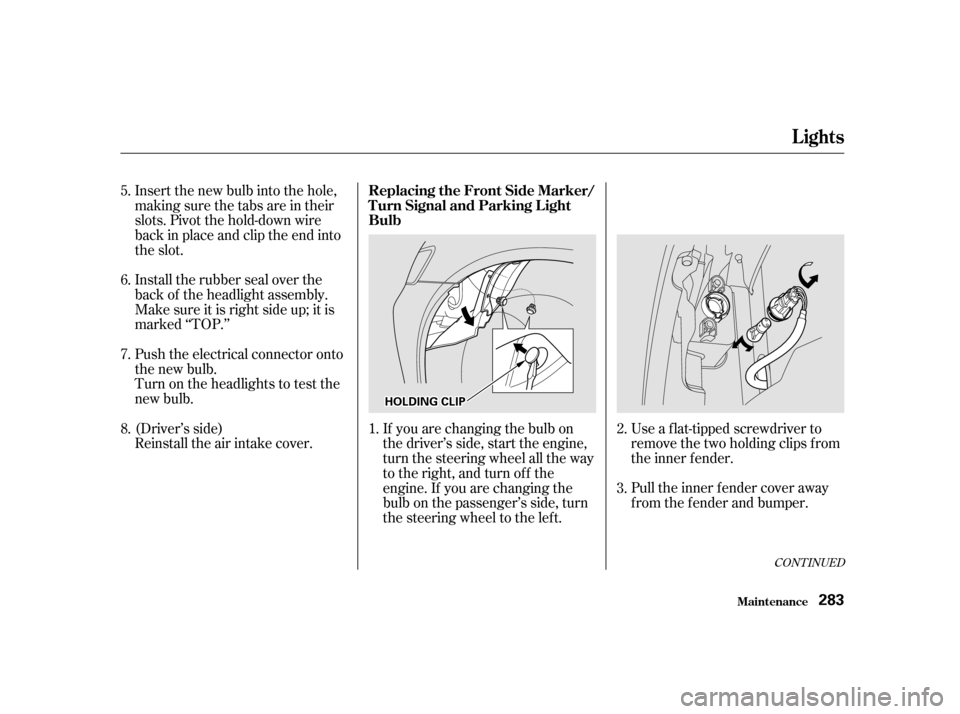
Torque the spark plug. (If you do
not have a torque wrench, tighten
the spark plug two-thirds of a turn
af ter it contacts the cylinder head.)
Tightening torque: Spark Plug Gap:
Install the ignition coil. Reinstall
the hexagon socket head cap bolt.
Push the wire connector onto the
ignition coil. Make sure it locks in
place.
Repeat this procedure f or the
other f ive spark plugs.
Reinstall the cover on the front
cylinder bank while putting its
mounting clip in the hole on the
passenger’s side. Secure the cover
by turning the heads of the two
holding clips one-quarter turn
clockwise with a f lat-tipped
screwdriver. NGK:
DENSO:
7. 8. 9.
10. 11. Specif ications:
Spark Plugs
Maint enance
266 13 lbf·ft (18 N·m , 1.8 kgf·m) 0.04 in (1.1 mm)
PKJ16CR-L11
PZFR5F-11
0
0.1 mm
Tighten the spark plugs caref ully. A
spark plug that is too loose can
overheat and damage the engine.
Overtightening can cause damage to
the threads in the cylinder head.
Page 270 of 363
Run the air conditioning at least once
a week during the cold weather
months. Run it f or at least ten
minutes while you are driving at a
steady speed with the engine at
normal operating temperature. This
circulates the lubricating oil con-
tained in the ref rigerant.If the air conditioning does not get as
cold as before, have your dealer
check the system. Recharge the
system with Ref rigerant HFC-134a
(R-134a). (See Specif ications on page
.)
Your vehicle’s air conditioning is a
sealed system. Any major mainte-
nance, such as recharging, should be
done by a qualif ied mechanic. You
can do a couple of things to make
sure the air conditioning works
ef f iciently.
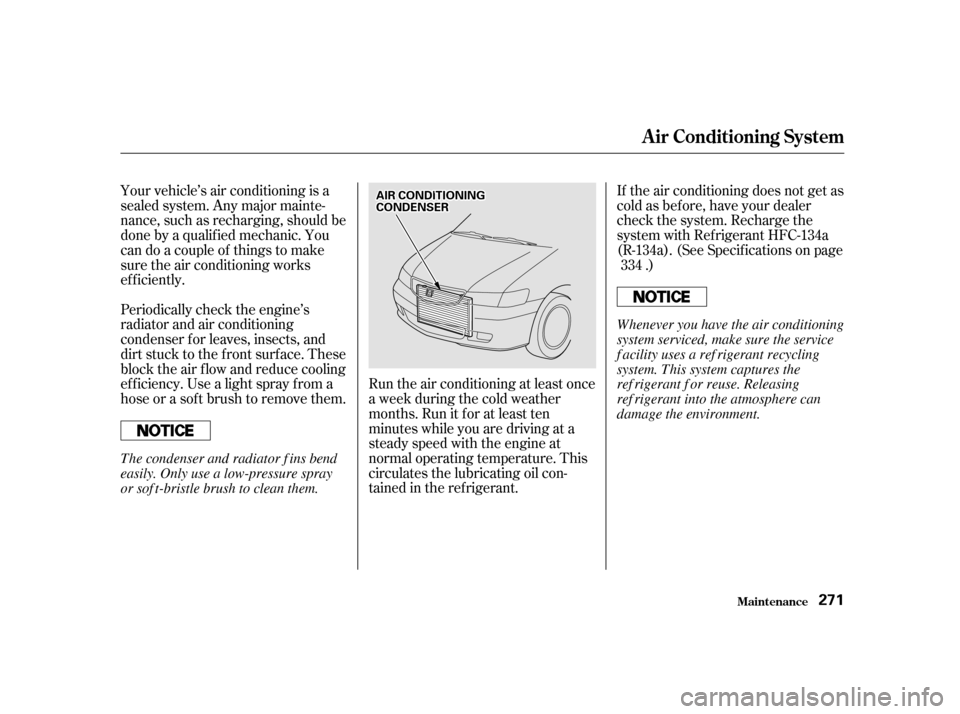
Periodically check the engine’s
radiator and air conditioning
condenser f or leaves, insects, and
dirt stuck to the f ront surf ace. These
block the air f low and reduce cooling
ef f iciency. Use a light spray f rom a
hose or a sof t brush to remove them. 334
Maint enance
A ir Condit ioning Syst em
271
AAIIRRCCOONNDDIITTIIOONNIINNGGCCOONNDDEENNSSEERR Whenever you have the air conditioning
system serviced, make sure the service
f acility uses a ref rigerant recycling
system. This system captures the
ref rigerant f or reuse. Releasing
ref rigerant into the atmosphere can
damage the environment.
The condenser and radiator f ins bend
easily. Only use a low-pressure spray
or sof t-bristle brush to clean them.
Page 282 of 363
Use a f lat-tipped screwdriver to
remove the two holding clips f rom
the inner f ender.
Pull the inner f ender cover away
f rom the f ender and bumper.
If you are changing the bulb on
the driver’s side, start the engine,
turn the steering wheel all the way
to the right, and turn off the
engine. If you are changing the
bulb on the passenger’s side, turn
the steering wheel to the left.
Insert the new bulb into the hole,
making sure the tabs are in their
slots. Pivot the hold-down wire
back in place and clip the end into
the slot.
Install the rubber seal over the
back of the headlight assembly.
Make sure it is right side up; it is
marked ‘‘TOP.’’
Push the electrical connector onto
the new bulb.
Turn on the headlights to test the
new bulb.
(Driver’s side)
Reinstall the air intake cover.
1.
2. 3.
5. 6. 7.8.
CONT INUED
Lights
Maint enance
Replacing the Front Side Marker/
Turn Signal and Parking L ightBulb
283
HHOOLLDDIINNGGCCLLIIPP
Page 290 of 363

If you need to park your vehicle f or
an extended period (more than one
month), there are several things you
should do to prepare it f or storage.
Proper preparation helps prevent
deterioration and makes it easier to
get your vehicle back on the road. If
possible, store your vehicle indoors.Block the rear wheels.
If the vehicle is to be stored f or a
longer period, it should be
supported on jackstands so the
tires are of f the ground.
Leave one window open slightly (if
the vehicle is being stored
indoors).
Fill the f uel tank.
Change the engine oil and f ilter
(see page ).
Wash and dry the exterior
completely.
Cleantheinterior.Makesurethe
carpeting, floor mats, etc. are
completely dry.
Leave the parking brake off. Put
the transmission in Park. Support the f ront and rear wiper
blade arms with a f olded towel or
ragsotheydonottouchthe
windshield.
Disconnect the battery.
To minimize sticking, apply a
silicone spray lubricant to all door
and tailgate seals. Also, apply a
vehiclebodywaxtothepainted
surfaces that mate with the door
and tailgate seals. Cover the vehicle with a
‘‘breathable’’ cover, one made
f rom a porous material such as
cotton. Nonporous materials, such
as plastic sheeting, trap moisture,
which can damage the paint.
If possible, run the engine f or a
while periodically (pref erably once
amonth).
If you store your vehicle f or 12
months or longer, have your Honda
dealer perf orm the inspections called
f or in the 24 months/30,000 miles
(48,000 km) maintenance schedule
(Normal Conditions) as soon as you
take it out of storage (see page ).
The replacements called f or in the
maintenance schedule are not
needed unless the vehicle has
actually reached that time or mileage.
251
240
St oring Your Vehicle
Maint enance291
Page 300 of 363

This section covers the more-
common problems that motorists
experience with their vehicles. It
gives you inf ormation about how to
safely evaluate the problem and what
to do to correct it. If the problem has
stranded you on the side of the road,
you may be able to get going again.
If not, you will also f ind instructions
on getting your vehicle towed.......................
Compact Spare Tire . 302
....................
Changing a Flat Tire . 303
..........
If Your Engine Won’t Start . 312
Nothing Happens or theStarter Motor Operates ........................
Very Slowly . 312
The Starter Operates ................................
Normally . 313
................................
Jump Starting . 313
............
If Your Engine Overheats . 315
.........
Low Oil Pressure Indicator . 318
..........
Charging System Indicator . 319
.......
Malf unction Indicator Lamp . 320
.......................
Readiness Codes . 321
...............
Brake System Indicator . 322
..............................................
Fuses . 323
..........
Checking and Replacing . 324
......................
Emergency Towing . 329
Taking Care of the Unexpected
T aking Care of t he Unexpect ed 301
Page 311 of 363

Diagnosing why your engine won’t
start f alls into two areas, depending
on what you hear when you turn the
key to START (III):You hear nothing, or almost
nothing. The engine’s starter
motor does not operate at all, or
operates very slowly.
You can hear the starter motor
operating normally, or the starter
motor sounds like it is spinning
f aster than normal, but the engine
does not start up and run. If the headlights dim noticeably or
go out when you try to start the
engine, either the battery is dis-
charged or the connections are
corroded. Check the condition of
the battery and terminal connec-
tions (see page ). You can
then try jump starting the vehicle
f rom a booster battery (see page
).
Check the transmission interlock.
The transmission must be in Park
orNeutralorthestarterwillnot
operate.
Turn the ignition switch to ON (II).
Turn on the headlights and check
their brightness. If the headlights
are very dim or don’t light at all,
the battery is discharged. See
on page .
When you turn the ignition switch to
START (III), you do not hear the
normal noise of the engine trying to
start. You may hear a clicking sound
or series of clicks, or nothing at all.
Check these things: Your vehicle has the Immobilizer
System. You should use a
properly-coded master or valet key
to start the engine (see page ).
A key that is not properly coded
will cause the immobilizer system
indicator in the dash panel to blink
rapidly.
Turn the ignition switch to START
(III). If the headlights do not dim,
check the condition of the f uses. If
thefusesareOK,thereisproba-
bly something wrong with the
electrical circuit f or the ignition
switch or starter motor. You will
need a qualif ied technician to
determine the problem. (See
on page .)
81
313 313267329
Jump Starting
Nothing Happens or the Starter
Motor Operates Very Slowly Emergency T owing
T aking Care of t he Unexpect ed
If Your Engine Won’t Start
312
Page 312 of 363

To jump start your vehicle, f ollow
these directions closely:
If your vehicle’s battery has run
down, you may be able to start the
engine by using a booster battery.
Although this seems like a simple
procedure, you should take several
precautions.
Put the transmission in Neutral or
Park and set the parking brake.
In this case, the starter motor’s
speed sounds normal, or even f aster
than normal, when you turn the
ignition switch to START (III), but
the engine does not run.
Open the hood and check the
physical condition of the battery
(see page ). In very cold
weather, check the condition of
the electrolyte. If it seems slushy
or like ice, do not try jump starting
until it thaws.
You cannot start a Honda by pushing
or pulling it.
Are you using the proper starting
procedure? Ref er to
on page .
Do you have f uel? Turn the
ignition switch to ON (II) for a
minute and watch the f uel gauge.
The low f uel level warning light
may not be working, so you were
not reminded to f ill the tank.
There may be an electrical
problem, such as no power to the
f uel pump. Check all the f uses
(see page ). Turn of f all the electrical acces-
sories: heater, A/C, climate
control, stereo system, lights, etc.
If youfindnothingwrong,youwill
need a qualif ied technician to f ind
the problem. See on page . 1. 2.
211
323 329 267
CONT INUED
T he Starter Operates Normally Jump Starting
Starting the
Engine
Emergency
Towing
If Your Engine Won’t Start, Jump Starting
T aking Care of t he Unexpect ed 313
A battery can explode if you do
not follow the correct procedure,
seriously injuring anyonenearby.
Keep all sparks, open flames,
and smoking materials away
from the battery.
If a battery sits in extreme cold, the
electrolyte inside can f reeze.
Attempting to jump start with a f rozen
battery can cause it to rupture.