Page 323 of 363
If something electrical in your
vehicle stops working, the first thing
youshouldcheckforisablownfuse.
Determine f rom the chart on pagesand , or the diagram on the
f use box lid (the diagram f or the
driver’s side interior f use box is on
the kick panel below the f use box),
which f use or f uses control that
component. Check those f uses f irst,
but check all the f uses bef ore
deciding that a blown f use is not the
cause. Replace any blown f uses and
check the component’s operation.
Turn the ignition switch to LOCK
(0). Make sure the headlights and
all other accessories are of f .
Remove the cover f rom the f use
box.
The secondary f use box is in the
engine compartment next to the
battery.
The primary under-hood f use box is
located in the back of the engine
compartment on the passenger’s side.
To open it, push the tabs as shown.
1.
2. 327 328
Fuses
T aking Care of t he Unexpect ed Checking and Replacing Fuses
324
UUNNDDEERR--HHOOOODDUUNNDDEERR--HHOOOODD
Page 328 of 363

�µ
�µ �µ
CONT INUED
If your vehicle needs to be towed,
call a prof essional towing service or,
if youbelongtoone,anorganization
that provides roadside assistance.
Never tow your vehicle behind
another vehicle with just a rope or
chain. It is very dangerous. The tow
truck uses metal cables with hooks
on the ends. These hooks go around
parts of the f rame or suspension and
the cables lif t that end of the vehicle
of f the ground. Your vehicle’s sus-
pension and body can be seriously
damaged.
If your Honda cannot be transported
by f lat-bed, it should be towed by
wheel-lif t equipment with the f ront
wheels of f the ground. If , due to
damage, your vehicle must be towed
with the f ront wheels on the ground,
do the f ollowing.
Release the parking brake.
Start the engine.
ShifttoD ,thentoN.
Turn of f the engine. With the f ront wheels on the ground,
it is best to tow the vehicle no farther
than 50 miles (80 km), and keep the
speedbelow35mph(55km/h).
There are three popular types of
prof essional towing equipment.
The operator
loads your vehicle on the back of a
truck.
The tow
truck uses two pivoting arms that go
under the tires (f ront or rear) and lif t
them of f the ground. The other two
tires remain on the ground. 4
Emergency T owing
T aking Care of t he Unexpect ed
Sling-t ype Equipment
Flat -bed Equipment Wheel-lif t Equipment
T his method of towing
is unacceptable.
This is the best way to trans-
port your Honda.
T his is
an acceptable way to tow your
Honda.
329
Improper towing preparation will
damage the transmission. Follow the
above procedure exactly. If you cannot
shif t the transmission or start the
engine, your vehicle must be trans-
ported with the f ront wheels of f the
ground.
Page 331 of 363
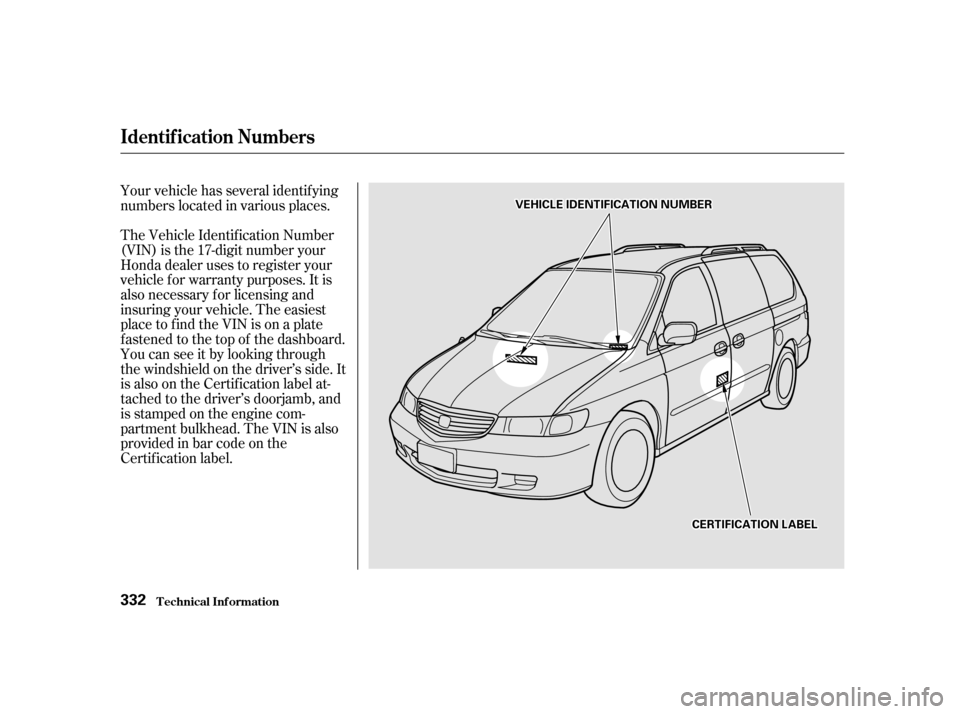
Your vehicle has several identif ying
numbers located in various places.
The Vehicle Identif ication Number
(VIN) is the 17-digit number your
Honda dealer uses to register your
vehicle f or warranty purposes. It is
also necessary f or licensing and
insuring your vehicle. The easiest
placetofindtheVINisonaplate
fastened to the top of the dashboard.
Youcanseeitbylookingthrough
the windshield on the driver’s side. It
is also on the Certification label at-
tached to the driver’s doorjamb, and
is stamped on the engine com-
partment bulkhead. The VIN is also
provided in bar code on the
Certif ication label.
Identif ication Numbers
T echnical Inf ormation
332
VVEEHHIICCLLEEIIDDEENNTTIIFFIICCAATTIIOONNNNUUMMBBEERR
CCEERRTTIIFFIICCAATTIIOONNLLAABBEELL
Page 332 of 363
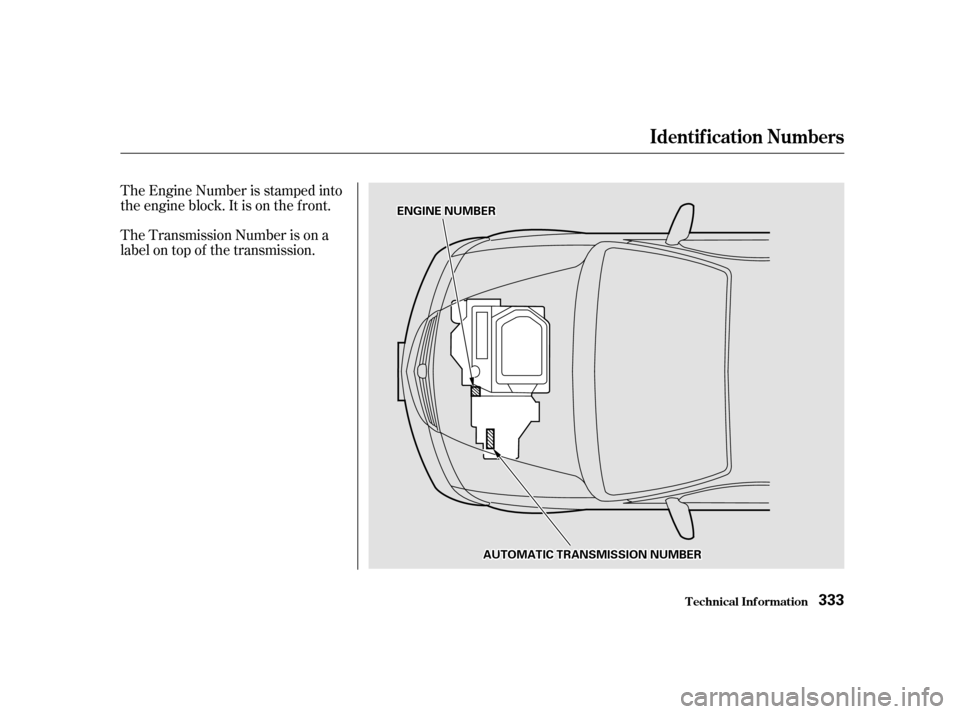
The Transmission Number is on a
label on top of the transmission.
The Engine Number is stamped into
the engine block. It is on the f ront.
Identif ication Numbers
T echnical Inf ormation
333
AAUUTTOOMMAATTIICCTTRRAANNSSMMIISSSSIIOONNNNUUMMBBEERR
EENNGGIINNEENNUUMMBBEERR
Page 333 of 363

�µ�µ�Î �Î
�Î �Î
�Î �Î
�Î �Î
Specif ications
T echnical Inf ormation
334 Dimensions
Weights
Air Conditioning
Capacities
201.2 in (5,110 mm)
75.6 in (1,920 mm)
5.3 US qt (5.0
, 4.4 Imp qt)
2.6 US qt (2.5
, 2.2 Imp qt)
Including the coolant in the reserve tank and that remaining in the
engine.
Reserve tank capacity:
0.16 US gal (0.6
, 0.13 Imp gal)
Excluding the oil remaining in the engine. 4.6 US qt (4.4
, 3.9 Imp qt)
4.2 US qt (4.0
, 3.5 Imp qt)
2.48 US gal (9.4
, 2.07 Imp gal)
3.1 US qt (2.9
, 2.6 Imp qt)
7.6 US qt (7.2, 6.3 Imp qt)
4.8 US qt (4.5
, 4.0 Imp qt)
HFC-134a (R-134a)
66.1 in (1,680 mm)
66.1 in (1,680 mm)
118.1 in (3,000 mm)
68.5 in (1,740 mm)
32 34 oz (850 900 g) ND-OIL8 20.00 US gal (75.7
, 16.65 Imp gal)
1.98 US gal (7.5, 1.65 Imp gal)
69.7 in (1,770 mm)
Length
Width
Height
Wheelbase
Track
Gross vehicle weight rating
Gross combined weight
rating (GCWR)
See the tire information label atta-
ched to the driver’s doorjamb.
Refrigerant type
Charge quantity
Lubricant type Fuel tank
Engine
coolant
Engine oil Automatic
transmission
fluid
Windshield
washer
reservoir
8,160 lbs (3,700 kg) Approx.
FrontRear
1: 2:Change Total
Change
Including
filter
Without
filter
Total
ChangeTotal
U.S. Vehicles
Canada Vehicles
1: LX
2: EX 1 2
1 2
Page 334 of 363

�µ
�µ �µ �µ �µ �µ �µ�µ�µ�µ�µ�µ�µ �µ �µ
Specif ications
T echnical Inf ormation
335
Lights Battery
Fuses
Engine
Alignment
Tires
12 V 21 W
12 V 21/5 W
3.50 x 3.66 in (89.0 x 93.0 mm)
212 cu-in (3,471 cm
)
9.4 : 1
0.00 in (0.0 mm)
0.00 in (0.0 mm) 0°
0°30’
2°07’
P215/65R16 96T
T135/80D16 101M
35 psi (240 kPa , 2.4 kgf/cm
)
60 psi (420 kPa , 4.2 kgf/cm)
24/2.2 CP
12 V 1.8 W
12 V 8 W
12 V 21 W
12 V 3 CP
2CP
21 CP (18 W)
4CP
10 W
12 V
12 V
12 V
12 V
12 V
60/55 W (HB2)
12 V
65 AH/20 HR
52 AH/5 HR
12 V
12 V
Headlights
Front turn signal/parking/side
marker lights
Rear turn signal lights
Stop/Taillights/Rear side
marker lights
Taillights
Back-up lights
License plate light
High-mount brake light
Individual map lights
Cargo area light
Vanity mirror lights
Capacity
Interior
Under-hood Type
BorexStroke
Displacement
Compression ratio
Spark plugs
Toe-in
CamberCaster Size
Pressure
See page 328 or the fuse label
attached to the dashboard.
See page 328 or the fuse label
attached to the inside of the fuse
box door under the dashboard.
See page 327 or the fuse box
cover. See spark plug maintenance sec-
tion page 266 .
High/Low
Front/Rear
Spare
Front/Rear
Spare
FrontRear
FrontRear
Front
FrontRear
Driver’s side
Passenger’s side
Water cooled 4-stroke SOHC VTEC, 6-cylinder, gasoline engine
Page 339 of 363

�Î
�Î
The burning of gasoline in your
vehicle’s engine produces several by-
products. Some of these are carbon
monoxide (CO), oxides of nitrogen
(NOx) and hydrocarbons (HC).
Gasoline evaporating f rom the tank
also produces hydrocarbons. Con-
trolling the production of NOx, CO,
and HC is important to the environ-
ment. Under certain conditions of
sunlight and climate, NOx and HC
react to f orm photochemical ‘‘smog.’’
Carbon monoxide does not contri-
bute to smog creation, but it is a
poisonous gas. The United States Clean Air Act
sets standards f or automobile
emissions. It also requires that
automobile manufacturers explain to
owners how their emissions controls
workandwhattodotomaintain
them. This section summarizes how
the emissions controls work.
Scheduled maintenance is on page
.
In Canada, Honda vehicles comply
with the Canadian Motor Vehicle
Saf ety Standards (CMVSS) f or
Emissions valid at the time they are
manuf actured.
Your vehicle has a Positive
Crankcase Ventilation System. This
keeps gasses that build up in the
engine’s crankcase f rom going into
the atmosphere. The Positive Crank-
case Ventilation valve routes them from the crankcase back to the
intake manif old. They are then
drawn into the engine and burned.
As gasoline evaporates in the f uel
tank, an evaporative emissions
control canister f illed with charcoal
adsorbs the vapor. It is stored in this
canister while the engine is of f . Af ter
the engine is started and warmed up,
the vapor is drawn into the engine
and burned during driving.
The Onboard Ref ueling Vapor
Recovery (ORVR) system captures
the f uel vapors during ref ueling. The
vapors are adsorbed in a canister
f illed with activated carbon. While
driving, the f uel vapors are drawn
into the engine and burned of f .
240
The Clean Air Act
Crankcase Emissions Control
System Evaporative Emissions Control
System
Onboard Ref ueling Vapor
Recovery
T echnical Inf ormation
Emissions Cont rols
340
Page 340 of 363

The exhaust emissions controls
include f our systems: PGM-FI,
Ignition Timing Control, Exhaust
Gas Recirculation and Three Way
Catalytic Converter. These four
systems work together to control the
engine’s combustion and minimize
the amount of HC, CO, and NOx that
comes out the tailpipe. The exhaust
emissions control systems are
separate f rom the crankcase and
evaporative emissions control
systems.The emissions control systems are
designed and certif ied to work to-
gether in reducing emissions to
levels that comply with the Clean Air
Act. To make sure the emissions
remain low, you should use only new
genuine Honda replacement parts or
their equivalent f or repairs. Using
lower quality parts may increase the
emissions f rom your vehicle.
The emissions control systems are
covered by warranties separate f rom
the rest of your vehicle. Read your
warranty manual f or more inf orma-
tion.
The PGM-FI System uses sequential
multiport f uel injection.
It has three subsystems: Air Intake,
Engine Control, and Fuel Control.
The Powertrain Control Module
(PCM) uses various sensors to
determine how much air is going
into the engine. It then controls how
much f uel to inject under all operat-
ing conditions. This system constantly adjusts the
ignition timing, reducing the amount
of HC, CO and NOx produced.
The Exhaust Gas Recirculation
(EGR) system takes some of the
exhaust gas and routes it back into
the intake manif old. Adding exhaust
gas to the air/f uel mixture reduces
the amount of NOx produced when
the f uel is burned.
The three way catalytic converter is
in the exhaust system. Through
chemical reactions, it converts HC,
CO, and NOx in the engine’s exhaust
to carbon dioxide (CO ), dinitrogen
(N ), and water vapor.
2
2
Exhaust Emissions Controls
Replacement Parts
PGM-FI Syst emIgnit ion T iming Cont rol Syst em
Exhaust Gas Recirculat ion (EGR)Syst em
Three Way Catalytic Converter
T echnical Inf ormation
Emissions Cont rols
341