2001 DODGE RAM torque
[x] Cancel search: torquePage 211 of 2889
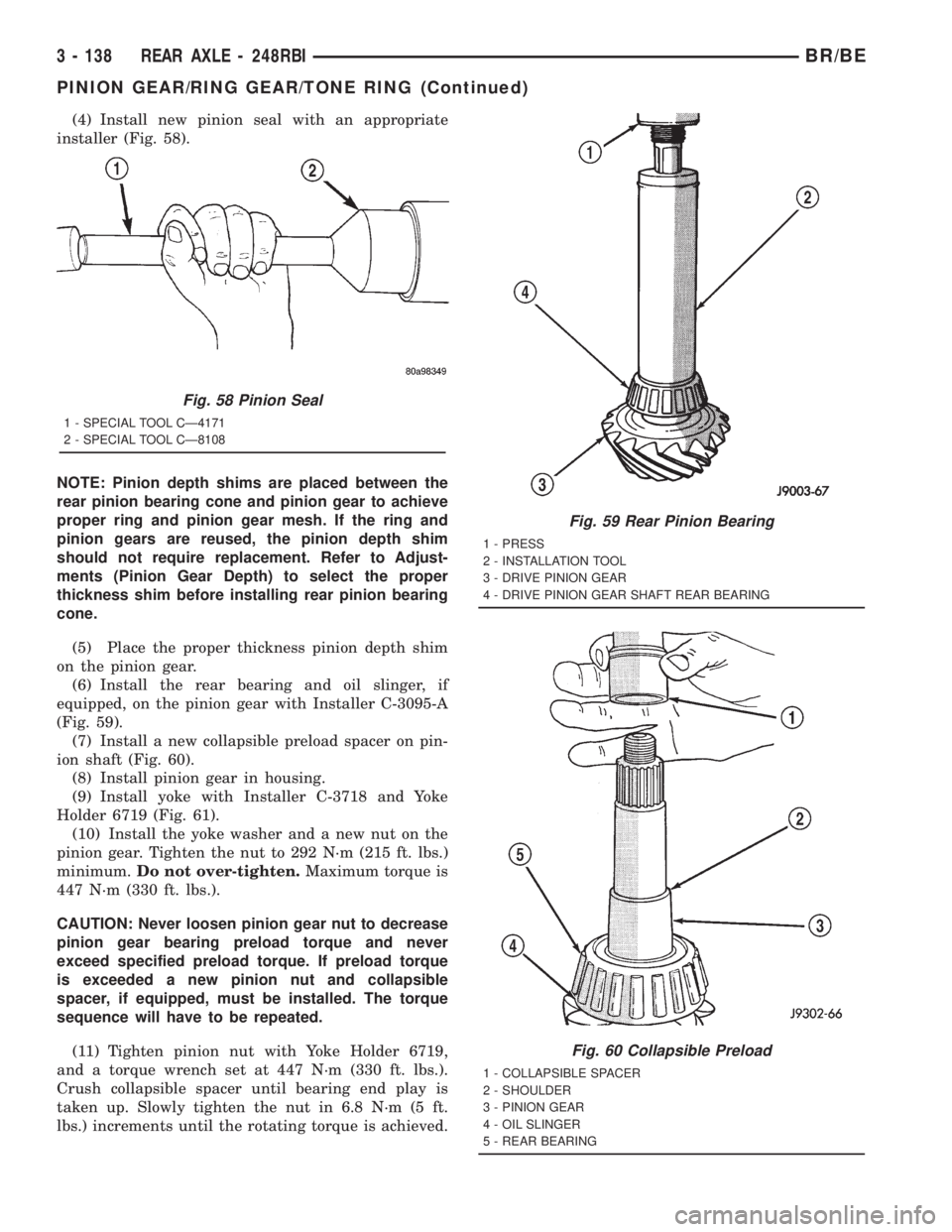
(4) Install new pinion seal with an appropriate
installer (Fig. 58).
NOTE: Pinion depth shims are placed between the
rear pinion bearing cone and pinion gear to achieve
proper ring and pinion gear mesh. If the ring and
pinion gears are reused, the pinion depth shim
should not require replacement. Refer to Adjust-
ments (Pinion Gear Depth) to select the proper
thickness shim before installing rear pinion bearing
cone.
(5) Place the proper thickness pinion depth shim
on the pinion gear.
(6) Install the rear bearing and oil slinger, if
equipped, on the pinion gear with Installer C-3095-A
(Fig. 59).
(7) Install a new collapsible preload spacer on pin-
ion shaft (Fig. 60).
(8) Install pinion gear in housing.
(9) Install yoke with Installer C-3718 and Yoke
Holder 6719 (Fig. 61).
(10) Install the yoke washer and a new nut on the
pinion gear. Tighten the nut to 292 N´m (215 ft. lbs.)
minimum.Do not over-tighten.Maximum torque is
447 N´m (330 ft. lbs.).
CAUTION: Never loosen pinion gear nut to decrease
pinion gear bearing preload torque and never
exceed specified preload torque. If preload torque
is exceeded a new pinion nut and collapsible
spacer, if equipped, must be installed. The torque
sequence will have to be repeated.
(11) Tighten pinion nut with Yoke Holder 6719,
and a torque wrench set at 447 N´m (330 ft. lbs.).
Crush collapsible spacer until bearing end play is
taken up. Slowly tighten the nut in 6.8 N´m (5 ft.
lbs.) increments until the rotating torque is achieved.
Fig. 58 Pinion Seal
1 - SPECIAL TOOL CÐ4171
2 - SPECIAL TOOL CÐ8108
Fig. 59 Rear Pinion Bearing
1 - PRESS
2 - INSTALLATION TOOL
3 - DRIVE PINION GEAR
4 - DRIVE PINION GEAR SHAFT REAR BEARING
Fig. 60 Collapsible Preload
1 - COLLAPSIBLE SPACER
2 - SHOULDER
3 - PINION GEAR
4 - OIL SLINGER
5 - REAR BEARING
3 - 138 REAR AXLE - 248RBIBR/BE
PINION GEAR/RING GEAR/TONE RING (Continued)
Page 212 of 2889
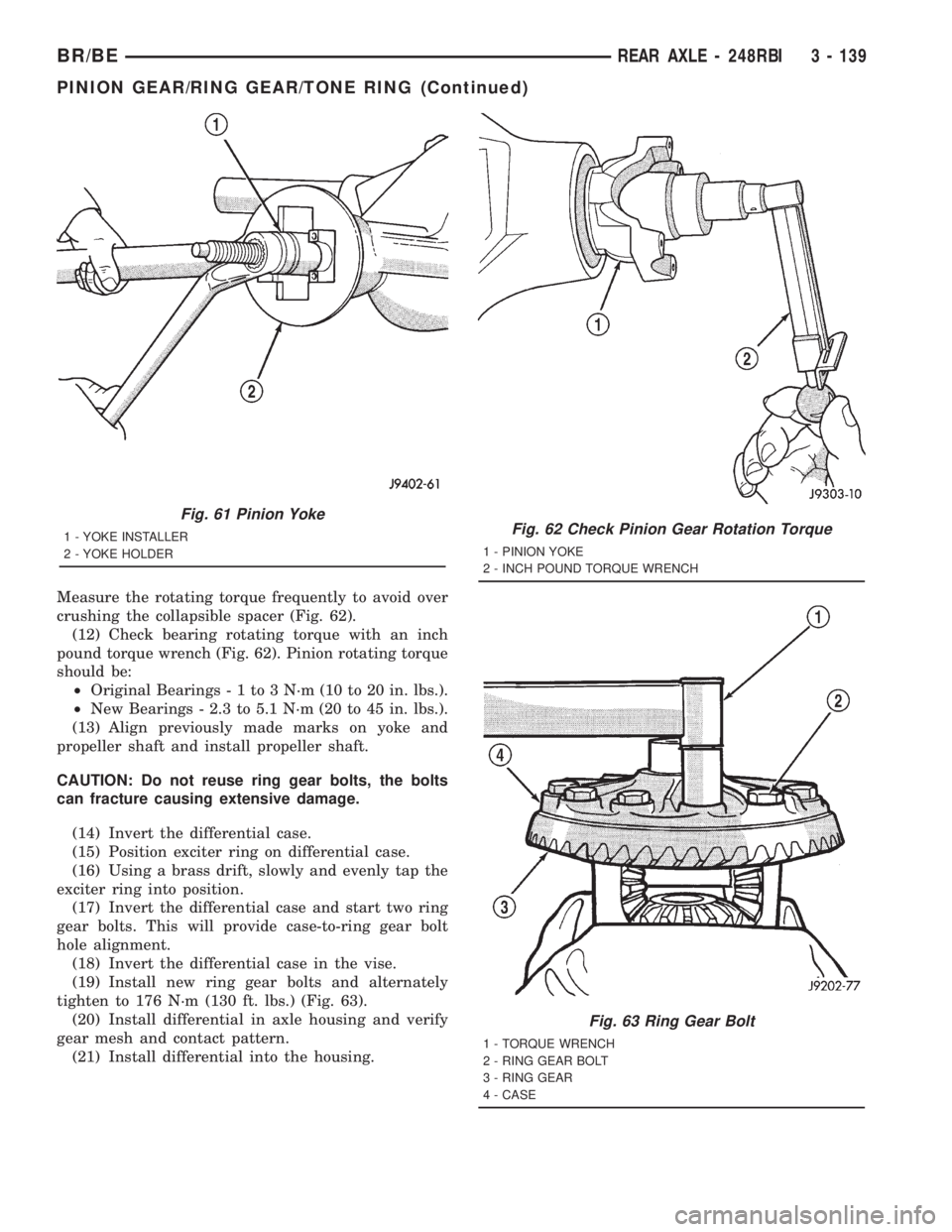
Measure the rotating torque frequently to avoid over
crushing the collapsible spacer (Fig. 62).
(12) Check bearing rotating torque with an inch
pound torque wrench (Fig. 62). Pinion rotating torque
should be:
²Original Bearings-1to3N´m(10to20in.lbs.).
²New Bearings - 2.3 to 5.1 N´m (20 to 45 in. lbs.).
(13) Align previously made marks on yoke and
propeller shaft and install propeller shaft.
CAUTION: Do not reuse ring gear bolts, the bolts
can fracture causing extensive damage.
(14) Invert the differential case.
(15) Position exciter ring on differential case.
(16) Using a brass drift, slowly and evenly tap the
exciter ring into position.
(17) Invert the differential case and start two ring
gear bolts. This will provide case-to-ring gear bolt
hole alignment.
(18) Invert the differential case in the vise.
(19) Install new ring gear bolts and alternately
tighten to 176 N´m (130 ft. lbs.) (Fig. 63).
(20) Install differential in axle housing and verify
gear mesh and contact pattern.
(21) Install differential into the housing.
Fig. 61 Pinion Yoke
1 - YOKE INSTALLER
2 - YOKE HOLDERFig. 62 Check Pinion Gear Rotation Torque
1 - PINION YOKE
2 - INCH POUND TORQUE WRENCH
Fig. 63 Ring Gear Bolt
1 - TORQUE WRENCH
2 - RING GEAR BOLT
3 - RING GEAR
4 - CASE
BR/BEREAR AXLE - 248RBI 3 - 139
PINION GEAR/RING GEAR/TONE RING (Continued)
Page 213 of 2889

REAR AXLE - 267RBI
TABLE OF CONTENTS
page page
REAR AXLE - 267RBI
DESCRIPTION..........................140
OPERATION............................140
DIAGNOSIS AND TESTING................142
AXLE...............................142
REMOVAL.............................144
INSTALLATION..........................145
ADJUSTMENTS.........................145
SPECIFICATIONS........................153
SPECIAL TOOLS........................153
AXLE SHAFTS
REMOVAL.............................156
INSTALLATION..........................156
AXLE BEARINGS
REMOVAL.............................156
INSTALLATION..........................156
PINION SEAL
REMOVAL.............................156INSTALLATION..........................157
DIFFERENTIAL
REMOVAL.............................158
DISASSEMBLY..........................158
ASSEMBLY............................159
INSTALLATION..........................159
DIFFERENTIAL - POWR-LOK
DIAGNOSIS AND TESTING................161
POWR-LOK .........................161
DISASSEMBLY..........................161
ASSEMBLY............................163
DIFFERENTIAL CASE BEARINGS
REMOVAL.............................164
INSTALLATION..........................164
PINION GEAR/RING GEAR/TONE RING
REMOVAL.............................165
INSTALLATION..........................166
REAR AXLE - 267RBI
DESCRIPTION
The Rear Beam-design Iron (RBI) axle housings
consist of an iron center casting (differential housing)
with axle shaft tubes extending from either side. The
tubes are pressed in to form a one-piece axle housing.
The integral type housing, hypoid gear design has
the centerline of the pinion set below the centerline
of the ring gear.
The axles are equipped with full-floating axle
shafts, meaning that loads are supported by the axle
housing tubes. The full-float axle shafts are retained
by bolts attached to the hub. The hub rides on two
bearings at the outboard end of the axle tube. The
axle shafts can be removed without disturbing or
removing the wheel bearings. The wheel bearings are
opposed tapered roller bearings and are contained in
the hub assembly.
The removable, stamped steel cover provides a
means for inspection and service without removing
the complete axle from the vehicle. A small, stamped
metal axle gear ratio identification tag is attached to
the housing cover via one of the cover bolts. This tag
also identifies the number of ring and pinion teeth.
The rear wheel anti-lock (RWAL) brake speed sen-
sor is attached to the top, forward exterior of the dif-
ferential housing. A seal is located between the
sensor and the wire harness connector. The seal mustbe in place when the wire connector is connected to
the sensor. The RWAL brake exciter ring is press-fit-
ted onto the differential case against the ring gear
flange.
The differential case for the standard differential is
a one-piece design. The differential pinion mate shaft
is retained with a roll pin. Differential bearing pre-
load and ring gear backlash are adjusted by the use
of shims located between the differential bearing
cones and case. Pinion bearing preload is set and
maintained by the use of a solid shims.
Axles equipped with a Powr-Lokydifferential are
optional. A Powr-lokydifferential has a two-piece dif-
ferential case. A Powr-lokydifferential contains four
pinion gears and a two-piece pinion mate cross shaft
to provide increased torque to the non-slipping wheel
through a ramping motion in addition to the stan-
dard Trac-lokycomponents.
OPERATION
STANDARD DIFFERENTIAL
The axle receives power from the transmission/
transfer case through the rear propeller shaft. The
rear propeller shaft is connected to the pinion gear
which rotates the differential through the gear mesh
with the ring gear bolted to the differential case. The
engine power is transmitted to the axle shafts
3 - 140 REAR AXLE - 267RBIBR/BE
Page 214 of 2889
through the pinion mate and side gears. The side
gears are splined to the axle shafts.
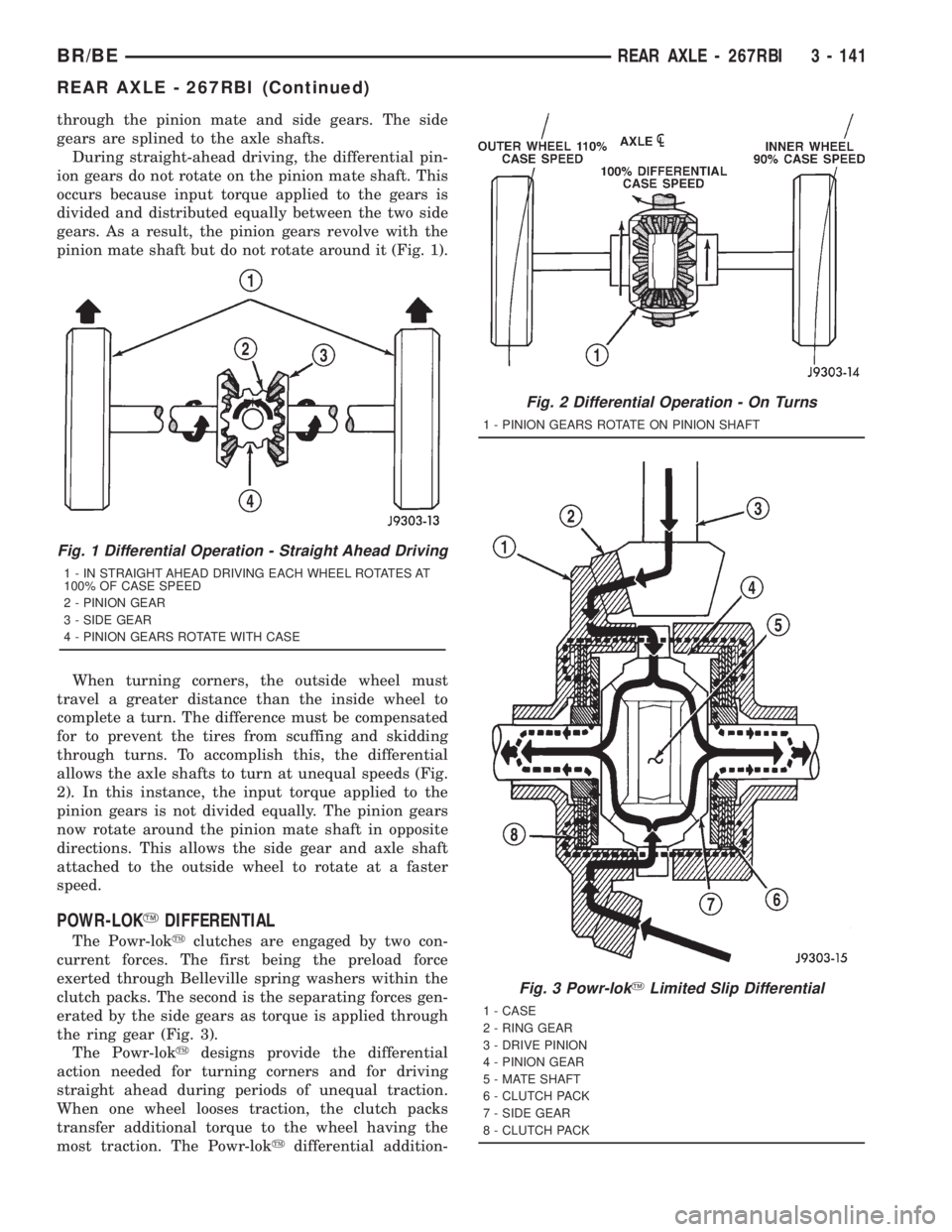
During straight-ahead driving, the differential pin-
ion gears do not rotate on the pinion mate shaft. This
occurs because input torque applied to the gears is
divided and distributed equally between the two side
gears. As a result, the pinion gears revolve with the
pinion mate shaft but do not rotate around it (Fig. 1).
When turning corners, the outside wheel must
travel a greater distance than the inside wheel to
complete a turn. The difference must be compensated
for to prevent the tires from scuffing and skidding
through turns. To accomplish this, the differential
allows the axle shafts to turn at unequal speeds (Fig.
2). In this instance, the input torque applied to the
pinion gears is not divided equally. The pinion gears
now rotate around the pinion mate shaft in opposite
directions. This allows the side gear and axle shaft
attached to the outside wheel to rotate at a faster
speed.
POWR-LOKYDIFFERENTIAL
The Powr-lokyclutches are engaged by two con-
current forces. The first being the preload force
exerted through Belleville spring washers within the
clutch packs. The second is the separating forces gen-
erated by the side gears as torque is applied through
the ring gear (Fig. 3).
The Powr-lokydesigns provide the differential
action needed for turning corners and for driving
straight ahead during periods of unequal traction.
When one wheel looses traction, the clutch packs
transfer additional torque to the wheel having the
most traction. The Powr-lokydifferential addition-
Fig. 1 Differential Operation - Straight Ahead Driving
1 - IN STRAIGHT AHEAD DRIVING EACH WHEEL ROTATES AT
100% OF CASE SPEED
2 - PINION GEAR
3 - SIDE GEAR
4 - PINION GEARS ROTATE WITH CASE
Fig. 2 Differential Operation - On Turns
1 - PINION GEARS ROTATE ON PINION SHAFT
Fig. 3 Powr-lokYLimited Slip Differential
1 - CASE
2 - RING GEAR
3 - DRIVE PINION
4 - PINION GEAR
5 - MATE SHAFT
6 - CLUTCH PACK
7 - SIDE GEAR
8 - CLUTCH PACK
BR/BEREAR AXLE - 267RBI 3 - 141
REAR AXLE - 267RBI (Continued)
Page 215 of 2889
ally utilizes a ramping action supplied by the cross
shafts to increase the force applied to the clutch
packs to increase the torque supplied to the non-slip-
ping wheel. Powr-lokydifferentials resist wheel spin
on bumpy roads and provide more pulling power
when one wheel looses traction. Pulling power is pro-
vided continuously until both wheels loose traction. If
both wheels slip due to unequal traction, operation is
normal. In extreme cases of differences of traction,
the wheel with the least traction may spin.
DIAGNOSIS AND TESTING - AXLE
GEAR NOISE
Axle gear noise can be caused by insufficient lubri-
cant, incorrect backlash, incorrect pinion depth, tooth
contact, worn/damaged gears, or the carrier housing
not having the proper offset and squareness.
Gear noise usually happens at a specific speed
range. The noise can also occur during a specific type
of driving condition. These conditions are accelera-
tion, deceleration, coast, or constant load.
When road testing, first warm-up the axle fluid by
driving the vehicle at least 5 miles and then acceler-
ate the vehicle to the speed range where the noise is
the greatest. Shift out-of-gear and coast through the
peak-noise range. If the noise stops or changes
greatly:
²Check for insufficient lubricant.
²Incorrect ring gear backlash.
²Gear damage.
Differential side gears and pinions can be checked
by turning the vehicle. They usually do not cause
noise during straight-ahead driving when the gears
are unloaded. The side gears are loaded during vehi-
cle turns. A worn pinion shaft can also cause a snap-
ping or a knocking noise.
BEARING NOISE
The axle shaft, differential and pinion bearings can
all produce noise when worn or damaged. Bearing
noise can be either a whining, or a growling sound.
Pinion bearings have a constant-pitch noise. This
noise changes only with vehicle speed. Pinion bearing
noise will be higher pitched because it rotates at a
faster rate. Drive the vehicle and load the differen-
tial. If bearing noise occurs, the rear pinion bearing
is the source of the noise. If the bearing noise is
heard during a coast, the front pinion bearing is the
source.
Worn or damaged differential bearings usually pro-
duce a low pitch noise. Differential bearing noise is
similar to pinion bearing noise. The pitch of differen-
tial bearing noise is also constant and varies only
with vehicle speed.Axle shaft bearings produce noise and vibration
when worn or damaged. The noise generally changes
when the bearings are loaded. Road test the vehicle.
Turn the vehicle sharply to the left and to the right.
This will load the bearings and change the noise
level. Where axle bearing damage is slight, the noise
is usually not noticeable at speeds above 30 mph.
LOW SPEED KNOCK
Low speed knock is generally caused by a worn
U-joint or by worn side±gear thrust washers. A worn
pinion shaft bore will also cause low speed knock.
VIBRATION
Vibration at the rear of the vehicle is usually
caused by a:
²Damaged drive shaft.
²Missing drive shaft balance weight(s).
²Worn or out-of-balance wheels.
²Loose wheel lug nuts.
²Worn U-joint(s).
²Loose/broken springs.
²Damaged axle shaft bearing(s).
²Loose pinion gear nut.
²Excessive pinion yoke run out.
²Bent axle shaft(s).
Check for loose or damaged front-end components
or engine/transmission mounts. These components
can contribute to what appears to be a rearend vibra-
tion. Do not overlook engine accessories, brackets
and drive belts.
All driveline components should be examined
before starting any repair.
(Refer to 22 - TIRES/WHEELS - DIAGNOSIS AND
TESTING)
DRIVELINE SNAP
A snap or clunk noise when the vehicle is shifted
into gear (or the clutch engaged), can be caused by:
²High engine idle speed.
²Transmission shift operation.
²Loose engine/transmission/transfer case mounts.
²Worn U-joints.
²Loose spring mounts.
²Loose pinion gear nut and yoke.
²Excessive ring gear backlash.
²Excessive side gear to case clearance.
The source of a snap or a clunk noise can be deter-
mined with the assistance of a helper. Raise the vehi-
cle on a hoist with the wheels free to rotate. Instruct
the helper to shift the transmission into gear. Listen
for the noise, a mechanics stethoscope is helpful in
isolating the source of a noise.
3 - 142 REAR AXLE - 267RBIBR/BE
REAR AXLE - 267RBI (Continued)
Page 217 of 2889
Condition Possible Causes Correction
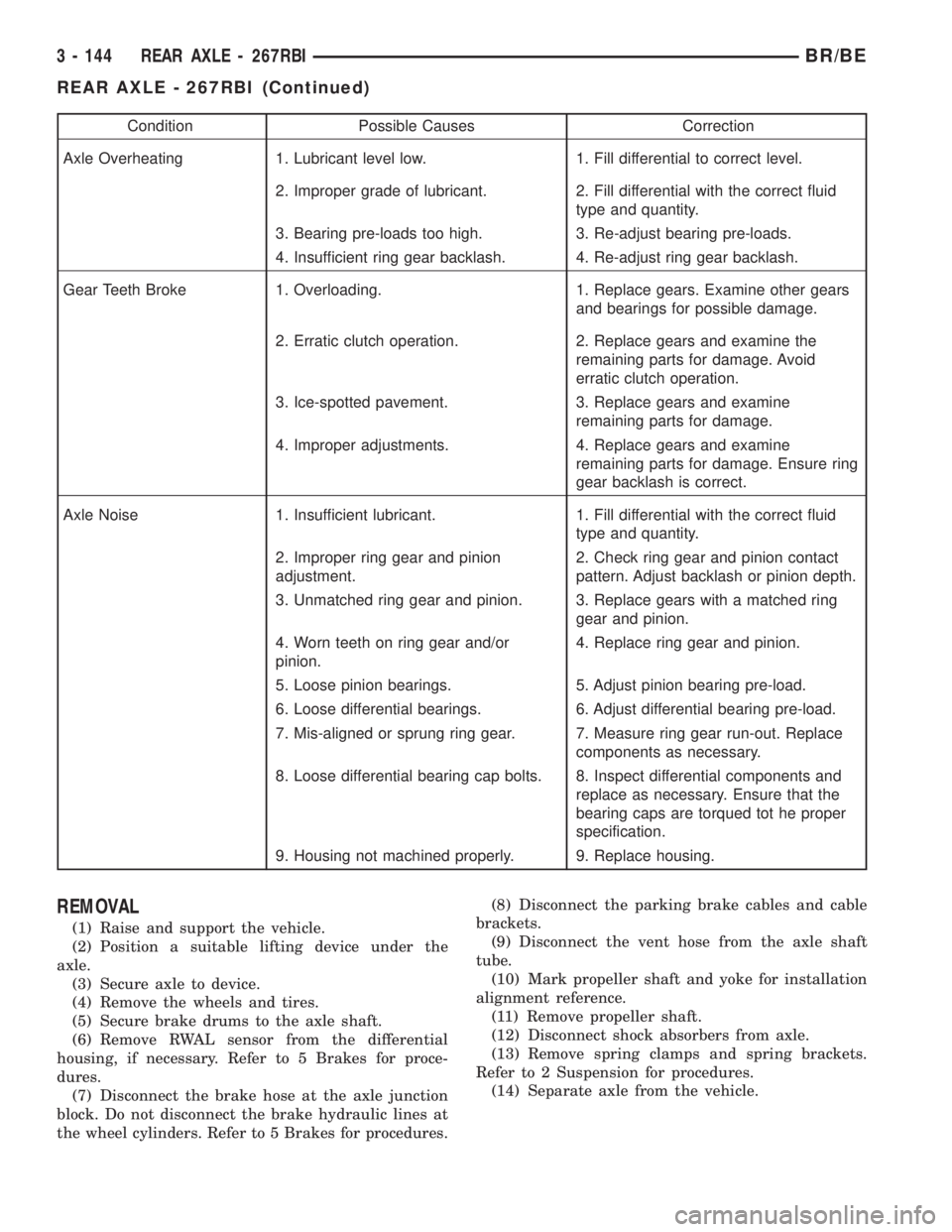
Axle Overheating 1. Lubricant level low. 1. Fill differential to correct level.
2. Improper grade of lubricant. 2. Fill differential with the correct fluid
type and quantity.
3. Bearing pre-loads too high. 3. Re-adjust bearing pre-loads.
4. Insufficient ring gear backlash. 4. Re-adjust ring gear backlash.
Gear Teeth Broke 1. Overloading. 1. Replace gears. Examine other gears
and bearings for possible damage.
2. Erratic clutch operation. 2. Replace gears and examine the
remaining parts for damage. Avoid
erratic clutch operation.
3. Ice-spotted pavement. 3. Replace gears and examine
remaining parts for damage.
4. Improper adjustments. 4. Replace gears and examine
remaining parts for damage. Ensure ring
gear backlash is correct.
Axle Noise 1. Insufficient lubricant. 1. Fill differential with the correct fluid
type and quantity.
2. Improper ring gear and pinion
adjustment.2. Check ring gear and pinion contact
pattern. Adjust backlash or pinion depth.
3. Unmatched ring gear and pinion. 3. Replace gears with a matched ring
gear and pinion.
4. Worn teeth on ring gear and/or
pinion.4. Replace ring gear and pinion.
5. Loose pinion bearings. 5. Adjust pinion bearing pre-load.
6. Loose differential bearings. 6. Adjust differential bearing pre-load.
7. Mis-aligned or sprung ring gear. 7. Measure ring gear run-out. Replace
components as necessary.
8. Loose differential bearing cap bolts. 8. Inspect differential components and
replace as necessary. Ensure that the
bearing caps are torqued tot he proper
specification.
9. Housing not machined properly. 9. Replace housing.
REMOVAL
(1) Raise and support the vehicle.
(2) Position a suitable lifting device under the
axle.
(3) Secure axle to device.
(4) Remove the wheels and tires.
(5) Secure brake drums to the axle shaft.
(6) Remove RWAL sensor from the differential
housing, if necessary. Refer to 5 Brakes for proce-
dures.
(7) Disconnect the brake hose at the axle junction
block. Do not disconnect the brake hydraulic lines at
the wheel cylinders. Refer to 5 Brakes for procedures.(8) Disconnect the parking brake cables and cable
brackets.
(9) Disconnect the vent hose from the axle shaft
tube.
(10) Mark propeller shaft and yoke for installation
alignment reference.
(11) Remove propeller shaft.
(12) Disconnect shock absorbers from axle.
(13) Remove spring clamps and spring brackets.
Refer to 2 Suspension for procedures.
(14) Separate axle from the vehicle.
3 - 144 REAR AXLE - 267RBIBR/BE
REAR AXLE - 267RBI (Continued)
Page 222 of 2889
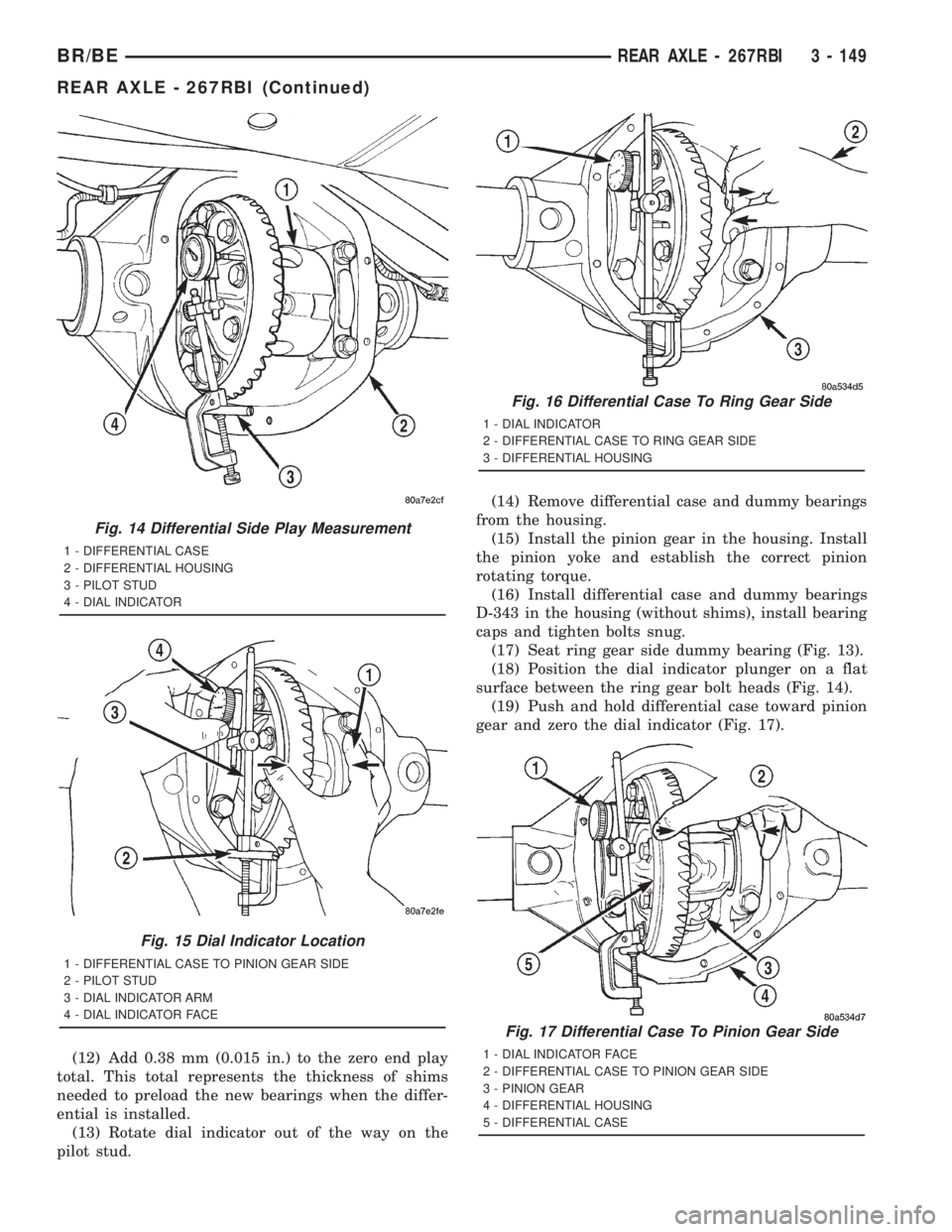
(12) Add 0.38 mm (0.015 in.) to the zero end play
total. This total represents the thickness of shims
needed to preload the new bearings when the differ-
ential is installed.
(13) Rotate dial indicator out of the way on the
pilot stud.(14) Remove differential case and dummy bearings
from the housing.
(15) Install the pinion gear in the housing. Install
the pinion yoke and establish the correct pinion
rotating torque.
(16) Install differential case and dummy bearings
D-343 in the housing (without shims), install bearing
caps and tighten bolts snug.
(17) Seat ring gear side dummy bearing (Fig. 13).
(18) Position the dial indicator plunger on a flat
surface between the ring gear bolt heads (Fig. 14).
(19) Push and hold differential case toward pinion
gear and zero the dial indicator (Fig. 17).
Fig. 14 Differential Side Play Measurement
1 - DIFFERENTIAL CASE
2 - DIFFERENTIAL HOUSING
3 - PILOT STUD
4 - DIAL INDICATOR
Fig. 15 Dial Indicator Location
1 - DIFFERENTIAL CASE TO PINION GEAR SIDE
2 - PILOT STUD
3 - DIAL INDICATOR ARM
4 - DIAL INDICATOR FACE
Fig. 16 Differential Case To Ring Gear Side
1 - DIAL INDICATOR
2 - DIFFERENTIAL CASE TO RING GEAR SIDE
3 - DIFFERENTIAL HOUSING
Fig. 17 Differential Case To Pinion Gear Side
1 - DIAL INDICATOR FACE
2 - DIFFERENTIAL CASE TO PINION GEAR SIDE
3 - PINION GEAR
4 - DIFFERENTIAL HOUSING
5 - DIFFERENTIAL CASE
BR/BEREAR AXLE - 267RBI 3 - 149
REAR AXLE - 267RBI (Continued)
Page 226 of 2889
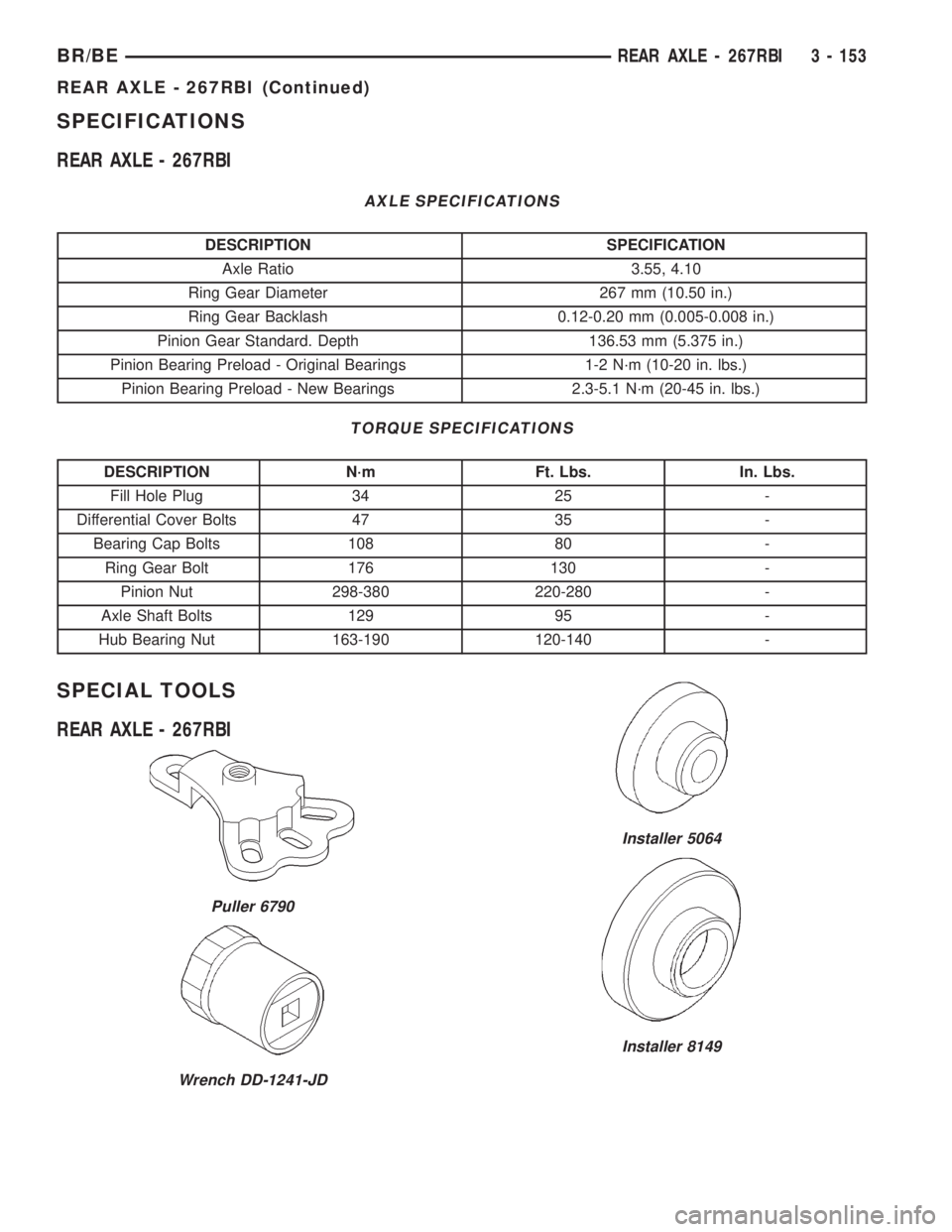
SPECIFICATIONS
REAR AXLE - 267RBI
AXLE SPECIFICATIONS
DESCRIPTION SPECIFICATION
Axle Ratio 3.55, 4.10
Ring Gear Diameter 267 mm (10.50 in.)
Ring Gear Backlash 0.12-0.20 mm (0.005-0.008 in.)
Pinion Gear Standard. Depth 136.53 mm (5.375 in.)
Pinion Bearing Preload - Original Bearings 1-2 N´m (10-20 in. lbs.)
Pinion Bearing Preload - New Bearings 2.3-5.1 N´m (20-45 in. lbs.)
TORQUE SPECIFICATIONS
DESCRIPTION N´m Ft. Lbs. In. Lbs.
Fill Hole Plug 34 25 -
Differential Cover Bolts 47 35 -
Bearing Cap Bolts 108 80 -
Ring Gear Bolt 176 130 -
Pinion Nut 298-380 220-280 -
Axle Shaft Bolts 129 95 -
Hub Bearing Nut 163-190 120-140 -
SPECIAL TOOLS
REAR AXLE - 267RBI
Puller 6790
Wrench DD-1241-JD
Installer 5064
Installer 8149
BR/BEREAR AXLE - 267RBI 3 - 153
REAR AXLE - 267RBI (Continued)