2001 DODGE RAM torque
[x] Cancel search: torquePage 2487 of 2889
INSTALLATION
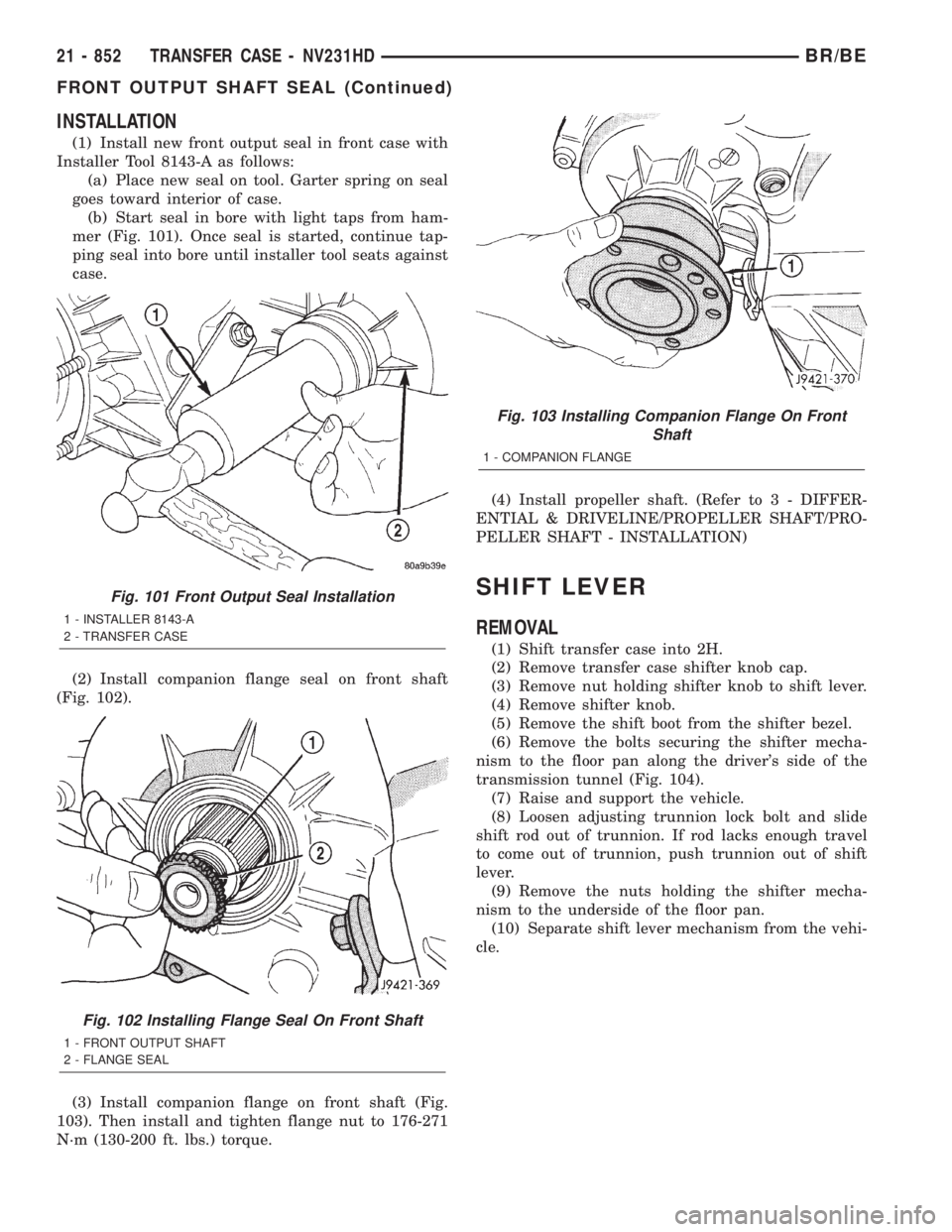
(1) Install new front output seal in front case with
Installer Tool 8143-A as follows:
(a) Place new seal on tool. Garter spring on seal
goes toward interior of case.
(b) Start seal in bore with light taps from ham-
mer (Fig. 101). Once seal is started, continue tap-
ping seal into bore until installer tool seats against
case.
(2) Install companion flange seal on front shaft
(Fig. 102).
(3) Install companion flange on front shaft (Fig.
103). Then install and tighten flange nut to 176-271
N´m (130-200 ft. lbs.) torque.(4) Install propeller shaft. (Refer to 3 - DIFFER-
ENTIAL & DRIVELINE/PROPELLER SHAFT/PRO-
PELLER SHAFT - INSTALLATION)
SHIFT LEVER
REMOVAL
(1) Shift transfer case into 2H.
(2) Remove transfer case shifter knob cap.
(3) Remove nut holding shifter knob to shift lever.
(4) Remove shifter knob.
(5) Remove the shift boot from the shifter bezel.
(6) Remove the bolts securing the shifter mecha-
nism to the floor pan along the driver's side of the
transmission tunnel (Fig. 104).
(7) Raise and support the vehicle.
(8) Loosen adjusting trunnion lock bolt and slide
shift rod out of trunnion. If rod lacks enough travel
to come out of trunnion, push trunnion out of shift
lever.
(9) Remove the nuts holding the shifter mecha-
nism to the underside of the floor pan.
(10) Separate shift lever mechanism from the vehi-
cle.
Fig. 101 Front Output Seal Installation
1 - INSTALLER 8143-A
2 - TRANSFER CASE
Fig. 102 Installing Flange Seal On Front Shaft
1 - FRONT OUTPUT SHAFT
2 - FLANGE SEAL
Fig. 103 Installing Companion Flange On Front
Shaft
1 - COMPANION FLANGE
21 - 852 TRANSFER CASE - NV231HDBR/BE
FRONT OUTPUT SHAFT SEAL (Continued)
Page 2489 of 2889
(4) Check shift rod fit in trunnion. Be sure rod
does not bind in trunnion. Lubricate the shift rod
and trunnion if necessary.
(5) Verify that transfer case shift lever is in 2H
detent position. The 2H detent position on the trans-
fer case shift arm is the second position from full for-
ward.
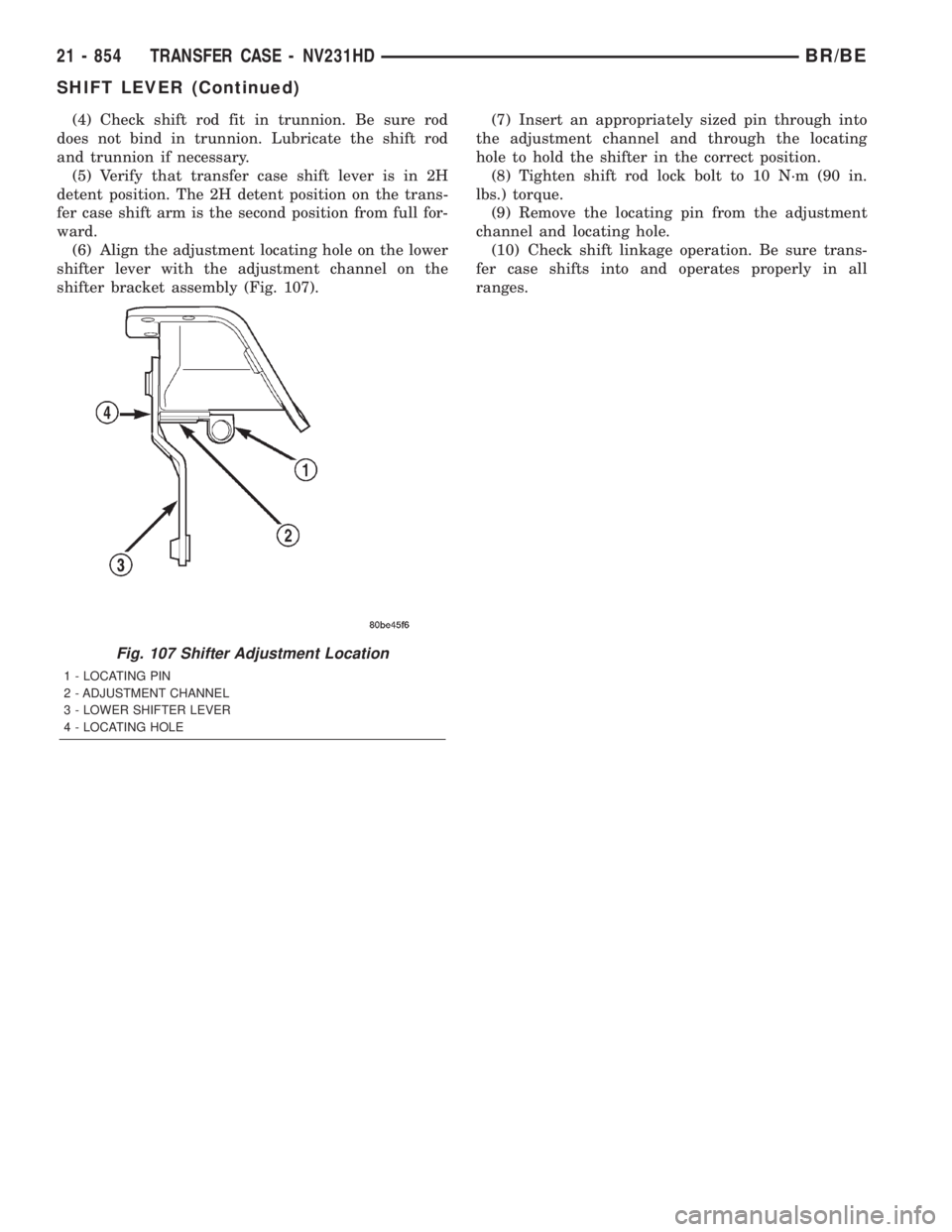
(6) Align the adjustment locating hole on the lower
shifter lever with the adjustment channel on the
shifter bracket assembly (Fig. 107).(7) Insert an appropriately sized pin through into
the adjustment channel and through the locating
hole to hold the shifter in the correct position.
(8) Tighten shift rod lock bolt to 10 N´m (90 in.
lbs.) torque.
(9) Remove the locating pin from the adjustment
channel and locating hole.
(10) Check shift linkage operation. Be sure trans-
fer case shifts into and operates properly in all
ranges.
Fig. 107 Shifter Adjustment Location
1 - LOCATING PIN
2 - ADJUSTMENT CHANNEL
3 - LOWER SHIFTER LEVER
4 - LOCATING HOLE
21 - 854 TRANSFER CASE - NV231HDBR/BE
SHIFT LEVER (Continued)
Page 2490 of 2889
TRANSFER CASE - NV241LD
TABLE OF CONTENTS
page page
TRANSFER CASE - NV241LD
DESCRIPTION..........................855
OPERATION............................855
DIAGNOSIS AND TESTING................856
TRANSFER CASE.....................856
REMOVAL.............................858
DISASSEMBLY..........................858
CLEANING.............................866
INSPECTION...........................867
ASSEMBLY............................869
INSTALLATION..........................882
SPECIFICATIONS........................883
SPECIAL TOOLS........................884EXTENSION HOUSING BUSHING AND SEAL
REMOVAL.............................885
INSTALLATION..........................885
FLUID
STANDARD PROCEDURE.................885
FLUID DRAIN AND REFILL...............885
FRONT OUTPUT SHAFT SEAL
REMOVAL.............................886
INSTALLATION..........................886
SHIFT LEVER
REMOVAL.............................887
INSTALLATION..........................888
ADJUSTMENTS.........................888
TRANSFER CASE - NV241LD
DESCRIPTION
The NV241LD transfer case is a part-time transfer
case with a low-range gear system. It provides three
operating ranges plus a NEUTRAL position. The low
range position provides a gear reduction ratio of
2.72:1 for increased low speed torque capability.
The synchronizer mechanism consists of a brass
stop ring, synchro hub, and the sliding clutch. The
synchronizer components allow the transfer case to
be shifted between the 2H and 4H operating ranges
while the vehicle is in motion.
The gear cases, retainer and extension are all of
aluminum. Drive sprockets and an interconnecting
drive chain are used to transmit engine torque to the
front/rear propeller shafts. The mainshaft, input gear
and front output shaft are supported by ball and nee-
dle bearings.
IDENTIFICATION
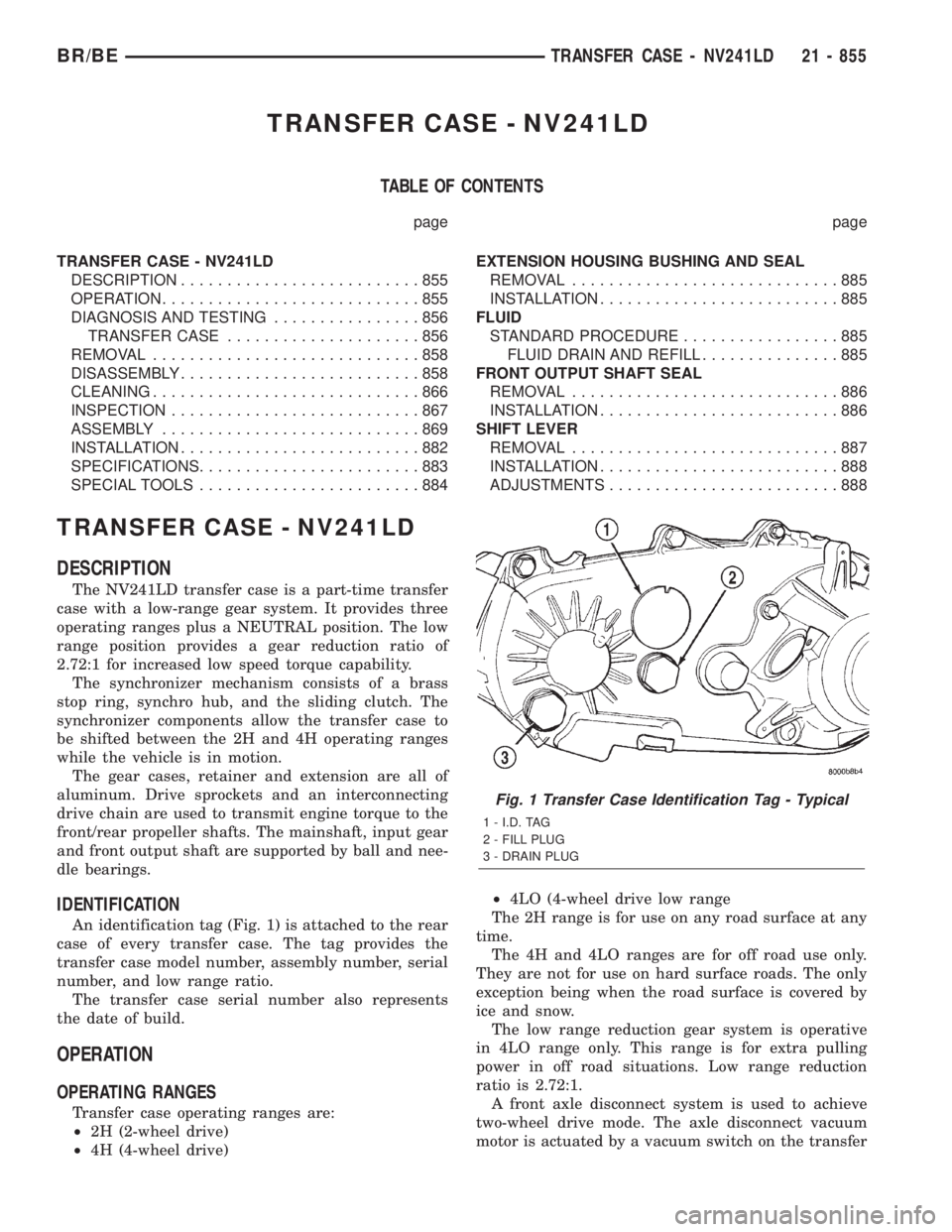
An identification tag (Fig. 1) is attached to the rear
case of every transfer case. The tag provides the
transfer case model number, assembly number, serial
number, and low range ratio.
The transfer case serial number also represents
the date of build.
OPERATION
OPERATING RANGES
Transfer case operating ranges are:
²2H (2-wheel drive)
²4H (4-wheel drive)²4LO (4-wheel drive low range
The 2H range is for use on any road surface at any
time.
The 4H and 4LO ranges are for off road use only.
They are not for use on hard surface roads. The only
exception being when the road surface is covered by
ice and snow.
The low range reduction gear system is operative
in 4LO range only. This range is for extra pulling
power in off road situations. Low range reduction
ratio is 2.72:1.
A front axle disconnect system is used to achieve
two-wheel drive mode. The axle disconnect vacuum
motor is actuated by a vacuum switch on the transfer
Fig. 1 Transfer Case Identification Tag - Typical
1 - I.D. TAG
2 - FILL PLUG
3 - DRAIN PLUG
BR/BETRANSFER CASE - NV241LD 21 - 855
Page 2492 of 2889
DIAGNOSIS CHART
Condition Possible Cause Correction
Transfer Case difficult to shift or will
not shift into desired range.1) Vehicle speed too great to permit
shifting.1) Stop vehicle and shift into desired
range. Or, reduce speed to below 3-4
km/h (2-3 mph) before attempting the
shift.
2) If vehicle was operated for an
extended period in 4H on a dry paved
surface, the driveline torque load may
be causing a bind.2) Stop vehicle and shift the
transmission into neutral. Shift the
transfer case to 2H and operate
vehicle in 2H on dry paved surfaces.
3) Transfer case external shift linkage
binding.3) Lubricate, repair, or replace linkage
bushings, or tighten loose
components as necessary.
4) Insufficient or incorrect lubricant. 4) Drain and refill to edge of fill hole
with MoparTATF +4, type 9602,
Automatic Transmission fluid.
5) Internal components binding, worn,
or damaged.5) Disassemble the transfer case and
replace worn or damaged
components as necessary.
Transfer Case noisy in all operating
ranges.1) Insufficient or incorrect lubricant. 1) Drain and refill to edge of fill hole
with MoparTATF +4, type 9602,
Automatic Transmission fluid.
Noisy in, or jumps out of, four wheel
drive low range.1) Transfer case not completely
engaged in 4L position.1) With the transmission in
NEUTRAL, or the clutch depressed in
the case of a manual transmission
and the vehicle moving under 3-4
km/h (2-3 mph), shift the transfer case
to NEUTRAL and then shift into the
4L position.
2) Shift linkage out of adjustment. 2) Adjust linkage.
3) Shift linkage loose or binding. 3) Tighten, lubricate, or repair linkage
as necessary.
4) Range fork damaged, inserts worn,
or fork is binding on the shift rail.4) Disassemble unit and repair as
necessary.
5) Low range gear worn or damaged. 5) Disassemble unit and repair as
necessary.
Lubricant leaking from output shaft
seal or vent.1) Transfer case overfilled. 1) Drain lubricant to the correct level.
2) Vent closed or restricted. 2) Clear or replace vent as necessary.
3) Output shaft seals damaged or
installed incorrectly.3) Replace seal as necessary. Check
to ensure that another component, the
propeller shaft slip yoke for example,
is not causing damage to seal.
Abnormal tire wear. 1) Extended operation on hard, dry
surfaces in the 4H position.1) Operate vehicle in the 2H position
on hard, dry surfaces.
BR/BETRANSFER CASE - NV241LD 21 - 857
TRANSFER CASE - NV241LD (Continued)
Page 2508 of 2889
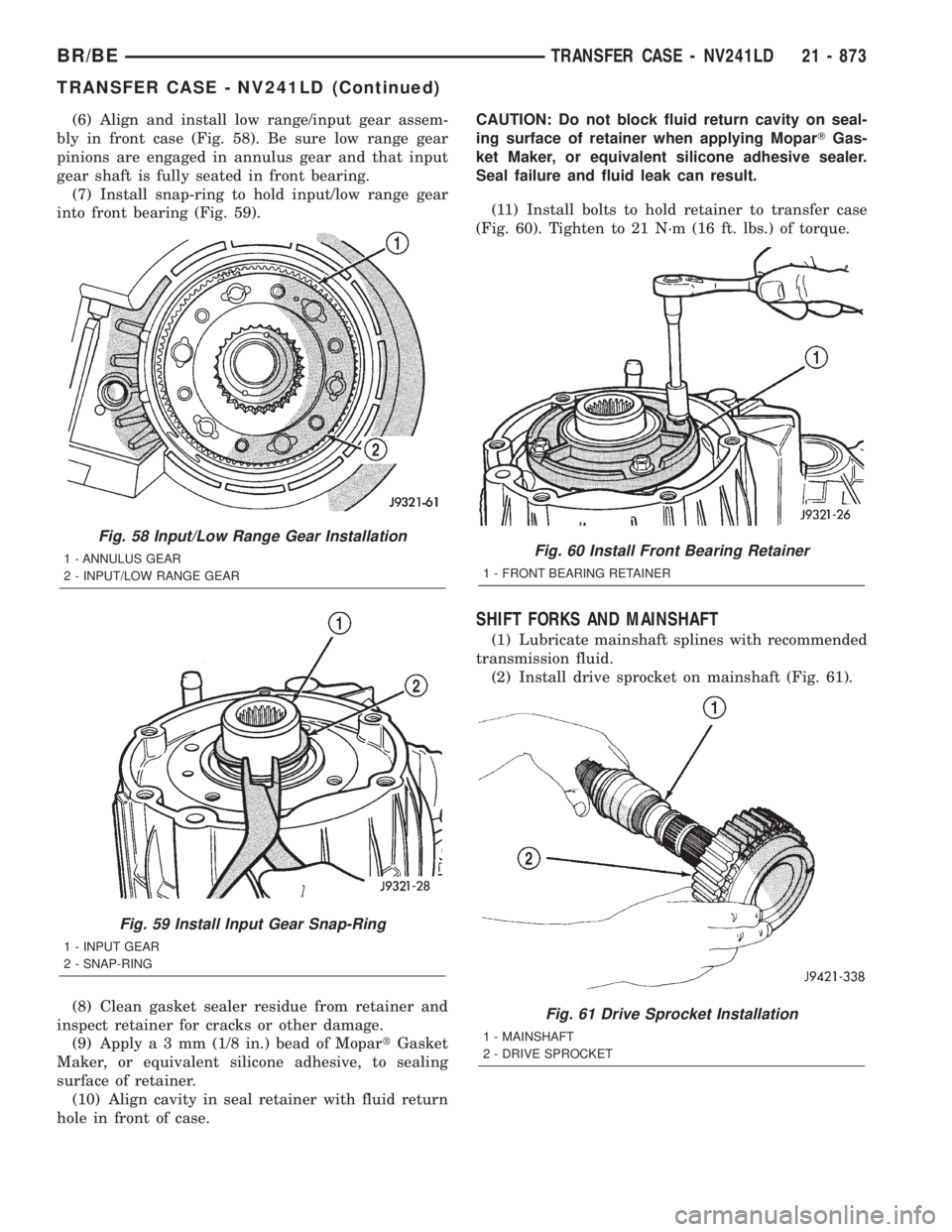
(6) Align and install low range/input gear assem-
bly in front case (Fig. 58). Be sure low range gear
pinions are engaged in annulus gear and that input
gear shaft is fully seated in front bearing.
(7) Install snap-ring to hold input/low range gear
into front bearing (Fig. 59).
(8) Clean gasket sealer residue from retainer and
inspect retainer for cracks or other damage.
(9) Applya3mm(1/8 in.) bead of MopartGasket
Maker, or equivalent silicone adhesive, to sealing
surface of retainer.
(10) Align cavity in seal retainer with fluid return
hole in front of case.CAUTION: Do not block fluid return cavity on seal-
ing surface of retainer when applying MoparTGas-
ket Maker, or equivalent silicone adhesive sealer.
Seal failure and fluid leak can result.
(11) Install bolts to hold retainer to transfer case
(Fig. 60). Tighten to 21 N´m (16 ft. lbs.) of torque.
SHIFT FORKS AND MAINSHAFT
(1) Lubricate mainshaft splines with recommended
transmission fluid.
(2) Install drive sprocket on mainshaft (Fig. 61).
Fig. 58 Input/Low Range Gear Installation
1 - ANNULUS GEAR
2 - INPUT/LOW RANGE GEAR
Fig. 59 Install Input Gear Snap-Ring
1 - INPUT GEAR
2 - SNAP-RING
Fig. 60 Install Front Bearing Retainer
1 - FRONT BEARING RETAINER
Fig. 61 Drive Sprocket Installation
1 - MAINSHAFT
2 - DRIVE SPROCKET
BR/BETRANSFER CASE - NV241LD 21 - 873
TRANSFER CASE - NV241LD (Continued)
Page 2512 of 2889
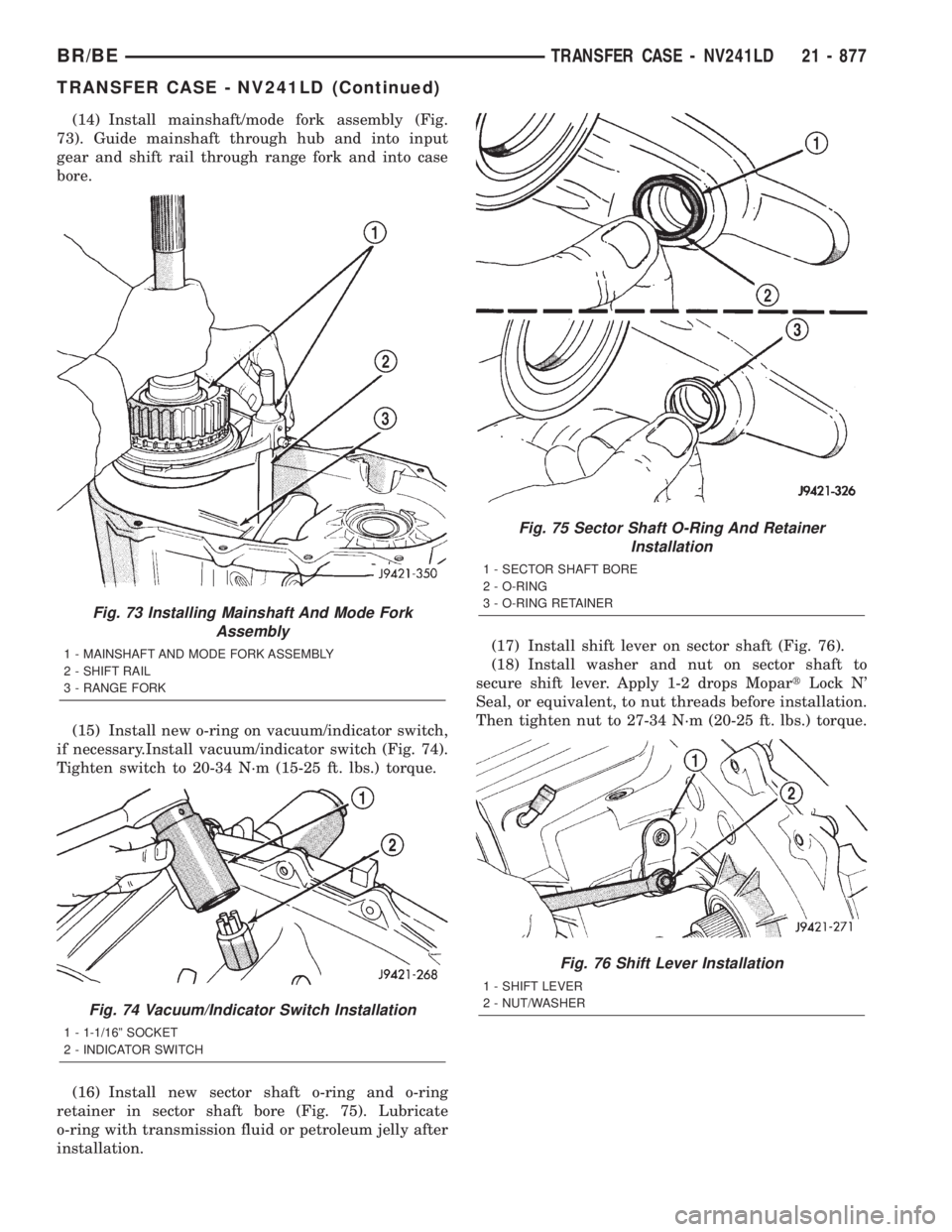
(14) Install mainshaft/mode fork assembly (Fig.
73). Guide mainshaft through hub and into input
gear and shift rail through range fork and into case
bore.
(15) Install new o-ring on vacuum/indicator switch,
if necessary.Install vacuum/indicator switch (Fig. 74).
Tighten switch to 20-34 N´m (15-25 ft. lbs.) torque.
(16) Install new sector shaft o-ring and o-ring
retainer in sector shaft bore (Fig. 75). Lubricate
o-ring with transmission fluid or petroleum jelly after
installation.(17) Install shift lever on sector shaft (Fig. 76).
(18) Install washer and nut on sector shaft to
secure shift lever. Apply 1-2 drops MopartLock N'
Seal, or equivalent, to nut threads before installation.
Then tighten nut to 27-34 N´m (20-25 ft. lbs.) torque.
Fig. 73 Installing Mainshaft And Mode Fork
Assembly
1 - MAINSHAFT AND MODE FORK ASSEMBLY
2 - SHIFT RAIL
3 - RANGE FORK
Fig. 74 Vacuum/Indicator Switch Installation
1 - 1-1/16º SOCKET
2 - INDICATOR SWITCH
Fig. 75 Sector Shaft O-Ring And Retainer
Installation
1 - SECTOR SHAFT BORE
2 - O-RING
3 - O-RING RETAINER
Fig. 76 Shift Lever Installation
1 - SHIFT LEVER
2 - NUT/WASHER
BR/BETRANSFER CASE - NV241LD 21 - 877
TRANSFER CASE - NV241LD (Continued)
Page 2515 of 2889
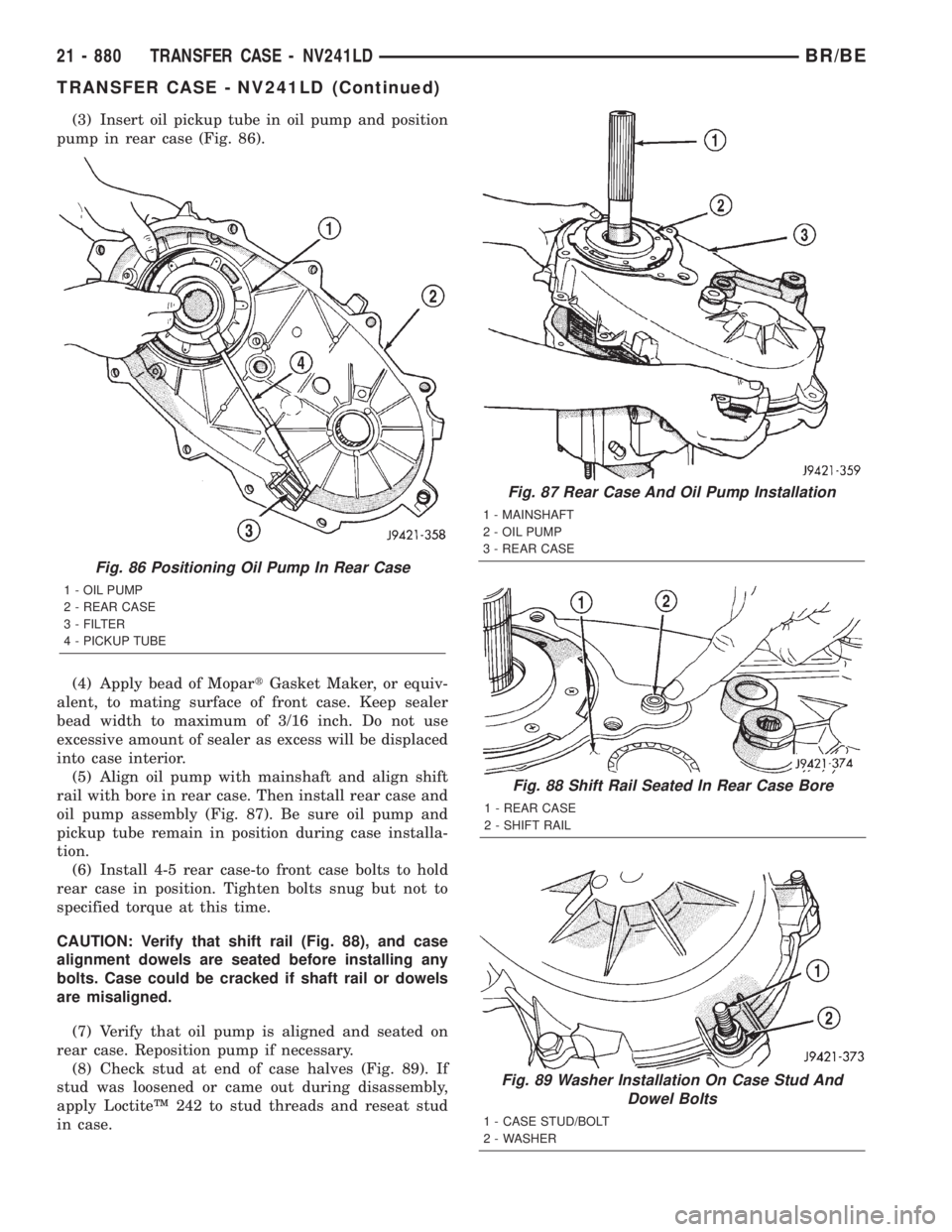
(3) Insert oil pickup tube in oil pump and position
pump in rear case (Fig. 86).
(4) Apply bead of MopartGasket Maker, or equiv-
alent, to mating surface of front case. Keep sealer
bead width to maximum of 3/16 inch. Do not use
excessive amount of sealer as excess will be displaced
into case interior.
(5) Align oil pump with mainshaft and align shift
rail with bore in rear case. Then install rear case and
oil pump assembly (Fig. 87). Be sure oil pump and
pickup tube remain in position during case installa-
tion.
(6) Install 4-5 rear case-to front case bolts to hold
rear case in position. Tighten bolts snug but not to
specified torque at this time.
CAUTION: Verify that shift rail (Fig. 88), and case
alignment dowels are seated before installing any
bolts. Case could be cracked if shaft rail or dowels
are misaligned.
(7) Verify that oil pump is aligned and seated on
rear case. Reposition pump if necessary.
(8) Check stud at end of case halves (Fig. 89). If
stud was loosened or came out during disassembly,
apply LoctiteŸ 242 to stud threads and reseat stud
in case.
Fig. 87 Rear Case And Oil Pump Installation
1 - MAINSHAFT
2 - OIL PUMP
3 - REAR CASE
Fig. 88 Shift Rail Seated In Rear Case Bore
1 - REAR CASE
2 - SHIFT RAIL
Fig. 89 Washer Installation On Case Stud And
Dowel Bolts
1 - CASE STUD/BOLT
2 - WASHER
Fig. 86 Positioning Oil Pump In Rear Case
1 - OIL PUMP
2 - REAR CASE
3 - FILTER
4 - PICKUP TUBE
21 - 880 TRANSFER CASE - NV241LDBR/BE
TRANSFER CASE - NV241LD (Continued)
Page 2516 of 2889
(9) Apply LoctiteŸ 242 to remainder of rear case-
to-front case bolt threads and install bolts. Be sure
lock washers are used on studs/bolts at case ends.
Tighten bolts, or stud nuts as follows:
²flange head bolts to 47-61 N´m (35-45 ft. lbs.)
²all other bolts/nuts to 27-34 N´m (20-25 ft. lbs.)
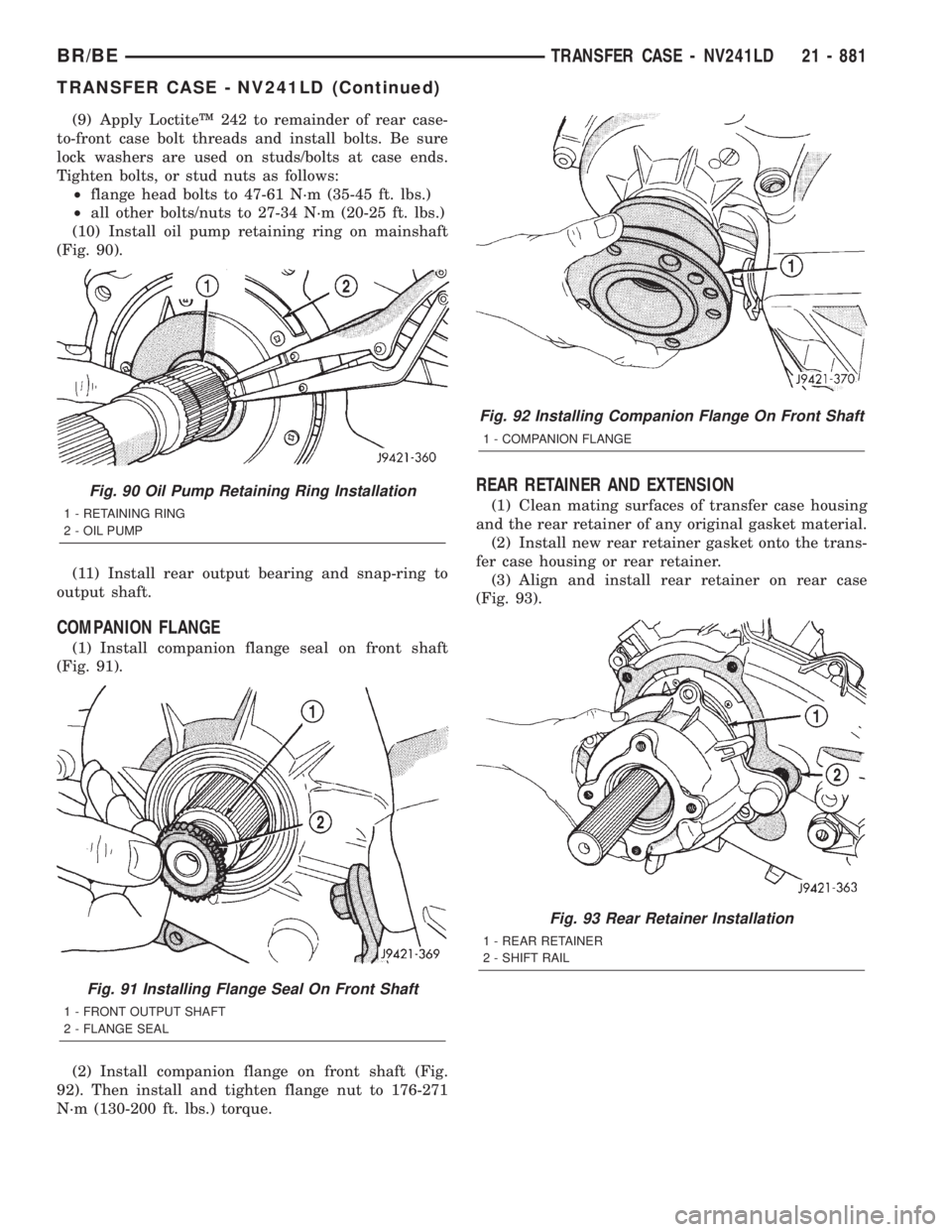
(10) Install oil pump retaining ring on mainshaft
(Fig. 90).
(11) Install rear output bearing and snap-ring to
output shaft.
COMPANION FLANGE
(1) Install companion flange seal on front shaft
(Fig. 91).
(2) Install companion flange on front shaft (Fig.
92). Then install and tighten flange nut to 176-271
N´m (130-200 ft. lbs.) torque.
REAR RETAINER AND EXTENSION
(1) Clean mating surfaces of transfer case housing
and the rear retainer of any original gasket material.
(2) Install new rear retainer gasket onto the trans-
fer case housing or rear retainer.
(3) Align and install rear retainer on rear case
(Fig. 93).Fig. 90 Oil Pump Retaining Ring Installation
1 - RETAINING RING
2 - OIL PUMP
Fig. 91 Installing Flange Seal On Front Shaft
1 - FRONT OUTPUT SHAFT
2 - FLANGE SEAL
Fig. 92 Installing Companion Flange On Front Shaft
1 - COMPANION FLANGE
Fig. 93 Rear Retainer Installation
1 - REAR RETAINER
2 - SHIFT RAIL
BR/BETRANSFER CASE - NV241LD 21 - 881
TRANSFER CASE - NV241LD (Continued)