2001 DODGE RAM ABS
[x] Cancel search: ABSPage 2451 of 2889
3-4 ACCUMULATOR
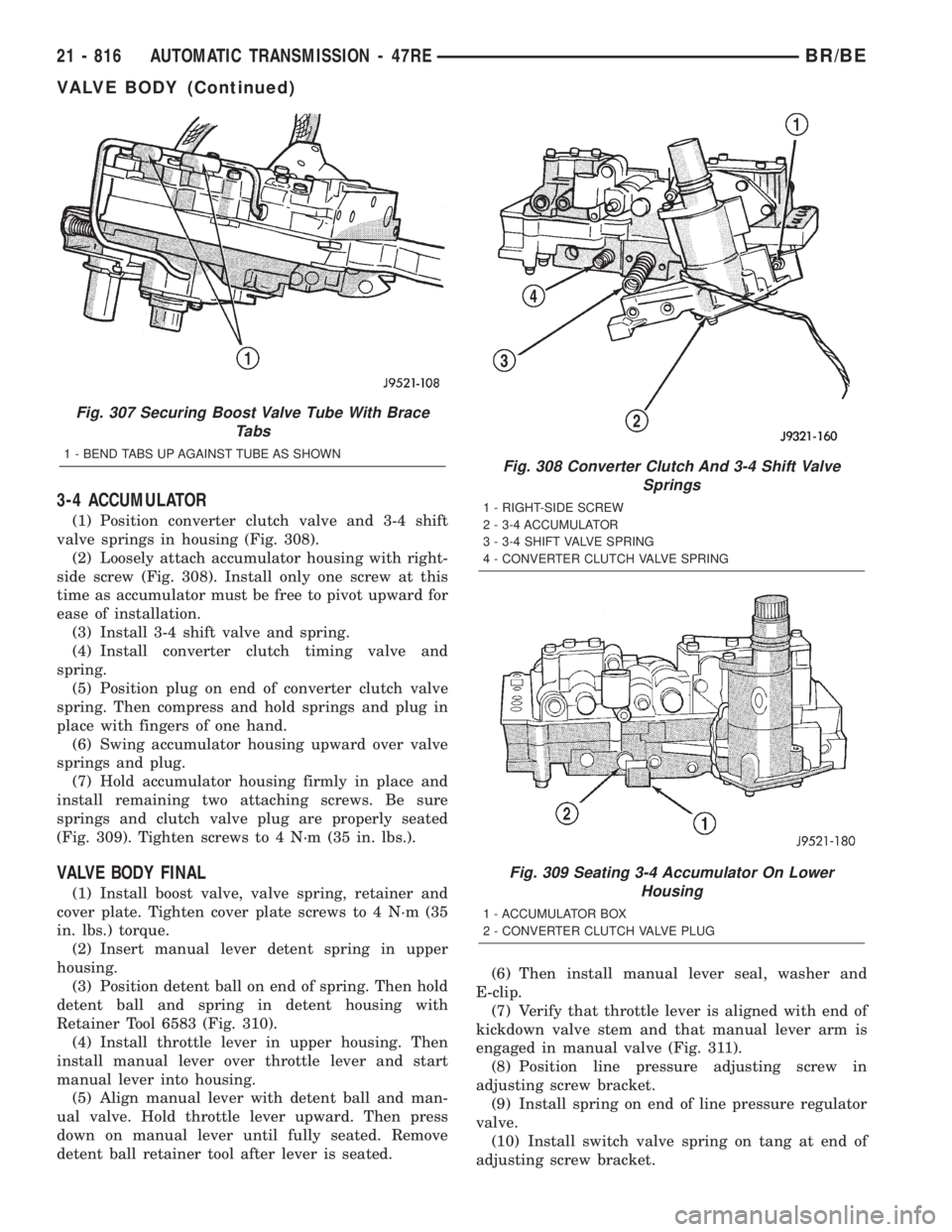
(1) Position converter clutch valve and 3-4 shift
valve springs in housing (Fig. 308).
(2) Loosely attach accumulator housing with right-
side screw (Fig. 308). Install only one screw at this
time as accumulator must be free to pivot upward for
ease of installation.
(3) Install 3-4 shift valve and spring.
(4) Install converter clutch timing valve and
spring.
(5) Position plug on end of converter clutch valve
spring. Then compress and hold springs and plug in
place with fingers of one hand.
(6) Swing accumulator housing upward over valve
springs and plug.
(7) Hold accumulator housing firmly in place and
install remaining two attaching screws. Be sure
springs and clutch valve plug are properly seated
(Fig. 309). Tighten screws to 4 N´m (35 in. lbs.).
VALVE BODY FINAL
(1) Install boost valve, valve spring, retainer and
cover plate. Tighten cover plate screws to 4 N´m (35
in. lbs.) torque.
(2) Insert manual lever detent spring in upper
housing.
(3) Position detent ball on end of spring. Then hold
detent ball and spring in detent housing with
Retainer Tool 6583 (Fig. 310).
(4) Install throttle lever in upper housing. Then
install manual lever over throttle lever and start
manual lever into housing.
(5) Align manual lever with detent ball and man-
ual valve. Hold throttle lever upward. Then press
down on manual lever until fully seated. Remove
detent ball retainer tool after lever is seated.(6) Then install manual lever seal, washer and
E-clip.
(7) Verify that throttle lever is aligned with end of
kickdown valve stem and that manual lever arm is
engaged in manual valve (Fig. 311).
(8) Position line pressure adjusting screw in
adjusting screw bracket.
(9) Install spring on end of line pressure regulator
valve.
(10) Install switch valve spring on tang at end of
adjusting screw bracket.
Fig. 307 Securing Boost Valve Tube With Brace
Tabs
1 - BEND TABS UP AGAINST TUBE AS SHOWNFig. 308 Converter Clutch And 3-4 Shift Valve
Springs
1 - RIGHT-SIDE SCREW
2 - 3-4 ACCUMULATOR
3 - 3-4 SHIFT VALVE SPRING
4 - CONVERTER CLUTCH VALVE SPRING
Fig. 309 Seating 3-4 Accumulator On Lower
Housing
1 - ACCUMULATOR BOX
2 - CONVERTER CLUTCH VALVE PLUG
21 - 816 AUTOMATIC TRANSMISSION - 47REBR/BE
VALVE BODY (Continued)
Page 2471 of 2889
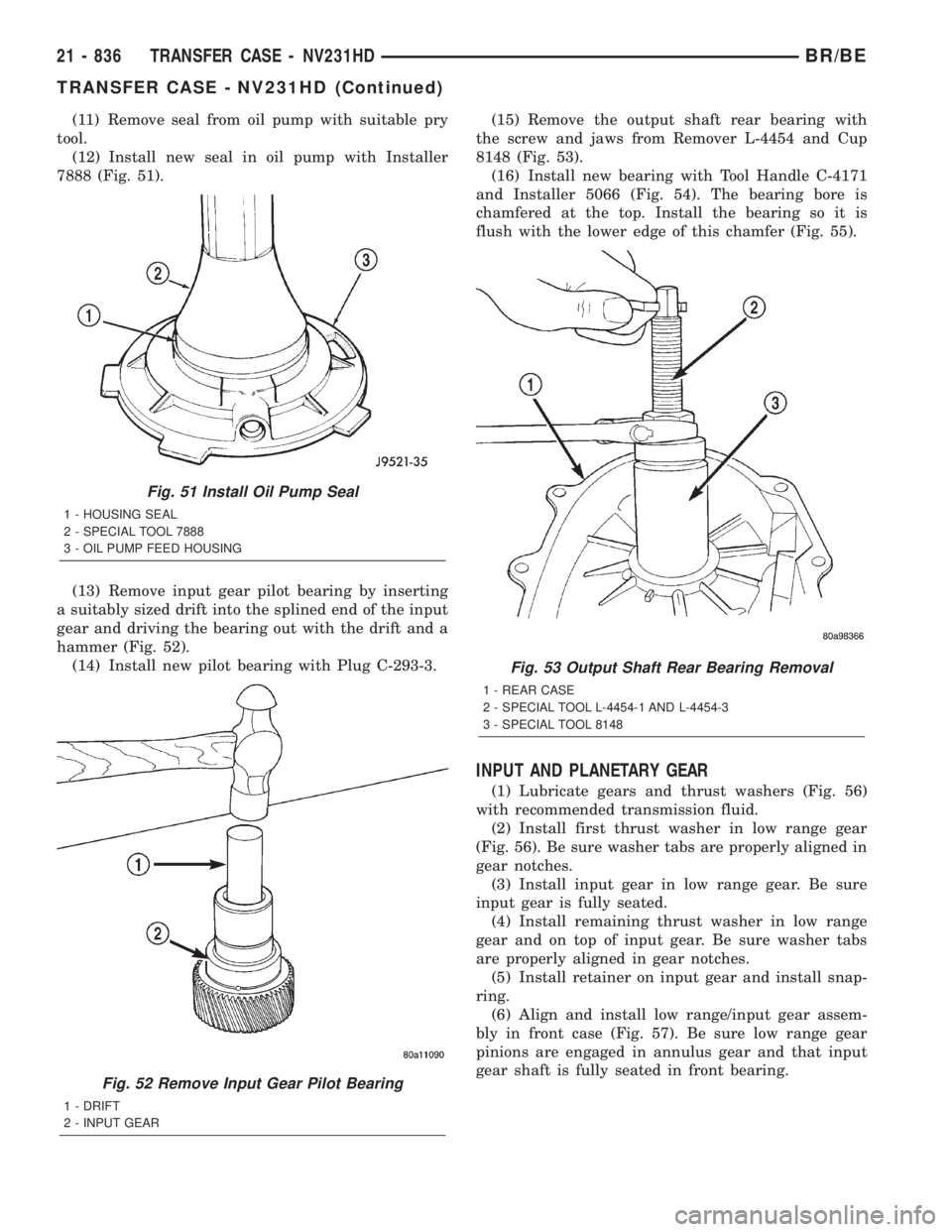
(11) Remove seal from oil pump with suitable pry
tool.
(12) Install new seal in oil pump with Installer
7888 (Fig. 51).
(13) Remove input gear pilot bearing by inserting
a suitably sized drift into the splined end of the input
gear and driving the bearing out with the drift and a
hammer (Fig. 52).
(14) Install new pilot bearing with Plug C-293-3.(15) Remove the output shaft rear bearing with
the screw and jaws from Remover L-4454 and Cup
8148 (Fig. 53).
(16) Install new bearing with Tool Handle C-4171
and Installer 5066 (Fig. 54). The bearing bore is
chamfered at the top. Install the bearing so it is
flush with the lower edge of this chamfer (Fig. 55).
INPUT AND PLANETARY GEAR
(1) Lubricate gears and thrust washers (Fig. 56)
with recommended transmission fluid.
(2) Install first thrust washer in low range gear
(Fig. 56). Be sure washer tabs are properly aligned in
gear notches.
(3) Install input gear in low range gear. Be sure
input gear is fully seated.
(4) Install remaining thrust washer in low range
gear and on top of input gear. Be sure washer tabs
are properly aligned in gear notches.
(5) Install retainer on input gear and install snap-
ring.
(6) Align and install low range/input gear assem-
bly in front case (Fig. 57). Be sure low range gear
pinions are engaged in annulus gear and that input
gear shaft is fully seated in front bearing.
Fig. 51 Install Oil Pump Seal
1 - HOUSING SEAL
2 - SPECIAL TOOL 7888
3 - OIL PUMP FEED HOUSING
Fig. 52 Remove Input Gear Pilot Bearing
1 - DRIFT
2 - INPUT GEAR
Fig. 53 Output Shaft Rear Bearing Removal
1 - REAR CASE
2 - SPECIAL TOOL L-4454-1 AND L-4454-3
3 - SPECIAL TOOL 8148
21 - 836 TRANSFER CASE - NV231HDBR/BE
TRANSFER CASE - NV231HD (Continued)
Page 2507 of 2889
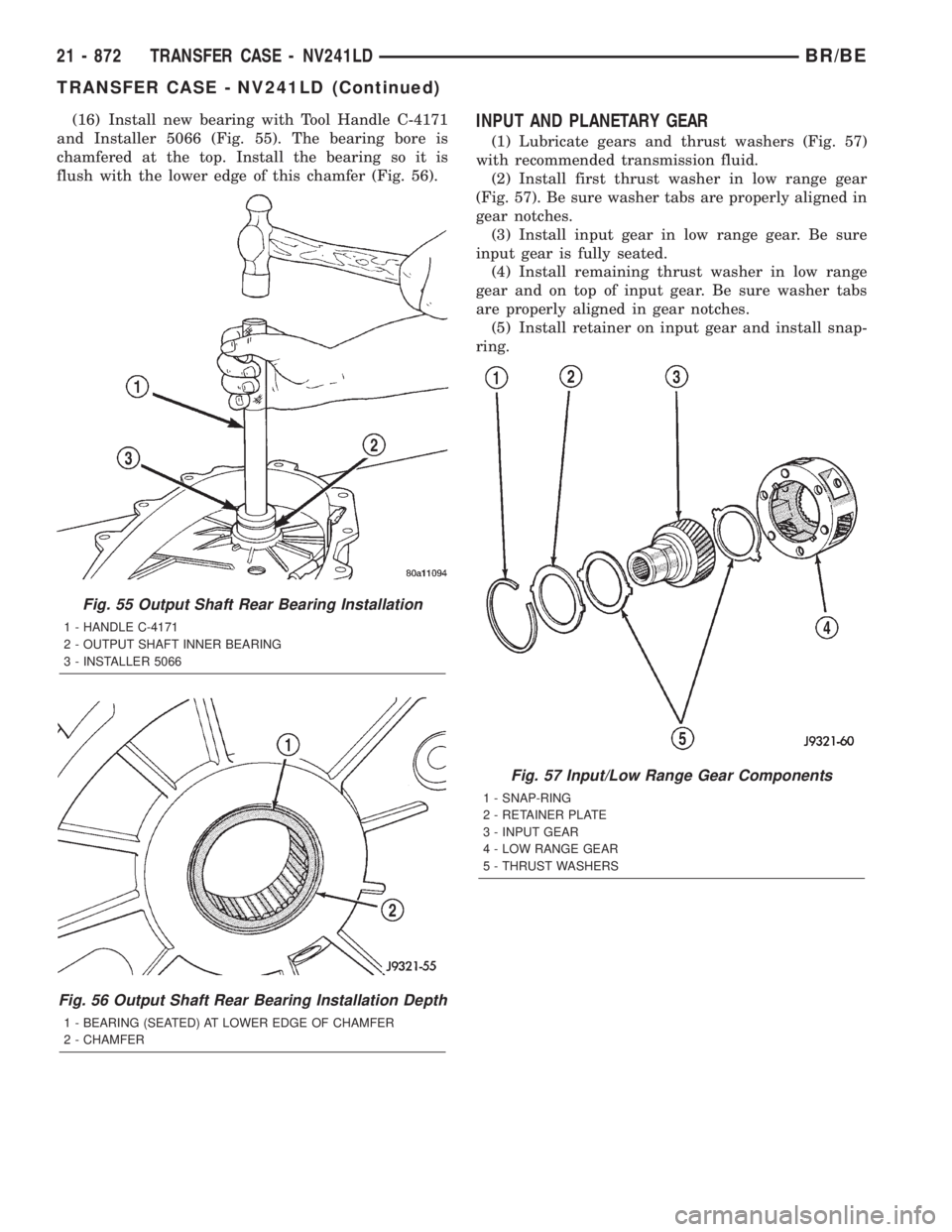
(16) Install new bearing with Tool Handle C-4171
and Installer 5066 (Fig. 55). The bearing bore is
chamfered at the top. Install the bearing so it is
flush with the lower edge of this chamfer (Fig. 56).INPUT AND PLANETARY GEAR
(1) Lubricate gears and thrust washers (Fig. 57)
with recommended transmission fluid.
(2) Install first thrust washer in low range gear
(Fig. 57). Be sure washer tabs are properly aligned in
gear notches.
(3) Install input gear in low range gear. Be sure
input gear is fully seated.
(4) Install remaining thrust washer in low range
gear and on top of input gear. Be sure washer tabs
are properly aligned in gear notches.
(5) Install retainer on input gear and install snap-
ring.
Fig. 55 Output Shaft Rear Bearing Installation
1 - HANDLE C-4171
2 - OUTPUT SHAFT INNER BEARING
3 - INSTALLER 5066
Fig. 56 Output Shaft Rear Bearing Installation Depth
1 - BEARING (SEATED) AT LOWER EDGE OF CHAMFER
2 - CHAMFER
Fig. 57 Input/Low Range Gear Components
1 - SNAP-RING
2 - RETAINER PLATE
3 - INPUT GEAR
4 - LOW RANGE GEAR
5 - THRUST WASHERS
21 - 872 TRANSFER CASE - NV241LDBR/BE
TRANSFER CASE - NV241LD (Continued)
Page 2543 of 2889
INPUT AND PLANETARY GEAR
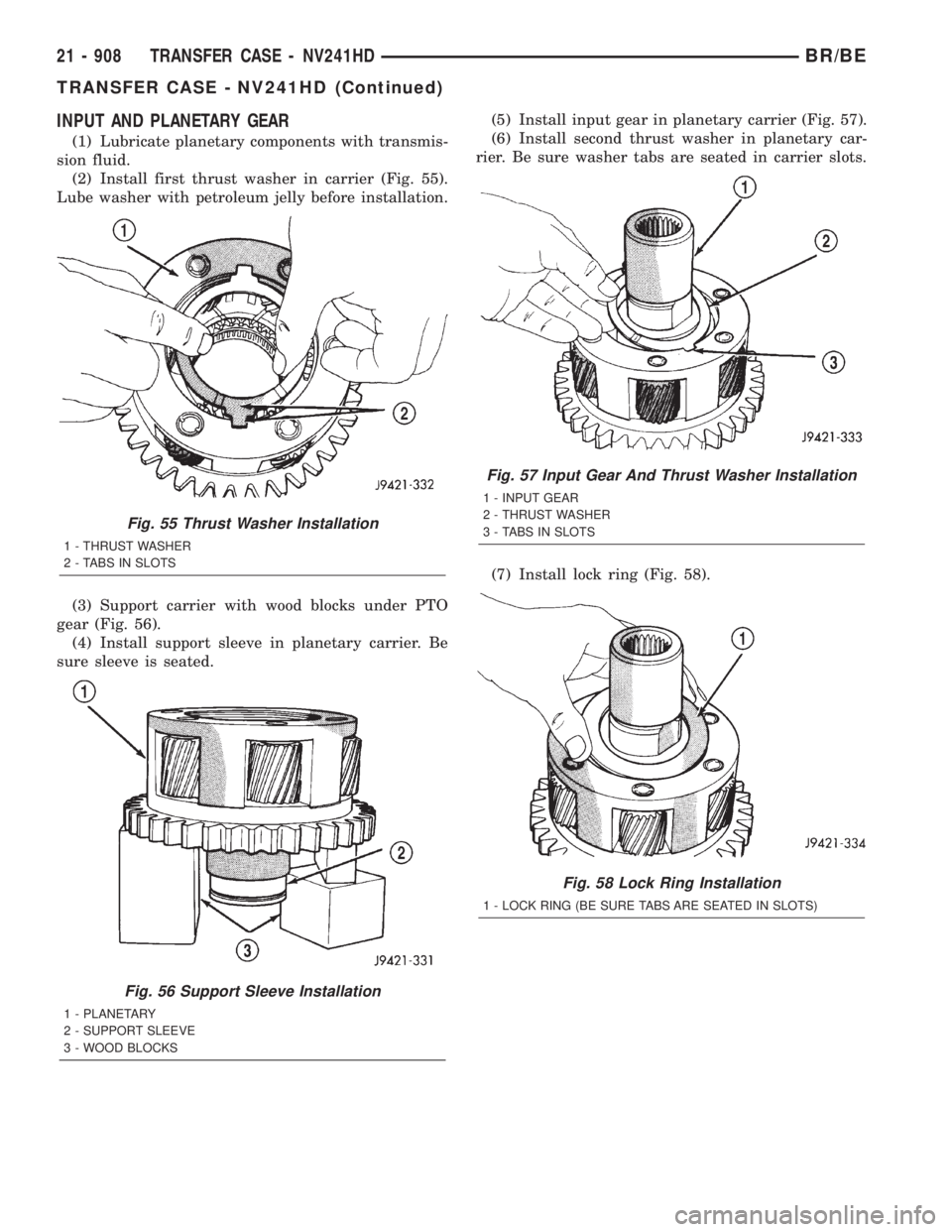
(1) Lubricate planetary components with transmis-
sion fluid.
(2) Install first thrust washer in carrier (Fig. 55).
Lube washer with petroleum jelly before installation.
(3) Support carrier with wood blocks under PTO
gear (Fig. 56).
(4) Install support sleeve in planetary carrier. Be
sure sleeve is seated.(5) Install input gear in planetary carrier (Fig. 57).
(6) Install second thrust washer in planetary car-
rier. Be sure washer tabs are seated in carrier slots.
(7) Install lock ring (Fig. 58).
Fig. 55 Thrust Washer Installation
1 - THRUST WASHER
2 - TABS IN SLOTS
Fig. 56 Support Sleeve Installation
1 - PLANETARY
2 - SUPPORT SLEEVE
3 - WOOD BLOCKS
Fig. 57 Input Gear And Thrust Washer Installation
1 - INPUT GEAR
2 - THRUST WASHER
3 - TABS IN SLOTS
Fig. 58 Lock Ring Installation
1 - LOCK RING (BE SURE TABS ARE SEATED IN SLOTS)
21 - 908 TRANSFER CASE - NV241HDBR/BE
TRANSFER CASE - NV241HD (Continued)
Page 2650 of 2889
DOOR - CARGO
TABLE OF CONTENTS
page page
AIR EXHAUSTER
REMOVAL..............................77
INSTALLATION...........................77
CHECK
REMOVAL..............................78
INSTALLATION...........................78
DOOR
REMOVAL..............................78
INSTALLATION...........................78
ADJUSTMENTS..........................78
EXHAUST VENT
REMOVAL..............................79
INSTALLATION...........................79
HINGE
REMOVAL..............................79
INSTALLATION...........................79
INSIDE HANDLE ACTUATOR
REMOVAL..............................80
INSTALLATION...........................80
LATCH - LOWER
REMOVAL..............................80
INSTALLATION...........................80
LATCH - UPPER
REMOVAL..............................81INSTALLATION...........................81
LATCH STRIKER - LOWER
REMOVAL..............................82
INSTALLATION...........................82
LATCH STRIKER - UPPER
REMOVAL..............................82
INSTALLATION...........................82
RELEASE CABLE
REMOVAL..............................82
INSTALLATION...........................83
SHUTFACE HANDLE
REMOVAL..............................83
INSTALLATION...........................83
TRIM PANEL
REMOVAL..............................84
INSTALLATION...........................84
VENT WINDOW
REMOVAL..............................85
INSTALLATION...........................85
WATERDAM
REMOVAL..............................85
INSTALLATION...........................85
AIR EXHAUSTER
REMOVAL
(1) Remove cargo door trim panel (Refer to 23 -
BODY/DOOR - CARGO/TRIM PANEL - REMOVAL).
(2) Peel back waterdam.
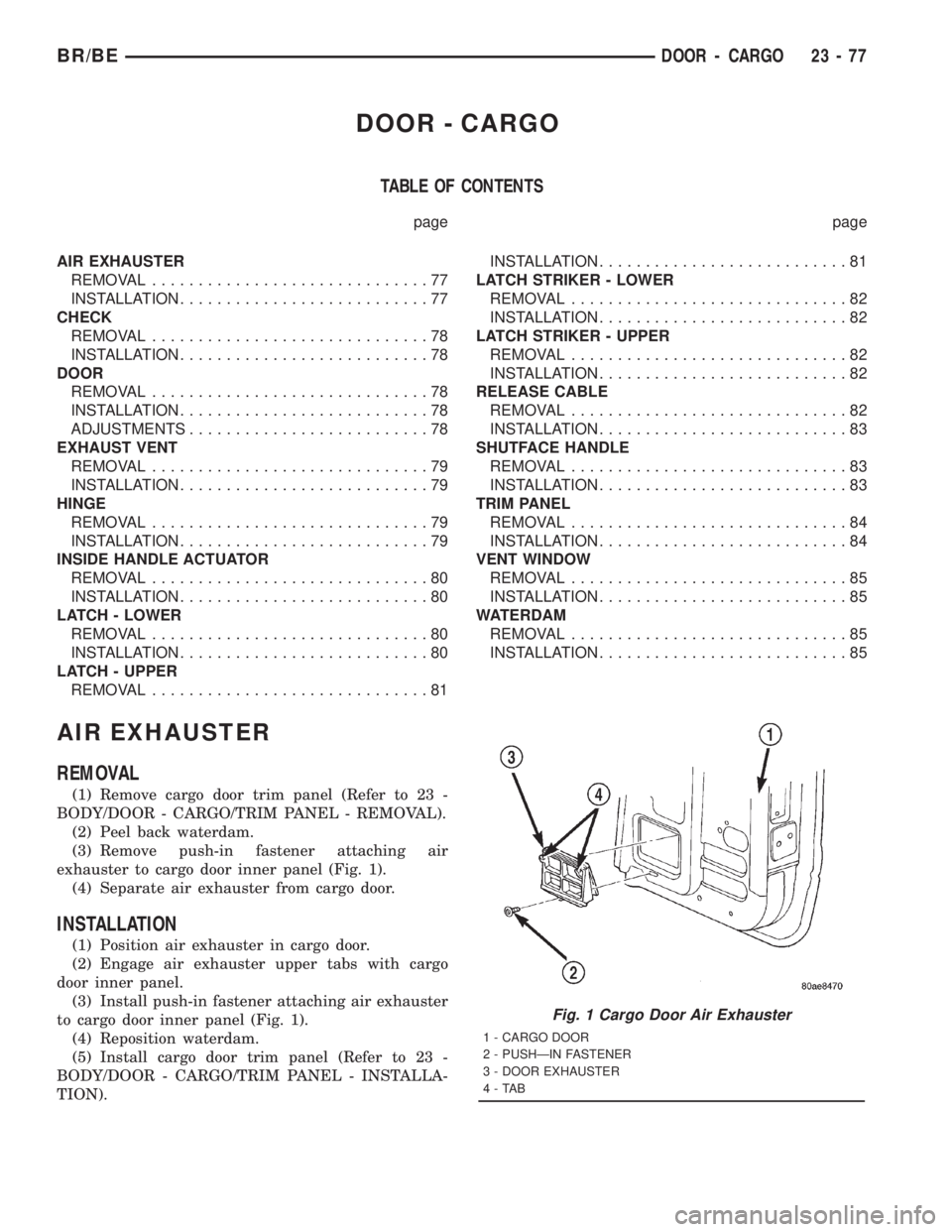
(3) Remove push-in fastener attaching air
exhauster to cargo door inner panel (Fig. 1).
(4) Separate air exhauster from cargo door.
INSTALLATION
(1) Position air exhauster in cargo door.
(2) Engage air exhauster upper tabs with cargo
door inner panel.
(3) Install push-in fastener attaching air exhauster
to cargo door inner panel (Fig. 1).
(4) Reposition waterdam.
(5) Install cargo door trim panel (Refer to 23 -
BODY/DOOR - CARGO/TRIM PANEL - INSTALLA-
TION).
Fig. 1 Cargo Door Air Exhauster
1 - CARGO DOOR
2 - PUSHÐIN FASTENER
3 - DOOR EXHAUSTER
4-TAB
BR/BEDOOR - CARGO 23 - 77
Page 2652 of 2889
(5) If necessary, loosen the bolts attaching the
lower striker and move striker to the correct position.
(6)
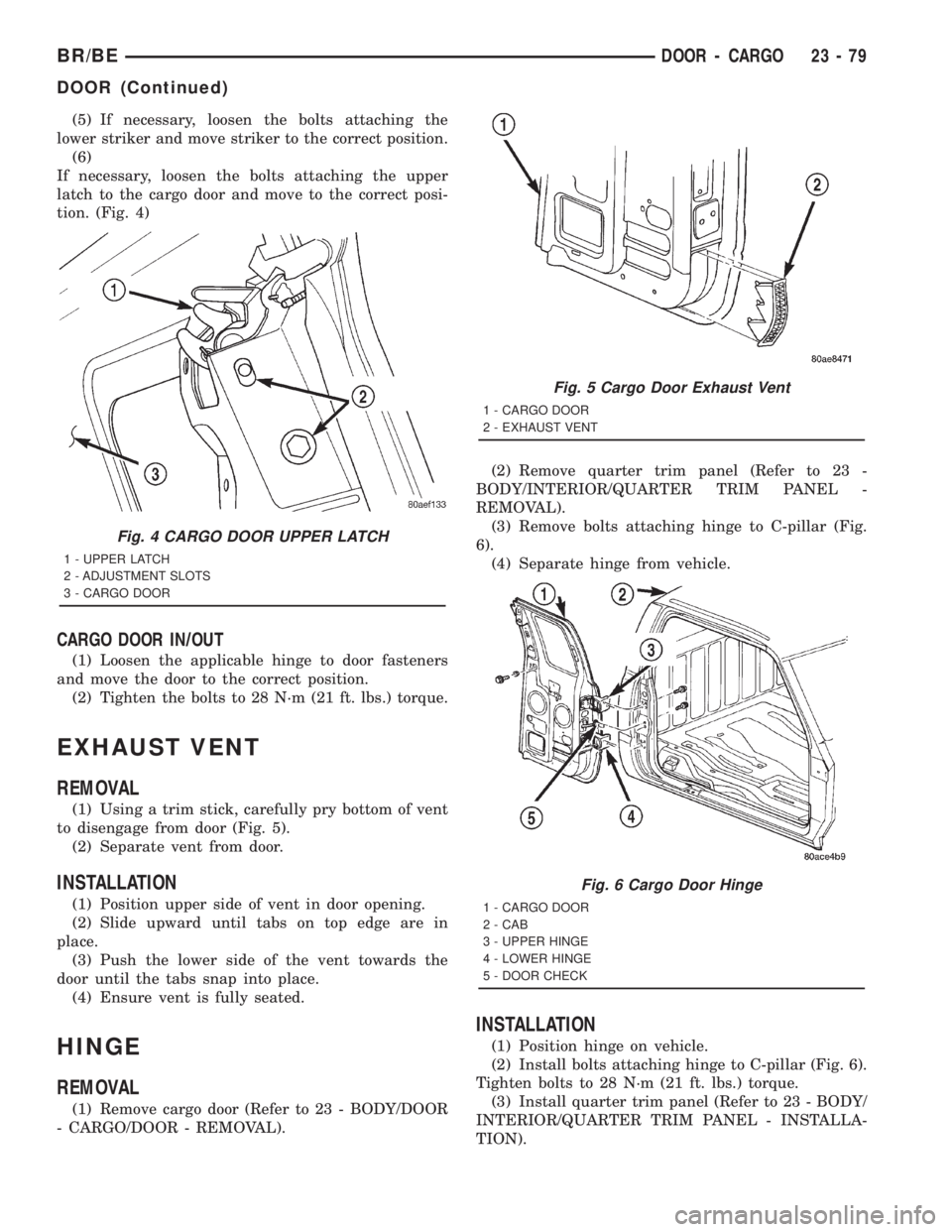
If necessary, loosen the bolts attaching the upper
latch to the cargo door and move to the correct posi-
tion. (Fig. 4)
CARGO DOOR IN/OUT
(1) Loosen the applicable hinge to door fasteners
and move the door to the correct position.
(2) Tighten the bolts to 28 N´m (21 ft. lbs.) torque.
EXHAUST VENT
REMOVAL
(1) Using a trim stick, carefully pry bottom of vent
to disengage from door (Fig. 5).
(2) Separate vent from door.
INSTALLATION
(1) Position upper side of vent in door opening.
(2) Slide upward until tabs on top edge are in
place.
(3) Push the lower side of the vent towards the
door until the tabs snap into place.
(4) Ensure vent is fully seated.
HINGE
REMOVAL
(1) Remove cargo door (Refer to 23 - BODY/DOOR
- CARGO/DOOR - REMOVAL).(2) Remove quarter trim panel (Refer to 23 -
BODY/INTERIOR/QUARTER TRIM PANEL -
REMOVAL).
(3) Remove bolts attaching hinge to C-pillar (Fig.
6).
(4) Separate hinge from vehicle.
INSTALLATION
(1) Position hinge on vehicle.
(2) Install bolts attaching hinge to C-pillar (Fig. 6).
Tighten bolts to 28 N´m (21 ft. lbs.) torque.
(3) Install quarter trim panel (Refer to 23 - BODY/
INTERIOR/QUARTER TRIM PANEL - INSTALLA-
TION).
Fig. 4 CARGO DOOR UPPER LATCH
1 - UPPER LATCH
2 - ADJUSTMENT SLOTS
3 - CARGO DOOR
Fig. 5 Cargo Door Exhaust Vent
1 - CARGO DOOR
2 - EXHAUST VENT
Fig. 6 Cargo Door Hinge
1 - CARGO DOOR
2 - CAB
3 - UPPER HINGE
4 - LOWER HINGE
5 - DOOR CHECK
BR/BEDOOR - CARGO 23 - 79
DOOR (Continued)
Page 2659 of 2889
EXTERIOR
TABLE OF CONTENTS
page page
EXTERIOR
DESCRIPTION...........................86
OPERATION.............................86
BODY SIDE MOLDINGS
REMOVAL..............................87
INSTALLATION...........................87
BODY STRIPES AND DECALS
REMOVAL..............................87
INSTALLATION...........................87
TAPE STRIPE
REMOVAL..............................88
INSTALLATION...........................88
EXTERIOR NAME PLATES
REMOVAL..............................89
INSTALLATION...........................89
COWL GRILLE
REMOVAL..............................90
INSTALLATION...........................90
ROOF JOINT MOLDING
REMOVAL..............................91
INSTALLATION...........................91
GRILLE
REMOVAL..............................91
INSTALLATION...........................91
GRILLE FRAME
REMOVAL..............................91
INSTALLATION...........................92
FRONT END SPLASH SHIELDS
REMOVAL..............................92
INSTALLATION...........................92LEFT FRONT FENDER
REMOVAL..............................92
INSTALLATION...........................93
RIGHT FRONT FENDER
REMOVAL..............................94
INSTALLATION...........................94
FUEL FILL DOOR
REMOVAL..............................95
INSTALLATION...........................95
REAR FENDER
REMOVAL..............................95
INSTALLATION...........................95
REAR SPLASH SHIELD
REMOVAL..............................96
INSTALLATION...........................96
REAR WHEELHOUSE LINER
REMOVAL..............................96
INSTALLATION...........................96
CARGO BOX
REMOVAL..............................96
INSTALLATION...........................97
SIDE VIEW MIRROR
REMOVAL..............................97
INSTALLATION...........................97
SIDE VIEW MIRROR - LOW MOUNTED
REMOVAL..............................98
INSTALLATION...........................98
SIDE VIEW MIRROR GLASS
REMOVAL..............................98
INSTALLATION...........................98
EXTERIOR
DESCRIPTION
Exterior sheet metal components make up the
exterior of the vehicle. Some exterior metal systems
are welded assemblies, such as doors and hoods.
Some exterior trim items are made of composite.
OPERATION
The exterior is finished in various metal stampings
and composite moldings. These assemblies give the
vehicle a finished appearance and protect the occu-
pants from the elements. Some components are partof the energy absorbing system used to protect the
occupants in collisions. The exterior sheet metal is
repairable and adjustable for fit and finish. Welded
and bonded component systems are adjustable as a
system. Trim components made of composite are
stamped with the type of material used. Daimler-
Chrysler uses various fasteners to retain trim items.
At times, it is not possible to remove trim items
without damaging the fastener. If it is not possible to
remove an item without damaging a component, cut
or break the fasteners and use new ones when
installing the component.
23 - 86 EXTERIORBR/BE
Page 2666 of 2889
(2) Remove air cleaner from wheelhouse (DIESEL
ONLY).
(3) Remove coolant overflow bottle (V-10 ONLY).
(4) Remove battery tray (Refer to 8 - ELECTRI-
CAL/BATTERY SYSTEM/TRAY - REMOVAL).
(5) Remove screws attaching power distribution
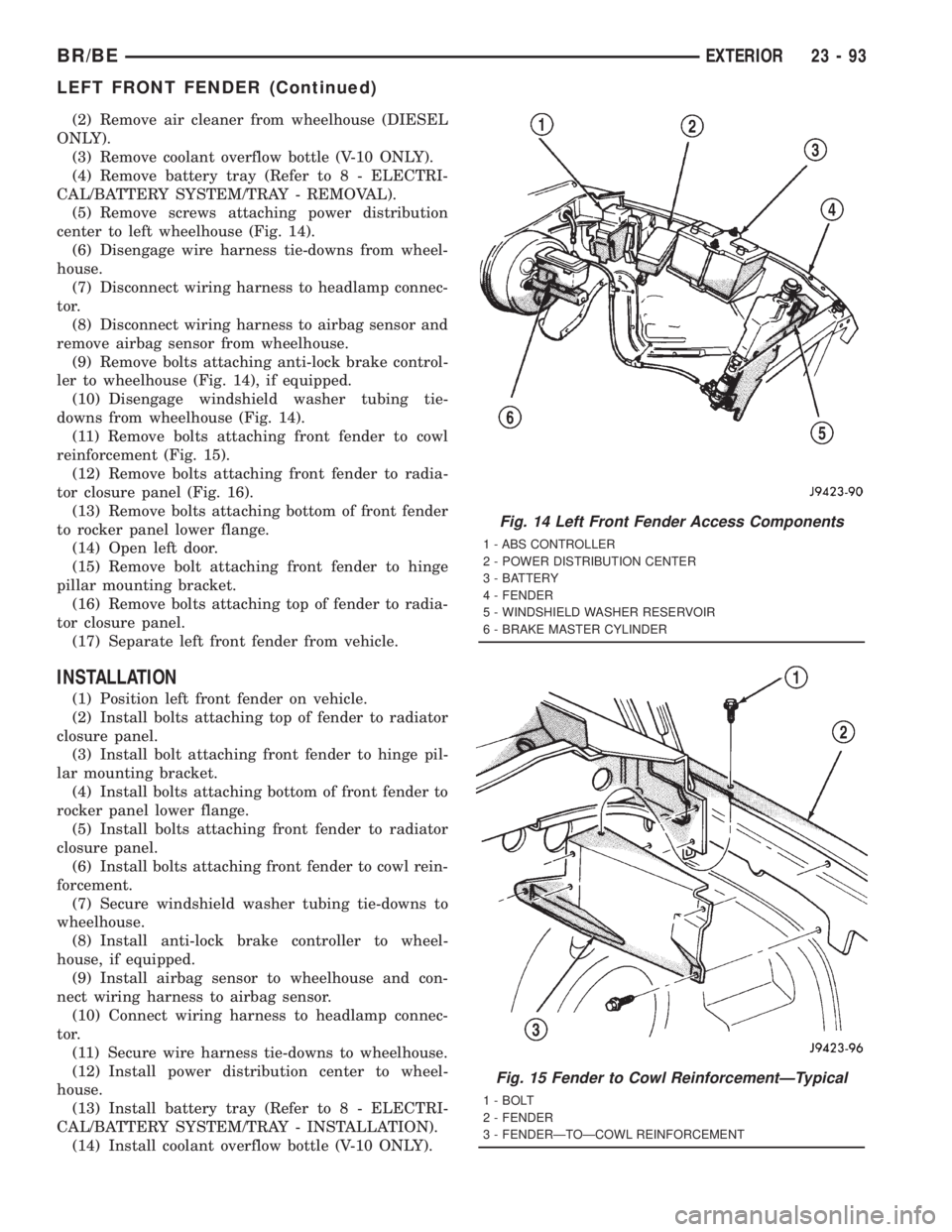
center to left wheelhouse (Fig. 14).
(6) Disengage wire harness tie-downs from wheel-
house.
(7) Disconnect wiring harness to headlamp connec-
tor.
(8) Disconnect wiring harness to airbag sensor and
remove airbag sensor from wheelhouse.
(9) Remove bolts attaching anti-lock brake control-
ler to wheelhouse (Fig. 14), if equipped.
(10) Disengage windshield washer tubing tie-
downs from wheelhouse (Fig. 14).
(11) Remove bolts attaching front fender to cowl
reinforcement (Fig. 15).
(12) Remove bolts attaching front fender to radia-
tor closure panel (Fig. 16).
(13) Remove bolts attaching bottom of front fender
to rocker panel lower flange.
(14) Open left door.
(15) Remove bolt attaching front fender to hinge
pillar mounting bracket.
(16) Remove bolts attaching top of fender to radia-
tor closure panel.
(17) Separate left front fender from vehicle.
INSTALLATION
(1) Position left front fender on vehicle.
(2) Install bolts attaching top of fender to radiator
closure panel.
(3) Install bolt attaching front fender to hinge pil-
lar mounting bracket.
(4) Install bolts attaching bottom of front fender to
rocker panel lower flange.
(5) Install bolts attaching front fender to radiator
closure panel.
(6) Install bolts attaching front fender to cowl rein-
forcement.
(7) Secure windshield washer tubing tie-downs to
wheelhouse.
(8) Install anti-lock brake controller to wheel-
house, if equipped.
(9) Install airbag sensor to wheelhouse and con-
nect wiring harness to airbag sensor.
(10) Connect wiring harness to headlamp connec-
tor.
(11) Secure wire harness tie-downs to wheelhouse.
(12) Install power distribution center to wheel-
house.
(13) Install battery tray (Refer to 8 - ELECTRI-
CAL/BATTERY SYSTEM/TRAY - INSTALLATION).
(14) Install coolant overflow bottle (V-10 ONLY).
Fig. 14 Left Front Fender Access Components
1 - ABS CONTROLLER
2 - POWER DISTRIBUTION CENTER
3 - BATTERY
4 - FENDER
5 - WINDSHIELD WASHER RESERVOIR
6 - BRAKE MASTER CYLINDER
Fig. 15 Fender to Cowl ReinforcementÐTypical
1 - BOLT
2 - FENDER
3 - FENDERÐTOÐCOWL REINFORCEMENT
BR/BEEXTERIOR 23 - 93
LEFT FRONT FENDER (Continued)