2001 DODGE RAM ABS
[x] Cancel search: ABSPage 1922 of 2889
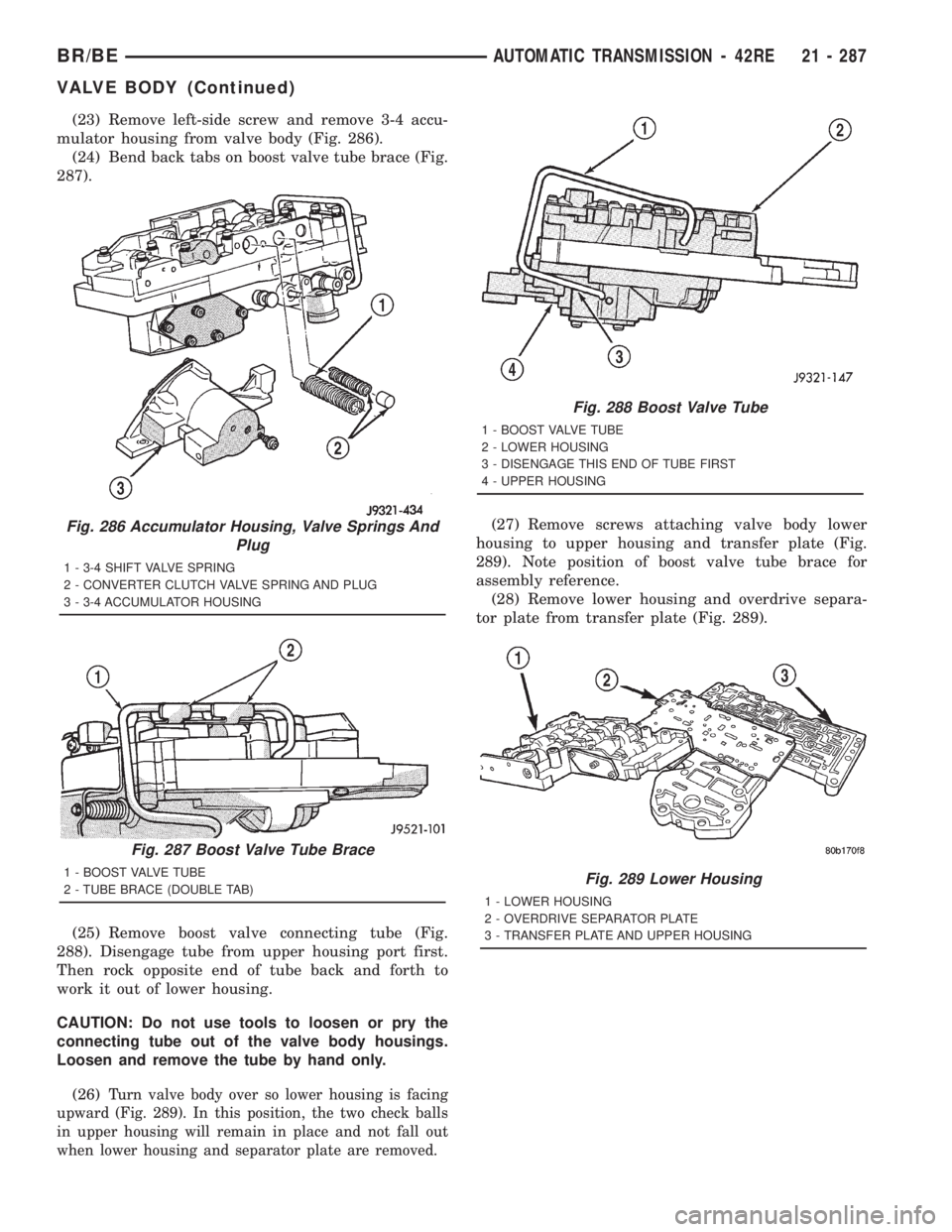
(23) Remove left-side screw and remove 3-4 accu-
mulator housing from valve body (Fig. 286).
(24) Bend back tabs on boost valve tube brace (Fig.
287).
(25) Remove boost valve connecting tube (Fig.
288). Disengage tube from upper housing port first.
Then rock opposite end of tube back and forth to
work it out of lower housing.
CAUTION: Do not use tools to loosen or pry the
connecting tube out of the valve body housings.
Loosen and remove the tube by hand only.
(26)
Turn valve body over so lower housing is facing
upward (Fig. 289). In this position, the two check balls
in upper housing will remain in place and not fall out
when lower housing and separator plate are removed.
(27) Remove screws attaching valve body lower
housing to upper housing and transfer plate (Fig.
289). Note position of boost valve tube brace for
assembly reference.
(28) Remove lower housing and overdrive separa-
tor plate from transfer plate (Fig. 289).
Fig. 288 Boost Valve Tube
1 - BOOST VALVE TUBE
2 - LOWER HOUSING
3 - DISENGAGE THIS END OF TUBE FIRST
4 - UPPER HOUSING
Fig. 289 Lower Housing
1 - LOWER HOUSING
2 - OVERDRIVE SEPARATOR PLATE
3 - TRANSFER PLATE AND UPPER HOUSING
Fig. 286 Accumulator Housing, Valve Springs And
Plug
1 - 3-4 SHIFT VALVE SPRING
2 - CONVERTER CLUTCH VALVE SPRING AND PLUG
3 - 3-4 ACCUMULATOR HOUSING
Fig. 287 Boost Valve Tube Brace
1 - BOOST VALVE TUBE
2 - TUBE BRACE (DOUBLE TAB)
BR/BEAUTOMATIC TRANSMISSION - 42RE 21 - 287
VALVE BODY (Continued)
Page 1935 of 2889
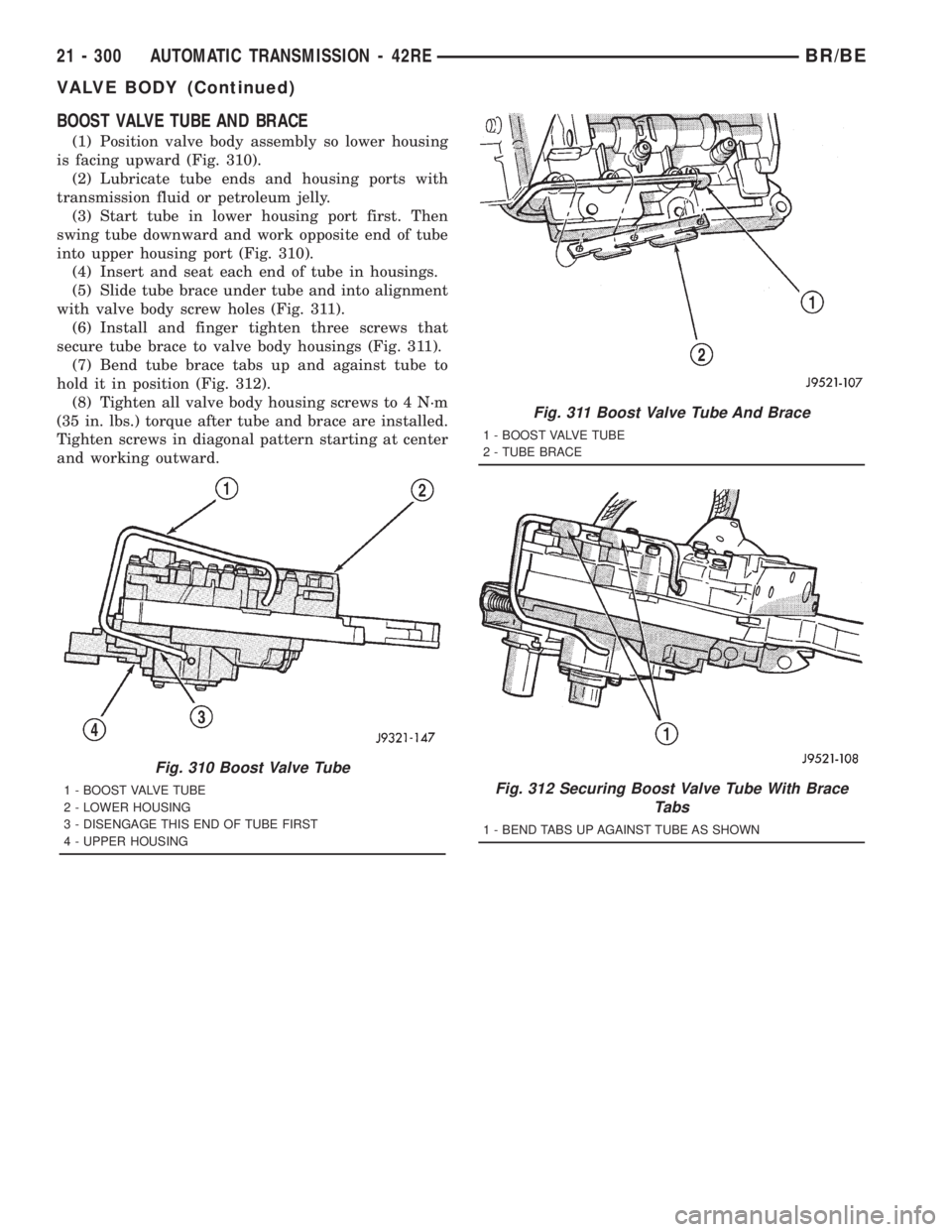
BOOST VALVE TUBE AND BRACE
(1) Position valve body assembly so lower housing
is facing upward (Fig. 310).
(2) Lubricate tube ends and housing ports with
transmission fluid or petroleum jelly.
(3) Start tube in lower housing port first. Then
swing tube downward and work opposite end of tube
into upper housing port (Fig. 310).
(4) Insert and seat each end of tube in housings.
(5) Slide tube brace under tube and into alignment
with valve body screw holes (Fig. 311).
(6) Install and finger tighten three screws that
secure tube brace to valve body housings (Fig. 311).
(7) Bend tube brace tabs up and against tube to
hold it in position (Fig. 312).
(8) Tighten all valve body housing screws to 4 N´m
(35 in. lbs.) torque after tube and brace are installed.
Tighten screws in diagonal pattern starting at center
and working outward.
Fig. 310 Boost Valve Tube
1 - BOOST VALVE TUBE
2 - LOWER HOUSING
3 - DISENGAGE THIS END OF TUBE FIRST
4 - UPPER HOUSING
Fig. 311 Boost Valve Tube And Brace
1 - BOOST VALVE TUBE
2 - TUBE BRACE
Fig. 312 Securing Boost Valve Tube With Brace
Tabs
1 - BEND TABS UP AGAINST TUBE AS SHOWN
21 - 300 AUTOMATIC TRANSMISSION - 42REBR/BE
VALVE BODY (Continued)
Page 2001 of 2889
vary due to various environmental factors or manu-
facturing tolerances.
The pressure transducer is affected by barometric
pressure as well as temperature. Calibration of the
zero pressure offset is required to compensate for
shifting output due to these factors.
Normal calibration will be performed when sump
temperature is above 50 degrees F, or in the absence
of sump temperature data, after the first 10 minutes
of vehicle operation. Calibration of the pressure
transducer offset occurs each time the output shaft
speed falls below 200 RPM. Calibration shall be
repeated each 3 seconds the output shaft speed is
below 200 RPM. A 0.5 second pulse of 95% duty cycle
is applied to the governor pressure solenoid valve
and the transducer output is read during this pulse.
Averaging of the transducer signal is necessary to
reject electrical noise.
Under cold conditions (below 50 degrees F sump),
the governor pressure solenoid valve response may
be too slow to guarantee 0 psi during the 0.5 second
calibration pulse. Calibration pulses are continued
during this period, however the transducer output
valves are discarded. Transducer offset must be read
at key-on, under conditions which promote a stable
reading. This value is retained and becomes the off-
set during the9cold9period of operation.
GOVERNOR PRESSURE SOLENOID VALVE
The inlet side of the solenoid valve is exposed to
normal transmission line pressure. The outlet side of
the valve leads to the valve body governor circuit.
The solenoid valve regulates line pressure to pro-
duce governor pressure. The average current sup-
plied to the solenoid controls governor pressure. One
amp current produces zero kPa/psi governor pres-
sure. Zero amps sets the maximum governor pres-
sure.
The powertrain control module (PCM) turns on the
trans control relay which supplies electrical power to
the solenoid valve. Operating voltage is 12 volts
(DC). The PCM controls the ground side of the sole-
noid using the governor pressure solenoid control cir-
cuit.
GOVERNOR PRESSURE SENSOR
The sensor output signal provides the necessary
feedback to the PCM. This feedback is needed to ade-
quately control governor pressure.
GOVERNOR BODY AND TRANSFER PLATE
The transfer plate channels line pressure to the
solenoid valve through the governor body. It also
channels governor pressure from the solenoid valve
to the governor circuit. It is the solenoid valve that
develops the necessary governor pressure.
GOVERNOR PRESSURE CURVES
LOW TRANSMISSION FLUID TEMPERATURE
When the transmission fluid is cold the conven-
tional governor can delay shifts, resulting in higher
than normal shift speeds and harsh shifts. The elec-
tronically controlled low temperature governor pres-
sure curve is higher than normal to make the
transmission shift at normal speeds and sooner. The
PCM uses a temperature sensor in the transmission
oil sump to determine when low temperature gover-
nor pressure is needed.
NORMAL OPERATION
Normal operation is refined through the increased
computing power of the PCM and through access to
data on engine operating conditions provided by the
PCM that were not available with the previous
stand-alone electronic module. This facilitated the
development of a load adaptive shift strategy - the
ability to alter the shift schedule in response to vehi-
cle load condition. One manifestation of this capabil-
ity is grade9hunting9prevention - the ability of the
transmission logic to delay an upshift on a grade if
the engine does not have sufficient power to main-
tain speed in the higher gear. The 3-2 downshift and
the potential for hunting between gears occurs with a
heavily loaded vehicle or on steep grades. When
hunting occurs, it is very objectionable because shifts
are frequent and accompanied by large changes in
noise and acceleration.
WIDE OPEN THROTTLE OPERATION
In wide-open throttle (WOT) mode, adaptive mem-
ory in the PCM assures that up-shifts occur at the
preprogrammed optimum speed. WOT operation is
determined from the throttle position sensor, which
is also a part of the emission control system. The ini-
tial setting for the WOT upshift is below the opti-
mum engine speed. As WOT shifts are repeated, the
PCM learns the time required to complete the shifts
by comparing the engine speed when the shifts occur
to the optimum speed. After each shift, the PCM
adjusts the shift point until the optimum speed is
reached. The PCM also considers vehicle loading,
grade and engine performance changes due to high
altitude in determining when to make WOT shifts. It
does this by measuring vehicle and engine accelera-
tion and then factoring in the shift time.
TRANSFER CASE LOW RANGE OPERATION
On four-wheel drive vehicles operating in low
range, the engine can accelerate to its peak more
rapidly than in Normal range, resulting in delayed
shifts and undesirable engine9flare.9The low range
governor pressure curve is also higher than normal
21 - 366 AUTOMATIC TRANSMISSION - 44REBR/BE
ELECTRONIC GOVERNOR (Continued)
Page 2047 of 2889
Inspect the geartrain spacers, thrust plates, snap-
rings, and thrust washers. Replace any of these parts
that are worn, distorted or damaged. Do not attempt
to reuse these parts.
The planetary gear thrust washers are different
sizes. The large diameter washers go on the front
planetary and the smaller washers go on the rear
planetary. All the washers have four locating tabs on
them. These tabs fit in the holes or slots provided in
each planetary gear.
Inspect the output shaft carefully. Pay particular
attention to the machined bushing/bearing surfaces
on the shaft and the governor valve shaft bore at the
shaft rear.
Replace the output shaft if the machined surfaces
are scored, pitted, or damaged in any way. Also
replace the shaft if the splines are damaged, or
exhibits cracks at any location (especially at the gov-
ernor valve shaft bore).
The annulus gears can be removed from their sup-
ports if necessary. Just remove the snap-rings and
separate the two parts when replacement is neces-
sary. In addition, the annulus gear bushings can be
replaced if severely worn, or scored. However it is not
necessary to replace the bushings if they only exhibit
normal wear. Check bushing fit on the output shaft
to be sure.
ASSEMBLY
(1) Lubricate output shaft and planetary compo-
nents with transmission fluid. Use petroleum jelly to
lubricate and hold thrust washers and plates in posi-
tion.
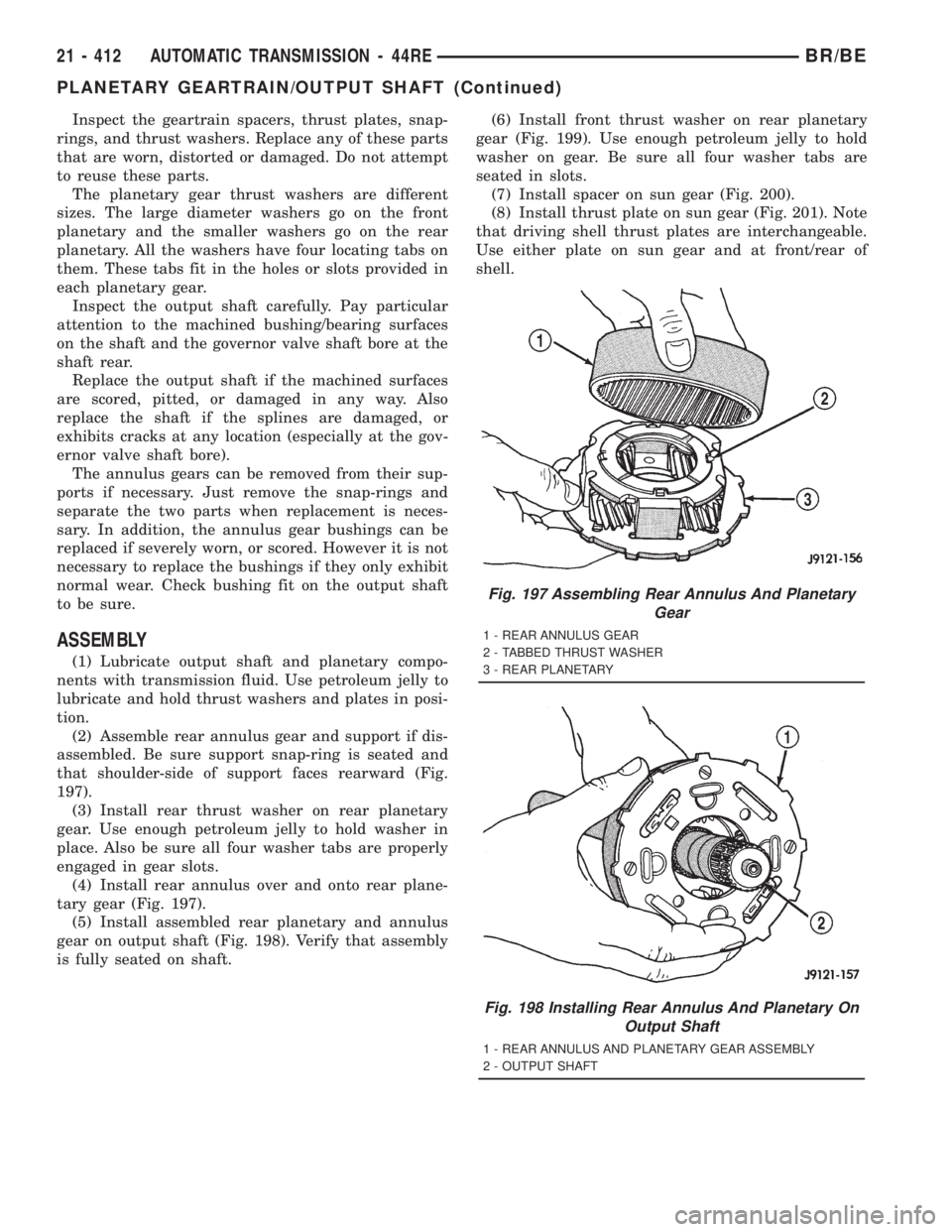
(2) Assemble rear annulus gear and support if dis-
assembled. Be sure support snap-ring is seated and
that shoulder-side of support faces rearward (Fig.
197).
(3) Install rear thrust washer on rear planetary
gear. Use enough petroleum jelly to hold washer in
place. Also be sure all four washer tabs are properly
engaged in gear slots.
(4) Install rear annulus over and onto rear plane-
tary gear (Fig. 197).
(5) Install assembled rear planetary and annulus
gear on output shaft (Fig. 198). Verify that assembly
is fully seated on shaft.(6) Install front thrust washer on rear planetary
gear (Fig. 199). Use enough petroleum jelly to hold
washer on gear. Be sure all four washer tabs are
seated in slots.
(7) Install spacer on sun gear (Fig. 200).
(8) Install thrust plate on sun gear (Fig. 201). Note
that driving shell thrust plates are interchangeable.
Use either plate on sun gear and at front/rear of
shell.
Fig. 197 Assembling Rear Annulus And Planetary
Gear
1 - REAR ANNULUS GEAR
2 - TABBED THRUST WASHER
3 - REAR PLANETARY
Fig. 198 Installing Rear Annulus And Planetary On
Output Shaft
1 - REAR ANNULUS AND PLANETARY GEAR ASSEMBLY
2 - OUTPUT SHAFT
21 - 412 AUTOMATIC TRANSMISSION - 44REBR/BE
PLANETARY GEARTRAIN/OUTPUT SHAFT (Continued)
Page 2048 of 2889
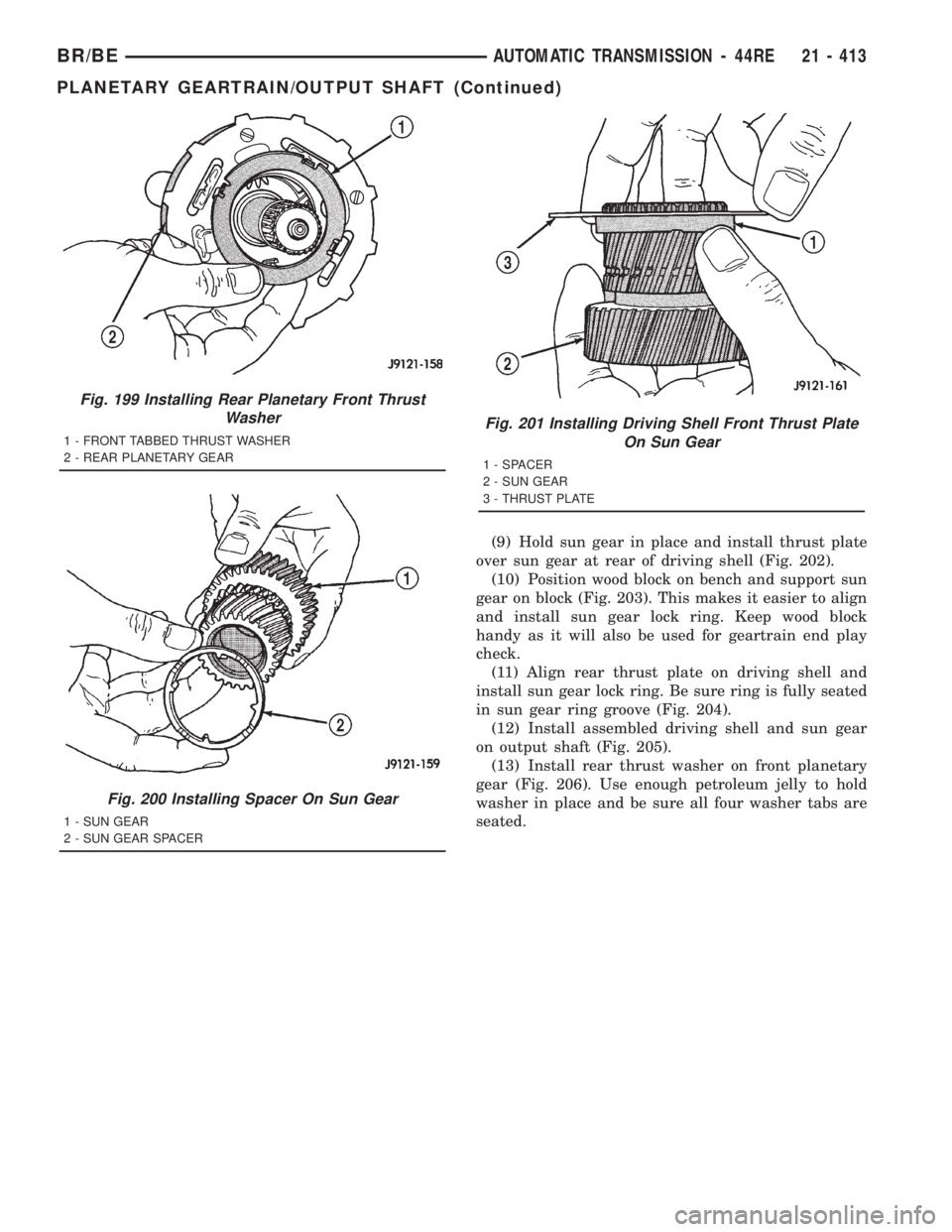
(9) Hold sun gear in place and install thrust plate
over sun gear at rear of driving shell (Fig. 202).
(10) Position wood block on bench and support sun
gear on block (Fig. 203). This makes it easier to align
and install sun gear lock ring. Keep wood block
handy as it will also be used for geartrain end play
check.
(11) Align rear thrust plate on driving shell and
install sun gear lock ring. Be sure ring is fully seated
in sun gear ring groove (Fig. 204).
(12) Install assembled driving shell and sun gear
on output shaft (Fig. 205).
(13) Install rear thrust washer on front planetary
gear (Fig. 206). Use enough petroleum jelly to hold
washer in place and be sure all four washer tabs are
seated.
Fig. 199 Installing Rear Planetary Front Thrust
Washer
1 - FRONT TABBED THRUST WASHER
2 - REAR PLANETARY GEAR
Fig. 200 Installing Spacer On Sun Gear
1 - SUN GEAR
2 - SUN GEAR SPACER
Fig. 201 Installing Driving Shell Front Thrust Plate
On Sun Gear
1 - SPACER
2 - SUN GEAR
3 - THRUST PLATE
BR/BEAUTOMATIC TRANSMISSION - 44RE 21 - 413
PLANETARY GEARTRAIN/OUTPUT SHAFT (Continued)
Page 2050 of 2889
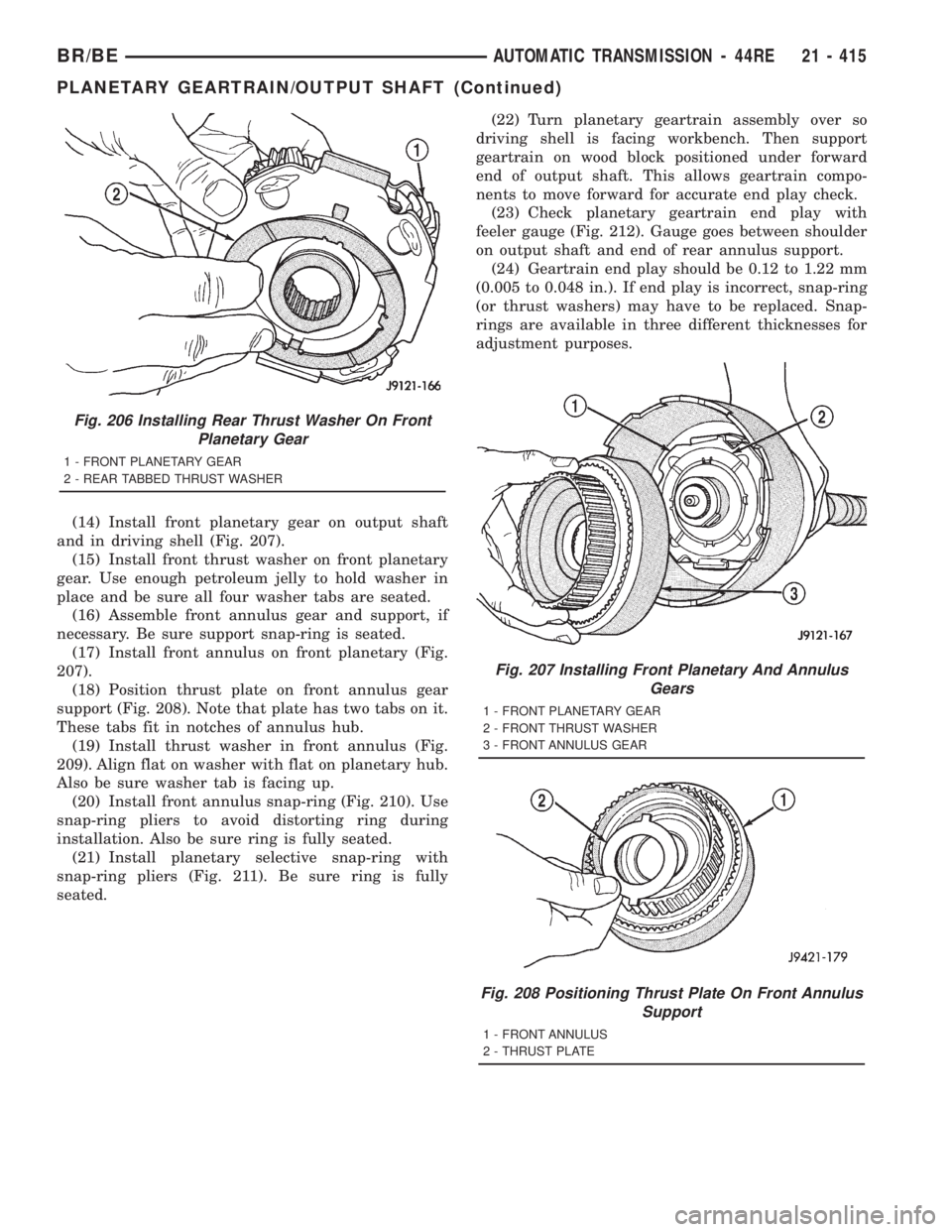
(14) Install front planetary gear on output shaft
and in driving shell (Fig. 207).
(15) Install front thrust washer on front planetary
gear. Use enough petroleum jelly to hold washer in
place and be sure all four washer tabs are seated.
(16) Assemble front annulus gear and support, if
necessary. Be sure support snap-ring is seated.
(17) Install front annulus on front planetary (Fig.
207).
(18) Position thrust plate on front annulus gear
support (Fig. 208). Note that plate has two tabs on it.
These tabs fit in notches of annulus hub.
(19) Install thrust washer in front annulus (Fig.
209). Align flat on washer with flat on planetary hub.
Also be sure washer tab is facing up.
(20) Install front annulus snap-ring (Fig. 210). Use
snap-ring pliers to avoid distorting ring during
installation. Also be sure ring is fully seated.
(21) Install planetary selective snap-ring with
snap-ring pliers (Fig. 211). Be sure ring is fully
seated.(22) Turn planetary geartrain assembly over so
driving shell is facing workbench. Then support
geartrain on wood block positioned under forward
end of output shaft. This allows geartrain compo-
nents to move forward for accurate end play check.
(23) Check planetary geartrain end play with
feeler gauge (Fig. 212). Gauge goes between shoulder
on output shaft and end of rear annulus support.
(24) Geartrain end play should be 0.12 to 1.22 mm
(0.005 to 0.048 in.). If end play is incorrect, snap-ring
(or thrust washers) may have to be replaced. Snap-
rings are available in three different thicknesses for
adjustment purposes.
Fig. 206 Installing Rear Thrust Washer On Front
Planetary Gear
1 - FRONT PLANETARY GEAR
2 - REAR TABBED THRUST WASHER
Fig. 207 Installing Front Planetary And Annulus
Gears
1 - FRONT PLANETARY GEAR
2 - FRONT THRUST WASHER
3 - FRONT ANNULUS GEAR
Fig. 208 Positioning Thrust Plate On Front Annulus
Support
1 - FRONT ANNULUS
2 - THRUST PLATE
BR/BEAUTOMATIC TRANSMISSION - 44RE 21 - 415
PLANETARY GEARTRAIN/OUTPUT SHAFT (Continued)
Page 2092 of 2889
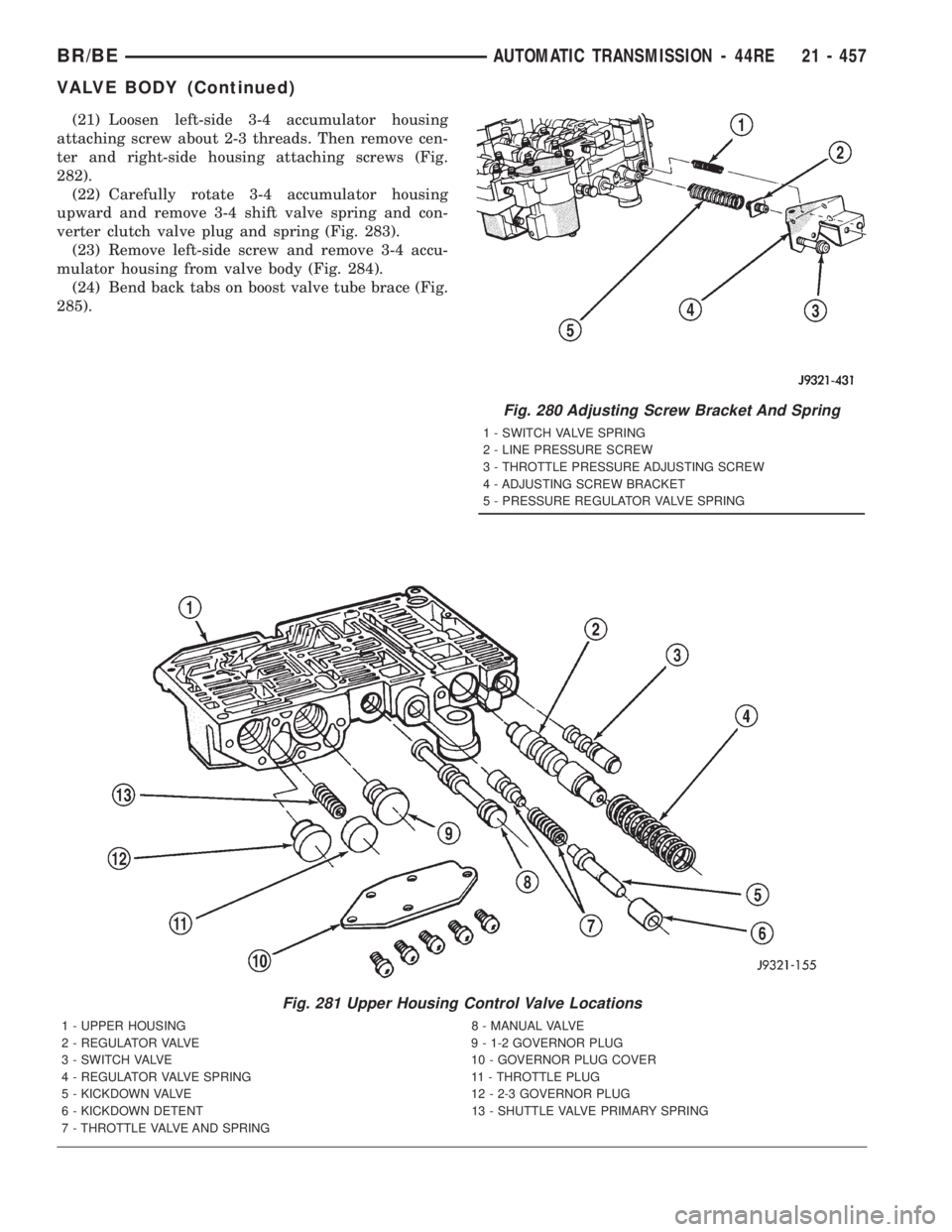
(21) Loosen left-side 3-4 accumulator housing
attaching screw about 2-3 threads. Then remove cen-
ter and right-side housing attaching screws (Fig.
282).
(22) Carefully rotate 3-4 accumulator housing
upward and remove 3-4 shift valve spring and con-
verter clutch valve plug and spring (Fig. 283).
(23) Remove left-side screw and remove 3-4 accu-
mulator housing from valve body (Fig. 284).
(24) Bend back tabs on boost valve tube brace (Fig.
285).
Fig. 281 Upper Housing Control Valve Locations
1 - UPPER HOUSING 8 - MANUAL VALVE
2 - REGULATOR VALVE 9 - 1-2 GOVERNOR PLUG
3 - SWITCH VALVE 10 - GOVERNOR PLUG COVER
4 - REGULATOR VALVE SPRING 11 - THROTTLE PLUG
5 - KICKDOWN VALVE 12 - 2-3 GOVERNOR PLUG
6 - KICKDOWN DETENT 13 - SHUTTLE VALVE PRIMARY SPRING
7 - THROTTLE VALVE AND SPRING
Fig. 280 Adjusting Screw Bracket And Spring
1 - SWITCH VALVE SPRING
2 - LINE PRESSURE SCREW
3 - THROTTLE PRESSURE ADJUSTING SCREW
4 - ADJUSTING SCREW BRACKET
5 - PRESSURE REGULATOR VALVE SPRING
BR/BEAUTOMATIC TRANSMISSION - 44RE 21 - 457
VALVE BODY (Continued)
Page 2107 of 2889
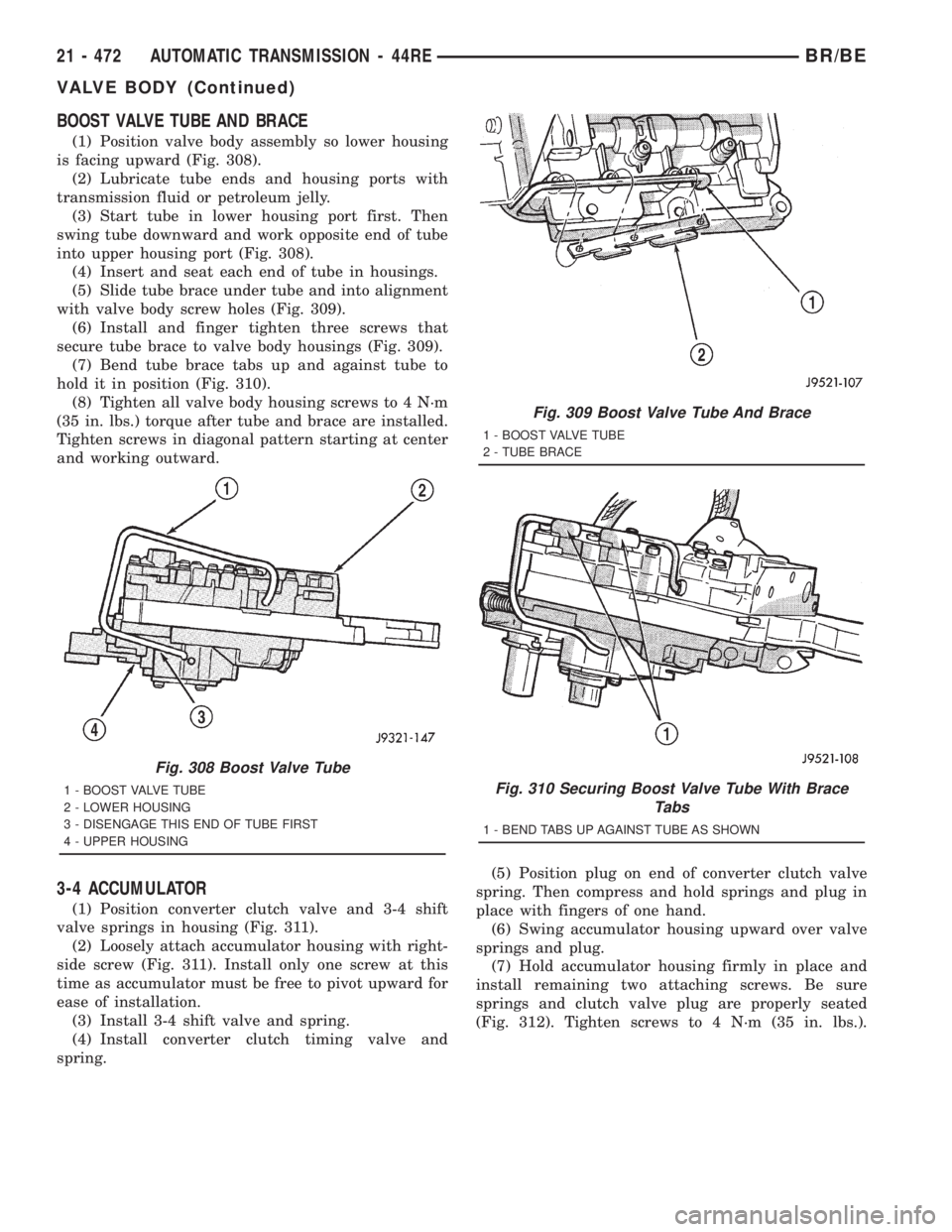
BOOST VALVE TUBE AND BRACE
(1) Position valve body assembly so lower housing
is facing upward (Fig. 308).
(2) Lubricate tube ends and housing ports with
transmission fluid or petroleum jelly.
(3) Start tube in lower housing port first. Then
swing tube downward and work opposite end of tube
into upper housing port (Fig. 308).
(4) Insert and seat each end of tube in housings.
(5) Slide tube brace under tube and into alignment
with valve body screw holes (Fig. 309).
(6) Install and finger tighten three screws that
secure tube brace to valve body housings (Fig. 309).
(7) Bend tube brace tabs up and against tube to
hold it in position (Fig. 310).
(8) Tighten all valve body housing screws to 4 N´m
(35 in. lbs.) torque after tube and brace are installed.
Tighten screws in diagonal pattern starting at center
and working outward.
3-4 ACCUMULATOR
(1) Position converter clutch valve and 3-4 shift
valve springs in housing (Fig. 311).
(2) Loosely attach accumulator housing with right-
side screw (Fig. 311). Install only one screw at this
time as accumulator must be free to pivot upward for
ease of installation.
(3) Install 3-4 shift valve and spring.
(4) Install converter clutch timing valve and
spring.(5) Position plug on end of converter clutch valve
spring. Then compress and hold springs and plug in
place with fingers of one hand.
(6) Swing accumulator housing upward over valve
springs and plug.
(7) Hold accumulator housing firmly in place and
install remaining two attaching screws. Be sure
springs and clutch valve plug are properly seated
(Fig. 312). Tighten screws to 4 N´m (35 in. lbs.).
Fig. 308 Boost Valve Tube
1 - BOOST VALVE TUBE
2 - LOWER HOUSING
3 - DISENGAGE THIS END OF TUBE FIRST
4 - UPPER HOUSING
Fig. 309 Boost Valve Tube And Brace
1 - BOOST VALVE TUBE
2 - TUBE BRACE
Fig. 310 Securing Boost Valve Tube With Brace
Tabs
1 - BEND TABS UP AGAINST TUBE AS SHOWN
21 - 472 AUTOMATIC TRANSMISSION - 44REBR/BE
VALVE BODY (Continued)