2001 DODGE RAM adding oil
[x] Cancel search: adding oilPage 2005 of 2889
FLUID AND FILTER
DIAGNOSIS AND TESTING - EFFECTS OF
INCORRECT FLUID LEVEL
A low fluid level allows the pump to take in air
along with the fluid. Air in the fluid will cause fluid
pressures to be low and develop slower than normal.
If the transmission is overfilled, the gears churn the
fluid into foam. This aerates the fluid and causing
the same conditions occurring with a low level. In
either case, air bubbles cause fluid overheating, oxi-
dation and varnish buildup which interferes with
valve and clutch operation. Foaming also causes fluid
expansion which can result in fluid overflow from the
transmission vent or fill tube. Fluid overflow can eas-
ily be mistaken for a leak if inspection is not careful.
DIAGNOSIS AND TESTING - CAUSES OF
BURNT FLUID
Burnt, discolored fluid is a result of overheating
which has two primary causes.
(1)
A result of restricted fluid flow through the main
and/or auxiliary cooler. This condition is usually the
result of a faulty or improperly installed drainback
valve, a damaged main cooler, or severe restrictions in
the coolers and lines caused by debris or kinked lines.
(2) Heavy duty operation with a vehicle not prop-
erly equipped for this type of operation. Trailer tow-
ing or similar high load operation will overheat the
transmission fluid if the vehicle is improperly
equipped. Such vehicles should have an auxiliary
transmission fluid cooler, a heavy duty cooling sys-
tem, and the engine/axle ratio combination needed to
handle heavy loads.
DIAGNOSIS AND TESTING - FLUID
CONTAMINATION
Transmission fluid contamination is generally a
result of:
²adding incorrect fluid
²failure to clean dipstick and fill tube when
checking level
²engine coolant entering the fluid
²internal failure that generates debris
²
overheat that generates sludge (fluid breakdown)
²failure to reverse flush cooler and lines after repair
²failure to replace contaminated converter after
repair
The use of non-recommended fluids can result in
transmission failure. The usual results are erratic
shifts, slippage, abnormal wear and eventual failure
due to fluid breakdown and sludge formation. Avoid
this condition by using recommended fluids only.
The dipstick cap and fill tube should be wiped
clean before checking fluid level. Dirt, grease andother foreign material on the cap and tube could fall
into the tube if not removed beforehand. Take the
time to wipe the cap and tube clean before withdraw-
ing the dipstick.
Engine coolant in the transmission fluid is gener-
ally caused by a cooler malfunction. The only remedy
is to replace the radiator as the cooler in the radiator
is not a serviceable part. If coolant has circulated
through the transmission, an overhaul is necessary.
The transmission cooler and lines should be
reverse flushed whenever a malfunction generates
sludge and/or debris. The torque converter should
also be replaced at the same time.
Failure to flush the cooler and lines will result in
recontamination. Flushing applies to auxiliary coolers
as well. The torque converter should also be replaced
whenever a failure generates sludge and debris. This is
necessary because normal converter flushing procedures
will not remove all contaminants.
STANDARD PROCEDURE - FLUID LEVEL
CHECK
Low fluid level can cause a variety of conditions
because it allows the pump to take in air along with
the fluid. As in any hydraulic system, air bubbles
make the fluid spongy, therefore, pressures will be
low and build up slowly.
Improper filling can also raise the fluid level too
high. When the transmssion has too much fluid, the
geartrain churns up foam and cause the same condi-
tions which occur with a low fluid level.
In either case, air bubbles can cause overheating
and/or fluid oxidation, and varnishing. This can
interfere with normal valve, clutch, and accumulator
operation. Foaming can also result in fluid escaping
from the transmission vent where it may be mis-
taken for a leak.
Along with fluid level, it is important to check the
condition of the fluid. When the fluid smells burned,
and is contaminated with metal or friction material
particles, a complete transmission recondition is
needed. Be sure to examine the fluid on the dipstick
closely. If there is any doubt about its condition,
drain out a sample for a double check.
After the fluid has been checked, seat the dipstick
fully to seal out water and dirt.
The transmission has a dipstick to check oil level.
It is located on the right side of the engine. Be sure
to wipe all dirt from dipstick handle before removing.
Fluid level is checked with the engine running at
curb idle speed, the transmission in NEUTRAL and the
transmission fluid at normal operating temperature.
The engine should be running at idle speed for at
least one minute, with the vehicle on level
ground.
The transmission fluid level can be checked two ways.
21 - 370 AUTOMATIC TRANSMISSION - 44REBR/BE
Page 2006 of 2889
PROCEDURE ONE
(1) Transmission fluid must be at normal operat-
ing temperature for accurate fluid level check. Drive
vehicle if necessary to bring fluid temperature up to
normal hot operating temperature of 82ÉC (180ÉF).
(2) Position vehicle on level surface.
(3) Start and run engine at curb idle speed.
(4) Apply parking brakes.
(5) Shift transmission momentarily into all gear
ranges. Then shift transmission back to NEUTRAL.
(6) Clean top of filler tube and dipstick to keep
dirt from entering tube.
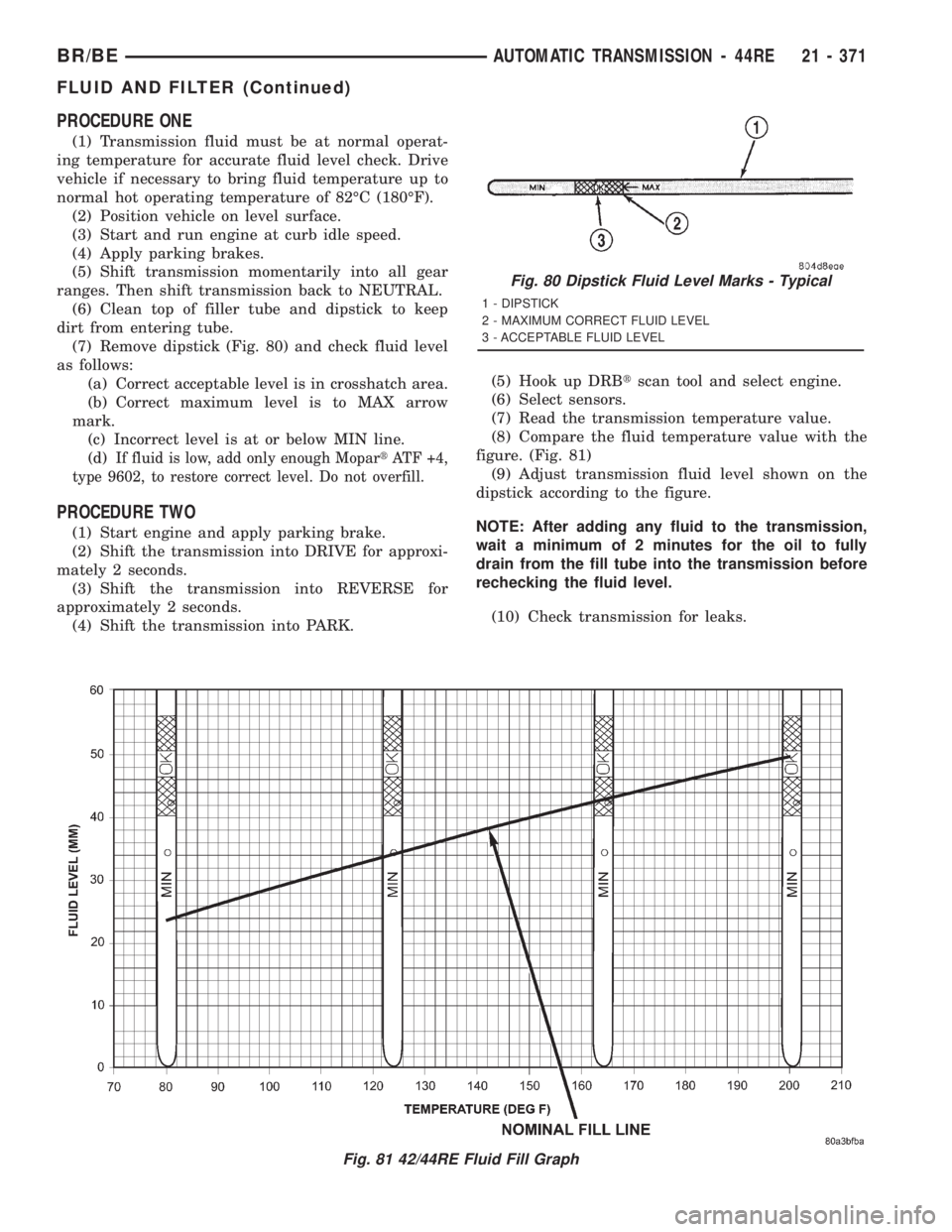
(7) Remove dipstick (Fig. 80) and check fluid level
as follows:
(a) Correct acceptable level is in crosshatch area.
(b) Correct maximum level is to MAX arrow
mark.
(c) Incorrect level is at or below MIN line.
(d)
If fluid is low, add only enough MopartATF +4,
type 9602, to restore correct level. Do not overfill.
PROCEDURE TWO
(1) Start engine and apply parking brake.
(2) Shift the transmission into DRIVE for approxi-
mately 2 seconds.
(3) Shift the transmission into REVERSE for
approximately 2 seconds.
(4) Shift the transmission into PARK.(5) Hook up DRBtscan tool and select engine.
(6) Select sensors.
(7) Read the transmission temperature value.
(8) Compare the fluid temperature value with the
figure. (Fig. 81)
(9) Adjust transmission fluid level shown on the
dipstick according to the figure.
NOTE: After adding any fluid to the transmission,
wait a minimum of 2 minutes for the oil to fully
drain from the fill tube into the transmission before
rechecking the fluid level.
(10) Check transmission for leaks.
Fig. 80 Dipstick Fluid Level Marks - Typical
1 - DIPSTICK
2 - MAXIMUM CORRECT FLUID LEVEL
3 - ACCEPTABLE FLUID LEVEL
Fig. 81 42/44RE Fluid Fill Graph
BR/BEAUTOMATIC TRANSMISSION - 44RE 21 - 371
FLUID AND FILTER (Continued)
Page 2180 of 2889
FLUID AND FILTER
DIAGNOSIS AND TESTING - EFFECTS OF
INCORRECT FLUID LEVEL
A low fluid level allows the pump to take in air
along with the fluid. Air in the fluid will cause fluid
pressures to be low and develop slower than normal.
If the transmission is overfilled, the gears churn the
fluid into foam. This aerates the fluid and causing
the same conditions occurring with a low level. In
either case, air bubbles cause fluid overheating, oxi-
dation and varnish buildup which interferes with
valve and clutch operation. Foaming also causes fluid
expansion which can result in fluid overflow from the
transmission vent or fill tube. Fluid overflow can eas-
ily be mistaken for a leak if inspection is not careful.
DIAGNOSIS AND TESTING - CAUSES OF
BURNT FLUID
Burnt, discolored fluid is a result of overheating
which has two primary causes.
(1)
A result of restricted fluid flow through the main
and/or auxiliary cooler. This condition is usually the
result of a faulty or improperly installed drainback
valve, a damaged main cooler, or severe restrictions in
the coolers and lines caused by debris or kinked lines.
(2) Heavy duty operation with a vehicle not prop-
erly equipped for this type of operation. Trailer tow-
ing or similar high load operation will overheat the
transmission fluid if the vehicle is improperly
equipped. Such vehicles should have an auxiliary
transmission fluid cooler, a heavy duty cooling sys-
tem, and the engine/axle ratio combination needed to
handle heavy loads.
DIAGNOSIS AND TESTING - FLUID
CONTAMINATION
Transmission fluid contamination is generally a
result of:
²adding incorrect fluid
²failure to clean dipstick and fill tube when
checking level
²engine coolant entering the fluid
²internal failure that generates debris
²
overheat that generates sludge (fluid breakdown)
²failure to reverse flush cooler and lines after repair
²failure to replace contaminated converter after
repair
The use of non-recommended fluids can result in
transmission failure. The usual results are erratic
shifts, slippage, abnormal wear and eventual failure
due to fluid breakdown and sludge formation. Avoid
this condition by using recommended fluids only.
The dipstick cap and fill tube should be wiped
clean before checking fluid level. Dirt, grease andother foreign material on the cap and tube could fall
into the tube if not removed beforehand. Take the
time to wipe the cap and tube clean before withdraw-
ing the dipstick.
Engine coolant in the transmission fluid is gener-
ally caused by a cooler malfunction. The only remedy
is to replace the radiator as the cooler in the radiator
is not a serviceable part. If coolant has circulated
through the transmission, an overhaul is necessary.
The transmission cooler and lines should be
reverse flushed whenever a malfunction generates
sludge and/or debris. The torque converter should
also be replaced at the same time.
Failure to flush the cooler and lines will result in
recontamination. Flushing applies to auxiliary coolers
as well. The torque converter should also be replaced
whenever a failure generates sludge and debris. This is
necessary because normal converter flushing procedures
will not remove all contaminants.
STANDARD PROCEDURE - FLUID LEVEL
CHECK
Low fluid level can cause a variety of conditions
because it allows the pump to take in air along with
the fluid. As in any hydraulic system, air bubbles
make the fluid spongy, therefore, pressures will be
low and build up slowly.
Improper filling can also raise the fluid level too
high. When the transmssion has too much fluid, the
geartrain churns up foam and cause the same condi-
tions which occur with a low fluid level.
In either case, air bubbles can cause overheating
and/or fluid oxidation, and varnishing. This can
interfere with normal valve, clutch, and accumulator
operation. Foaming can also result in fluid escaping
from the transmission vent where it may be mis-
taken for a leak.
Along with fluid level, it is important to check the
condition of the fluid. When the fluid smells burned,
and is contaminated with metal or friction material
particles, a complete transmission recondition is
needed. Be sure to examine the fluid on the dipstick
closely. If there is any doubt about its condition,
drain out a sample for a double check.
After the fluid has been checked, seat the dipstick
fully to seal out water and dirt.
The transmission has a dipstick to check oil level.
It is located on the right side of the engine. Be sure
to wipe all dirt from dipstick handle before removing.
Fluid level is checked with the engine running at
curb idle speed, the transmission in NEUTRAL and
the transmission fluid at normal operating tempera-
ture.The engine should be running at idle
speed for at least one minute, with the vehicle
on level ground.
The transmission fluid level can be checked two ways.
BR/BEAUTOMATIC TRANSMISSION - 46RE 21 - 545
Page 2181 of 2889
PROCEDURE ONE
(1) Transmission fluid must be at normal operat-
ing temperature for accurate fluid level check. Drive
vehicle if necessary to bring fluid temperature up to
normal hot operating temperature of 82ÉC (180ÉF).
(2) Position vehicle on level surface.
(3) Start and run engine at curb idle speed.
(4) Apply parking brakes.
(5) Shift transmission momentarily into all gear
ranges. Then shift transmission back to NEUTRAL.
(6) Clean top of filler tube and dipstick to keep
dirt from entering tube.
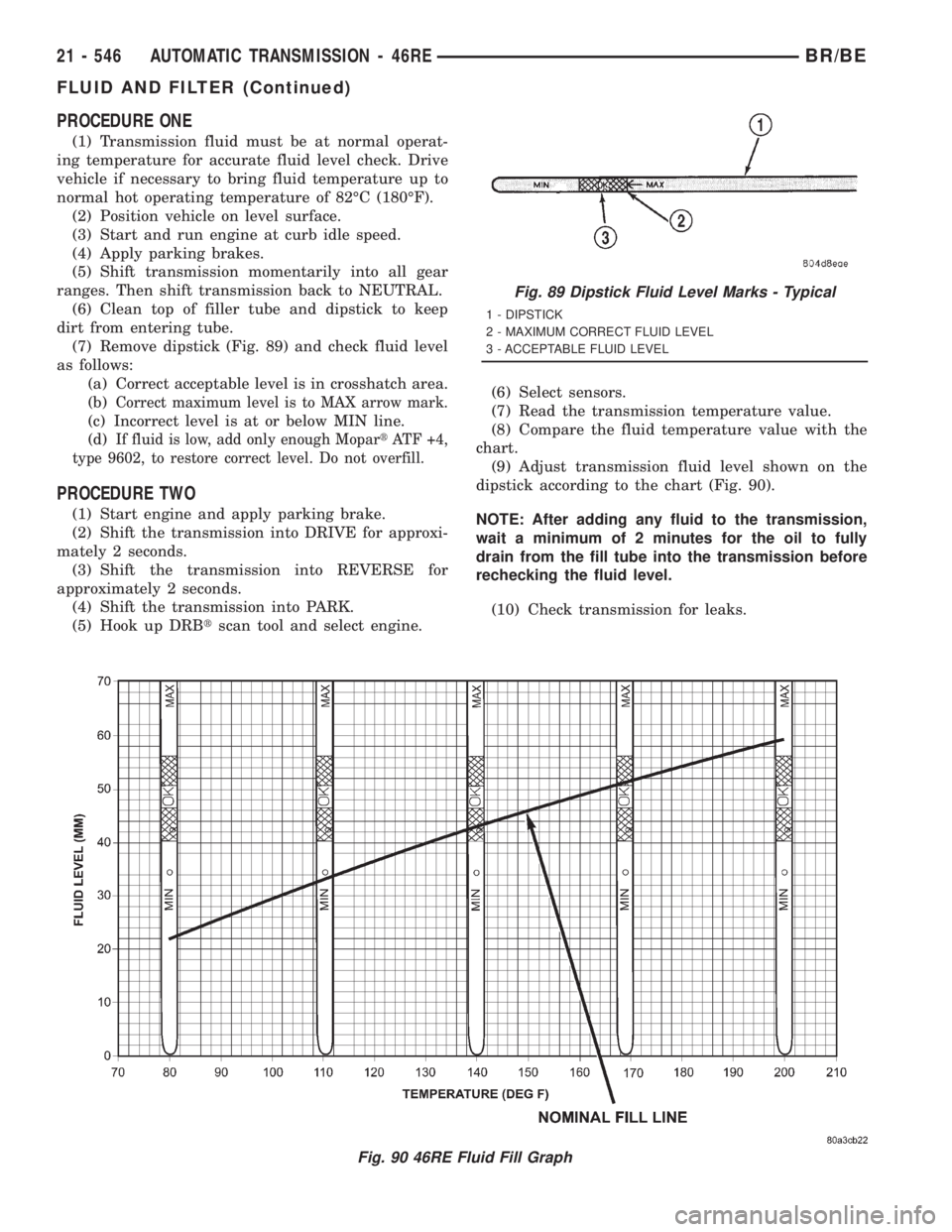
(7) Remove dipstick (Fig. 89) and check fluid level
as follows:
(a) Correct acceptable level is in crosshatch area.
(b)
Correct maximum level is to MAX arrow mark.
(c) Incorrect level is at or below MIN line.
(d)
If fluid is low, add only enough MopartATF +4,
type 9602, to restore correct level. Do not overfill.
PROCEDURE TWO
(1) Start engine and apply parking brake.
(2) Shift the transmission into DRIVE for approxi-
mately 2 seconds.
(3) Shift the transmission into REVERSE for
approximately 2 seconds.
(4) Shift the transmission into PARK.
(5) Hook up DRBtscan tool and select engine.(6) Select sensors.
(7) Read the transmission temperature value.
(8) Compare the fluid temperature value with the
chart.
(9) Adjust transmission fluid level shown on the
dipstick according to the chart (Fig. 90).
NOTE: After adding any fluid to the transmission,
wait a minimum of 2 minutes for the oil to fully
drain from the fill tube into the transmission before
rechecking the fluid level.
(10) Check transmission for leaks.
Fig. 89 Dipstick Fluid Level Marks - Typical
1 - DIPSTICK
2 - MAXIMUM CORRECT FLUID LEVEL
3 - ACCEPTABLE FLUID LEVEL
Fig. 90 46RE Fluid Fill Graph
21 - 546 AUTOMATIC TRANSMISSION - 46REBR/BE
FLUID AND FILTER (Continued)
Page 2351 of 2889
Improper filling can also raise the fluid level too
high. When the transmssion has too much fluid, the
geartrain churns up foam and cause the same condi-
tions which occur with a low fluid level.
In either case, air bubbles can cause overheating
and/or fluid oxidation, and varnishing. This can
interfere with normal valve, clutch, and accumulator
operation. Foaming can also result in fluid escaping
from the transmission vent where it may be mis-
taken for a leak.
Along with fluid level, it is important to check the
condition of the fluid. When the fluid smells burned,
and is contaminated with metal or friction material
particles, a complete transmission recondition is
needed. Be sure to examine the fluid on the dipstick
closely. If there is any doubt about its condition,
drain out a sample for a double check.
After the fluid has been checked, seat the dipstick
fully to seal out water and dirt.
The transmission has a dipstick to check oil level.
It is located on the right side of the engine. Be sure
to wipe all dirt from dipstick handle before removing.
Fluid level is checked with the engine running at
curb idle speed, the transmission in NEUTRAL and
the transmission fluid at normal operating tempera-
ture.The engine should be running at idle
speed for at least one minute, with the vehicle
on level ground.
The transmission fluid level can be checked two
ways.
PROCEDURE ONE
(1) Transmission fluid must be at normal operat-
ing temperature for accurate fluid level check. Drive
vehicle if necessary to bring fluid temperature up to
normal hot operating temperature of 82ÉC (180ÉF).
(2) Position vehicle on level surface.
(3) Start and run engine at curb idle speed.
(4) Apply parking brakes.
(5) Shift transmission momentarily into all gear
ranges. Then shift transmission back to NEUTRAL.
(6) Clean top of filler tube and dipstick to keep
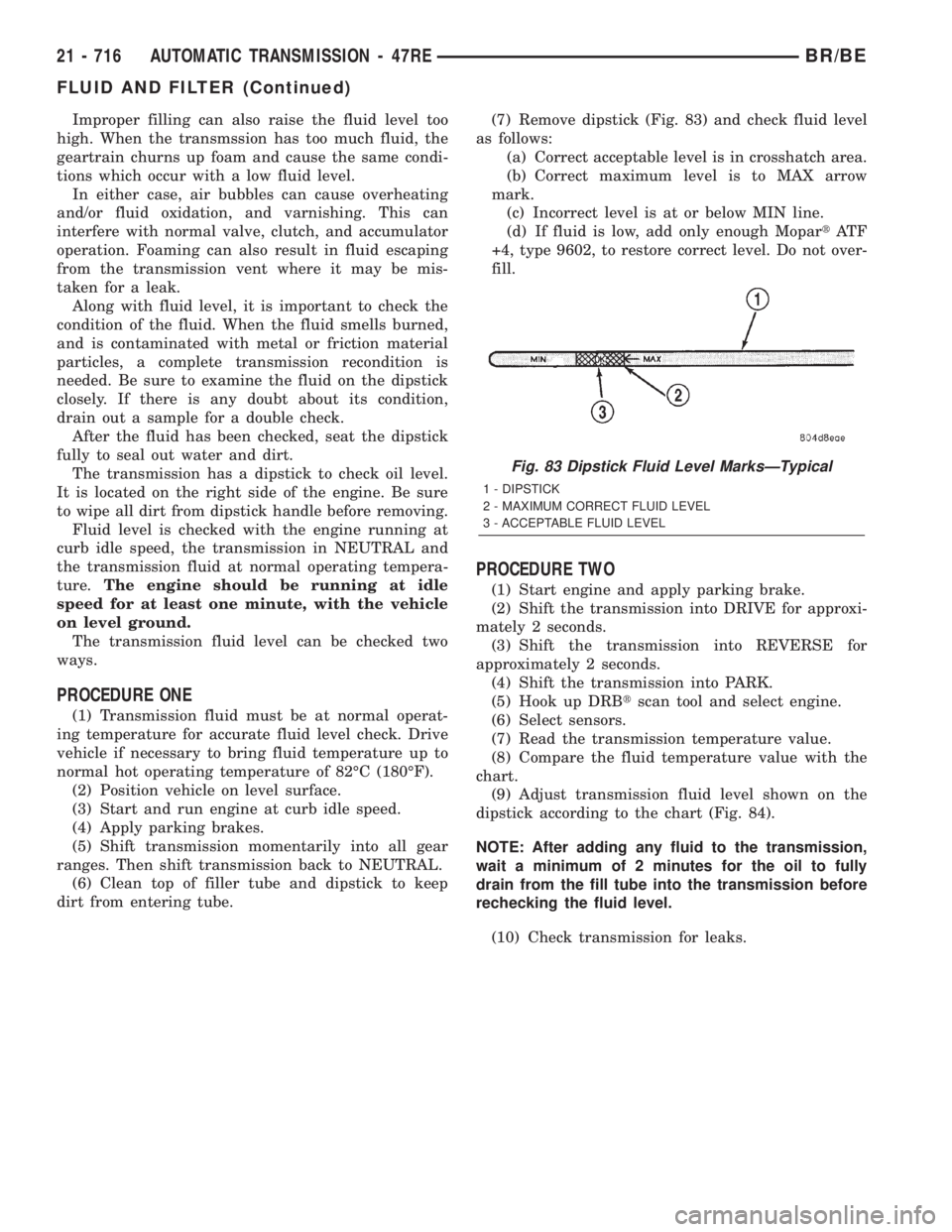
dirt from entering tube.(7) Remove dipstick (Fig. 83) and check fluid level
as follows:
(a) Correct acceptable level is in crosshatch area.
(b) Correct maximum level is to MAX arrow
mark.
(c) Incorrect level is at or below MIN line.
(d) If fluid is low, add only enough MopartAT F
+4, type 9602, to restore correct level. Do not over-
fill.
PROCEDURE TWO
(1) Start engine and apply parking brake.
(2) Shift the transmission into DRIVE for approxi-
mately 2 seconds.
(3) Shift the transmission into REVERSE for
approximately 2 seconds.
(4) Shift the transmission into PARK.
(5) Hook up DRBtscan tool and select engine.
(6) Select sensors.
(7) Read the transmission temperature value.
(8) Compare the fluid temperature value with the
chart.
(9) Adjust transmission fluid level shown on the
dipstick according to the chart (Fig. 84).
NOTE: After adding any fluid to the transmission,
wait a minimum of 2 minutes for the oil to fully
drain from the fill tube into the transmission before
rechecking the fluid level.
(10) Check transmission for leaks.
Fig. 83 Dipstick Fluid Level MarksÐTypical
1 - DIPSTICK
2 - MAXIMUM CORRECT FLUID LEVEL
3 - ACCEPTABLE FLUID LEVEL
21 - 716 AUTOMATIC TRANSMISSION - 47REBR/BE
FLUID AND FILTER (Continued)
Page 2831 of 2889
Check windshield washer solvent reservoir and fill
as necessary (Fig. 6).
NOTE: When using concentrated solvent such as
MoparTAll-Weather Windshield Washer Solution,
dilute per container directions.
COOLING SYSTEM RESERVOIR
WARNING: DO NOT REMOVE RADIATOR CAP
WHILE COOLING SYSTEM IS UNDER PRESSURE.
NOTE: Add coolant only to plastic reserve tank if it is
required. Engine must be at normal operating temper-
ature before adding coolant to reserve tank. In cold
climates, coolant in reserve tank may appear low; do
not add coolant until normal temperature is reached.
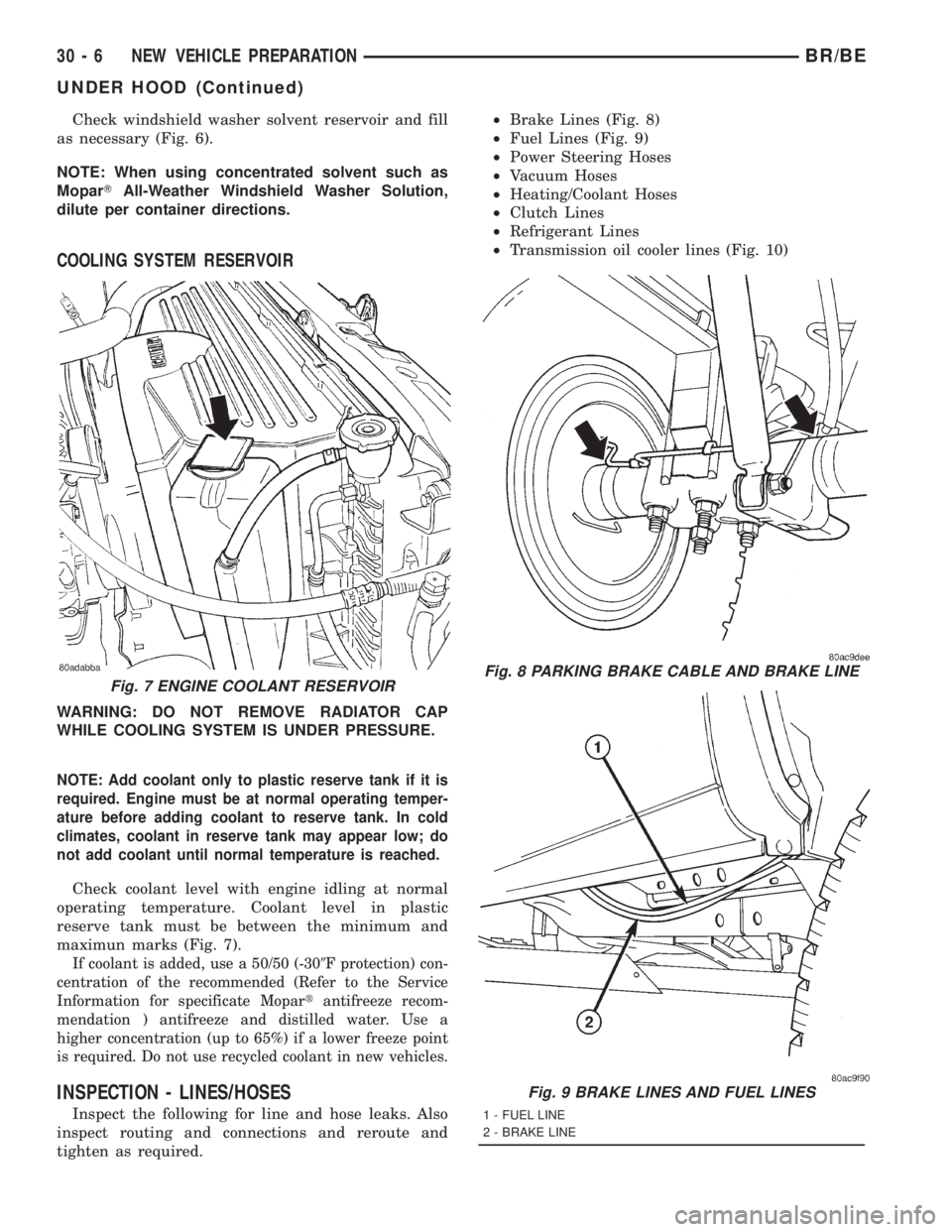
Check coolant level with engine idling at normal
operating temperature. Coolant level in plastic
reserve tank must be between the minimum and
maximun marks (Fig. 7).
If coolant is added, use a 50/50 (-309F protection) con-
centration of the recommended (Refer to the Service
Information for specificate Mopartantifreeze recom-
mendation ) antifreeze and distilled water. Use a
higher concentration (up to 65%) if a lower freeze point
is required. Do not use recycled coolant in new vehicles.
INSPECTION - LINES/HOSES
Inspect the following for line and hose leaks. Also
inspect routing and connections and reroute and
tighten as required.²Brake Lines (Fig. 8)
²Fuel Lines (Fig. 9)
²Power Steering Hoses
²Vacuum Hoses
²Heating/Coolant Hoses
²Clutch Lines
²Refrigerant Lines
²Transmission oil cooler lines (Fig. 10)
Fig. 7 ENGINE COOLANT RESERVOIRFig. 8 PARKING BRAKE CABLE AND BRAKE LINE
Fig. 9 BRAKE LINES AND FUEL LINES
1 - FUEL LINE
2 - BRAKE LINE
30 - 6 NEW VEHICLE PREPARATIONBR/BE
UNDER HOOD (Continued)
Page 2848 of 2889
ABS INDICATOR - DESCRIPTION.........8J-14
ABS INDICATOR - OPERATION..........8J-14
A/C APPLICATION TABLE,
SPECIFICATIONS......................24-8
A/C COMPRESSOR - DESCRIPTION......24-46
A/C COMPRESSOR - DIAGNOSIS AND
TESTING...........................24-46
A/C COMPRESSOR - INSTALLATION......24-47
A/C COMPRESSOR - OPERATION........24-46
A/C COMPRESSOR - REMOVAL.........24-47
A/C COMPRESSOR CLUTCH -
DESCRIPTION.......................24-13
A/C COMPRESSOR CLUTCH -
INSPECTION........................24-16
A/C COMPRESSOR CLUTCH -
INSTALLATION.......................24-16
A/C COMPRESSOR CLUTCH -
OPERATION.........................24-13
A/C COMPRESSOR CLUTCH - REMOVAL . . 24-14
A/C COMPRESSOR CLUTCH BREAK-IN -
STANDARD PROCEDURE...............24-13
A/C COMPRESSOR CLUTCH COIL -
DIAGNOSIS AND TESTING.............24-13
A/C COMPRESSOR CLUTCH RELAY -
DESCRIPTION.......................24-17
A/C COMPRESSOR CLUTCH RELAY -
DIAGNOSIS AND TESTING.............24-17
A/C COMPRESSOR CLUTCH RELAY -
INSTALLATION.......................24-18
A/C COMPRESSOR CLUTCH RELAY -
OPERATION.........................24-17
A/C COMPRESSOR CLUTCH RELAY -
REMOVAL..........................24-18
A/C CONDENSER - DESCRIPTION........24-48
A/C CONDENSER - INSTALLATION.......24-49
A/C CONDENSER - OPERATION..........24-48
A/C CONDENSER - REMOVAL...........24-49
A/C EVAPORATOR - DESCRIPTION.......24-52
A/C EVAPORATOR - INSTALLATION......24-53
A/C EVAPORATOR - OPERATION.........24-53
A/C EVAPORATOR - REMOVAL..........24-53
A/C HEATER CONTROL - DESCRIPTION . . . 24-18
A/C HEATER CONTROL - DIAGNOSIS
AND TESTING.......................24-19
A/C HEATER CONTROL - INSTALLATION . . . 24-20
A/C HEATER CONTROL - OPERATION.....24-18
A/C HEATER CONTROL - REMOVAL......24-19
A/C HIGH PRESSURE SWITCH -
DESCRIPTION.......................24-20
A/C HIGH PRESSURE SWITCH -
DIAGNOSIS AND TESTING.............24-20
A/C HIGH PRESSURE SWITCH -
INSTALLATION.......................24-21
A/C HIGH PRESSURE SWITCH -
OPERATION.........................24-20
A/C HIGH PRESSURE SWITCH -
REMOVAL..........................24-21
A/C LINE COUPLERS - DESCRIPTION.....24-40
A/C LINE COUPLERS - OPERATION......24-41
A/C LINE COUPLERS - STANDARD
PROCEDURE........................24-43
A/C LOW PRESSURE SWITCH -
DESCRIPTION.......................24-21
A/C LOW PRESSURE SWITCH -
DIAGNOSIS AND TESTING.............24-21
A/C LOW PRESSURE SWITCH -
INSTALLATION.......................24-22
A/C LOW PRESSURE SWITCH -
OPERATION.........................24-21
A/C LOW PRESSURE SWITCH -
REMOVAL..........................24-21
A/C ORIFICE TUBE - DESCRIPTION.......24-53
A/C ORIFICE TUBE - OPERATION........24-53
A/C ORIFICE TUBE - REMOVAL..........24-54
A/C PERFORMANCE - DIAGNOSIS AND
TESTING............................24-2
ACCELERATOR PEDAL - INSTALLATION . . . 14-37
ACCELERATOR PEDAL - REMOVAL.......14-37
ACCELERATOR PEDAL POSITION
SENSOR - DESCRIPTION
...............14-91
ACCELERATOR PEDAL POSITION
SENSOR - INSTALLATION
..............14-93
ACCELERATOR PEDAL POSITION
SENSOR - OPERATION
................14-91
ACCELERATOR PEDAL POSITION
SENSOR - REMOVAL
..................14-91
ACCESSORY DRIVE BELT - DIAGNOSIS
AND TESTING
................7-24,7-27,7-31ACCUMULATOR - DESCRIPTION.........24-54
ACCUMULATOR - DESCRIPTION . 21-191,21-362,
21-537,21-707
ACCUMULATOR - INSPECTION . . 21-192,21-363,
21-538,21-708
ACCUMULATOR - INSTALLATION........24-55
ACCUMULATOR - OPERATION..........24-54
ACCUMULATOR - OPERATION . . . 21-191,21-362,
21-537,21-708
ACCUMULATOR - REMOVAL............24-54
ACTUATION TEST MODE - DESCRIPTION,
CIRCUIT.............................25-1
ACTUATOR - INSTALLATION, BLEND
DOOR.............................24-26
ACTUATOR - INSTALLATION, HEAT/
DEFROST DOOR.....................24-27
ACTUATOR - INSTALLATION, INSIDE
HANDLE.......................23-71,23-80
ACTUATOR - INSTALLATION, PANEL/
DEFROST DOOR.....................24-27
ACTUATOR - INSTALLATION,
RECIRCULATION DOOR................24-28
ACTUATOR - REMOVAL, BLEND DOOR....24-25
ACTUATOR - REMOVAL, HEAT/DEFROST
DOOR.............................24-26
ACTUATOR - REMOVAL, INSIDE HANDLE . 23-71,
23-80
ACTUATOR - REMOVAL, PANEL/DEFROST
DOOR.............................24-27
ACTUATOR - REMOVAL, RECIRCULATION
DOOR.............................24-27
ADAPTER - INSTALLATION, DEFROSTER
AND DEMISTER DUCT.................24-35
ADAPTER - REMOVAL, DEFROSTER AND
DEMISTER DUCT.....................24-35
ADAPTER BRACKET - INSTALLATION,
CAB CHASSIS........................13-9
ADAPTER BRACKET - REMOVAL, CAB
CHASSIS............................13-9
ADAPTER HOUSING SEAL -
INSTALLATION.................21-132,21-87
ADAPTER HOUSING SEAL - REMOVAL . . 21-132,
21-87
ADDING ADDITIONAL COOLANT -
STANDARD PROCEDURE................7-16
ADDITIONAL COOLANT - STANDARD
PROCEDURE, ADDING..................7-16
ADHESIVE LOCATIONS, SPECIFICATIONS
- STRUCTURAL......................23-44
ADJUSTER - DIAGNOSIS & TESTING,
POWER LUMBAR....................8N-18
ADJUSTER - INSTALLATION, SEAT BELT
TURNING LOOP.....................8O-29
ADJUSTER - INSTALLATION, SEAT
TRACK............................23-143
ADJUSTER - REMOVAL, SEAT BELT
TURNING LOOP.....................8O-29
ADJUSTER - REMOVAL, SEAT TRACK....23-143
ADJUSTER ASSEMBLY - INSTALLATION,
ROCKER ARM........................9-85
ADJUSTER ASSEMBLY - REMOVAL,
ROCKER ARM........................9-85
ADJUSTER ASSY - CLEANING, ROCKER
ARM ..............................9-262
ADJUSTER ASSY - DESCRIPTION,
ROCKER ARM.......................9-261
ADJUSTER ASSY - INSPECTION,
ROCKER ARM.......................9-262
ADJUSTER ASSY - INSTALLATION,
ROCKER ARM.............9-142,9-200,9-263
ADJUSTER ASSY - REMOVAL, ROCKER
ARM ....................9-142,9-200,9-261
ADJUSTER KNOB - INSTALLATION,
TURNING LOOP HEIGHT...............8O-30
ADJUSTER KNOB - REMOVAL, TURNING
LOOP HEIGHT.......................8O-30
ADJUSTMENT - STANDARD
PROCEDURE, COMPASS VARIATION......8M-4
ADJUSTMENT AND VERIFICATION -
STANDARD PROCEDURE, VALVE LASH....9-256
ADJUSTMENT, BANDS . . . 21-193,21-364,21-539,
21-709
ADJUSTMENT, CABLE TENSIONER
........5-40
ADJUSTMENT, CARGO DOOR
...........23-78
ADJUSTMENT, CENTER BEARING -
CENTER BEARING
.....................3-10
ADJUSTMENT, FRONT DOOR FORE/AFT
. . . 23-68
ADJUSTMENT, FRONT DOOR IN/OUT
.....23-69ADJUSTMENT, FRONT DOOR LATCH......23-72
ADJUSTMENT, FRONT DOOR UP/DOWN . . . 23-69
ADJUSTMENT, FRONT FASCIA...........13-2
ADJUSTMENT, HOOD................23-100
ADJUSTMENT, LATCH................23-100
ADJUSTMENT, LATCH STRIKER........23-102
ADJUSTMENT, REAR BRAKE DRUM.......5-34
ADJUSTMENT, SHIFT LEVER....21-853,21-888,
21-925
ADJUSTMENT, SHIFT MECHANISM.....21-252,
21-423,21-596,21-769
ADJUSTMENTS, FOG LAMP UNIT........8L-12
ADJUSTMENTS, FRONT AXLE - 216FBI....3-17
ADJUSTMENTS, FRONT AXLE - 248FBI....3-50
ADJUSTMENTS, GEAR.................19-16
ADJUSTMENTS, HEADLAMP UNIT.......8L-21
ADJUSTMENTS, REAR AXLE - 248RBI....3-114
ADJUSTMENTS, REAR AXLE - 267RBI....3-145
ADJUSTMENTS, REAR AXLE - 286RBI....3-174
ADJUSTMENTS, REAR AXLE - 9 1/4 .......3-84
ADJUSTMENTS, TRANSMISSION
THROTTLE VALVE CABLE . 21-254,21-425,21-598,
21-771
ADJUSTMENTS, VALVE BODY . . . 21-304,21-476,
21-646,21-818
AFTER AN AIRBAG DEPLOYMENT -
STANDARD PROCEDURE, SERVICE.......8O-4
AIR BLEED - STANDARD PROCEDURE....14-57
AIR CHECKING TRANSMISSION CLUTCH
AND BAND OPERATION - DIAGNOSIS
AND TESTING................21-147,21-318
AIR CLEANER ELEMENT - INSTALLATION . . 9-245
AIR CLEANER ELEMENT - REMOVAL.....9-244
AIR CONDITIONER - DESCRIPTION,
HEATER .............................24-1
AIR CONDITIONER - OPERATION,
HEATER .............................24-1
AIR CONDITIONING - INSTALLATION,
WATER PUMP BYPASS HOSE WITH.......7-77
AIR CONDITIONING - INSTALLATION,
WATER PUMP BYPASS HOSE
WITHOUT............................7-78
AIR CONDITIONING - REMOVAL, WATER
PUMP BYPASS HOSE WITH.............7-74
AIR CONDITIONING - REMOVAL, WATER
PUMP BYPASS HOSE WITHOUT..........7-77
AIR CONTROL MOTOR - DESCRIPTION,
IDLE...............................14-41
AIR CONTROL MOTOR - OPERATION,
IDLE...............................14-41
AIR COOLER AND PLUMBING -
CLEANING, CHARGE..................11-18
AIR COOLER AND PLUMBING -
DESCRIPTION, CHARGE...............11-17
AIR COOLER AND PLUMBING -
INSPECTION, CHARGE.................11-18
AIR COOLER AND PLUMBING -
INSTALLATION, CHARGE...............11-18
AIR COOLER AND PLUMBING -
OPERATION, CHARGE.................11-17
AIR COOLER AND PLUMBING -
REMOVAL, CHARGE..................11-17
AIR DAM - INSTALLATION, FRONT........13-2
AIR DAM - REMOVAL, FRONT...........13-1
AIR EXHAUSTER - INSTALLATION.......23-77
AIR EXHAUSTER - REMOVAL...........23-77
AIR HEATER - DESCRIPTION, INTAKE....14-100
AIR HEATER - INSTALLATION, INTAKE . . . 14-101
AIR HEATER - OPERATION, INTAKE.....14-100
AIR HEATER - REMOVAL, INTAKE.......14-100
AIR HEATER RELAY - DESCRIPTION,
INTAKE............................14-101
AIR HEATER RELAY - INSTALLATION,
INTAKE............................14-102
AIR HEATER RELAY - OPERATION,
INTAKE............................14-102
AIR HEATER RELAY - REMOVAL, INTAKE . 14-102
AIR IN FUEL SYSTEM - DIAGNOSIS AND
TESTING...........................14-56
AIR INJECTION PUMP - DESCRIPTION....25-28
AIR INJECTION PUMP - DIAGNOSIS AND
TESTING...........................25-28
AIR INJECTION PUMP - INSTALLATION . . . 25-29
AIR INJECTION PUMP - OPERATION
.....25-28
AIR INJECTION PUMP - REMOVAL
.......25-29
AIR INJECTION SYSTEM - DESCRIPTION
. . 25-25
AIR INJECTION SYSTEM - OPERATION
....25-27
AIR INJECTION SYSTEM - TORQUE
......25-28
BR/BEINDEX 1
Description Group-Page Description Group-Page Description Group-Page
Page 2856 of 2889
CONTROL/CENTRAL TIMER MODULE -
INSTALLATION, BODY..................8E-6
CONTROL/CENTRAL TIMER MODULE -
OPERATION, BODY....................8E-3
CONTROL/CENTRAL TIMER MODULE -
REMOVAL, BODY......................8E-5
CONTROLLER ANTILOCK BRAKE -
DESCRIPTION.......................8E-11
CONTROLLER ANTILOCK BRAKE -
INSTALLATION.......................8E-12
CONTROLLER ANTILOCK BRAKE -
OPERATION.........................8E-11
CONTROLLER ANTILOCK BRAKE -
REMOVAL..........................8E-12
CONTROLS - DIAGNOSIS AND TESTING,
OVERDRIVE
ELECTRICAL.....21-215,21-386,21-579,21-732
CONVERTER - 3.9L/5.2L/5.9L -
DESCRIPTION, CATALYTIC...............11-5
CONVERTER - 3.9L/5.2L/5.9L -
INSPECTION, CATALYTIC................11-5
CONVERTER - 3.9L/5.2L/5.9L -
INSTALLATION, CATALYTIC..............11-5
CONVERTER - 3.9L/5.2L/5.9L -
OPERATION, CATALYTIC................11-5
CONVERTER - 3.9L/5.2L/5.9L -
REMOVAL, CATALYTIC..................11-5
CONVERTER - 5.9L HEAVY DUTY/8.0L -
DESCRIPTION, CATALYTIC...............11-6
CONVERTER - 5.9L HEAVY DUTY/8.0L -
INSPECTION, CATALYTIC................11-7
CONVERTER - 5.9L HEAVY DUTY/8.0L -
INSTALLATION, CATALYTIC..............11-7
CONVERTER - 5.9L HEAVY DUTY/8.0L -
OPERATION, CATALYTIC................11-6
CONVERTER - 5.9L HEAVY DUTY/8.0L -
REMOVAL, CATALYTIC..................11-6
CONVERTER - DESCRIPTION,
TORQUE........21-256,21-427,21-600,21-773
CONVERTER - INSTALLATION,
TORQUE........21-261,21-432,21-605,21-778
CONVERTER - OPERATION,
TORQUE........21-260,21-430,21-604,21-777
CONVERTER - REMOVAL,
TORQUE........21-261,21-432,21-605,21-778
CONVERTER DRAINBACK VALVE -
DESCRIPTION,
TORQUE........21-262,21-432,21-605,21-778
CONVERTER DRAINBACK VALVE -
OPERATION,
TORQUE........21-262,21-432,21-605,21-778
CONVERTER DRAINBACK VALVE -
STANDARD PROCEDURE,
TORQUE........21-262,21-432,21-606,21-778
CONVERTER HOUSING FLUID LEAK -
DIAGNOSIS AND
TESTING........21-148,21-319,21-491,21-662
COOLANT - DESCRIPTION...............7-40
COOLANT - OPERATION
................7-40
COOLANT - STANDARD PROCEDURE,
ADDING ADDITIONAL
..................7-16
COOLANT FLOW - DIAGNOSIS AND
TESTING, RADIATOR
...........7-59,7-61,7-63
COOLANT LEVEL CHECK - STANDARD
PROCEDURE
.........................7-16
COOLANT RECOVERY CONTAINER -
3.9L/5.2L/5.9L/5.9L DIESEL -
DESCRIPTION
........................7-41
COOLANT RECOVERY CONTAINER -
3.9L/5.2L/5.9L/5.9L DIESEL -
INSTALLATION
........................7-41
COOLANT RECOVERY CONTAINER -
3.9L/5.2L/5.9L/5.9L DIESEL -
OPERATION
..........................7-41
COOLANT RECOVERY CONTAINER -
3.9L/5.2L/5.9L/5.9L DIESEL -
REMOVAL
...........................7-41
COOLANT RECOVERY CONTAINER - 8.0L
- DESCRIPTION
.......................7-42
COOLANT RECOVERY CONTAINER - 8.0L
- OPERATION
.........................7-42
COOLANT SELECTION-ADDITIVES -
STANDARD PROCEDURE
................7-17
COOLANT TEMP SENSOR - 3.9L/5.2L/
5.9L - DESCRIPTION, ENGINE
............7-48
COOLANT TEMP SENSOR - 3.9L/5.2L/
5.9L - INSTALLATION, ENGINE
...........7-48COOLANT TEMP SENSOR - 3.9L/5.2L/
5.9L - OPERATION, ENGINE.............7-48
COOLANT TEMP SENSOR - 3.9L/5.2L/
5.9L - REMOVAL, ENGINE...............7-48
COOLANT THERMOSTAT - 3.9L/5.2L/
5.9L - DESCRIPTION, ENGINE............7-49
COOLANT THERMOSTAT - 3.9L/5.2L/
5.9L - INSTALLATION, ENGINE...........7-50
COOLANT THERMOSTAT - 3.9L/5.2L/
5.9L - OPERATION, ENGINE.............7-49
COOLANT THERMOSTAT - 3.9L/5.2L/
5.9L - REMOVAL, ENGINE...............7-49
COOLANT THERMOSTAT - 5.9L DIESEL -
DESCRIPTION, ENGINE.................7-54
COOLANT THERMOSTAT - 5.9L DIESEL -
INSTALLATION, ENGINE................7-55
COOLANT THERMOSTAT - 5.9L DIESEL -
OPERATION, ENGINE...................7-54
COOLANT THERMOSTAT - 5.9L DIESEL -
REMOVAL, ENGINE....................7-55
COOLANT THERMOSTAT - 8.0L -
DESCRIPTION, ENGINE.................7-52
COOLANT THERMOSTAT - 8.0L -
INSTALLATION, ENGINE................7-53
COOLANT THERMOSTAT - 8.0L -
OPERATION, ENGINE...................7-52
COOLANT THERMOSTAT - 8.0L -
REMOVAL, ENGINE....................7-52
COOLER - 3.9L/5.2L/5.9L - ASSEMBLY,
TRANS..............................7-82
COOLER - 3.9L/5.2L/5.9L -
DESCRIPTION, TRANS.................7-79
COOLER - 3.9L/5.2L/5.9L -
DISASSEMBLY, TRANS...................7-81
COOLER - 3.9L/5.2L/5.9L -
INSTALLATION, TRANS.................7-82
COOLER - 3.9L/5.2L/5.9L - OPERATION,
TRANS..............................7-79
COOLER - 3.9L/5.2L/5.9L - REMOVAL,
TRANS..............................7-81
COOLER - 5.9L DIESEL - DESCRIPTION,
TRANS..............................7-85
COOLER - 5.9L DIESEL - INSTALLATION,
TRANS..............................7-88
COOLER - 5.9L DIESEL - OPERATION,
TRANS..............................7-85
COOLER - 8.0L - DESCRIPTION, TRANS....7-82
COOLER - 8.0L - INSTALLATION, TRANS . . . 7-85
COOLER - 8.0L - OPERATION, TRANS.....7-82
COOLER - 8.0L - REMOVAL, TRANS.......7-84
COOLER - INSTALLATION, AIR TO OIL.....7-88
COOLER & LINES - CLEANING AND
INSPECTION, OIL.....................9-296
COOLER - REMOVAL, AIR TO OIL.........7-87
COOLER - REMOVAL, WATER TO OIL......7-87
COOLER - STANDARD PROCEDURE,
FLUSHING COOLER AND TUBES -
WITHOUT RADIATOR IN-TANK
TRANSMISSION OIL...........7-80,7-83,7-86
COOLER - STANDARD PROCEDURE,
FLUSHING COOLERS AND TUBES -
WITH RADIATOR IN-TANK
TRANSMISSION OIL...........7-79,7-83,7-85
COOLER AND PLUMBING - CLEANING,
CHARGE AIR........................11-18
COOLER AND PLUMBING -
DESCRIPTION, CHARGE AIR............11-17
COOLER AND PLUMBING - INSPECTION,
CHARGE AIR........................11-18
COOLER AND PLUMBING -
INSTALLATION, CHARGE AIR...........11-18
COOLER AND PLUMBING - OPERATION,
CHARGE AIR........................11-17
COOLER AND PLUMBING - REMOVAL,
CHARGE AIR........................11-17
COOLER AND TUBES - WITHOUT
RADIATOR IN-TANK TRANSMISSION
OIL COOLER - STANDARD
PROCEDURE, FLUSHING
........7-80,7-83,7-86
COOLERS AND TUBES - WITH
RADIATOR IN-TANK TRANSMISSION
OIL COOLER - STANDARD
PROCEDURE, FLUSHING
........7-79,7-83,7-85
COOLING, SPECIAL TOOLS
..............7-18
COOLING SYSTEM - OPERATION
..........7-4
COOLING SYSTEM 3.9L/5.2L/5.9L/8.0L
ENGINES - STANDARD PROCEDURE,
DRAINING
...........................7-15COOLING SYSTEM 3.9L/5.2L/5.9L/8.0L
ENGINES - STANDARD PROCEDURE,
REFILLING...........................7-15
COOLING SYSTEM 5.9L DIESEL ENGINE
- STANDARD PROCEDURE, DRAINING.....7-15
COOLING SYSTEM 5.9L DIESEL ENGINE
- STANDARD PROCEDURE, REFILLING.....7-15
COOLING SYSTEM CLEANING/REVERSE
FLUSHING - STANDARD PROCEDURE.....7-16
COOLING SYSTEM DIESEL ENGINE -
DIAGNOSIS AND TESTING..............7-12
COOLING SYSTEM FLOW - 3.9L/5.2L/
5.9L ENGINE - DESCRIPTION.............7-1
COOLING SYSTEM FLOW - 5.9L DIESEL
- DESCRIPTION........................7-1
COOLING SYSTEM GAS ENGINE -
DIAGNOSIS AND TESTING...............7-7
COOLING SYSTEM LEAKS - DIAGNOSIS
AND TESTING.........................7-5
COOLING SYSTEM REQUIREMENTS -
DESCRIPTION........................24-1
CORE - DESCRIPTION, HEATER.........24-55
CORE - INSTALLATION, HEATER.........24-56
CORE - OPERATION, HEATER...........24-55
CORE - REMOVAL, HEATER............24-56
CORE GROUND STRAP - INSTALLATION,
HEATER............................8A-15
CORE GROUND STRAP - REMOVAL,
HEATER............................8A-14
CORNER SEAL - INSTALLATION, FRONT
DOOR UPPER......................23-154
CORNER SEAL - REMOVAL, FRONT
DOOR UPPER........................23-154
COUPLERS - DESCRIPTION, A/C LINE....24-40
COUPLERS - OPERATION, A/C LINE......24-41
COUPLERS - STANDARD PROCEDURE,
A/C LINE...........................24-43
COVER - INSTALLATION, CENTER SEAT
ARMREST/LATCH...................23-132
COVER - INSTALLATION, COWL TRIM . . . 23-120
COVER - INSTALLATION, GEAR HOUSING . 9-307
COVER - INSTALLATION, INSTRUMENT
PANEL TOP........................23-115
COVER - INSTALLATION, SEAT BACK....23-137
COVER - INSTALLATION, SEAT CUSHION . 23-139
COVER - INSTALLATION, SHIFT . . . 21-133,21-90
COVER - INSTALLATION, STANCHION....23-143
COVER - INSTALLATION, STEERING
COLUMN OPENING..................23-116
COVER - REMOVAL, CENTER SEAT
ARMREST/LATCH...................23-132
COVER - REMOVAL, COWL TRIM.......23-119
COVER - REMOVAL, GEAR HOUSING.....9-306
COVER - REMOVAL, INSTRUMENT
PANEL TOP........................23-114
COVER - REMOVAL, SEAT BACK........23-137
COVER - REMOVAL, SEAT CUSHION.....23-139
COVER - REMOVAL, SHIFT.......21-132,21-90
COVER - REMOVAL, STANCHION.......23-143
COVER - REMOVAL, STEERING COLUMN
OPENING..........................23-115
COVER - REMOVAL, WHEEL............22-12
COVER - SPLIT BENCH - INSTALLATION,
SEAT BACK........................23-138
COVER - SPLIT BENCH - INSTALLATION,
SEAT CUSHION.....................23-140
COVER - SPLIT BENCH - REMOVAL,
SEAT BACK........................23-137
COVER - SPLIT BENCH - REMOVAL,
SEAT CUSHION.....................23-139
COVER GASKET - DESCRIPTION,
CYLINDER...........................9-79
COVER GASKET - DESCRIPTION,
CYLINDER HEAD......................9-22
COVER GASKET - OPERATION,
CYLINDER HEAD......................9-22
COVER INSTALLED - INSTALLATION,
FRONT OIL SEAL - FRONT.............9-205
COVER INSTALLED - REMOVAL, FRONT
OIL SEAL - FRONT
...................9-204
COVER REMOVED - INSTALLATION,
FRONT OIL SEAL - FRONT
.............9-205
COVER REMOVED - REMOVAL, FRONT
OIL SEAL - FRONT
...................9-204
COVER(S) - CLEANING, CYLINDER HEAD
. 9-138,
9-194,9-24,9-253,9-81
COVER(S) - DESCRIPTION, CYLINDER
HEAD
..............................9-194
BR/BEINDEX 9
Description Group-Page Description Group-Page Description Group-Page