2001 DODGE RAM lock
[x] Cancel search: lockPage 2493 of 2889
REMOVAL
(1) Raise and support vehicle.
(2) Remove skid plate, if equipped. (Refer to 13 -
FRAMES & BUMPERS/FRAME/TRANSFER CASE
SKID PLATE - REMOVAL)
(3) Position drain oil container under transfer
case.
(4) Remove transfer case drain plug and drain
lubricant into container.
(5) Disconnect vent hose and vacuum harness at
transfer case switch.
(6) Disconnect shift rod from grommet in transfer
case shift lever, or from floor shift arm whichever
provides easy access. Use channel lock style pliers to
press rod out of lever grommet.
(7) Support transmission with jack stand.
(8) Remove rear crossmember.
(9) Mark front and rear propeller shafts for assem-
bly reference.
(10) Remove front and rear propeller shafts. (Refer
to 3 - DIFFERENTIAL & DRIVELINE/PROPELLER
SHAFT/PROPELLER SHAFT - REMOVAL)
(11) Support transfer case with suitable jack.
Secure transfer case to jack with safety chains.
(12) Remove nuts attaching transfer case to trans-
mission.
(13) Move transfer case assembly rearward until
free of transmission output shaft.
(14) Lower jack and move transfer case from
under vehicle.
DISASSEMBLY
Position transfer case in a shallow drain pan.
Remove drain plug and drain any remaining lubri-
cant remaining in case.
REAR EXTENSION, RETAINER, AND REAR CASE
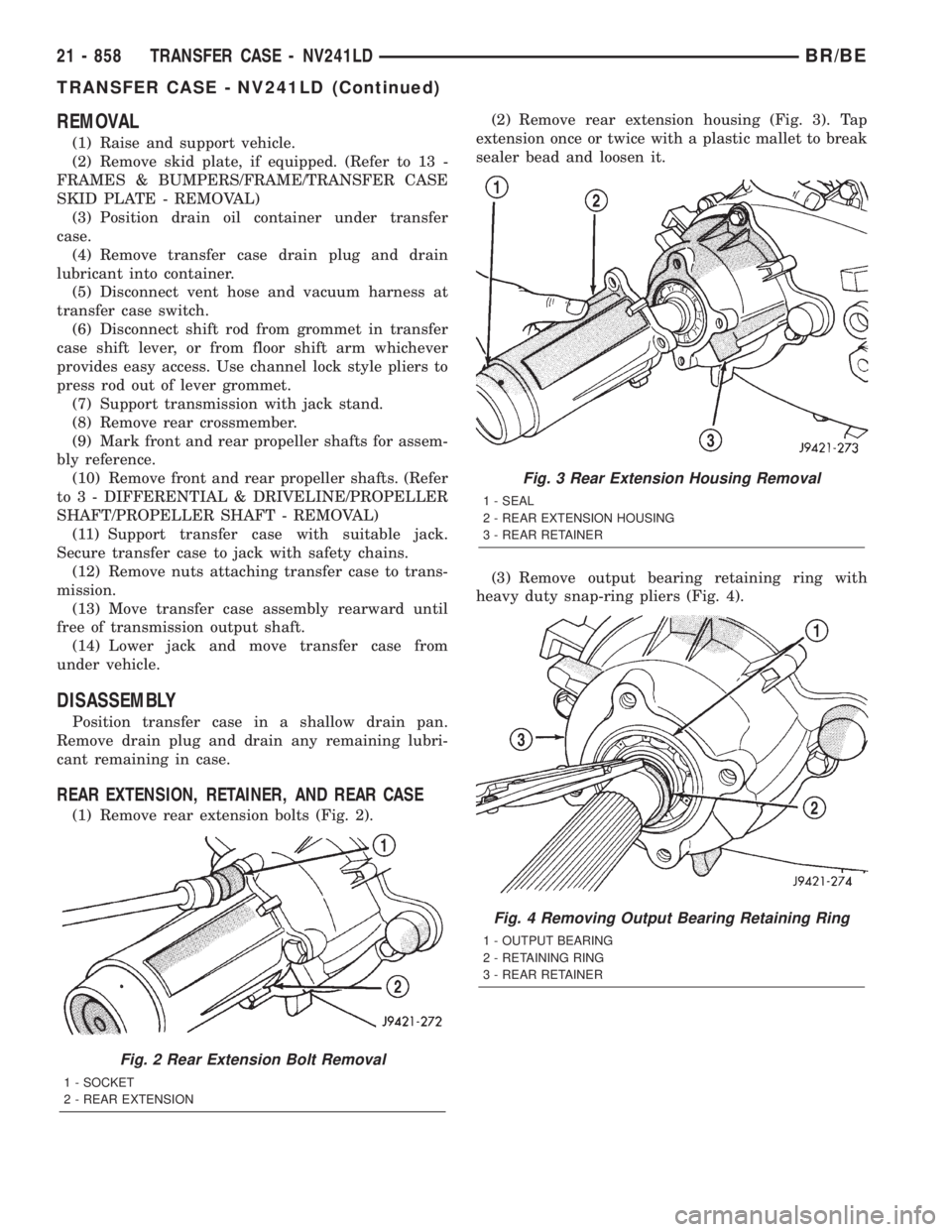
(1) Remove rear extension bolts (Fig. 2).(2) Remove rear extension housing (Fig. 3). Tap
extension once or twice with a plastic mallet to break
sealer bead and loosen it.
(3) Remove output bearing retaining ring with
heavy duty snap-ring pliers (Fig. 4).
Fig. 2 Rear Extension Bolt Removal
1 - SOCKET
2 - REAR EXTENSION
Fig. 3 Rear Extension Housing Removal
1 - SEAL
2 - REAR EXTENSION HOUSING
3 - REAR RETAINER
Fig. 4 Removing Output Bearing Retaining Ring
1 - OUTPUT BEARING
2 - RETAINING RING
3 - REAR RETAINER
21 - 858 TRANSFER CASE - NV241LDBR/BE
TRANSFER CASE - NV241LD (Continued)
Page 2502 of 2889
INSPECTION
MAINSHAFT/SPROCKET/HUB
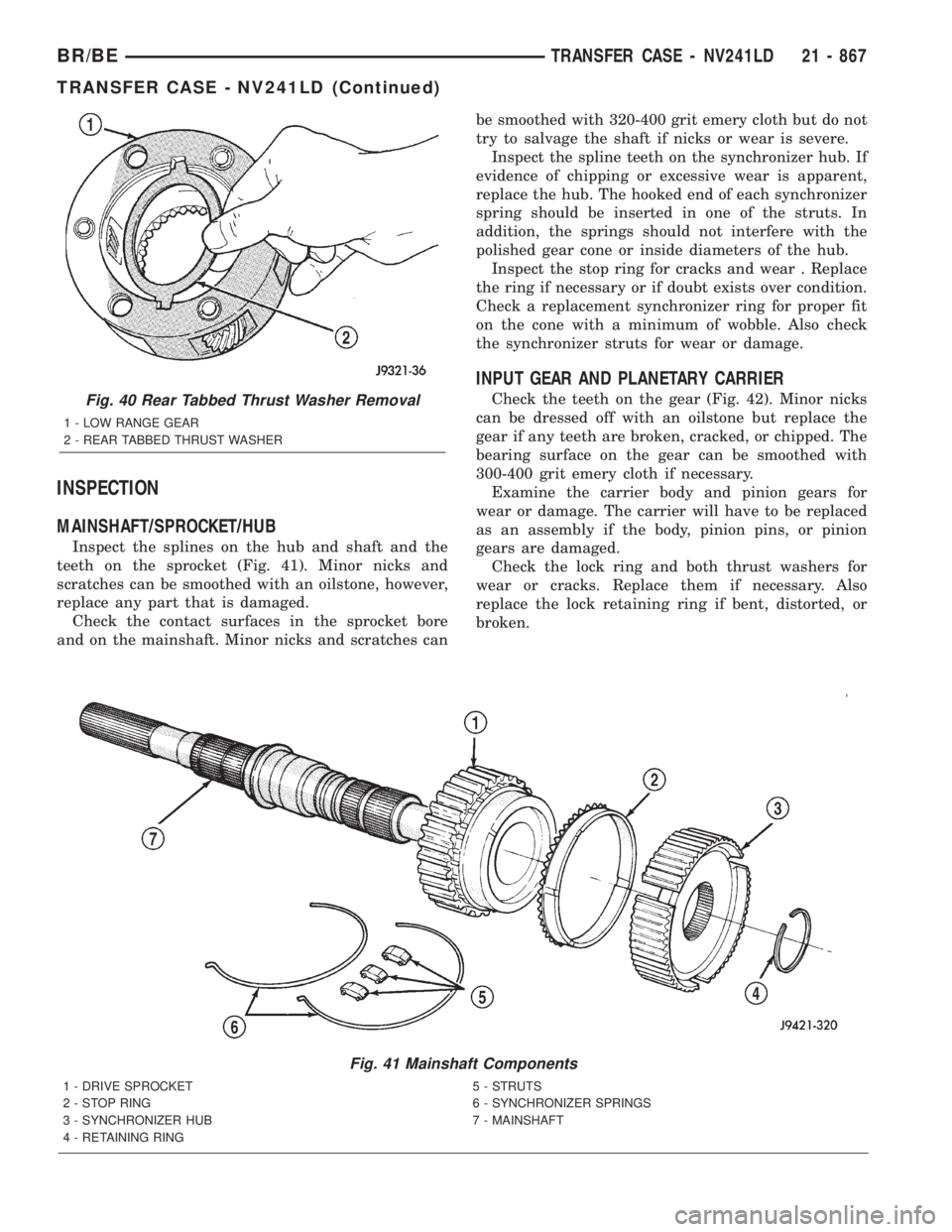
Inspect the splines on the hub and shaft and the
teeth on the sprocket (Fig. 41). Minor nicks and
scratches can be smoothed with an oilstone, however,
replace any part that is damaged.
Check the contact surfaces in the sprocket bore
and on the mainshaft. Minor nicks and scratches canbe smoothed with 320-400 grit emery cloth but do not
try to salvage the shaft if nicks or wear is severe.
Inspect the spline teeth on the synchronizer hub. If
evidence of chipping or excessive wear is apparent,
replace the hub. The hooked end of each synchronizer
spring should be inserted in one of the struts. In
addition, the springs should not interfere with the
polished gear cone or inside diameters of the hub.
Inspect the stop ring for cracks and wear . Replace
the ring if necessary or if doubt exists over condition.
Check a replacement synchronizer ring for proper fit
on the cone with a minimum of wobble. Also check
the synchronizer struts for wear or damage.
INPUT GEAR AND PLANETARY CARRIER
Check the teeth on the gear (Fig. 42). Minor nicks
can be dressed off with an oilstone but replace the
gear if any teeth are broken, cracked, or chipped. The
bearing surface on the gear can be smoothed with
300-400 grit emery cloth if necessary.
Examine the carrier body and pinion gears for
wear or damage. The carrier will have to be replaced
as an assembly if the body, pinion pins, or pinion
gears are damaged.
Check the lock ring and both thrust washers for
wear or cracks. Replace them if necessary. Also
replace the lock retaining ring if bent, distorted, or
broken.
Fig. 41 Mainshaft Components
1 - DRIVE SPROCKET 5 - STRUTS
2 - STOP RING 6 - SYNCHRONIZER SPRINGS
3 - SYNCHRONIZER HUB 7 - MAINSHAFT
4 - RETAINING RING
Fig. 40 Rear Tabbed Thrust Washer Removal
1 - LOW RANGE GEAR
2 - REAR TABBED THRUST WASHER
BR/BETRANSFER CASE - NV241LD 21 - 867
TRANSFER CASE - NV241LD (Continued)
Page 2503 of 2889
SHIFT FORKS/HUBS/SLEEVES
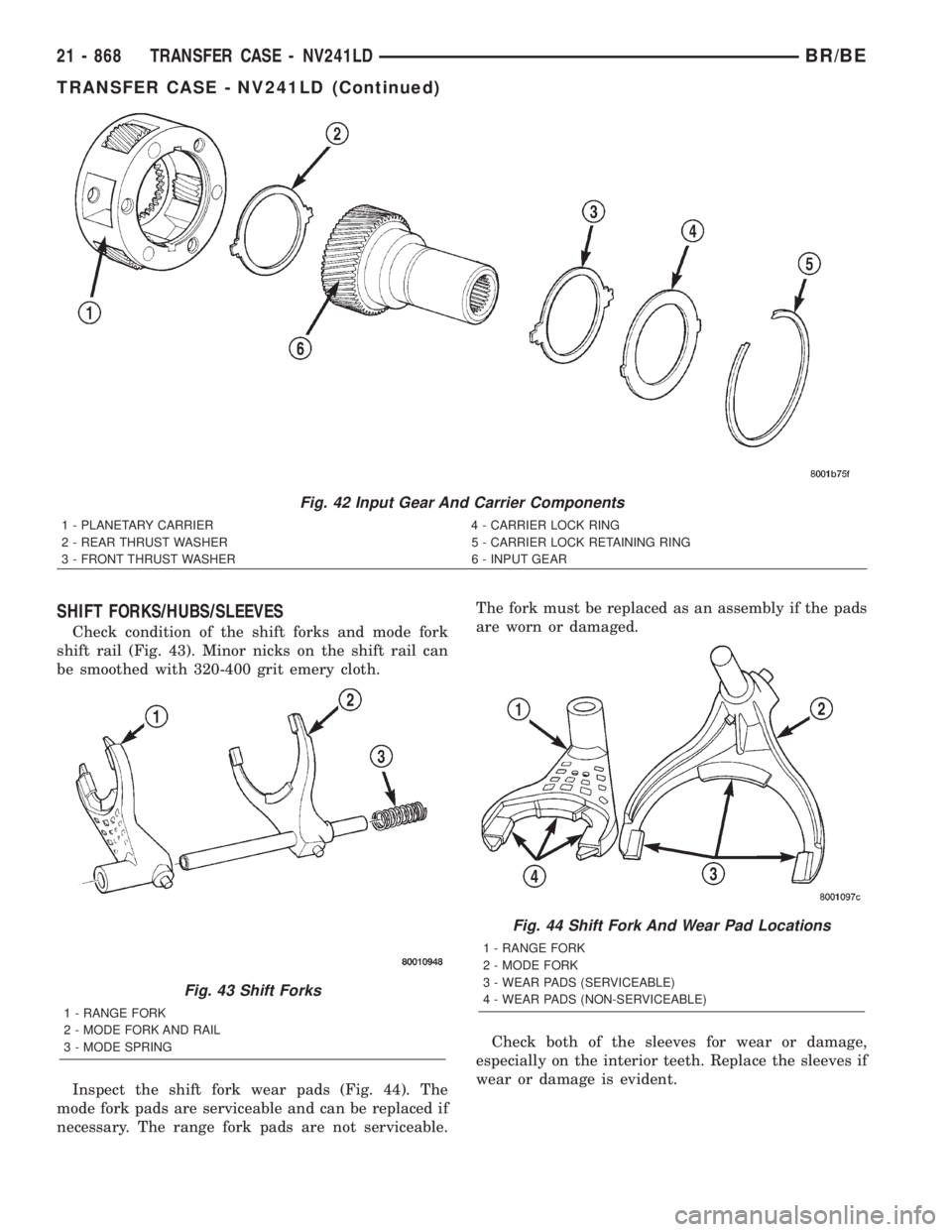
Check condition of the shift forks and mode fork
shift rail (Fig. 43). Minor nicks on the shift rail can
be smoothed with 320-400 grit emery cloth.
Inspect the shift fork wear pads (Fig. 44). The
mode fork pads are serviceable and can be replaced if
necessary. The range fork pads are not serviceable.The fork must be replaced as an assembly if the pads
are worn or damaged.
Check both of the sleeves for wear or damage,
especially on the interior teeth. Replace the sleeves if
wear or damage is evident.
Fig. 42 Input Gear And Carrier Components
1 - PLANETARY CARRIER 4 - CARRIER LOCK RING
2 - REAR THRUST WASHER 5 - CARRIER LOCK RETAINING RING
3 - FRONT THRUST WASHER 6 - INPUT GEAR
Fig. 43 Shift Forks
1 - RANGE FORK
2 - MODE FORK AND RAIL
3 - MODE SPRING
Fig. 44 Shift Fork And Wear Pad Locations
1 - RANGE FORK
2 - MODE FORK
3 - WEAR PADS (SERVICEABLE)
4 - WEAR PADS (NON-SERVICEABLE)
21 - 868 TRANSFER CASE - NV241LDBR/BE
TRANSFER CASE - NV241LD (Continued)
Page 2508 of 2889
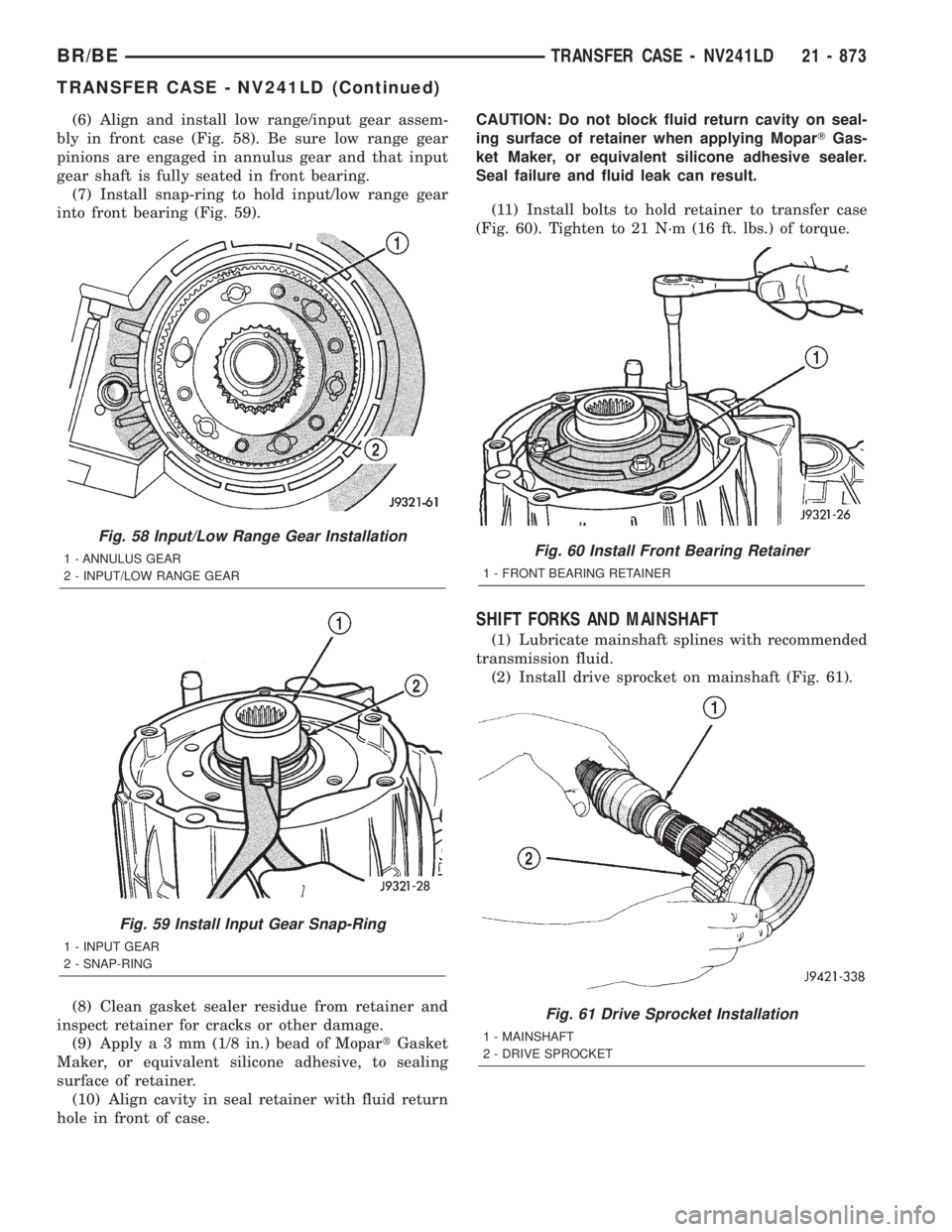
(6) Align and install low range/input gear assem-
bly in front case (Fig. 58). Be sure low range gear
pinions are engaged in annulus gear and that input
gear shaft is fully seated in front bearing.
(7) Install snap-ring to hold input/low range gear
into front bearing (Fig. 59).
(8) Clean gasket sealer residue from retainer and
inspect retainer for cracks or other damage.
(9) Applya3mm(1/8 in.) bead of MopartGasket
Maker, or equivalent silicone adhesive, to sealing
surface of retainer.
(10) Align cavity in seal retainer with fluid return
hole in front of case.CAUTION: Do not block fluid return cavity on seal-
ing surface of retainer when applying MoparTGas-
ket Maker, or equivalent silicone adhesive sealer.
Seal failure and fluid leak can result.
(11) Install bolts to hold retainer to transfer case
(Fig. 60). Tighten to 21 N´m (16 ft. lbs.) of torque.
SHIFT FORKS AND MAINSHAFT
(1) Lubricate mainshaft splines with recommended
transmission fluid.
(2) Install drive sprocket on mainshaft (Fig. 61).
Fig. 58 Input/Low Range Gear Installation
1 - ANNULUS GEAR
2 - INPUT/LOW RANGE GEAR
Fig. 59 Install Input Gear Snap-Ring
1 - INPUT GEAR
2 - SNAP-RING
Fig. 60 Install Front Bearing Retainer
1 - FRONT BEARING RETAINER
Fig. 61 Drive Sprocket Installation
1 - MAINSHAFT
2 - DRIVE SPROCKET
BR/BETRANSFER CASE - NV241LD 21 - 873
TRANSFER CASE - NV241LD (Continued)
Page 2510 of 2889
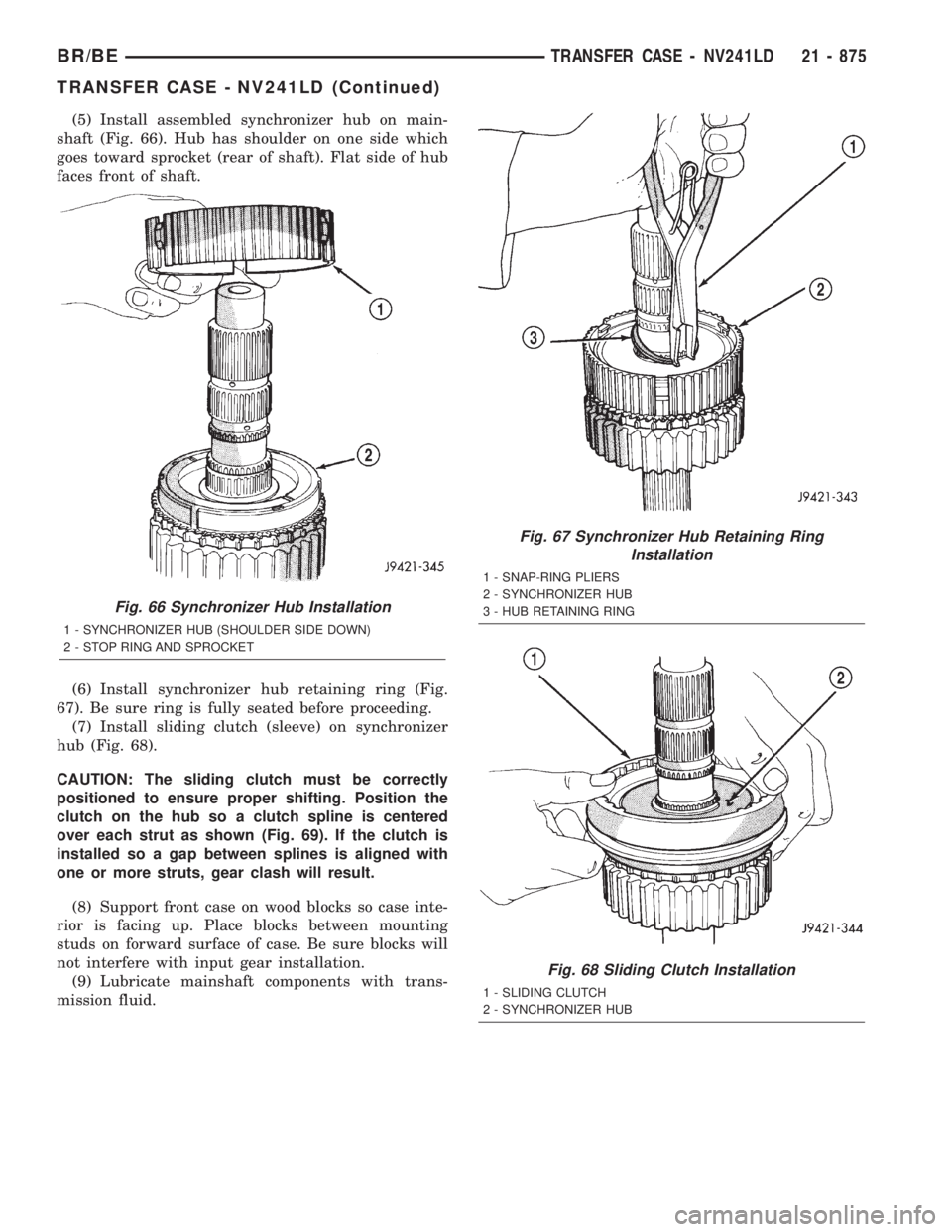
(5) Install assembled synchronizer hub on main-
shaft (Fig. 66). Hub has shoulder on one side which
goes toward sprocket (rear of shaft). Flat side of hub
faces front of shaft.
(6) Install synchronizer hub retaining ring (Fig.
67). Be sure ring is fully seated before proceeding.
(7) Install sliding clutch (sleeve) on synchronizer
hub (Fig. 68).
CAUTION: The sliding clutch must be correctly
positioned to ensure proper shifting. Position the
clutch on the hub so a clutch spline is centered
over each strut as shown (Fig. 69). If the clutch is
installed so a gap between splines is aligned with
one or more struts, gear clash will result.
(8) Support front case on wood blocks so case inte-
rior is facing up. Place blocks between mounting
studs on forward surface of case. Be sure blocks will
not interfere with input gear installation.
(9) Lubricate mainshaft components with trans-
mission fluid.
Fig. 66 Synchronizer Hub Installation
1 - SYNCHRONIZER HUB (SHOULDER SIDE DOWN)
2 - STOP RING AND SPROCKET
Fig. 67 Synchronizer Hub Retaining Ring
Installation
1 - SNAP-RING PLIERS
2 - SYNCHRONIZER HUB
3 - HUB RETAINING RING
Fig. 68 Sliding Clutch Installation
1 - SLIDING CLUTCH
2 - SYNCHRONIZER HUB
BR/BETRANSFER CASE - NV241LD 21 - 875
TRANSFER CASE - NV241LD (Continued)
Page 2512 of 2889
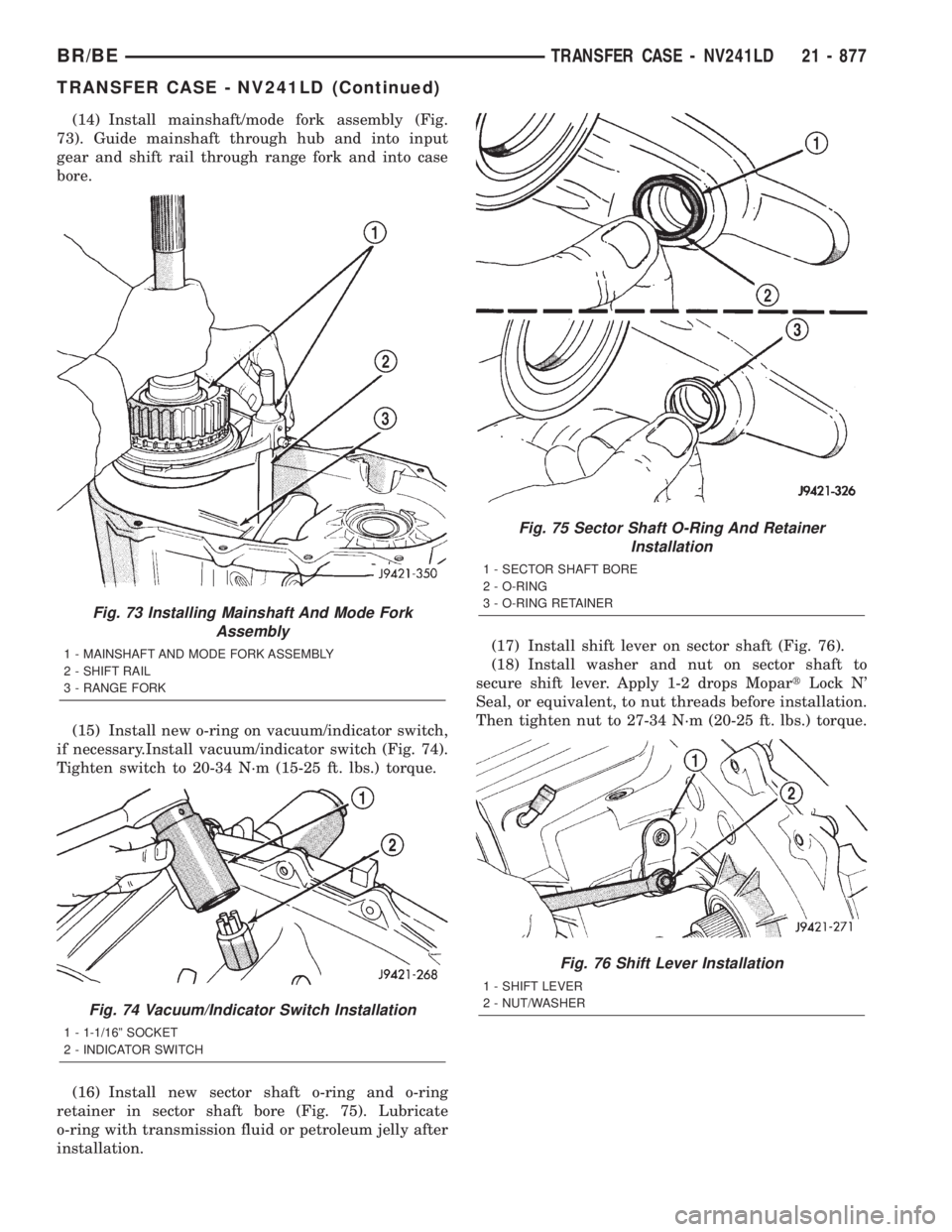
(14) Install mainshaft/mode fork assembly (Fig.
73). Guide mainshaft through hub and into input
gear and shift rail through range fork and into case
bore.
(15) Install new o-ring on vacuum/indicator switch,
if necessary.Install vacuum/indicator switch (Fig. 74).
Tighten switch to 20-34 N´m (15-25 ft. lbs.) torque.
(16) Install new sector shaft o-ring and o-ring
retainer in sector shaft bore (Fig. 75). Lubricate
o-ring with transmission fluid or petroleum jelly after
installation.(17) Install shift lever on sector shaft (Fig. 76).
(18) Install washer and nut on sector shaft to
secure shift lever. Apply 1-2 drops MopartLock N'
Seal, or equivalent, to nut threads before installation.
Then tighten nut to 27-34 N´m (20-25 ft. lbs.) torque.
Fig. 73 Installing Mainshaft And Mode Fork
Assembly
1 - MAINSHAFT AND MODE FORK ASSEMBLY
2 - SHIFT RAIL
3 - RANGE FORK
Fig. 74 Vacuum/Indicator Switch Installation
1 - 1-1/16º SOCKET
2 - INDICATOR SWITCH
Fig. 75 Sector Shaft O-Ring And Retainer
Installation
1 - SECTOR SHAFT BORE
2 - O-RING
3 - O-RING RETAINER
Fig. 76 Shift Lever Installation
1 - SHIFT LEVER
2 - NUT/WASHER
BR/BETRANSFER CASE - NV241LD 21 - 877
TRANSFER CASE - NV241LD (Continued)
Page 2516 of 2889
(9) Apply LoctiteŸ 242 to remainder of rear case-
to-front case bolt threads and install bolts. Be sure
lock washers are used on studs/bolts at case ends.
Tighten bolts, or stud nuts as follows:
²flange head bolts to 47-61 N´m (35-45 ft. lbs.)
²all other bolts/nuts to 27-34 N´m (20-25 ft. lbs.)
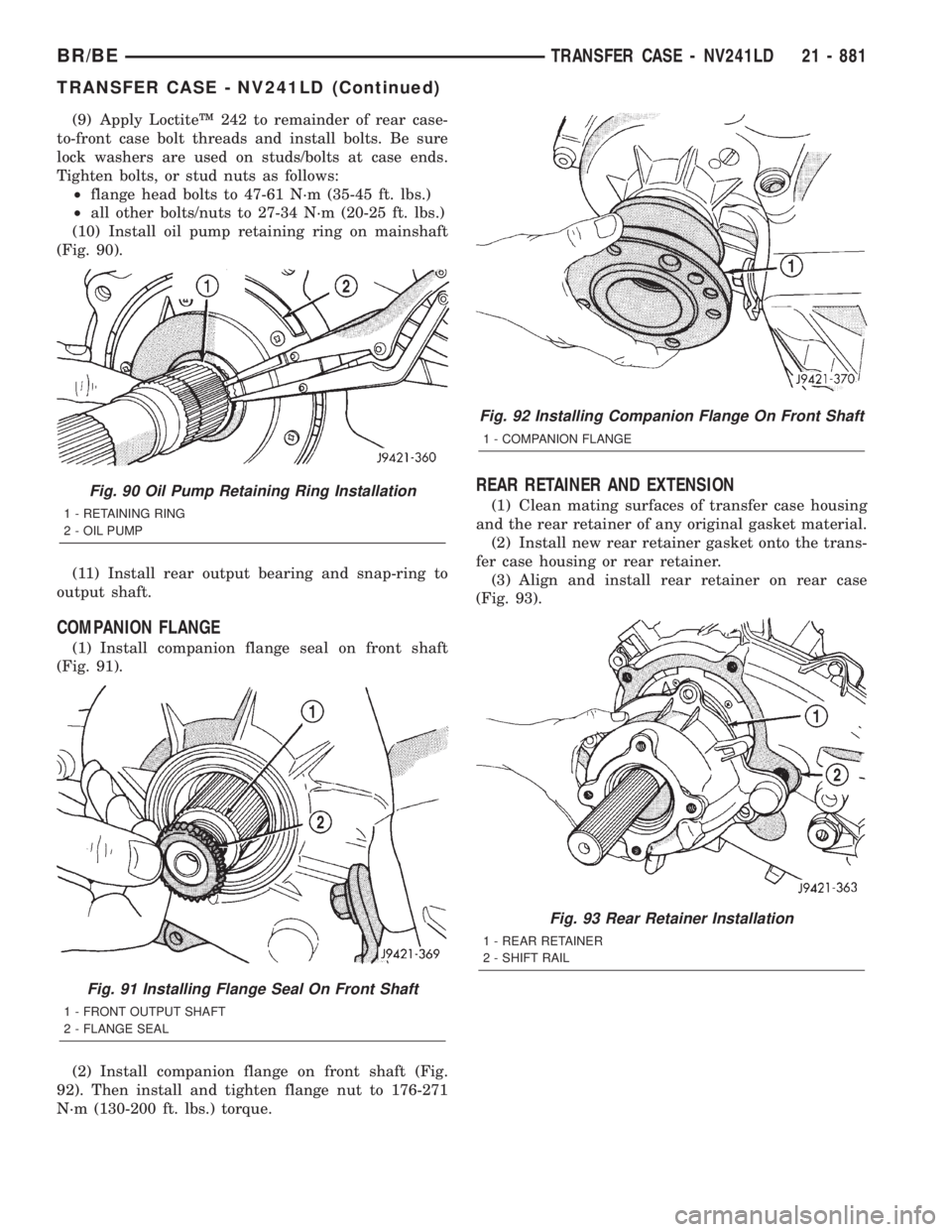
(10) Install oil pump retaining ring on mainshaft
(Fig. 90).
(11) Install rear output bearing and snap-ring to
output shaft.
COMPANION FLANGE
(1) Install companion flange seal on front shaft
(Fig. 91).
(2) Install companion flange on front shaft (Fig.
92). Then install and tighten flange nut to 176-271
N´m (130-200 ft. lbs.) torque.
REAR RETAINER AND EXTENSION
(1) Clean mating surfaces of transfer case housing
and the rear retainer of any original gasket material.
(2) Install new rear retainer gasket onto the trans-
fer case housing or rear retainer.
(3) Align and install rear retainer on rear case
(Fig. 93).Fig. 90 Oil Pump Retaining Ring Installation
1 - RETAINING RING
2 - OIL PUMP
Fig. 91 Installing Flange Seal On Front Shaft
1 - FRONT OUTPUT SHAFT
2 - FLANGE SEAL
Fig. 92 Installing Companion Flange On Front Shaft
1 - COMPANION FLANGE
Fig. 93 Rear Retainer Installation
1 - REAR RETAINER
2 - SHIFT RAIL
BR/BETRANSFER CASE - NV241LD 21 - 881
TRANSFER CASE - NV241LD (Continued)
Page 2517 of 2889
(4) Apply MopartSilicone Sealer to threads of rear
retainer bolts. Then install retainer bolts finger tight.
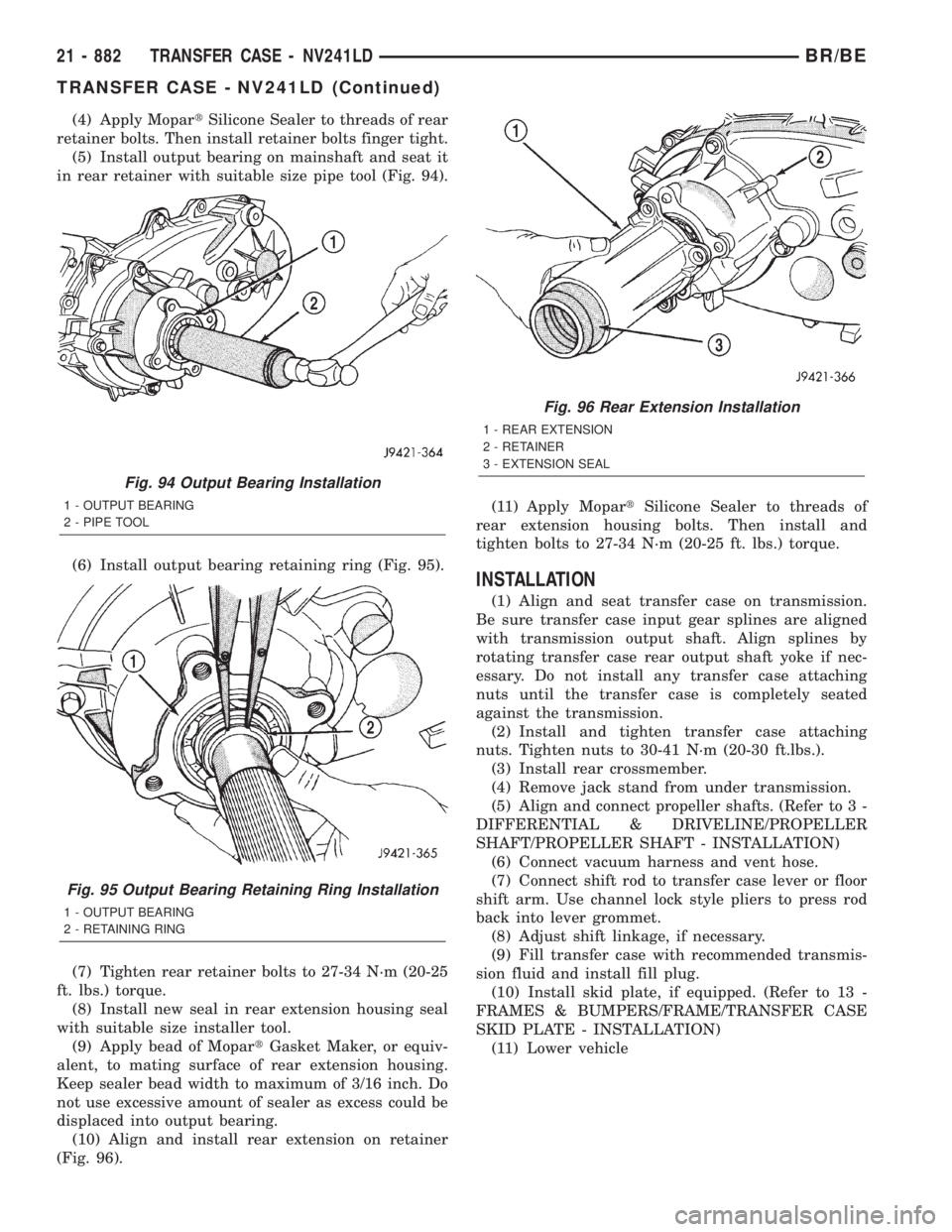
(5) Install output bearing on mainshaft and seat it
in rear retainer with suitable size pipe tool (Fig. 94).
(6) Install output bearing retaining ring (Fig. 95).
(7) Tighten rear retainer bolts to 27-34 N´m (20-25
ft. lbs.) torque.
(8) Install new seal in rear extension housing seal
with suitable size installer tool.
(9) Apply bead of MopartGasket Maker, or equiv-
alent, to mating surface of rear extension housing.
Keep sealer bead width to maximum of 3/16 inch. Do
not use excessive amount of sealer as excess could be
displaced into output bearing.
(10) Align and install rear extension on retainer
(Fig. 96).(11) Apply MopartSilicone Sealer to threads of
rear extension housing bolts. Then install and
tighten bolts to 27-34 N´m (20-25 ft. lbs.) torque.
INSTALLATION
(1) Align and seat transfer case on transmission.
Be sure transfer case input gear splines are aligned
with transmission output shaft. Align splines by
rotating transfer case rear output shaft yoke if nec-
essary. Do not install any transfer case attaching
nuts until the transfer case is completely seated
against the transmission.
(2) Install and tighten transfer case attaching
nuts. Tighten nuts to 30-41 N´m (20-30 ft.lbs.).
(3) Install rear crossmember.
(4) Remove jack stand from under transmission.
(5) Align and connect propeller shafts. (Refer to 3 -
DIFFERENTIAL & DRIVELINE/PROPELLER
SHAFT/PROPELLER SHAFT - INSTALLATION)
(6) Connect vacuum harness and vent hose.
(7) Connect shift rod to transfer case lever or floor
shift arm. Use channel lock style pliers to press rod
back into lever grommet.
(8) Adjust shift linkage, if necessary.
(9) Fill transfer case with recommended transmis-
sion fluid and install fill plug.
(10) Install skid plate, if equipped. (Refer to 13 -
FRAMES & BUMPERS/FRAME/TRANSFER CASE
SKID PLATE - INSTALLATION)
(11) Lower vehicle
Fig. 94 Output Bearing Installation
1 - OUTPUT BEARING
2 - PIPE TOOL
Fig. 95 Output Bearing Retaining Ring Installation
1 - OUTPUT BEARING
2 - RETAINING RING
Fig. 96 Rear Extension Installation
1 - REAR EXTENSION
2 - RETAINER
3 - EXTENSION SEAL
21 - 882 TRANSFER CASE - NV241LDBR/BE
TRANSFER CASE - NV241LD (Continued)