2001 CHRYSLER VOYAGER clutch
[x] Cancel search: clutchPage 4114 of 4284
responding element is applied. If a switch fails to
close, it is retested, If it fails the second test, the
code is set.
Transmission Effects:The MIL illuminates and
the transmission system defaults to Relay Open
limp-in mode.
Possible causes:
> Pressure switch sense circuit shorted to battery
between TCM and solenoid pack.
> Low line pressure
> Solenoid Pack
Name of code:P1791(35) - Loss Of Prime
When monitored:If the transmission is slipping
in any forward gear and the pressure switches are
not indicating pressure, a loss of prime test is run.
Set condition:If the transmission begins to slip in
any forward gear, and the pressure switch or
switches that should be closed for a given gear are
open, a loss of prime test begins. All available
elements (in 1st gear L-R, 2-4 and OD, in 2nd, 3rd,
and 4th gear 2-4 and OD) are turned on by the
Transmission Control Module (TCM) to see if pump
prime exists. The code is set if none of the pressure
switches respond. The TCM will continue to run the
loss of prime test until pump pressure returns.
Theory of operation:The loss of prime test is
used to prevent transmission defaults which can be
caused by a lack of pump prime.
Transmission Effects:Vehicle will not move or
transmission slips. Normal operation will continue
if pump prime returns.
Possible causes:
> Low transmission fluid level
> PRNDL indicates a valid OD code in the hydrau-
lic reverse position
> Transmission fluid filter clogged or damaged
> Transmission fluid filter improperly installed
(Bolts loose or O-ring missing)
> Oil pump - If a customer has a problem when the
transmission is cold whereby he shifts to reverse,
gets reverse, and then shifts to OD and does not
get OD (gets a neutral condition), and then can
not get reverse or OD for between 3-20 seconds,
replace the oil pump. High side clearance in the
oil pump will set a code 35. The pump will prime
upon start-up, but as the torque converter purges
air (drain down) the air will leak across the inner
rotor into the pump suction port and cause a loss
of prime right after the shift into OD. After 3- 20
seconds, pump prime will return and normal
operation will continue. The pump should be
replaced only after all other possible causes
above have been checked and verified.Name of code:P1790(36) - Fault Immediately
After Shift
When monitored:After a gear ratio error is
stored.
Set condition:This code is set if the associated
gear ratio code is stored within 1.3 seconds after a
shift.
Theory of operation:This code will only be stored
along with a 50 series code. If this code is set, it
indicates the problem is mechanical in nature.
When this code exists, diagnosing the transmission
should be based on the associated gear ratio code
and primarily mechanical causes should be consid-
ered.
Transmission Effects:None
Possible causes:
> Mechanical causes as listed under associated
gear ratio code.
Name of code:P1775(37) - Solenoid Switch Valve
Latched in TCC Position
When monitored:During an attempted shift into
1st gear.
Set condition:This code is set if three unsuccess-
ful attempts are made to get into 1st gear in one
given key start.
Theory of operation:The solenoid switch valve
(SSV) controls the direction of the transmission
fluid when the L-R/TCC solenoid is energized. The
SSV will be in the downshifted position in 1st gear,
thus directing the fluid to the L-R clutch circuit. In
2nd, 3rd, and 4th, it will be in the upshifted position
and directs the fluid into the torque converter
clutch (TCC).
When shifting into 1st gear, a special hydraulic
sequence is performed to ensure SSV movement
into the downshifted position. The L-R pressure
switch is monitored to confirm SSV movement. If
movement is not confirmed (the L-R pressure
switch does not close), 2nd gear is substituted for
1st.
Transmission Effects:Transmission will have no
1st gear (2nd gear will be substituted), and no
EMCC operation.
Possible causes:
> PRNDL indicates a valid OD code in the hydrau-
lic reverse position
> Valve body- - Solenoid valve stuck in TCC posi-
tion
> High idle speed
> Solenoid malfunction - L-R pressure switch will
not close
> L-R Pressure Switch Sense circuit shorted to
battery
10
GENERAL INFORMATION
Page 4115 of 4284
Name of code:P0740(38) - Torque Converter
Clutch Control Circuit
When monitored:During Electronically Modu-
lated Converter Clutch (EMCC)
Set condition:
a) The transmission must be in EMCC, with the
input speed greater than 1750 RPM. The TCC/L-R
solenoid must achieve it's maximum duty cycle and
still not be able to pull the engine speed within 60
RPM of input speed.
b) If the transmission is in FEMCC and the engine
can slip the TCC by more than 100 RPM (Engine
speed - Input speed) for 10 seconds.
The code will be set if one of these event happens
three times at a throttle angle less than 30 degrees.
Theory of operation:When in 2nd, 3rd, or 4th
gear, the torque converter clutch (TCC) can be
locked when certain conditions are met. The TCC
piston is electronically modulated by increasing the
duty cycle of the L-R/TCC solenoid until the torque
converter slip difference (difference between engine
and turbine speed) is within 60 RPM. Then the
L-R/TCC solenoid is fully energized (FEMCC / 100%
duty cycle). Torque converter slip is monitored in
FEMCC to ensure adequate clutch capacity.
Transmission Effects:EMCC will still be avail-
able after code is set. MIL will illuminate after 5
minutes of accumulated slip in FEMCC. The trans-
mission will attempt normal operation (no limp-in)
even after the MIL is illuminated.
Possible causes:
> Worn pump bushing and/or failed torque con-
verter - both should be replaced during a rebuild
with code P0740(38) present
> Solenoid pack.
Name of code:P0750(41) - L-R Solenoid Circuit
P0755(42) - 2-4 Solenoid Circuit
P0760(43) - OD Solenoid Circuit
P0765(44) - UD Solenoid Circuit
When monitored:Ignition key is turned from off
position to run position and/or ignition key is
turned from crank position to run position, then
every 10 seconds thereafter, or when a speed ratio
or pressure switch error DTC is detected.
Set condition:All four solenoids are tested for
continuity continuously immediately upon start up
and during vehicle operation. For solenoids that are
currently energized, power is momentarily inter-
rupted, then reenergized. For solenoids that are not
currently energized, the solenoid is momentarily
energized, then deenergized. Under both situations,
if an inductive spike is not sensed by the Transmis-
sion Control Module (TCM) during the continuity
check, it is retested twice. If it fails the test the
third time, the appropriate code is set.
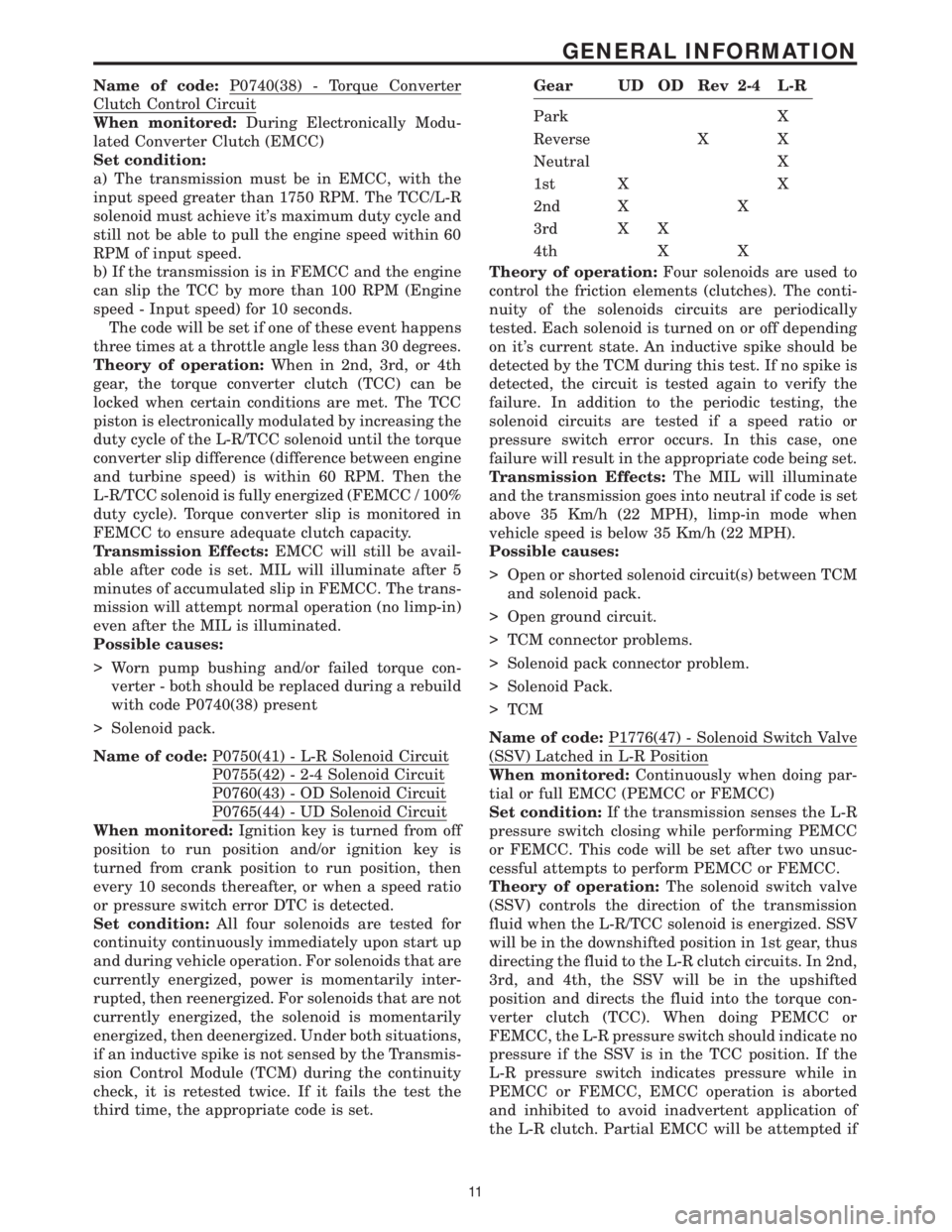
Gear UD OD Rev 2-4 L-R
Park X
Reverse X X
Neutral X
1st X X
2nd X X
3rd X X
4th X X
Theory of operation:Four solenoids are used to
control the friction elements (clutches). The conti-
nuity of the solenoids circuits are periodically
tested. Each solenoid is turned on or off depending
on it's current state. An inductive spike should be
detected by the TCM during this test. If no spike is
detected, the circuit is tested again to verify the
failure. In addition to the periodic testing, the
solenoid circuits are tested if a speed ratio or
pressure switch error occurs. In this case, one
failure will result in the appropriate code being set.
Transmission Effects:The MIL will illuminate
and the transmission goes into neutral if code is set
above 35 Km/h (22 MPH), limp-in mode when
vehicle speed is below 35 Km/h (22 MPH).
Possible causes:
> Open or shorted solenoid circuit(s) between TCM
and solenoid pack.
> Open ground circuit.
> TCM connector problems.
> Solenoid pack connector problem.
> Solenoid Pack.
> TCM
Name of code:P1776(47) - Solenoid Switch Valve
(SSV) Latched in L-R Position
When monitored:Continuously when doing par-
tial or full EMCC (PEMCC or FEMCC)
Set condition:If the transmission senses the L-R
pressure switch closing while performing PEMCC
or FEMCC. This code will be set after two unsuc-
cessful attempts to perform PEMCC or FEMCC.
Theory of operation:The solenoid switch valve
(SSV) controls the direction of the transmission
fluid when the L-R/TCC solenoid is energized. SSV
will be in the downshifted position in 1st gear, thus
directing the fluid to the L-R clutch circuits. In 2nd,
3rd, and 4th, the SSV will be in the upshifted
position and directs the fluid into the torque con-
verter clutch (TCC). When doing PEMCC or
FEMCC, the L-R pressure switch should indicate no
pressure if the SSV is in the TCC position. If the
L-R pressure switch indicates pressure while in
PEMCC or FEMCC, EMCC operation is aborted
and inhibited to avoid inadvertent application of
the L-R clutch. Partial EMCC will be attempted if
11
GENERAL INFORMATION
Page 4117 of 4284
throttle is applied below 72 Km/h (45 MPH) or
at 35 Km/h (22 MPH) with closed throttle.
± Codes 51, 52, 53, 54, 56, and 57 (at speeds
between 35 and 72 Km/h (22 and 45 MPH) - If
one of these codes is set between 35 and 72
Km/h (22 and 45 MPH), the current gear will
be maintained until the gear ratio problem
corrects itself. If throttle is applied, the trans
will go to 2nd gear. If this happens and the
gear ratio problem goes away, normal opera-
tion will resume. If three gear ratio problems
are identified in a given key start, the current
gear will be frozen until throttle is applied.
The transmission will then go into relay open
limp-in mode with throttle applied at speeds
between 35 and 72 Km/h (22 and 45 MPH).
± Codes 51, 52, 53, 54, 56, and 57 (at speeds
below 35 Km/h (22 MPH) - If a gear ratio
problem is identified below 35 Km/h (22 MPH),
the transmission will immediately substitute
second gear for the current gear. If the gear
ratio problem goes away, normal operation will
resume. If three gear ratio problems are iden-
tified in a given key start, the transmission
will go into relay open limp-in mode.
Possible causes:
Code P0736(50) - Excludes geartrain failures which
should be obvious upon disassembly
> If code P1791(35) is also set, follow diagnostic
procedure for code P1791(35) first
> Valve body - #1 ball check or LR switch valve
sticking - may also set code P0731(51)
> Speed sensor or associated wiring
± may also set codes P0731(51), P0715(56), or
P0720(57)
> Failed or slipping LR clutch - may also set code
P0731(51)
> LR seal leakage (Intermittent no drive or re-
verse)
> Sticky LR accumulator seals (Intermittent no
drive or reverse)
> Failed reverse clutch (hard code)
± OD/Rev lip seal leakage
± Worn reaction shaft support seal rings
± Snap ring out of position
Code P0731(51) - Excludes geartrain failures which
should be obvious upon disassembly
> If code P1791(35) is also set, follow diagnostic
procedure for code P1791(35) first
> Valve body - #1 ball check or LR switch valve
sticking - may also set code P0736(56) or have no
Reverse
> Speed sensor or associated wiring - may also set
codes P0736(50), P0715(56), or P0720(57)> Failed or intermittent slipping UD clutch - may
also set P0732(52), or P0733(53)
± UD seal leakage (intermittent)
± Worn input clutch hub bushing (hard code at
heavy throttle)
± Sticky UD accumulator seals (intermittent)
± Worn reaction shaft support seal rings (hard
code at heavy throttle)
± Solenoid pack (UD pressure in 4th gear)
> Failed or slipping LR clutch - may also set code
P0736(56) or have no Reverse
± LR seal leakage (Intermittent)
± Sticky LR accumulator seals (Intermittent)
Code P0732(52) - Excludes geartrain failures which
should be obvious upon disassembly
> If code P1791(35) is also set, follow diagnostic
procedure for code P1791(35) first
> Failed or slipping 2-4 clutch - may also set code
P0734(54)
± 2-4 seal leakage (intermittent)
± Sticky accumulator seals (intermittent)
> Failed or intermittent slipping UD clutch - may
also set code P0731(51) and/or P0733(53)
± UD seal leakage (intermittent)
± Worn input clutch hub bushing (hard code at
heavy throttle)
± Sticky UD accumulator seals (intermittent)
± Worn reaction shaft support seal rings (hard
code at heavy throttle)
± Solenoid pack (UD pressure in 4th gear)
Code P0733(53) - Excludes geartrain failures which
should be obvious upon disassembly
> If code P1791(35) is also set, follow diagnostic
procedure for code P1791(35) first
> Failed or slipping OD clutch - may also set code
P0734(54)
± OD and Reverse inner and outer lip seal leak-
age (usually hard code)
± Sticky OD accumulator seals (intermittent)
± Worn reaction shaft support seal rings (hard
code at heavy throttle)
± Broken OD/UD tapered snap ring - (hard code
at heavy throttle)
> Failed or intermittent slipping UD clutch - may
also set code P0731(51) and/or P0732(52)
± UD seal leakage (intermittent)
± Worn input clutch hub bushing (hard code at
heavy throttle)
± Sticky UD accumulator seals (intermittent)
± Worn reaction shaft support seal rings (hard
code at heavy throttle)
13
GENERAL INFORMATION
Page 4118 of 4284
± Solenoid pack (UD pressure in 4th gear)
Code P0734(54) - Excludes geartrain failures which
should be obvious upon disassembly
> If code P1791(35) is also set, follow diagnostic
procedure for code P1791(35) first
> Failed or slipping OD clutch - may also set code
P0733(53)
± OD and Reverse inner and outer lip seal leak-
age (usually hard code)
± Sticky OD accumulator seals (intermittent)
± Worn reaction shaft support seal rings (hard
code at heavy throttle)
± Broken OD/UD tapered snap ring - (hard code
at heavy throttle)
> Failed or slipping 2-4 clutch - may also set code
P0732(52)
± 2-4 seal leakage (intermittent)
± Sticky accumulator seals (intermittent)
Codes P0715(56) and P0720(57)
> Failed input or output speed sensor (intermittent
or hard code)
> Shorted or open wiring between TCM and speed
sensor(s) (intermittent)
> Connector problems at 60 TCM connector and/or
speed sensor connector
Code P1794(58)
> Open or shorted speed sensor ground (speed
sensor ground is different from chassis ground)
> Open or shorted Temperature Sensor wiring to
TRS
> TRS - Will also set code P1799(74)
> TCM
Name of code:P1796(70) - Autostick Sensor Cir-
cuit (If equipped)
Note: RS is a MUXED Autostick system
When monitored:Whenever the engine is run-
ning.
Set condition:
1) The transmission shift lever is not in AutoStick
and either the upshift or downshift switch is closed.
2) Upshift and downshift switches closed at the
same time.
Theory of operation:In the AutoStick Mode
(manual shift mode), upshifts and downshifts are
actuated manually. Shift requests are detected by
monitoring the MUXED upshift and downshift
switches. The Transmission Control Module (TCM)
monitors the above set conditions. A set condition
will be tolerated for up to 15 seconds before setting
a code.Transmission Effects:The OD position shift
schedule is substituted while operating in the au-
tostick gear selector position. No limp-in mode
occurs.
Possible causes:
> Wiring or connector problems
> AutoStick switch failure
> TCM
Name of code:P1797(71)- Manual Shift Overheat
When monitored:Whenever the engine is run-
ning.
Set condition:1) If the engine temperature ex-
ceeds 124C (255 ÉF) while operating in AutoStick
mode.
2) If the transmission temperature exceeds 135C
(275 ÉF) while in AutoStick mode
Theory of operation:Transmission and engine
temperatures are monitored during vehicle opera-
tion. If conditions occur causing the engine or
transmission to overheat, the AutoStick mode will
be canceled, and a code will be set.
Transmission Effects:The 3 position shift sched-
ule that is used in non-AutoStick applications is
substituted while operating in the AutoStick gear
selector position. No limp-in mode occurs.
Possible causes:
> Engine overheat - refer to service manual for
diagnosis and repair
> Transmission Overheat
± Restricted transmission cooling system
± Transmission fluid overfilled
± Radiator fan not functioning properly
± Extended driving in low gear
Note:Strenuous driving conditions may cause the
vehicle to overheat. If the driver operates in or
initiates AutoStick with an overheated vehicle, the
code will be set.
Name of code:P1798 (73) - Deteriorated Transaxle
Fluid
When monitored:At every Fully Electronically
Modulated Converter Clutch (FEMCC) to Partial
Electronically Modulated Converter Clutch (PEM-
CC) transition miles when A/C compressor clutch is
being cycled.
Set condition:The code will be set if vehicle
shudder is detected 20 times when the A/C clutch is
cycled.
Theory of operation:While in 3rd or 4th gear
FEMCC and just before the A/C clutch engages, the
Powertrain Control Module (PCM) requests the
Transmission Control Module (TCM) to momen-
tarily establish PEMCC operation. If vehicle shud-
der is detected during the FEMCC to PEMCC
transition, a counter is incremented. If the count
reaches 20, the trouble code is set. The driver may
14
GENERAL INFORMATION
Page 4119 of 4284
then notice harsh bumps when the A/C clutch is
being cycled, but vehicle shudder will be elimi-
nated. After 35 OBDII (EURO STAGE III OBD)
warm-up starts or if the code is cleared, PEMCC
will be reactivated to see if shudder is still present.
If one shudder event occurs, the code will be reset.
Clearing the code and running battery disconnect
with the DRBIIItis the only way to reset the
shudder counter from 20 back to zero.
Transmission Effects:This code does not cause
the transmission to go into limp-in mode. However,
once the code is set, FEMCC to PEMCC operation
before the A/C clutch engagement will be disabled
for 35 OBDII (EURO STAGE III OBD) warm up
starts.
Possible causes:
> Degraded transmission fluid
> Wheels severely out of alignment
> Internal torque converter problem
Name of Code:P1799(74) - Calculated Oil Temper-
ature in Use
When Monitored:When ever the Engine is run-
ning.
Set condition:The code is set if any of the follow-
ing conditions exist for three consecutive key starts:
> The Temperature Sensor voltage is out of range
(below 0.07 volts or greater than 4.94 volts)
> If continuous erratic Temperature Sensor voltage
is sensed.
> The Temperature Sensor temperature stays be-
low 27C (80ÉF) for an extended period of time.
Theory of Operation:The TCM uses a Tempera-
ture Sensor to monitor the transmission sump tem-
perature. This temperature is used to determine
which shift schedule the TCM is to use. (See Trans-
mission Operation and Shift Scheduling at Various
Sump Temperatures in this diagnostic manual) If
the Temperature Sensor circuit fails to operate
properly the TCM will use the calculated oil tem-
perature routine found in prior model year TCM. If
this occurs for three consecutive key starts, the code
will be set. The TCM will then test the Temperature
Sensor circuit after every 35 OBDII (EURO STAGE
III OBD) warm-up starts. If the Temperature Sen-
sor circuit is OK, the Temperature Sensor data is
used in place of the Calculated Oil Temperature
data.
Transmission Effects:If the Temperature Sensor
indicates a temperature below -18C (0É F) or above
115C (240É F) at start up, The TCM compares the
calculated oil temperature to the indicated Temper-
ature Sensor oil temperature. If the calculated oil
temperature differs significantly from the Temper-
ature Sensor value, the calculated oil temperature
will be used for that key start.Possible Causes:
> Wiring or Connector problems in the transmis-
sion temperature sensor signal circuit.
> TRS
> TCM
Name of Code:P1738(75) - High Temperature
Operation Activated.
When Monitored:Whenever the engine is running.
Set Condition:Immediately once the Overheat
Shift Schedule is activated.
Theory of Operation:If the transmission oil tem-
perature rises above 115C (240ÉF), the overheat
shift schedule is activated refer to Transmission
Operation as a function of Transmission Oil Tem-
perature and the code is set. The DTC is an infor-
mation code only and is being set to aid the techni-
cian in determining root cause of a customer
driveability issue. The code is also intended to alert
the technician to determine if a cooling system
malfunction has occurred or if an additional trans-
mission air to oil cooler should be added to the
vehicle if the customer regularly drives in a manner
that overheats the transmission. Extended opera-
tion above 115C (240ÉF) will reduce the durability of
the transmission and should be avoided. Correcting
the cooling system malfunction or installing an
additional transmission oil cooler will improve
transmission durability especially for customers
who operate in city/construction stop and go traffic,
tow trailers regularly, drive aggressively in low gear
or drive regularly in mountainous areas.
Transmission Effects:Information only code. -
Overheat shift schedule was activated, no limp-in
condition occurs. 2nd gear partial EMCC above 40
Km/h (25 MPH), 3rd gear EMCC from 45-69 Km/h
(28-43 MPH), delayed 3-4 upshift at 69 Km/h (43
MPH), early 4-3 coastdown at 66 Km/h (41 MPH),
EMCC operation under all conditions above 40
Km/h (25 MPH) except at closed throttle or 1st gear.
Possible Causes:
± Transmission Overfilled with Oil
± Engine cooling fan failure
± Engine thermostat stuck closed
± Radiator corroded or packed with dirt
± Transmission Oil Cooler Plugged
± Customer driving pattern requires additional
transmission cooling
Name Of Code:P1739(76) - Power-Up at Speed
When Monitored:When TCM (transmission con-
trol module) initially powers-up.
Set Condition:If the TCM powers up while in the
9Drive9position and the vehicle is going above 32
Km/h (20 MPH), the code is set.
Theory of Operation:If a vehicle loses power to
the TCM, the vehicle will go to the 2nd gear mode
15
GENERAL INFORMATION
Page 4121 of 4284
> Quick Learn should generally not be used as a
repair procedure unless directed by a repair or
diagnostic procedure. If the transmission system
is exhibiting a problem that you think is caused
by an invalid CVI, you should try to relearn the
value by performing the appropriate driving ma-
neuver. In most cases, if a quick learn makes a
vehicle shift better, the vehicle will return with
the same problem.
> Before performing Quick Learn, it is imperative
that the vehicle be shifted into OD with the
engine running and the oil level set to the correct
level. This step will purge air from the clutch
circuits to prevent erroneous clutch volume val-
ues which could cause poor initial shift quality.
> If an unused TCM is installed on a vehicle with a
HOT engine, Quick Learn will cause the TCM to
report a cold calculated oil temperature. This
requires monitoring the calculated oil tempera-
ture using the DRBIIIt. If the temperature is
below 15C (60É F), the transmission must be run
at idle or driven in gear until it goes above 15C
(60ÉF). If the temperature is above 93C (200ÉF),
the transmission must cool to below 93C (200ÉF).
> First gear is engaged in overdrive after Quick
Learn is completed. Place the vehicle in park
after performing Quick Learn.
The Quick Learn function should be performed:
± Upon installation of a new service TCM
± After replacement or rebuild of internal trans-
mission components or the torque converter
± If one or more of the clutch volumes indexes
(CVI's) contain skewed readings because of
abnormal conditions.
To perform the Quick Learn procedure, the fol-
lowing conditions must be met.
± It is imperative that the vehicle be shifted into
OD with the engine running and the oil level
set to the correct level. This step will purge the
air in the clutch circuits to prevent erroneous
clutch volume values, which could cause poor
initial shift quality.
± The brakes must be applied.
± The engine must be idling.
± The throttle angle (TP sensor) must be less
than 3 degrees.
± The shift lever position must stay in neutral
until prompted to shift into OD.
± The shift lever must stay in OD after the9Shift
to Overdrive9prompt until the DRBIIItindi-
cates the procedure is complete.
± The oil temperature must be between 15C
(60ÉF) and 93C (200ÉF).NOTE:The above conditions must be maintained
during the procedure to keep the procedure from
being aborted.
The Quick Learn procedure is performed with the
DRBIIItby selecting9Transmission9system then
9Miscellaneous9functions, then9Quick Learn9. Follow
the procedure instructions displayed on the DRBIIIt.
3.3.9 CLUTCH VOLUMES
The L-R clutch volume is updated when doing a
2-1 or 3-1 coast down shift. The transmission tem-
perature must be between 21-49C (70-120É F). The
clutch volume should be between 35 and 83.
The 2-4 clutch volume is updated when doing a
1-2 shift. The transmission temperature must be
above 43C (110ÉF). The clutch volume should be
between 20 and 77.
The OD clutch volume is updated when doing a
2-3 shift. The transmission temperature must be
above 43C (110ÉF). The clutch volume should be
between 40 and 150.
The UD clutch volume is updated when doing a
4-3 or 4-2 shift. The transmission temperature must
be above 43C (110ÉF). The clutch volume should be
between 24 and 70.
3.3.10 ELECTRONIC PINION FACTOR
The transmission output speed signal supplies
distance pulses to the powertrain control module
(PCM), which are used to calculate speed and
mileage. A pinion factor is stored in the transmis-
sion control module (TCM) in order to provide the
appropriate distance pulses for the vehicle. The
pinion factor is programmed into the TCM at the
assembly plant.
Using the following steps, the pinion factor can be
checked and/or reset using the DRBIIIt:
1. Select Transmission system, then Miscellaneous
functions, then Pinion Factor. The DRBIIItwill
display the current tire size.
2. If the tire size is incorrect, depress the Enter key
and then select the correct size.
3. Depress the Page Back key to exit the reset
procedure.
Notes About Electronic Pinion Factor Features
The nature of the electronic pinion factor requires that
certain features must be taken into consideration.
> If no pinion factor is stored in an installed TCM,
the vehicle speedometer will not operate, engine
speed will be limited to 2300 RPM, and catalyst
damage may occur.
> Selecting a wrong tire size will cause the speed-
ometer to be inaccurate and will also cause any
speed related features to operate improperly.
Note: After replacing the TCM, you must
reprogram pinion factor
17
GENERAL INFORMATION
Page 4124 of 4284
4.3 WARNINGS
4.3.1 VEHICLE DAMAGE WARNINGS
Before disconnecting any control module, make
sure the ignition is ªoffº. Failure to do so could
damage the module.
When testing voltage or continuity at any control
module, use the terminal side (not the wire end) of
the connector. Do not probe a wire through the
insulation; this will damage it and eventually cause
it to fail because of corrosion.
Be careful when performing electrical tests so as
to prevent accidental shorting of terminals. Such
mistakes can damage fuses or components. Also, a
second code could be set, making diagnosis of the
original problem more difficult.
4.3.2 ROAD TEST COMPLAINT VEHICLE
Some complaints will require a test drive as part
of the repair verification procedure. The purpose of
the test drive is to try to duplicate the diagnostic
code or symptom condition.
CAUTION: BEFORE ROAD TESTING A
VEHICLE, BE SURE THAT ALL
COMPONENTS ARE REASSEMBLED.
DURING THE TEST DRIVE, DO NOT TRY TO
READ THE DRBIIITSCREEN WHILE IN
MOTION. DO NOT HANG THE DRBIIITFROM
THE REAR VIEW MIRROR OR OPERATE IT
YOURSELF. HAVE AN ASSISTANT
AVAILABLE TO OPERATE THE DRBIIIT.
Road testing is an essential step in the diagnostic
process that must not be overlooked. Along with
diagnostic information obtained from the DRBIIIt
Scan Tool and the original customer concern, the
road test helps to verify the problem and observe
operation under actual vehicle driving conditions.
Just as important as the road test is, there are
preliminary inspections that should be carried out
prior to the road test. Always check the fluid level
and condition before going on a road test or per-
forming other tests. Also try to determine the type
of fluid being used. Improper fluid can result in
problems. Additionally, a variety of complaints can
be caused by incorrect fluid level. Some of the
conditions caused by incorrect fluid level are as
follows:
²Delayed engagement
²Poor shifting or erratic shifts
²Excessive noise
²Overheating
The next step is to verify that the shift linkage is
correctly adjusted. If the gearshift linkage is incor-rectly adjusted because of wear or incorrect adjust-
ment, a number of complaints can result.
The TCM monitors the Shift Lever Position (SLP)
Sensor at all times. If the linkage is incorrectly
adjusted, the TCM may sense a shift lever position
that is not correct for the gear range chosen by the
driver. This may cause diagnostic trouble codes to
be set and a possible limp-in situation.
The following complaints may also be the result
of an incorrectly adjusted or worn linkage.
²Delayed clutch engagement or erratic shifts
²Vehicle able to drive in Neutral
²Engine not able to crank in Park or Neutral
²Gearshift linkage able to be shifted without the
key in the ignition
²Not able to remove the ignition key in Reverse
²Parking pawl not engaging
The shift linkage should also be adjusted when
replacing the transaxle, repairing the valve body or
repairing any component between the shift lever
and the transaxle.
Some questions to ask yourself when considering
the road test are listed below:
²Is the complaint or concern what you think it is,
based the driver 's description of the problem?
²Is the transaxle operating normally, or is there a
real problem?
²When does the malfunction occur?
²Is the problem in only one gear range?
²What temperature does the complaint occur?
²Is the transaxle in limp-in mode?
4.3.3 ELECTRONIC PINION FACTOR
WARNINGS
The pinion factor must be set for all new trans-
mission control modules. If the pinion factor is not
set or if it is set incorrectly, any speedometer, speed
control, rolling door locks, and other devices that
are operated by the powertrain and body controllers
will not function properly.
4.3.4 BULLETINS AND RECALLS
The service procedures contained in this manual
are correct. provided that all applicable Safety
Recalls and Technical Service Bulletins have been
performed.
5.0 REQUIRED TOOLS AND
EQUIPMENT
> DRBIIIt(diagnostic read-out box) - Must be at
latest release level.
20
GENERAL INFORMATION
Page 4125 of 4284
> Transmission Simulator (Miller # 8333)
> Transmission Simulator (Miller # 8333-1)
Adapter harness kit and panel overlay for FWD
vehicles.
> Jumper wires
> Test Light (minimum of 25 ohms of resistance)
> Ohmmeter
> Voltmeter
> Pressure gauge (0-300 PSI)
6.0 GLOSSARY OF TERMS
6.1 ACRONYMS
BCMBody Control Module
CKTCircuit
CVIClutch Volume Index
DLCData Link Connector
DRBIIItDiagnostic Readout Box
DTCDiagnostic Trouble Code
EATXElectronic Automatic Transaxle
EMCCElectronically Modulated Converter
Clutch
FCMFront Control Module (part of the
IPM system)
IODIgnition off-draw
IPMIntelligent Power Module
IRTIntelligent Recovery Timer
ISSInput Speed Sensor
LEDLight Emitting Diode
LRLow/reverse Clutch or Pressure
Switch
LULockupMICMechanical Instrument Cluster
MILMalfunction Indicator Lamp
OBDIIOn Board Diagnostics
ODOverdrive Clutch or Pressure
Switch
OSSOutput Speed Sensor
PCMPowertrain Control Module
PEMCCPartial Electronically Modulated
Converter Clutch
PLUPartial Lockup
REVReverse Clutch
SLPKSolenoid Pack
SSVSolenoid Switch Valve
SWSwitch
TCCTorque Converter Clutch
TCMTransmission Control Module
TPThrottle Position
TRDTorque Reduction
TRSTransmission Range Sensor
UDUnderdrive Clutch
2-42nd and 4th gear Clutch or Pres-
sure Switch
6.2 DEFINITIONS
OBDII (EURO STAGE III OBD) Trip - A vehicle
start and drive cycle such that all once per trip
diagnostic monitors have run.
Key Start - A vehicle start and run cycle of at least
20 seconds.
Warm-up Cycle - A vehicle start and run cycle
such that the engine coolant must rise to at least
71C (160ÉF) and must rise by at least 4.4C (40ÉF)
from initial start up. To count as a warm-up cycle,
no DTC may occur during the cycle.
21
GENERAL INFORMATION