2001 CHRYSLER VOYAGER clutch
[x] Cancel search: clutchPage 4102 of 4284
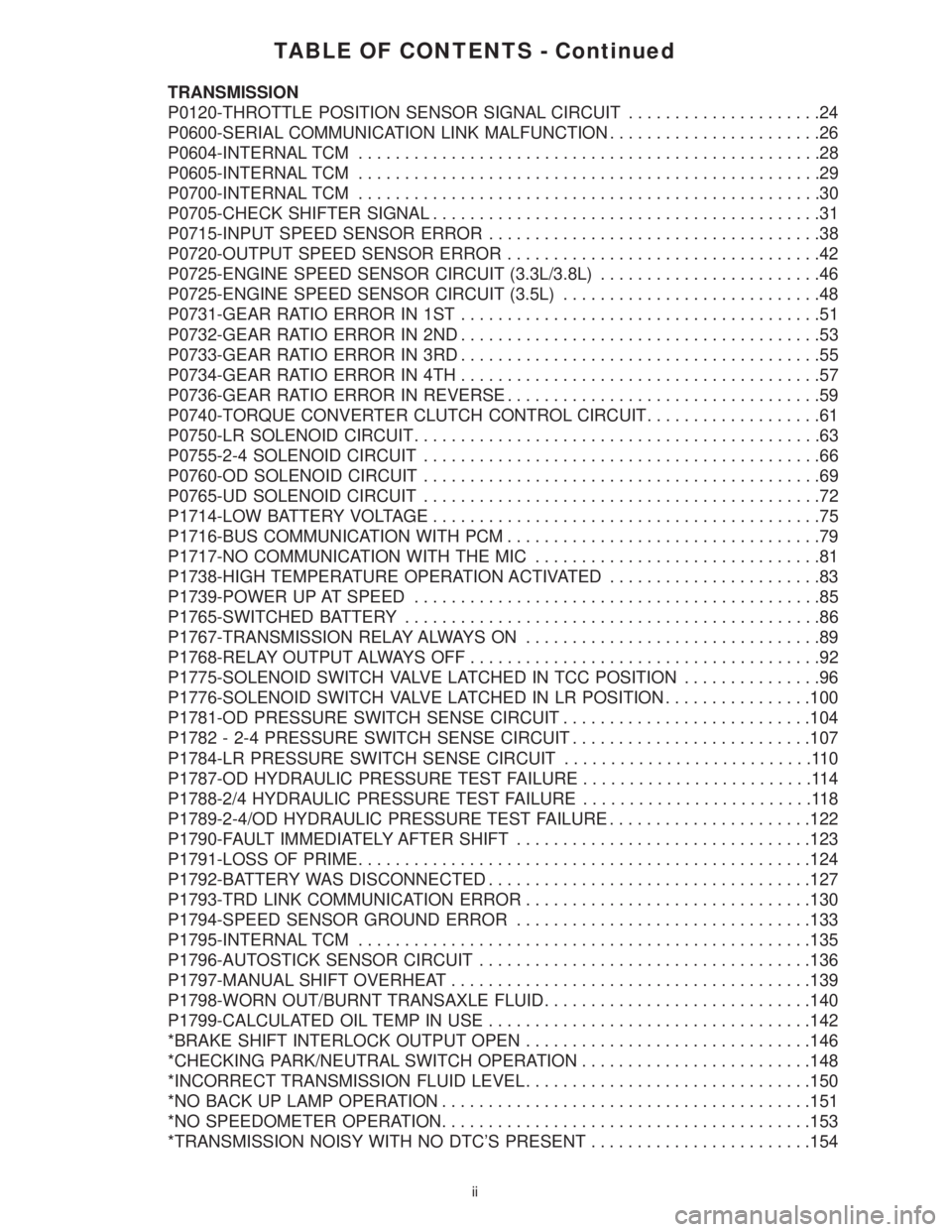
TABLE OF CONTENTS - Continued
TRANSMISSION
P0120-THROTTLE POSITION SENSOR SIGNAL CIRCUIT.....................24
P0600-SERIAL COMMUNICATION LINK MALFUNCTION.......................26
P0604-INTERNAL TCM..................................................28
P0605-INTERNAL TCM..................................................29
P0700-INTERNAL TCM..................................................30
P0705-CHECK SHIFTER SIGNAL..........................................31
P0715-INPUT SPEED SENSOR ERROR....................................38
P0720-OUTPUT SPEED SENSOR ERROR..................................42
P0725-ENGINE SPEED SENSOR CIRCUIT (3.3L/3.8L)........................46
P0725-ENGINE SPEED SENSOR CIRCUIT (3.5L)............................48
P0731-GEAR RATIO ERROR IN 1ST.......................................51
P0732-GEAR RATIO ERROR IN 2ND.......................................53
P0733-GEAR RATIO ERROR IN 3RD.......................................55
P0734-GEAR RATIO ERROR IN 4TH.......................................57
P0736-GEAR RATIO ERROR IN REVERSE..................................59
P0740-TORQUE CONVERTER CLUTCH CONTROL CIRCUIT...................61
P0750-LR SOLENOID CIRCUIT............................................63
P0755-2-4 SOLENOID CIRCUIT...........................................66
P0760-OD SOLENOID CIRCUIT...........................................69
P0765-UD SOLENOID CIRCUIT...........................................72
P1714-LOW BATTERY VOLTAGE..........................................75
P1716-BUS COMMUNICATION WITH PCM..................................79
P1717-NO COMMUNICATION WITH THE MIC...............................81
P1738-HIGH TEMPERATURE OPERATION ACTIVATED.......................83
P1739-POWER UP AT SPEED............................................85
P1765-SWITCHED BATTERY.............................................86
P1767-TRANSMISSION RELAY ALWAYS ON................................89
P1768-RELAY OUTPUT ALWAYS OFF......................................92
P1775-SOLENOID SWITCH VALVE LATCHED IN TCC POSITION...............96
P1776-SOLENOID SWITCH VALVE LATCHED IN LR POSITION................100
P1781-OD PRESSURE SWITCH SENSE CIRCUIT...........................104
P1782 - 2-4 PRESSURE SWITCH SENSE CIRCUIT..........................107
P1784-LR PRESSURE SWITCH SENSE CIRCUIT...........................110
P1787-OD HYDRAULIC PRESSURE TEST FAILURE.........................114
P1788-2/4 HYDRAULIC PRESSURE TEST FAILURE.........................118
P1789-2-4/OD HYDRAULIC PRESSURE TEST FAILURE......................122
P1790-FAULT IMMEDIATELY AFTER SHIFT................................123
P1791-LOSS OF PRIME.................................................124
P1792-BATTERY WAS DISCONNECTED...................................127
P1793-TRD LINK COMMUNICATION ERROR...............................130
P1794-SPEED SENSOR GROUND ERROR................................133
P1795-INTERNAL TCM.................................................135
P1796-AUTOSTICK SENSOR CIRCUIT....................................136
P1797-MANUAL SHIFT OVERHEAT.......................................139
P1798-WORN OUT/BURNT TRANSAXLE FLUID.............................140
P1799-CALCULATED OIL TEMP IN USE...................................142
*BRAKE SHIFT INTERLOCK OUTPUT OPEN...............................146
*CHECKING PARK/NEUTRAL SWITCH OPERATION.........................148
*INCORRECT TRANSMISSION FLUID LEVEL...............................150
*NO BACK UP LAMP OPERATION........................................151
*NO SPEEDOMETER OPERATION........................................153
*TRANSMISSION NOISY WITH NO DTC'S PRESENT........................154
ii
Page 4103 of 4284
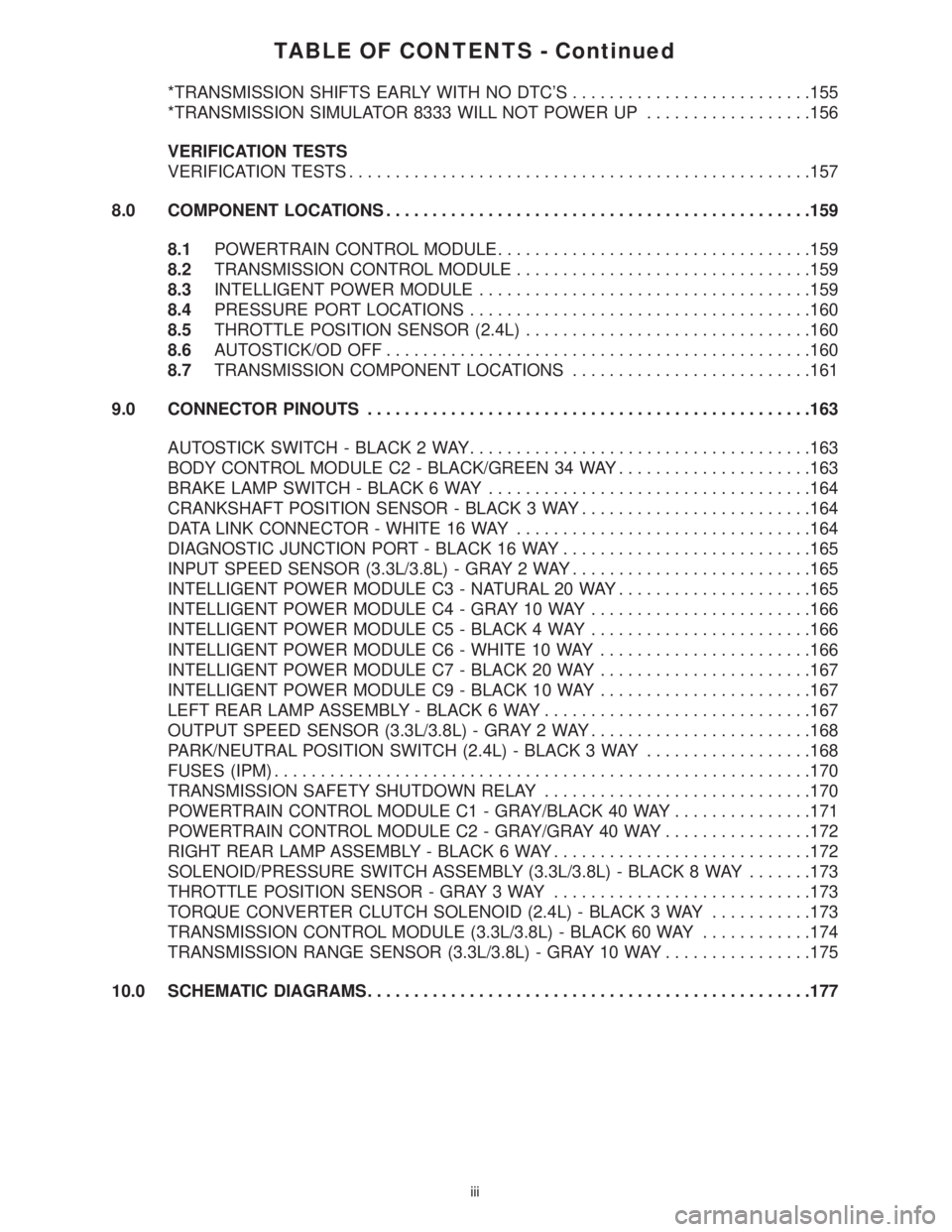
TABLE OF CONTENTS - Continued
*TRANSMISSION SHIFTS EARLY WITH NO DTC'S..........................155
*TRANSMISSION SIMULATOR 8333 WILL NOT POWER UP..................156
VERIFICATION TESTS
VERIFICATION TESTS..................................................157
8.0 COMPONENT LOCATIONS..............................................159
8.1POWERTRAIN CONTROL MODULE..................................159
8.2TRANSMISSION CONTROL MODULE................................159
8.3INTELLIGENT POWER MODULE....................................159
8.4PRESSURE PORT LOCATIONS.....................................160
8.5THROTTLE POSITION SENSOR (2.4L)...............................160
8.6AUTOSTICK/OD OFF..............................................160
8.7TRANSMISSION COMPONENT LOCATIONS..........................161
9.0 CONNECTOR PINOUTS................................................163
AUTOSTICK SWITCH - BLACK 2 WAY.....................................163
BODY CONTROL MODULE C2 - BLACK/GREEN 34 WAY.....................163
BRAKE LAMP SWITCH - BLACK 6 WAY...................................164
CRANKSHAFT POSITION SENSOR - BLACK 3 WAY.........................164
DATA LINK CONNECTOR - WHITE 16 WAY................................164
DIAGNOSTIC JUNCTION PORT - BLACK 16 WAY...........................165
INPUT SPEED SENSOR (3.3L/3.8L) - GRAY 2 WAY..........................165
INTELLIGENT POWER MODULE C3 - NATURAL 20 WAY.....................165
INTELLIGENT POWER MODULE C4 - GRAY 10 WAY........................166
INTELLIGENT POWER MODULE C5 - BLACK 4 WAY........................166
INTELLIGENT POWER MODULE C6 - WHITE 10 WAY.......................166
INTELLIGENT POWER MODULE C7 - BLACK 20 WAY.......................167
INTELLIGENT POWER MODULE C9 - BLACK 10 WAY.......................167
LEFT REAR LAMP ASSEMBLY - BLACK 6 WAY.............................167
OUTPUT SPEED SENSOR (3.3L/3.8L) - GRAY 2 WAY........................168
PARK/NEUTRAL POSITION SWITCH (2.4L) - BLACK 3 WAY..................168
FUSES (IPM)..........................................................170
TRANSMISSION SAFETY SHUTDOWN RELAY.............................170
POWERTRAIN CONTROL MODULE C1 - GRAY/BLACK 40 WAY...............171
POWERTRAIN CONTROL MODULE C2 - GRAY/GRAY 40 WAY................172
RIGHT REAR LAMP ASSEMBLY - BLACK 6 WAY............................172
SOLENOID/PRESSURE SWITCH ASSEMBLY (3.3L/3.8L) - BLACK 8 WAY.......173
THROTTLE POSITION SENSOR - GRAY 3 WAY............................173
TORQUE CONVERTER CLUTCH SOLENOID (2.4L) - BLACK 3 WAY...........173
TRANSMISSION CONTROL MODULE (3.3L/3.8L) - BLACK 60 WAY............174
TRANSMISSION RANGE SENSOR (3.3L/3.8L) - GRAY 10 WAY................175
10.0 SCHEMATIC DIAGRAMS................................................177
iii
Page 4105 of 4284
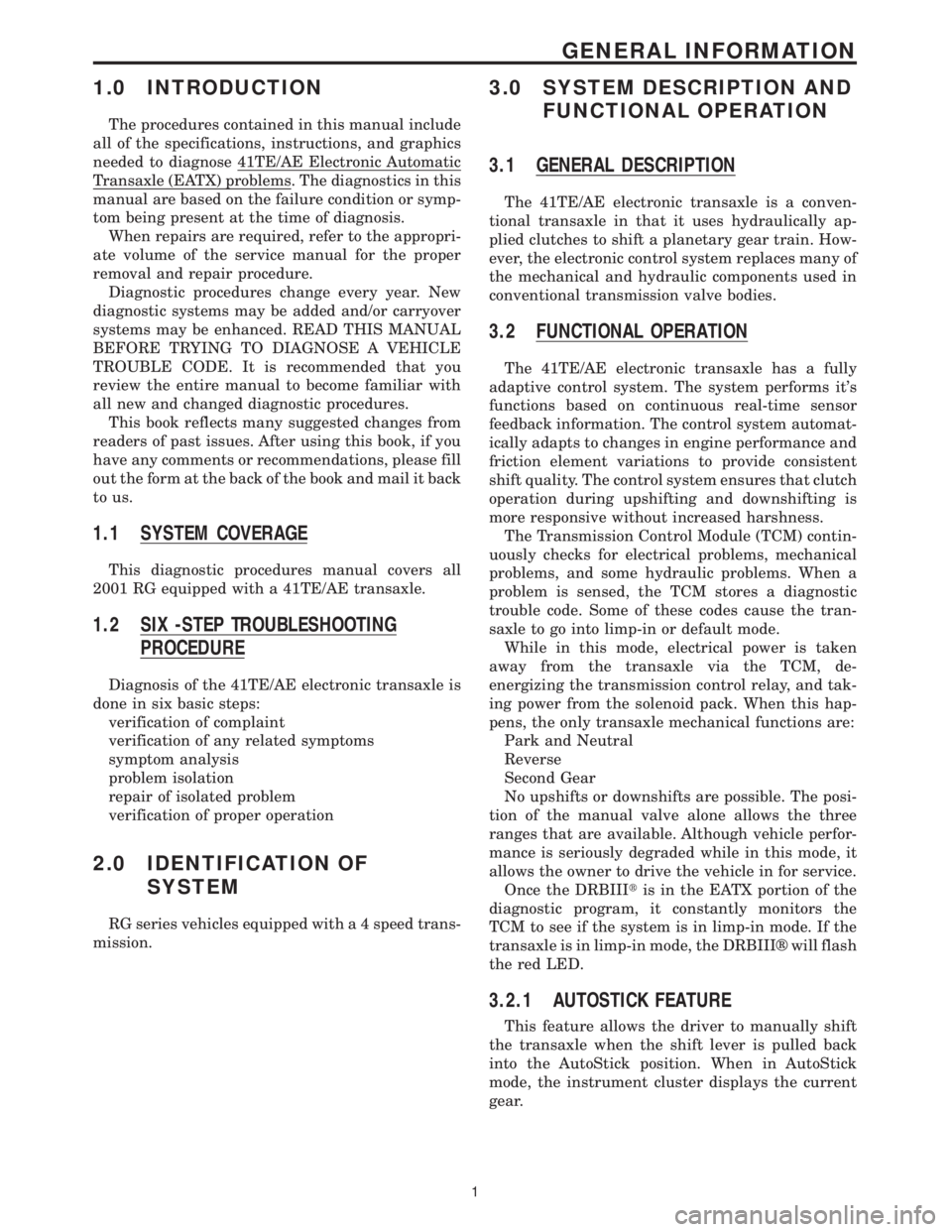
1.0 INTRODUCTION
The procedures contained in this manual include
all of the specifications, instructions, and graphics
needed to diagnose 41TE/AE Electronic Automatic
Transaxle (EATX) problems. The diagnostics in this
manual are based on the failure condition or symp-
tom being present at the time of diagnosis.
When repairs are required, refer to the appropri-
ate volume of the service manual for the proper
removal and repair procedure.
Diagnostic procedures change every year. New
diagnostic systems may be added and/or carryover
systems may be enhanced. READ THIS MANUAL
BEFORE TRYING TO DIAGNOSE A VEHICLE
TROUBLE CODE. It is recommended that you
review the entire manual to become familiar with
all new and changed diagnostic procedures.
This book reflects many suggested changes from
readers of past issues. After using this book, if you
have any comments or recommendations, please fill
out the form at the back of the book and mail it back
to us.
1.1 SYSTEM COVERAGE
This diagnostic procedures manual covers all
2001 RG equipped with a 41TE/AE transaxle.
1.2 SIX -STEP TROUBLESHOOTING
PROCEDURE
Diagnosis of the 41TE/AE electronic transaxle is
done in six basic steps:
verification of complaint
verification of any related symptoms
symptom analysis
problem isolation
repair of isolated problem
verification of proper operation
2.0 IDENTIFICATION OF
SYSTEM
RG series vehicles equipped with a 4 speed trans-
mission.
3.0 SYSTEM DESCRIPTION AND
FUNCTIONAL OPERATION
3.1 GENERAL DESCRIPTION
The 41TE/AE electronic transaxle is a conven-
tional transaxle in that it uses hydraulically ap-
plied clutches to shift a planetary gear train. How-
ever, the electronic control system replaces many of
the mechanical and hydraulic components used in
conventional transmission valve bodies.
3.2 FUNCTIONAL OPERATION
The 41TE/AE electronic transaxle has a fully
adaptive control system. The system performs it's
functions based on continuous real-time sensor
feedback information. The control system automat-
ically adapts to changes in engine performance and
friction element variations to provide consistent
shift quality. The control system ensures that clutch
operation during upshifting and downshifting is
more responsive without increased harshness.
The Transmission Control Module (TCM) contin-
uously checks for electrical problems, mechanical
problems, and some hydraulic problems. When a
problem is sensed, the TCM stores a diagnostic
trouble code. Some of these codes cause the tran-
saxle to go into limp-in or default mode.
While in this mode, electrical power is taken
away from the transaxle via the TCM, de-
energizing the transmission control relay, and tak-
ing power from the solenoid pack. When this hap-
pens, the only transaxle mechanical functions are:
Park and Neutral
Reverse
Second Gear
No upshifts or downshifts are possible. The posi-
tion of the manual valve alone allows the three
ranges that are available. Although vehicle perfor-
mance is seriously degraded while in this mode, it
allows the owner to drive the vehicle in for service.
Once the DRBIIItis in the EATX portion of the
diagnostic program, it constantly monitors the
TCM to see if the system is in limp-in mode. If the
transaxle is in limp-in mode, the DRBIIIž will flash
the red LED.
3.2.1 AUTOSTICK FEATURE
This feature allows the driver to manually shift
the transaxle when the shift lever is pulled back
into the AutoStick position. When in AutoStick
mode, the instrument cluster displays the current
gear.
1
GENERAL INFORMATION
Page 4106 of 4284
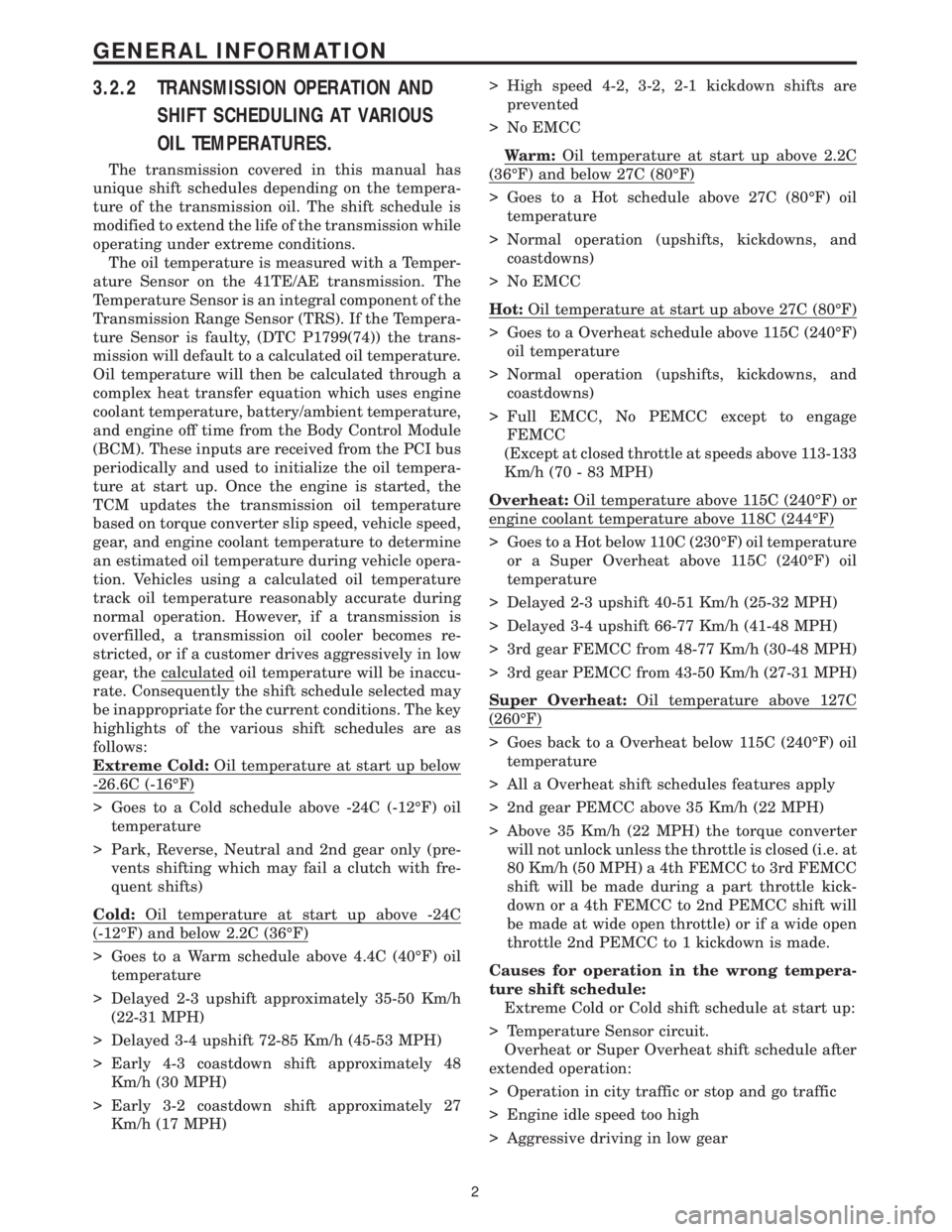
3.2.2 TRANSMISSION OPERATION AND
SHIFT SCHEDULING AT VARIOUS
OIL TEMPERATURES.
The transmission covered in this manual has
unique shift schedules depending on the tempera-
ture of the transmission oil. The shift schedule is
modified to extend the life of the transmission while
operating under extreme conditions.
The oil temperature is measured with a Temper-
ature Sensor on the 41TE/AE transmission. The
Temperature Sensor is an integral component of the
Transmission Range Sensor (TRS). If the Tempera-
ture Sensor is faulty, (DTC P1799(74)) the trans-
mission will default to a calculated oil temperature.
Oil temperature will then be calculated through a
complex heat transfer equation which uses engine
coolant temperature, battery/ambient temperature,
and engine off time from the Body Control Module
(BCM). These inputs are received from the PCI bus
periodically and used to initialize the oil tempera-
ture at start up. Once the engine is started, the
TCM updates the transmission oil temperature
based on torque converter slip speed, vehicle speed,
gear, and engine coolant temperature to determine
an estimated oil temperature during vehicle opera-
tion. Vehicles using a calculated oil temperature
track oil temperature reasonably accurate during
normal operation. However, if a transmission is
overfilled, a transmission oil cooler becomes re-
stricted, or if a customer drives aggressively in low
gear, the calculated oil temperature will be inaccu-
rate. Consequently the shift schedule selected may
be inappropriate for the current conditions. The key
highlights of the various shift schedules are as
follows:
Extreme Cold:Oil temperature at start up below
-26.6C (-16ÉF)
> Goes to a Cold schedule above -24C (-12ÉF) oil
temperature
> Park, Reverse, Neutral and 2nd gear only (pre-
vents shifting which may fail a clutch with fre-
quent shifts)
Cold:Oil temperature at start up above -24C
(-12ÉF) and below 2.2C (36ÉF)
> Goes to a Warm schedule above 4.4C (40ÉF) oil
temperature
> Delayed 2-3 upshift approximately 35-50 Km/h
(22-31 MPH)
> Delayed 3-4 upshift 72-85 Km/h (45-53 MPH)
> Early 4-3 coastdown shift approximately 48
Km/h (30 MPH)
> Early 3-2 coastdown shift approximately 27
Km/h (17 MPH)> High speed 4-2, 3-2, 2-1 kickdown shifts are
prevented
> No EMCC
Warm:Oil temperature at start up above 2.2C
(36ÉF) and below 27C (80ÉF)
> Goes to a Hot schedule above 27C (80ÉF) oil
temperature
> Normal operation (upshifts, kickdowns, and
coastdowns)
> No EMCC
Hot:Oil temperature at start up above 27C (80ÉF)
> Goes to a Overheat schedule above 115C (240ÉF)
oil temperature
> Normal operation (upshifts, kickdowns, and
coastdowns)
> Full EMCC, No PEMCC except to engage
FEMCC
(Except at closed throttle at speeds above 113-133
Km/h (70 - 83 MPH)
Overheat:Oil temperature above 115C (240ÉF) or
engine coolant temperature above 118C (244ÉF)
> Goes to a Hot below 110C (230ÉF) oil temperature
or a Super Overheat above 115C (240ÉF) oil
temperature
> Delayed 2-3 upshift 40-51 Km/h (25-32 MPH)
> Delayed 3-4 upshift 66-77 Km/h (41-48 MPH)
> 3rd gear FEMCC from 48-77 Km/h (30-48 MPH)
> 3rd gear PEMCC from 43-50 Km/h (27-31 MPH)
Super Overheat:Oil temperature above 127C
(260ÉF)
> Goes back to a Overheat below 115C (240ÉF) oil
temperature
> All a Overheat shift schedules features apply
> 2nd gear PEMCC above 35 Km/h (22 MPH)
> Above 35 Km/h (22 MPH) the torque converter
will not unlock unless the throttle is closed (i.e. at
80 Km/h (50 MPH) a 4th FEMCC to 3rd FEMCC
shift will be made during a part throttle kick-
down or a 4th FEMCC to 2nd PEMCC shift will
be made at wide open throttle) or if a wide open
throttle 2nd PEMCC to 1 kickdown is made.
Causes for operation in the wrong tempera-
ture shift schedule:
Extreme Cold or Cold shift schedule at start up:
> Temperature Sensor circuit.
Overheat or Super Overheat shift schedule after
extended operation:
> Operation in city traffic or stop and go traffic
> Engine idle speed too high
> Aggressive driving in low gear
2
GENERAL INFORMATION
Page 4107 of 4284
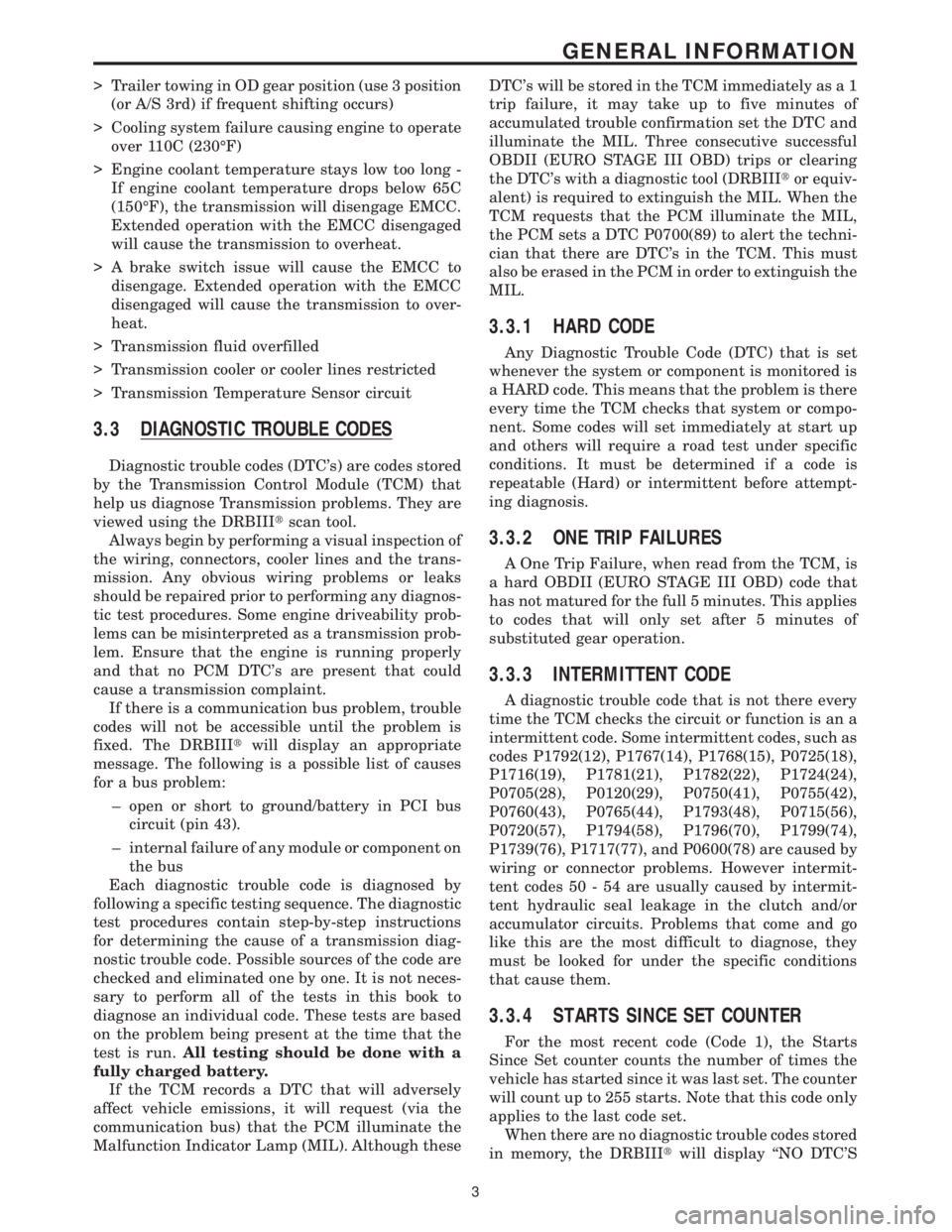
> Trailer towing in OD gear position (use 3 position
(or A/S 3rd) if frequent shifting occurs)
> Cooling system failure causing engine to operate
over 110C (230ÉF)
> Engine coolant temperature stays low too long -
If engine coolant temperature drops below 65C
(150ÉF), the transmission will disengage EMCC.
Extended operation with the EMCC disengaged
will cause the transmission to overheat.
> A brake switch issue will cause the EMCC to
disengage. Extended operation with the EMCC
disengaged will cause the transmission to over-
heat.
> Transmission fluid overfilled
> Transmission cooler or cooler lines restricted
> Transmission Temperature Sensor circuit
3.3 DIAGNOSTIC TROUBLE CODES
Diagnostic trouble codes (DTC's) are codes stored
by the Transmission Control Module (TCM) that
help us diagnose Transmission problems. They are
viewed using the DRBIIItscan tool.
Always begin by performing a visual inspection of
the wiring, connectors, cooler lines and the trans-
mission. Any obvious wiring problems or leaks
should be repaired prior to performing any diagnos-
tic test procedures. Some engine driveability prob-
lems can be misinterpreted as a transmission prob-
lem. Ensure that the engine is running properly
and that no PCM DTC's are present that could
cause a transmission complaint.
If there is a communication bus problem, trouble
codes will not be accessible until the problem is
fixed. The DRBIIItwill display an appropriate
message. The following is a possible list of causes
for a bus problem:
± open or short to ground/battery in PCI bus
circuit (pin 43).
± internal failure of any module or component on
the bus
Each diagnostic trouble code is diagnosed by
following a specific testing sequence. The diagnostic
test procedures contain step-by-step instructions
for determining the cause of a transmission diag-
nostic trouble code. Possible sources of the code are
checked and eliminated one by one. It is not neces-
sary to perform all of the tests in this book to
diagnose an individual code. These tests are based
on the problem being present at the time that the
test is run.All testing should be done with a
fully charged battery.
If the TCM records a DTC that will adversely
affect vehicle emissions, it will request (via the
communication bus) that the PCM illuminate the
Malfunction Indicator Lamp (MIL). Although theseDTC's will be stored in the TCM immediately as a 1
trip failure, it may take up to five minutes of
accumulated trouble confirmation set the DTC and
illuminate the MIL. Three consecutive successful
OBDII (EURO STAGE III OBD) trips or clearing
the DTC's with a diagnostic tool (DRBIIItor equiv-
alent) is required to extinguish the MIL. When the
TCM requests that the PCM illuminate the MIL,
the PCM sets a DTC P0700(89) to alert the techni-
cian that there are DTC's in the TCM. This must
also be erased in the PCM in order to extinguish the
MIL.
3.3.1 HARD CODE
Any Diagnostic Trouble Code (DTC) that is set
whenever the system or component is monitored is
a HARD code. This means that the problem is there
every time the TCM checks that system or compo-
nent. Some codes will set immediately at start up
and others will require a road test under specific
conditions. It must be determined if a code is
repeatable (Hard) or intermittent before attempt-
ing diagnosis.
3.3.2 ONE TRIP FAILURES
A One Trip Failure, when read from the TCM, is
a hard OBDII (EURO STAGE III OBD) code that
has not matured for the full 5 minutes. This applies
to codes that will only set after 5 minutes of
substituted gear operation.
3.3.3 INTERMITTENT CODE
A diagnostic trouble code that is not there every
time the TCM checks the circuit or function is an a
intermittent code. Some intermittent codes, such as
codes P1792(12), P1767(14), P1768(15), P0725(18),
P1716(19), P1781(21), P1782(22), P1724(24),
P0705(28), P0120(29), P0750(41), P0755(42),
P0760(43), P0765(44), P1793(48), P0715(56),
P0720(57), P1794(58), P1796(70), P1799(74),
P1739(76), P1717(77), and P0600(78) are caused by
wiring or connector problems. However intermit-
tent codes 50 - 54 are usually caused by intermit-
tent hydraulic seal leakage in the clutch and/or
accumulator circuits. Problems that come and go
like this are the most difficult to diagnose, they
must be looked for under the specific conditions
that cause them.
3.3.4 STARTS SINCE SET COUNTER
For the most recent code (Code 1), the Starts
Since Set counter counts the number of times the
vehicle has started since it was last set. The counter
will count up to 255 starts. Note that this code only
applies to the last code set.
When there are no diagnostic trouble codes stored
in memory, the DRBIIItwill display ``NO DTC'S
3
GENERAL INFORMATION
Page 4108 of 4284
PRESENT'' and the reset counter will show
``STARTS SINCE CLEAR = XXX''.
The number of starts helps determine if the
diagnostic trouble code is hard or intermittent.
± If the count is less than 3, the code is usually a
hard code.
± If the count is greater than 3, it is considered
an intermittent code. This means that the
engine has been started most of the time
without the code recurring.
3.3.5 TROUBLE CODE ERASURE
A Diagnostic trouble code will be cleared from
TCM memory if it has not reset for 40 warm-up
cycles.A warm-up cycle is defined as sufficient vehicle
operation such that the coolant temperature has
risen by at least 4.4C (40ÉF) from engine starting
and reaches a minimum temperature of 71C
(160ÉF).
The Malfunction Indicator Lamp (MIL) will turn
off after 3 good trips or when the DTC's are cleared
from the TCM.
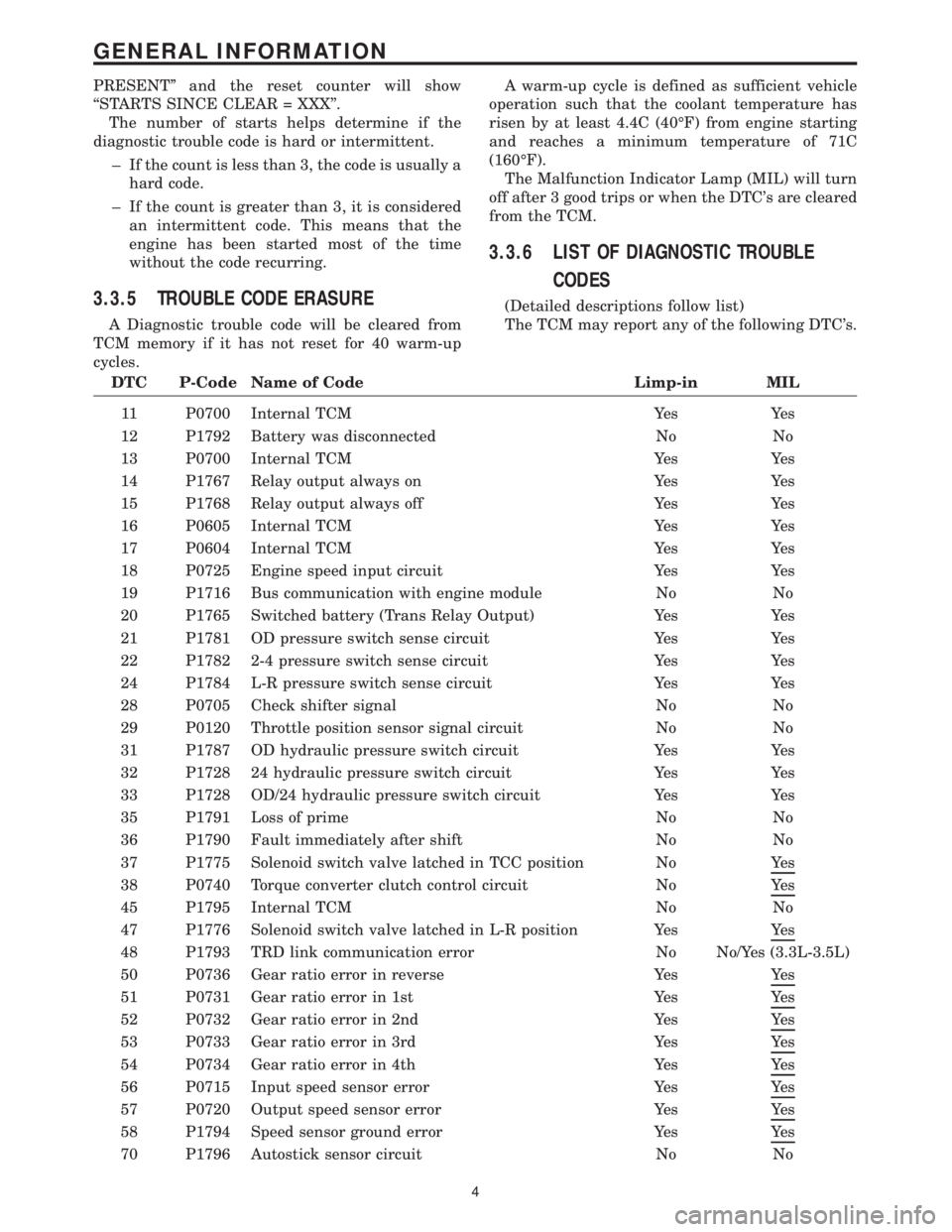
3.3.6 LIST OF DIAGNOSTIC TROUBLE
CODES
(Detailed descriptions follow list)
The TCM may report any of the following DTC's.
DTC P-Code Name of Code Limp-in MIL
11 P0700 Internal TCM Yes Yes
12 P1792 Battery was disconnected No No
13 P0700 Internal TCM Yes Yes
14 P1767 Relay output always on Yes Yes
15 P1768 Relay output always off Yes Yes
16 P0605 Internal TCM Yes Yes
17 P0604 Internal TCM Yes Yes
18 P0725 Engine speed input circuit Yes Yes
19 P1716 Bus communication with engine module No No
20 P1765 Switched battery (Trans Relay Output) Yes Yes
21 P1781 OD pressure switch sense circuit Yes Yes
22 P1782 2-4 pressure switch sense circuit Yes Yes
24 P1784 L-R pressure switch sense circuit Yes Yes
28 P0705 Check shifter signal No No
29 P0120 Throttle position sensor signal circuit No No
31 P1787 OD hydraulic pressure switch circuit Yes Yes
32 P1728 24 hydraulic pressure switch circuit Yes Yes
33 P1728 OD/24 hydraulic pressure switch circuit Yes Yes
35 P1791 Loss of prime No No
36 P1790 Fault immediately after shift No No
37 P1775 Solenoid switch valve latched in TCC position No Yes
38 P0740 Torque converter clutch control circuit No Yes
45 P1795 Internal TCM No No
47 P1776 Solenoid switch valve latched in L-R position Yes Yes
48 P1793 TRD link communication error No No/Yes (3.3L-3.5L)
50 P0736 Gear ratio error in reverse Yes Yes
51 P0731 Gear ratio error in 1st Yes Yes
52 P0732 Gear ratio error in 2nd Yes Yes
53 P0733 Gear ratio error in 3rd Yes Yes
54 P0734 Gear ratio error in 4th Yes Yes
56 P0715 Input speed sensor error Yes Yes
57 P0720 Output speed sensor error Yes Yes
58 P1794 Speed sensor ground error Yes Yes
70 P1796 Autostick sensor circuit No No
4
GENERAL INFORMATION
Page 4111 of 4284
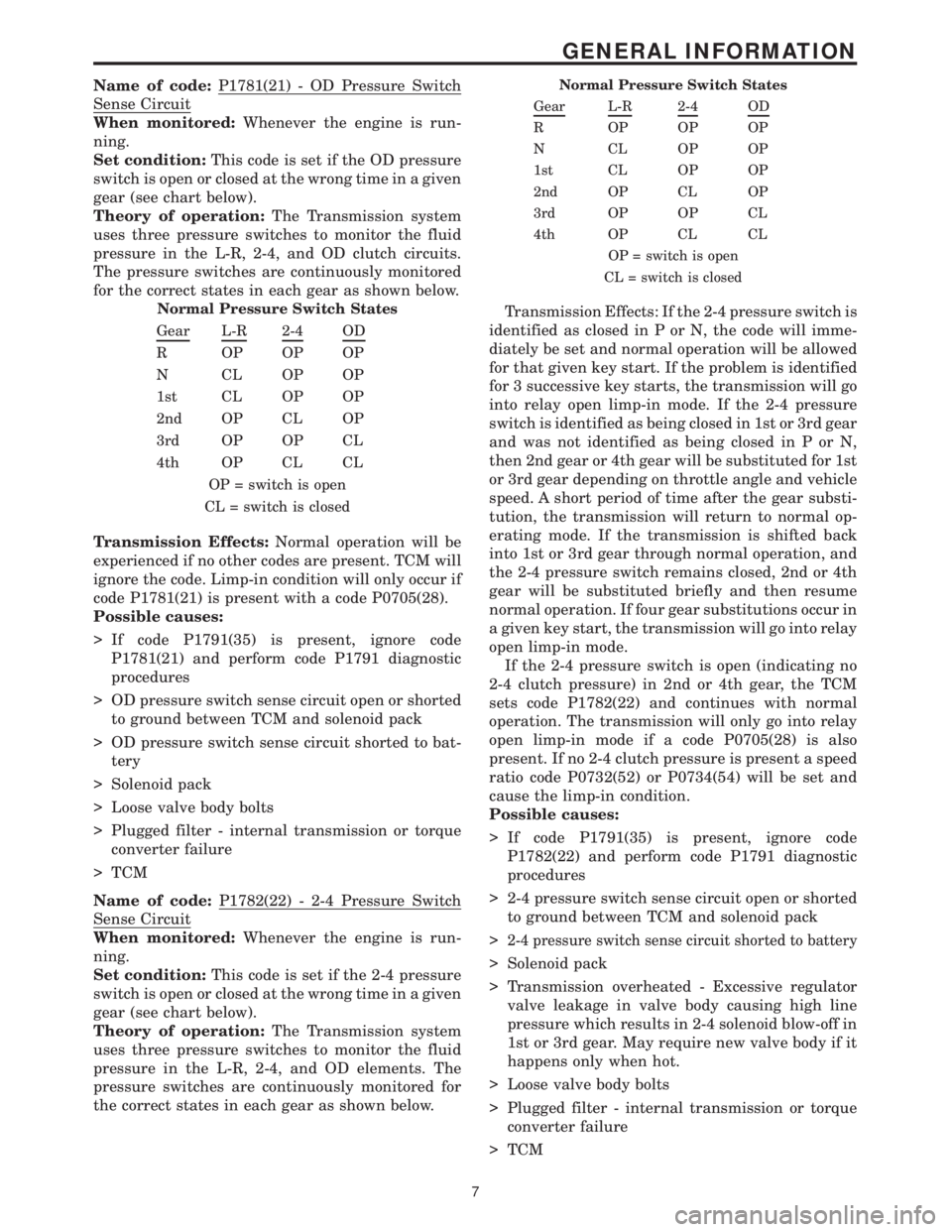
Name of code:P1781(21) - OD Pressure Switch
Sense Circuit
When monitored:Whenever the engine is run-
ning.
Set condition:This code is set if the OD pressure
switch is open or closed at the wrong time in a given
gear (see chart below).
Theory of operation:The Transmission system
uses three pressure switches to monitor the fluid
pressure in the L-R, 2-4, and OD clutch circuits.
The pressure switches are continuously monitored
for the correct states in each gear as shown below.
Normal Pressure Switch States
Gear
L-R2-4OD
R OPOPOP
NCLOPOP
1st CL OP OP
2nd OP CL OP
3rd OP OP CL
4th OP CL CL
OP = switch is open
CL = switch is closed
Transmission Effects:Normal operation will be
experienced if no other codes are present. TCM will
ignore the code. Limp-in condition will only occur if
code P1781(21) is present with a code P0705(28).
Possible causes:
> If code P1791(35) is present, ignore code
P1781(21) and perform code P1791 diagnostic
procedures
> OD pressure switch sense circuit open or shorted
to ground between TCM and solenoid pack
> OD pressure switch sense circuit shorted to bat-
tery
> Solenoid pack
> Loose valve body bolts
> Plugged filter - internal transmission or torque
converter failure
> TCM
Name of code:P1782(22) - 2-4 Pressure Switch
Sense Circuit
When monitored:Whenever the engine is run-
ning.
Set condition:This code is set if the 2-4 pressure
switch is open or closed at the wrong time in a given
gear (see chart below).
Theory of operation:The Transmission system
uses three pressure switches to monitor the fluid
pressure in the L-R, 2-4, and OD elements. The
pressure switches are continuously monitored for
the correct states in each gear as shown below.
Normal Pressure Switch States
Gear
L-R2-4OD
R OPOPOP
NCLOPOP
1st CL OP OP
2nd OP CL OP
3rd OP OP CL
4th OP CL CL
OP = switch is open
CL = switch is closed
Transmission Effects: If the 2-4 pressure switch is
identified as closed in P or N, the code will imme-
diately be set and normal operation will be allowed
for that given key start. If the problem is identified
for 3 successive key starts, the transmission will go
into relay open limp-in mode. If the 2-4 pressure
switch is identified as being closed in 1st or 3rd gear
and was not identified as being closed in P or N,
then 2nd gear or 4th gear will be substituted for 1st
or 3rd gear depending on throttle angle and vehicle
speed. A short period of time after the gear substi-
tution, the transmission will return to normal op-
erating mode. If the transmission is shifted back
into 1st or 3rd gear through normal operation, and
the 2-4 pressure switch remains closed, 2nd or 4th
gear will be substituted briefly and then resume
normal operation. If four gear substitutions occur in
a given key start, the transmission will go into relay
open limp-in mode.
If the 2-4 pressure switch is open (indicating no
2-4 clutch pressure) in 2nd or 4th gear, the TCM
sets code P1782(22) and continues with normal
operation. The transmission will only go into relay
open limp-in mode if a code P0705(28) is also
present. If no 2-4 clutch pressure is present a speed
ratio code P0732(52) or P0734(54) will be set and
cause the limp-in condition.
Possible causes:
> If code P1791(35) is present, ignore code
P1782(22) and perform code P1791 diagnostic
procedures
> 2-4 pressure switch sense circuit open or shorted
to ground between TCM and solenoid pack
>
2-4 pressure switch sense circuit shorted to battery
> Solenoid pack
> Transmission overheated - Excessive regulator
valve leakage in valve body causing high line
pressure which results in 2-4 solenoid blow-off in
1st or 3rd gear. May require new valve body if it
happens only when hot.
> Loose valve body bolts
> Plugged filter - internal transmission or torque
converter failure
> TCM
7
GENERAL INFORMATION
Page 4113 of 4284
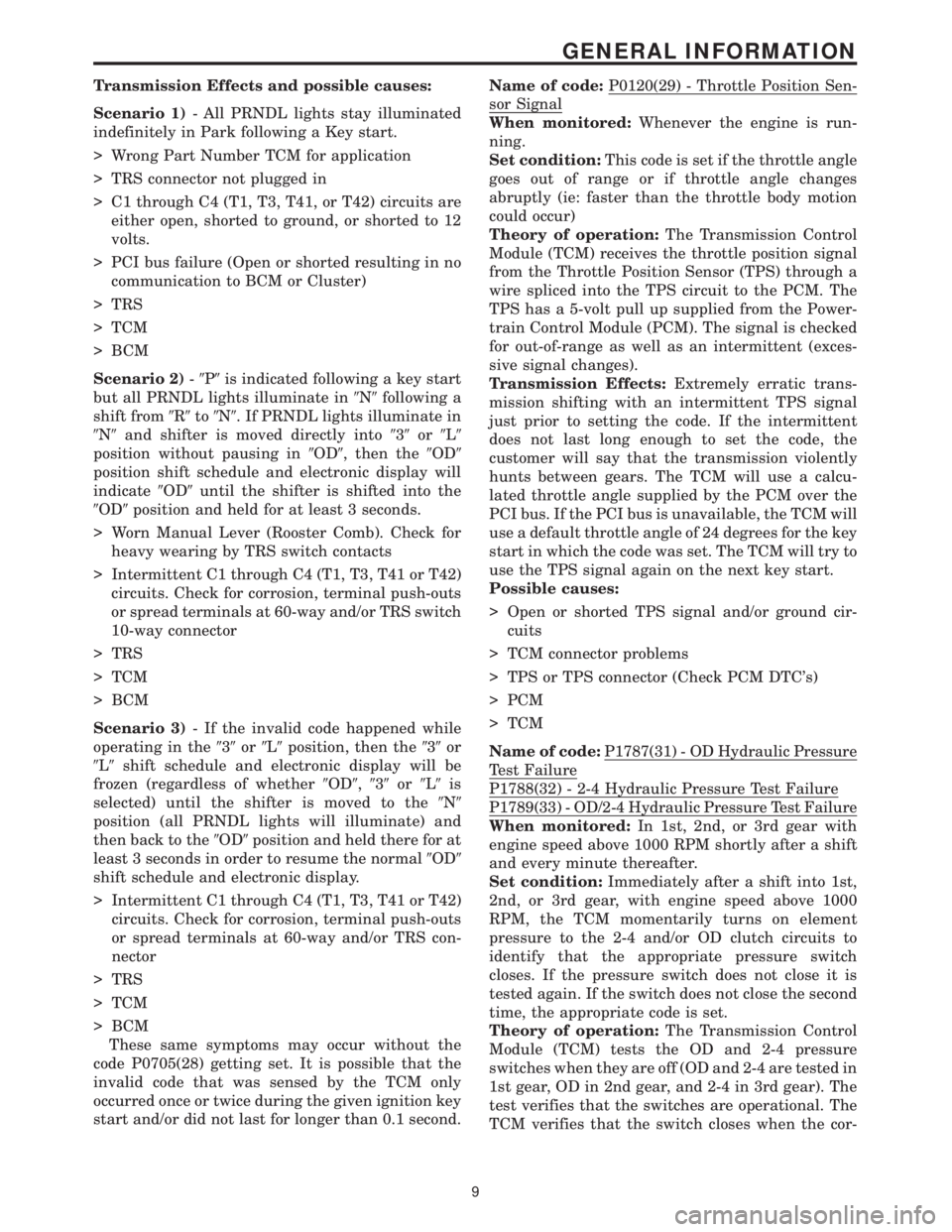
Transmission Effects and possible causes:
Scenario 1)- All PRNDL lights stay illuminated
indefinitely in Park following a Key start.
> Wrong Part Number TCM for application
> TRS connector not plugged in
> C1 through C4 (T1, T3, T41, or T42) circuits are
either open, shorted to ground, or shorted to 12
volts.
> PCI bus failure (Open or shorted resulting in no
communication to BCM or Cluster)
> TRS
> TCM
> BCM
Scenario 2)-9P9is indicated following a key start
but all PRNDL lights illuminate in9N9following a
shift from9R9to9N9. If PRNDL lights illuminate in
9N9and shifter is moved directly into939or9L9
position without pausing in9OD9, then the9OD9
position shift schedule and electronic display will
indicate9OD9until the shifter is shifted into the
9OD9position and held for at least 3 seconds.
> Worn Manual Lever (Rooster Comb). Check for
heavy wearing by TRS switch contacts
> Intermittent C1 through C4 (T1, T3, T41 or T42)
circuits. Check for corrosion, terminal push-outs
or spread terminals at 60-way and/or TRS switch
10-way connector
> TRS
> TCM
> BCM
Scenario 3)- If the invalid code happened while
operating in the939or9L9position, then the939or
9L9shift schedule and electronic display will be
frozen (regardless of whether9OD9,939or9L9is
selected) until the shifter is moved to the9N9
position (all PRNDL lights will illuminate) and
then back to the9OD9position and held there for at
least 3 seconds in order to resume the normal9OD9
shift schedule and electronic display.
> Intermittent C1 through C4 (T1, T3, T41 or T42)
circuits. Check for corrosion, terminal push-outs
or spread terminals at 60-way and/or TRS con-
nector
> TRS
> TCM
> BCM
These same symptoms may occur without the
code P0705(28) getting set. It is possible that the
invalid code that was sensed by the TCM only
occurred once or twice during the given ignition key
start and/or did not last for longer than 0.1 second.Name of code:P0120(29) - Throttle Position Sen-
sor Signal
When monitored:Whenever the engine is run-
ning.
Set condition:This code is set if the throttle angle
goes out of range or if throttle angle changes
abruptly (ie: faster than the throttle body motion
could occur)
Theory of operation:The Transmission Control
Module (TCM) receives the throttle position signal
from the Throttle Position Sensor (TPS) through a
wire spliced into the TPS circuit to the PCM. The
TPS has a 5-volt pull up supplied from the Power-
train Control Module (PCM). The signal is checked
for out-of-range as well as an intermittent (exces-
sive signal changes).
Transmission Effects:Extremely erratic trans-
mission shifting with an intermittent TPS signal
just prior to setting the code. If the intermittent
does not last long enough to set the code, the
customer will say that the transmission violently
hunts between gears. The TCM will use a calcu-
lated throttle angle supplied by the PCM over the
PCI bus. If the PCI bus is unavailable, the TCM will
use a default throttle angle of 24 degrees for the key
start in which the code was set. The TCM will try to
use the TPS signal again on the next key start.
Possible causes:
> Open or shorted TPS signal and/or ground cir-
cuits
> TCM connector problems
> TPS or TPS connector (Check PCM DTC's)
> PCM
> TCM
Name of code:P1787(31) - OD Hydraulic Pressure
Test Failure
P1788(32) - 2-4 Hydraulic Pressure Test Failure
P1789(33) - OD/2-4 Hydraulic Pressure Test Failure
When monitored:In 1st, 2nd, or 3rd gear with
engine speed above 1000 RPM shortly after a shift
and every minute thereafter.
Set condition:Immediately after a shift into 1st,
2nd, or 3rd gear, with engine speed above 1000
RPM, the TCM momentarily turns on element
pressure to the 2-4 and/or OD clutch circuits to
identify that the appropriate pressure switch
closes. If the pressure switch does not close it is
tested again. If the switch does not close the second
time, the appropriate code is set.
Theory of operation:The Transmission Control
Module (TCM) tests the OD and 2-4 pressure
switches when they are off (OD and 2-4 are tested in
1st gear, OD in 2nd gear, and 2-4 in 3rd gear). The
test verifies that the switches are operational. The
TCM verifies that the switch closes when the cor-
9
GENERAL INFORMATION