2001 CHRYSLER VOYAGER reset
[x] Cancel search: resetPage 4067 of 4284
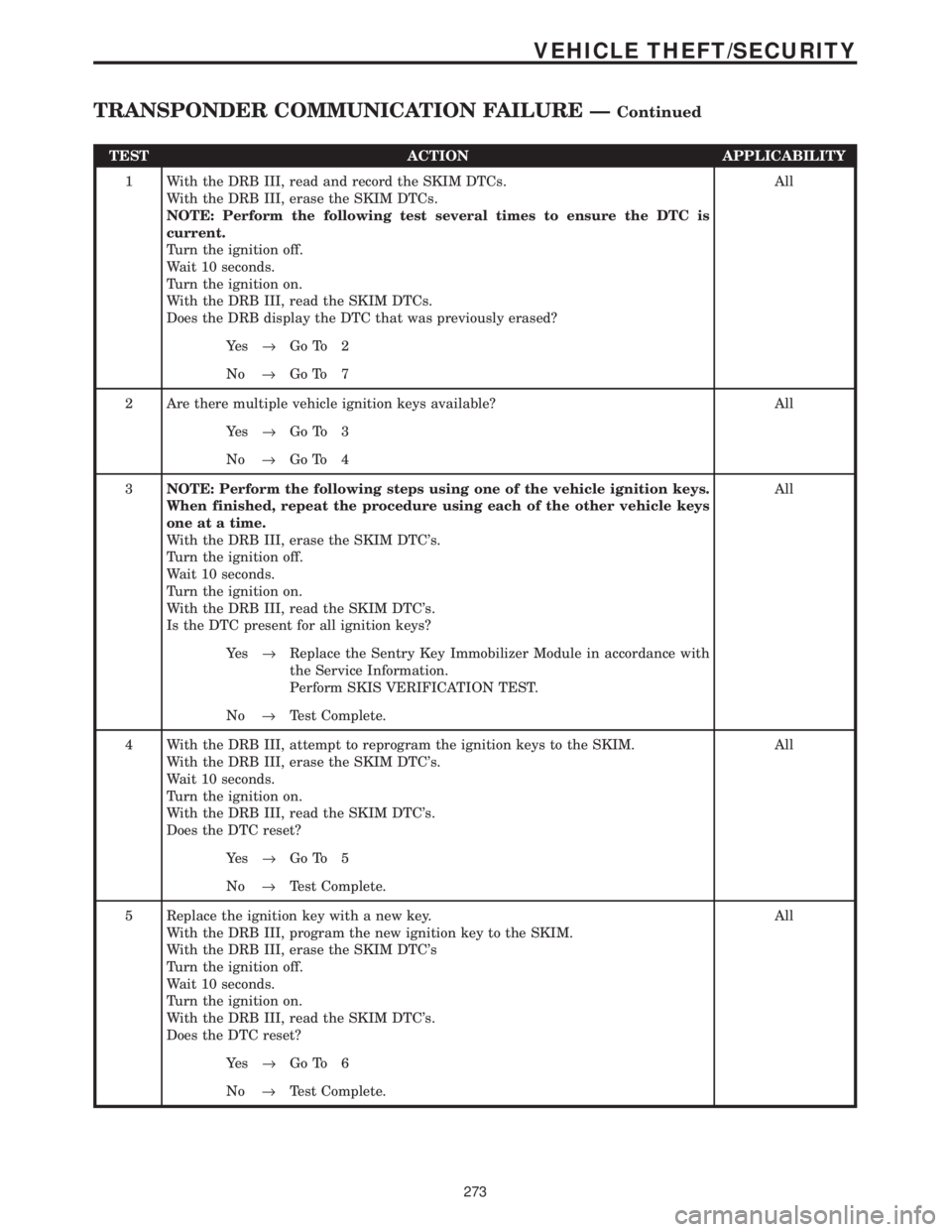
TEST ACTION APPLICABILITY
1 With the DRB III, read and record the SKIM DTCs.
With the DRB III, erase the SKIM DTCs.
NOTE: Perform the following test several times to ensure the DTC is
current.
Turn the ignition off.
Wait 10 seconds.
Turn the ignition on.
With the DRB III, read the SKIM DTCs.
Does the DRB display the DTC that was previously erased?All
Ye s®Go To 2
No®Go To 7
2 Are there multiple vehicle ignition keys available? All
Ye s®Go To 3
No®Go To 4
3NOTE: Perform the following steps using one of the vehicle ignition keys.
When finished, repeat the procedure using each of the other vehicle keys
one at a time.
With the DRB III, erase the SKIM DTC's.
Turn the ignition off.
Wait 10 seconds.
Turn the ignition on.
With the DRB III, read the SKIM DTC's.
Is the DTC present for all ignition keys?All
Ye s®Replace the Sentry Key Immobilizer Module in accordance with
the Service Information.
Perform SKIS VERIFICATION TEST.
No®Test Complete.
4 With the DRB III, attempt to reprogram the ignition keys to the SKIM.
With the DRB III, erase the SKIM DTC's.
Wait 10 seconds.
Turn the ignition on.
With the DRB III, read the SKIM DTC's.
Does the DTC reset?All
Ye s®Go To 5
No®Test Complete.
5 Replace the ignition key with a new key.
With the DRB III, program the new ignition key to the SKIM.
With the DRB III, erase the SKIM DTC's
Turn the ignition off.
Wait 10 seconds.
Turn the ignition on.
With the DRB III, read the SKIM DTC's.
Does the DTC reset?All
Ye s®Go To 6
No®Test Complete.
273
VEHICLE THEFT/SECURITY
TRANSPONDER COMMUNICATION FAILURE ÐContinued
Page 4069 of 4284
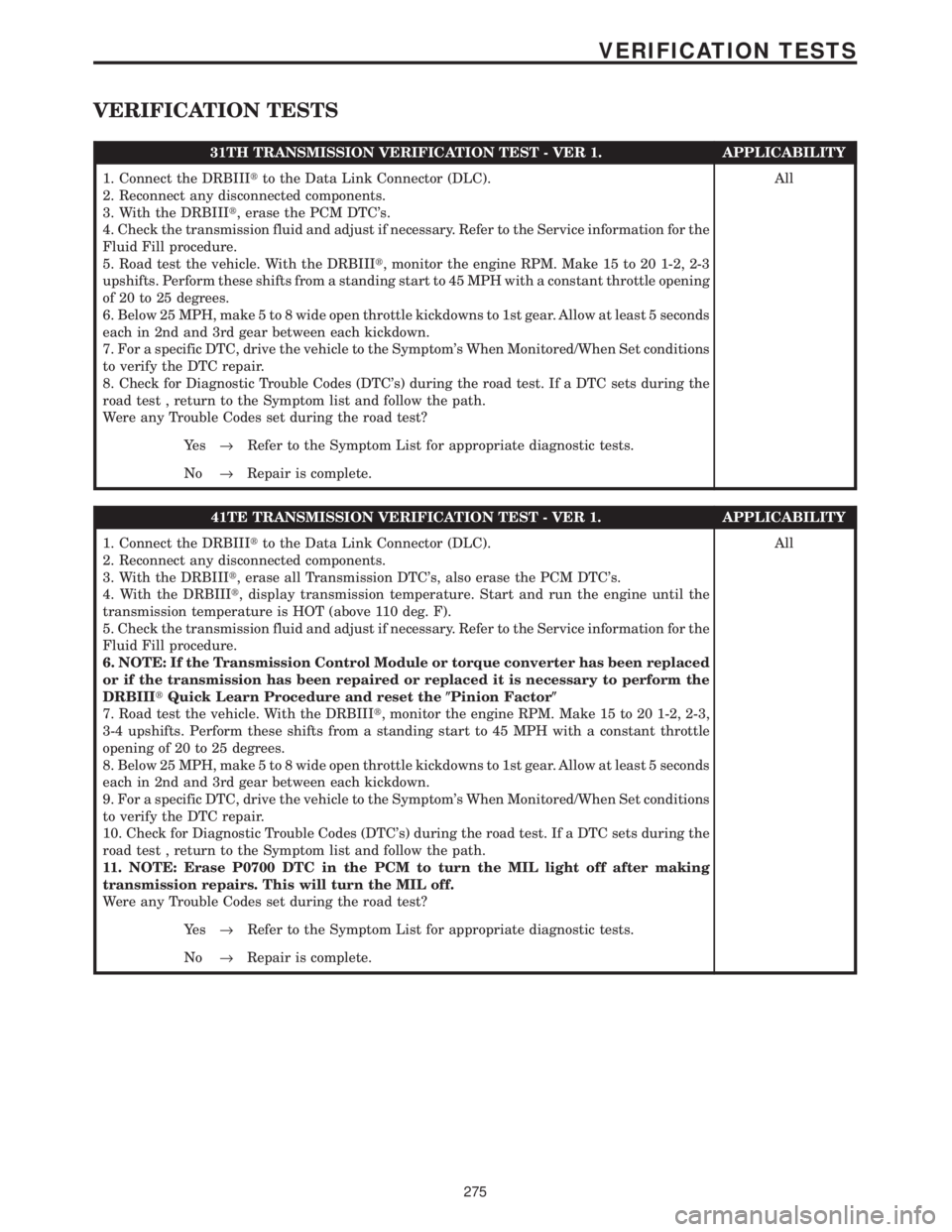
VERIFICATION TESTS
31TH TRANSMISSION VERIFICATION TEST - VER 1. APPLICABILITY
1. Connect the DRBIIItto the Data Link Connector (DLC).
2. Reconnect any disconnected components.
3. With the DRBIIIt, erase the PCM DTC's.
4. Check the transmission fluid and adjust if necessary. Refer to the Service information for the
Fluid Fill procedure.
5. Road test the vehicle. With the DRBIIIt, monitor the engine RPM. Make 15 to 20 1-2, 2-3
upshifts. Perform these shifts from a standing start to 45 MPH with a constant throttle opening
of 20 to 25 degrees.
6. Below 25 MPH, make 5 to 8 wide open throttle kickdowns to 1st gear. Allow at least 5 seconds
each in 2nd and 3rd gear between each kickdown.
7. For a specific DTC, drive the vehicle to the Symptom's When Monitored/When Set conditions
to verify the DTC repair.
8. Check for Diagnostic Trouble Codes (DTC's) during the road test. If a DTC sets during the
road test , return to the Symptom list and follow the path.
Were any Trouble Codes set during the road test?All
Ye s®Refer to the Symptom List for appropriate diagnostic tests.
No®Repair is complete.
41TE TRANSMISSION VERIFICATION TEST - VER 1. APPLICABILITY
1. Connect the DRBIIItto the Data Link Connector (DLC).
2. Reconnect any disconnected components.
3. With the DRBIIIt, erase all Transmission DTC's, also erase the PCM DTC's.
4. With the DRBIIIt, display transmission temperature. Start and run the engine until the
transmission temperature is HOT (above 110 deg. F).
5. Check the transmission fluid and adjust if necessary. Refer to the Service information for the
Fluid Fill procedure.
6. NOTE: If the Transmission Control Module or torque converter has been replaced
or if the transmission has been repaired or replaced it is necessary to perform the
DRBIIItQuick Learn Procedure and reset the(Pinion Factor(
7. Road test the vehicle. With the DRBIIIt, monitor the engine RPM. Make 15 to 20 1-2, 2-3,
3-4 upshifts. Perform these shifts from a standing start to 45 MPH with a constant throttle
opening of 20 to 25 degrees.
8. Below 25 MPH, make 5 to 8 wide open throttle kickdowns to 1st gear. Allow at least 5 seconds
each in 2nd and 3rd gear between each kickdown.
9. For a specific DTC, drive the vehicle to the Symptom's When Monitored/When Set conditions
to verify the DTC repair.
10. Check for Diagnostic Trouble Codes (DTC's) during the road test. If a DTC sets during the
road test , return to the Symptom list and follow the path.
11. NOTE: Erase P0700 DTC in the PCM to turn the MIL light off after making
transmission repairs. This will turn the MIL off.
Were any Trouble Codes set during the road test?All
Ye s®Refer to the Symptom List for appropriate diagnostic tests.
No®Repair is complete.
275
VERIFICATION TESTS
Page 4071 of 4284
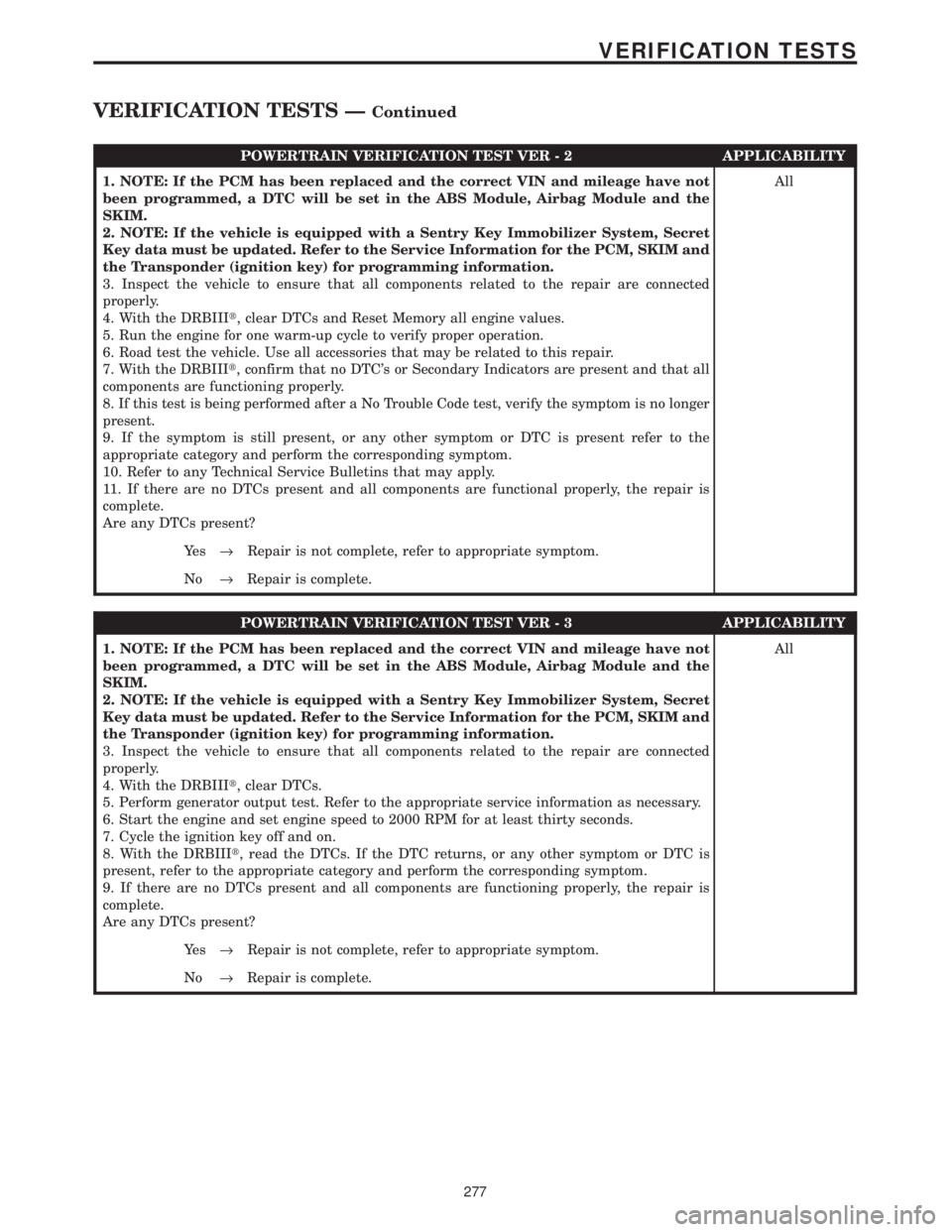
POWERTRAIN VERIFICATION TEST VER - 2 APPLICABILITY
1. NOTE: If the PCM has been replaced and the correct VIN and mileage have not
been programmed, a DTC will be set in the ABS Module, Airbag Module and the
SKIM.
2. NOTE: If the vehicle is equipped with a Sentry Key Immobilizer System, Secret
Key data must be updated. Refer to the Service Information for the PCM, SKIM and
the Transponder (ignition key) for programming information.
3. Inspect the vehicle to ensure that all components related to the repair are connected
properly.
4. With the DRBIIIt, clear DTCs and Reset Memory all engine values.
5. Run the engine for one warm-up cycle to verify proper operation.
6. Road test the vehicle. Use all accessories that may be related to this repair.
7. With the DRBIIIt, confirm that no DTC's or Secondary Indicators are present and that all
components are functioning properly.
8. If this test is being performed after a No Trouble Code test, verify the symptom is no longer
present.
9. If the symptom is still present, or any other symptom or DTC is present refer to the
appropriate category and perform the corresponding symptom.
10. Refer to any Technical Service Bulletins that may apply.
11. If there are no DTCs present and all components are functional properly, the repair is
complete.
Are any DTCs present?All
Ye s®Repair is not complete, refer to appropriate symptom.
No®Repair is complete.
POWERTRAIN VERIFICATION TEST VER - 3 APPLICABILITY
1. NOTE: If the PCM has been replaced and the correct VIN and mileage have not
been programmed, a DTC will be set in the ABS Module, Airbag Module and the
SKIM.
2. NOTE: If the vehicle is equipped with a Sentry Key Immobilizer System, Secret
Key data must be updated. Refer to the Service Information for the PCM, SKIM and
the Transponder (ignition key) for programming information.
3. Inspect the vehicle to ensure that all components related to the repair are connected
properly.
4. With the DRBIIIt, clear DTCs.
5. Perform generator output test. Refer to the appropriate service information as necessary.
6. Start the engine and set engine speed to 2000 RPM for at least thirty seconds.
7. Cycle the ignition key off and on.
8. With the DRBIIIt, read the DTCs. If the DTC returns, or any other symptom or DTC is
present, refer to the appropriate category and perform the corresponding symptom.
9. If there are no DTCs present and all components are functioning properly, the repair is
complete.
Are any DTCs present?All
Ye s®Repair is not complete, refer to appropriate symptom.
No®Repair is complete.
277
VERIFICATION TESTS
VERIFICATION TESTS ÐContinued
Page 4073 of 4284
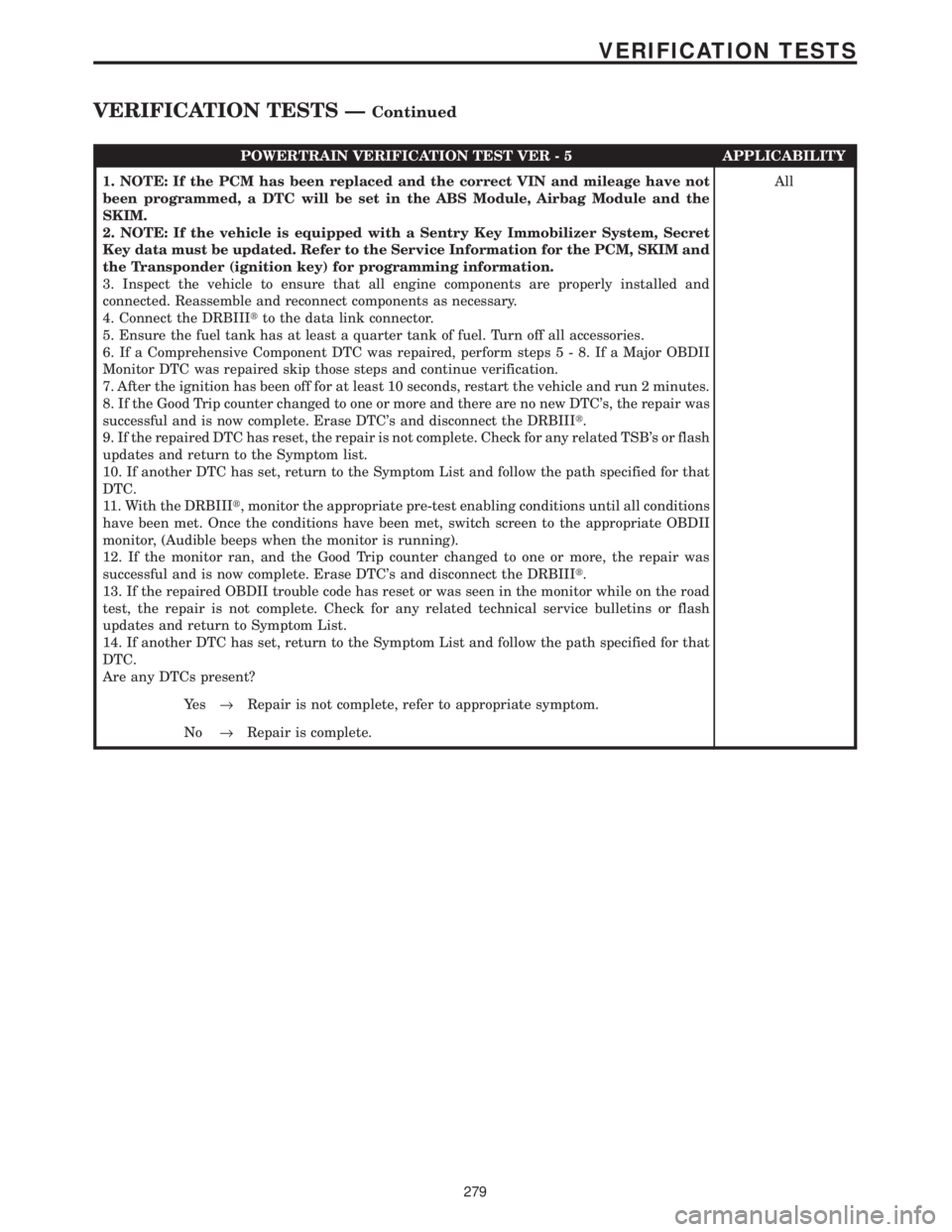
POWERTRAIN VERIFICATION TEST VER - 5 APPLICABILITY
1. NOTE: If the PCM has been replaced and the correct VIN and mileage have not
been programmed, a DTC will be set in the ABS Module, Airbag Module and the
SKIM.
2. NOTE: If the vehicle is equipped with a Sentry Key Immobilizer System, Secret
Key data must be updated. Refer to the Service Information for the PCM, SKIM and
the Transponder (ignition key) for programming information.
3. Inspect the vehicle to ensure that all engine components are properly installed and
connected. Reassemble and reconnect components as necessary.
4. Connect the DRBIIItto the data link connector.
5. Ensure the fuel tank has at least a quarter tank of fuel. Turn off all accessories.
6. If a Comprehensive Component DTC was repaired, perform steps5-8.IfaMajor OBDII
Monitor DTC was repaired skip those steps and continue verification.
7. After the ignition has been off for at least 10 seconds, restart the vehicle and run 2 minutes.
8. If the Good Trip counter changed to one or more and there are no new DTC's, the repair was
successful and is now complete. Erase DTC's and disconnect the DRBIIIt.
9. If the repaired DTC has reset, the repair is not complete. Check for any related TSB's or flash
updates and return to the Symptom list.
10. If another DTC has set, return to the Symptom List and follow the path specified for that
DTC.
11. With the DRBIIIt, monitor the appropriate pre-test enabling conditions until all conditions
have been met. Once the conditions have been met, switch screen to the appropriate OBDII
monitor, (Audible beeps when the monitor is running).
12. If the monitor ran, and the Good Trip counter changed to one or more, the repair was
successful and is now complete. Erase DTC's and disconnect the DRBIIIt.
13. If the repaired OBDII trouble code has reset or was seen in the monitor while on the road
test, the repair is not complete. Check for any related technical service bulletins or flash
updates and return to Symptom List.
14. If another DTC has set, return to the Symptom List and follow the path specified for that
DTC.
Are any DTCs present?All
Ye s®Repair is not complete, refer to appropriate symptom.
No®Repair is complete.
279
VERIFICATION TESTS
VERIFICATION TESTS ÐContinued
Page 4108 of 4284
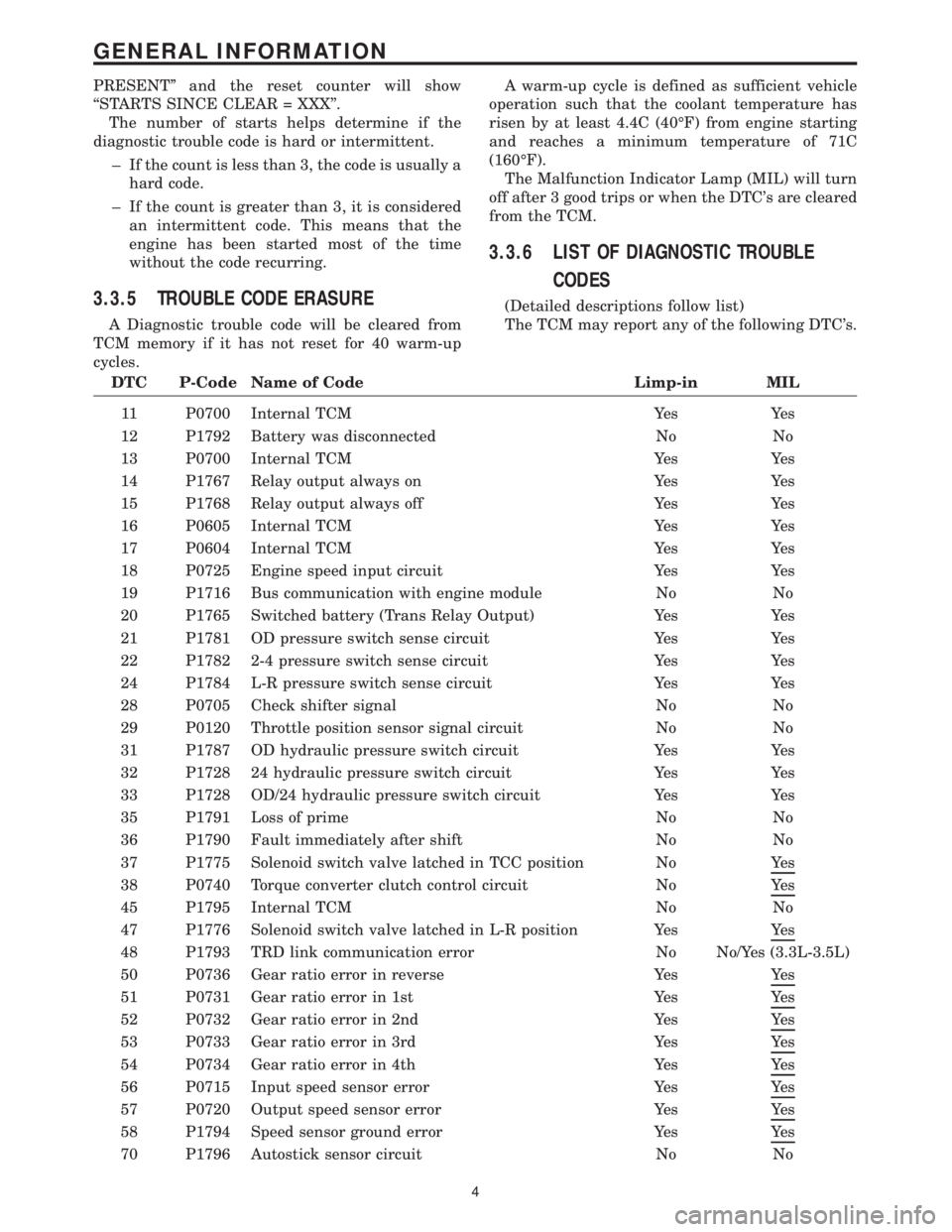
PRESENT'' and the reset counter will show
``STARTS SINCE CLEAR = XXX''.
The number of starts helps determine if the
diagnostic trouble code is hard or intermittent.
± If the count is less than 3, the code is usually a
hard code.
± If the count is greater than 3, it is considered
an intermittent code. This means that the
engine has been started most of the time
without the code recurring.
3.3.5 TROUBLE CODE ERASURE
A Diagnostic trouble code will be cleared from
TCM memory if it has not reset for 40 warm-up
cycles.A warm-up cycle is defined as sufficient vehicle
operation such that the coolant temperature has
risen by at least 4.4C (40ÉF) from engine starting
and reaches a minimum temperature of 71C
(160ÉF).
The Malfunction Indicator Lamp (MIL) will turn
off after 3 good trips or when the DTC's are cleared
from the TCM.
3.3.6 LIST OF DIAGNOSTIC TROUBLE
CODES
(Detailed descriptions follow list)
The TCM may report any of the following DTC's.
DTC P-Code Name of Code Limp-in MIL
11 P0700 Internal TCM Yes Yes
12 P1792 Battery was disconnected No No
13 P0700 Internal TCM Yes Yes
14 P1767 Relay output always on Yes Yes
15 P1768 Relay output always off Yes Yes
16 P0605 Internal TCM Yes Yes
17 P0604 Internal TCM Yes Yes
18 P0725 Engine speed input circuit Yes Yes
19 P1716 Bus communication with engine module No No
20 P1765 Switched battery (Trans Relay Output) Yes Yes
21 P1781 OD pressure switch sense circuit Yes Yes
22 P1782 2-4 pressure switch sense circuit Yes Yes
24 P1784 L-R pressure switch sense circuit Yes Yes
28 P0705 Check shifter signal No No
29 P0120 Throttle position sensor signal circuit No No
31 P1787 OD hydraulic pressure switch circuit Yes Yes
32 P1728 24 hydraulic pressure switch circuit Yes Yes
33 P1728 OD/24 hydraulic pressure switch circuit Yes Yes
35 P1791 Loss of prime No No
36 P1790 Fault immediately after shift No No
37 P1775 Solenoid switch valve latched in TCC position No Yes
38 P0740 Torque converter clutch control circuit No Yes
45 P1795 Internal TCM No No
47 P1776 Solenoid switch valve latched in L-R position Yes Yes
48 P1793 TRD link communication error No No/Yes (3.3L-3.5L)
50 P0736 Gear ratio error in reverse Yes Yes
51 P0731 Gear ratio error in 1st Yes Yes
52 P0732 Gear ratio error in 2nd Yes Yes
53 P0733 Gear ratio error in 3rd Yes Yes
54 P0734 Gear ratio error in 4th Yes Yes
56 P0715 Input speed sensor error Yes Yes
57 P0720 Output speed sensor error Yes Yes
58 P1794 Speed sensor ground error Yes Yes
70 P1796 Autostick sensor circuit No No
4
GENERAL INFORMATION
Page 4110 of 4284
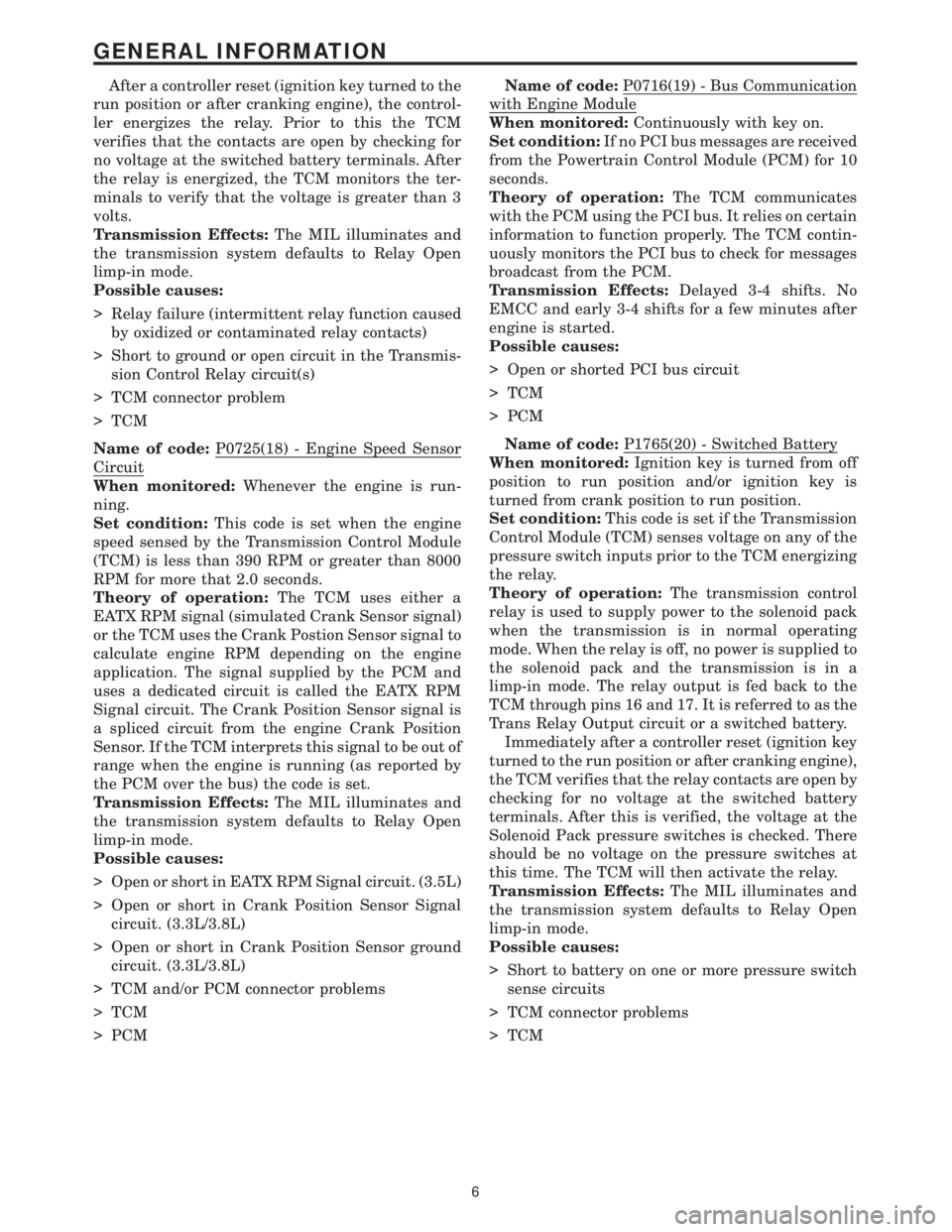
After a controller reset (ignition key turned to the
run position or after cranking engine), the control-
ler energizes the relay. Prior to this the TCM
verifies that the contacts are open by checking for
no voltage at the switched battery terminals. After
the relay is energized, the TCM monitors the ter-
minals to verify that the voltage is greater than 3
volts.
Transmission Effects:The MIL illuminates and
the transmission system defaults to Relay Open
limp-in mode.
Possible causes:
> Relay failure (intermittent relay function caused
by oxidized or contaminated relay contacts)
> Short to ground or open circuit in the Transmis-
sion Control Relay circuit(s)
> TCM connector problem
> TCM
Name of code:P0725(18) - Engine Speed Sensor
Circuit
When monitored:Whenever the engine is run-
ning.
Set condition:This code is set when the engine
speed sensed by the Transmission Control Module
(TCM) is less than 390 RPM or greater than 8000
RPM for more that 2.0 seconds.
Theory of operation:The TCM uses either a
EATX RPM signal (simulated Crank Sensor signal)
or the TCM uses the Crank Postion Sensor signal to
calculate engine RPM depending on the engine
application. The signal supplied by the PCM and
uses a dedicated circuit is called the EATX RPM
Signal circuit. The Crank Position Sensor signal is
a spliced circuit from the engine Crank Position
Sensor. If the TCM interprets this signal to be out of
range when the engine is running (as reported by
the PCM over the bus) the code is set.
Transmission Effects:The MIL illuminates and
the transmission system defaults to Relay Open
limp-in mode.
Possible causes:
> Open or short in EATX RPM Signal circuit. (3.5L)
> Open or short in Crank Position Sensor Signal
circuit. (3.3L/3.8L)
> Open or short in Crank Position Sensor ground
circuit. (3.3L/3.8L)
> TCM and/or PCM connector problems
> TCM
> PCMName of code:P0716(19) - Bus Communication
with Engine Module
When monitored:Continuously with key on.
Set condition:If no PCI bus messages are received
from the Powertrain Control Module (PCM) for 10
seconds.
Theory of operation:The TCM communicates
with the PCM using the PCI bus. It relies on certain
information to function properly. The TCM contin-
uously monitors the PCI bus to check for messages
broadcast from the PCM.
Transmission Effects:Delayed 3-4 shifts. No
EMCC and early 3-4 shifts for a few minutes after
engine is started.
Possible causes:
> Open or shorted PCI bus circuit
> TCM
> PCM
Name of code:P1765(20) - Switched Battery
When monitored:Ignition key is turned from off
position to run position and/or ignition key is
turned from crank position to run position.
Set condition:This code is set if the Transmission
Control Module (TCM) senses voltage on any of the
pressure switch inputs prior to the TCM energizing
the relay.
Theory of operation:The transmission control
relay is used to supply power to the solenoid pack
when the transmission is in normal operating
mode. When the relay is off, no power is supplied to
the solenoid pack and the transmission is in a
limp-in mode. The relay output is fed back to the
TCM through pins 16 and 17. It is referred to as the
Trans Relay Output circuit or a switched battery.
Immediately after a controller reset (ignition key
turned to the run position or after cranking engine),
the TCM verifies that the relay contacts are open by
checking for no voltage at the switched battery
terminals. After this is verified, the voltage at the
Solenoid Pack pressure switches is checked. There
should be no voltage on the pressure switches at
this time. The TCM will then activate the relay.
Transmission Effects:The MIL illuminates and
the transmission system defaults to Relay Open
limp-in mode.
Possible causes:
> Short to battery on one or more pressure switch
sense circuits
> TCM connector problems
> TCM
6
GENERAL INFORMATION
Page 4116 of 4284
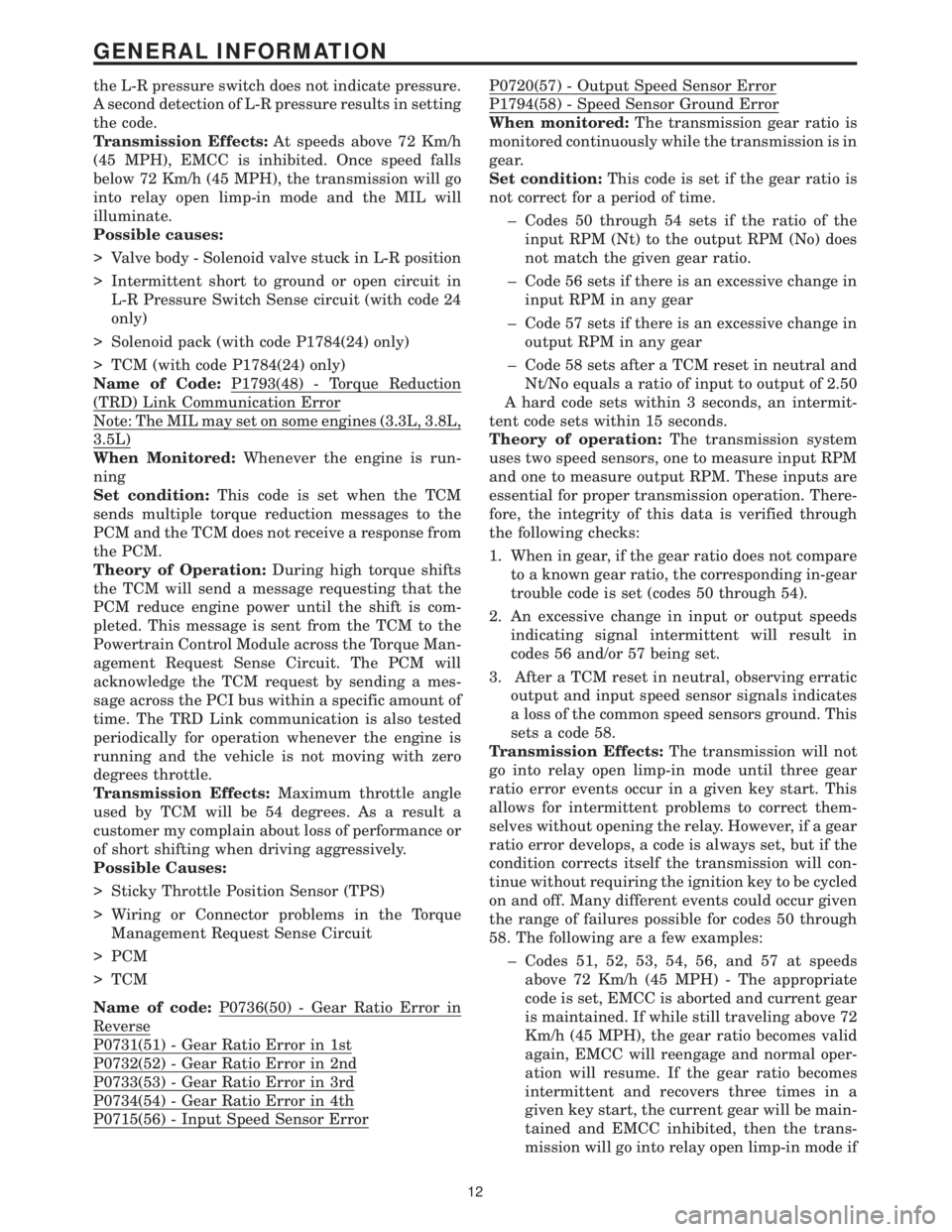
the L-R pressure switch does not indicate pressure.
A second detection of L-R pressure results in setting
the code.
Transmission Effects:At speeds above 72 Km/h
(45 MPH), EMCC is inhibited. Once speed falls
below 72 Km/h (45 MPH), the transmission will go
into relay open limp-in mode and the MIL will
illuminate.
Possible causes:
> Valve body - Solenoid valve stuck in L-R position
> Intermittent short to ground or open circuit in
L-R Pressure Switch Sense circuit (with code 24
only)
> Solenoid pack (with code P1784(24) only)
> TCM (with code P1784(24) only)
Name of Code:P1793(48) - Torque Reduction
(TRD) Link Communication Error
Note: The MIL may set on some engines (3.3L, 3.8L,
3.5L)
When Monitored:Whenever the engine is run-
ning
Set condition:This code is set when the TCM
sends multiple torque reduction messages to the
PCM and the TCM does not receive a response from
the PCM.
Theory of Operation:During high torque shifts
the TCM will send a message requesting that the
PCM reduce engine power until the shift is com-
pleted. This message is sent from the TCM to the
Powertrain Control Module across the Torque Man-
agement Request Sense Circuit. The PCM will
acknowledge the TCM request by sending a mes-
sage across the PCI bus within a specific amount of
time. The TRD Link communication is also tested
periodically for operation whenever the engine is
running and the vehicle is not moving with zero
degrees throttle.
Transmission Effects:Maximum throttle angle
used by TCM will be 54 degrees. As a result a
customer my complain about loss of performance or
of short shifting when driving aggressively.
Possible Causes:
> Sticky Throttle Position Sensor (TPS)
> Wiring or Connector problems in the Torque
Management Request Sense Circuit
> PCM
> TCM
Name of code:P0736(50) - Gear Ratio Error in
Reverse
P0731(51) - Gear Ratio Error in 1st
P0732(52) - Gear Ratio Error in 2nd
P0733(53) - Gear Ratio Error in 3rd
P0734(54) - Gear Ratio Error in 4th
P0715(56) - Input Speed Sensor Error
P0720(57) - Output Speed Sensor Error
P1794(58) - Speed Sensor Ground Error
When monitored:The transmission gear ratio is
monitored continuously while the transmission is in
gear.
Set condition:This code is set if the gear ratio is
not correct for a period of time.
± Codes 50 through 54 sets if the ratio of the
input RPM (Nt) to the output RPM (No) does
not match the given gear ratio.
± Code 56 sets if there is an excessive change in
input RPM in any gear
± Code 57 sets if there is an excessive change in
output RPM in any gear
± Code 58 sets after a TCM reset in neutral and
Nt/No equals a ratio of input to output of 2.50
A hard code sets within 3 seconds, an intermit-
tent code sets within 15 seconds.
Theory of operation:The transmission system
uses two speed sensors, one to measure input RPM
and one to measure output RPM. These inputs are
essential for proper transmission operation. There-
fore, the integrity of this data is verified through
the following checks:
1. When in gear, if the gear ratio does not compare
to a known gear ratio, the corresponding in-gear
trouble code is set (codes 50 through 54).
2. An excessive change in input or output speeds
indicating signal intermittent will result in
codes 56 and/or 57 being set.
3. After a TCM reset in neutral, observing erratic
output and input speed sensor signals indicates
a loss of the common speed sensors ground. This
sets a code 58.
Transmission Effects:The transmission will not
go into relay open limp-in mode until three gear
ratio error events occur in a given key start. This
allows for intermittent problems to correct them-
selves without opening the relay. However, if a gear
ratio error develops, a code is always set, but if the
condition corrects itself the transmission will con-
tinue without requiring the ignition key to be cycled
on and off. Many different events could occur given
the range of failures possible for codes 50 through
58. The following are a few examples:
± Codes 51, 52, 53, 54, 56, and 57 at speeds
above 72 Km/h (45 MPH) - The appropriate
code is set, EMCC is aborted and current gear
is maintained. If while still traveling above 72
Km/h (45 MPH), the gear ratio becomes valid
again, EMCC will reengage and normal oper-
ation will resume. If the gear ratio becomes
intermittent and recovers three times in a
given key start, the current gear will be main-
tained and EMCC inhibited, then the trans-
mission will go into relay open limp-in mode if
12
GENERAL INFORMATION
Page 4119 of 4284
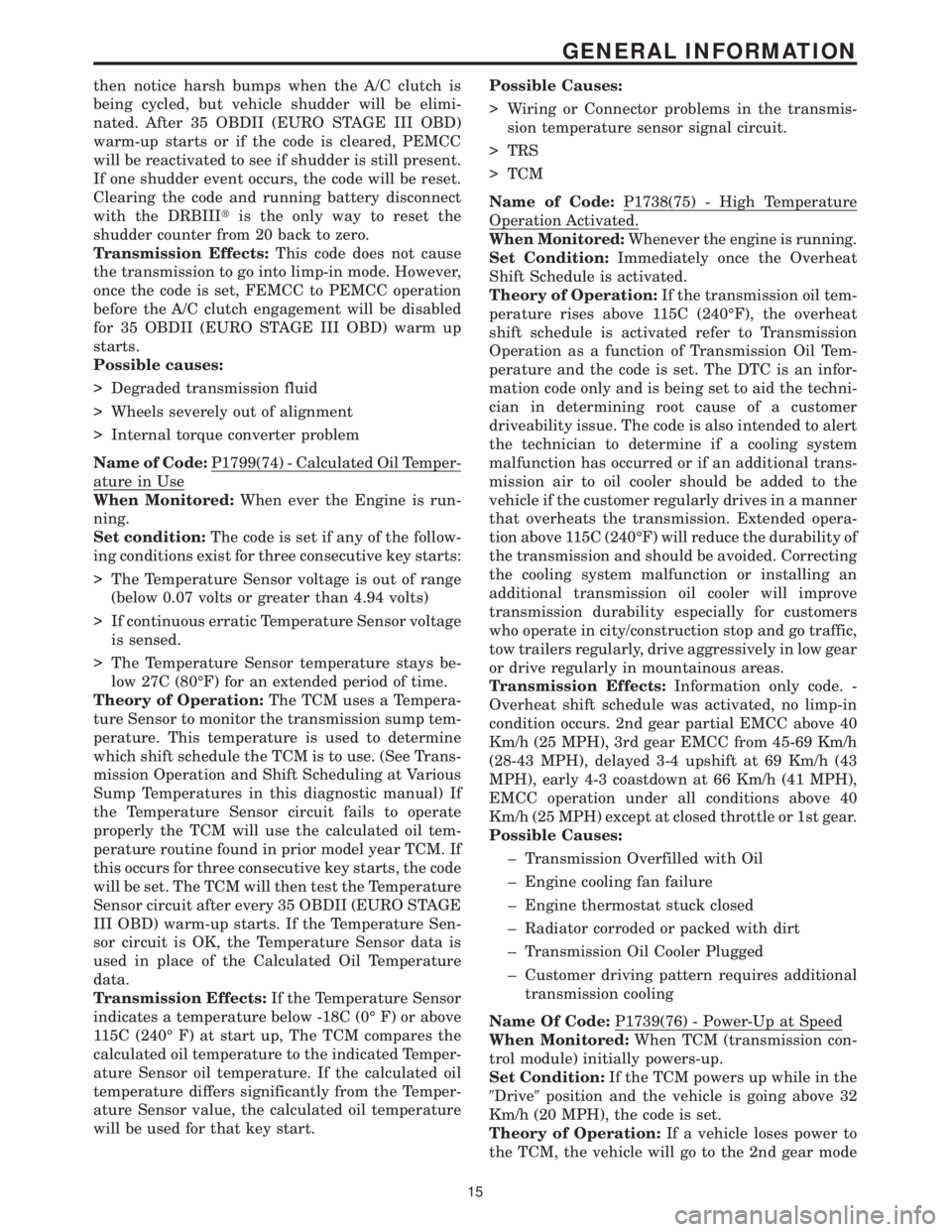
then notice harsh bumps when the A/C clutch is
being cycled, but vehicle shudder will be elimi-
nated. After 35 OBDII (EURO STAGE III OBD)
warm-up starts or if the code is cleared, PEMCC
will be reactivated to see if shudder is still present.
If one shudder event occurs, the code will be reset.
Clearing the code and running battery disconnect
with the DRBIIItis the only way to reset the
shudder counter from 20 back to zero.
Transmission Effects:This code does not cause
the transmission to go into limp-in mode. However,
once the code is set, FEMCC to PEMCC operation
before the A/C clutch engagement will be disabled
for 35 OBDII (EURO STAGE III OBD) warm up
starts.
Possible causes:
> Degraded transmission fluid
> Wheels severely out of alignment
> Internal torque converter problem
Name of Code:P1799(74) - Calculated Oil Temper-
ature in Use
When Monitored:When ever the Engine is run-
ning.
Set condition:The code is set if any of the follow-
ing conditions exist for three consecutive key starts:
> The Temperature Sensor voltage is out of range
(below 0.07 volts or greater than 4.94 volts)
> If continuous erratic Temperature Sensor voltage
is sensed.
> The Temperature Sensor temperature stays be-
low 27C (80ÉF) for an extended period of time.
Theory of Operation:The TCM uses a Tempera-
ture Sensor to monitor the transmission sump tem-
perature. This temperature is used to determine
which shift schedule the TCM is to use. (See Trans-
mission Operation and Shift Scheduling at Various
Sump Temperatures in this diagnostic manual) If
the Temperature Sensor circuit fails to operate
properly the TCM will use the calculated oil tem-
perature routine found in prior model year TCM. If
this occurs for three consecutive key starts, the code
will be set. The TCM will then test the Temperature
Sensor circuit after every 35 OBDII (EURO STAGE
III OBD) warm-up starts. If the Temperature Sen-
sor circuit is OK, the Temperature Sensor data is
used in place of the Calculated Oil Temperature
data.
Transmission Effects:If the Temperature Sensor
indicates a temperature below -18C (0É F) or above
115C (240É F) at start up, The TCM compares the
calculated oil temperature to the indicated Temper-
ature Sensor oil temperature. If the calculated oil
temperature differs significantly from the Temper-
ature Sensor value, the calculated oil temperature
will be used for that key start.Possible Causes:
> Wiring or Connector problems in the transmis-
sion temperature sensor signal circuit.
> TRS
> TCM
Name of Code:P1738(75) - High Temperature
Operation Activated.
When Monitored:Whenever the engine is running.
Set Condition:Immediately once the Overheat
Shift Schedule is activated.
Theory of Operation:If the transmission oil tem-
perature rises above 115C (240ÉF), the overheat
shift schedule is activated refer to Transmission
Operation as a function of Transmission Oil Tem-
perature and the code is set. The DTC is an infor-
mation code only and is being set to aid the techni-
cian in determining root cause of a customer
driveability issue. The code is also intended to alert
the technician to determine if a cooling system
malfunction has occurred or if an additional trans-
mission air to oil cooler should be added to the
vehicle if the customer regularly drives in a manner
that overheats the transmission. Extended opera-
tion above 115C (240ÉF) will reduce the durability of
the transmission and should be avoided. Correcting
the cooling system malfunction or installing an
additional transmission oil cooler will improve
transmission durability especially for customers
who operate in city/construction stop and go traffic,
tow trailers regularly, drive aggressively in low gear
or drive regularly in mountainous areas.
Transmission Effects:Information only code. -
Overheat shift schedule was activated, no limp-in
condition occurs. 2nd gear partial EMCC above 40
Km/h (25 MPH), 3rd gear EMCC from 45-69 Km/h
(28-43 MPH), delayed 3-4 upshift at 69 Km/h (43
MPH), early 4-3 coastdown at 66 Km/h (41 MPH),
EMCC operation under all conditions above 40
Km/h (25 MPH) except at closed throttle or 1st gear.
Possible Causes:
± Transmission Overfilled with Oil
± Engine cooling fan failure
± Engine thermostat stuck closed
± Radiator corroded or packed with dirt
± Transmission Oil Cooler Plugged
± Customer driving pattern requires additional
transmission cooling
Name Of Code:P1739(76) - Power-Up at Speed
When Monitored:When TCM (transmission con-
trol module) initially powers-up.
Set Condition:If the TCM powers up while in the
9Drive9position and the vehicle is going above 32
Km/h (20 MPH), the code is set.
Theory of Operation:If a vehicle loses power to
the TCM, the vehicle will go to the 2nd gear mode
15
GENERAL INFORMATION