2001 CHRYSLER VOYAGER light
[x] Cancel search: lightPage 1193 of 4284
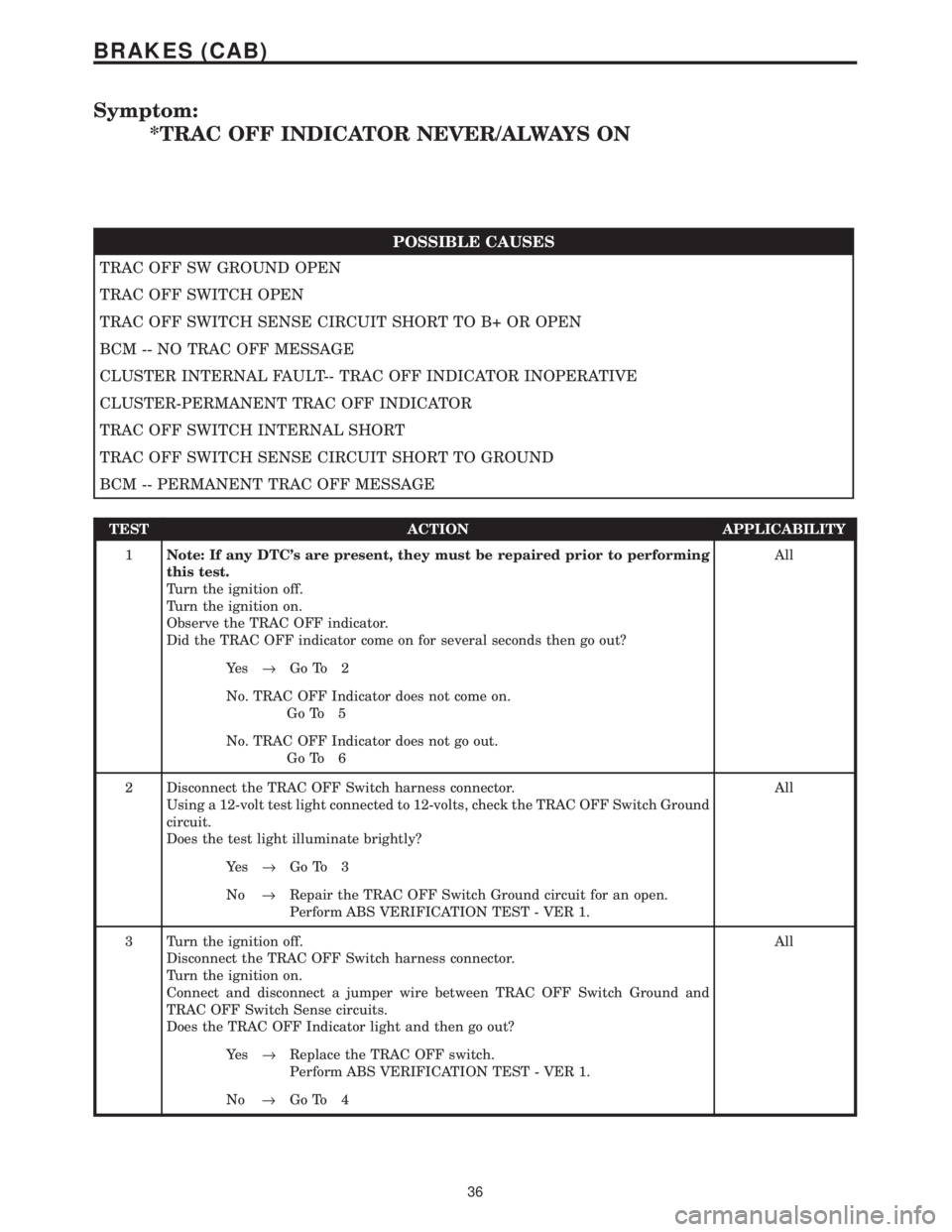
Symptom:
*TRAC OFF INDICATOR NEVER/ALWAYS ON
POSSIBLE CAUSES
TRAC OFF SW GROUND OPEN
TRAC OFF SWITCH OPEN
TRAC OFF SWITCH SENSE CIRCUIT SHORT TO B+ OR OPEN
BCM -- NO TRAC OFF MESSAGE
CLUSTER INTERNAL FAULT-- TRAC OFF INDICATOR INOPERATIVE
CLUSTER-PERMANENT TRAC OFF INDICATOR
TRAC OFF SWITCH INTERNAL SHORT
TRAC OFF SWITCH SENSE CIRCUIT SHORT TO GROUND
BCM -- PERMANENT TRAC OFF MESSAGE
TEST ACTION APPLICABILITY
1Note: If any DTC's are present, they must be repaired prior to performing
this test.
Turn the ignition off.
Turn the ignition on.
Observe the TRAC OFF indicator.
Did the TRAC OFF indicator come on for several seconds then go out?All
Ye s®Go To 2
No. TRAC OFF Indicator does not come on.
Go To 5
No. TRAC OFF Indicator does not go out.
Go To 6
2 Disconnect the TRAC OFF Switch harness connector.
Using a 12-volt test light connected to 12-volts, check the TRAC OFF Switch Ground
circuit.
Does the test light illuminate brightly?All
Ye s®Go To 3
No®Repair the TRAC OFF Switch Ground circuit for an open.
Perform ABS VERIFICATION TEST - VER 1.
3 Turn the ignition off.
Disconnect the TRAC OFF Switch harness connector.
Turn the ignition on.
Connect and disconnect a jumper wire between TRAC OFF Switch Ground and
TRAC OFF Switch Sense circuits.
Does the TRAC OFF Indicator light and then go out?All
Ye s®Replace the TRAC OFF switch.
Perform ABS VERIFICATION TEST - VER 1.
No®Go To 4
36
BRAKES (CAB)
Page 1194 of 4284
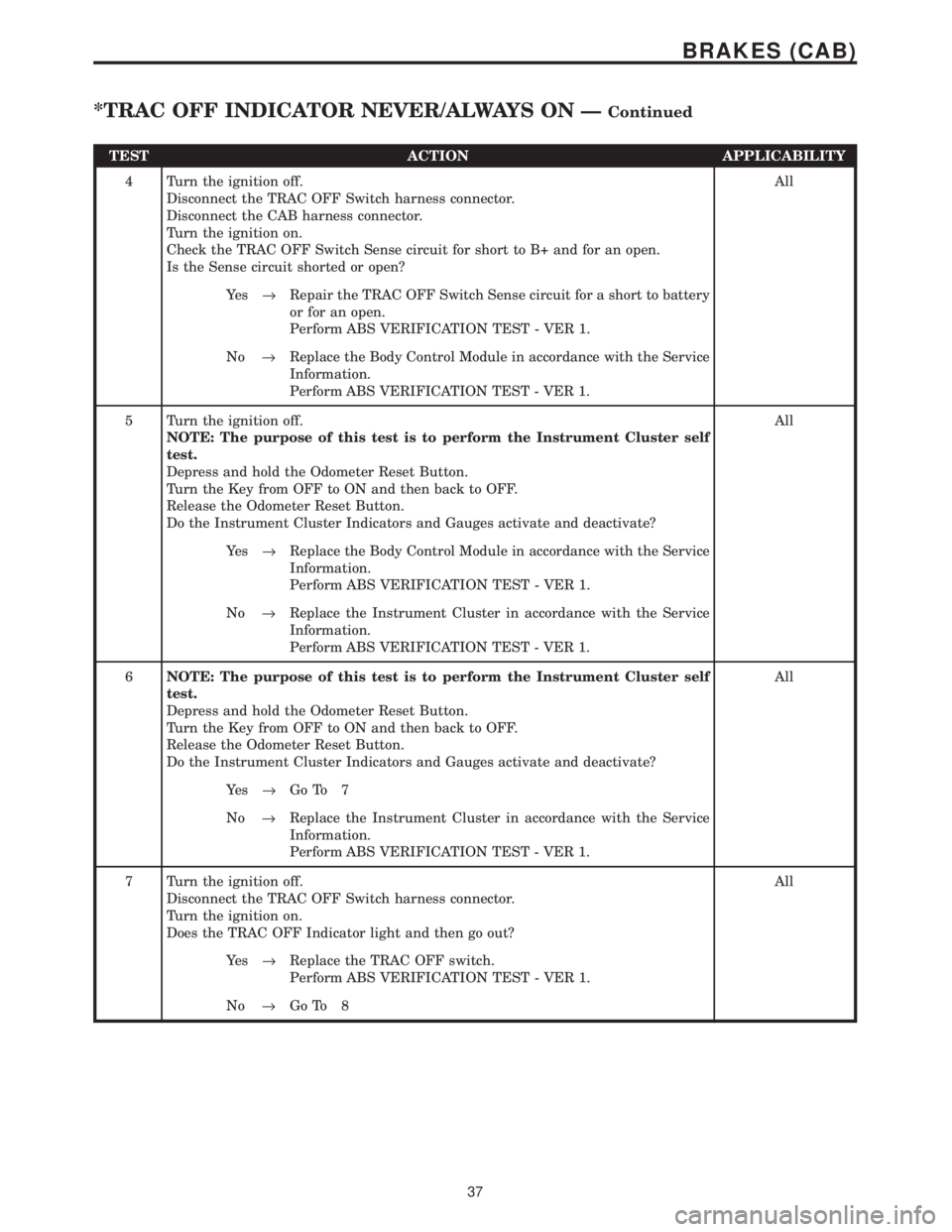
TEST ACTION APPLICABILITY
4 Turn the ignition off.
Disconnect the TRAC OFF Switch harness connector.
Disconnect the CAB harness connector.
Turn the ignition on.
Check the TRAC OFF Switch Sense circuit for short to B+ and for an open.
Is the Sense circuit shorted or open?All
Ye s®Repair the TRAC OFF Switch Sense circuit for a short to battery
or for an open.
Perform ABS VERIFICATION TEST - VER 1.
No®Replace the Body Control Module in accordance with the Service
Information.
Perform ABS VERIFICATION TEST - VER 1.
5 Turn the ignition off.
NOTE: The purpose of this test is to perform the Instrument Cluster self
test.
Depress and hold the Odometer Reset Button.
Turn the Key from OFF to ON and then back to OFF.
Release the Odometer Reset Button.
Do the Instrument Cluster Indicators and Gauges activate and deactivate?All
Ye s®Replace the Body Control Module in accordance with the Service
Information.
Perform ABS VERIFICATION TEST - VER 1.
No®Replace the Instrument Cluster in accordance with the Service
Information.
Perform ABS VERIFICATION TEST - VER 1.
6NOTE: The purpose of this test is to perform the Instrument Cluster self
test.
Depress and hold the Odometer Reset Button.
Turn the Key from OFF to ON and then back to OFF.
Release the Odometer Reset Button.
Do the Instrument Cluster Indicators and Gauges activate and deactivate?All
Ye s®Go To 7
No®Replace the Instrument Cluster in accordance with the Service
Information.
Perform ABS VERIFICATION TEST - VER 1.
7 Turn the ignition off.
Disconnect the TRAC OFF Switch harness connector.
Turn the ignition on.
Does the TRAC OFF Indicator light and then go out?All
Ye s®Replace the TRAC OFF switch.
Perform ABS VERIFICATION TEST - VER 1.
No®Go To 8
37
BRAKES (CAB)
*TRAC OFF INDICATOR NEVER/ALWAYS ON ÐContinued
Page 1225 of 4284
J1850 COMMUNICATION BUS SPI ERROR
J1850 COMMUNICATION BUS RECEIVE TIME-
OUT
J1850 COMMUNICATION BUS UNAUTHO-
RIZED RESET
EEPROM PLAUSIBILITY CHECKSUM ERROR
EEPROM PLAUSIBILITY VIN CHECKSUM
ERROR
EEPROM PLAUSIBILITY COMMUNICATION
ERROR
EEPROM PLAUSIBILITY WRITE ERROR
EEPROM PLAUSIBILITY VARIATION NUM-
BER ERROR
EEPROM PLAUSIBILITY CODE WORD IN-
CORRECT OR MISSING
SKIM SYSTEM SKIM ERROR
SKIM SYSTEM WRITE ACCESS TO EEPROM
FAILURE
SKIM SYSTEM INVALID SECRET KEY IN EE-
PROM
SKIM SYSTEM KEY COMMUNICATION
TIMED OUT
SKIM SYSTEM INVALID KEY CODE RE-
CEIVED
EEPROM RECOVERY OCCURRED
EEPROM REDUNDANT OVERRUN MONI-
TORING
EEPROM QUANTITY STOP
EEPROM COMMUNICATION ERROR
EEPROM COMMUNICATION NOT VERIFIED
ACC PEDAL POSITION SENSOR 1 CKT SIG-
NAL VOLTAGE TOO HIGH
ACC PEDAL POSITION SENSOR 1 CKT SIG-
NAL VOLTAGE TOO LOW
ACC PEDAL POSITION SENSOR 1 CKT SUP-
PLY VOLTAGE TOO HIGH OR LOW
ACC PEDAL POSITION SENSOR 1 CKT PLAU-
SIBILITY WITH POTENTIOMETER
ACC PEDAL POSITION SENSOR 1 CKT PLAU-
SIBILITY WITH BRAKE SWITCH
ACC PEDAL POSITION SENSOR 1 CKT PLAU-
SIBILITY
3.3.4 SKIM DIAGNOSTIC TROUBLE CODES
ANTENNA FAILURE
COP FAILURE
EEPROM FAILURE
PCM STATUS FAILURE
INTERNAL FAULT
RAM FAILURE
ROLLING CODE FAILURE
SERIAL LINK EXTERNAL FAULT
SERIAL LINK INTERNAL FAULT
STACK OVERFLOW FAILURE
TRANSPONDER COMMUNICATION FAILURE
TRANSPONDER CRC (CYCLIC REDUN-
DANCY CHECK) FAILURE
TRANSPONDER ID MISMATCHTRANSPONDER RESPONSE MISMATCH
VIN MISMATCH
3.3.5 HANDLING NO TROUBLE CODE
PROBLEMS
After reading Section 3.0 (System Description
and Functional Operation), you should have a bet-
ter understanding of the theory and operation of the
on-board diagnostics, and how this relates to the
diagnosis of a vehicle that may have a driveability-
related symptom or complaint.
3.4 USING THE DRBIIIT
Refer to the DRBIIItuser 's guide for instructions
and assistance with reading the DTCs, erasing the
DTCs, lab scope usage and other DRBIIItfunc-
tions.
3.4.1 DRBIIITDOES NOT POWER UP
If the LEDs do not light or no sound is emitted at
start up, check for loose cable connections or a bad
cable. Check the vehicle battery voltage at data link
connector cavity 16. A minimum of 11.0 volts is
required to adequately power the DRB. Check for
proper ground connection at data link connector
cavities 4 and 5.
If all connections are proper between the
DRBIIItand the vehicle or other devices, and the
vehicle battery is fully charged, an inoperative
DRBIIItmay be the result of a faulty cable or
vehicle wiring. For a blank screen, refer to the
appropriate diagnostic manual.
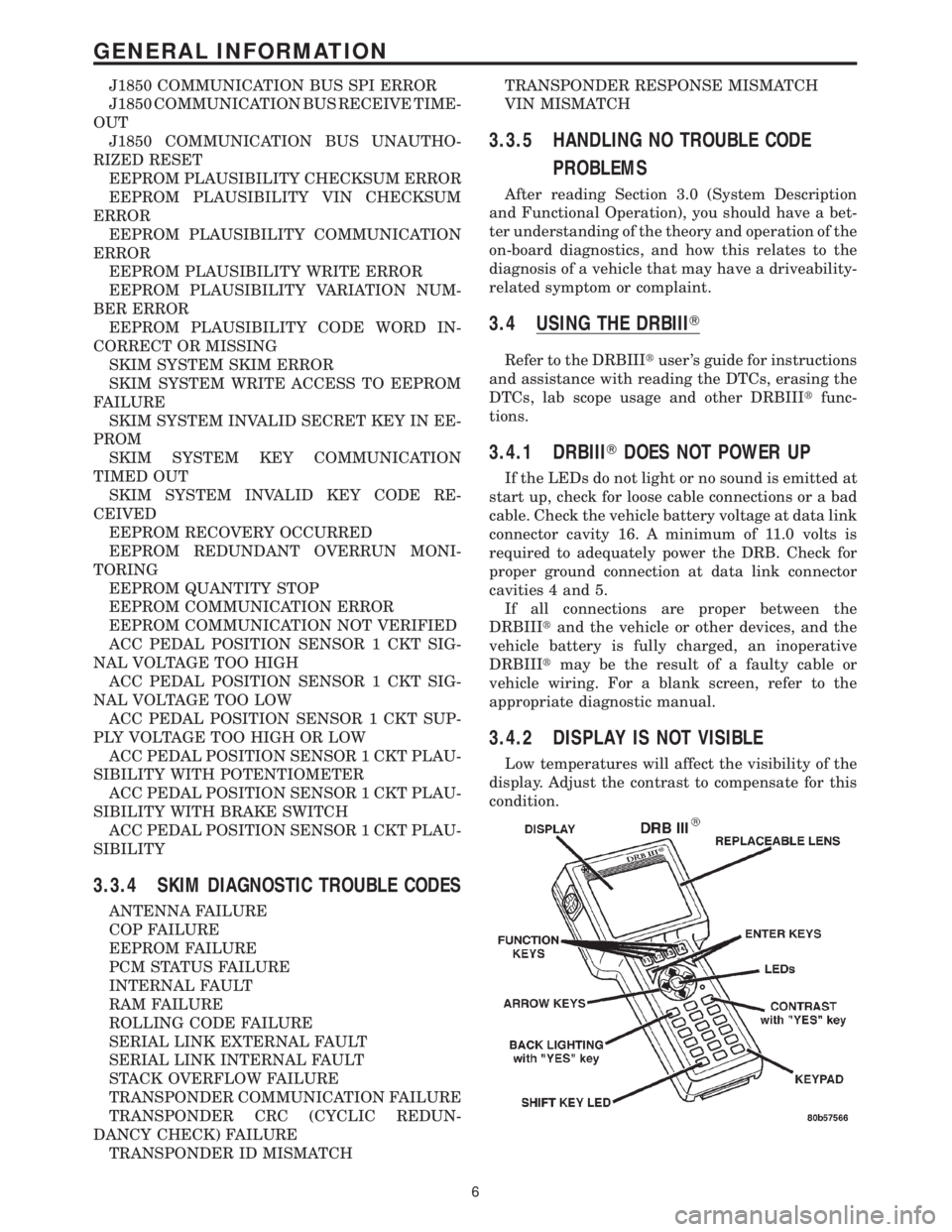
3.4.2 DISPLAY IS NOT VISIBLE
Low temperatures will affect the visibility of the
display. Adjust the contrast to compensate for this
condition.
6
GENERAL INFORMATION
Page 1300 of 4284
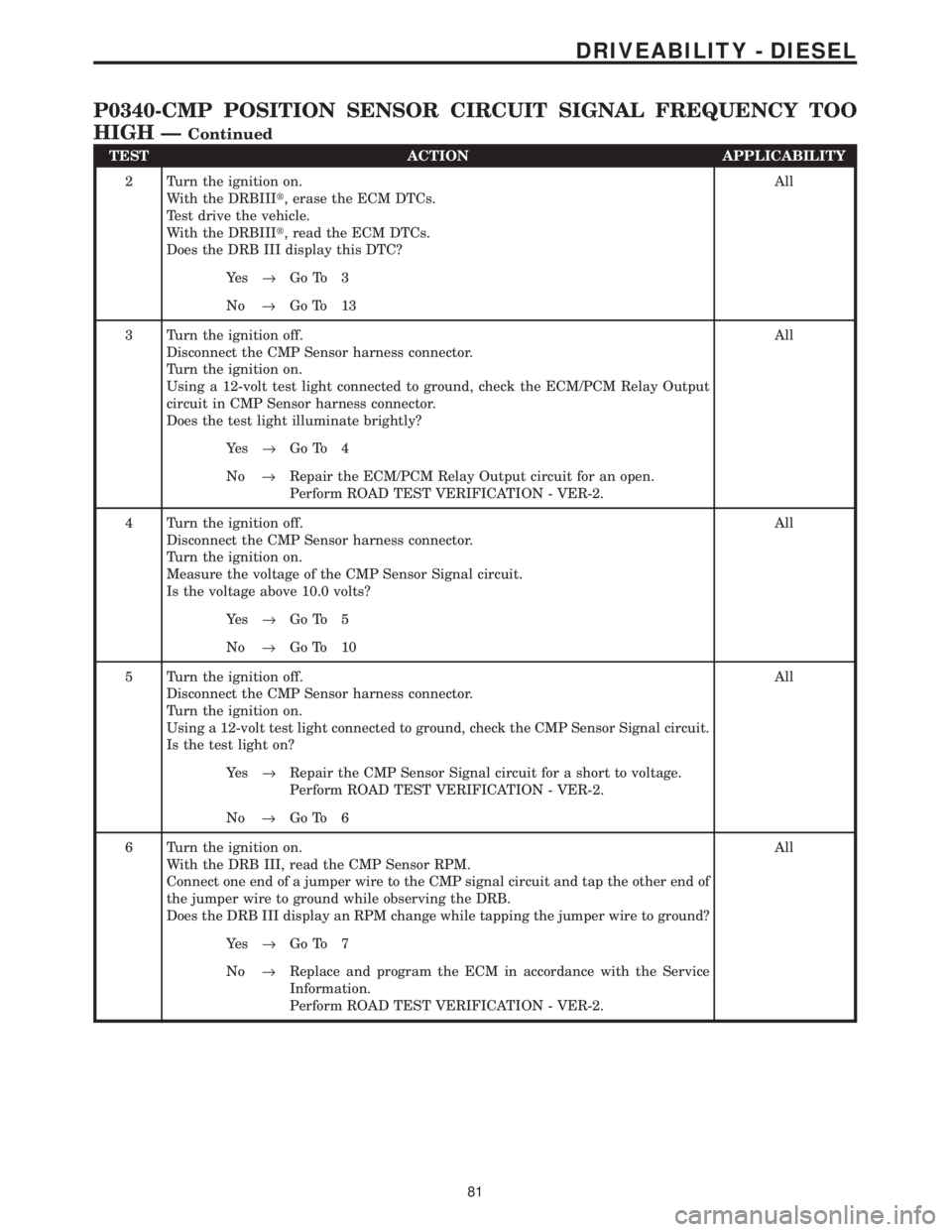
TEST ACTION APPLICABILITY
2 Turn the ignition on.
With the DRBIIIt, erase the ECM DTCs.
Test drive the vehicle.
With the DRBIIIt, read the ECM DTCs.
Does the DRB III display this DTC?All
Ye s®Go To 3
No®Go To 13
3 Turn the ignition off.
Disconnect the CMP Sensor harness connector.
Turn the ignition on.
Using a 12-volt test light connected to ground, check the ECM/PCM Relay Output
circuit in CMP Sensor harness connector.
Does the test light illuminate brightly?All
Ye s®Go To 4
No®Repair the ECM/PCM Relay Output circuit for an open.
Perform ROAD TEST VERIFICATION - VER-2.
4 Turn the ignition off.
Disconnect the CMP Sensor harness connector.
Turn the ignition on.
Measure the voltage of the CMP Sensor Signal circuit.
Is the voltage above 10.0 volts?All
Ye s®Go To 5
No®Go To 10
5 Turn the ignition off.
Disconnect the CMP Sensor harness connector.
Turn the ignition on.
Using a 12-volt test light connected to ground, check the CMP Sensor Signal circuit.
Is the test light on?All
Ye s®Repair the CMP Sensor Signal circuit for a short to voltage.
Perform ROAD TEST VERIFICATION - VER-2.
No®Go To 6
6 Turn the ignition on.
With the DRB III, read the CMP Sensor RPM.
Connect one end of a jumper wire to the CMP signal circuit and tap the other end of
the jumper wire to ground while observing the DRB.
Does the DRB III display an RPM change while tapping the jumper wire to ground?All
Ye s®Go To 7
No®Replace and program the ECM in accordance with the Service
Information.
Perform ROAD TEST VERIFICATION - VER-2.
81
DRIVEABILITY - DIESEL
P0340-CMP POSITION SENSOR CIRCUIT SIGNAL FREQUENCY TOO
HIGH Ð
Continued
Page 1304 of 4284
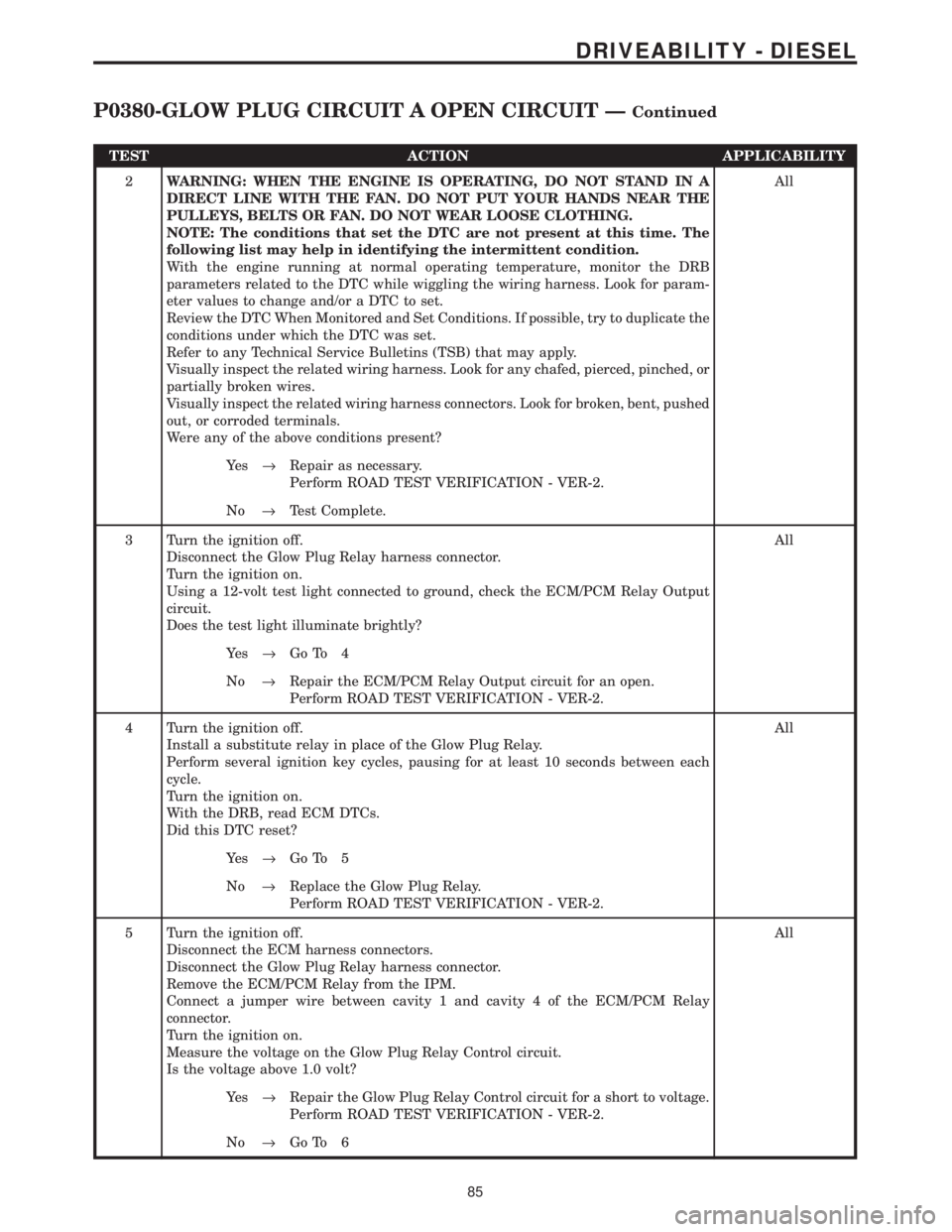
TEST ACTION APPLICABILITY
2WARNING: WHEN THE ENGINE IS OPERATING, DO NOT STAND IN A
DIRECT LINE WITH THE FAN. DO NOT PUT YOUR HANDS NEAR THE
PULLEYS, BELTS OR FAN. DO NOT WEAR LOOSE CLOTHING.
NOTE: The conditions that set the DTC are not present at this time. The
following list may help in identifying the intermittent condition.
With the engine running at normal operating temperature, monitor the DRB
parameters related to the DTC while wiggling the wiring harness. Look for param-
eter values to change and/or a DTC to set.
Review the DTC When Monitored and Set Conditions. If possible, try to duplicate the
conditions under which the DTC was set.
Refer to any Technical Service Bulletins (TSB) that may apply.
Visually inspect the related wiring harness. Look for any chafed, pierced, pinched, or
partially broken wires.
Visually inspect the related wiring harness connectors. Look for broken, bent, pushed
out, or corroded terminals.
Were any of the above conditions present?All
Ye s®Repair as necessary.
Perform ROAD TEST VERIFICATION - VER-2.
No®Test Complete.
3 Turn the ignition off.
Disconnect the Glow Plug Relay harness connector.
Turn the ignition on.
Using a 12-volt test light connected to ground, check the ECM/PCM Relay Output
circuit.
Does the test light illuminate brightly?All
Ye s®Go To 4
No®Repair the ECM/PCM Relay Output circuit for an open.
Perform ROAD TEST VERIFICATION - VER-2.
4 Turn the ignition off.
Install a substitute relay in place of the Glow Plug Relay.
Perform several ignition key cycles, pausing for at least 10 seconds between each
cycle.
Turn the ignition on.
With the DRB, read ECM DTCs.
Did this DTC reset?All
Ye s®Go To 5
No®Replace the Glow Plug Relay.
Perform ROAD TEST VERIFICATION - VER-2.
5 Turn the ignition off.
Disconnect the ECM harness connectors.
Disconnect the Glow Plug Relay harness connector.
Remove the ECM/PCM Relay from the IPM.
Connect a jumper wire between cavity 1 and cavity 4 of the ECM/PCM Relay
connector.
Turn the ignition on.
Measure the voltage on the Glow Plug Relay Control circuit.
Is the voltage above 1.0 volt?All
Ye s®Repair the Glow Plug Relay Control circuit for a short to voltage.
Perform ROAD TEST VERIFICATION - VER-2.
No®Go To 6
85
DRIVEABILITY - DIESEL
P0380-GLOW PLUG CIRCUIT A OPEN CIRCUIT ÐContinued
Page 1306 of 4284
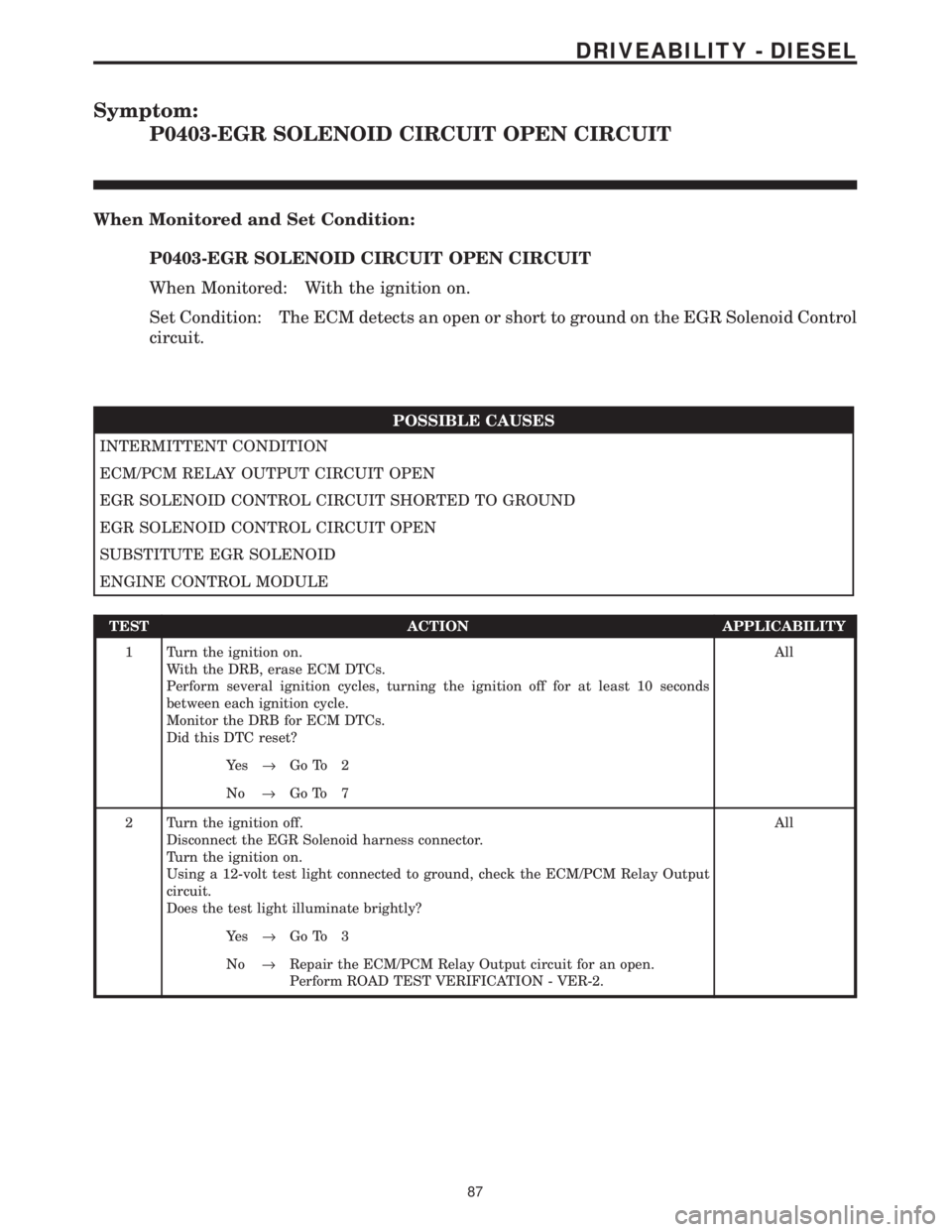
Symptom:
P0403-EGR SOLENOID CIRCUIT OPEN CIRCUIT
When Monitored and Set Condition:
P0403-EGR SOLENOID CIRCUIT OPEN CIRCUIT
When Monitored: With the ignition on.
Set Condition: The ECM detects an open or short to ground on the EGR Solenoid Control
circuit.
POSSIBLE CAUSES
INTERMITTENT CONDITION
ECM/PCM RELAY OUTPUT CIRCUIT OPEN
EGR SOLENOID CONTROL CIRCUIT SHORTED TO GROUND
EGR SOLENOID CONTROL CIRCUIT OPEN
SUBSTITUTE EGR SOLENOID
ENGINE CONTROL MODULE
TEST ACTION APPLICABILITY
1 Turn the ignition on.
With the DRB, erase ECM DTCs.
Perform several ignition cycles, turning the ignition off for at least 10 seconds
between each ignition cycle.
Monitor the DRB for ECM DTCs.
Did this DTC reset?All
Ye s®Go To 2
No®Go To 7
2 Turn the ignition off.
Disconnect the EGR Solenoid harness connector.
Turn the ignition on.
Using a 12-volt test light connected to ground, check the ECM/PCM Relay Output
circuit.
Does the test light illuminate brightly?All
Ye s®Go To 3
No®Repair the ECM/PCM Relay Output circuit for an open.
Perform ROAD TEST VERIFICATION - VER-2.
87
DRIVEABILITY - DIESEL
Page 1312 of 4284
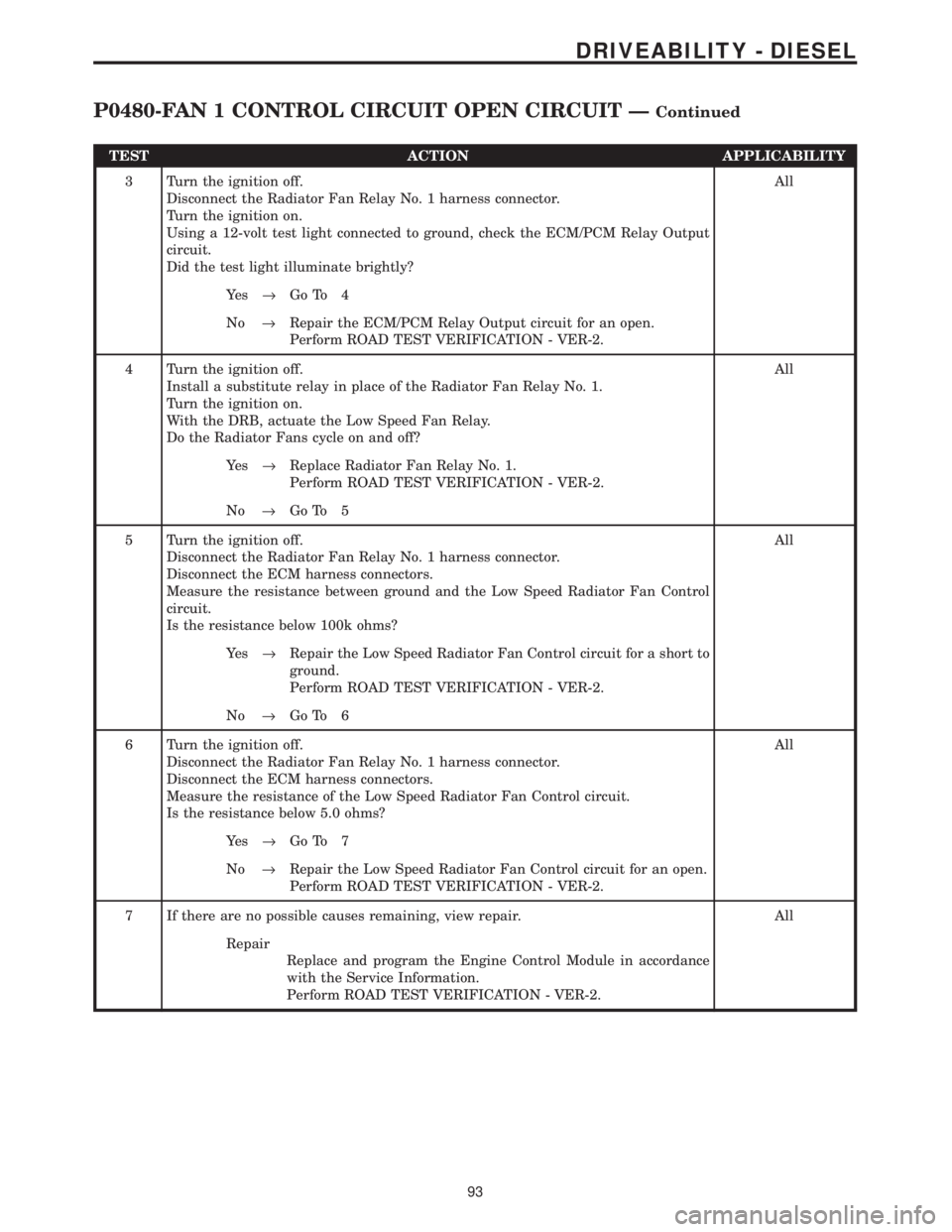
TEST ACTION APPLICABILITY
3 Turn the ignition off.
Disconnect the Radiator Fan Relay No. 1 harness connector.
Turn the ignition on.
Using a 12-volt test light connected to ground, check the ECM/PCM Relay Output
circuit.
Did the test light illuminate brightly?All
Ye s®Go To 4
No®Repair the ECM/PCM Relay Output circuit for an open.
Perform ROAD TEST VERIFICATION - VER-2.
4 Turn the ignition off.
Install a substitute relay in place of the Radiator Fan Relay No. 1.
Turn the ignition on.
With the DRB, actuate the Low Speed Fan Relay.
Do the Radiator Fans cycle on and off?All
Ye s®Replace Radiator Fan Relay No. 1.
Perform ROAD TEST VERIFICATION - VER-2.
No®Go To 5
5 Turn the ignition off.
Disconnect the Radiator Fan Relay No. 1 harness connector.
Disconnect the ECM harness connectors.
Measure the resistance between ground and the Low Speed Radiator Fan Control
circuit.
Is the resistance below 100k ohms?All
Ye s®Repair the Low Speed Radiator Fan Control circuit for a short to
ground.
Perform ROAD TEST VERIFICATION - VER-2.
No®Go To 6
6 Turn the ignition off.
Disconnect the Radiator Fan Relay No. 1 harness connector.
Disconnect the ECM harness connectors.
Measure the resistance of the Low Speed Radiator Fan Control circuit.
Is the resistance below 5.0 ohms?All
Ye s®Go To 7
No®Repair the Low Speed Radiator Fan Control circuit for an open.
Perform ROAD TEST VERIFICATION - VER-2.
7 If there are no possible causes remaining, view repair. All
Repair
Replace and program the Engine Control Module in accordance
with the Service Information.
Perform ROAD TEST VERIFICATION - VER-2.
93
DRIVEABILITY - DIESEL
P0480-FAN 1 CONTROL CIRCUIT OPEN CIRCUIT ÐContinued
Page 1316 of 4284
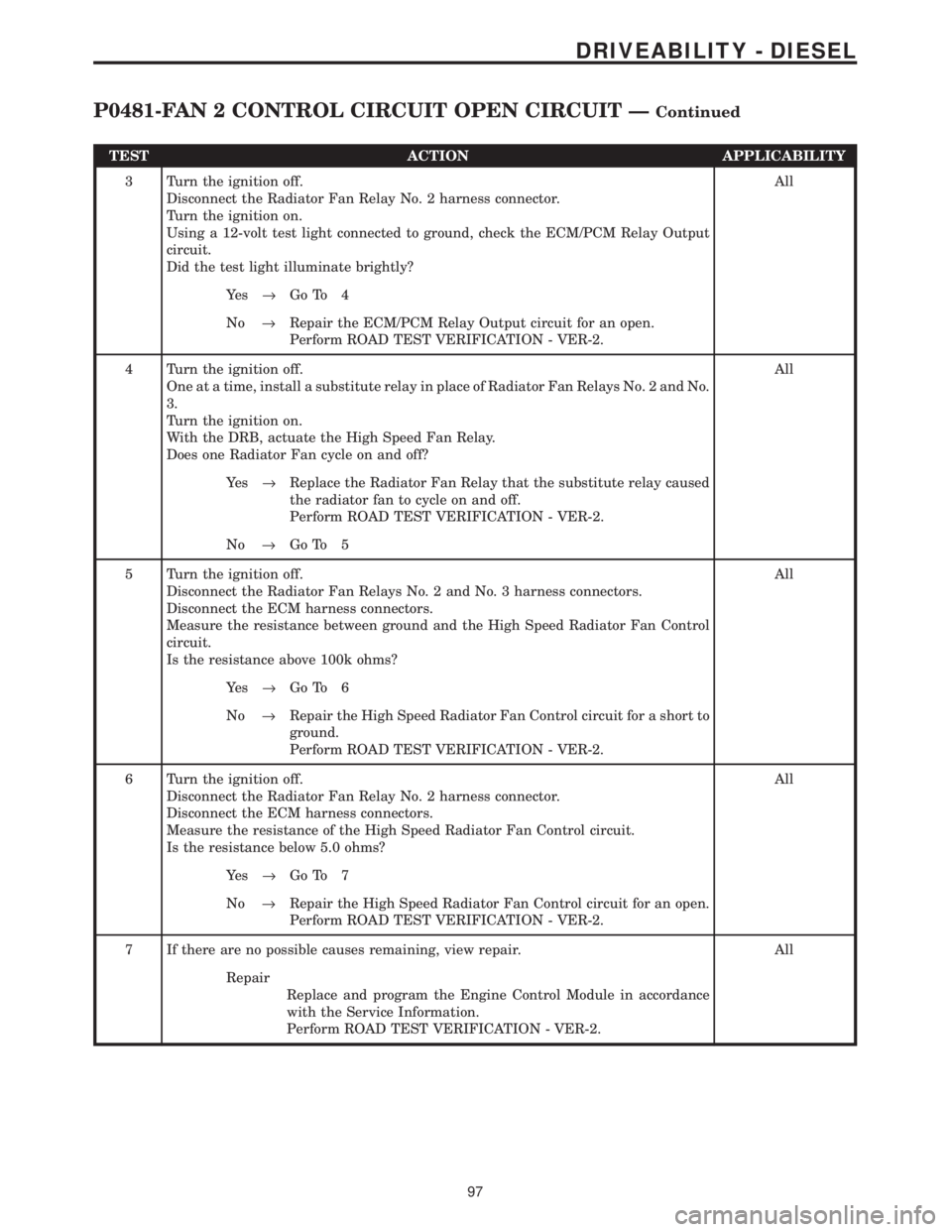
TEST ACTION APPLICABILITY
3 Turn the ignition off.
Disconnect the Radiator Fan Relay No. 2 harness connector.
Turn the ignition on.
Using a 12-volt test light connected to ground, check the ECM/PCM Relay Output
circuit.
Did the test light illuminate brightly?All
Ye s®Go To 4
No®Repair the ECM/PCM Relay Output circuit for an open.
Perform ROAD TEST VERIFICATION - VER-2.
4 Turn the ignition off.
One at a time, install a substitute relay in place of Radiator Fan Relays No. 2 and No.
3.
Turn the ignition on.
With the DRB, actuate the High Speed Fan Relay.
Does one Radiator Fan cycle on and off?All
Ye s®Replace the Radiator Fan Relay that the substitute relay caused
the radiator fan to cycle on and off.
Perform ROAD TEST VERIFICATION - VER-2.
No®Go To 5
5 Turn the ignition off.
Disconnect the Radiator Fan Relays No. 2 and No. 3 harness connectors.
Disconnect the ECM harness connectors.
Measure the resistance between ground and the High Speed Radiator Fan Control
circuit.
Is the resistance above 100k ohms?All
Ye s®Go To 6
No®Repair the High Speed Radiator Fan Control circuit for a short to
ground.
Perform ROAD TEST VERIFICATION - VER-2.
6 Turn the ignition off.
Disconnect the Radiator Fan Relay No. 2 harness connector.
Disconnect the ECM harness connectors.
Measure the resistance of the High Speed Radiator Fan Control circuit.
Is the resistance below 5.0 ohms?All
Ye s®Go To 7
No®Repair the High Speed Radiator Fan Control circuit for an open.
Perform ROAD TEST VERIFICATION - VER-2.
7 If there are no possible causes remaining, view repair. All
Repair
Replace and program the Engine Control Module in accordance
with the Service Information.
Perform ROAD TEST VERIFICATION - VER-2.
97
DRIVEABILITY - DIESEL
P0481-FAN 2 CONTROL CIRCUIT OPEN CIRCUIT ÐContinued