2001 CHRYSLER VOYAGER radiator
[x] Cancel search: radiatorPage 3740 of 4284
INSTALLATION
(1) Install both flexible coolant lines to the heater
unit and install clamps.
(2) Install flexible coolant lines to the coolant pipes
and install clamps.
(3) Install heater unit into vehicle(Refer to 24 -
HEATING & AIR CONDITIONING/CABIN HEAT-
ER/HEATER UNIT - INSTALLATION).
(4) Lower vehicle.
(5) Refill cooling system(Refer to 7 - COOLING -
STANDARD PROCEDURE).
(6) Verify operation of heater unit.
HEATER PIPES - DIESEL
SUPPLEMENTAL HEATER
REMOVAL
CAUTION: Allow cooling system to cool completely
before removing radiator cap or draining cooling
system. Injury could result is system is opened
while system coolant is hot and under pressure.
NOTE: Steel heater lines from engine compartment
to heater unit are part of an assembly that includes
the air intake pipe. If the heater lines or air intake
pipe require removal or replacement the entire
assembly must be removed or replaced.
(1) Open hood.
(2) Drain the cooling system(Refer to 7 - COOL-
ING - STANDARD PROCEDURE).
(3) Remove clamps from both the EGR cooler and
the lower heater port. Separate hoses from the mat-
ing plumbing port. (Fig. 1).
(4) Remove retaining nut from heater line under
hood bracket.(5) Elevate vehicle on a lift.
NOTE: When supporting vehicle care should be
taken not to damage the heater exhaust tube.
(6) Remove clamps from heater lines to the rubber
connection nearest the tubes. Separate the hoses
from the tube assembly leaving the rubber hose
attached to the supplemental heater.
(7) Remove heater unit intake pipe from heater-
(Refer to 24 - HEATING & AIR CONDITIONING/
CABIN HEATER/INLET HOSE - REMOVAL) (Fig.
2).
(8) Remove heater pipe assembly retaining screws
and remove assembly from vehicle.
INSTALLATION
(1) With vehicle on a lift position the heater pipe
assembly and install the retaining screws.
(2) Install the heater unit intake pipe to the
heater unit(Refer to 24 - HEATING & AIR CONDI-
TIONING/CABIN HEATER/INLET HOSE - INSTAL-
LATION).
(3) Connect heater hoses to the heater unit and
tighten the clamps.
(4) Install heater unit intake pipe to heater uni-
t(Refer to 24 - HEATING & AIR CONDITIONING/
CABIN HEATER/INLET HOSE - INSTALLATION).
(5) Lower vehicle on lift.
(6) Install retaining nut to heater line under hood
bracket and tighten.
(7) Connect heater lines to heater hoses at heater
core and EGR port. Position spring clamps onto the
installed hoses.
(8) Refill cooling system(Refer to 7 - COOLING -
STANDARD PROCEDURE).
(9) Close hood.
24a - 2 HEATING & AIR CONDITIONINGRG
HEATER HOSES - DIESEL SUPPLEMENTAL HEATER (Continued)
Page 3752 of 4284
put component, it can verify that the command was
carried out by monitoring specific input signals for
expected changes. For example, when the PCM com-
mands the Idle Air Control (IAC) Motor to a specific
position under certain operating conditions, it expects
to see a specific (target) idle speed (RPM). If it does
not, it stores a DTC.
PCM outputs monitored for functionality include:
²Fuel Injectors
²Ignition Coils
²Torque Converter Clutch Solenoid
²Idle Air Control
²Purge Solenoid
²EGR Solenoid
²LDP Solenoid
²Radiator Fan Control
²Trans Controls
OXYGEN SENSOR (O2S) MONITOR
DESCRIPTIONÐEffective control of exhaust
emissions is achieved by an oxygen feedback system.
The most important element of the feedback system
is the O2S. The O2S is located in the exhaust path.
Once it reaches operating temperature 300É to 350ÉC
(572É to 662ÉF), the sensor generates a voltage that
is inversely proportional to the amount of oxygen in
the exhaust. When there is a large amount of oxygen
in the exhaust caused by a lean condition, the sensor
produces a low voltage, below 450 mV. When the oxy-
gen content is lower, caused by a rich condition, the
sensor produces a higher voltage, above 450mV.
The information obtained by the sensor is used to
calculate the fuel injector pulse width. The PCM is
programmed to maintain the optimum air/fuel ratio.
At this mixture ratio, the catalyst works best to
remove hydrocarbons (HC), carbon monoxide (CO)
and nitrous oxide (NOx) from the exhaust.
The O2S is also the main sensing element for the
EGR, Catalyst and Fuel Monitors.
The O2S may fail in any or all of the following
manners:
²Slow response rate (Big Slope)
²Reduced output voltage (Half Cycle)
²Heater Performance
Slow Response Rate (Big Slope)ÐResponse rate
is the time required for the sensor to switch from
lean to rich signal output once it is exposed to a
richer than optimum A/F mixture or vice versa. As
the PCM adjusts the air/fuel ratio, the sensor must
be able to rapidly detect the change. As the sensor
ages, it could take longer to detect the changes in the
oxygen content of the exhaust gas. The rate of
change that an oxygen sensor experiences is called
'Big Slope'. The PCM checks the oxygen sensor volt-
age in increments of a few milliseconds.Reduced Output Voltage (Half Cycle)ÐThe
output voltage of the O2S ranges from 0 to 1 volt. A
good sensor can easily generate any output voltage in
this range as it is exposed to different concentrations
of oxygen. To detect a shift in the A/F mixture (lean
or rich), the output voltage has to change beyond a
threshold value. A malfunctioning sensor could have
difficulty changing beyond the threshold value. Each
time the voltage signal surpasses the threshold, a
counter is incremented by one. This is called the Half
Cycle Counter.
Heater PerformanceÐThe heater is tested by a
separate monitor. Refer to the Oxygen Sensor Heater
Monitor.
OPERATIONÐAs the Oxygen Sensor signal
switches, the PCM monitors the half cycle and big
slope signals from the oxygen sensor. If during the
test neither counter reaches a predetermined value, a
malfunction is entered and a Freeze Frame is stored.
Only one counter reaching its predetermined value is
needed for the monitor to pass.
The Oxygen Sensor Monitor is a two trip monitor
that is tested only once per trip. When the Oxygen
Sensor fails the test in two consecutive trips, the
MIL is illuminated and a DTC is set. The MIL is
extinguished when the Oxygen Sensor monitor
passes in three consecutive trips. The DTC is erased
from memory after 40 consecutive warm-up cycles
without test failure.
Enabling ConditionsÐThe following conditions
must typically be met for the PCM to run the oxygen
sensor monitor:
²Battery voltage
²Engine temperature
²Engine run time
²Engine run time at a predetermined speed
²Engine run time at a predetermined speed and
throttle opening
²Transmission in gear (automatic only)
²Fuel system in Closed Loop
²Long Term Adaptive (within parameters)
²Power Steering Switch in low PSI (no load)
²Engine at idle
²Fuel level above 15%
²Ambient air temperature
²Barometric pressure
²Engine RPM within acceptable range of desired
idle
²Closed throttle speed
Pending ConditionsÐThe Task Manager typi-
cally does not run the Oxygen Sensor Monitor if over-
lapping monitors are running or the MIL is
illuminated for any of the following:
²Misfire Monitor
²Front Oxygen Sensor and Heater Monitor
²MAP Sensor
25 - 2 EMISSIONS CONTROLRS
EMISSIONS CONTROL (Continued)
Page 3792 of 4284
TABLE OF CONTENTS - Continued
*CHECKING MAP SENSOR..............................................233
*CHECKING PCM POWER AND GROUND CIRCUITS........................234
*CHECKING RADIATOR FAN RELAY OUTPUT..............................235
*CHECKING THE A/C RELAY OUTPUT....................................236
*CHECKING TP SENSOR...............................................238
HEATING & A/C
P0645-A/C CLUTCH RELAY CKT.........................................239
P1598-A/C PRESSURE SENSOR VOLTS TOO HIGH.........................242
P1599-A/C PRESSURE SENSOR VOLTS TOO LOW.........................245
SPEED CONTROL
P1595-SPEED CONTROL SOLENOID CIRCUITS............................248
P1683-SPD CTRL PWR RELAY; OR S/C 12V DRIVER CKT...................248
STARTING
*ENGINE CRANKS DOES NOT START....................................253
*NO CRANK CONDITION................................................258
*NO RESPONSE FROM PCM WITH A NO START CONDITION................261
*START AND STALL CONDITION.........................................262
VEHICLE THEFT/SECURITY
ANTENNA FAILURE....................................................266
COP FAILURE.........................................................266
EEPROM FAILURE.....................................................266
INTERNAL FAULT......................................................266
RAM FAILURE.........................................................266
SERIAL LINK INTERNAL FAULT..........................................266
STACK OVERFLOW FAILURE............................................266
PCM STATUS FAILURE.................................................268
SERIAL LINK EXTERNAL FAULT.........................................268
ROLLING CODE FAILURE...............................................270
TRANSPONDER COMMUNICATION FAILURE..............................272
TRANSPONDER CYCLIC REDUNDANCY CHECK (CRC) FAILURE.............272
TRANSPONDER ID MISMATCH..........................................272
TRANSPONDER RESPONSE MISMATCH..................................272
VERIFICATION TESTS
VERIFICATION TESTS..................................................275
8.0 COMPONENT LOCATIONS..............................................283
8.1CONTROL MODULES AND FUSE & RELAY CENTER...................283
8.2CONTROLS AND SOLENOID.......................................283
8.3DATA LINK CONNECTOR..........................................285
8.4SENSORS.......................................................286
8.5FUEL SYSTEM...................................................288
8.6SWITCHES......................................................289
9.0 CONNECTOR PINOUTS................................................291
A/C COMPRESSOR CLUTCH - LT. GRAY 2 WAY............................291
A/C PRESSURE TRANSDUCER - GRAY 4 WAY.............................291
AIR TEMPERATRUE SENSOR - BLACK 2 WAY.............................291
iv
Page 4004 of 4284
Symptom:
P1491-RAD FAN CONTROL RELAY CIRCUIT
When Monitored and Set Condition:
P1491-RAD FAN CONTROL RELAY CIRCUIT
When Monitored: With the ignition on. Battery voltage greater than 10 volts.
Set Condition: An open or shorted circuit is detected in the radiator fan relay control
circuit.
POSSIBLE CAUSES
RADIATOR FAN RELAY INTERMITTENT OPERATION
INTERMITTENT CONDITION
GROUND CIRCUIT
FUSED B+ OUTPUT CIRCUIT
POWERTRAIN CONTROL MODULE
RADIATOR FAN RELAY CONTROL CIRCUIT SHORT TO GROUND
RADIATOR FAN RELAY CONTROL CIRCUIT OPEN (IPM)
RADIATOR FAN RELAY CONTROL CIRCUIT OPEN (PCM)
RADIATOR FAN RELAY CONTROL CIRCUIT SHORTED TO GROUND (IPM)
RADIATOR FAN RELAY CONTROL CIRCUIT SHORT TO GROUND (PCM)
INTELLIGENT POWER MODULE (OPEN)
INTELLIGENT POWER MODULE (SHORTED)
TEST ACTION APPLICABILITY
1 Turn the ignition on.
With the DRBIIIt, actuate the Radiator Fan Relay.
Are both Radiator Fan operating?All
Ye s®Go To 2
No®Go To 4
2 Turn the ignition on.
With the DRBIIIt, actuate the Radiator Fan Relay.
Wiggle the wiring harness from the Radiator Fan Relay to the PCM while the relay
is actuating.
Did the Radiator Fan Relay stop when wiggling the wiring harness?All
Ye s®Repair as necessary.
Perform POWERTRAIN VERIFICATION TEST VER - 5.
No®Go To 3
210
DRIVEABILITY - GAS
Page 4005 of 4284
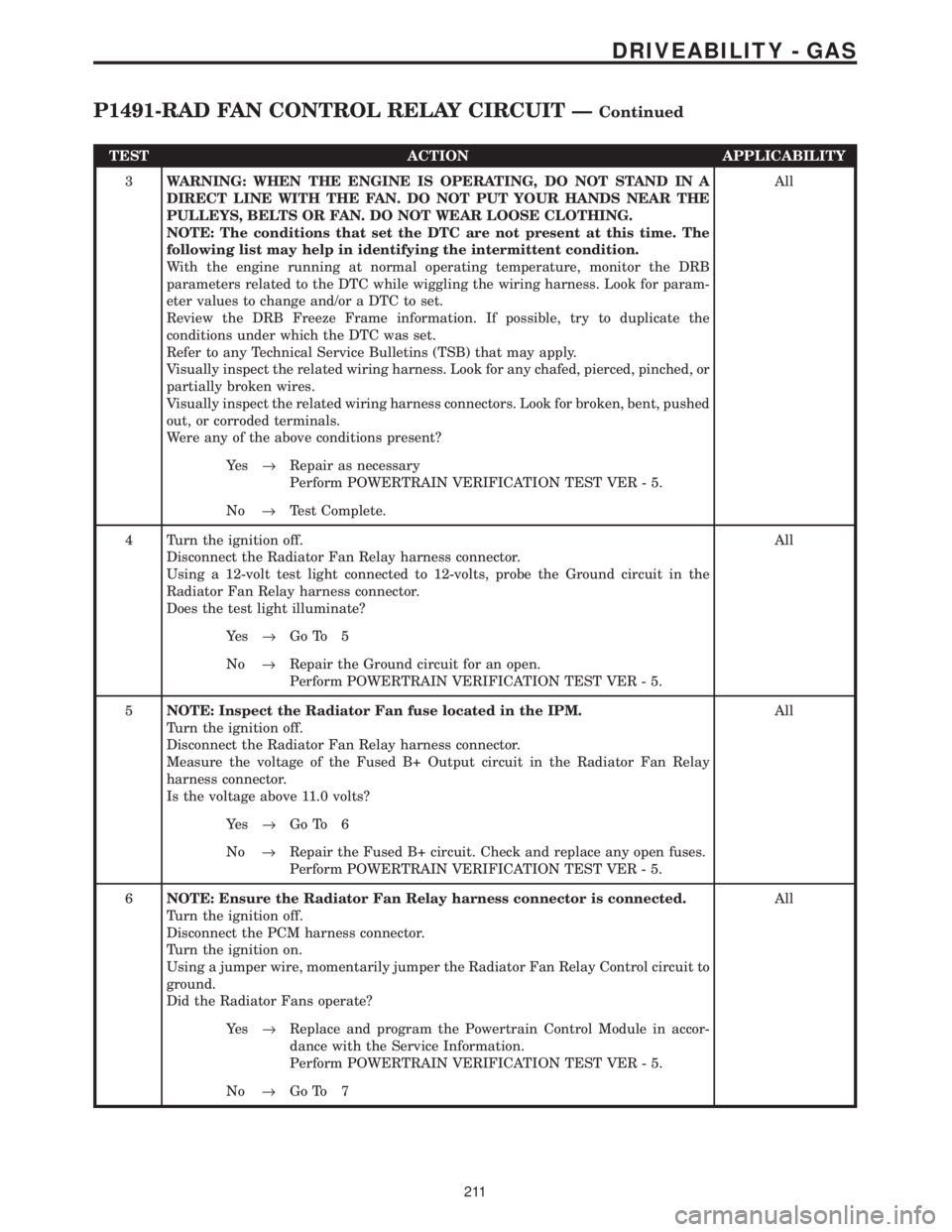
TEST ACTION APPLICABILITY
3WARNING: WHEN THE ENGINE IS OPERATING, DO NOT STAND IN A
DIRECT LINE WITH THE FAN. DO NOT PUT YOUR HANDS NEAR THE
PULLEYS, BELTS OR FAN. DO NOT WEAR LOOSE CLOTHING.
NOTE: The conditions that set the DTC are not present at this time. The
following list may help in identifying the intermittent condition.
With the engine running at normal operating temperature, monitor the DRB
parameters related to the DTC while wiggling the wiring harness. Look for param-
eter values to change and/or a DTC to set.
Review the DRB Freeze Frame information. If possible, try to duplicate the
conditions under which the DTC was set.
Refer to any Technical Service Bulletins (TSB) that may apply.
Visually inspect the related wiring harness. Look for any chafed, pierced, pinched, or
partially broken wires.
Visually inspect the related wiring harness connectors. Look for broken, bent, pushed
out, or corroded terminals.
Were any of the above conditions present?All
Ye s®Repair as necessary
Perform POWERTRAIN VERIFICATION TEST VER - 5.
No®Test Complete.
4 Turn the ignition off.
Disconnect the Radiator Fan Relay harness connector.
Using a 12-volt test light connected to 12-volts, probe the Ground circuit in the
Radiator Fan Relay harness connector.
Does the test light illuminate?All
Ye s®Go To 5
No®Repair the Ground circuit for an open.
Perform POWERTRAIN VERIFICATION TEST VER - 5.
5NOTE: Inspect the Radiator Fan fuse located in the IPM.
Turn the ignition off.
Disconnect the Radiator Fan Relay harness connector.
Measure the voltage of the Fused B+ Output circuit in the Radiator Fan Relay
harness connector.
Is the voltage above 11.0 volts?All
Ye s®Go To 6
No®Repair the Fused B+ circuit. Check and replace any open fuses.
Perform POWERTRAIN VERIFICATION TEST VER - 5.
6NOTE: Ensure the Radiator Fan Relay harness connector is connected.
Turn the ignition off.
Disconnect the PCM harness connector.
Turn the ignition on.
Using a jumper wire, momentarily jumper the Radiator Fan Relay Control circuit to
ground.
Did the Radiator Fans operate?All
Ye s®Replace and program the Powertrain Control Module in accor-
dance with the Service Information.
Perform POWERTRAIN VERIFICATION TEST VER - 5.
No®Go To 7
211
DRIVEABILITY - GAS
P1491-RAD FAN CONTROL RELAY CIRCUIT ÐContinued
Page 4006 of 4284
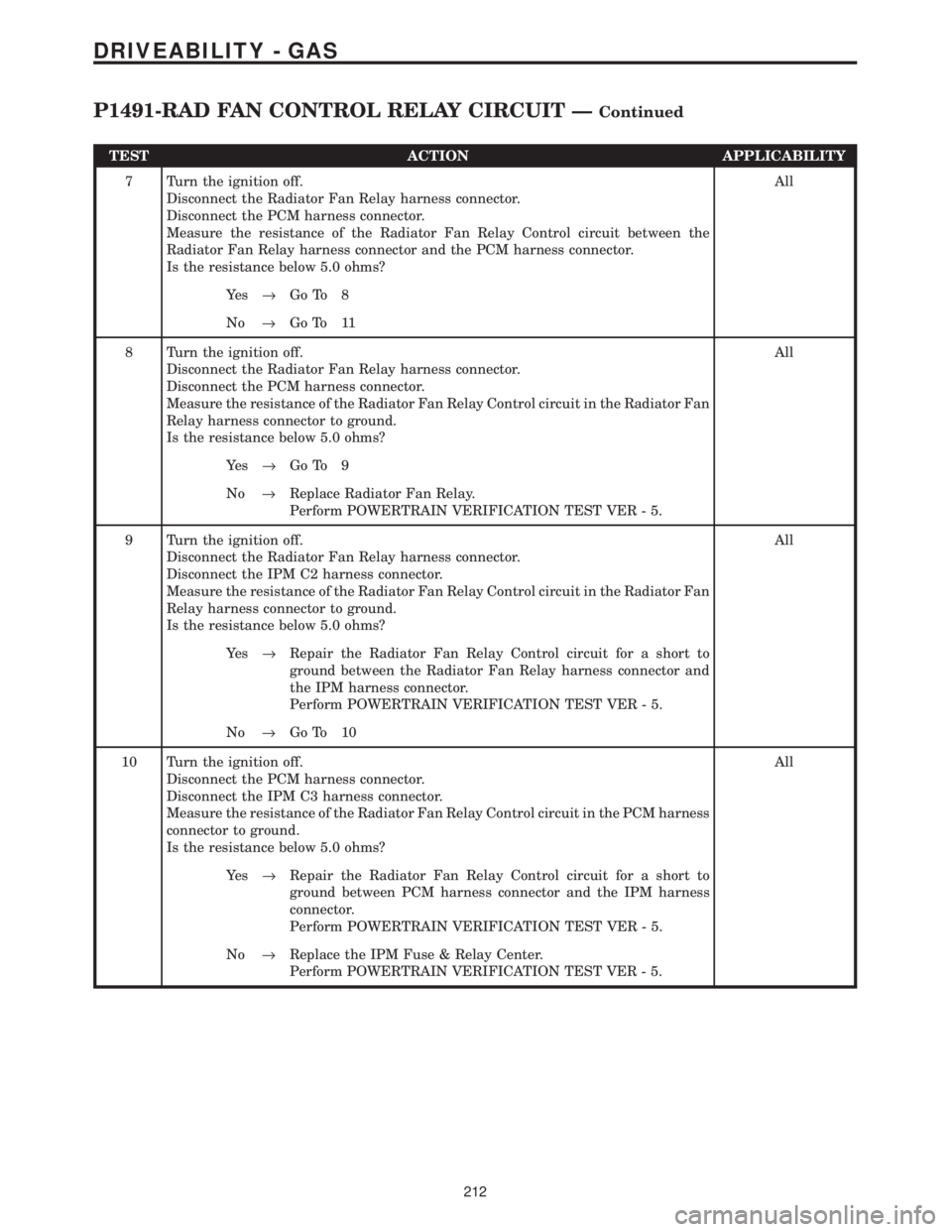
TEST ACTION APPLICABILITY
7 Turn the ignition off.
Disconnect the Radiator Fan Relay harness connector.
Disconnect the PCM harness connector.
Measure the resistance of the Radiator Fan Relay Control circuit between the
Radiator Fan Relay harness connector and the PCM harness connector.
Is the resistance below 5.0 ohms?All
Ye s®Go To 8
No®Go To 11
8 Turn the ignition off.
Disconnect the Radiator Fan Relay harness connector.
Disconnect the PCM harness connector.
Measure the resistance of the Radiator Fan Relay Control circuit in the Radiator Fan
Relay harness connector to ground.
Is the resistance below 5.0 ohms?All
Ye s®Go To 9
No®Replace Radiator Fan Relay.
Perform POWERTRAIN VERIFICATION TEST VER - 5.
9 Turn the ignition off.
Disconnect the Radiator Fan Relay harness connector.
Disconnect the IPM C2 harness connector.
Measure the resistance of the Radiator Fan Relay Control circuit in the Radiator Fan
Relay harness connector to ground.
Is the resistance below 5.0 ohms?All
Ye s®Repair the Radiator Fan Relay Control circuit for a short to
ground between the Radiator Fan Relay harness connector and
the IPM harness connector.
Perform POWERTRAIN VERIFICATION TEST VER - 5.
No®Go To 10
10 Turn the ignition off.
Disconnect the PCM harness connector.
Disconnect the IPM C3 harness connector.
Measure the resistance of the Radiator Fan Relay Control circuit in the PCM harness
connector to ground.
Is the resistance below 5.0 ohms?All
Ye s®Repair the Radiator Fan Relay Control circuit for a short to
ground between PCM harness connector and the IPM harness
connector.
Perform POWERTRAIN VERIFICATION TEST VER - 5.
No®Replace the IPM Fuse & Relay Center.
Perform POWERTRAIN VERIFICATION TEST VER - 5.
212
DRIVEABILITY - GAS
P1491-RAD FAN CONTROL RELAY CIRCUIT ÐContinued
Page 4007 of 4284
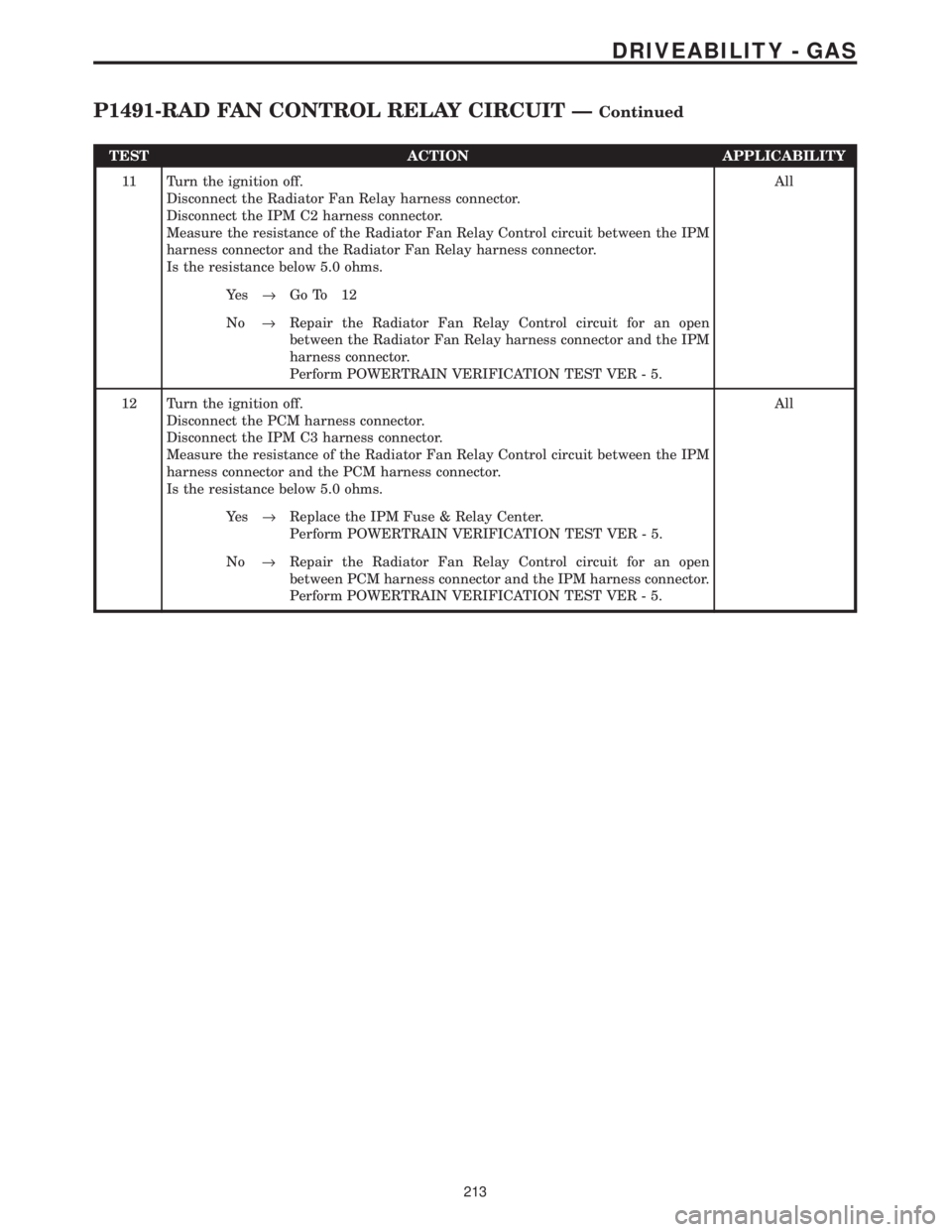
TEST ACTION APPLICABILITY
11 Turn the ignition off.
Disconnect the Radiator Fan Relay harness connector.
Disconnect the IPM C2 harness connector.
Measure the resistance of the Radiator Fan Relay Control circuit between the IPM
harness connector and the Radiator Fan Relay harness connector.
Is the resistance below 5.0 ohms.All
Ye s®Go To 12
No®Repair the Radiator Fan Relay Control circuit for an open
between the Radiator Fan Relay harness connector and the IPM
harness connector.
Perform POWERTRAIN VERIFICATION TEST VER - 5.
12 Turn the ignition off.
Disconnect the PCM harness connector.
Disconnect the IPM C3 harness connector.
Measure the resistance of the Radiator Fan Relay Control circuit between the IPM
harness connector and the PCM harness connector.
Is the resistance below 5.0 ohms.All
Ye s®Replace the IPM Fuse & Relay Center.
Perform POWERTRAIN VERIFICATION TEST VER - 5.
No®Repair the Radiator Fan Relay Control circuit for an open
between PCM harness connector and the IPM harness connector.
Perform POWERTRAIN VERIFICATION TEST VER - 5.
213
DRIVEABILITY - GAS
P1491-RAD FAN CONTROL RELAY CIRCUIT ÐContinued
Page 4029 of 4284
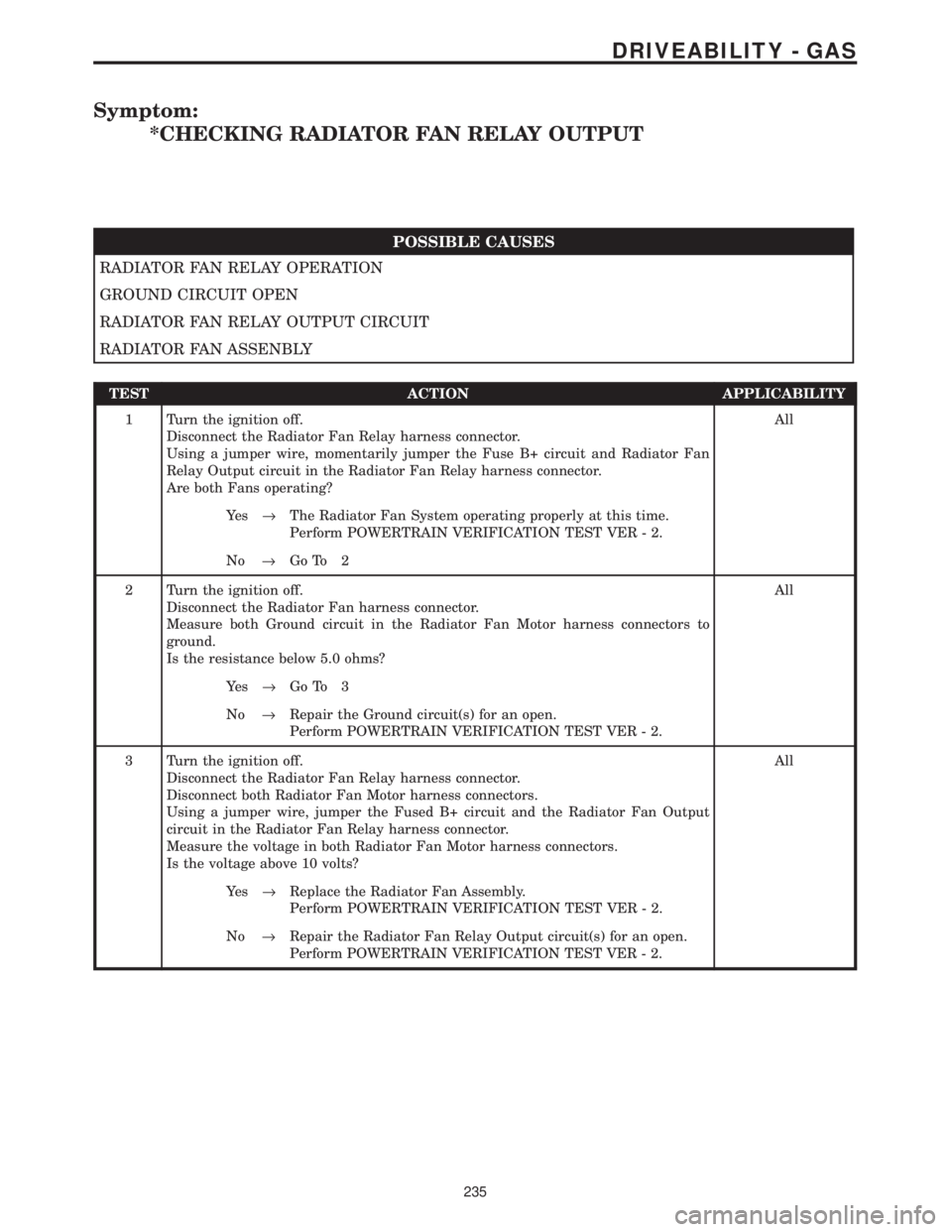
Symptom:
*CHECKING RADIATOR FAN RELAY OUTPUT
POSSIBLE CAUSES
RADIATOR FAN RELAY OPERATION
GROUND CIRCUIT OPEN
RADIATOR FAN RELAY OUTPUT CIRCUIT
RADIATOR FAN ASSENBLY
TEST ACTION APPLICABILITY
1 Turn the ignition off.
Disconnect the Radiator Fan Relay harness connector.
Using a jumper wire, momentarily jumper the Fuse B+ circuit and Radiator Fan
Relay Output circuit in the Radiator Fan Relay harness connector.
Are both Fans operating?All
Ye s®The Radiator Fan System operating properly at this time.
Perform POWERTRAIN VERIFICATION TEST VER - 2.
No®Go To 2
2 Turn the ignition off.
Disconnect the Radiator Fan harness connector.
Measure both Ground circuit in the Radiator Fan Motor harness connectors to
ground.
Is the resistance below 5.0 ohms?All
Ye s®Go To 3
No®Repair the Ground circuit(s) for an open.
Perform POWERTRAIN VERIFICATION TEST VER - 2.
3 Turn the ignition off.
Disconnect the Radiator Fan Relay harness connector.
Disconnect both Radiator Fan Motor harness connectors.
Using a jumper wire, jumper the Fused B+ circuit and the Radiator Fan Output
circuit in the Radiator Fan Relay harness connector.
Measure the voltage in both Radiator Fan Motor harness connectors.
Is the voltage above 10 volts?All
Ye s®Replace the Radiator Fan Assembly.
Perform POWERTRAIN VERIFICATION TEST VER - 2.
No®Repair the Radiator Fan Relay Output circuit(s) for an open.
Perform POWERTRAIN VERIFICATION TEST VER - 2.
235
DRIVEABILITY - GAS