2001 CHRYSLER VOYAGER service
[x] Cancel search: servicePage 449 of 4284

Symptom:
*NO RESPONSE FROM TRANSMISSION CONTROL MODULE
POSSIBLE CAUSES
NO RESPONSE FROM TRANSMISSION CONTROL MODULE
FCM OUTPUT (RUN/ST) CIRCUIT OPEN
IGNITION SWITCH OUTPUT (START) CIRCUIT OPEN
FUSED B(+) CIRCUIT OPEN
GROUND CIRCUIT(S) OPEN
OPEN PCI BUS CIRCUIT
TRANSMISSION CONTROL MODULE
TEST ACTION APPLICABILITY
1 Turn the ignition on.
Note: As soon as one or more module communicates with the DRB, answer
the question.
With the DRB, attempt to communicate with the Airbag Control Module (ACM).
With the DRB, attempt to communicate with the Body Control Module (BCM).
Was the DRB able to I/D or establish communications with either of the modules?All
Ye s®Go To 2
No®Refer to the Body Communication category and perform the
symptom PCI Bus Communication Failure.
Perform 41TE TRANSMISSION VERIFICATION TEST - VER 1.
2 Turn the ignition off.
Disconnect the TCM harness connector.
Turn the ignition on.
Using a 12-volt test light connected to ground, probe the FCM Output (Run/St)
circuit.
Note: The light must illuminate brightly, if it does not light, or lights dimly,
the circuit must be repaired. If there is any doubt, compare the brightness
when testing the circuit, to the brightness when connected directly to the
battery positive post.
Is the test light illuminated?All
Ye s®Go To 3
No®Repair the FCM Output (Run/St) circuit for an open. Refer to the
wiring diagrams location in the Service Information.
Perform 41TE TRANSMISSION VERIFICATION TEST - VER 1.
420
COMMUNICATION
Page 450 of 4284

TEST ACTION APPLICABILITY
3 Turn the ignition off.
Disconnect the TCM harness connector.
Remove the starter relay from the IPM.
Using a 12-volt test light connected to ground, probe the Ignition Switch Output
(Start) circuit.
Note: The light must illuminate brightly, if it does not light, or lights dimly,
the circuit must be repaired. If there is any doubt, compare the brightness
when testing the circuit, to the brightness when connected directly to the
battery positive post.
Observe the test light while momentarily turning the ignition switch to the Start
position.
Is the test light illuminated?All
Ye s®Go To 4
No®Repair the Ignition Switch Output (Start) circuit for an open.
Refer to the wiring diagrams located in the Service Information.
Perform 41TE TRANSMISSION VERIFICATION TEST - VER 1.
Note: Reinstall the original Starter Relay.
4 Turn the ignition off.
Disconnect the TCM harness connector.
Using a 12-volt test light connected to ground, probe the Fused B(+) circuit.
Note: The light must illuminate brightly, if it does not light, or lights dimly,
the circuit must be repaired. If there is any doubt, compare the brightness
when testing the circuit, to the brightness when connected directly to the
battery positive post.
Is the test light illuminated?All
Ye s®Go To 5
No®Check IPM fuse #15 for an open. If OK, repair the Fused B(+)
circuit for an open. Refer to the wiring diagrams located in the
Service Information.
Perform 41TE TRANSMISSION VERIFICATION TEST - VER 1.
5 Turn the ignition off.
Disconnect the TCM harness connector.
Using a 12-volt test light connected to 12-volts, probe each ground circuit in the TCM
connector.
NOTE: The light must illuminate brightly, if it does not light, or lights dimly,
the circuit must be repaired. If there is any doubt, compare the brightness
when testing the circuit, to the brightness when connected directly to the
battery negative post.
Is the light illuminated at all ground circuits?All
Ye s®Go To 6
No®Repair the Ground circuit(s) for an open. Check the main ground
connection to engine block and/or chassis. Refer to the wiring
diagrams located in the Service Information.
Perform 41TE TRANSMISSION VERIFICATION TEST - VER 1.
421
COMMUNICATION
*NO RESPONSE FROM TRANSMISSION CONTROL MODULE ÐContinued
Page 451 of 4284

TEST ACTION APPLICABILITY
6Note: Ensure there is PCI Bus communication with other modules on the
vehicle before proceeding. If not, refer to the symptom list from the menu
and repair as necessary.
Disconnect the TCM harness connector.
Use Scope input cable CH7058, Cable to Probe adapter CH7062, and the red and
black test probes.
Connect the scope input cable to the channel one connector on the DRB. Attach the
red and black leads and the cable to probe adapter to the scope input cable.
With the DRBIIItselect Pep Module Tools.
Select lab scope.
Select Live Data.
Select 12 volt square wave.
Press F2 for Scope.
Press F2 and use the down arrow to set voltage range to 20 volts. Press F2 again
when complete.
Connect the Black lead to the chassis ground. Connect the Red lead to the PCI Bus
circuit in the TCM connector.
Turn the ignition on.
Observe the voltage display on the DRB Lab Scope.
Does the voltage pulse from 0 to approximately 7.5 volts?All
Ye s®Go To 7
No®Repair the PCI Bus circuit for an open.
Perform 41TE TRANSMISSION VERIFICATION TEST - VER 1.
7 If there are no possible causes remaining, view repair. All
Repair
Replace the Transmission Control Module in accordance with the
Service Information.
Perform 41TE TRANSMISSION VERIFICATION TEST - VER 1.
422
COMMUNICATION
*NO RESPONSE FROM TRANSMISSION CONTROL MODULE ÐContinued
Page 478 of 4284

Symptom:
HEADLAMP SWITCH MISMATCH
When Monitored and Set Condition:
HEADLAMP SWITCH MISMATCH
When Monitored: Ignition ON
Set Condition: Headlamp switch is in Auto mode and the vehicle is not EC Mirror
equipped.
POSSIBLE CAUSES
VERIFY AUTO HEADLAMP SWITCH
INTERMITTENT WIRING AND CONNECTORS
BODY CONTROL MODULE
TEST ACTION APPLICABILITY
1 Turn the ignition on.
With the DRBIIIt, record and erase DTC's.
Turn the headlamps to the Auto position.
With the DRBIIIt, read DTCs.
Does the DRBIIItdisplay HEADLAMP SWITCH MISMATCH?All
Ye s®Go To 2
No®Go To 4
2 Visually identify the Headlamp Switch type.
Does the Headlamp Switch Contain an Auto Headlamp position?All
Ye s®Replace the Auto Headlamp Switch with a non Auto Headlamp
Switch.
Perform BODY VERIFICATION TEST - VER 1.
No®Go To 3
3 If there are no possible causes remaining, view repair. All
Repair
Replace and program the Body Control Module in accordance with
the Service Information.
Perform BODY VERIFICATION TEST - VER 1.
4 The conditions necessary to set this DTC are not present at this time.
Using the schematics as a guide, inspect the wiring and connectors specific to this
circuit.
Wiggle the wiring while checking for shorts and open circuits.
Were there any problems found?All
Ye s®Repair as necessary.
Perform BODY VERIFICATION TEST - VER 1.
No®Test Complete.
449
EXTERIOR LIGHTING
Page 479 of 4284

Symptom:
HEADLAMP SWITCH OPEN
When Monitored and Set Condition:
HEADLAMP SWITCH OPEN
When Monitored: Ignition ON
Set Condition: A Sensor voltage is over 4.8 volts for more than .0625 seconds.
POSSIBLE CAUSES
INTERMITTENT WIRING AND CONNECTORS
HEADLAMP SWITCH MUX CIRCUIT OPEN
HEADLAMP SWITCH MUX RETURN CIRCUIT OPEN
HEADLAMP SWITCH OPEN
BODY CONTROL MODULE
TEST ACTION APPLICABILITY
1 Turn the ignition on.
With the DRBIIIt, record and erase DTC's.
Turn the headlamps to the ON position.
With the DRBIIIt, read DTCs.
Does the DRBIIItdisplay HEADLAMP SWITCH OPEN?All
Ye s®Go To 2
No®Go To 5
2 Turn the ignition off.
Disconnect the Headlamp Switch harness connector.
Connect a jumper wire between the Headlamp Switch MUX circuit and the
Headlamp Switch MUX Return circuit in the Headlamp Switch harness connector.
Turn the ignition on.
With the DRB, select Body, Body Controller and read the Headlamp Switch volts.
Does the DRB Headlamp Switch Sensor voltage read less than 0.5 Volts?All
Ye s®Replace the Headlamp Switch in accordance with the Service
Information.
Perform BODY VERIFICATION TEST - VER 1.
No®Go To 3
450
EXTERIOR LIGHTING
Page 480 of 4284

TEST ACTION APPLICABILITY
3 Turn the ignition off to the lock position.
Disconnect the Body Control Module harness connector.
Disconnect the Headlamp Switch harness connector.
Note: Check connectors - Clean/repair as necessary.
Measure the resistance of the Headlamp Switch MUX circuit from the Body Control
Module connector to the Headlamp Switch harness connector.
Is the resistance above 5.0 ohms?All
Ye s®Repair the Headlamp Switch MUX circuit for an open.
Perform BODY VERIFICATION TEST - VER 1.
No®Go To 4
4 Turn the ignition off to the lock position.
Disconnect the Body Control Module harness connector.
Disconnect the Headlamp Switch harness connector.
Note: Check connectors - Clean/repair as necessary.
Measure the resistance of the Headlamp Switch MUX Return circuit from the Body
Control Module connector to the Headlamp Switch harness connector.
Is the resistance above 5.0 ohms?All
Ye s®Repair the Headlamp Switch MUX Return circuit for an open.
Perform BODY VERIFICATION TEST - VER 1.
No®Replace the Body Control Module in accordance with the Service
Information.
Perform BODY VERIFICATION TEST - VER 1.
5 The conditions necessary to set this DTC are not present at this time.
Using the schematics as a guide, inspect the wiring and connectors specific to this
circuit.
Wiggle the wiring while checking for shorts and open circuits.
Were there any problems found?All
Ye s®Repair as necessary.
Perform BODY VERIFICATION TEST - VER 1.
No®Test Complete.
451
EXTERIOR LIGHTING
HEADLAMP SWITCH OPEN ÐContinued
Page 481 of 4284
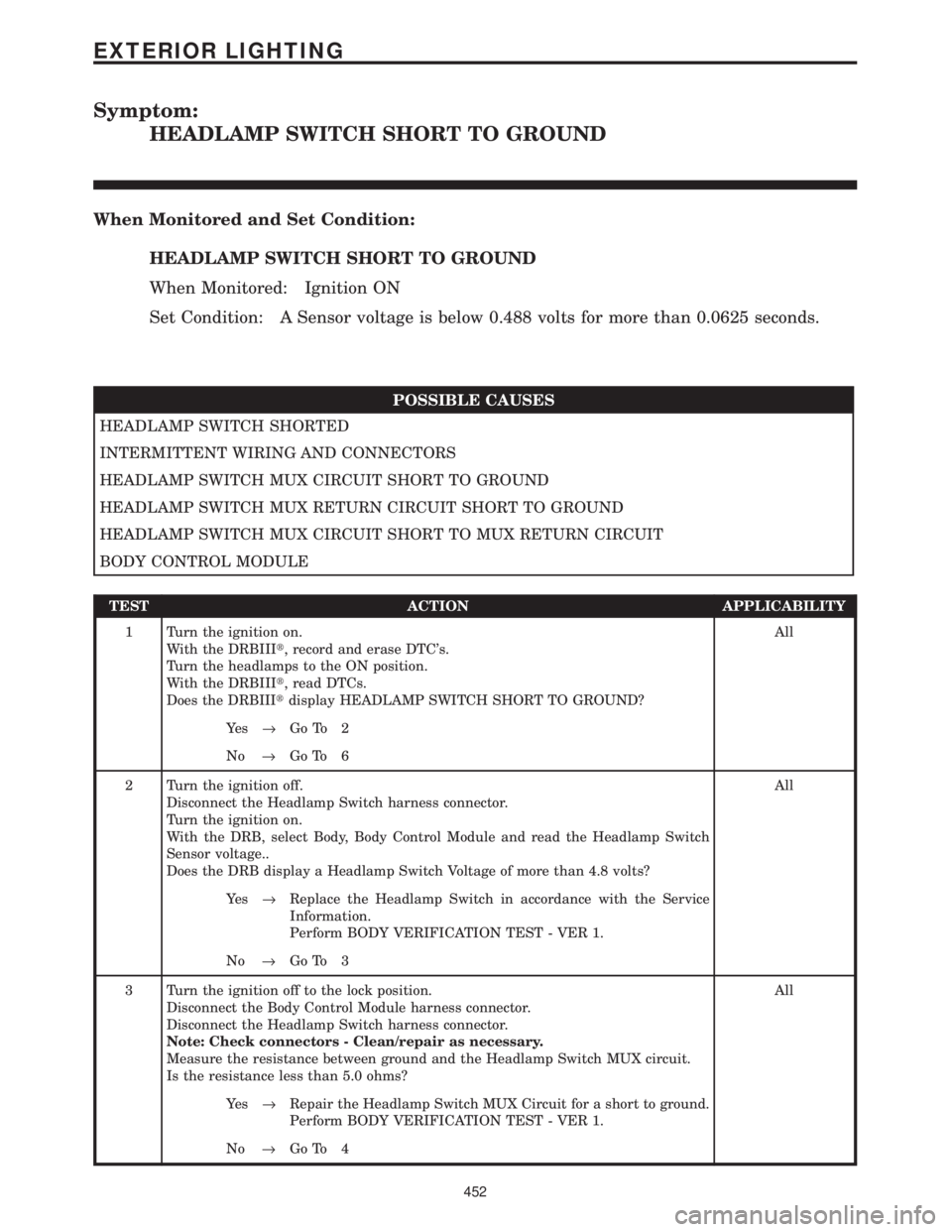
Symptom:
HEADLAMP SWITCH SHORT TO GROUND
When Monitored and Set Condition:
HEADLAMP SWITCH SHORT TO GROUND
When Monitored: Ignition ON
Set Condition: A Sensor voltage is below 0.488 volts for more than 0.0625 seconds.
POSSIBLE CAUSES
HEADLAMP SWITCH SHORTED
INTERMITTENT WIRING AND CONNECTORS
HEADLAMP SWITCH MUX CIRCUIT SHORT TO GROUND
HEADLAMP SWITCH MUX RETURN CIRCUIT SHORT TO GROUND
HEADLAMP SWITCH MUX CIRCUIT SHORT TO MUX RETURN CIRCUIT
BODY CONTROL MODULE
TEST ACTION APPLICABILITY
1 Turn the ignition on.
With the DRBIIIt, record and erase DTC's.
Turn the headlamps to the ON position.
With the DRBIIIt, read DTCs.
Does the DRBIIItdisplay HEADLAMP SWITCH SHORT TO GROUND?All
Ye s®Go To 2
No®Go To 6
2 Turn the ignition off.
Disconnect the Headlamp Switch harness connector.
Turn the ignition on.
With the DRB, select Body, Body Control Module and read the Headlamp Switch
Sensor voltage..
Does the DRB display a Headlamp Switch Voltage of more than 4.8 volts?All
Ye s®Replace the Headlamp Switch in accordance with the Service
Information.
Perform BODY VERIFICATION TEST - VER 1.
No®Go To 3
3 Turn the ignition off to the lock position.
Disconnect the Body Control Module harness connector.
Disconnect the Headlamp Switch harness connector.
Note: Check connectors - Clean/repair as necessary.
Measure the resistance between ground and the Headlamp Switch MUX circuit.
Is the resistance less than 5.0 ohms?All
Ye s®Repair the Headlamp Switch MUX Circuit for a short to ground.
Perform BODY VERIFICATION TEST - VER 1.
No®Go To 4
452
EXTERIOR LIGHTING
Page 482 of 4284
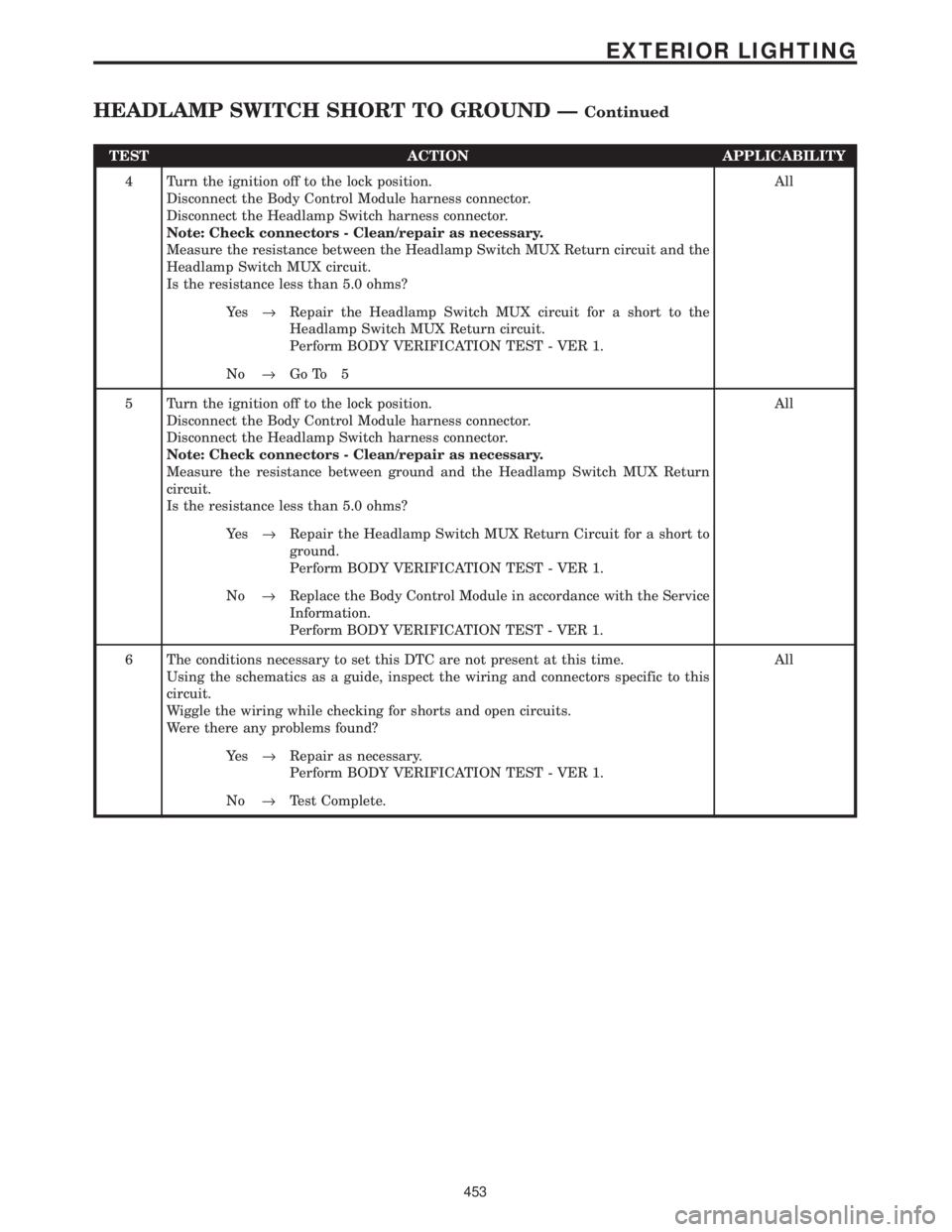
TEST ACTION APPLICABILITY
4 Turn the ignition off to the lock position.
Disconnect the Body Control Module harness connector.
Disconnect the Headlamp Switch harness connector.
Note: Check connectors - Clean/repair as necessary.
Measure the resistance between the Headlamp Switch MUX Return circuit and the
Headlamp Switch MUX circuit.
Is the resistance less than 5.0 ohms?All
Ye s®Repair the Headlamp Switch MUX circuit for a short to the
Headlamp Switch MUX Return circuit.
Perform BODY VERIFICATION TEST - VER 1.
No®Go To 5
5 Turn the ignition off to the lock position.
Disconnect the Body Control Module harness connector.
Disconnect the Headlamp Switch harness connector.
Note: Check connectors - Clean/repair as necessary.
Measure the resistance between ground and the Headlamp Switch MUX Return
circuit.
Is the resistance less than 5.0 ohms?All
Ye s®Repair the Headlamp Switch MUX Return Circuit for a short to
ground.
Perform BODY VERIFICATION TEST - VER 1.
No®Replace the Body Control Module in accordance with the Service
Information.
Perform BODY VERIFICATION TEST - VER 1.
6 The conditions necessary to set this DTC are not present at this time.
Using the schematics as a guide, inspect the wiring and connectors specific to this
circuit.
Wiggle the wiring while checking for shorts and open circuits.
Were there any problems found?All
Ye s®Repair as necessary.
Perform BODY VERIFICATION TEST - VER 1.
No®Test Complete.
453
EXTERIOR LIGHTING
HEADLAMP SWITCH SHORT TO GROUND ÐContinued