Page 45 of 171
45n
IndexDataTechnologyRepairsCar careControlsOverview
Power convertible top
* – roadster
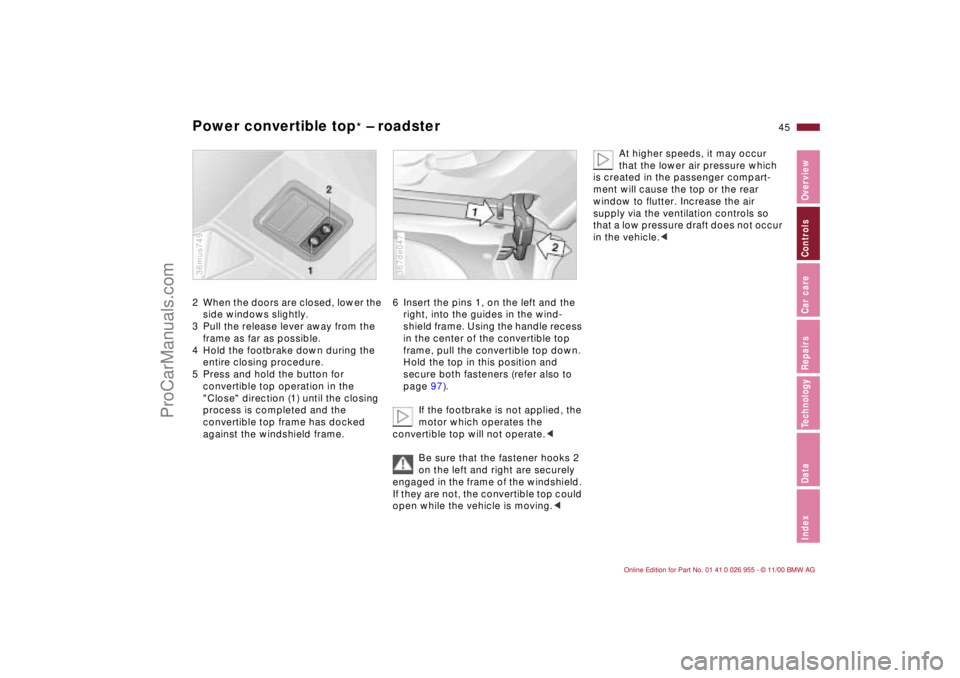
2 When the doors are closed, lower the
side windows slightly.
3 Pull the release lever away from the
frame as far as possible.
4 Hold the footbrake down during the
entire closing procedure.
5 Press and hold the button for
convertible top operation in the
"Close" direction (1) until the closing
process is completed and the
convertible top frame has docked
against the windshield frame.36mus749
6 Insert the pins 1, on the left and the
right, into the guides in the wind-
shield frame. Using the handle recess
in the center of the convertible top
frame, pull the convertible top down.
Hold the top in this position and
secure both fasteners (refer also to
page 97).
If the footbrake is not applied, the
motor which operates the
convertible top will not operate.<
Be sure that the fastener hooks 2
on the left and right are securely
engaged in the frame of the windshield.
If they are not, the convertible top could
open while the vehicle is moving.< 367de047
At higher speeds, it may occur
that the lower air pressure which
is created in the passenger compart-
ment will cause the top or the rear
window to flutter. Increase the air
supply via the ventilation controls so
that a low pressure draft does not occur
in the vehicle.<
ProCarManuals.com
Page 46 of 171
46n
For maximum safety, please comply
with the following:
Never try to adjust your seat while
operating the vehicle. The seat
could respond with an unexpected
movement, and the ensuing loss of
vehicle control could result in an acci-
dent.
Be sure that the safety belt is fastened
firmly against your body at all times. In
the event of a frontal impact, a loose lap
belt could slide over your hips, leading
to abdominal injury. In addition, the
safety belt's restraint effectiveness is
reduced if the belt is worn loosely.
When adjusting your seat, select a
position that provides the maximum
distance between you and the steering
wheel, instrument panel and door while
still allowing comfortable and safe
access to all vehicle controls.<
Correct sitting postureTo reduce strain on your spinal column,
sit all the way back in the seat and rest
your back fully against the backrest.
In the ideal sitting posture, your head
extends along a straight line from your
spine.
For long-distance driving, you may wish
to increase the backrest tilt angle
slightly to reduce muscular tension.
You should also be able to grasp the
highest point of the steering wheel with
your arms slightly bent.
After a seat adjustment in the coupe,
adjust the height of the safety belt also.
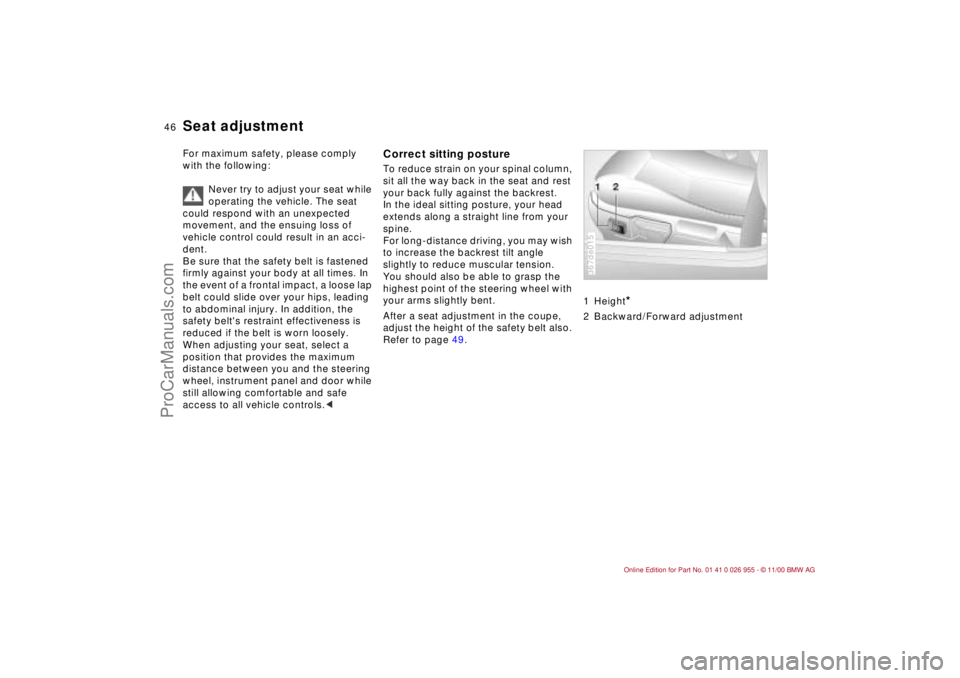
Refer to page 49.1 Height
*
2 Backward/Forward adjustment367de015
Seat adjustment
ProCarManuals.com
Page 48 of 171
48n
MirrorsInterior rearview mirror with
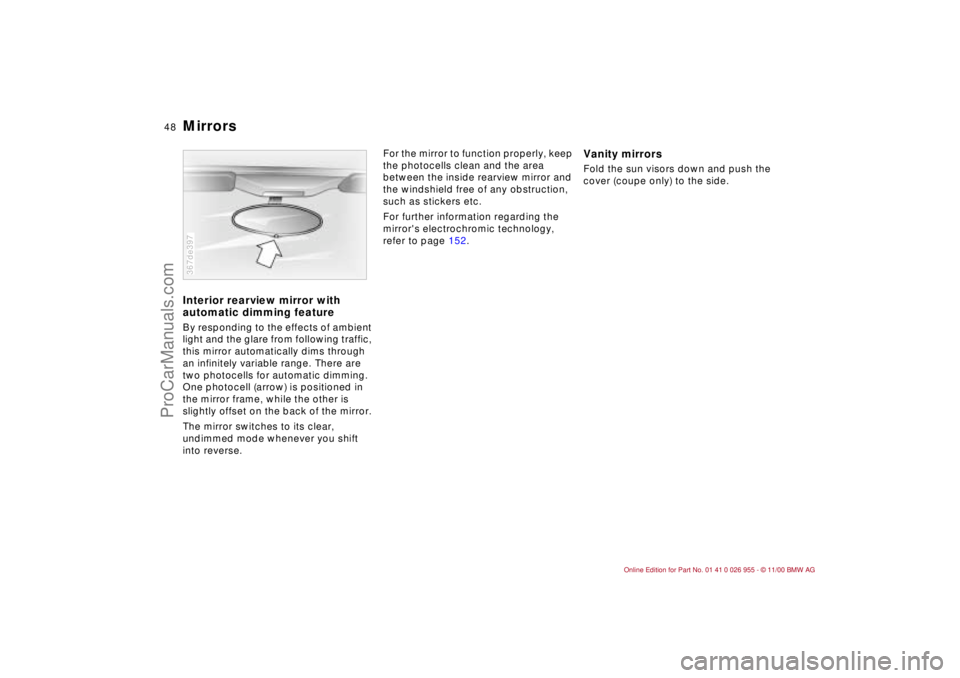
automatic dimming featureBy responding to the effects of ambient
light and the glare from following traffic,
this mirror automatically dims through
an infinitely variable range. There are
two photocells for automatic dimming.
One photocell (arrow) is positioned in
the mirror frame, while the other is
slightly offset on the back of the mirror.
The mirror switches to its clear,
undimmed mode whenever you shift
into reverse. 367de397
For the mirror to function properly, keep
the photocells clean and the area
between the inside rearview mirror and
the windshield free of any obstruction,
such as stickers etc.
For further information regarding the
mirror's electrochromic technology,
refer to page 152.
Vanity mirrorsFold the sun visors down and push the
cover (coupe only) to the side.
ProCarManuals.com
Page 51 of 171
51n
IndexDataTechnologyRepairsCar careControlsOverview
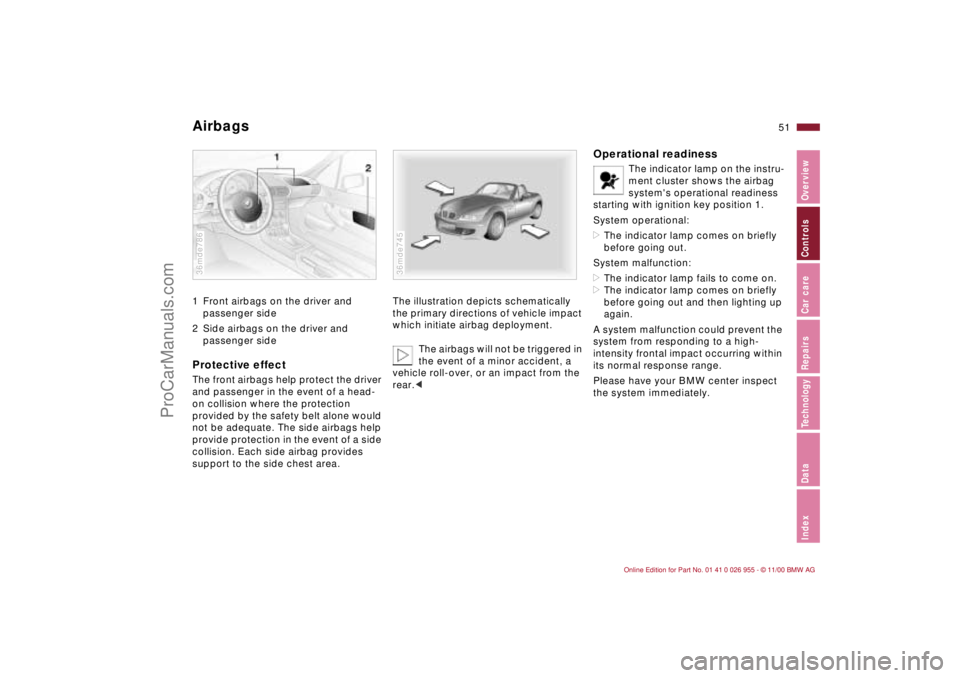
Airbags1 Front airbags on the driver and
passenger side
2 Side airbags on the driver and
passenger sideProtective effectThe front airbags help protect the driver
and passenger in the event of a head-
on collision where the protection
provided by the safety belt alone would
not be adequate. The side airbags help
provide protection in the event of a side
collision. Each side airbag provides
support to the side chest area.36mde786
The illustration depicts schematically
the primary directions of vehicle impact
which initiate airbag deployment.
The airbags will not be triggered in
the event of a minor accident, a
vehicle roll-over, or an impact from the
rear.< 36mde745
Operational readiness
The indicator lamp on the instru-
ment cluster shows the airbag
system's operational readiness
starting with ignition key position 1.
System operational:
>The indicator lamp comes on briefly
before going out.
System malfunction:
>The indicator lamp fails to come on.
>The indicator lamp comes on briefly
before going out and then lighting up
again.
A system malfunction could prevent the
system from responding to a high-
intensity frontal impact occurring within
its normal response range.
Please have your BMW center inspect
the system immediately.
ProCarManuals.com
Page 55 of 171
55n
IndexDataTechnologyRepairsCar careControlsOverview
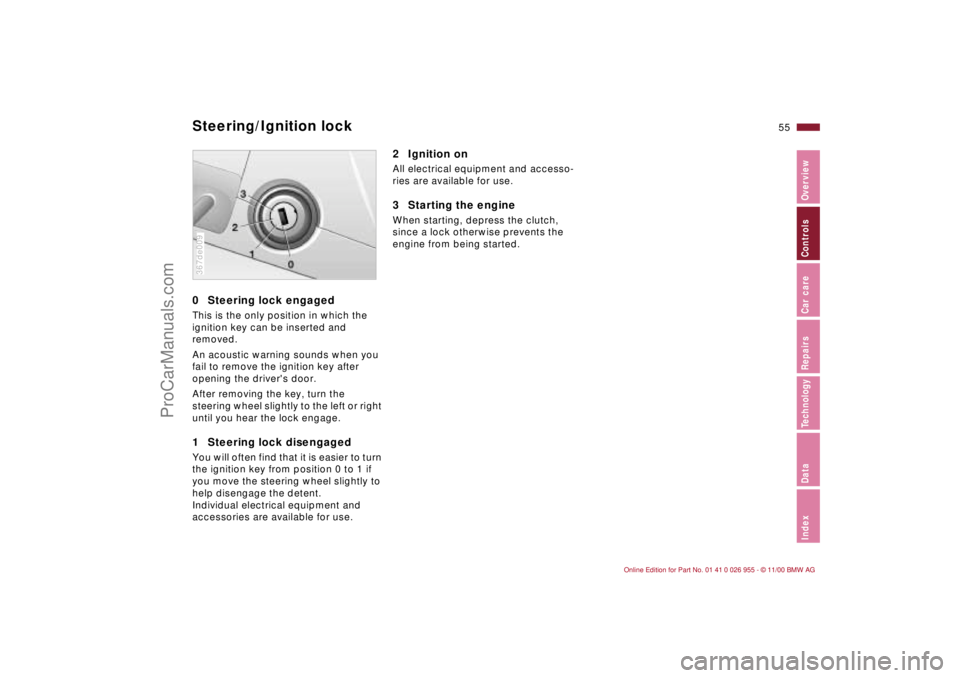
0 Steering lock engagedThis is the only position in which the
ignition key can be inserted and
removed.
An acoustic warning sounds when you
fail to remove the ignition key after
opening the driver's door.
After removing the key, turn the
steering wheel slightly to the left or right
until you hear the lock engage.1 Steering lock disengagedYou will often find that it is easier to turn
the ignition key from position 0 to 1 if
you move the steering wheel slightly to
help disengage the detent.
Individual electrical equipment and
accessories are available for use.367de009
2 Ignition onAll electrical equipment and accesso-
ries are available for use.3 Starting the engineWhen starting, depress the clutch,
since a lock otherwise prevents the
engine from being started.
Steering/Ignition lock
ProCarManuals.com
Page 57 of 171
57n
IndexDataTechnologyRepairsCar careControlsOverview
Switching off the engine Parking brakeTurn the ignition key to position 1 or 0.
Never remove the ignition key
while the vehicle is rolling. The
steering locks and it is impossible to
steer the vehicle.
Always remove the ignition key and
engage the steering lock before leaving
the vehicle.
Always engage the parking brake when
parking on slopes and inclined
surfaces, since even placing the lever in
1st gear or reverse may not provide
adequate resistance to rolling.<
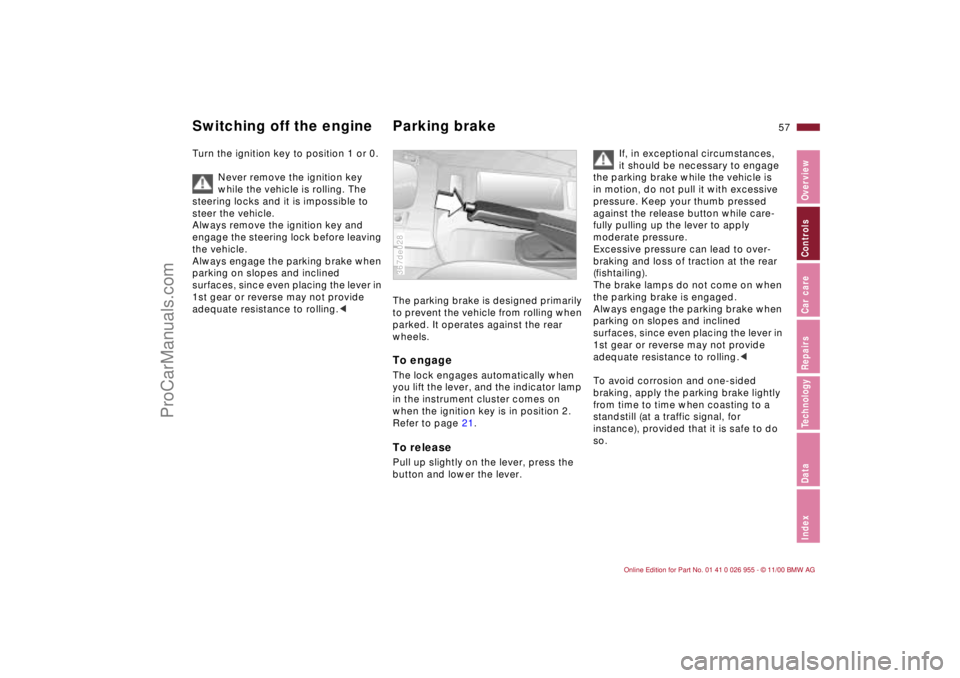
The parking brake is designed primarily
to prevent the vehicle from rolling when
parked. It operates against the rear
wheels.To engageThe lock engages automatically when
you lift the lever, and the indicator lamp
in the instrument cluster comes on
when the ignition key is in position 2.
Refer to page 21.To releasePull up slightly on the lever, press the
button and lower the lever.367de028
If, in exceptional circumstances,
it should be necessary to engage
the parking brake while the vehicle is
in motion, do not pull it with excessive
pressure. Keep your thumb pressed
against the release button while care-
fully pulling up the lever to apply
moderate pressure.
Excessive pressure can lead to over-
braking and loss of traction at the rear
(fishtailing).
The brake lamps do not come on when
the parking brake is engaged.
Always engage the parking brake when
parking on slopes and inclined
surfaces, since even placing the lever in
1st gear or reverse may not provide
adequate resistance to rolling.<
To avoid corrosion and one-sided
braking, apply the parking brake lightly
from time to time when coasting to a
standstill (at a traffic signal, for
instance), provided that it is safe to do
so.
ProCarManuals.com
Page 62 of 171
62n
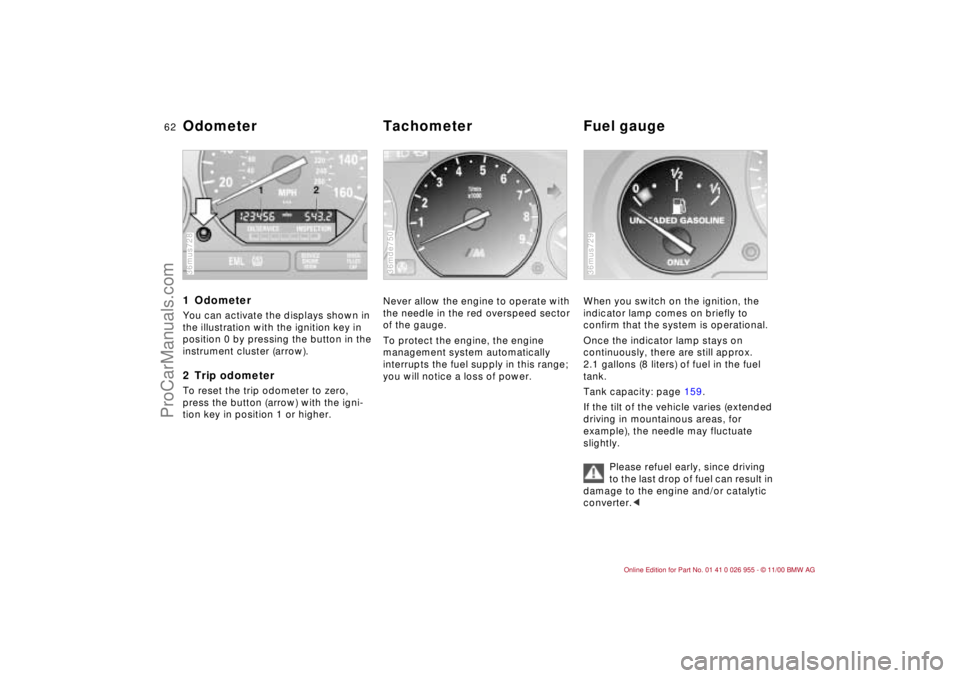
1 OdometerYou can activate the displays shown in
the illustration with the ignition key in
position 0 by pressing the button in the
instrument cluster (arrow).2 Trip odometerTo reset the trip odometer to zero,
press the button (arrow) with the igni-
tion key in position 1 or higher.36mus728
Never allow the engine to operate with
the needle in the red overspeed sector
of the gauge.
To protect the engine, the engine
management system automatically
interrupts the fuel supply in this range;
you will notice a loss of power.36mde750
When you switch on the ignition, the
indicator lamp comes on briefly to
confirm that the system is operational.
Once the indicator lamp stays on
continuously, there are still approx.
2.1 gallons (8 liters) of fuel in the fuel
tank.
Tank capacity: page 159.
If the tilt of the vehicle varies (extended
driving in mountainous areas, for
example), the needle may fluctuate
slightly.
Please refuel early, since driving
to the last drop of fuel can result in
damage to the engine and/or catalytic
converter.< 36mus729
Odometer Tachometer Fuel gauge
ProCarManuals.com
Page 67 of 171
67n
IndexDataTechnologyRepairsCar careControlsOverview
Tire Pressure Warning (RDW)The conceptThe Tire Pressure Warning (RDW) moni-
tors the tire pressure in all four wheels
while driving. The system is designed to
detect whenever the inflation pressure
in a tire drops significantly, monitoring
the speed of the tires relative to each
other. A flat tire can be detected and
reported because its speed suddenly
deviates drastically from that of the
other tires.
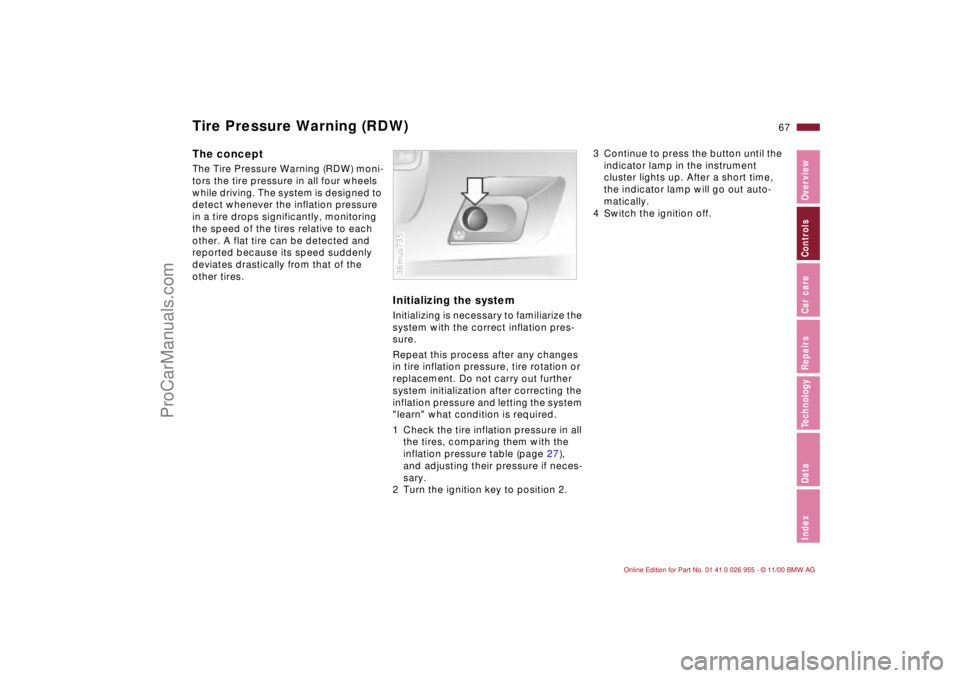
Initializing the systemInitializing is necessary to familiarize the
system with the correct inflation pres-
sure.
Repeat this process after any changes
in tire inflation pressure, tire rotation or
replacement. Do not carry out further
system initialization after correcting the
inflation pressure and letting the system
"learn" what condition is required.
1 Check the tire inflation pressure in all
the tires, comparing them with the
inflation pressure table (page 27),
and adjusting their pressure if neces-
sary.
2 Turn the ignition key to position 2.36mus735
3 Continue to press the button until the
indicator lamp in the instrument
cluster lights up. After a short time,
the indicator lamp will go out auto-
matically.
4 Switch the ignition off.
ProCarManuals.com