2001 BMW M ROADSTER COUPE light
[x] Cancel search: lightPage 68 of 171
68n
Tire Pressure Warning (RDW)Activating/deactivating the
systemThe system is automatically active in
ignition key position 2 and is therefore
always on during driving.
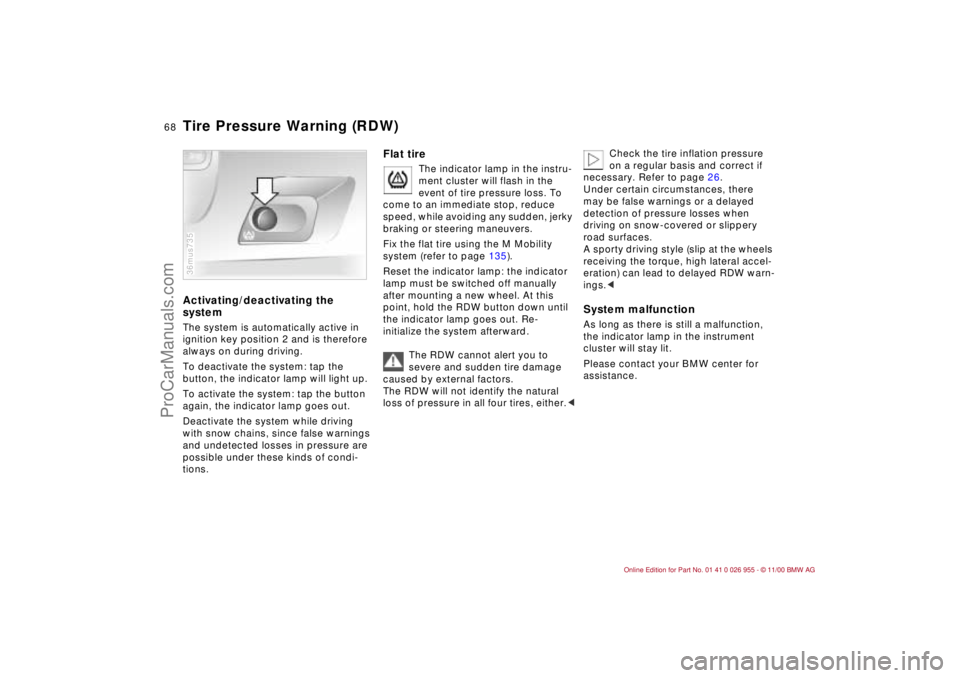
To deactivate the system: tap the
button, the indicator lamp will light up.
To activate the system: tap the button
again, the indicator lamp goes out.
Deactivate the system while driving
with snow chains, since false warnings
and undetected losses in pressure are
possible under these kinds of condi-
tions. 36mus735
Flat tire
The indicator lamp in the instru-
ment cluster will flash in the
event of tire pressure loss. To
come to an immediate stop, reduce
speed, while avoiding any sudden, jerky
braking or steering maneuvers.
Fix the flat tire using the M Mobility
system (refer to page 135).
Reset the indicator lamp: the indicator
lamp must be switched off manually
after mounting a new wheel. At this
point, hold the RDW button down until
the indicator lamp goes out. Re-
initialize the system afterward.
The RDW cannot alert you to
severe and sudden tire damage
caused by external factors.
The RDW will not identify the natural
loss of pressure in all four tires, either.<
Check the tire inflation pressure
on a regular basis and correct if
necessary. Refer to page 26.
Under certain circumstances, there
may be false warnings or a delayed
detection of pressure losses when
driving on snow-covered or slippery
road surfaces.
A sporty driving style (slip at the wheels
receiving the torque, high lateral accel-
eration) can lead to delayed RDW warn-
ings.<
System malfunctionAs long as there is still a malfunction,
the indicator lamp in the instrument
cluster will stay lit.
Please contact your BMW center for
assistance.
ProCarManuals.com
Page 69 of 171
69n
IndexDataTechnologyRepairsCar careControlsOverview
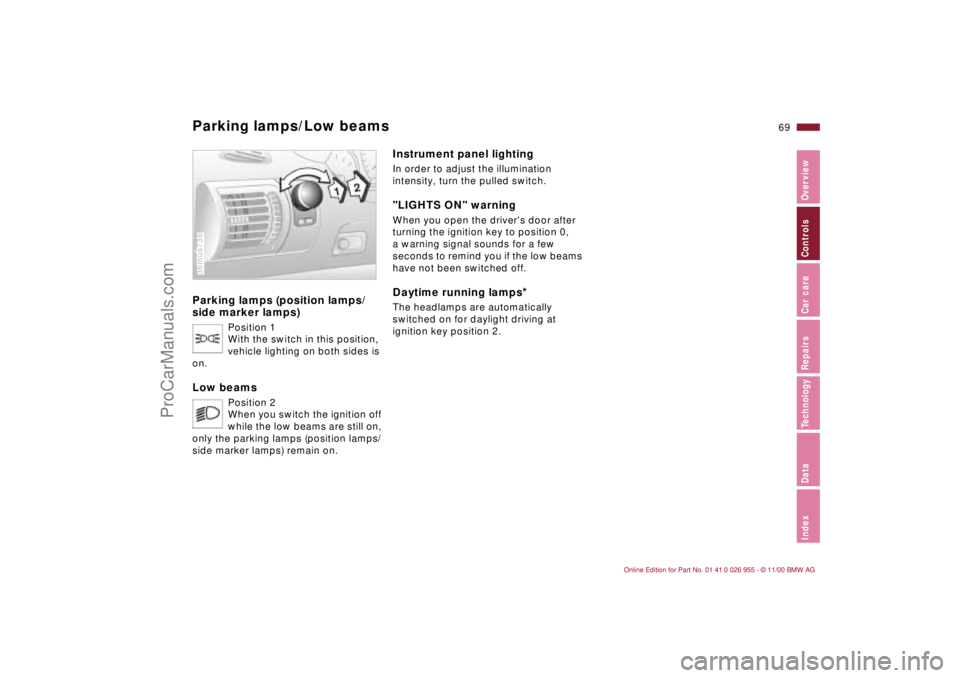
Parking lamps/Low beamsParking lamps (position lamps/
side marker lamps)
Position 1
With the switch in this position,
vehicle lighting on both sides is
on.
Low beams
Position 2
When you switch the ignition off
while the low beams are still on,
only the parking lamps (position lamps/
side marker lamps) remain on.
36mus736
Instrument panel lightingIn order to adjust the illumination
intensity, turn the pulled switch. "LIGHTS ON" warningWhen you open the driver's door after
turning the ignition key to position 0,
a warning signal sounds for a few
seconds to remind you if the low beams
have not been switched off.Daytime running lamps
*
The headlamps are automatically
switched on for daylight driving at
ignition key position 2.
ProCarManuals.com
Page 80 of 171
80n
Cigarette lighter
*
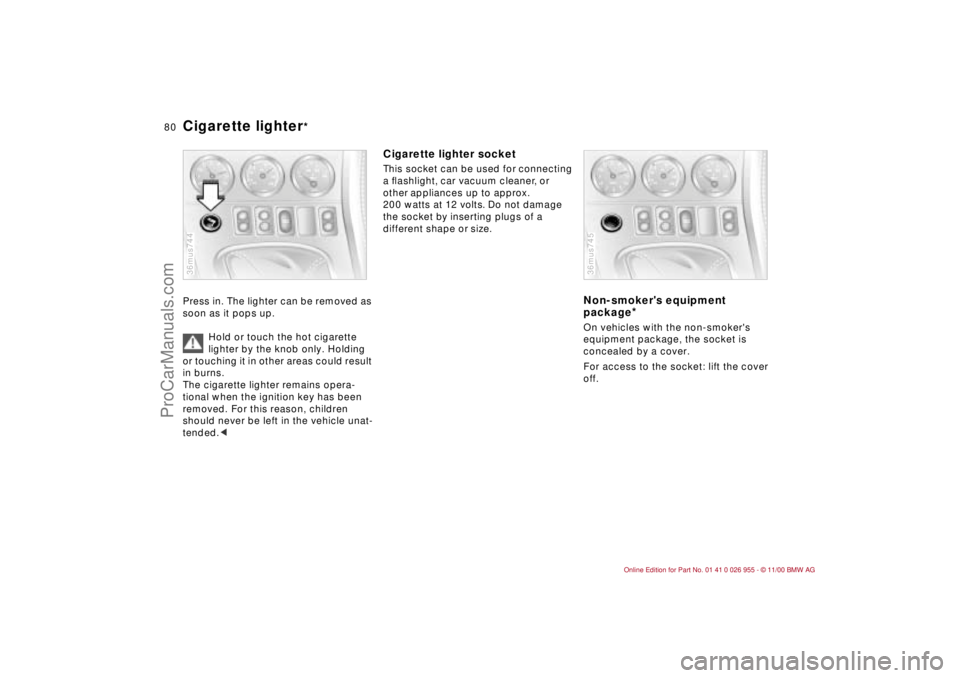
Press in. The lighter can be removed as
soon as it pops up.
Hold or touch the hot cigarette
lighter by the knob only. Holding
or touching it in other areas could result
in burns.
The cigarette lighter remains opera-
tional when the ignition key has been
removed. For this reason, children
should never be left in the vehicle unat-
tended.< 36mus744
Cigarette lighter socketThis socket can be used for connecting
a flashlight, car vacuum cleaner, or
other appliances up to approx.
200 watts at 12 volts. Do not damage
the socket by inserting plugs of a
different shape or size.
Non-smoker's equipment
package
*
On vehicles with the non-smoker's
equipment package, the socket is
concealed by a cover.
For access to the socket: lift the cover
off.36mus745
ProCarManuals.com
Page 81 of 171
81n
IndexDataTechnologyRepairsCar careControlsOverview
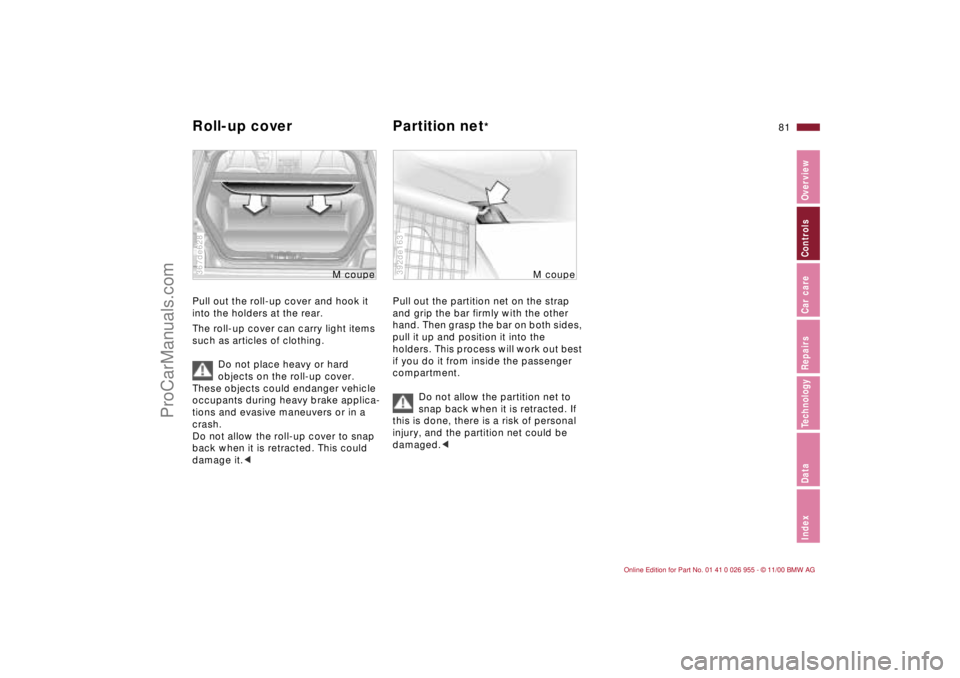
Pull out the roll-up cover and hook it
into the holders at the rear.
The roll-up cover can carry light items
such as articles of clothing.
Do not place heavy or hard
objects on the roll-up cover.
These objects could endanger vehicle
occupants during heavy brake applica-
tions and evasive maneuvers or in a
crash.
Do not allow the roll-up cover to snap
back when it is retracted. This could
damage it.< 367de628
M cou
pe
Pull out the partition net on the strap
and grip the bar firmly with the other
hand. Then grasp the bar on both sides,
pull it up and position it into the
holders. This process will work out best
if you do it from inside the passenger
compartment.
Do not allow the partition net to
snap back when it is retracted. If
this is done, there is a risk of personal
injury, and the partition net could be
damaged.< 392de163
M cou
pe
Roll-up cover Partition net
*
ProCarManuals.com
Page 86 of 171

86n
To ensure that your vehicle provides
maximum economy throughout a long
service life, we request that you
observe the following:
Engine and differentialUp to 1,200 miles (2,000 km):
Drive with varying engine and road
speeds, but do not exceed 4,500 rpm
or 100 mph (150 km/h).
Comply with local and state maximum
speed limits.
Refrain from using full throttle and avoid
pressing the accelerator beyond the
"Kickdown" point.
After you have driven 1,200 miles
(2,000 km), you can gradually increase
the engine and road speeds.
You should also comply with these
break-in procedures if the engine or
differential is replaced later in the
course of the vehicle's service life.
TiresDue to technical factors associated with
their manufacture, tires do not achieve
their full traction potential until an initial
break-in period has elapsed. You should
therefore drive with extra caution during
the initial 200 miles (300 km).
Comply with local and state maximum
speed limits.
When the vehicle is operated on
wet or slushy roads, a wedge of
water may form between the tire and
the road surface. This phenomenon is
referred to as aquaplaning or hydro-
planing, and can lead to partial or
complete loss of traction, vehicle
control and braking effectiveness.
Reduce your speed on wet roads.<
Brake systemApprox. 300 miles (500 km) must
elapse before the brake pads and discs
achieve the optimal surface and wear
pattern.
To break-in the separate parking brake
drums, apply the parking brake lightly
when coasting to a standstill (at a traffic
signal, for instance), provided that
traffic conditions allow you to do so.
To avoid corrosion, repeat this proce-
dure from time to time.
The brake lamps do not light up
when the parking brake is applied.
Vacuum for the brake system booster
on your BMW is available only when the
engine is running. When you move the vehicle with the engine off – for instance
,
by towing – substantially higher levels
of pedal force will be required to brake
the vehicle.<
ClutchThe clutch will reach optimal function
after approx. 300 miles (500 km). Shift
gears carefully during the break-in
period.
Break-in procedure
ProCarManuals.com
Page 87 of 171

87n
IndexDataTechnologyRepairsCar careControlsOverview
Driving notes
Brakes:
Do not drive with your foot resting
on the brake pedal. Even light but
consistent pedal pressure can lead to
high temperatures, brake wear and
possibly even brake failure.
Aquaplaning:
When driving on wet or slushy roads,
reduce vehicle speed. If you do not, a
wedge of water may form between the
tires and the road surface. This
phenomenon is referred to as aqua-
planing or hydroplaning. It is character-
ized by a partial or complete loss of
contact between the tires and the road
surface. The ultimate results are loss of
steering and braking control.
Driving through water:
When there is water on the roads, do
not drive in it if it is deeper than 1 ft
(30 cm). If the water is at that depth,
drive only at walking speed, otherwise
the vehicle can sustain damage to the
engine, the electrical systems and the
transmission.
Roll-up cover (coupe):
Never use the roll-up cover to store
heavy or bulky objects. If you do so,
such objects could injure vehicle occu-
pants during braking and evasive
maneuvers or in a crash.
Clothes hook (coupe):
Hang items of clothing on the hooks in
such a manner that they do not obstruct
the driver's vision. Do not hang heavy
objects on the hooks. If you do so, they
could cause personal injury during
braking and evasive maneuvers or in
a crash, for example.<
ProCarManuals.com
Page 91 of 171

91n
IndexDataTechnologyRepairsCar careControlsOverview
Disc brakesDisc brakes furnish optimum decelera-
tion and braking control and greater
fade resistance under heavy use.
When the vehicle is driven only occa-
sionally, during extended periods when
the vehicle is not used at all, or in oper-
ating conditions where brake applica-
tions are less frequent, there is an
increased tendency for corrosion of the
discs and accumulation of contamina-
tion on the brake pads. This occurs
because the minimal pressure which
must be exerted by the pads to clean
the discs by brake applications is not
reached.
If the brake discs are corroded, they will
tend to respond to braking with a
pulsating effect which even extended
application will fail to cure.
For your own safety: use only
brake pads that BMW has
approved for your specific vehicle
model. BMW cannot evaluate non-
approved brake pads to determine if
they are suited for use, and therefore
cannot ensure the operating safety of
the vehicle in the event of their use.<
Driving notesWhile driving in wet conditions and in
heavy rain, it is advisable to apply light
pressure to the brake pedal every few
miles – watch traffic conditions to
ensure that this maneuver does not
endanger other road users. The heat
generated in this braking process helps
dry the brake pads and discs.
Maximum braking force is obtained
while the wheels continue to rotate,
peaking when the wheels remain on the
verge of locking without actually doing
so. ABS maintains this state automati-
cally. If the ABS fails, you should revert
to the staggered braking technique
described on page 94.
Extended or steep mountain descents
should be driven in the gear in which
only minimal periodic brake application
is required. This avoids excessive strain
on the brakes and possible impairment
of the braking effect.
You can increase the engine's braking
effect by selecting progressively lower
gears, downshifting into first gear, if
necessary. Should engine braking prove inade-
quate, you should still avoid extended,
continuous braking. Instead, decelerate
the vehicle with increased pressure on
the brake pedal (watch for following
traffic!), release the pedal and then
repeat the brake application (staggered
braking). This staggered braking tech-
nique allows the brakes to cool in the
intervals between active braking
phases, preventing overheating and
ensuring that full braking capacity
remains available at all times.
Do not drive the vehicle with the
clutch depressed, with the shift
lever in neutral or with the engine shut
off. The engine provides no braking
control when the transmission is in
neutral and there is no power assist for
braking and steering when the engine is
shut off.
Never allow floor mats, carpets or any
other objects to protrude into the area
around the accelerator, clutch and
brake pedals and obstruct their move-
ment.<
ProCarManuals.com
Page 94 of 171

94n
Winter operation Power steeringIf it should occur that the ABS does not
respond in a critical braking situation
and the wheels lock: reduce the pres-
sure on the brake pedal until the wheels
just start to roll again while still main-
taining enough force to continue
braking. Following that, increase pedal
pressure again. Reduce the pressure as
the wheels lock, then reapply pressure.
Repeat this process.
This type of staggered braking will
lower the braking distance, and the
vehicle still remains responsive to
steering.
You can still attempt to steer around
hazards once you have reduced the
pressure on the brake pedal.
Do not shift down on slick road
surfaces. Doing so could cause
the rear wheels to lose traction and
skid, which could result in the loss of
vehicle control.<
Depress the clutch pedal during
hard braking on road surfaces
which provide only poor or uneven trac-
tion.<
Skid controlDepress the clutch pedal and release
the accelerator pedal. Countersteer
carefully and attempt to regain control
of the vehicle.ParkingEngage 1st or reverse gear. Depending
on the steepness of the incline, you can
apply the parking brake as well. In order
to prevent the parking brake pads from
locking due to frost or corrosion, dry
them by gently applying the parking
brake as the vehicle is coming to a stop.
Make sure that following traffic is not
endangered.
The brake lamps do not light
up when the parking brake is
applied.<
Changes in steering response
(high steering effort, for example):
Consult a BMW center to have the
system checked.
If the power steering fails,
increased effort will be required
to steer the vehicle.<
ProCarManuals.com