2001 BMW M ROADSTER COUPE clock
[x] Cancel search: clockPage 10 of 171

Contents
Overview
Controls and features
Cockpit16
Instrument cluster18
Indicator and warning lamps20
Hazard warning flashers24
Warning triangle24
First-aid kit25
Refueling25
Fuel specifications26
Tire inflation pressure26
Tire inflation pressure (table)27
Opening and closing:
Keys30
Electronic vehicle
immobilizer31
Central locking system32
Opening and closing from the
outside32
Opening and closing from the
inside33
Luggage compartment lid34
Electric power windows35
Sunroof – coupe36
Convertible top – roadster37
Adjustments:
Seats46
Mirrors47
Safety systems:
Safety belts49
Airbags51
Transporting children safely53
Driving:
Steering/Ignition lock55
Starting the engine56
Switching off the engine57
Parking brake57
Manual transmission58
Turn signal indicators/High
beams58
Wiper/Washer system59
Rear window defroster60
Cruise control61
Everything under control:
Odometer62
Tachometer62
Fuel gauge62
Coolant temperature gauge63
Engine oil temperature gauge63
Service Interval Display64
Outside temperature64
Clock64
Technology for safety and
driving convenience:
Dynamic Stability Control
(DSC)65
Tire Pressure Warning (RDW)67
Lamps:
Parking lamps/Low beams69
Interior lamps70
Reading lamps71
Controlling the climate
for pleasant driving:
Heating and ventilation/
Air conditioner72
Seat heating77
Contents
ProCarManuals.com
Page 25 of 171
25n
IndexDataTechnologyRepairsCar careControlsOverview
First-aid kit
*
Refueling
M coupeIn the luggage compartment at the left
rear. Release the Velcro
® fasteners.
M roadsterIn the luggage compartment on the left
in a storage area; swing retaining strap
upward.
Some of the articles in the first-aid
kit may be used within a limited
time only. For this reason, check the
expiration dates of each of the items
regularly, and replace any whose expi-
ration dates have passed. You can
acquire replacements in any drugstore
or pharmacy.
Comply with legal requirements which
cover availability of a first-aid kit in the
vehicle.<
Before filling the tank, shut off the
engine, as otherwise fuel cannot
flow into the tank and the Service
Engine Soon warning lamp may come
on. Refer to page 22.<
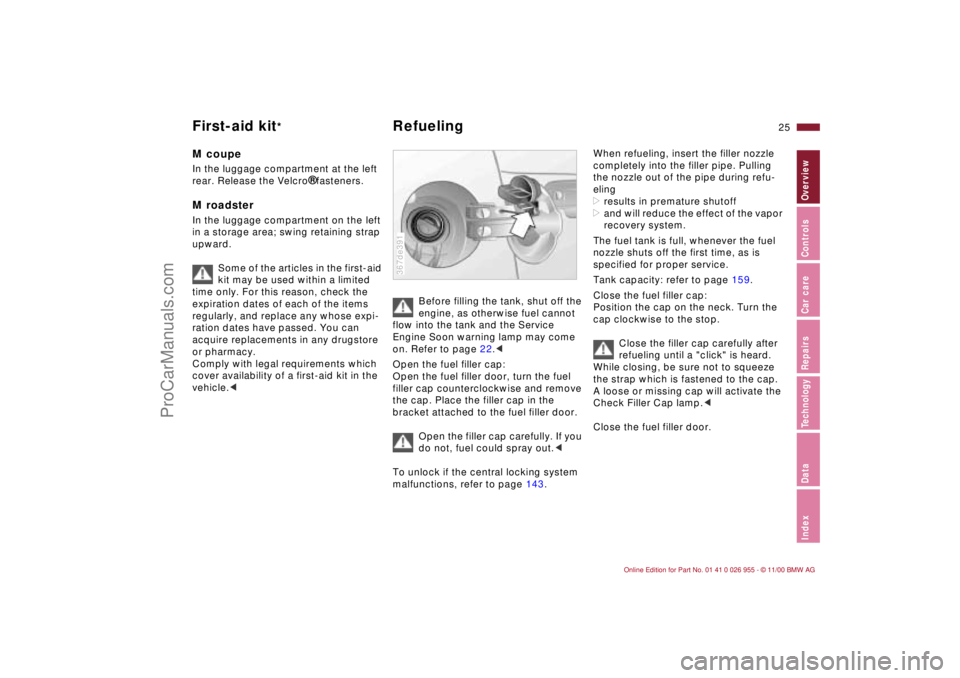
Open the fuel filler cap:
Open the fuel filler door, turn the fuel
filler cap counterclockwise and remove
the cap. Place the filler cap in the
bracket attached to the fuel filler door.
Open the filler cap carefully. If you
do not, fuel could spray out.<
To unlock if the central locking system
malfunctions, refer to page 143.
367de391
When refueling, insert the filler nozzle
completely into the filler pipe. Pulling
the nozzle out of the pipe during refu-
eling
>results in premature shutoff
>and will reduce the effect of the vapor
recovery system.
The fuel tank is full, whenever the fuel
nozzle shuts off the first time, as is
specified for proper service.
Tank capacity: refer to page 159.
Close the fuel filler cap:
Position the cap on the neck. Turn the
cap clockwise to the stop.
Close the filler cap carefully after
refueling until a "click" is heard.
While closing, be sure not to squeeze
the strap which is fastened to the cap.
A loose or missing cap will activate the
Check Filler Cap lamp.<
Close the fuel filler door.
ProCarManuals.com
Page 29 of 171
Overview
Controls and features
Operation, care
and maintenance
Owner service procedures
Technical data
Index Advanced technology
29n
IndexDataTechnologyRepairsCar careControlsOverview
Everything under control:
Odometer62
Tachometer62
Fuel gauge62
Coolant temperature gauge63
Engine oil temperature gauge63
Service Interval Display64
Outside temperature64
Clock64
Technology for safety and
driving convenience:
Dynamic Stability Control
(DSC)65
Tire Pressure Warning (RDW)67
Lamps:
Parking lamps/Low beams69
Interior lamps70
Reading lamps71Controlling the climate
for pleasant driving:
Heating and ventilation/
Air conditioner72
Seat heating77
Cabin convenience:
Glove compartment78
Storage compartments78
Storage boxes78
Beverage holder79
Ashtray79
Cigarette lighter80
Loading and transporting
cargo:
coupe:
Roll-up cover81
Partition net81
Cargo loading82
Roof-mounted luggage
rack83
ProCarManuals.com
Page 52 of 171
52n
AirbagsSitting correctly with airbags
For your safety, comply with the
following instructions for the
airbags. If you do not, the airbags may
not be able to provide their maximum
protection. All passengers in the vehicle
should be aware of and comply with
this information:
The airbags are supplemental restraint
devices designed to provide extra
protection; they are not a substitute for
safety belts. Wear your safety belt at
all times.
Adjust your seat to a position that is
comfortable for you, allowing unre-
stricted vehicle operation, and is not
closer to the steering wheel than
necessary.
Always grasp the steering wheel by the
steering wheel rim, keeping your hands
at the "9-o'clock" and "3-o'clock" posi-
tions in order to minimize any risk of
injury to hands or arms if the airbag
does deploy.
There should not be any other people,
animals or objects between the airbag
and the passenger in that seat.
Do not use the cover panel for the front
airbag on the passenger side as a
storage area.
Do not apply adhesive materials to the
cover panels of the airbags, cover them
or modify them in any other way.
If you use a child restraint system, read
carefully and comply with the instruc-
tions on page 53.
Be sure that child seats are installed
correctly and with the greatest possible
distance from the airbag in the side trim
panel. Do not allow children to lean out
of the child's seat in the direction of the
side trim panel. Otherwise, serious inju-
ries could occur if the airbag is trig-
gered.<
Even when you have complied with all
of these guidelines, there is still a small
residual risk of minor facial, hand and
arm injuries from airbag deployment
occurring in isolated instances.
The ignition and inflation noise may
cause a mild temporary hearing loss in
extremely sensitive individuals.
Corresponding airbag safety precau-
tions are provided on both sun visors
and the instrument panel (US models).
For additional information concerning
the airbag system, refer to pages 122
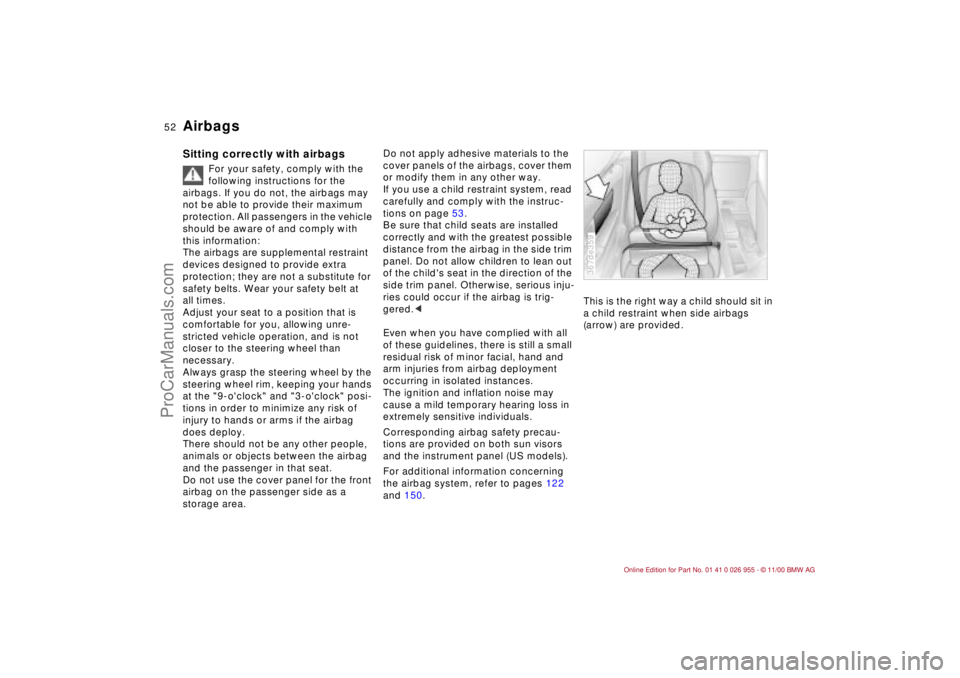
and 150.This is the right way a child should sit in
a child restraint when side airbags
(arrow) are provided.
367de359
ProCarManuals.com
Page 64 of 171
64n
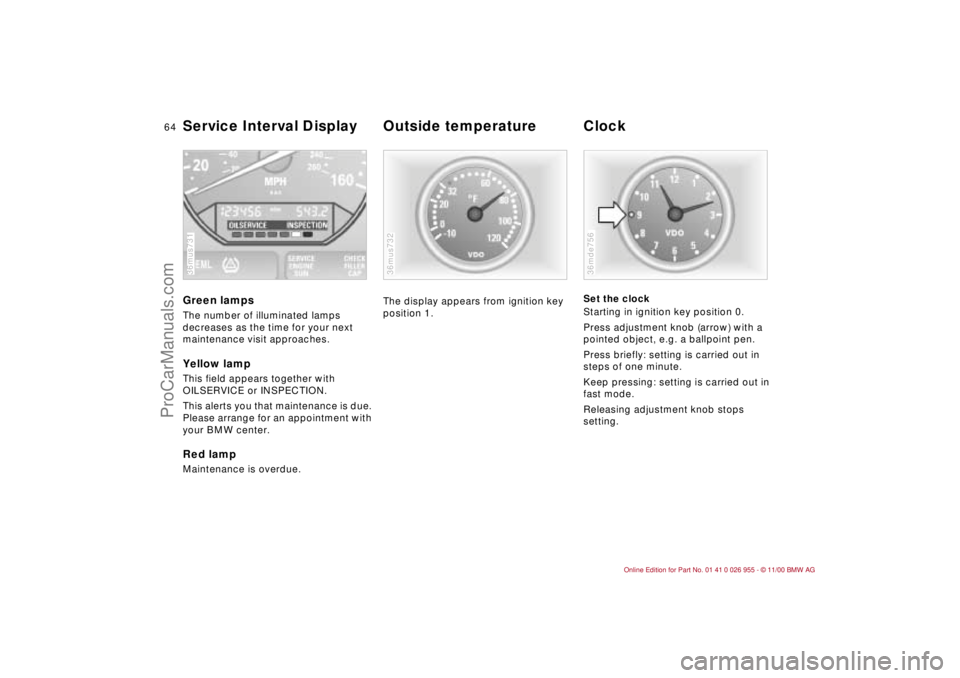
Service Interval Display Outside temperature ClockGreen lamps The number of illuminated lamps
decreases as the time for your next
maintenance visit approaches.Yellow lamp This field appears together with
OILSERVICE or INSPECTION.
This alerts you that maintenance is due.
Please arrange for an appointment with
your BMW center.Red lamp Maintenance is overdue.36mus731
The display appears from ignition key
position 1.36mus732
Set the clock
Starting in ignition key position 0.
Press adjustment knob (arrow) with a
pointed object, e.g. a ballpoint pen.
Press briefly: setting is carried out in
steps of one minute.
Keep pressing: setting is carried out in
fast mode.
Releasing adjustment knob stops
setting.36mde756
ProCarManuals.com
Page 74 of 171
74n
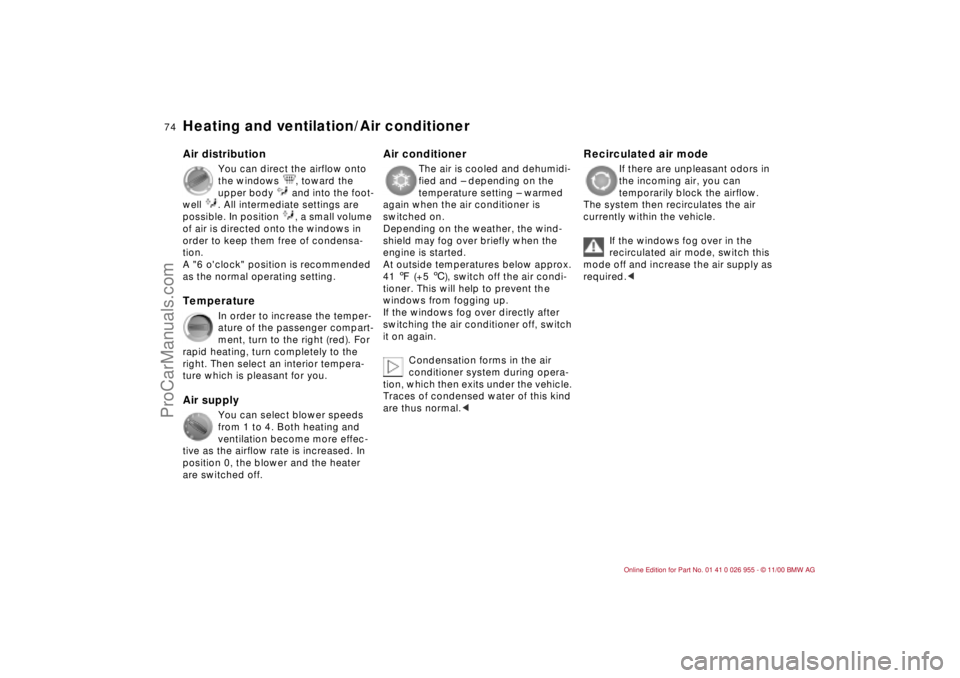
Heating and ventilation/Air conditionerAir distribution
You can direct the airflow onto
the windows , toward the
upper body and into the foot-
well . All intermediate settings are
possible. In position , a small volume
of air is directed onto the windows in
order to keep them free of condensa-
tion.
A "6 o'clock" position is recommended
as the normal operating setting.
Temperature
In order to increase the temper-
ature of the passenger compart-
ment, turn to the right (red). For
rapid heating, turn completely to the
right. Then select an interior tempera-
ture which is pleasant for you.
Air supply
You can select blower speeds
from 1 to 4. Both heating and
ventilation become more effec-
tive as the airflow rate is increased. In
position 0, the blower and the heater
are switched off.
Air conditioner
The air is cooled and dehumidi-
fied and – depending on the
temperature setting – warmed
again when the air conditioner is
switched on.
Depending on the weather, the wind-
shield may fog over briefly when the
engine is started.
At outside temperatures below approx.
41 7 (+5 6), switch off the air condi-
tioner. This will help to prevent the
windows from fogging up.
If the windows fog over directly after
switching the air conditioner off, switch
it on again.
Condensation forms in the air
conditioner system during opera-
tion, which then exits under the vehicle.
Traces of condensed water of this kind
are thus normal.<
Recirculated air mode
If there are unpleasant odors in
the incoming air, you can
temporarily block the airflow.
The system then recirculates the air
currently within the vehicle.
If the windows fog over in the
recirculated air mode, switch this
mode off and increase the air supply as
required.<
ProCarManuals.com
Page 112 of 171
112n
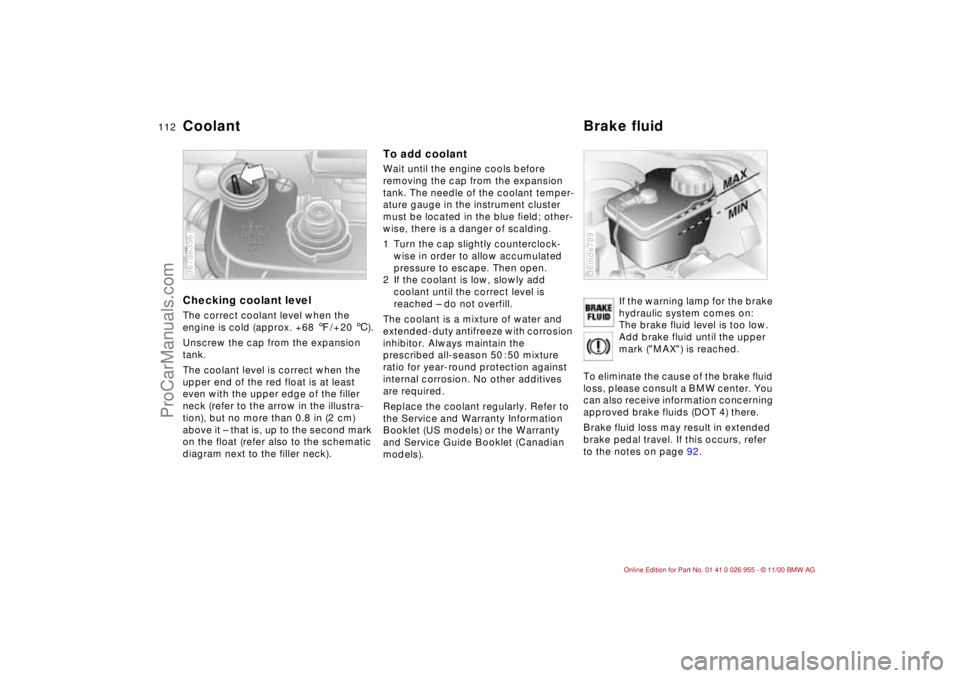
Coolant Brake fluid Checking coolant levelThe correct coolant level when the
engine is cold (approx. +68 7/+20 6).
Unscrew the cap from the expansion
tank.
The coolant level is correct when the
upper end of the red float is at least
even with the upper edge of the filler
neck (refer to the arrow in the illustra-
tion), but no more than 0.8 in (2 cm)
above it – that is, up to the second mark
on the float (refer also to the schematic
diagram next to the filler neck).367de356
To add coolantWait until the engine cools before
removing the cap from the expansion
tank. The needle of the coolant temper-
ature gauge in the instrument cluster
must be located in the blue field; other-
wise, there is a danger of scalding.
1 Turn the cap slightly counterclock-
wise in order to allow accumulated
pressure to escape. Then open.
2 If the coolant is low, slowly add
coolant until the correct level is
reached – do not overfill.
The coolant is a mixture of water and
extended-duty antifreeze with corrosion
inhibitor. Always maintain the
prescribed all-season 50 : 50 mixture
ratio for year-round protection against
internal corrosion. No other additives
are required.
Replace the coolant regularly. Refer to
the Service and Warranty Information
Booklet (US models) or the Warranty
and Service Guide Booklet (Canadian
models).If the warning lamp for the brake
hydraulic system comes on:
The brake fluid level is too low.
Add brake fluid until the upper
mark ("MAX") is reached.
To eliminate the cause of the brake fluid
loss, please consult a BMW center. You
can also receive information concerning
approved brake fluids (DOT 4) there.
Brake fluid loss may result in extended
brake pedal travel. If this occurs, refer
to the notes on page 92.
36mde789
ProCarManuals.com