2001 BMW M ROADSTER COUPE brakes
[x] Cancel search: brakesPage 11 of 171

11n
Controls and features
Operation, care and maintenance
Cabin convenience:
Glove compartment78
Storage compartments78
Storage boxes78
Beverage holder79
Ashtray79
Cigarette lighter80
Loading and transporting:
coupe:
Roll-up cover81
Partition net81
Cargo loading82
Roof-mounted luggage
rack83
Special operating instructions:
Break-in procedure86
Driving notes87
Catalytic converter88
Antilock Brake System (ABS)89
Disc brakes91
Brake system92
Winter operation93
Power steering94
Cellular phone95
Radio reception95
Hardtop – roadster96
Wheels and tires:
Notes on tire inflation
pressure98
Tire condition98
Tire replacement99
Tire rotation100
Wheel and tire
combinations101
Special features of winter
tires102
Snow chains102
Approved wheel and tire
specifications103
Under the hood:
Hood104
Engine compartment106
Fluids for the washer
systems108
Washer nozzles108
Engine oil109
Coolant111
Brake fluid112
Vehicle Identification
Number113
Care and maintenance:
The BMW Maintenance
System114
Caring for your vehicle115
Airbags122
Storing your vehicle123
Laws and regulations:
Technical modifications124
California Proposition
65 Warning124
OBD connector125
ProCarManuals.com
Page 61 of 171
61n
IndexDataTechnologyRepairsCar careControlsOverview
Cruise control
*
You can store and automatically main-
tain any desired vehicle speed above
approx. 25 mph (40 km/h).
The system is switched off and the
stored speed deleted from its memory
when you turn the ignition key to posi-
tion 0.
Do not use the cruise control on
winding roads, when high traffic
density prevents driving at a constant
speed, when the road surface is slick
(snow, rain, ice) or when the road
surface is loose (rocks or gravel,
sand).< 365us059
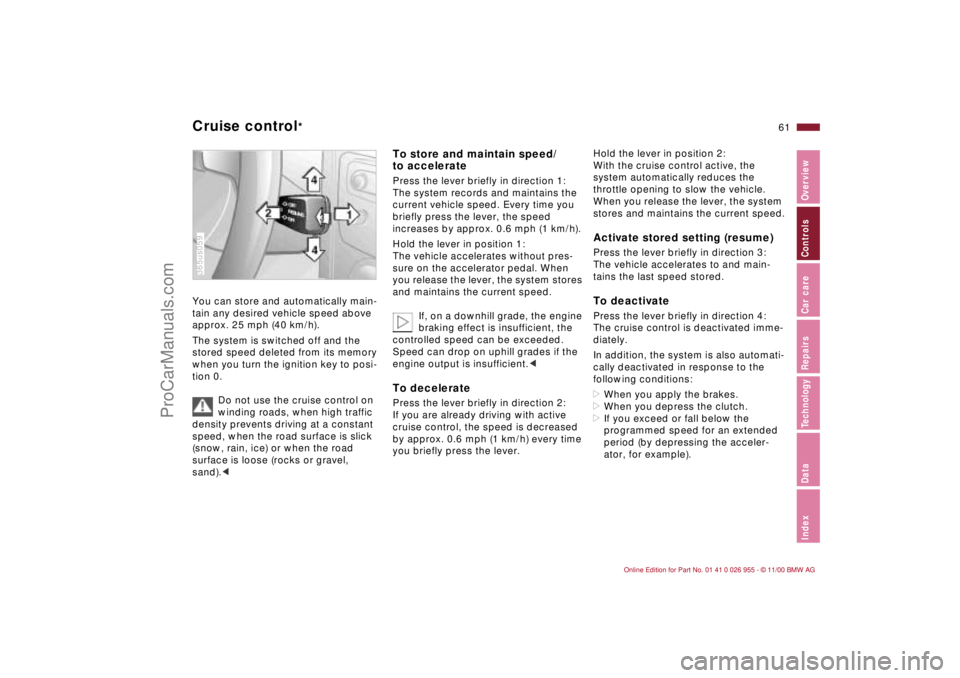
To store and maintain speed/
to acceleratePress the lever briefly in direction 1:
The system records and maintains the
current vehicle speed. Every time you
briefly press the lever, the speed
increases by approx. 0.6 mph (1 km/h).
Hold the lever in position 1:
The vehicle accelerates without pres-
sure on the accelerator pedal. When
you release the lever, the system stores
and maintains the current speed.
If, on a downhill grade, the engine
braking effect is insufficient, the
controlled speed can be exceeded.
Speed can drop on uphill grades if the
engine output is insufficient.< To deceleratePress the lever briefly in direction 2:
If you are already driving with active
cruise control, the speed is decreased
by approx. 0.6 mph (1 km/h) every time
you briefly press the lever.
Hold the lever in position 2:
With the cruise control active, the
system automatically reduces the
throttle opening to slow the vehicle.
When you release the lever, the system
stores and maintains the current speed.Activate stored setting (resume)Press the lever briefly in direction 3:
The vehicle accelerates to and main-
tains the last speed stored.To deactivatePress the lever briefly in direction 4:
The cruise control is deactivated imme-
diately.
In addition, the system is also automati-
cally deactivated in response to the
following conditions:
>When you apply the brakes.
>When you depress the clutch.
>If you exceed or fall below the
programmed speed for an extended
period (by depressing the acceler-
ator, for example).
ProCarManuals.com
Page 85 of 171
Overview
Controls and features
Operation, care
and maintenance
Owner service procedures
Technical data
Index Advanced technology
85n
IndexDataTechnologyRepairsCar careControlsOverview
Special operating instructions:
Break-in procedure86
Driving notes87
Catalytic converter88
Antilock Brake System (ABS)89
Disc brakes91
Brake system92
Winter operation93
Power steering94
Cellular phone95
Radio reception95
Hardtop – roadster96
Wheels and tires:
Notes on tire inflation
pressure98
Tire condition98
Tire replacement99
Tire rotation100
Wheel and tire
combinations101
Special features of winter
tires102
Snow chains102
Approved wheel and tire
specifications103Under the hood:
Hood104
Engine compartment106
Fluids for the washer
systems108
Washer nozzles108
Engine oil109
Coolant111
Brake fluid112
Vehicle Identification
Number113
Care and maintenance:
The BMW Maintenance
System114
Caring for your vehicle115
Airbags122
Storing your vehicle123
Laws and regulations:
Technical modifications124
California Proposition
65 Warning124
OBD connector125
Car care
ProCarManuals.com
Page 87 of 171

87n
IndexDataTechnologyRepairsCar careControlsOverview
Driving notes
Brakes:
Do not drive with your foot resting
on the brake pedal. Even light but
consistent pedal pressure can lead to
high temperatures, brake wear and
possibly even brake failure.
Aquaplaning:
When driving on wet or slushy roads,
reduce vehicle speed. If you do not, a
wedge of water may form between the
tires and the road surface. This
phenomenon is referred to as aqua-
planing or hydroplaning. It is character-
ized by a partial or complete loss of
contact between the tires and the road
surface. The ultimate results are loss of
steering and braking control.
Driving through water:
When there is water on the roads, do
not drive in it if it is deeper than 1 ft
(30 cm). If the water is at that depth,
drive only at walking speed, otherwise
the vehicle can sustain damage to the
engine, the electrical systems and the
transmission.
Roll-up cover (coupe):
Never use the roll-up cover to store
heavy or bulky objects. If you do so,
such objects could injure vehicle occu-
pants during braking and evasive
maneuvers or in a crash.
Clothes hook (coupe):
Hang items of clothing on the hooks in
such a manner that they do not obstruct
the driver's vision. Do not hang heavy
objects on the hooks. If you do so, they
could cause personal injury during
braking and evasive maneuvers or in
a crash, for example.<
ProCarManuals.com
Page 90 of 171
90n
Antilock Brake System (ABS)Information for your safetyNot even ABS can suspend the laws
of physics. ABS alone cannot prevent
accidents if the brakes are applied
without an adequate, safe distance
between vehicles or if the speed limit
has been exceeded. Nor can it prevent
the hazards of aquaplaning. Responsi-
bility for these types of situations
remains in the hands (and at the feet) of
the driver. You should never allow the
added safety of ABS to lull you into a
false sense of security, or mislead you
into taking increased risks that could
affect your own safety and that of
others.
Do not make any modifications to
the ABS system.
Service procedures on ABS are to be
performed by authorized technicians
only.< Antilock Brake System (ABS)/
Cornering Brake Control (CBC)CBC is an advanced engineering
feature of the ABS. When braking while
cornering at high speed or braking
during high lateral acceleration, or
when braking during a lane change,
vehicle stability is improved and
steering response is enhanced.
In the event of a malfunction
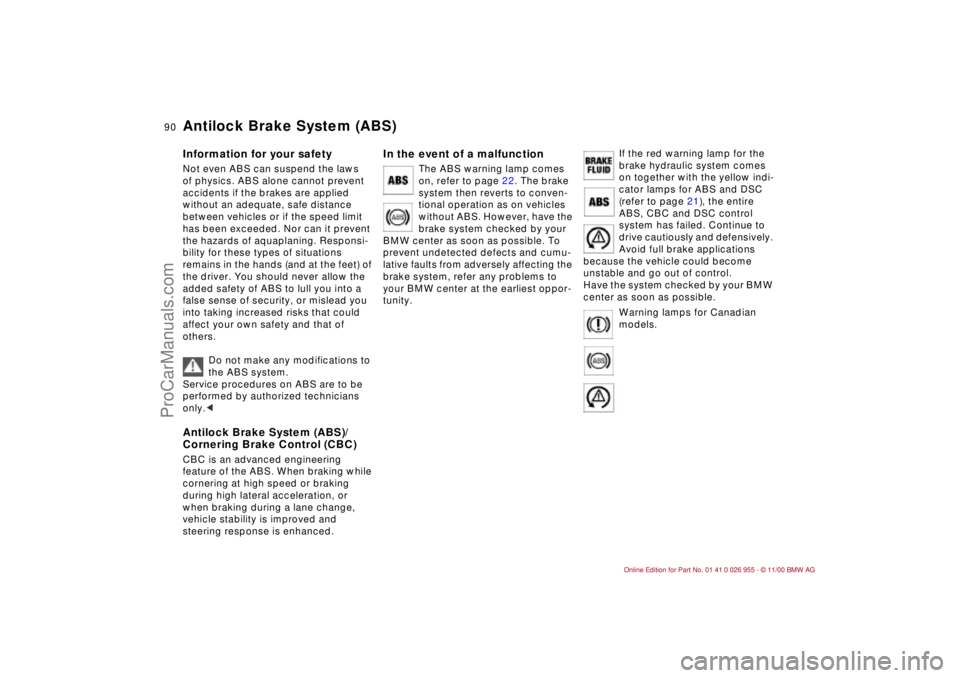
The ABS warning lamp comes
on, refer to page 22. The brake
system then reverts to conven-
tional operation as on vehicles
without ABS. However, have the
brake system checked by your
BMW center as soon as possible. To
prevent undetected defects and cumu-
lative faults from adversely affecting the
brake system, refer any problems to
your BMW center at the earliest oppor-
tunity.
If the red warning lamp for the
brake hydraulic system comes
on together with the yellow indi-
cator lamps for ABS and DSC
(refer to page 21), the entire
ABS, CBC and DSC control
system has failed. Continue to
drive cautiously and defensively.
Avoid full brake applications
because the vehicle could become
unstable and go out of control.
Have the system checked by your BMW
center as soon as possible.
Warning lamps for Canadian
models.
ProCarManuals.com
Page 91 of 171

91n
IndexDataTechnologyRepairsCar careControlsOverview
Disc brakesDisc brakes furnish optimum decelera-
tion and braking control and greater
fade resistance under heavy use.
When the vehicle is driven only occa-
sionally, during extended periods when
the vehicle is not used at all, or in oper-
ating conditions where brake applica-
tions are less frequent, there is an
increased tendency for corrosion of the
discs and accumulation of contamina-
tion on the brake pads. This occurs
because the minimal pressure which
must be exerted by the pads to clean
the discs by brake applications is not
reached.
If the brake discs are corroded, they will
tend to respond to braking with a
pulsating effect which even extended
application will fail to cure.
For your own safety: use only
brake pads that BMW has
approved for your specific vehicle
model. BMW cannot evaluate non-
approved brake pads to determine if
they are suited for use, and therefore
cannot ensure the operating safety of
the vehicle in the event of their use.<
Driving notesWhile driving in wet conditions and in
heavy rain, it is advisable to apply light
pressure to the brake pedal every few
miles – watch traffic conditions to
ensure that this maneuver does not
endanger other road users. The heat
generated in this braking process helps
dry the brake pads and discs.
Maximum braking force is obtained
while the wheels continue to rotate,
peaking when the wheels remain on the
verge of locking without actually doing
so. ABS maintains this state automati-
cally. If the ABS fails, you should revert
to the staggered braking technique
described on page 94.
Extended or steep mountain descents
should be driven in the gear in which
only minimal periodic brake application
is required. This avoids excessive strain
on the brakes and possible impairment
of the braking effect.
You can increase the engine's braking
effect by selecting progressively lower
gears, downshifting into first gear, if
necessary. Should engine braking prove inade-
quate, you should still avoid extended,
continuous braking. Instead, decelerate
the vehicle with increased pressure on
the brake pedal (watch for following
traffic!), release the pedal and then
repeat the brake application (staggered
braking). This staggered braking tech-
nique allows the brakes to cool in the
intervals between active braking
phases, preventing overheating and
ensuring that full braking capacity
remains available at all times.
Do not drive the vehicle with the
clutch depressed, with the shift
lever in neutral or with the engine shut
off. The engine provides no braking
control when the transmission is in
neutral and there is no power assist for
braking and steering when the engine is
shut off.
Never allow floor mats, carpets or any
other objects to protrude into the area
around the accelerator, clutch and
brake pedals and obstruct their move-
ment.<
ProCarManuals.com
Page 116 of 171

116n
Caring for your vehicleWhen using an automatic car wash, be
sure that:
>The car wash system is suited for the
dimensions of your vehicle.
>No damage will occur on vehicles
with attached body accessories (such
as spoilers or antennas). Consult the
car wash operator if necessary.
>The wheels and tires of your vehicle
cannot be damaged by the convey-
ance devices of the car wash system.
>The vehicle is cleaned with minimum
brush pressure, and ample water is
available for washing and rinsing.
Parts of the vehicle which are inacces-
sible to the automatic washer – such as
door sills, door and hood edges, etc. –
should be cleaned by hand.
In the winter months, it is especially
important to ensure that the vehicle is
washed on a regular basis. Large quan-
tities of dirt and road salt are difficult to
remove, and they also cause damage to
the vehicle.If spray wands or high-pressure
washers are used, be sure to
maintain an adequate distance between
the spray source and the vehicle's
surface. Inadequate distance and
excessive pressure can damage or
weaken the finish, making it more
susceptible to subsequent attack. In
addition, moisture could penetrate to
vehicle components, leading to long-
term damage.<
When cleaning the headlamps,
please observe the following:
>Do not rub dry (this causes scratches)
and never use abrasives or strong
solvents to clean the covers.
>Remove dirt and contamination (such
as insects) by soaking with BMW Car
Shampoo and then rinsing with plenty
of water.
>Always use a deicer spray to remove
accumulated ice and snow – never
use a scraper.<
After washing the vehicle, apply
the brakes briefly to dry them.
Braking efficiency might otherwise be
reduced by the moisture and the brake
discs could also be corroded.<
ProCarManuals.com
Page 146 of 171
146n
Towing the vehicle
The towed vehicle should always
be the lighter of the two vehicles.
If this is not the case, it will not be
possible to control vehicle handling.<
Tow-startingFor instructions on jump-starting, refer
to page 144.
Never attempt to use your vehicle to
push another vehicle, since damage to
the energy-absorbing bumpers could
result.
Towing a vehicle 1 Put the manual-shift gear lever in
neutral.
2 Towing speed:
45 mph (70 km/h) maximum.
3 Towing distance:
95 miles (150 km) maximum.
4 Leave the ignition key at position 1 to
ensure that brake lamps, turn signal
indicators, horn and windshield
wipers remain operative, and to
prevent the steering lock from
engaging.
5 Switch on the hazard warning
flashers (observe applicable legal
regulations).
Find some means of identifying the
vehicle in tow, for instance, place a sign
or warning triangle in the rear window.
Make sure that the ignition key
remains in position 1 even when
the electrical system has failed to
prevent the steering lock from
engaging.
The steering and brakes are without
power assist when the engine is off.
This means that increased effort is
required for steering and braking.<
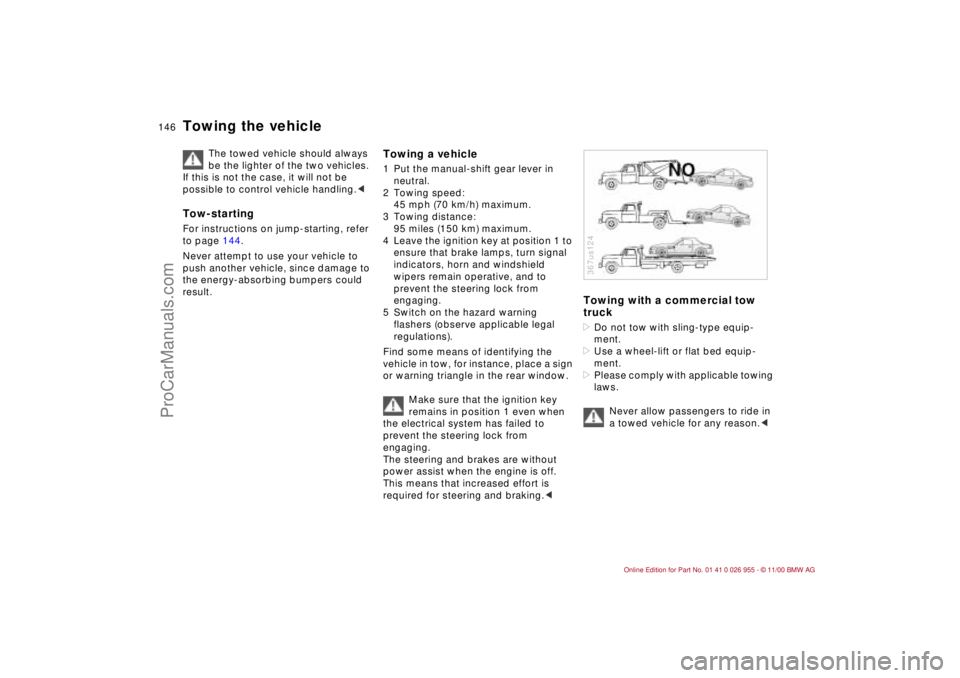
Towing with a commercial tow
truck>Do not tow with sling-type equip-
ment.
>Use a wheel-lift or flat bed equip-
ment.
>Please comply with applicable towing
laws.
Never allow passengers to ride in
a towed vehicle for any reason.< 367us124
ProCarManuals.com