Page 10 of 171

Contents
Overview
Controls and features
Cockpit16
Instrument cluster18
Indicator and warning lamps20
Hazard warning flashers24
Warning triangle24
First-aid kit25
Refueling25
Fuel specifications26
Tire inflation pressure26
Tire inflation pressure (table)27
Opening and closing:
Keys30
Electronic vehicle
immobilizer31
Central locking system32
Opening and closing from the
outside32
Opening and closing from the
inside33
Luggage compartment lid34
Electric power windows35
Sunroof – coupe36
Convertible top – roadster37
Adjustments:
Seats46
Mirrors47
Safety systems:
Safety belts49
Airbags51
Transporting children safely53
Driving:
Steering/Ignition lock55
Starting the engine56
Switching off the engine57
Parking brake57
Manual transmission58
Turn signal indicators/High
beams58
Wiper/Washer system59
Rear window defroster60
Cruise control61
Everything under control:
Odometer62
Tachometer62
Fuel gauge62
Coolant temperature gauge63
Engine oil temperature gauge63
Service Interval Display64
Outside temperature64
Clock64
Technology for safety and
driving convenience:
Dynamic Stability Control
(DSC)65
Tire Pressure Warning (RDW)67
Lamps:
Parking lamps/Low beams69
Interior lamps70
Reading lamps71
Controlling the climate
for pleasant driving:
Heating and ventilation/
Air conditioner72
Seat heating77
Contents
ProCarManuals.com
Page 19 of 171

19n
IndexDataTechnologyRepairsCar careControlsOverview
Instrument cluster
1 Fuel gauge with indicator lamp
for reserve range62
2 Indicator lamp for turn signals23
3 Speedometer
4 Indicator and warning lamps for:
>
Battery charge current20
>
High beams23
>
Engine oil pressure20
5 Tachometer62
6 Coolant temperature gauge63
Also refer to Engine oil temperature
gauge on page63
7 Indicator and warning lamps for:
>
Brake pad wear22
>
Brake hydraulic
system/Cornering Brake Control
(CBC)20, 21
>
Parking brake21
>
Airbags21
8 Indicator and warning lamps for:
>
Service Engine Soon22
>
Check Filler Cap22
>
Safety belts21
>
Engine oil level22
>
Antilock Brake System (ABS)22
9 Indicator lamp for Dynamic Stability
Control (DSC)21, 2210 Trip odometer62
11 Service Interval Display64, 114
12 Odometer62
13 Indicator and warning lamps for:
>
Engine electronics22
>
Tire Pressure Warning
(RDW)21, 22
14 Trip odometer reset button62
The illustration shows the instrument
cluster in the US version. In the Cana-
dian models, some of the indicator and
warning lamps have a different appear-
ance. Refer to pages 20 to 23.
ProCarManuals.com
Page 26 of 171
26n
Refueling Fuel specifications Tire inflation pressure
When handling fuels, comply with
all of the applicable safety precau-
tions displayed at gas stations.
Never carry spare fuel containers in
your vehicle. Whether they are empty or
full, these containers can leak, cause an
explosion, or lead to fire in the event of
a collision.<
The engine uses lead-free gasoline
only.
Required fuel:
>Premium Unleaded Gasoline,
min. 91 AKI.
AKI = Anti Knock Index
Do not use leaded fuels. The use
of leaded fuels will cause perma-
nent damage to the system's oxygen
sensor and the catalytic converter.<
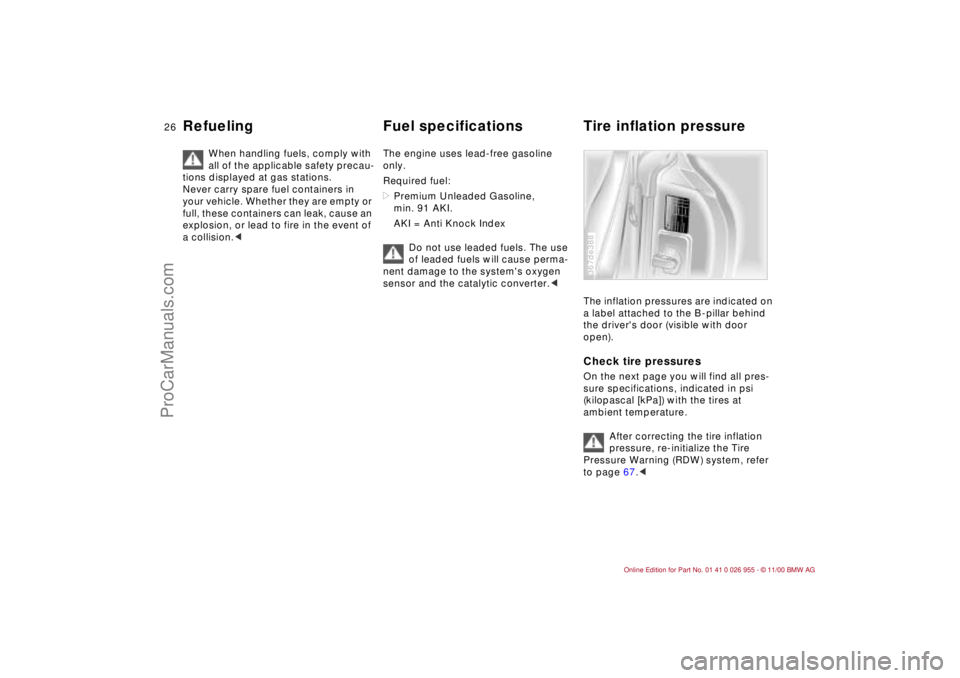
The inflation pressures are indicated on
a label attached to the B-pillar behind
the driver's door (visible with door
open).Check tire pressuresOn the next page you will find all pres-
sure specifications, indicated in psi
(kilopascal [kPa]) with the tires at
ambient temperature.
After correcting the tire inflation
pressure, re-initialize the Tire
Pressure Warning (RDW) system, refer
to page 67.<367de388
ProCarManuals.com
Page 29 of 171
Overview
Controls and features
Operation, care
and maintenance
Owner service procedures
Technical data
Index Advanced technology
29n
IndexDataTechnologyRepairsCar careControlsOverview
Everything under control:
Odometer62
Tachometer62
Fuel gauge62
Coolant temperature gauge63
Engine oil temperature gauge63
Service Interval Display64
Outside temperature64
Clock64
Technology for safety and
driving convenience:
Dynamic Stability Control
(DSC)65
Tire Pressure Warning (RDW)67
Lamps:
Parking lamps/Low beams69
Interior lamps70
Reading lamps71Controlling the climate
for pleasant driving:
Heating and ventilation/
Air conditioner72
Seat heating77
Cabin convenience:
Glove compartment78
Storage compartments78
Storage boxes78
Beverage holder79
Ashtray79
Cigarette lighter80
Loading and transporting
cargo:
coupe:
Roll-up cover81
Partition net81
Cargo loading82
Roof-mounted luggage
rack83
ProCarManuals.com
Page 62 of 171
62n
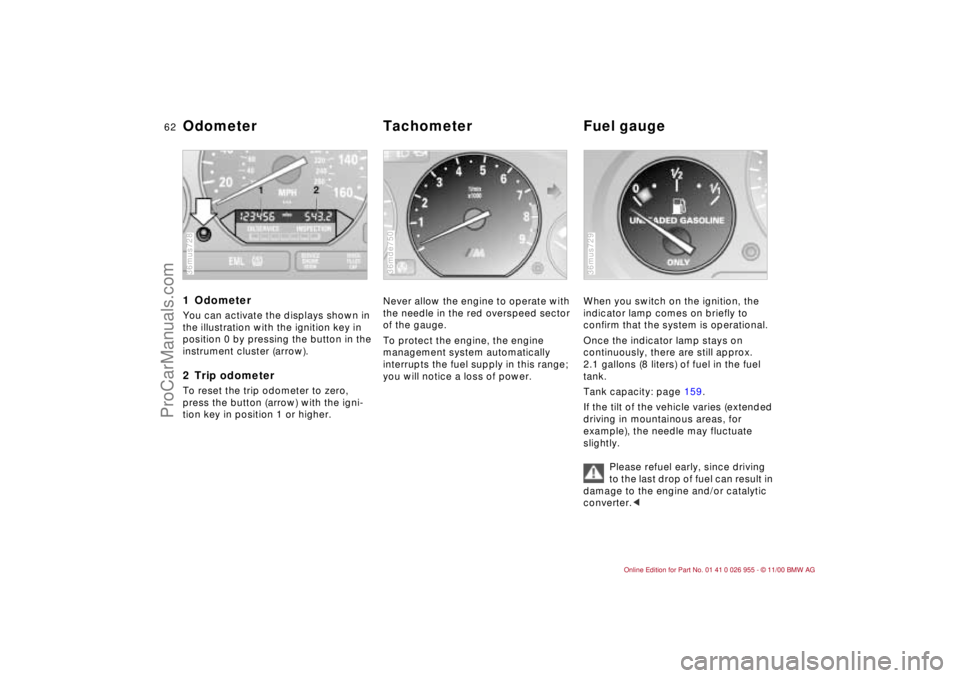
1 OdometerYou can activate the displays shown in
the illustration with the ignition key in
position 0 by pressing the button in the
instrument cluster (arrow).2 Trip odometerTo reset the trip odometer to zero,
press the button (arrow) with the igni-
tion key in position 1 or higher.36mus728
Never allow the engine to operate with
the needle in the red overspeed sector
of the gauge.
To protect the engine, the engine
management system automatically
interrupts the fuel supply in this range;
you will notice a loss of power.36mde750
When you switch on the ignition, the
indicator lamp comes on briefly to
confirm that the system is operational.
Once the indicator lamp stays on
continuously, there are still approx.
2.1 gallons (8 liters) of fuel in the fuel
tank.
Tank capacity: page 159.
If the tilt of the vehicle varies (extended
driving in mountainous areas, for
example), the needle may fluctuate
slightly.
Please refuel early, since driving
to the last drop of fuel can result in
damage to the engine and/or catalytic
converter.< 36mus729
Odometer Tachometer Fuel gauge
ProCarManuals.com
Page 64 of 171
64n
Service Interval Display Outside temperature ClockGreen lamps The number of illuminated lamps
decreases as the time for your next
maintenance visit approaches.Yellow lamp This field appears together with
OILSERVICE or INSPECTION.
This alerts you that maintenance is due.
Please arrange for an appointment with
your BMW center.Red lamp Maintenance is overdue.36mus731
The display appears from ignition key
position 1.36mus732
Set the clock
Starting in ignition key position 0.
Press adjustment knob (arrow) with a
pointed object, e.g. a ballpoint pen.
Press briefly: setting is carried out in
steps of one minute.
Keep pressing: setting is carried out in
fast mode.
Releasing adjustment knob stops
setting.36mde756
ProCarManuals.com
Page 102 of 171

102n
Special features of winter tires Snow chains
*
Choosing the right tireBMW recommends winter tires (M+S
radial tires) for operation under
inclement winter driving conditions.
While so-called all season tires (M+S
designation) provide better winter trac-
tion than summer tires with the load
ratings H, V, W, Y and ZR, they gener-
ally do not achieve the performance of
winter tires.
In the interests of sure tracking and safe
steering response, mount winter tires
which are made by the same manufac-
turer and which have the same tread
pattern at all four wheels.Comply with recommended speed
Never exceed the maximum
speed for which the winter tires
are rated.
Unprofessional attempts by laymen to
service tires can lead to damage and
accidents.
Have this work performed by skilled
professionals only. Any BMW center
has the required technical knowledge
and the proper equipment and will be
happy to assist you.<
Tire condition, tire pressureOnce the tire wears to below 0.16 in
(4 mm), winter tires display a percep-
tible decrease in their ability to cope
with winter driving conditions, and
should be replaced in the interest of
safety.
Comply with the specified tire inflation
pressures – and be sure to have the
wheel and tire assemblies balanced
every time you change the tires.The use of narrow-link BMW snow
chains on winter tires is approved only
in pairs and only on the rear wheels.
Comply with all manufacturer's safety
precautions when mounting the chains.
Deactivate the Tire Pressure
Warning (RDW) when using snow
chains. The snow chains can lead to
malfunction warnings and undetected
losses in pressure.
For further information, refer to
page 67.<
ProCarManuals.com
Page 114 of 171
114n
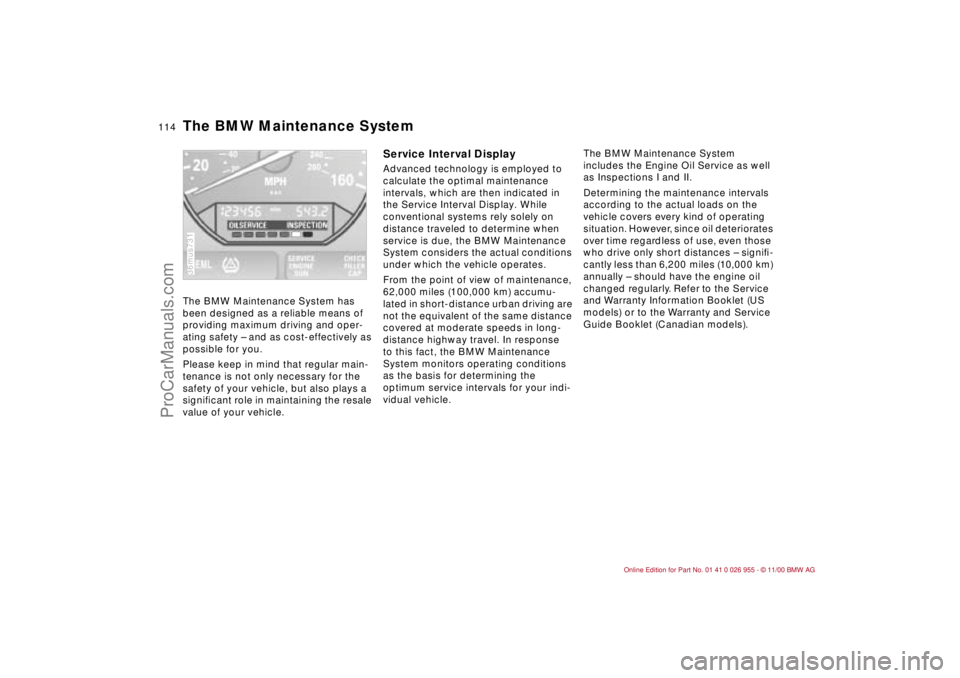
The BMW Maintenance System has
been designed as a reliable means of
providing maximum driving and oper-
ating safety – and as cost-effectively as
possible for you.
Please keep in mind that regular main-
tenance is not only necessary for the
safety of your vehicle, but also plays a
significant role in maintaining the resale
value of your vehicle.
36mus731
Service Interval DisplayAdvanced technology is employed to
calculate the optimal maintenance
intervals, which are then indicated in
the Service Interval Display. While
conventional systems rely solely on
distance traveled to determine when
service is due, the BMW Maintenance
System considers the actual conditions
under which the vehicle operates.
From the point of view of maintenance,
62,000 miles (100,000 km) accumu-
lated in short-distance urban driving are
not the equivalent of the same distance
covered at moderate speeds in long-
distance highway travel. In response
to this fact, the BMW Maintenance
System monitors operating conditions
as the basis for determining the
optimum service intervals for your indi-
vidual vehicle. The BMW Maintenance System
includes the Engine Oil Service as well
as Inspections I and II.
Determining the maintenance intervals
according to the actual loads on the
vehicle covers every kind of operating
situation. However, since oil deteriorates
over time regardless of use, even those
who drive only short distances – signifi-
cantly less than 6,200 miles (10,000 km)
annually – should have the engine oil
changed regularly. Refer to the Service
and Warranty Information Booklet (US
models) or to the Warranty and Service
Guide Booklet (Canadian models).
The BMW Maintenance System
ProCarManuals.com