2000 HONDA PASSPORT seats
[x] Cancel search: seatsPage 20 of 267
We recommend that a pregnant
woman use a lap/shoulder belt
whenever possible. Remember to
keep the lap portion of the belt as low as possible across your hips.
Pregnant women should also sit as far back as possible from thesteering wheel or dashboard. This
will reduce the risk of injuries to
both the mother and her unborn
child that can be caused by a
crash or an inflating airbag.
Each time you have a checkup,
ask your doctor if it's okay for
you to drive.
Additiona l Safet y
Precaution s
Two people should never use
the same seat belt. If they do, they could be very seriously
injured in a crash.
Do not put any accessories on
seat belts. Devices intended toimprove occupant comfort, or
reposition the shoulder part of a seat belt, can severely
compromise the protective
capability of the seat belt and increase the chance of serious
injury in a crash. Do not place hard or sharp
objects between yourself and
an airbag. Carrying hard orsharp objects on your lap, or
driving with a pipe or other sharp object in your mouth, can
result in injuries if your airbags inflate.
Keep your hands and arms
away from the airbag covers.
If your hands or arms are close
to the SRS covers in the center of the steering wheel or on top of the dashboard, they could be
injured if the airbags inflate.
Never let passengers ride in the cargo area or on top of a
folded-down back seat. All passengers must sit in locked,upright seats and be properly
restrained by seat belts.
Do not attach or place objects
on the airbag covers. Any
object attached to or placed on
the covers marked "SRS
AIRBAG" in the center of the steering wheel and on top of
the dashboard could interfere with the proper operation of theairbags. Or, if the airbags
inflate, the objects could be
propelled inside the car and hurt someone.
Drive r an d Passenge r Safet y
Page 22 of 267
Childre
n Shoul d Si t i n th e
Bac k Sea t
According to accident statistics,
children of all ages and sizes are safer when they are restrained in
the back seat, not the front seat.
The National Highway Traffic Safety Administration
recommends that all children ages 12 and under be properly
restrained in the back seat.
In the back seat, children are lesslikely to be injured by striking
hard interior parts during a
collision or hard braking. Also,
children cannot be injured by an inflating airbag when they ride in
the back.
Th
e Passenger' s Airba g
Pose s Seriou s Risk s t o
Childre n
Airbags have been designed to
help protect adults in a moderate to severe frontal collision. To do
this, the passenger's airbag is
quite large, and it inflates with
tremendous speed.
Infants
Never put a rear-facing child seat in the front seat of a vehicle
equipped with a passenger's
airbag. If the airbag inflates, it
can hit the back of the child seat
with enough force to kill or very seriously injure an infant. Small Children
Placing a forward-facing child seat in the front seat of a vehicle
equipped with a passenger's
airbag can be hazardous. If the vehicle seat is too far forward, or
the child's head is thrown forward
during a collision, an inflatingairbag can strike the child with
enough force to kill or very seriously injure a small child.
Larger Children Children who have outgrownchild seats are also at risk of
being injured or killed by an
inflating passenger's airbag.
Whenever possible, larger
children should sit in the back seat, properly restrained with a
seat belt. (See page 33 for
important information about
protecting larger children.)
Drive r an d Passenge r Safet y
Page 24 of 267
Additiona
l Safet y
Precaution s
Use child-safe door locks to
prevent children from opening the doors. Using this feature
will prevent children from
opening the doors and
accidentally falling out (see
page 101). Use the main power window
switch to prevent children
from opening the rear windows. Using this feature
will prevent children from
playing with the windows, which could expose them to
hazards or distract the driver (see page 103). Do not leave children alone in
your vehicle. Leaving children without adult supervision isillegal in most states and can be
very hazardous. For example, infants and small children left
in a vehicle on a hot day can
die from heat stroke. And
children left alone with the key in the ignition can accidentally
set the vehicle in motion,
possibly injuring themselves or
others.
Genera l Guideline s fo r
Usin g Chil d Seat s
The following pages give general guidelines for selecting and
installing child seats for infants
and small children.
Selecting a Child Seat
To provide proper protection,
a child seat should meet three
requirements:1 . The child seat should meet
safety standards. Th
e child
seat should meet Federal
Motor Vehicle Safety Standard
213 (FMVSS 213). Look for
the manufacturer's statement
of compliance on the box and
seat.
2 . The child seat should be of
the proper type
and
size to fit
the child.
Drive r an d Passenge r Safet y
Page 25 of 267
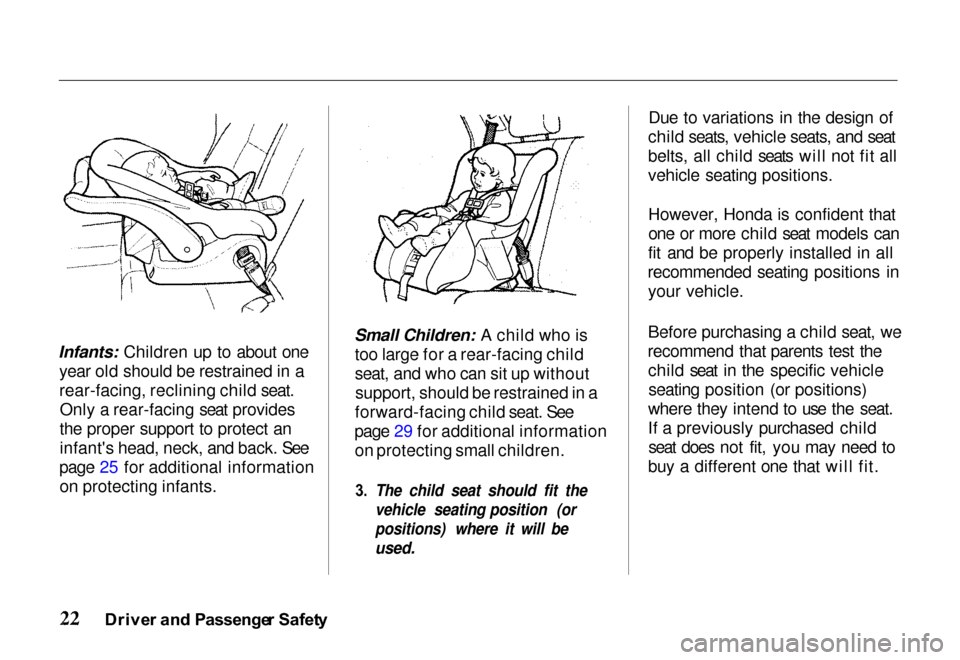
Infants: Children up to about one
yea
r old should be restrained in a
rear-facing
, reclining child seat.
Only a rear-facing seat provides
the proper support to protect an
infant's head, neck, and back. See
page
25 for additional information
on protecting infants. Small Children: A child who is
too
large for a rear-facing child
seat,
and who can sit up without
support, should be restrained in a
forward-facing child seat. See
page 29 for additional information on protecting small children.
3.
The child seat should fit the
vehicle seating position (or
positions) where it will be
used.
Due to variations in the design of
child
seats, vehicle seats, and seat
belts
, all child seats will not fit all
vehicl
e seating positions.
However,
Honda is confident that
one
or more child seat models can
fit and be properly installed in all
recommended
seating positions in
your vehicle.
Before purchasing a child seat, we
recommend
that parents test the
child seat in the specific vehicle seating
position (or positions)
where they intend to use the seat.
If a previously purchased child seat
does not fit, you may need to
buy
a different one that will fit.
Drive r an d Passenge r Safet y
Page 26 of 267
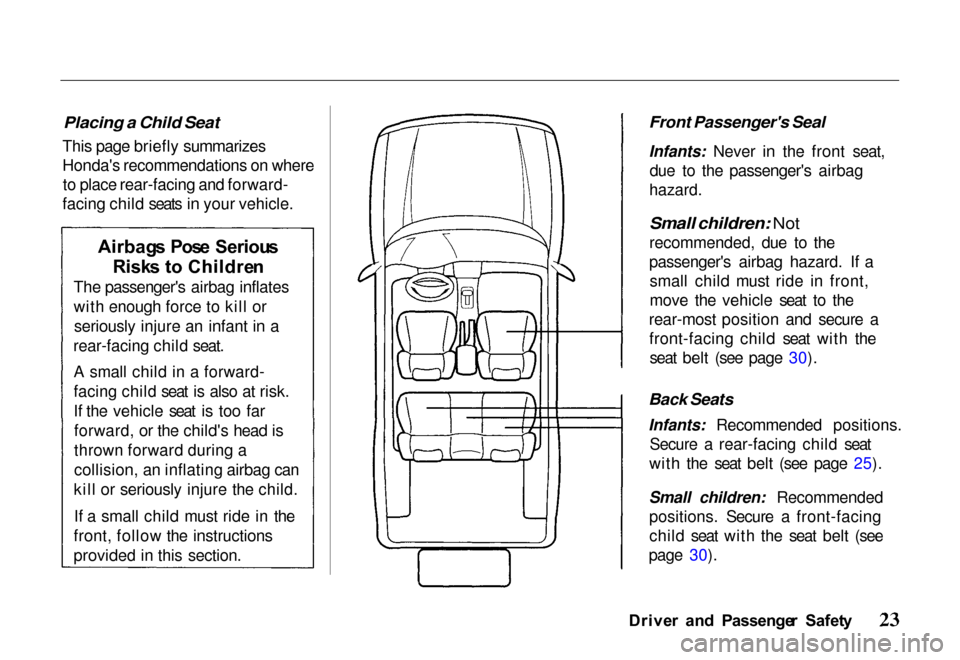
Placing a Child Seat
This page briefly summarizes
Honda's recommendations on where to place rear-facing and forward-
facing child seats in your vehicle.
Front Passenger's Seal
Infants: Never in the front seat,
due to the passenger's airbag
hazard.
Small children: Not
recommended, due to the
passenger's airbag hazard. If a small child must ride in front,
move the vehicle seat to the
rear-most position and secure a front-facing child seat with theseat belt (see page 30).
Back Seats
Infants: Recommended positions. Secure a rear-facing child seat
with the seat belt (see page 25).
Small children: Recommended positions. Secure a front-facing
child seat with the seat belt (see
page 30).Drive r an d Passenge r Safet y
Airbag s Pos e
Seriou
s
Risk s t o Childre n
The passenger's airbag inflates
with enough force to kill or seriously injure an infant in a
rear-facing child seat.
A small child in a forward-
facing child seat is also at risk.
If the vehicle seat is too farforward, or the child's head is
thrown forward during a
collision, an inflating airbag can
kill or seriously injure the child.
If a small child must ride in the
front, follow the instructions
provided in this section.
Page 27 of 267
Installing a Child Seat
After selecting a proper child seat,
and a good position to install theseat, there are three main steps to
installing the seat:
1. Secure the child seat to the vehicle with a seat belt. All
child seats must be secured to the vehicle with the lap belt or
the lap part of a lap/shoulder
belt. A child whose seat is not
properly secured to the vehicle can be endangered in a crash.See pages 25 and 30 for
instructions on how to secure
child seats in this vehicle.
2. Make sure the child seat is
firmly secured. After
installing a child seat, push
and pull the seat forward and
from side to side to verify that it is secure.
To provide security during normal
driving maneuvers, as well as
during a collision, we recommend
that parents secure a child seat as
firmly as possible.
However, a child seat does not
need to be "rock solid." In some
vehicles or seating positions, it
may be difficult to install a child seat so that it does not move at all.
Some side-to-side or back-and-
forth movement can be expected
and should not reduce the child
seat's effectiveness.
If the child seat is not secure, try
installing it in a different seating
position, or use a different style of
child seat that can be firmly
secured in the desired seating
position. 3. Secure the child in the child
seat. Make sure the child is
properly strapped in the child seat according to the child seat
maker's instructions. A child
who is not properly secured in
a child seat can be thrown out
of the seat in a crash and
seriously injured.
Storing a Child Seat
When you are not using a childseat, either remove it and store it
in a safe place, or make sure it is
properly secured. An unsecured
child seat can be thrown around
the vehicle during a crash or sudden stop and injure someone.
Drive r an d Passenge r Safet y
Page 28 of 267
Protectin
g Infant s
Child Seat Type
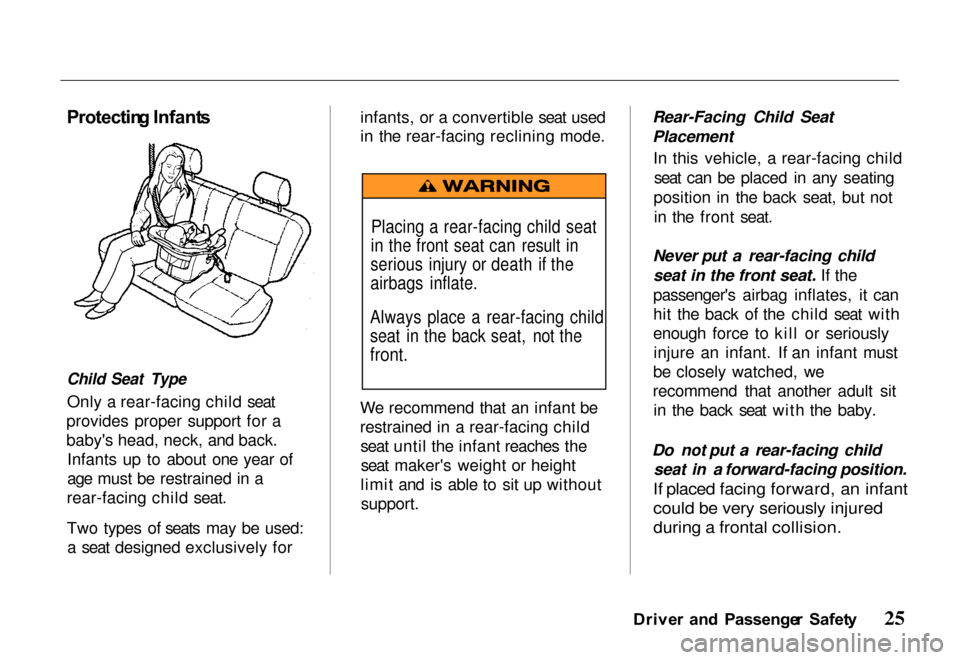
Only a rear-facing child seat
provides proper support for a
baby's head, neck, and back. Infants up to about one year of
age must be restrained in a
rear-facing child seat.
Two types of seats may be used: a seat designed exclusively for infants, or a convertible seat used
in the rear-facing reclining mode.
We recommend that an infant be
restrained in a rear-facing child seat until the infant reaches theseat maker's weight or height
limit and is able to sit up without support. Rear-Facing Child Seat
Placement
In this vehicle, a rear-facing childseat can be placed in any seating
position in the back seat, but not in the front seat.
Never put a rear-facing child seat in the front seat. If the
passenger's airbag inflates, it can
hit the back of the child seat with
enough force to kill or seriouslyinjure an infant. If an infant must
be closely watched, we
recommend that another adult sit in the back seat with the baby.
Do not put a rear-facing child seat in a forward-facing position.
If placed facing forward, an infant
could be very seriously injured
during a frontal collision.
Drive r an d Passenge r Safet y
Placing a rear-facing child seat
in the front seat can result in
serious injury or death if the
airbags inflate.
Always place a rear-facing child
seat in the back seat, not the
front.
Page 29 of 267
Installing a Rear-Facing Child
Seat With a Lap/Shoulder Belt
The lap/shoulder belts in the outer
back seats have a locking mechanism that must be activated
to secure a child seat.
The following pages provide instructions on how to secure a
rear-facing child seat with this type of seat belt.
See page 28 for how to secure a
rear-facing child seat in the center
back seat with the lap belt. For
tips on installing an infant seat
with either type of seat belt, see
page 28.
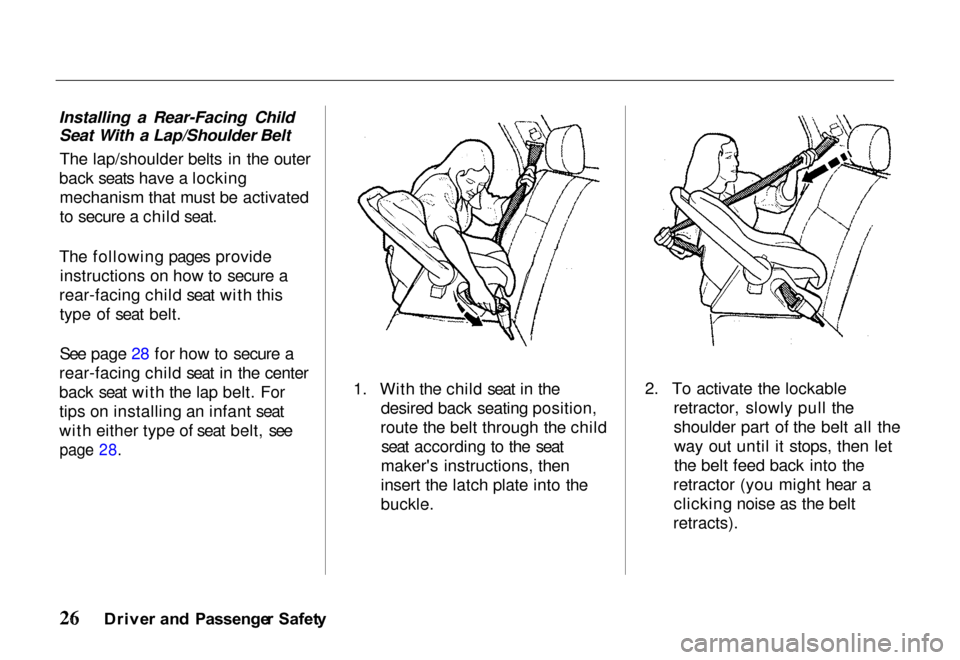
1. With the child seat in the
desired back seating position,
route the belt through the child seat according to the seat
maker's instructions, then
insert the latch plate into the
buckle. 2. To activate the lockable
retractor, slowly pull the
shoulder part of the belt all theway out until it stops, then let
the belt feed back into the
retractor (you might hear a clicking noise as the belt
retracts).
Drive r an d Passenge r Safet y