Page 92 of 267
Fore/Af
t Sea t Adjustmen t
See pages 10-11 for important
safety information and warnings
about how to properly position
seats and seat-backs.
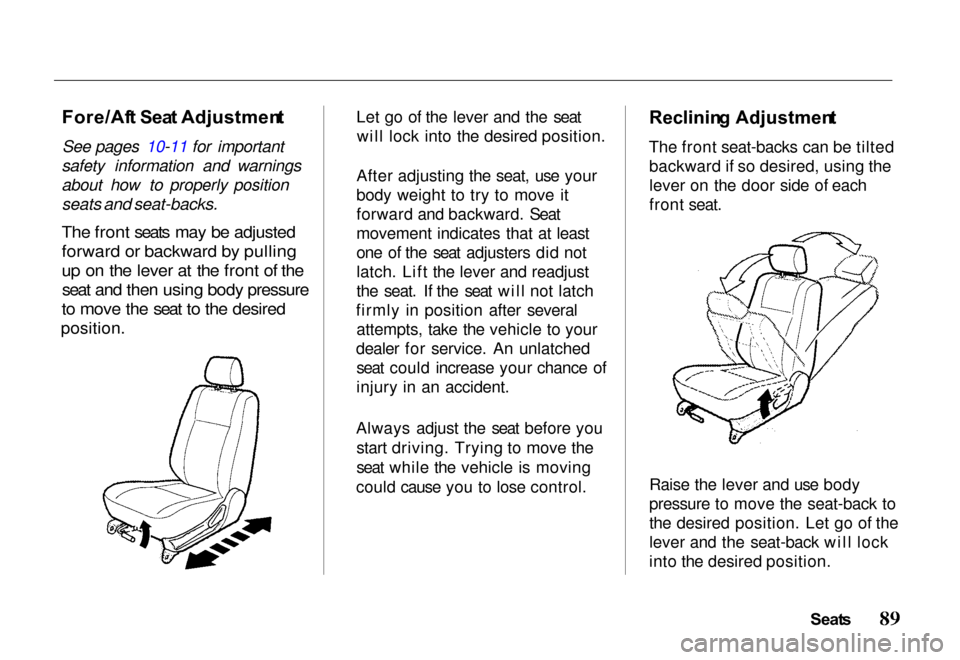
The front seats may be adjusted
forward or backward by pulling
up on the lever at the front of the seat and then using body pressure
to move the seat to the desired
position.
Let go of the lever and the seat
will lock into the desired position.
After adjusting the seat, use your
body weight to try to move it
forward and backward. Seat
movement indicates that at least
one of the seat adjusters did not
latch. Lift the lever and readjust
the seat. If the seat will not latch
firmly in position after several attempts, take the vehicle to your
dealer for service. An unlatched seat could increase your chance of
injury in an accident.
Always adjust the seat before you start driving. Trying to move the
seat while the vehicle is moving
could cause you to lose control.
Reclinin
g Adjustmen t
The front seat-backs can be tilted backward if so desired, using the
lever on the door side of each
front seat.
Raise the lever and use body
pressure to move the seat-back to
the desired position. Let go of the
lever and the seat-back will lock
into the desired position.
Seats
Page 93 of 267
Keep the seat belt's webbing and
latch clear of the seat parts when
you tilt the folding seats forward
or backward. This helps to
prevent damage to the seat belt
system.
Adjust the seat-back before you
start driving. Trying to adjust the
seat-back with the vehicle in
motion could cause you to lose
control.
Hea d Restraint s
See page 12 for important safety information and warnings about
how to properly position the head
restraints.
Head restraints are designed to
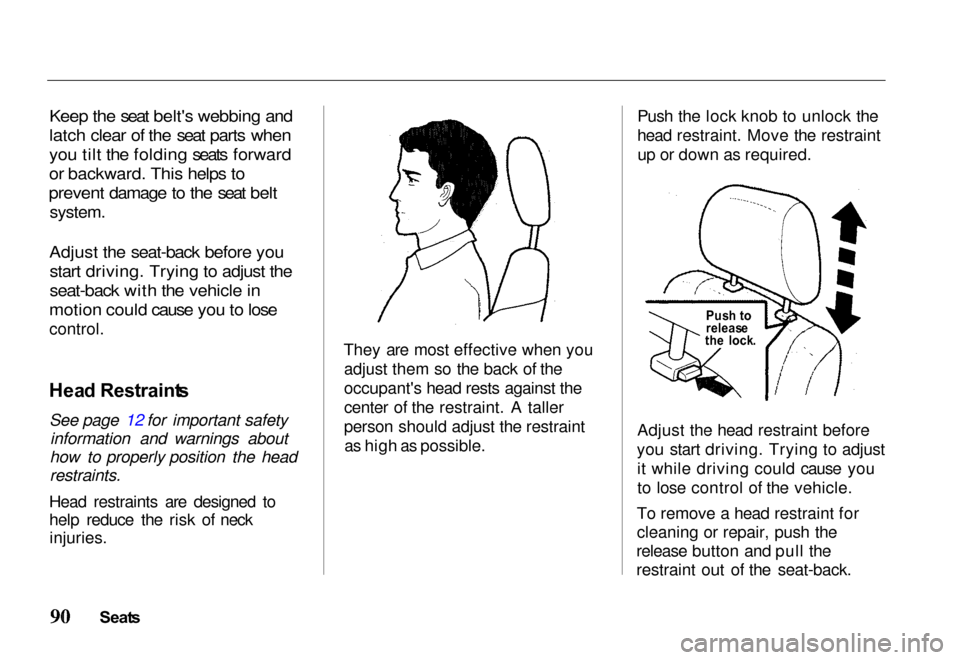
help reduce the risk of neck injuries. They are most effective when you
adjust them so the back of the
occupant's head rests against the
center of the restraint. A taller
person should adjust the restraintas high as possible. Push the lock knob to unlock the
head restraint. Move the restraint
up or down as required.
Adjust the head restraint before
you start driving. Trying to adjust it while driving could cause you
to lose control of the vehicle.
To remove a head restraint for
cleaning or repair, push the
release button and pull the
restraint out of the seat-back.
Seat s
Pus
h t o
releas e
th e lock .
Page 94 of 267
Rea
r Sea t
The rear seat can be folded
forward to provide additional
cargo area.
Foldin g
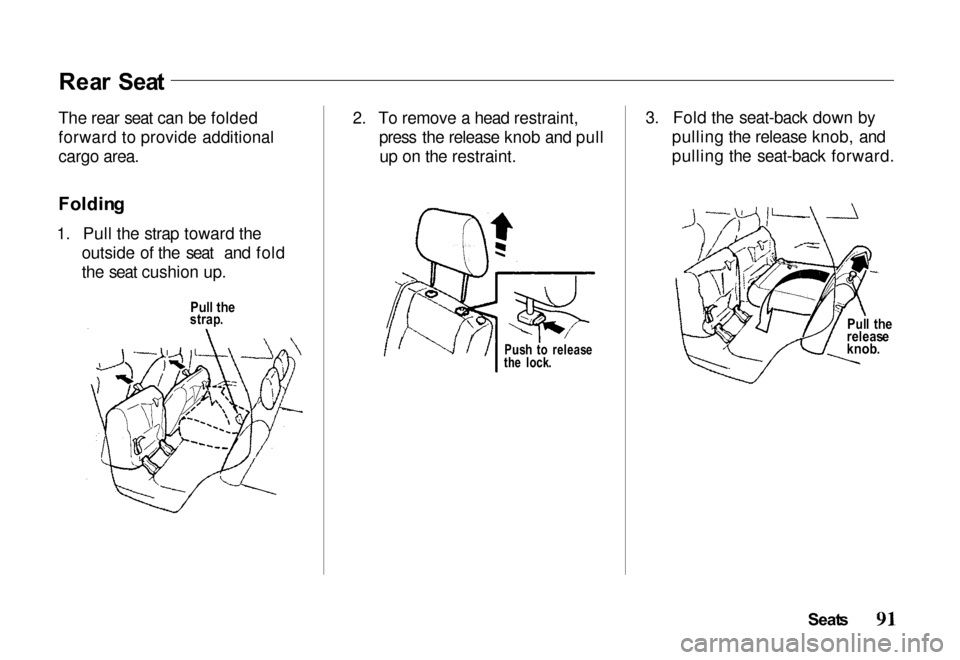
1. Pull the strap toward the outside of the seat and fold
the seat cushion up. 2. To remove a head restraint,
press the release knob and pullup on the restraint. 3. Fold the seat-back down by
pulling the release knob, and
pulling the seat-back forward.
Seats
Pul
l th e
releas e
knob .
Pul
l th e
strap .
Push t o releas e
th e lock .
Page 96 of 267
3. Make sure that the head
restraints are properly
reinstalled on the top of the
seat-backs.
4. Verify that the seat belts are routed properly and nottwisted.
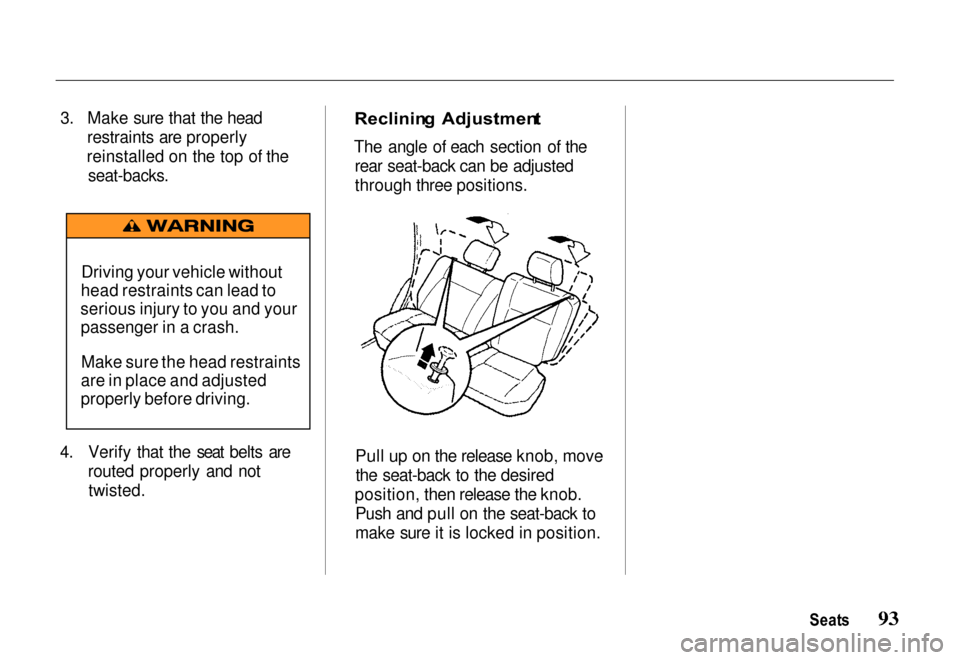
Reclinin
g Adjustmen t
The angle of each section of the rear seat-back can be adjusted
through three positions.
Pull up on the release knob, movethe seat-back to the desired
position, then release the knob. Push and pull on the seat-back to
make sure it is locked in position.
Seats
Driving your vehicle without
head restraints can lead to
serious injury to you and your passenger in a crash.
Make sure the head restraints
are in place and adjusted
properly before driving.
Page 176 of 267
Carryin
g Item s in th e
Passenge r Compartmen t
Store or secure all items that
could be thrown around and
hurt someone during a crash. Be sure items placed on the
floor behind the front seats
cannot roll under the seats
and interfere with the driver's
ability to operate the pedals,
or with the proper operation
of the seats. Keep the glove box closed
while driving. If the lid is open,
a passenger could injure his
knees during a crash or sudden
stop.
Carryin
g Carg o in th e Carg o
Are a o r o n a Roo f Rac k Distribute cargo evenly on the
floor of the cargo area, placing
the heaviest items on the
bottom and as far forward as
possible.
If you fold down the back seat,
tie down items that could be
thrown about the vehicle
during a crash or sudden stop. If you carry large items that
prevent you from closing the hatch glass or rear door,
exhaust gas can enter the
passenger area. To avoid the
possibility of carbon monoxide
poisoning, follow the instructions on page 44. If you carry any items on a roof
rack, be sure the total weight of the rack and the items does not
exceed 200 Ib (90 kg).
Driving Tip s
Page 209 of 267
Seat-bac
k latche s — Seat-back
latches are designed to prevent
forward motion of the seat-back when the vehicle stops suddenly.
Check to see that the seat-backlatches are holding by pulling
forward on the top of the folding
seat-back.
Also check to see that the
reclining seats are operating properly.
Light s an d beepers — Check
panel lighting, warning lights, and
the seat belt reminder light and
beeper. Also check the key beeper and interior lights. On the outside,
check the license plate light, sidemarker lights, headlights, parking
lights, taillights, brake lights, turnsignals, backup lights and hazard
warning flashers. Have the
headlight aim checked promptly if the beams seem to be aimed
improperly.
Glas
s — Check for broken,
scratched or damaged glass that
could reduce visibility or cause injury.
Doo r latches — Check that the
doors close, latch and lock
securely.
Hoo d latc h — Check that the
hood closes firmly. Check for
broken, damaged, or missing parts that might prevent secure
latching. Make sure the secondarylatch keeps the hood from
opening all the way when first
released.
Flui
d leaks — Check for fuel,
water, oil or other fluid leaks by
looking at the surface beneath the
vehicle after it has been parked
for awhile. Water dripping from
the air conditioning system after use is normal. If you notice
gasoline fumes or fluid at any
time, locate the source and have it
corrected at once.
Spar e tir e an d jac k — Check that
the spare tire and all jack gear are securely stowed at all times.
Tailgat e latc h — Check that the
tailgate closes, latches and locks
securely.
Car e an d Maintenanc e
Page 254 of 267

Inde
x
ABS. See Anti-Lock Brake
System
Accessories, Installation .... 169
ACCESSORY
(Ignition Key Position) ...... 97
Accessory Power Outlets ..... 113
Adding AutomaticTransmission Fluid .... 212
Brake Fluid ............ 215
Clutch Fluid ............ 219
Engine Oil ............ 208
Manual Transmission Fluid .... 211
Power Steering Fluid ..... 219
Radiator Coolant ........ 214
Windshield Washer Fluid ..
194
Adjustments
Head
Restraints .......... 12
Mirrors
Exterior ............ 101Interior ............. 101
Power. ............. 101
Seat-Backs .......... 11,
89
Reclining the Rear ...... 93
Seats, Front ......... 10,
89
Steering Wheel ..... 15,
111
Adults, Protecting ........... 10
Airbags (SRS) ............. 7
Serious Risk to Children .... 19
Air Cleaner Filter ......
166, 210
Air Conditioning
Maintenance ........... 217
Usage ................. 116
Air Filter. See Air Cleaner Filter
Air Outlets (Vents) ......... 120
Air Pressure, Tires ......... 235
Alcohol and Driving ........ 4
Alcohol in Gasoline ........ 196
Alternator Belt. See Drive Belts
Antifreeze ................ 213
Anti-Lock Brake System
Indicator Lights .......... 65
Operation .............. 155
Anti-Theft Steering Column Lock ..... 98
System .................
..... 148
Appearance Care. See Cleaning
Ashtray .................. 112
Assist Grip ..............
111
Audio System ............. 121
Page 256 of 267

Change Oil
How to ................ 208
When ......... 200, 201, 207
Changing a Flat Tire ....... 182 Lifting Points ........... 183
Changing Engine Coolant .. . 214
Charging System Indicator ... 60
Check Engine Light ......... 61
Checking Battery Condition ....... 194
Brake Fluid ............ 219
Clutch Fluid ............ 219
Engine Belts ............ 218
Engine Coolant ..... 213, 214
Engine Oil ............ 209 5-Speed Manual Transmission Fluid .... 211
Fuses .............
189, 236
Power Steering Fluid .....
219
Radiator Coolan
t ....... 213
Shift-on-the-Fly
System Fluid .......... 216
Tire Pressure ........... 194
Windshield Wipers ..... 205
Checklist, Before Driving ... 152
Children, Protecting .......... 18
Child-Safe Door Locks .... 101
Child Seats, General Guidelines ......... 21
Cigarette Lighter .......... 112
Circuit Breaker, Checking the 104
Cleaner, Air ............. 210
Cleaning Exterior ............... 220
Interior ................ 222Seat Belts .............. 225
Vinyl ................. 225 Clock, Setting the .......... 149
Clutch Fluid .............. 219
CO in the Exhaust ......
44, 245
Consumer Information ...... 242 Control Locations .......... 54
Controls, Instruments and .... 53
Controls Near the Steering Wheel
Hazard Warning .......... 74
Headlights ............. 70
Illumination Control ..... 71
Rear Window Defogger .... 72
Steering Wheel Adjustment 111
Turn Signals ............. 73
Windshield Wiper/Washer . 68
Rear Window Wiper/
Washer ............. 72