Page 33 of 267
Of the different seats available,
we recommend those that have a
five-point harness system as
shown.
We also recommend that a small
child stay in the child seat as long as possible, until the child reaches
the weight or height limit for the
seat.
Child Seat Placement In this vehicle, the best place toinstall a forward-facing child seatis in one of the seating positions
in the back seat.
Placing a forward-facing child seat in the front seat of a vehicle
equipped with a passenger's
airbag can be hazardous. If the
vehicle seat is too far forward, or
the child's head is thrown forward
during a collision, an inflating
passenger's airbag can strike the
child with enough force to cause
very serious or fatal injuries. If a
small child must be closely
watched, we recommend that
another adult sit in the back seat
with the child. If it is necessary to put a forward-
facing child seat in the front,
move the vehicle seat as far to the
rear as possible, be sure the child seat is firmly secured to the
vehicle, and that the child is
properly strapped in the seat.
Installing a Child Seat With a
Lap/Shoulder Belt The lap/shoulder belts in the outer
back and front passenger seating
positions have a lockingmechanism that must be activated
to secure a child seat.
The following pages provide instructions on how to secure a
forward-facing child seat with this
type of seat belt.
Drive r an d Passenge r Safet y
Improperly placing a
forward-facing child seat in the
front seat can result in serious injury or death if the airbags
inflate.
If you must place a forward-
facing child seat in the front, move the vehicle seat as far
back as possible and properly
restrain the child.
Page 36 of 267
seat while pulling on the belt).
Finally, follow instruction number 5 on page 32 to verify that the
child seat is secure.
Additional Precautions for Small
Children
Never hold a small child on
your lap. If you are not wearing a seat belt in a crash,you could be thrown forwardinto the dashboard and crush
the child.
If you are wearing a seat belt,
the child can be torn from your
arms during a crash. For
example, if your vehicle
crashes into a parked vehicle at 30 mph (48 km/h), a 30 lb (14
kg) child will become a 900 Ib (410 kg) force, and you will
not be able to hold on.
Never put a seat belt over
yourself and a child. During a crash, the belt could press deep
into the child and cause very
serious injuries.
Protectin g Large r Childre n
When a child reaches the recommended weight or heightlimit for a forward-facing childseat, the child should sit in one of
the outer back seats and wear a
lap/shoulder belt. The
lap/shoulder belt provides better
protection than the lap belt.
If a child is too short for the shoulder part of the belt to fit
properly, we recommend that the child use a booster seat until they
are tall enough to use the seat belt
without a booster. The following pages give
instructions on how to check
proper seat belt fit, what kind of
booster seat to use if one is
needed, and important precautions
for children who must sit in the
front seat.
Drive r an d Passenge r Safet y
Allowing a larger child to sit
improperly in the front seat can
result in injury or death if the
airbags inflate.
If a larger child must sit in front,
make sure the child moves the
seat as far back as possible
and wears the seat belt
properly.
Page 39 of 267
Physical Size — Physically, a child
must be large enough for the
lap/shoulder
belt to properly fit
over the hips, chest, and shoulder (see
page 13 and 35). If the seat
belt does not fit properly, the child should
not sit in the front.
Maturity — To safely ride in
front, a child must be able to
follow
the rules, including sitting
properly, and wearing the seat belt
properl
y throughout a ride. If you decide that a child can
safely ride up front, be sure to:
Carefully
read the owner's
manual,
and make sure you
understand all seat belt instructions and all safety
information.
Mov
e the vehicle seat to the
rear-most
position.
Have the child sit up straight,
back against the seat, and feet
on
or near the floor.
Check that the child's seat belt is
properly positioned and
secured.
Supervise the child. Even
mature
children sometimes
need
to be reminded to fasten
their seat belts or sit properly.
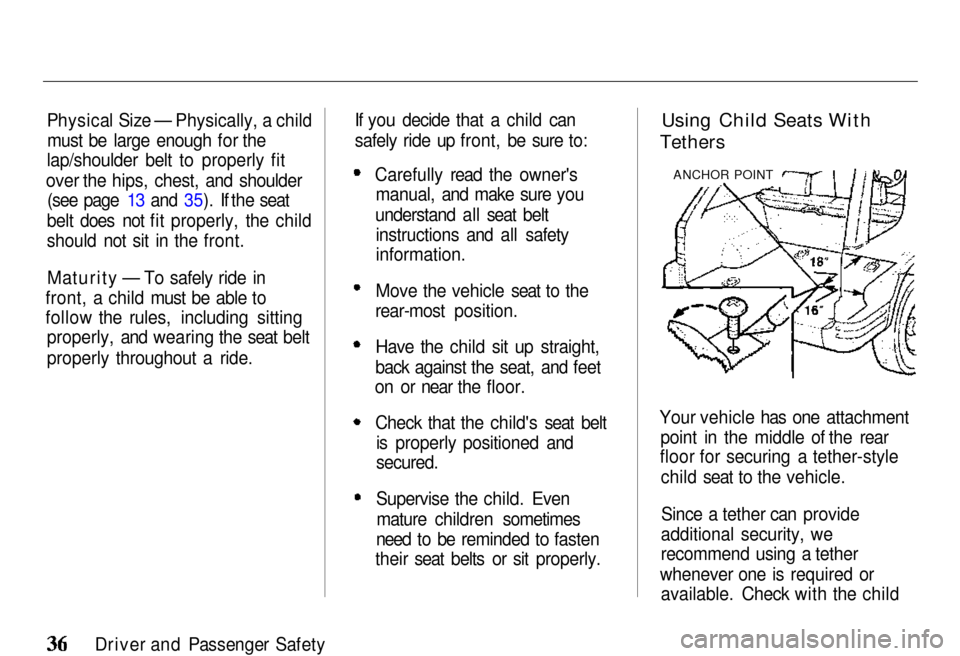
Using Child Seats With
Tethers
ANCHO
R POINT
Your vehicle has one attachment point in the middle of the rear
floor
for securing a tether-style
child seat to the vehicle.
Since
a tether can provide
additional security, we
recommend using a tether
whenever
one is required or
available. Check with the child
Driver and Passenger Safety
Page 41 of 267
To fasten the belt, insert the latch
plate into the buckle, then tug on
the belt to make sure the buckle is
latched.
To unlock the belt, push the red PRESS button on the buckle.
Guide the belt across your body to
the door pillar. After exiting the
vehicle, be sure the belt is out of
the way and will not get closed in
the door.
All lap/shoulder belts have an emergency locking retractor. In
normal driving, the retractor lets
you move freely in your seat while it keeps some tension on the
belt. During a collision or suddenstop, the retractor automatically
locks the belt to help restrain your
body.
Drive r an d Passenge r Safet y
Additiona
l Informatio n Abou t You r Sea t Belt s
Sea t Bel t Syste m
Component s
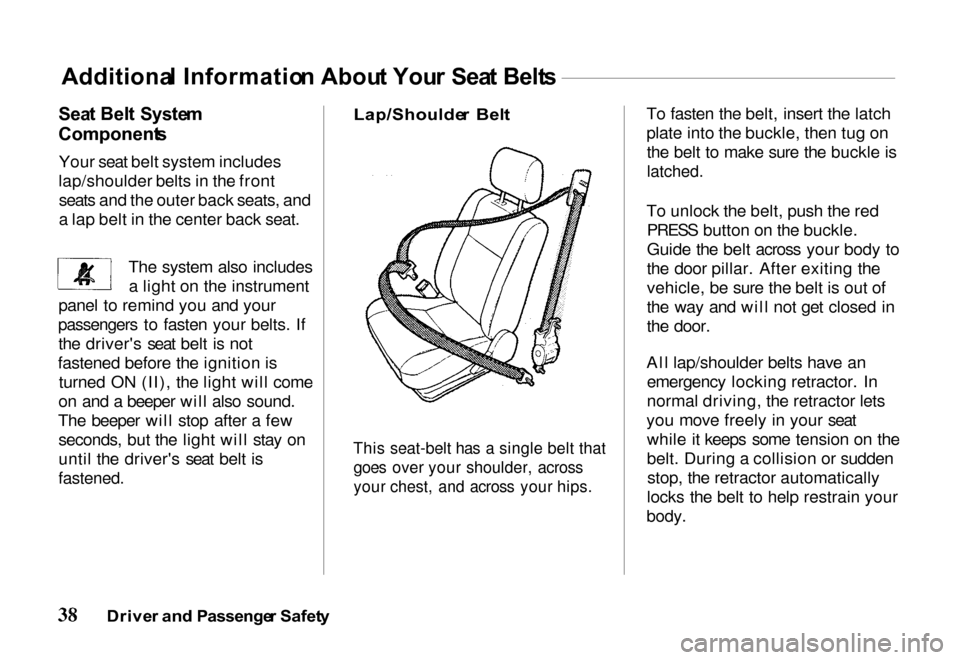
Your seat belt system includes
lap/shoulder belts in the front seats and the outer back seats, and
a lap belt in the center back seat.
Lap/Shoulde
r Bel t
This seat-belt has a single belt that
goes over your shoulder, across
your chest, and across your hips.
The system also includes
a light on the instrument
panel to remind you and your
passengers to fasten your belts. If the driver's seat belt is not
fastened before the ignition is turned ON (II), the light will come
on and a beeper will also sound.
The beeper will stop after a few seconds, but the light will stay on
until the driver's seat belt is
fastened.
Page 42 of 267
All the lap/shoulder belts except
the driver's have an additional
locking mechanism that must beactivated to secure a child seat.(See pages 25 and 30 for
instructions on how to secure
child seats with this type of seat
belt.)
If the shoulder part of the belt is
pulled all the way out, the locking
mechanism will activate. The belt
will retract, but it will not allow a
passenger to move freely.
To deactivate the locking
mechanism, unlatch the buckle
and let the seat belt fully retract.
To refasten the belt, pull it out only as far as needed.
See page 13 for instructions on
how to wear the lap/shoulder belt
properly.
La
p Bel t
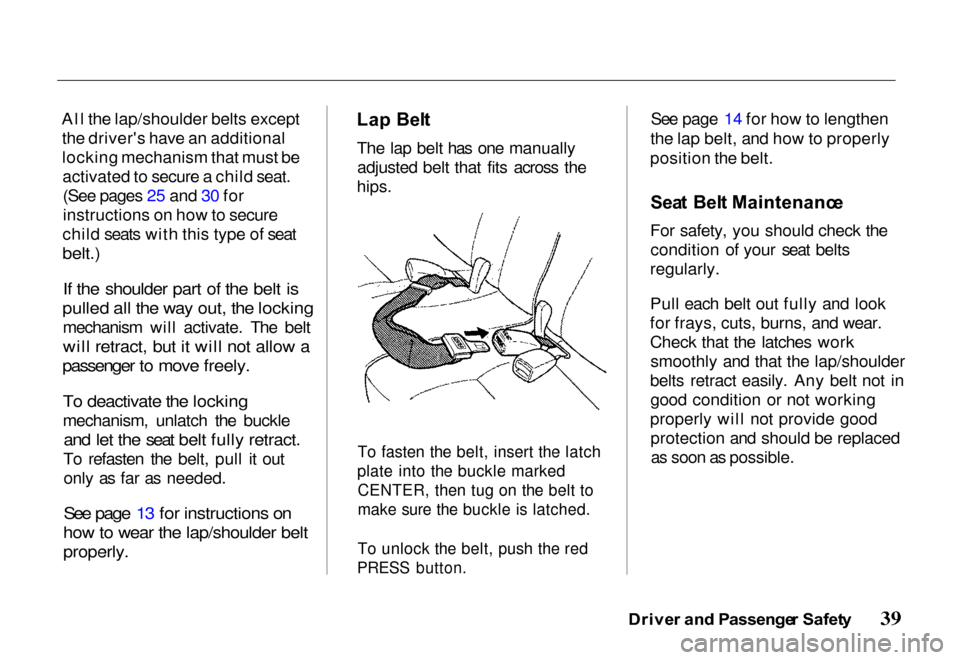
The lap belt has one manually adjusted belt that fits across the
hips.
To fasten the belt, insert the latch
plate into the buckle marked
CENTER, then tug on the belt to
make sure the buckle is latched.
To unlock the belt, push the red
PRESS button.
See page 14 for how to lengthen
the lap belt, and how to properly
position the belt.
Sea t Bel t Maintenanc e
For safety, you should check the condition of your seat belts
regularly.
Pull each belt out fully and look
for frays, cuts, burns, and wear.
Check that the latches work smoothly and that the lap/shoulder
belts retract easily. Any belt not in good condition or not working
properly will not provide good protection and should be replacedas soon as possible.
Drive r an d Passenge r Safet y
Page 50 of 267
Of
f to a Goo d Star t
To make it easier for you to enjoyyour new Passport, we've
gathered together the bits and
pieces of information that will get you "off to a good start." Eachitem in this section refers you to a
page of the manual for detailed instructions on that aspect of
vehicle operation. While you should take the time to become
familiar with all the information in this manual, we hope that thissection saves some time in getting
you safely behind the wheel.
Seats .................... 48
Interior .................. 49
Engine Compartment ....... 51
Off t o a Goo d Star t
Page 87 of 267
Operatio
n
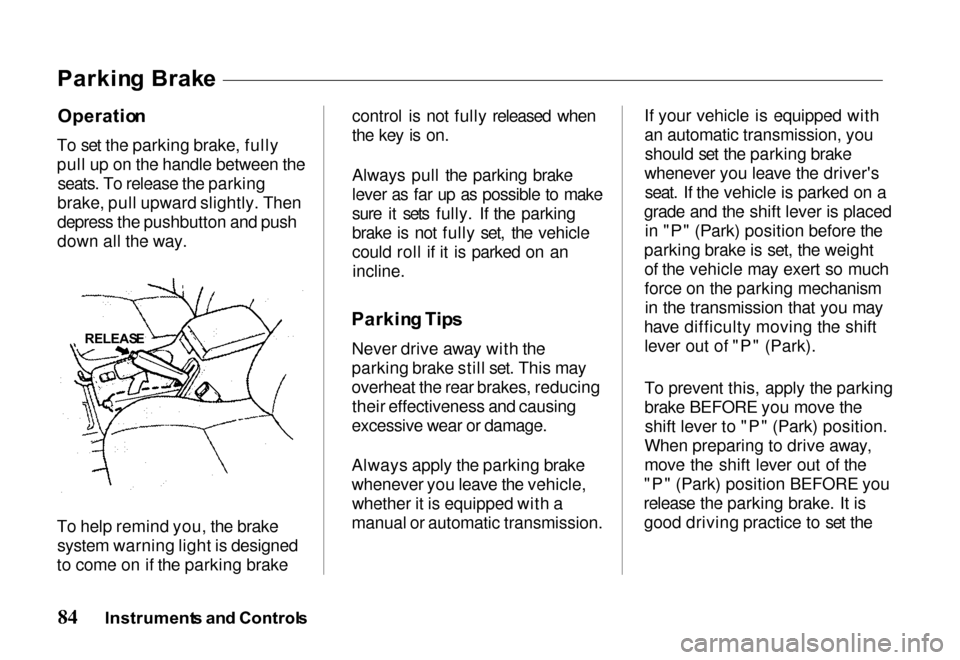
To set the parking brake, fully
pull up on the handle between the seats. To release the parking
brake, pull upward slightly. Then
depress the pushbutton and push
down all the way.
To help remind you, the brake system warning light is designed
to come on if the parking brake control is not fully released when
the key is on.
Always pull the parking brake
lever as far up as possible to make
sure it sets fully. If the parking
brake is not fully set, the vehicle
could roll if it is parked on an
incline.
Parkin g Tip s
Never drive away with the
parking brake still set. This may
overheat the rear brakes, reducing their effectiveness and causing
excessive wear or damage.
Always apply the parking brake
whenever you leave the vehicle, whether it is equipped with a
manual or automatic transmission. If your vehicle is equipped with
an automatic transmission, you
should set the parking brake
whenever you leave the driver's seat. If the vehicle is parked on a
grade and the shift lever is placed in "P" (Park) position before the
parking brake is set, the weight of the vehicle may exert so much
force on the parking mechanismin the transmission that you may
have difficulty moving the shift lever out of "P" (Park).
To prevent this, apply the parking
brake BEFORE you move theshift lever to "P" (Park) position.
When preparing to drive away,
move the shift lever out of the
"P" (Park) position BEFORE you
release the parking brake. It is good driving practice to set the
Instrument s an d Control s
Parkin
g Brak e
RELEAS E
Page 90 of 267
Seat
s
Seat Adjustment .......... 88Fore/Aft Seat Adjustment . 89
Reclining Adjustment .... 89
Head Restraints ......... 90
Rear Seat ................ 91 Folding ............... 91
Unfolding ............. 92
Seats