2000 HONDA PASSPORT fuel pressure
[x] Cancel search: fuel pressurePage 163 of 267
Inflatio
n
Keeping the tires properly inflated
provides the best combination of
handling, tread life, and riding
comfort. Underinflated tires wear
unevenly, adversely affect handling and fuel economy, and are more
likely to fail from being overheated. Overinflated tires can make your
vehicle ride more harshly, are
more prone to damage from road
hazards, and wear unevenly.
We recommend that you visually check your tires every day. If you
think a tire might be low, check it
immediately with a tire gauge.
Use a gauge to measure the air
pressure at least once a month. Even tires that are in good
condition may lose one to two psi
per month. Remember to checkthe spare tire at the same time you
check all the other tires. Check the pressure in the tires
when they are cold. This means
the vehicle has been parked for at
least three hours. If you have to
drive the vehicle before checking
the tire pressure, the tires can still be considered "cold" if you drive
less than 1 mile (1.6 km).
If you check the pressure when the tires are hot (the vehicle has
been driven several miles), you will see readings 4 to 6 psi (28 to
41 kPa, 0.3 to 0.4 kg/cm2) higher
than the cold reading. This is
normal. Do not let air out to
match the specified cold pressure.
The tire will be underinflated.
You should get your own tire
pressure gauge and use it at all times. That makes it easier for
you to tell if a pressure loss is
caused by a tire problem and not a
variation between gauges.
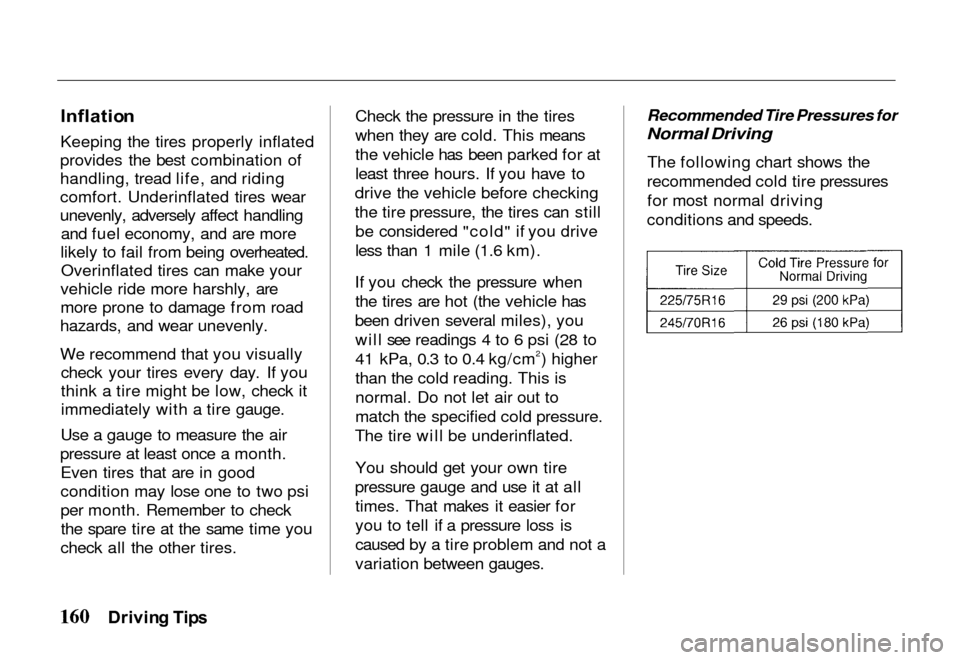
Recommended Tire Pressures for
Normal Driving
The
following chart shows the
recommended cold tire pressures for most normal driving
conditions and speeds.
Drivin g Tip s
Page 170 of 267

air cleaner, so it's important to
replace the air cleaner filter at
required intervals. See "Care and Maintenance." A dirty air cleaner
filter reduces engine performance
and can waste fuel.
Air Conditioning
Turn off the air conditioning whenit is not needed. The air
conditioning compressor is not on
in this position and the reduced
engine load can improve fuel
economy.
Tuned Engine
An engine that is properly
maintained will provide better
fuel economy than one that is not.
One misfiring spark plug will cut
fuel economy significantly, and
will make a difference in the
amount of pollution emitted from
your vehicle.
Excessive Weight
Fuel economy is related to thework the engine must do. The
heavier the load, the more fuel it takes to run your vehicle. Keep
weight to a minimum by removing
unnecessary luggage or cargo.
Tire Inflation
Underinflation not only causes
needless tire wear but can also
waste fuel. It's a good idea to
check tire pressure often and keep your tires inflated to the pressures
shown on the tire placard located
on the driver's doorjamb.
Wheel Alignment
Improper alignment will cause the
front tires to roll at an angle that
will result in faster tire wear. It takes power to overcome this
improper alignment, which, inturn, wastes fuel.
Use of 4-Wheel Drive
In normal driving, put the 4WD-2WD switch in the 2WD
position.
Driving Tip s
Page 194 of 267

Car
e an d Maintenanc e
This section explains why it is important to keep your vehicle
well maintained and to follow
basic maintenance safety
precautions.
This section also includes Maintenance Schedules for
normal driving and severe driving
conditions, a Maintenance
Record, and instructions for simple maintenance tasks you
may want to take care of yourself.
If you have the skills and tools
required to perform more complex
maintenance tasks on your Honda,
you may want to purchase the Service Manual. See page 249 for
information on how to obtain a
copy, or see your Honda dealer. Service Station Information . 193
Fuel Fill Cap .......... 193Fuel Recommendation ... 194
Fuel Tank Capacity ..... 194
Engine Oil Recommendation ...... 194
Windshield Washer ..... 194
Tire Inflation Pressures .. 194 Battery ............... 194
Hood Release .......... 195
Engine Oil Dipstick ..... 196
Fuel Requirements ........ 196 Oxygenated Fuels ...... 196
Maintenance Safety ....... 197 Important Safety
Precautions .......... 198
Maintenance Schedule ..... 199
Required Maintenance Record 202
Owner Safety Checks ...... 204
Engine Oil and Filter ...... 207 Proper Quality Oil ...... 207 Change Interval ........ 207
Oil
Change ........... 208
Oil Filter Installation . 208
Oil Viscosity .......... 209
Oil Level Check ....... 209
Engine Oil Additives ... 210
Air Cleaner Filter ........ 210
Manual Transmission Fluid 211
Automatic Transmission Fluid .................. 212
Front (4WD) and Rear Axles ............. 212
Engine Cooling System ... 213
Other Required Maintenance 215 Brake Master Cylinder . . 215
Shift-on-the-Fly System
. 216
Front Whee
l Bearings ... 216
Hood Latch and Hinges . 217
Air Conditioning ....... 217 Body Lubrication ...... 217
Car e an d Maintenanc e
Page 197 of 267
Fue
l Recommendatio n
Use only unleaded gasoline. For additional information see "Fuel
Requirements" in this section.
Fue l Tan k Capacit y
21.2 U.S. gallons (80 liters)
Engin e Oi l Recommendatio n
Use only SJ quality oil.
The chart shown under "Engine Oil and Filter" in this section willserve as a guide for choosing the
proper viscosity oil.
Windshiel d Washe r
Check the reservoir fluid level
regularly. Use a commercially available windshield washer fluid.
The windshield washer reservoir is located on the front right side of
the engine compartment. Tir
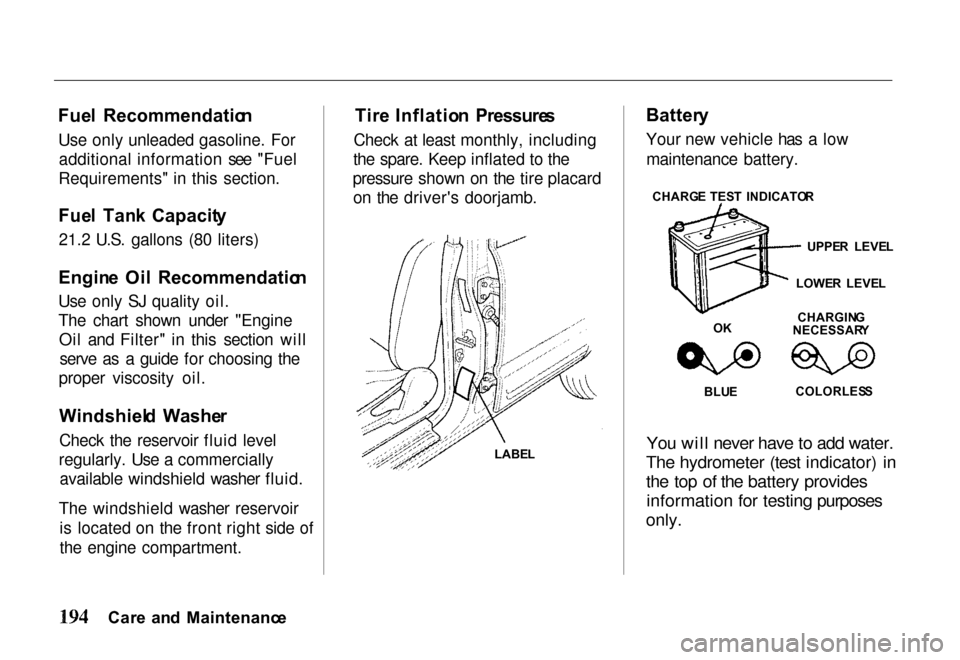
e Inflatio n Pressure s
Check at least monthly, including
the spare. Keep inflated to the
pressure shown on the tire placard on the driver's doorjamb. Batter
y
Your new vehicle has a low maintenance battery.
You will never have to add water.
The hydrometer (test indicator) in
the top of the battery provides information for testing purposes
only.
Car e an d Maintenanc e LABE
L CHARG
E TES T INDICATO R
UPPE R LEVE L
LOWE R LEVE L
CHARGIN G
NECESSAR Y
BLU E COLORLES
S
O
K
Page 203 of 267

Maintenanc
e Schedul e
Check oil and coolant level, at each fuel stop. Under severe driving conditions, service these items more often.
* 1 Using SAE 10W-40 oil, or any viscosity other than those recommended, may reduce engine life and affect the warranty.
* 2 This service is recommended only.
Inspec
t monthly :
— These fluids: brake, clutch, PIS, battery, ATF, windshield washer
— Tire pressure
Car e an d Maintenanc e
R — Replace L — Lube I — Inspect After inspection, clean, adjust, repair or replace if necessary.
Page 258 of 267

Emergency, In Case of ...... 179
Charging System Indicator . 60Check Engine Light ....... 61
Checking the Fuses ...... 189
Engine Overheating ...... 186 Jump Starting ........... 180
Malfunction Indicator Lamp 61Oil Pressure Indicator ..... 62
Emissions Controls ........ 245
Engine
Belts .................. 218
Break-in ............... 154
Check Light ............. 61Coolant Temperature Gauge 58
Identification Number .... 228
Malfunction Indicator Lamp 61 Oil
Capacity ............. 231
Recommendation ...... 194
Oil Pressure Indicator ..... 62 Overheating ............ 186
Specifications .......... 231
Starting ............... 153
Ethanol in Gasoline ........ 197
Evaporative
Emission Controls ........ 246
Exhaust Fumes ............ 44
Expectant Mothers,
Use of Seat Belts by ...... 16
Exterior, Cleaning the ...... 220
Fabric, Cleaning.
See Interior Cleaning
Fan Control Lever ......... 117
Features,
Comfort and Convenience . . 115
Filling the Fuel Tank ....... 193 Filters
Air .................. 210
Oil .................. 208
5-Speed Manual Transmission Checking Fluid Level ... 211Shifting ................ 81
Flashers, Hazard Warning ....
74
Flat Tire
, Changing a ....... 182
Fluids Automatic Transmission . .
212
Capacity ............
. 233
Brake ................. 215
Clutch ................ 219
5-Speed Manual Transmission .......... 211
Capacity ............. 233
Power Steering .......... 219
Windshield Washer ...... 69
FM Stereo
Radio Reception ........ 132