2000 DODGE NEON lock
[x] Cancel search: lockPage 1158 of 1285
INSTALLATION
(1) Position door outside handle in opening.
(2) Tighten attaching nuts.
(3) Connect linkage rods to latch.
(4) Connect lock and latch rods to door handle.
(5) Install door trim panel.
REAR DOOR LATCH
REMOVAL
(1) Remove door trim panel.
(2) Close door glass.
(3) Loosen lower rear run channel.
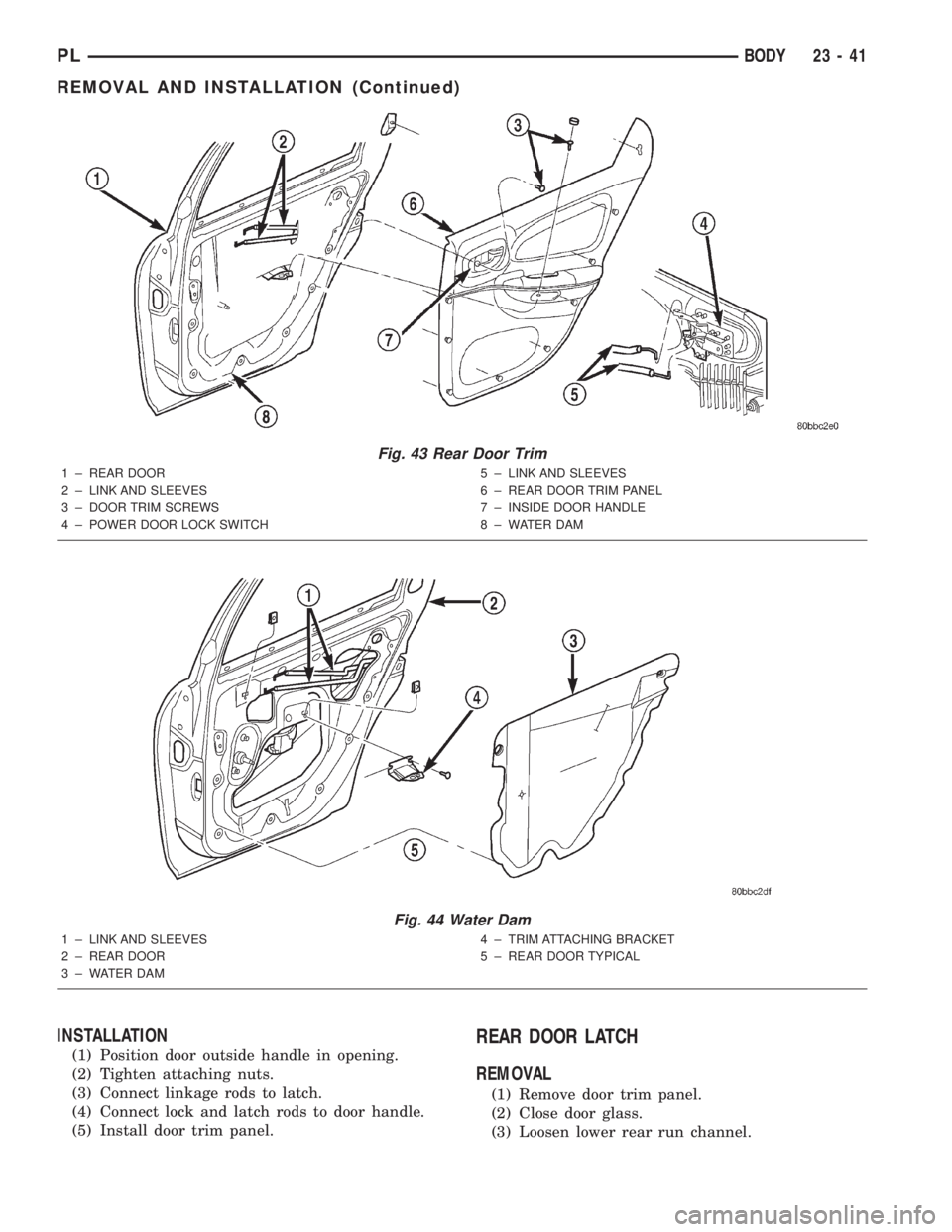
Fig. 43 Rear Door Trim
1 ± REAR DOOR
2 ± LINK AND SLEEVES
3 ± DOOR TRIM SCREWS
4 ± POWER DOOR LOCK SWITCH5 ± LINK AND SLEEVES
6 ± REAR DOOR TRIM PANEL
7 ± INSIDE DOOR HANDLE
8 ± WATER DAM
Fig. 44 Water Dam
1 ± LINK AND SLEEVES
2 ± REAR DOOR
3 ± WATER DAM4 ± TRIM ATTACHING BRACKET
5 ± REAR DOOR TYPICAL
PLBODY 23 - 41
REMOVAL AND INSTALLATION (Continued)
Page 1159 of 1285
(4) Disconnect clips attaching linkage rods to door
latch.
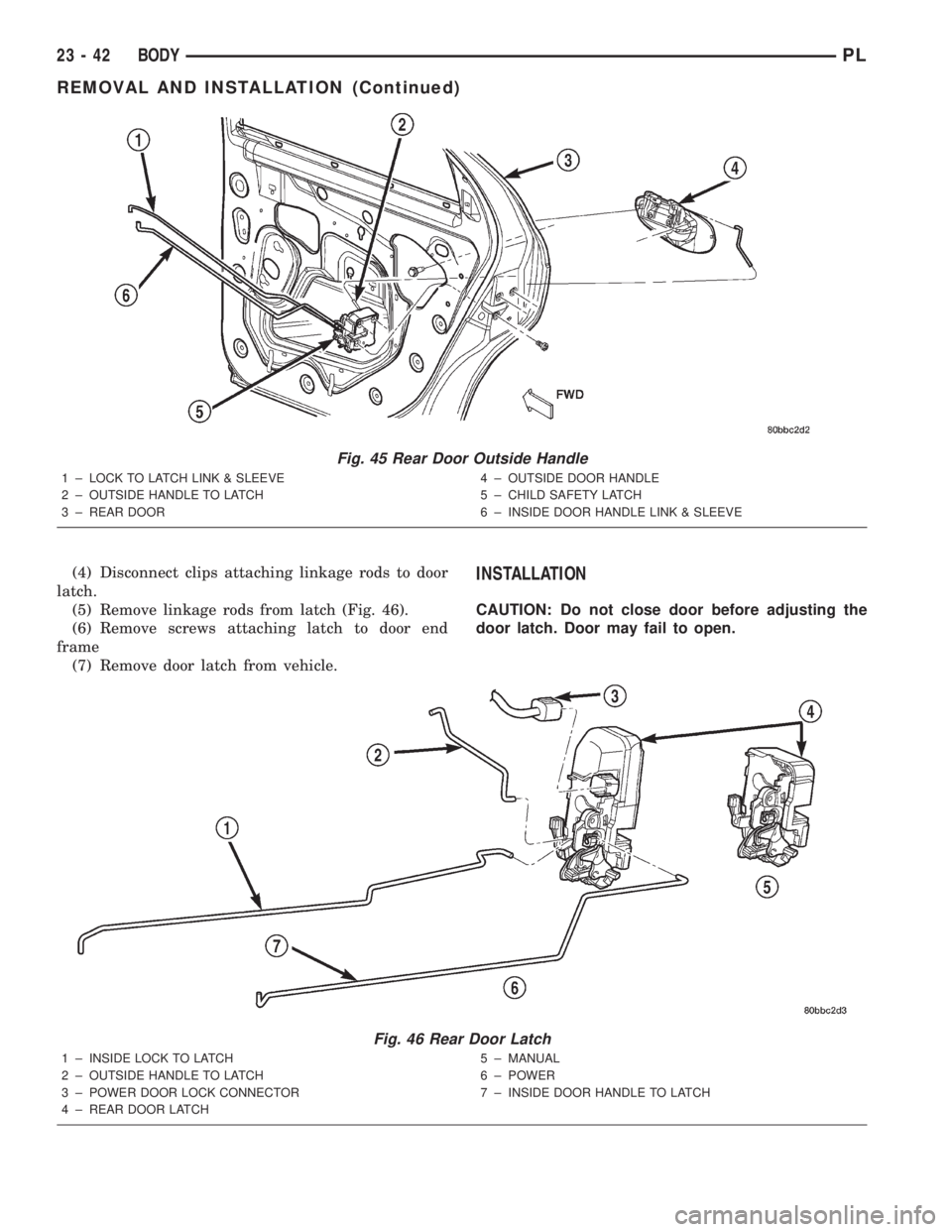
(5) Remove linkage rods from latch (Fig. 46).
(6) Remove screws attaching latch to door end
frame
(7) Remove door latch from vehicle.INSTALLATION
CAUTION: Do not close door before adjusting the
door latch. Door may fail to open.
Fig. 45 Rear Door Outside Handle
1 ± LOCK TO LATCH LINK & SLEEVE
2 ± OUTSIDE HANDLE TO LATCH
3 ± REAR DOOR4 ± OUTSIDE DOOR HANDLE
5 ± CHILD SAFETY LATCH
6 ± INSIDE DOOR HANDLE LINK & SLEEVE
Fig. 46 Rear Door Latch
1 ± INSIDE LOCK TO LATCH
2 ± OUTSIDE HANDLE TO LATCH
3 ± POWER DOOR LOCK CONNECTOR
4 ± REAR DOOR LATCH5 ± MANUAL
6 ± POWER
7 ± INSIDE DOOR HANDLE TO LATCH
23 - 42 BODYPL
REMOVAL AND INSTALLATION (Continued)
Page 1160 of 1285
(1) Position door latch on vehicle and install
screws attaching latch to door end frame.
(2) Connect linkage rods to latch.
(3) Connect lock and latch rods to door latch.
(4) Tighten lower rear run channel.
(5) Install door trim panel.
REAR DOOR LATCH STRIKER
REMOVAL
(1) Mark outline of door latch striker on B-pillar to
aid installation.
(2) Remove screws attaching door latch striker to
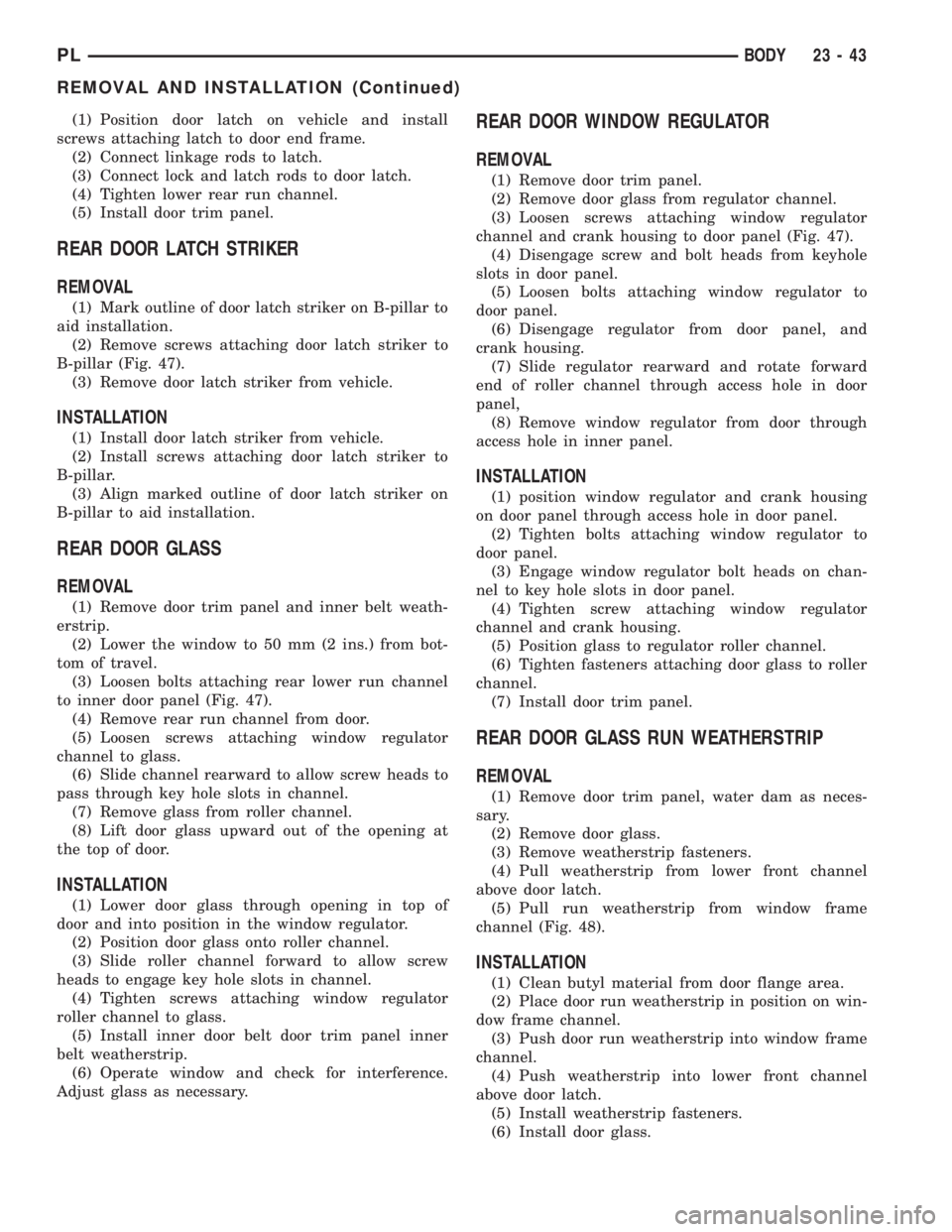
B-pillar (Fig. 47).
(3) Remove door latch striker from vehicle.
INSTALLATION
(1) Install door latch striker from vehicle.
(2) Install screws attaching door latch striker to
B-pillar.
(3) Align marked outline of door latch striker on
B-pillar to aid installation.
REAR DOOR GLASS
REMOVAL
(1) Remove door trim panel and inner belt weath-
erstrip.
(2) Lower the window to 50 mm (2 ins.) from bot-
tom of travel.
(3) Loosen bolts attaching rear lower run channel
to inner door panel (Fig. 47).
(4) Remove rear run channel from door.
(5) Loosen screws attaching window regulator
channel to glass.
(6) Slide channel rearward to allow screw heads to
pass through key hole slots in channel.
(7) Remove glass from roller channel.
(8) Lift door glass upward out of the opening at
the top of door.
INSTALLATION
(1) Lower door glass through opening in top of
door and into position in the window regulator.
(2) Position door glass onto roller channel.
(3) Slide roller channel forward to allow screw
heads to engage key hole slots in channel.
(4) Tighten screws attaching window regulator
roller channel to glass.
(5) Install inner door belt door trim panel inner
belt weatherstrip.
(6) Operate window and check for interference.
Adjust glass as necessary.
REAR DOOR WINDOW REGULATOR
REMOVAL
(1) Remove door trim panel.
(2) Remove door glass from regulator channel.
(3) Loosen screws attaching window regulator
channel and crank housing to door panel (Fig. 47).
(4) Disengage screw and bolt heads from keyhole
slots in door panel.
(5) Loosen bolts attaching window regulator to
door panel.
(6) Disengage regulator from door panel, and
crank housing.
(7) Slide regulator rearward and rotate forward
end of roller channel through access hole in door
panel,
(8) Remove window regulator from door through
access hole in inner panel.
INSTALLATION
(1) position window regulator and crank housing
on door panel through access hole in door panel.
(2) Tighten bolts attaching window regulator to
door panel.
(3) Engage window regulator bolt heads on chan-
nel to key hole slots in door panel.
(4) Tighten screw attaching window regulator
channel and crank housing.
(5) Position glass to regulator roller channel.
(6) Tighten fasteners attaching door glass to roller
channel.
(7) Install door trim panel.
REAR DOOR GLASS RUN WEATHERSTRIP
REMOVAL
(1) Remove door trim panel, water dam as neces-
sary.
(2) Remove door glass.
(3) Remove weatherstrip fasteners.
(4) Pull weatherstrip from lower front channel
above door latch.
(5) Pull run weatherstrip from window frame
channel (Fig. 48).
INSTALLATION
(1) Clean butyl material from door flange area.
(2) Place door run weatherstrip in position on win-
dow frame channel.
(3) Push door run weatherstrip into window frame
channel.
(4) Push weatherstrip into lower front channel
above door latch.
(5) Install weatherstrip fasteners.
(6) Install door glass.
PLBODY 23 - 43
REMOVAL AND INSTALLATION (Continued)
Page 1164 of 1285
DECKLID LATCH
REMOVAL
(1) Open decklid.
(2) Remove bolts attaching decklid latch to decklid
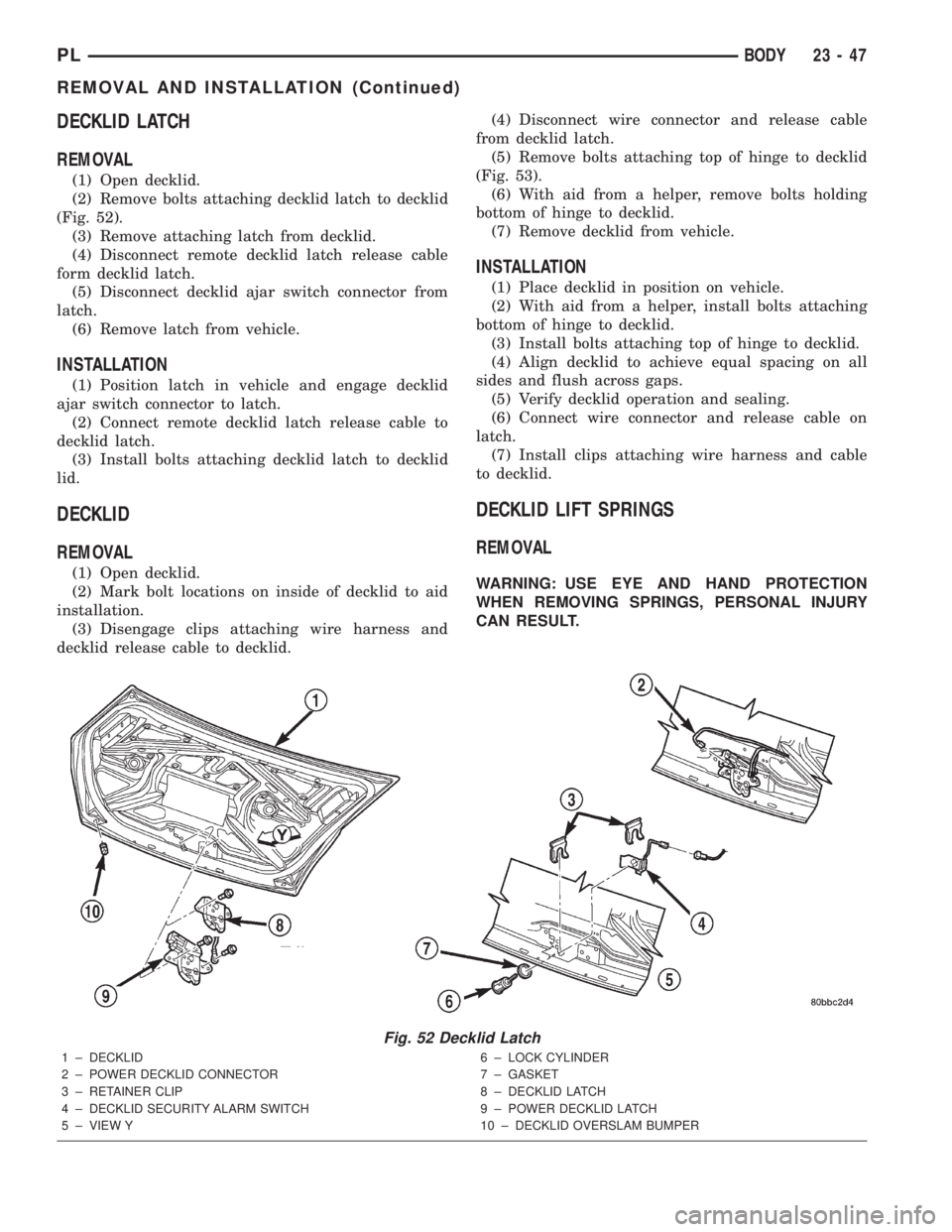
(Fig. 52).
(3) Remove attaching latch from decklid.
(4) Disconnect remote decklid latch release cable
form decklid latch.
(5) Disconnect decklid ajar switch connector from
latch.
(6) Remove latch from vehicle.
INSTALLATION
(1) Position latch in vehicle and engage decklid
ajar switch connector to latch.
(2) Connect remote decklid latch release cable to
decklid latch.
(3) Install bolts attaching decklid latch to decklid
lid.
DECKLID
REMOVAL
(1) Open decklid.
(2) Mark bolt locations on inside of decklid to aid
installation.
(3) Disengage clips attaching wire harness and
decklid release cable to decklid.(4) Disconnect wire connector and release cable
from decklid latch.
(5) Remove bolts attaching top of hinge to decklid
(Fig. 53).
(6) With aid from a helper, remove bolts holding
bottom of hinge to decklid.
(7) Remove decklid from vehicle.
INSTALLATION
(1) Place decklid in position on vehicle.
(2) With aid from a helper, install bolts attaching
bottom of hinge to decklid.
(3) Install bolts attaching top of hinge to decklid.
(4) Align decklid to achieve equal spacing on all
sides and flush across gaps.
(5) Verify decklid operation and sealing.
(6) Connect wire connector and release cable on
latch.
(7) Install clips attaching wire harness and cable
to decklid.
DECKLID LIFT SPRINGS
REMOVAL
WARNING: USE EYE AND HAND PROTECTION
WHEN REMOVING SPRINGS, PERSONAL INJURY
CAN RESULT.
Fig. 52 Decklid Latch
1 ± DECKLID
2 ± POWER DECKLID CONNECTOR
3 ± RETAINER CLIP
4 ± DECKLID SECURITY ALARM SWITCH
5 ± VIEW Y6 ± LOCK CYLINDER
7 ± GASKET
8 ± DECKLID LATCH
9 ± POWER DECKLID LATCH
10 ± DECKLID OVERSLAM BUMPER
PLBODY 23 - 47
REMOVAL AND INSTALLATION (Continued)
Page 1165 of 1285
(1) Release and open decklid.
(2) Support decklid on a suitable prop device.
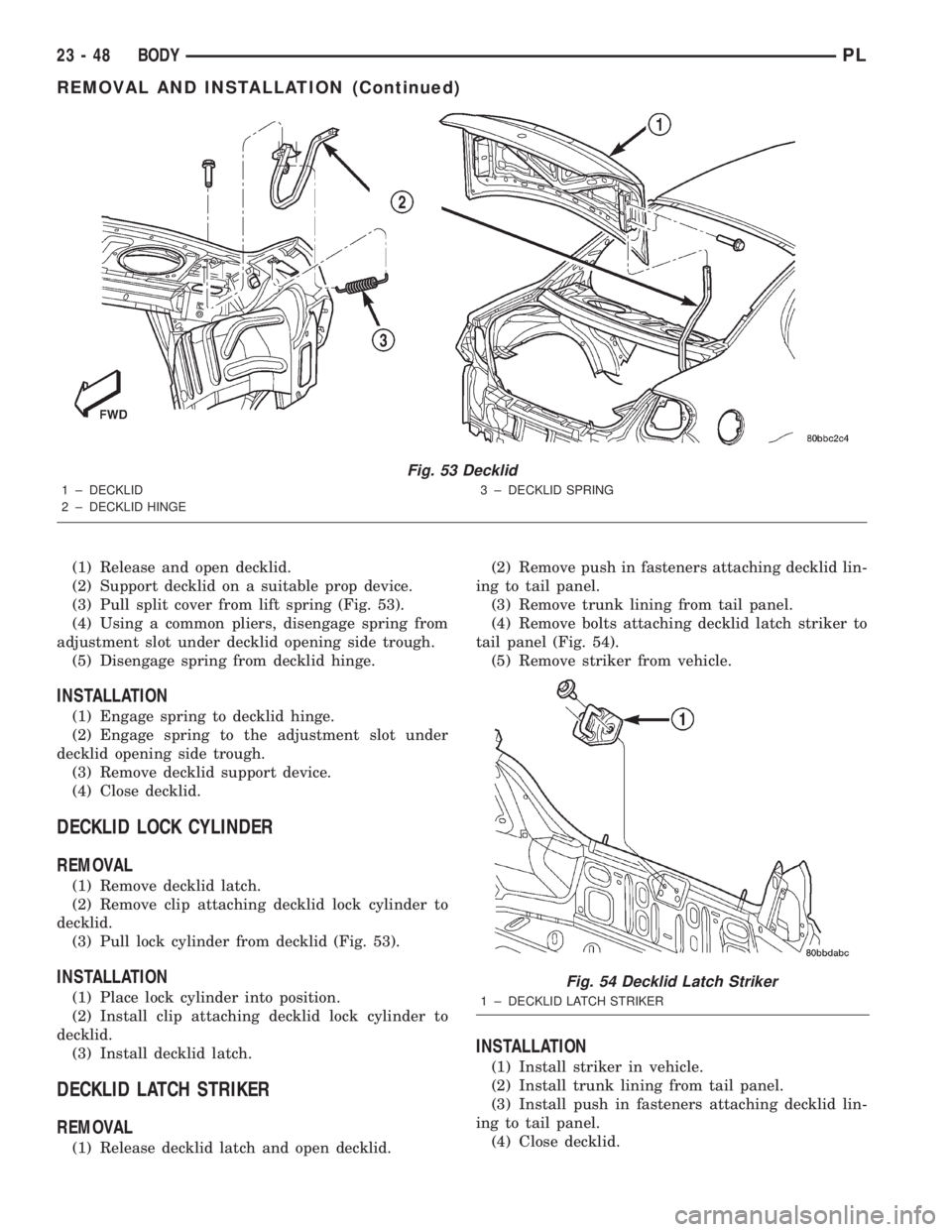
(3) Pull split cover from lift spring (Fig. 53).
(4) Using a common pliers, disengage spring from
adjustment slot under decklid opening side trough.
(5) Disengage spring from decklid hinge.
INSTALLATION
(1) Engage spring to decklid hinge.
(2) Engage spring to the adjustment slot under
decklid opening side trough.
(3) Remove decklid support device.
(4) Close decklid.
DECKLID LOCK CYLINDER
REMOVAL
(1) Remove decklid latch.
(2) Remove clip attaching decklid lock cylinder to
decklid.
(3) Pull lock cylinder from decklid (Fig. 53).
INSTALLATION
(1) Place lock cylinder into position.
(2) Install clip attaching decklid lock cylinder to
decklid.
(3) Install decklid latch.
DECKLID LATCH STRIKER
REMOVAL
(1) Release decklid latch and open decklid.(2) Remove push in fasteners attaching decklid lin-
ing to tail panel.
(3) Remove trunk lining from tail panel.
(4) Remove bolts attaching decklid latch striker to
tail panel (Fig. 54).
(5) Remove striker from vehicle.
INSTALLATION
(1) Install striker in vehicle.
(2) Install trunk lining from tail panel.
(3) Install push in fasteners attaching decklid lin-
ing to tail panel.
(4) Close decklid.
Fig. 53 Decklid
1 ± DECKLID
2 ± DECKLID HINGE3 ± DECKLID SPRING
Fig. 54 Decklid Latch Striker
1 ± DECKLID LATCH STRIKER
23 - 48 BODYPL
REMOVAL AND INSTALLATION (Continued)
Page 1176 of 1285

SPECIFICATIONS
BODY LUBRICATION
LUBRICATION REQUIREMENTS
Body mechanisms and linkages should be
inspected, cleaned, and lubricated, as required, to
maintain ease of operation and to provide protection
against rust and wear. When performing other
underhood services, the hood latch release mecha-
nism and safety catch should be inspected, cleaned,
and lubricated. During the winter season, external
door lock cylinders should be lubricated to assure
proper operation when exposed to water and ice.
Prior to the application of any lubricant, the parts
concerned should be wiped clean to remove dust and
grit. If necessary, a suitable solvent can be used to
clean the item to be lubricated. After lubricating a
component, any excess oil or grease should be
removed.
LUBRICANT APPLICATION
DOOR LOCK CYLINDERS
(1) Apply a small amount of lubricant directly into
the lock cylinder.
(2) Apply a small amount of lubricant to the key.
(3) Insert key into lock cylinder and cycle the
mechanism from the locked to the unlocked position.
NOTE: Do not add more lubricant.
(4) Cycle the lock cylinder mechanism several
times to allow the lubricant to flow throughout the
cylinder.
(5) Wipe all lubricant from exterior of lock cylinder
and key.
ALL OTHER BODY MECHANISMS
(1) Clean component as described above.(2) Apply specified lubricant to all pivoting and
sliding contact areas of component.
LUBRICANT USAGE
ENGINE OIL
²Decklid Hinges
MOPARTSPRAY WHITE LUBE OR EQUIVALENT
²Ash Receiver
²Fuel Filler Door Remote Control Latch Mecha-
nism
²Parking Brake Mechanism
²Sliding Seat Tracks
²Decklid Latch
MOPARTMULTIPURPOSE GREASE OR
EQUIVALENT
²All Other Hood Mechanisms
MOPARTLOCK CYLINDER LUBRICANT OR
EQUIVALENT
²Door Lock Cylinders
²Decklid Lock Cylinder
SPECIAL TOOLS
BODY
STICK, TRIM C 4755
PLBODY 23 - 59
Page 1177 of 1285
SPECIFICATIONS
TABLE OF CONTENTS
page page
SPECIFICATIONS
BODY LUBRICATION SPECIFICATIONS........60
BODY GAP AND FLUSH MEASUREMENTS.....61
BODY OPENING DIMENSION...............62BODY SEALING LOCATIONS................64
STRUCTURAL ADHESIVE LOCATIONS........74
TORQUE SPECIFICATIONS.................76
WELD LOCATIONS.......................77
SPECIFICATIONS
BODY LUBRICATION SPECIFICATIONS
LUBRICATION REQUIREMENTS
Body mechanisms and linkages should be
inspected, cleaned, and lubricated, as required, to
maintain ease of operation and to provide protection
against rust and wear. When performing other under
hood services, the hood latch release mechanism and
safety catch should be inspected, cleaned, and lubri-
cated. During the winter season, external door lock
cylinders should be lubricated to assure proper oper-
ation when exposed to water and ice.
Prior to the application of any lubricant, the parts
concerned should be wiped clean to remove dust and
grit. If necessary, a suitable solvent can be used to
clean the item to be lubricated. After lubricating a
component, any excess oil or grease should be
removed.
LUBRICANT APPLICATION
DOOR LOCK CYLINDERS
(1) Apply a small amount of lubricant directly into
the lock cylinder.
(2) Apply a small amount of lubricant to the key.
(3) Insert key into lock cylinder and cycle the
mechanism from the locked to the unlocked position.
NOTE: Do not add more lubricant.
(4) Cycle the lock cylinder mechanism several
times to allow the lubricant to flow throughout the
cylinder.
(5) Wipe all lubricant from exterior of lock cylinder
and key.ALL OTHER BODY MECHANISMS
(1) Clean component as described above.
(2) Apply specified lubricant to all pivoting and
sliding contact areas of component.
LUBRICANT USAGE
ENGINE OIL
²Door Hinges ± Hinge Pin and Pivot Contact
Areas
²Hood Hinges ± Pivot Points
²Liftgate Hinges
²Decklid Hinges
MOPARTSPRAY WHITE CUBE OR EQUIVALENT
²Door Check Straps
²Liftgate Latches
²Liftgate Prop Pivots
²Ash Receiver
²Fuel Filler Door Remote Control Latch Mecha-
nism
²Parking Brake Mechanism
²Sliding Seat Tracks
²Decklid Latch
MOPARTMultipurpose GREASE OR EQUIVALENT
²All Other Hood Mechanisms
MOPARTLOCK CYLINDER LUBRICANT OR
EQUIVALENT
²Door Lock Cylinders
²Decklid Lock Cylinder
23 - 60 BODYPL
Page 1233 of 1285
GENERAL INFORMATION
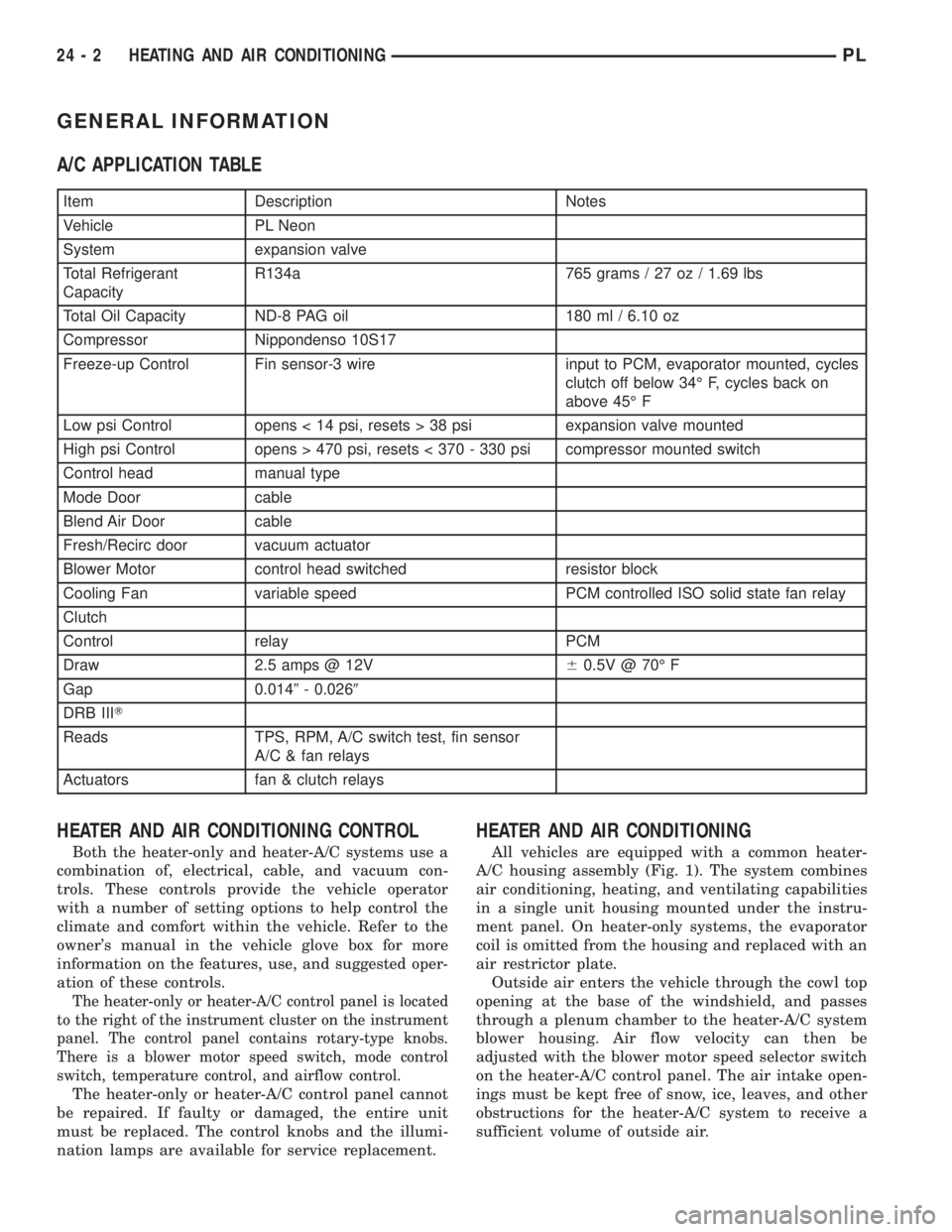
A/C APPLICATION TABLE
Item Description Notes
Vehicle PL Neon
System expansion valve
Total Refrigerant
CapacityR134a 765 grams / 27 oz / 1.69 lbs
Total Oil Capacity ND-8 PAG oil 180 ml / 6.10 oz
Compressor Nippondenso 10S17
Freeze-up Control Fin sensor-3 wire input to PCM, evaporator mounted, cycles
clutch off below 34É F, cycles back on
above 45É F
Low psi Control opens < 14 psi, resets > 38 psi expansion valve mounted
High psi Control opens > 470 psi, resets < 370 - 330 psi compressor mounted switch
Control head manual type
Mode Door cable
Blend Air Door cable
Fresh/Recirc door vacuum actuator
Blower Motor control head switched resistor block
Cooling Fan variable speed PCM controlled ISO solid state fan relay
Clutch
Control relay PCM
Draw 2.5 amps @ 12V60.5V @ 70É F
Gap 0.014º - 0.0269
DRB IIIT
Reads TPS, RPM, A/C switch test, fin sensor
A/C & fan relays
Actuators fan & clutch relays
HEATER AND AIR CONDITIONING CONTROL
Both the heater-only and heater-A/C systems use a
combination of, electrical, cable, and vacuum con-
trols. These controls provide the vehicle operator
with a number of setting options to help control the
climate and comfort within the vehicle. Refer to the
owner's manual in the vehicle glove box for more
information on the features, use, and suggested oper-
ation of these controls.
The heater-only or heater-A/C control panel is located
to the right of the instrument cluster on the instrument
panel. The control panel contains rotary-type knobs.
There is a blower motor speed switch, mode control
switch, temperature control, and airflow control.
The heater-only or heater-A/C control panel cannot
be repaired. If faulty or damaged, the entire unit
must be replaced. The control knobs and the illumi-
nation lamps are available for service replacement.
HEATER AND AIR CONDITIONING
All vehicles are equipped with a common heater-
A/C housing assembly (Fig. 1). The system combines
air conditioning, heating, and ventilating capabilities
in a single unit housing mounted under the instru-
ment panel. On heater-only systems, the evaporator
coil is omitted from the housing and replaced with an
air restrictor plate.
Outside air enters the vehicle through the cowl top
opening at the base of the windshield, and passes
through a plenum chamber to the heater-A/C system
blower housing. Air flow velocity can then be
adjusted with the blower motor speed selector switch
on the heater-A/C control panel. The air intake open-
ings must be kept free of snow, ice, leaves, and other
obstructions for the heater-A/C system to receive a
sufficient volume of outside air.
24 - 2 HEATING AND AIR CONDITIONINGPL