2000 DODGE NEON maintenance
[x] Cancel search: maintenancePage 121 of 1285
REMOVAL
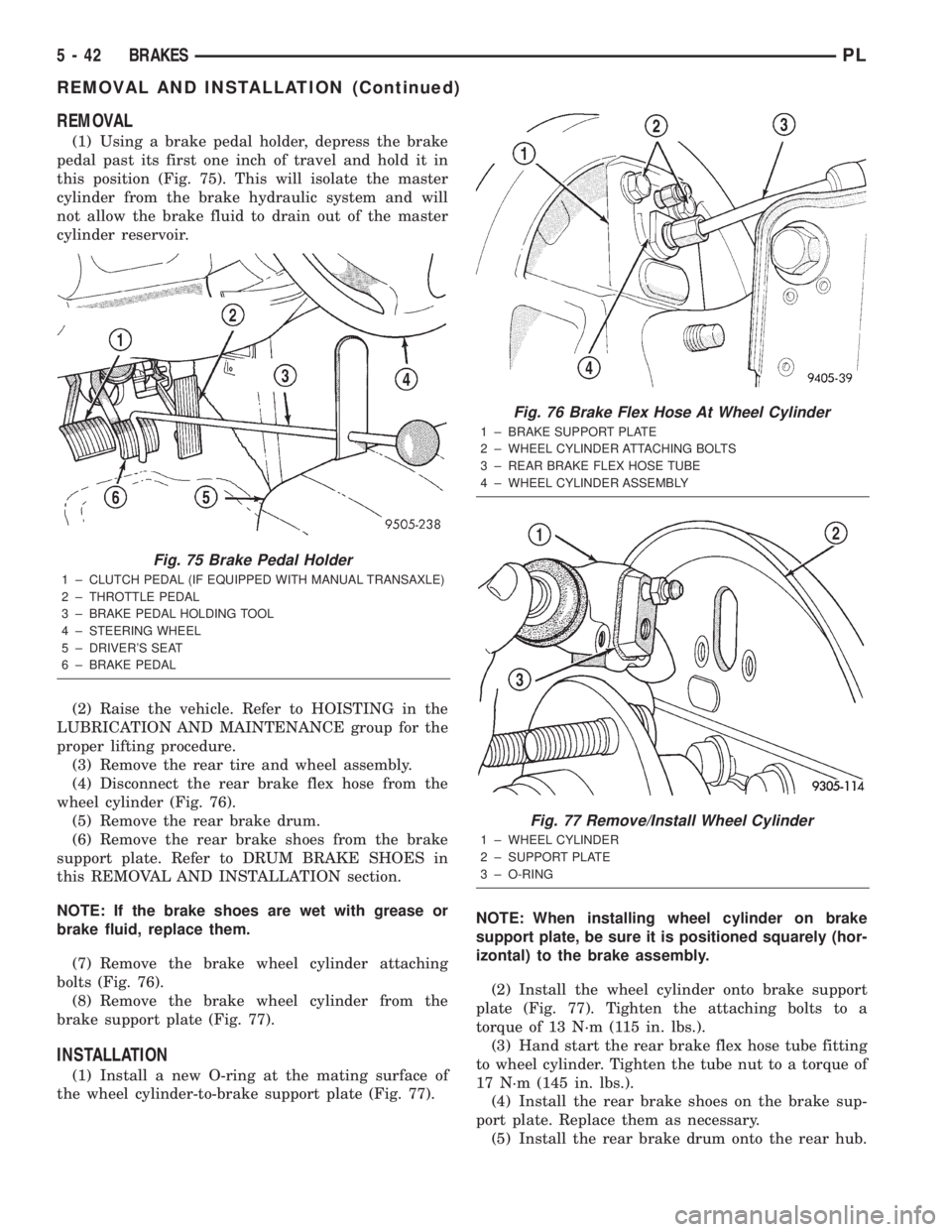
(1) Using a brake pedal holder, depress the brake
pedal past its first one inch of travel and hold it in
this position (Fig. 75). This will isolate the master
cylinder from the brake hydraulic system and will
not allow the brake fluid to drain out of the master
cylinder reservoir.
(2) Raise the vehicle. Refer to HOISTING in the
LUBRICATION AND MAINTENANCE group for the
proper lifting procedure.
(3) Remove the rear tire and wheel assembly.
(4) Disconnect the rear brake flex hose from the
wheel cylinder (Fig. 76).
(5) Remove the rear brake drum.
(6) Remove the rear brake shoes from the brake
support plate. Refer to DRUM BRAKE SHOES in
this REMOVAL AND INSTALLATION section.
NOTE: If the brake shoes are wet with grease or
brake fluid, replace them.
(7) Remove the brake wheel cylinder attaching
bolts (Fig. 76).
(8) Remove the brake wheel cylinder from the
brake support plate (Fig. 77).
INSTALLATION
(1) Install a new O-ring at the mating surface of
the wheel cylinder-to-brake support plate (Fig. 77).NOTE: When installing wheel cylinder on brake
support plate, be sure it is positioned squarely (hor-
izontal) to the brake assembly.
(2) Install the wheel cylinder onto brake support
plate (Fig. 77). Tighten the attaching bolts to a
torque of 13 N´m (115 in. lbs.).
(3) Hand start the rear brake flex hose tube fitting
to wheel cylinder. Tighten the tube nut to a torque of
17 N´m (145 in. lbs.).
(4) Install the rear brake shoes on the brake sup-
port plate. Replace them as necessary.
(5) Install the rear brake drum onto the rear hub.
Fig. 75 Brake Pedal Holder
1 ± CLUTCH PEDAL (IF EQUIPPED WITH MANUAL TRANSAXLE)
2 ± THROTTLE PEDAL
3 ± BRAKE PEDAL HOLDING TOOL
4 ± STEERING WHEEL
5 ± DRIVER'S SEAT
6 ± BRAKE PEDAL
Fig. 76 Brake Flex Hose At Wheel Cylinder
1 ± BRAKE SUPPORT PLATE
2 ± WHEEL CYLINDER ATTACHING BOLTS
3 ± REAR BRAKE FLEX HOSE TUBE
4 ± WHEEL CYLINDER ASSEMBLY
Fig. 77 Remove/Install Wheel Cylinder
1 ± WHEEL CYLINDER
2 ± SUPPORT PLATE
3 ± O-RING
5 - 42 BRAKESPL
REMOVAL AND INSTALLATION (Continued)
Page 122 of 1285
(6) Install the tire and wheel assembly. Tighten
the wheel mounting nuts to a torque of 135 N´m (100
ft. lbs.).
(7) Adjust the rear brakes. Refer to ADJUST-
MENTS in this section of this service manual group.
(8) Lower the vehicle.
(9) Remove the brake pedal holder.
(10) Bleed the wheel cylinder as necessary. Refer
to BASE BRAKE BLEEDING in the SERVICE PRO-
CEDURES section in this service manual group.
(11) Road test the vehicle to make sure the brakes
operate correctly.
DRUM BRAKE SHOES (REAR)
NOTE: Before proceeding with this removal and
installation procedure, review the SERVICE WARN-
INGS AND CAUTIONS at the beginning of REMOVAL
AND INSTALLATION in this section.
REMOVAL
(1) Raise the vehicle. Refer to HOISTING in the
LUBRICATION AND MAINTENANCE group for the
proper lifting procedure.
(2) Remove both rear tire and wheel assemblies
from the vehicle.
(3) Begin on one side of the vehicle.
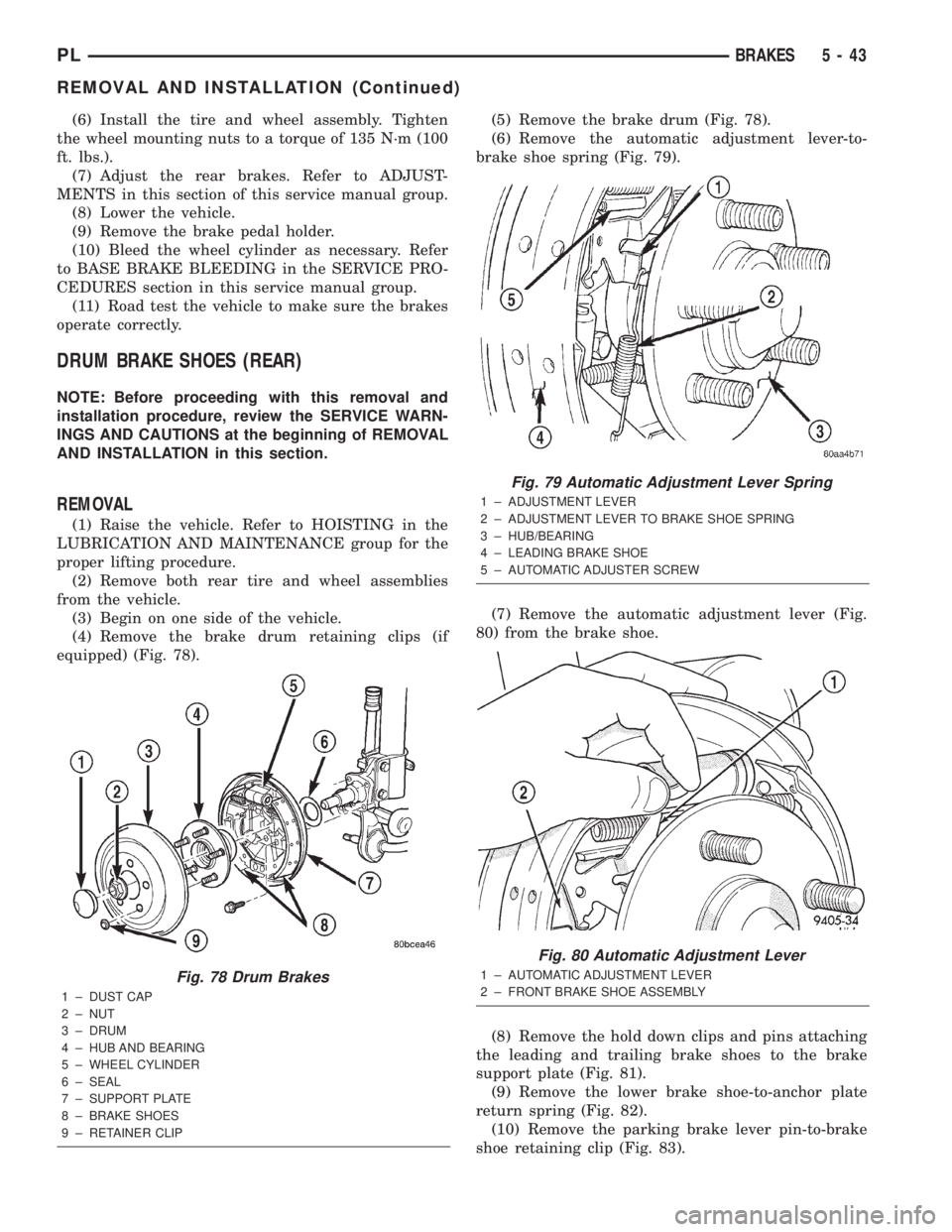
(4) Remove the brake drum retaining clips (if
equipped) (Fig. 78).(5) Remove the brake drum (Fig. 78).
(6) Remove the automatic adjustment lever-to-
brake shoe spring (Fig. 79).
(7) Remove the automatic adjustment lever (Fig.
80) from the brake shoe.
(8) Remove the hold down clips and pins attaching
the leading and trailing brake shoes to the brake
support plate (Fig. 81).
(9) Remove the lower brake shoe-to-anchor plate
return spring (Fig. 82).
(10) Remove the parking brake lever pin-to-brake
shoe retaining clip (Fig. 83).
Fig. 78 Drum Brakes
1 ± DUST CAP
2 ± NUT
3 ± DRUM
4 ± HUB AND BEARING
5 ± WHEEL CYLINDER
6 ± SEAL
7 ± SUPPORT PLATE
8 ± BRAKE SHOES
9 ± RETAINER CLIP
Fig. 79 Automatic Adjustment Lever Spring
1 ± ADJUSTMENT LEVER
2 ± ADJUSTMENT LEVER TO BRAKE SHOE SPRING
3 ± HUB/BEARING
4 ± LEADING BRAKE SHOE
5 ± AUTOMATIC ADJUSTER SCREW
Fig. 80 Automatic Adjustment Lever
1 ± AUTOMATIC ADJUSTMENT LEVER
2 ± FRONT BRAKE SHOE ASSEMBLY
PLBRAKES 5 - 43
REMOVAL AND INSTALLATION (Continued)
Page 124 of 1285
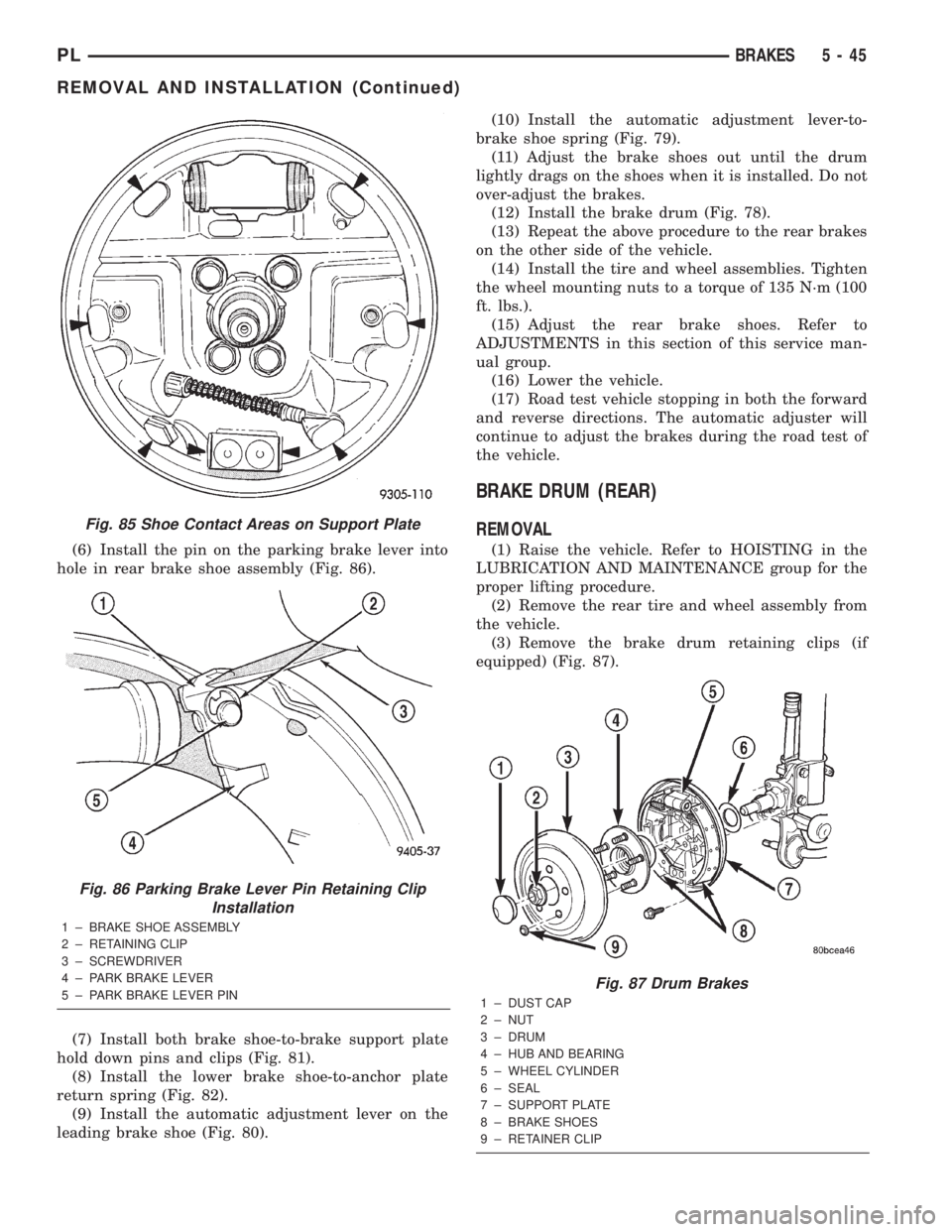
(6) Install the pin on the parking brake lever into
hole in rear brake shoe assembly (Fig. 86).
(7) Install both brake shoe-to-brake support plate
hold down pins and clips (Fig. 81).
(8) Install the lower brake shoe-to-anchor plate
return spring (Fig. 82).
(9) Install the automatic adjustment lever on the
leading brake shoe (Fig. 80).(10) Install the automatic adjustment lever-to-
brake shoe spring (Fig. 79).
(11) Adjust the brake shoes out until the drum
lightly drags on the shoes when it is installed. Do not
over-adjust the brakes.
(12) Install the brake drum (Fig. 78).
(13) Repeat the above procedure to the rear brakes
on the other side of the vehicle.
(14) Install the tire and wheel assemblies. Tighten
the wheel mounting nuts to a torque of 135 N´m (100
ft. lbs.).
(15) Adjust the rear brake shoes. Refer to
ADJUSTMENTS in this section of this service man-
ual group.
(16) Lower the vehicle.
(17) Road test vehicle stopping in both the forward
and reverse directions. The automatic adjuster will
continue to adjust the brakes during the road test of
the vehicle.
BRAKE DRUM (REAR)
REMOVAL
(1) Raise the vehicle. Refer to HOISTING in the
LUBRICATION AND MAINTENANCE group for the
proper lifting procedure.
(2) Remove the rear tire and wheel assembly from
the vehicle.
(3) Remove the brake drum retaining clips (if
equipped) (Fig. 87).
Fig. 85 Shoe Contact Areas on Support Plate
Fig. 86 Parking Brake Lever Pin Retaining Clip
Installation
1 ± BRAKE SHOE ASSEMBLY
2 ± RETAINING CLIP
3 ± SCREWDRIVER
4 ± PARK BRAKE LEVER
5 ± PARK BRAKE LEVER PIN
Fig. 87 Drum Brakes
1 ± DUST CAP
2 ± NUT
3 ± DRUM
4 ± HUB AND BEARING
5 ± WHEEL CYLINDER
6 ± SEAL
7 ± SUPPORT PLATE
8 ± BRAKE SHOES
9 ± RETAINER CLIP
PLBRAKES 5 - 45
REMOVAL AND INSTALLATION (Continued)
Page 125 of 1285
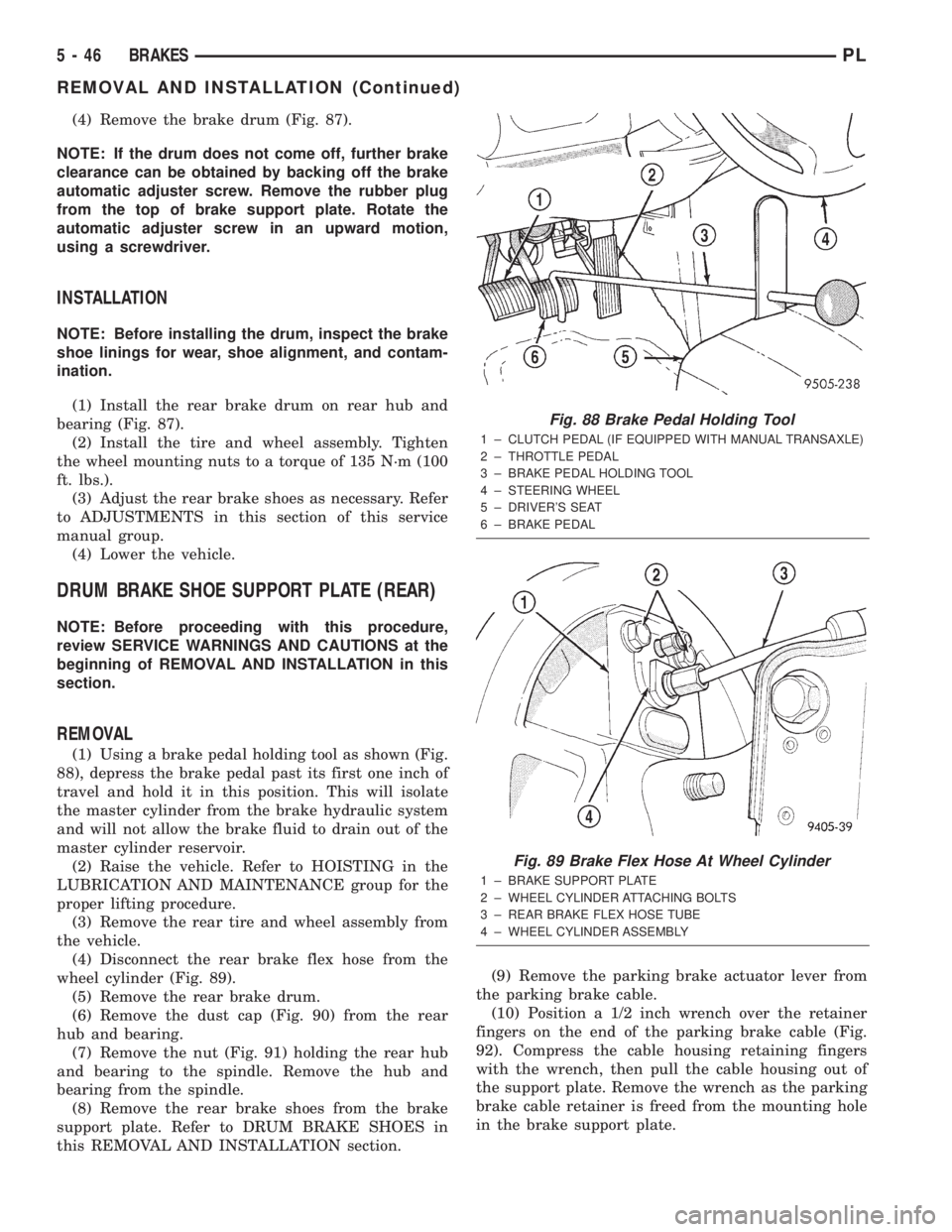
(4) Remove the brake drum (Fig. 87).
NOTE: If the drum does not come off, further brake
clearance can be obtained by backing off the brake
automatic adjuster screw. Remove the rubber plug
from the top of brake support plate. Rotate the
automatic adjuster screw in an upward motion,
using a screwdriver.
INSTALLATION
NOTE: Before installing the drum, inspect the brake
shoe linings for wear, shoe alignment, and contam-
ination.
(1) Install the rear brake drum on rear hub and
bearing (Fig. 87).
(2) Install the tire and wheel assembly. Tighten
the wheel mounting nuts to a torque of 135 N´m (100
ft. lbs.).
(3) Adjust the rear brake shoes as necessary. Refer
to ADJUSTMENTS in this section of this service
manual group.
(4) Lower the vehicle.
DRUM BRAKE SHOE SUPPORT PLATE (REAR)
NOTE: Before proceeding with this procedure,
review SERVICE WARNINGS AND CAUTIONS at the
beginning of REMOVAL AND INSTALLATION in this
section.
REMOVAL
(1) Using a brake pedal holding tool as shown (Fig.
88), depress the brake pedal past its first one inch of
travel and hold it in this position. This will isolate
the master cylinder from the brake hydraulic system
and will not allow the brake fluid to drain out of the
master cylinder reservoir.
(2) Raise the vehicle. Refer to HOISTING in the
LUBRICATION AND MAINTENANCE group for the
proper lifting procedure.
(3) Remove the rear tire and wheel assembly from
the vehicle.
(4) Disconnect the rear brake flex hose from the
wheel cylinder (Fig. 89).
(5) Remove the rear brake drum.
(6) Remove the dust cap (Fig. 90) from the rear
hub and bearing.
(7) Remove the nut (Fig. 91) holding the rear hub
and bearing to the spindle. Remove the hub and
bearing from the spindle.
(8) Remove the rear brake shoes from the brake
support plate. Refer to DRUM BRAKE SHOES in
this REMOVAL AND INSTALLATION section.(9) Remove the parking brake actuator lever from
the parking brake cable.
(10) Position a 1/2 inch wrench over the retainer
fingers on the end of the parking brake cable (Fig.
92). Compress the cable housing retaining fingers
with the wrench, then pull the cable housing out of
the support plate. Remove the wrench as the parking
brake cable retainer is freed from the mounting hole
in the brake support plate.
Fig. 88 Brake Pedal Holding Tool
1 ± CLUTCH PEDAL (IF EQUIPPED WITH MANUAL TRANSAXLE)
2 ± THROTTLE PEDAL
3 ± BRAKE PEDAL HOLDING TOOL
4 ± STEERING WHEEL
5 ± DRIVER'S SEAT
6 ± BRAKE PEDAL
Fig. 89 Brake Flex Hose At Wheel Cylinder
1 ± BRAKE SUPPORT PLATE
2 ± WHEEL CYLINDER ATTACHING BOLTS
3 ± REAR BRAKE FLEX HOSE TUBE
4 ± WHEEL CYLINDER ASSEMBLY
5 - 46 BRAKESPL
REMOVAL AND INSTALLATION (Continued)
Page 128 of 1285
INSTALLATION
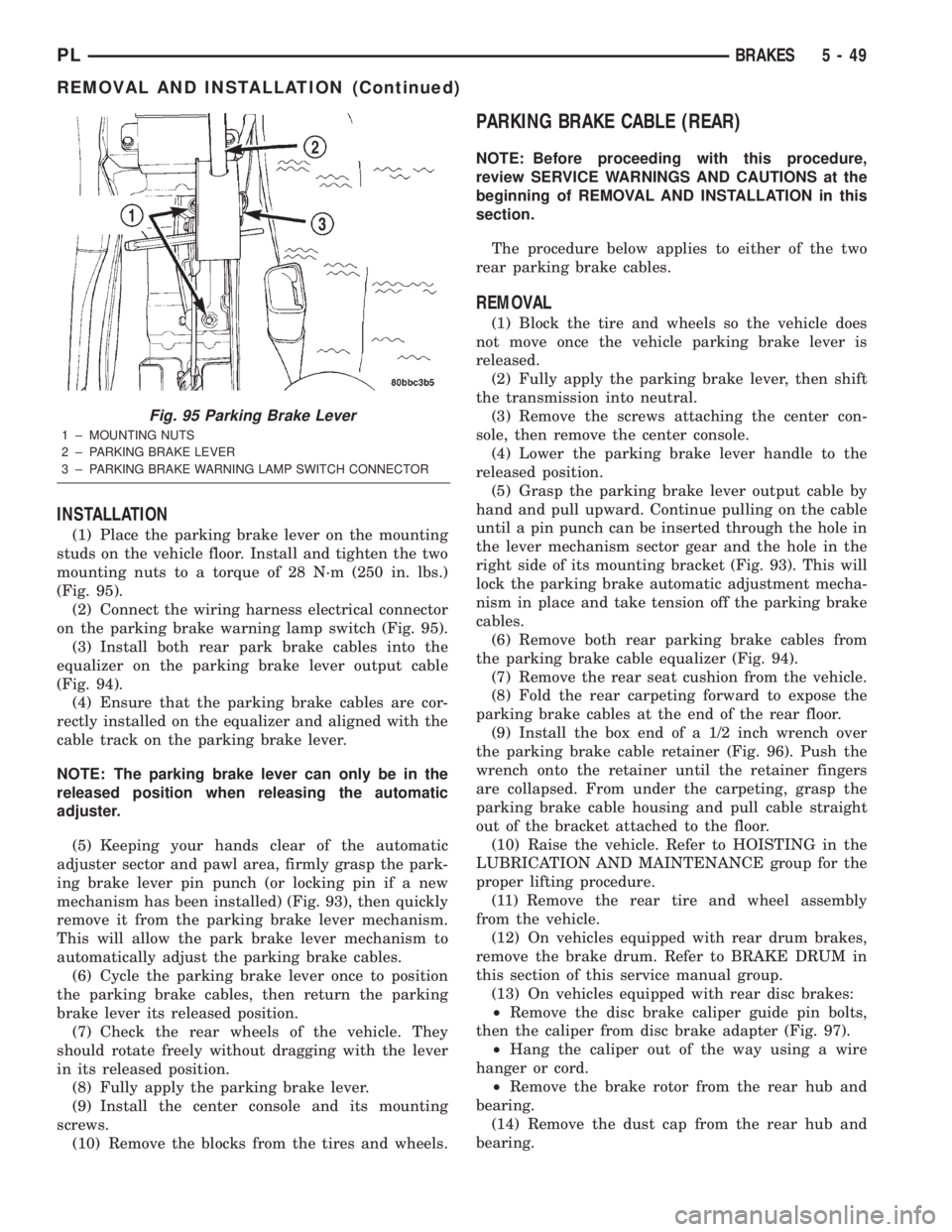
(1) Place the parking brake lever on the mounting
studs on the vehicle floor. Install and tighten the two
mounting nuts to a torque of 28 N´m (250 in. lbs.)
(Fig. 95).
(2) Connect the wiring harness electrical connector
on the parking brake warning lamp switch (Fig. 95).
(3) Install both rear park brake cables into the
equalizer on the parking brake lever output cable
(Fig. 94).
(4) Ensure that the parking brake cables are cor-
rectly installed on the equalizer and aligned with the
cable track on the parking brake lever.
NOTE: The parking brake lever can only be in the
released position when releasing the automatic
adjuster.
(5) Keeping your hands clear of the automatic
adjuster sector and pawl area, firmly grasp the park-
ing brake lever pin punch (or locking pin if a new
mechanism has been installed) (Fig. 93), then quickly
remove it from the parking brake lever mechanism.
This will allow the park brake lever mechanism to
automatically adjust the parking brake cables.
(6) Cycle the parking brake lever once to position
the parking brake cables, then return the parking
brake lever its released position.
(7) Check the rear wheels of the vehicle. They
should rotate freely without dragging with the lever
in its released position.
(8) Fully apply the parking brake lever.
(9) Install the center console and its mounting
screws.
(10) Remove the blocks from the tires and wheels.
PARKING BRAKE CABLE (REAR)
NOTE: Before proceeding with this procedure,
review SERVICE WARNINGS AND CAUTIONS at the
beginning of REMOVAL AND INSTALLATION in this
section.
The procedure below applies to either of the two
rear parking brake cables.
REMOVAL
(1) Block the tire and wheels so the vehicle does
not move once the vehicle parking brake lever is
released.
(2) Fully apply the parking brake lever, then shift
the transmission into neutral.
(3) Remove the screws attaching the center con-
sole, then remove the center console.
(4) Lower the parking brake lever handle to the
released position.
(5) Grasp the parking brake lever output cable by
hand and pull upward. Continue pulling on the cable
until a pin punch can be inserted through the hole in
the lever mechanism sector gear and the hole in the
right side of its mounting bracket (Fig. 93). This will
lock the parking brake automatic adjustment mecha-
nism in place and take tension off the parking brake
cables.
(6) Remove both rear parking brake cables from
the parking brake cable equalizer (Fig. 94).
(7) Remove the rear seat cushion from the vehicle.
(8) Fold the rear carpeting forward to expose the
parking brake cables at the end of the rear floor.
(9) Install the box end of a 1/2 inch wrench over
the parking brake cable retainer (Fig. 96). Push the
wrench onto the retainer until the retainer fingers
are collapsed. From under the carpeting, grasp the
parking brake cable housing and pull cable straight
out of the bracket attached to the floor.
(10) Raise the vehicle. Refer to HOISTING in the
LUBRICATION AND MAINTENANCE group for the
proper lifting procedure.
(11) Remove the rear tire and wheel assembly
from the vehicle.
(12) On vehicles equipped with rear drum brakes,
remove the brake drum. Refer to BRAKE DRUM in
this section of this service manual group.
(13) On vehicles equipped with rear disc brakes:
²Remove the disc brake caliper guide pin bolts,
then the caliper from disc brake adapter (Fig. 97).
²Hang the caliper out of the way using a wire
hanger or cord.
²Remove the brake rotor from the rear hub and
bearing.
(14) Remove the dust cap from the rear hub and
bearing.
Fig. 95 Parking Brake Lever
1 ± MOUNTING NUTS
2 ± PARKING BRAKE LEVER
3 ± PARKING BRAKE WARNING LAMP SWITCH CONNECTOR
PLBRAKES 5 - 49
REMOVAL AND INSTALLATION (Continued)
Page 132 of 1285
(22) Install the center console and its mounting
screws.
(23) Remove the blocks from the tires and wheels.
PARKING BRAKE SHOES (REAR DISC BRAKE)
NOTE: Before proceeding with this procedure,
review SERVICE WARNINGS AND CAUTIONS at the
beginning of REMOVAL AND INSTALLATION in this
section.
REMOVAL
(1) Raise the vehicle. Refer to HOISTING in the
LUBRICATION AND MAINTENANCE group for the
proper lifting procedure.
(2) Remove the rear tire and wheel assembly.
(3) Remove the rear disc brake caliper assembly
from the brake rotor and store it out of the way.
Refer to DISC BRAKE SHOES (REAR) in this
REMOVAL AND INSTALLATION section of this ser-
vice manual group.
(4) Remove rear brake rotor.
(5) Remove the dust cap from the rear hub and
bearing.
(6) Remove the rear hub and bearing assembly
retaining nut and washer.
(7) Remove the rear hub and bearing assembly
from the rear spindle.
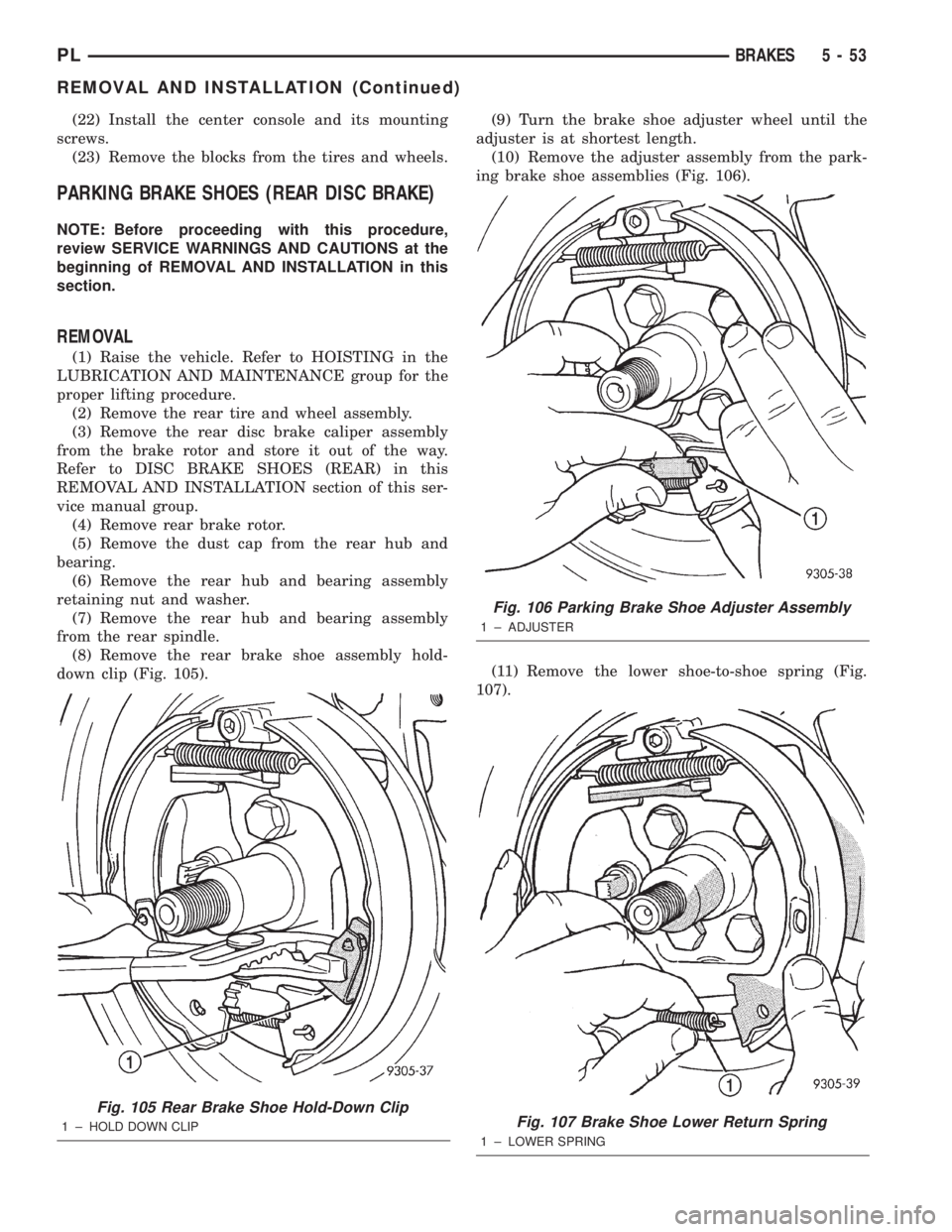
(8) Remove the rear brake shoe assembly hold-
down clip (Fig. 105).(9) Turn the brake shoe adjuster wheel until the
adjuster is at shortest length.
(10) Remove the adjuster assembly from the park-
ing brake shoe assemblies (Fig. 106).
(11) Remove the lower shoe-to-shoe spring (Fig.
107).
Fig. 105 Rear Brake Shoe Hold-Down Clip
1 ± HOLD DOWN CLIP
Fig. 106 Parking Brake Shoe Adjuster Assembly
1 ± ADJUSTER
Fig. 107 Brake Shoe Lower Return Spring
1 ± LOWER SPRING
PLBRAKES 5 - 53
REMOVAL AND INSTALLATION (Continued)
Page 140 of 1285
WHEEL CYLINDER
With the brake drums removed, inspect the wheel
cylinder boots for evidence of a brake fluid leak.
Visually check the boots for cuts, tears, or heat
cracks. If any of these conditions exist, the wheel cyl-
inders should be completely cleaned, inspected and
new parts installed.
If a wheel cylinder is leaking and the brake lining
material is saturated with brake fluid, the brake
shoes must be replaced.
ADJUSTMENTS
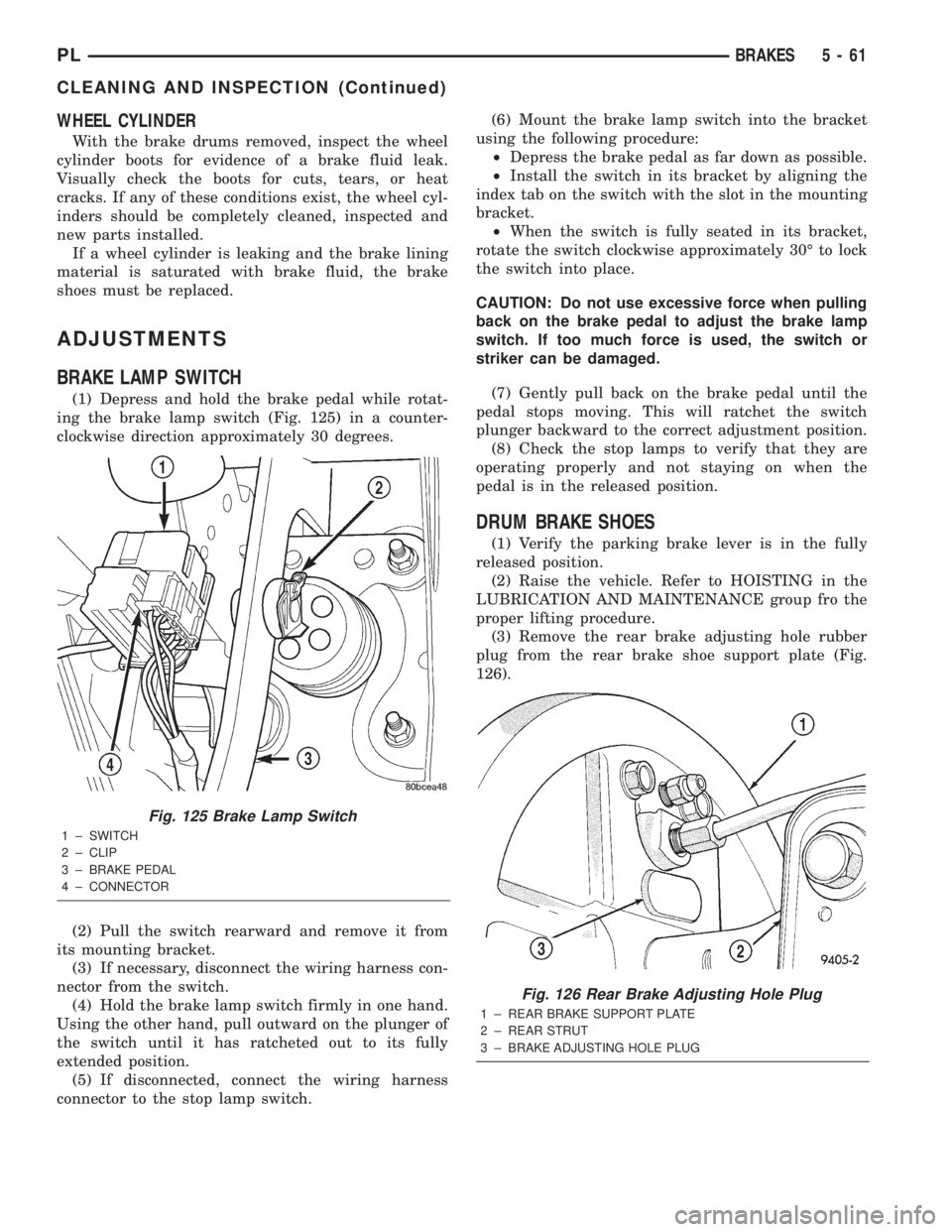
BRAKE LAMP SWITCH
(1) Depress and hold the brake pedal while rotat-
ing the brake lamp switch (Fig. 125) in a counter-
clockwise direction approximately 30 degrees.
(2) Pull the switch rearward and remove it from
its mounting bracket.
(3) If necessary, disconnect the wiring harness con-
nector from the switch.
(4) Hold the brake lamp switch firmly in one hand.
Using the other hand, pull outward on the plunger of
the switch until it has ratcheted out to its fully
extended position.
(5) If disconnected, connect the wiring harness
connector to the stop lamp switch.(6) Mount the brake lamp switch into the bracket
using the following procedure:
²Depress the brake pedal as far down as possible.
²Install the switch in its bracket by aligning the
index tab on the switch with the slot in the mounting
bracket.
²When the switch is fully seated in its bracket,
rotate the switch clockwise approximately 30É to lock
the switch into place.
CAUTION: Do not use excessive force when pulling
back on the brake pedal to adjust the brake lamp
switch. If too much force is used, the switch or
striker can be damaged.
(7) Gently pull back on the brake pedal until the
pedal stops moving. This will ratchet the switch
plunger backward to the correct adjustment position.
(8) Check the stop lamps to verify that they are
operating properly and not staying on when the
pedal is in the released position.
DRUM BRAKE SHOES
(1) Verify the parking brake lever is in the fully
released position.
(2) Raise the vehicle. Refer to HOISTING in the
LUBRICATION AND MAINTENANCE group fro the
proper lifting procedure.
(3) Remove the rear brake adjusting hole rubber
plug from the rear brake shoe support plate (Fig.
126).
Fig. 125 Brake Lamp Switch
1 ± SWITCH
2 ± CLIP
3 ± BRAKE PEDAL
4 ± CONNECTOR
Fig. 126 Rear Brake Adjusting Hole Plug
1 ± REAR BRAKE SUPPORT PLATE
2 ± REAR STRUT
3 ± BRAKE ADJUSTING HOLE PLUG
PLBRAKES 5 - 61
CLEANING AND INSPECTION (Continued)
Page 141 of 1285
(4) Insert a brake adjustment tool, or a screw-
driver, through the adjusting hole in support plate
and against the star wheel of the adjuster screw.
Move the handle of tool downward to adjust the
brake drag. Rotate the tire and wheel assembly while
adjusting the adjuster screw. Continue to adjust the
shoes until a slight drag is noticed when the tire and
wheel assembly is rotated.
NOTE: In the event the brake shoes are over-ad-
justed, the adjuster can be backed off using the fol-
lowing step. If not, proceed to step 6.
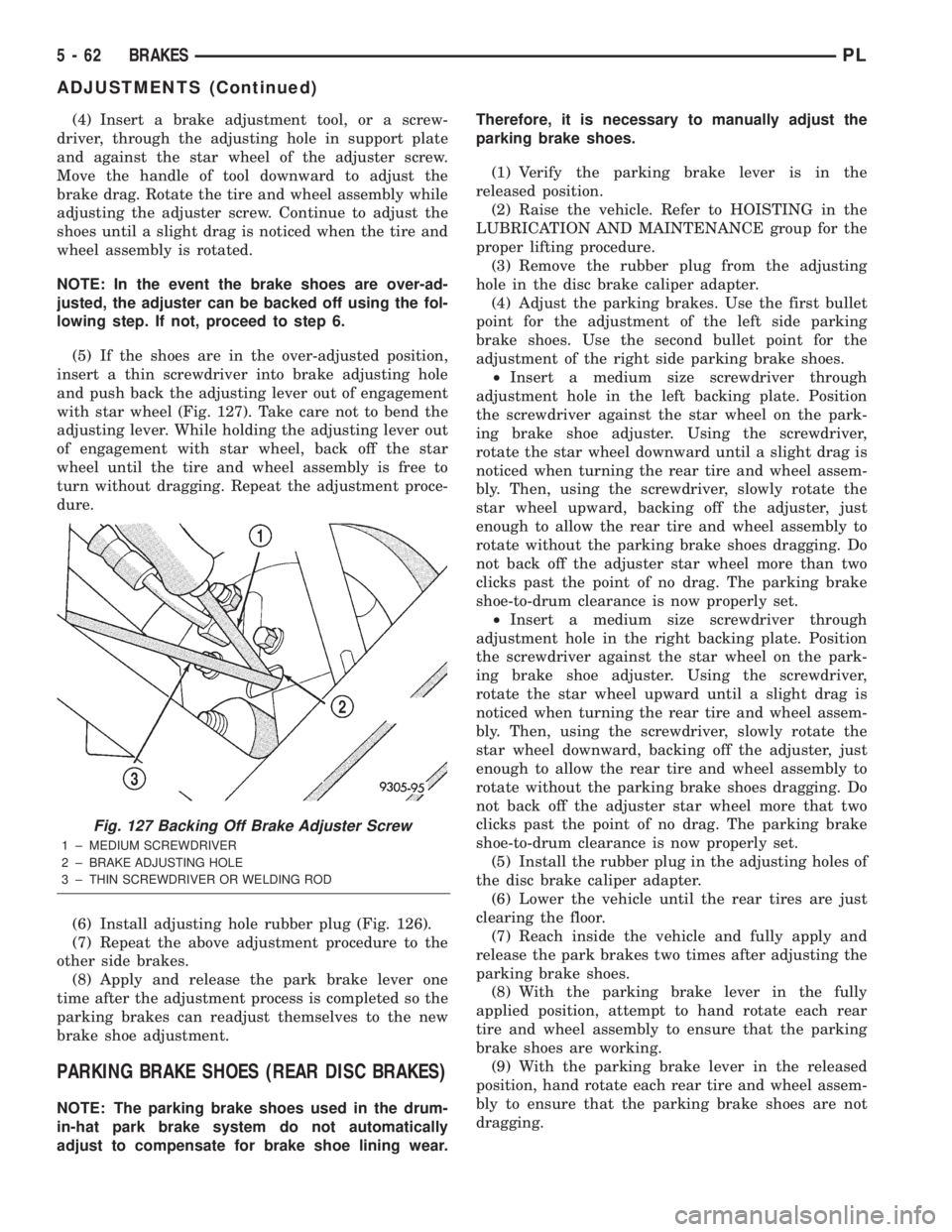
(5) If the shoes are in the over-adjusted position,
insert a thin screwdriver into brake adjusting hole
and push back the adjusting lever out of engagement
with star wheel (Fig. 127). Take care not to bend the
adjusting lever. While holding the adjusting lever out
of engagement with star wheel, back off the star
wheel until the tire and wheel assembly is free to
turn without dragging. Repeat the adjustment proce-
dure.
(6) Install adjusting hole rubber plug (Fig. 126).
(7) Repeat the above adjustment procedure to the
other side brakes.
(8) Apply and release the park brake lever one
time after the adjustment process is completed so the
parking brakes can readjust themselves to the new
brake shoe adjustment.
PARKING BRAKE SHOES (REAR DISC BRAKES)
NOTE: The parking brake shoes used in the drum-
in-hat park brake system do not automatically
adjust to compensate for brake shoe lining wear.Therefore, it is necessary to manually adjust the
parking brake shoes.
(1) Verify the parking brake lever is in the
released position.
(2) Raise the vehicle. Refer to HOISTING in the
LUBRICATION AND MAINTENANCE group for the
proper lifting procedure.
(3) Remove the rubber plug from the adjusting
hole in the disc brake caliper adapter.
(4) Adjust the parking brakes. Use the first bullet
point for the adjustment of the left side parking
brake shoes. Use the second bullet point for the
adjustment of the right side parking brake shoes.
²Insert a medium size screwdriver through
adjustment hole in the left backing plate. Position
the screwdriver against the star wheel on the park-
ing brake shoe adjuster. Using the screwdriver,
rotate the star wheel downward until a slight drag is
noticed when turning the rear tire and wheel assem-
bly. Then, using the screwdriver, slowly rotate the
star wheel upward, backing off the adjuster, just
enough to allow the rear tire and wheel assembly to
rotate without the parking brake shoes dragging. Do
not back off the adjuster star wheel more than two
clicks past the point of no drag. The parking brake
shoe-to-drum clearance is now properly set.
²Insert a medium size screwdriver through
adjustment hole in the right backing plate. Position
the screwdriver against the star wheel on the park-
ing brake shoe adjuster. Using the screwdriver,
rotate the star wheel upward until a slight drag is
noticed when turning the rear tire and wheel assem-
bly. Then, using the screwdriver, slowly rotate the
star wheel downward, backing off the adjuster, just
enough to allow the rear tire and wheel assembly to
rotate without the parking brake shoes dragging. Do
not back off the adjuster star wheel more that two
clicks past the point of no drag. The parking brake
shoe-to-drum clearance is now properly set.
(5) Install the rubber plug in the adjusting holes of
the disc brake caliper adapter.
(6) Lower the vehicle until the rear tires are just
clearing the floor.
(7) Reach inside the vehicle and fully apply and
release the park brakes two times after adjusting the
parking brake shoes.
(8) With the parking brake lever in the fully
applied position, attempt to hand rotate each rear
tire and wheel assembly to ensure that the parking
brake shoes are working.
(9) With the parking brake lever in the released
position, hand rotate each rear tire and wheel assem-
bly to ensure that the parking brake shoes are not
dragging.
Fig. 127 Backing Off Brake Adjuster Screw
1 ± MEDIUM SCREWDRIVER
2 ± BRAKE ADJUSTING HOLE
3 ± THIN SCREWDRIVER OR WELDING ROD
5 - 62 BRAKESPL
ADJUSTMENTS (Continued)