2000 DODGE NEON vacuum
[x] Cancel search: vacuumPage 288 of 1285
On most vehicles another resistor has been added
to the at rest circuit causing the PCM to never see 5
volts. This was done for diagnostic purposes. If the
switch circuit should open (bad connection) then the
PCM will see the 5 volts and know the circuit is bad.
The PCM will then set an open circuit fault.
STOP LAMP SWITCH
DESCRIPTION
The switch is mounted on the brake pedal mount-
ing bracket under the instrument panel.
OPERATION
Vehicles equipped with the speed control option use
a dual function stop lamp switch. The PCM monitors
the state of the dual function stop lamp switch. Refer
to the Brake section for more information on stop
lamp switch service and adjustment procedures.
The brake switch is equipped with three sets of
contacts, one normally open and the other two nor-
mally closed (brakes disengaged). The PCM sends a
12 volt signal to one of the normally closed contacts
in the brake switch, which is connected to a ground.
With the contacts closed, the 12 volt signal is pulled
to ground causing the signal to go low. The low volt-
age signal, monitored by the PCM, indicates that the
brakes are not applied. When the brakes are applied,
the contacts open, causing the PCM's output voltage
to go high, disengaging the speed control also
grounding the dump solenoid.
The second set of normally closed contacts is sup-
plied battery voltage any time speed control is
selected. From the brake switch, current is routed to
the speed control servo solenoids. The speed control
solenoids (vacuum, vent and dump) are provided this
current any time the speed control is ON and the
brakes are disengaged. When the driver applies the
brakes, the contacts open and current is interrupted
to the solenoids. The normally open contacts are fed
battery voltage. When the brakes are applied, battery
voltage is supplied to the stop lamps.
SERVO CABLE
DESCRIPTION
The speed control servo cable is connected between
the speed control vacuum servo diaphragm and the
throttle body control linkage.
OPERATION
This cable causes the throttle control linkage to
open or close the throttle valve in response to move-
ment of the vacuum servo diaphragm.
VACUUM RESERVOIR
OPERATION
The reservoir stores engine vacuum in the reser-
voir. When engine vacuum drops, as in climbing a
grade while driving, the reservoir supplies the vac-
uum needed to maintain proper speed control opera-
tion. The vacuum reservoir cannot be repaired and
must be replaced if faulty.
VEHICLE SPEED SENSOR
The Vehicle Speed Sensor (VSS) is a pulse genera-
tor mounted to an adapter near the transmission out-
put shaft. The sensor is driven through the adapter
by a speedometer pinion gear. The VSS pulse signal
to the speedometer/odometer is monitored by the
PCM speed control circuitry to determine vehicle
speed and to maintain speed control set speed.
REMOVAL AND INSTALLATION
SPEED CONTROL SERVO
REMOVAL
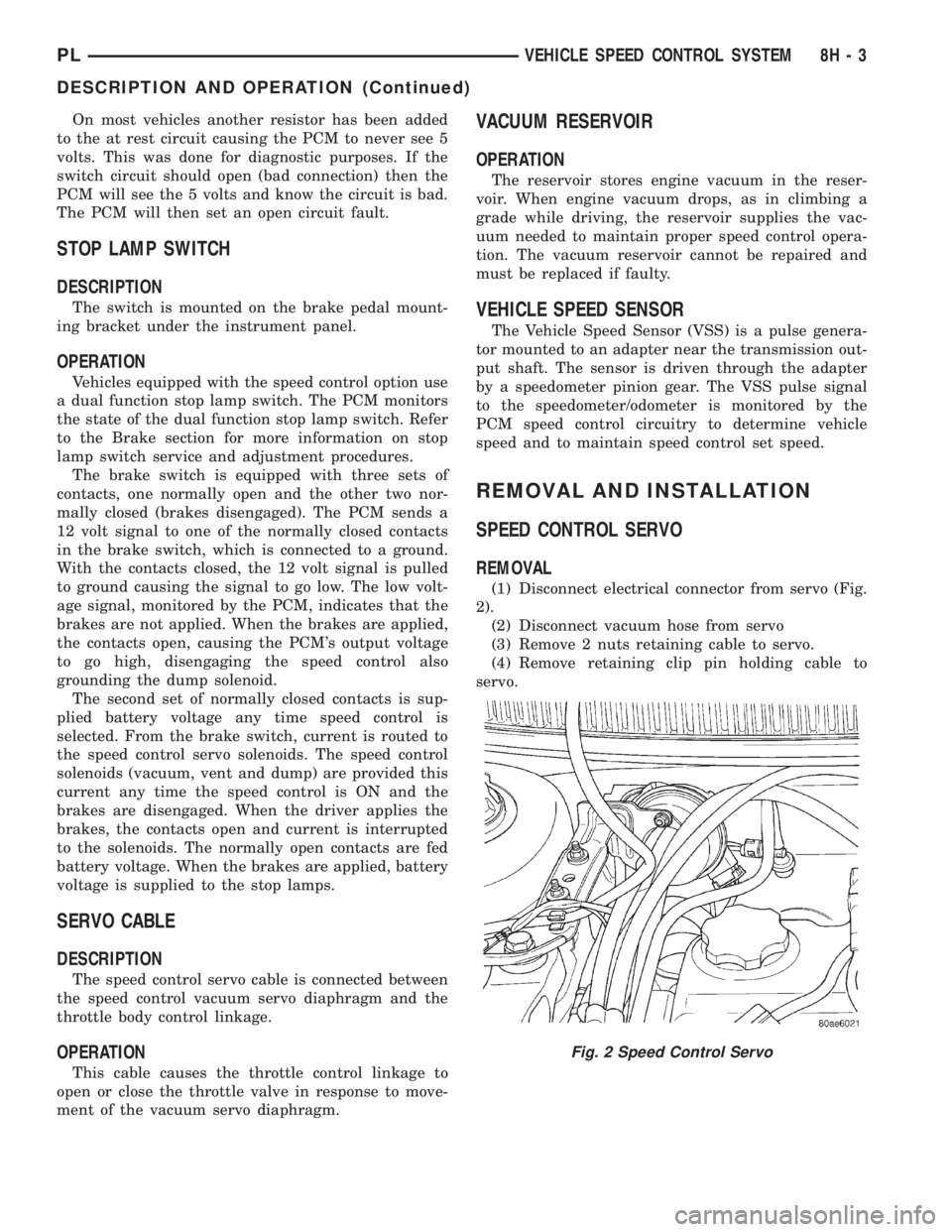
(1) Disconnect electrical connector from servo (Fig.
2).
(2) Disconnect vacuum hose from servo
(3) Remove 2 nuts retaining cable to servo.
(4) Remove retaining clip pin holding cable to
servo.
Fig. 2 Speed Control Servo
PLVEHICLE SPEED CONTROL SYSTEM 8H - 3
DESCRIPTION AND OPERATION (Continued)
Page 289 of 1285
INSTALLATION
(1) Install retaining clip to cable at servo.
(2) Install 2 nuts at cable to servo and servo
bracket, tighten to 7 N´m (60 ins. lbs.).
(3) Connect electrical connector to servo.
(4) Connect vacuum hose to servo
SPEED CONTROL SWITCH
The speed control switches are mounted in the
steering wheel and wired through the clock spring
device under the airbag module (Fig. 1).
WARNING: IF REMOVAL OF AIRBAG MODULE IS
NECESSARY, REFER TO THE RESTRAINT SYS-
TEMS.
REMOVAL
(1) Turn off ignition.
(2) Remove two screws from side of each switch.
(3) Rock switch away from airbag and steering
wheel.
(4) Disconnect two-way electrical connector.
(5) Repeat for the other switch.
INSTALLATION
(1) Install switches.
(2) Connect two-way electrical connector.
(3) Install two screws to the side of each switch.
(4) Install airbag, refer to the Restraint Systems
SPEED CONTROL SERVO CABLE
REMOVAL
(1) Disconnect the negative battery cable.
(2) Remove the throttle cable cover.
(3) Remove speed control cable from throttle lever
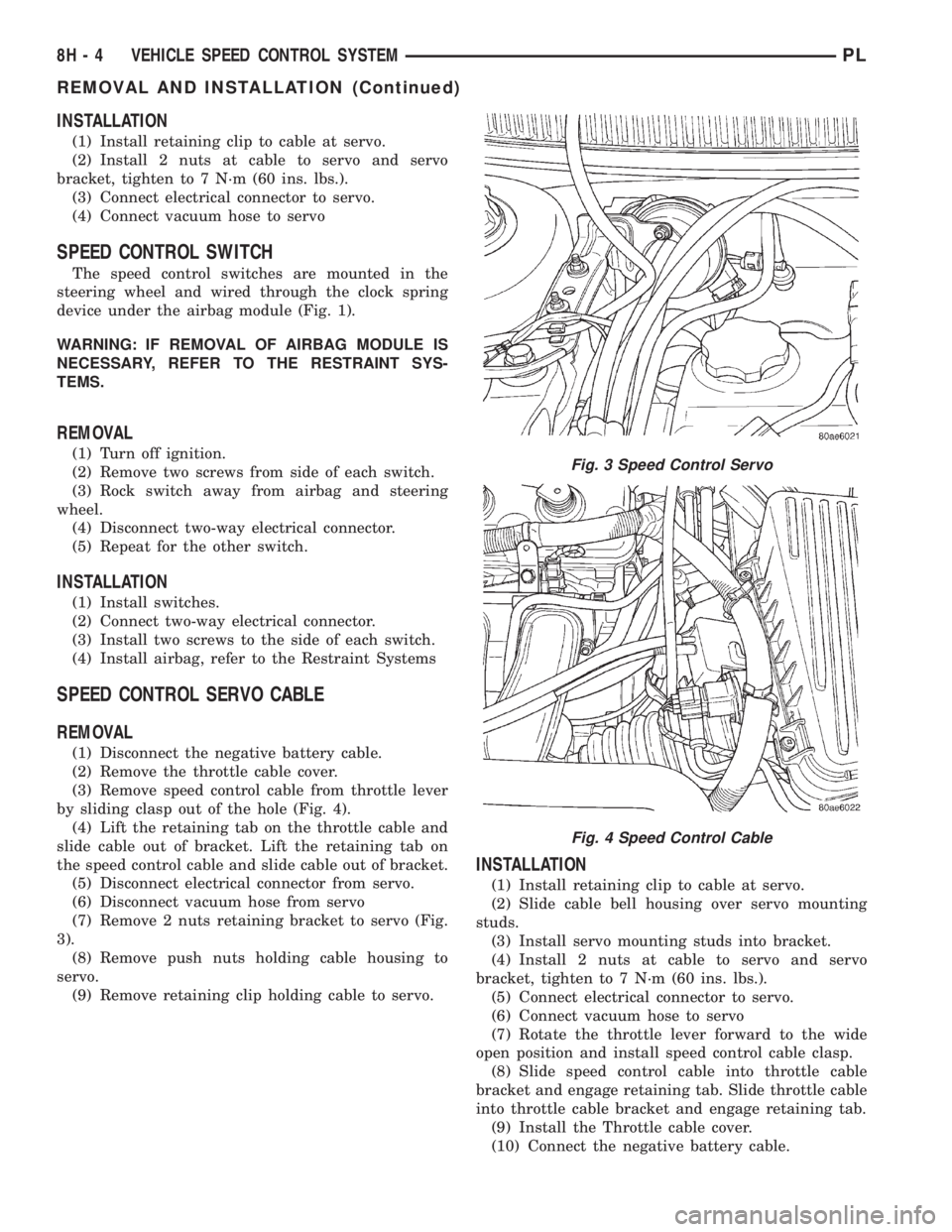
by sliding clasp out of the hole (Fig. 4).
(4) Lift the retaining tab on the throttle cable and
slide cable out of bracket. Lift the retaining tab on
the speed control cable and slide cable out of bracket.
(5) Disconnect electrical connector from servo.
(6) Disconnect vacuum hose from servo
(7) Remove 2 nuts retaining bracket to servo (Fig.
3).
(8) Remove push nuts holding cable housing to
servo.
(9) Remove retaining clip holding cable to servo.
INSTALLATION
(1) Install retaining clip to cable at servo.
(2) Slide cable bell housing over servo mounting
studs.
(3) Install servo mounting studs into bracket.
(4) Install 2 nuts at cable to servo and servo
bracket, tighten to 7 N´m (60 ins. lbs.).
(5) Connect electrical connector to servo.
(6) Connect vacuum hose to servo
(7) Rotate the throttle lever forward to the wide
open position and install speed control cable clasp.
(8) Slide speed control cable into throttle cable
bracket and engage retaining tab. Slide throttle cable
into throttle cable bracket and engage retaining tab.
(9) Install the Throttle cable cover.
(10) Connect the negative battery cable.
Fig. 3 Speed Control Servo
Fig. 4 Speed Control Cable
8H - 4 VEHICLE SPEED CONTROL SYSTEMPL
REMOVAL AND INSTALLATION (Continued)
Page 290 of 1285
VACUUM RESERVOIR
REMOVAL
(1) Raise and support vehicle.
(2) Remove screws on top of vacuum reservoir.
(3) Remove vacuum hose.
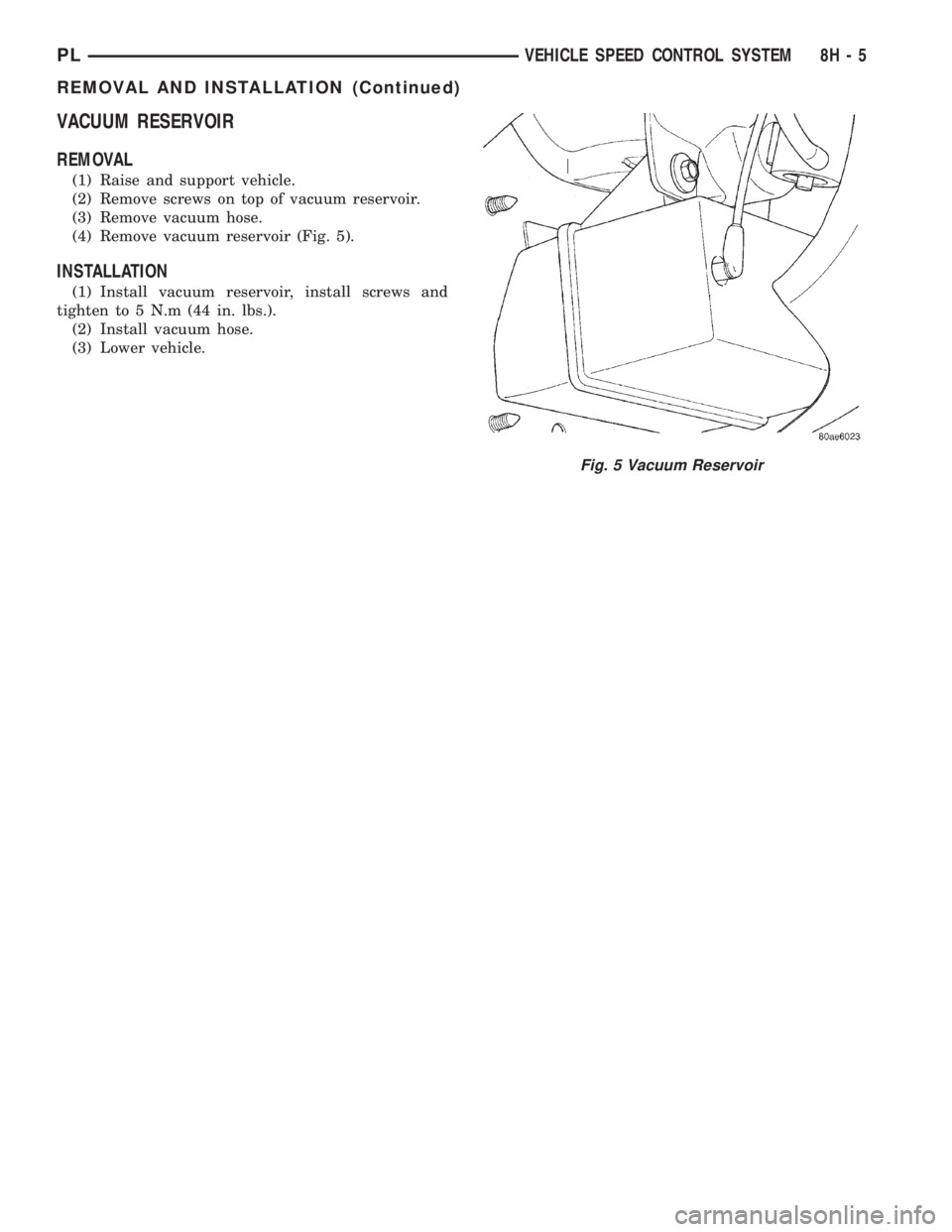
(4) Remove vacuum reservoir (Fig. 5).
INSTALLATION
(1) Install vacuum reservoir, install screws and
tighten to 5 N.m (44 in. lbs.).
(2) Install vacuum hose.
(3) Lower vehicle.
Fig. 5 Vacuum Reservoir
PLVEHICLE SPEED CONTROL SYSTEM 8H - 5
REMOVAL AND INSTALLATION (Continued)
Page 305 of 1285
WINDSHIELD WASHER SYSTEM
TABLE OF CONTENTS
page page
DESCRIPTION AND OPERATION
WINDSHIELD WASHER NOZZLE(S)............8
WINDSHIELD WASHER SYSTEM.............8
DIAGNOSIS AND TESTING
WINDSHIELD WASHER SYSTEM.............9REMOVAL AND INSTALLATION
WINDSHIELD WASHER HOSE................9
WINDSHIELD WASHER NOZZLES.............9
WINDSHIELD WASHER RESERVOIR..........10
WINDSHIELD WASHER PUMP...............10
DESCRIPTION AND OPERATION
WINDSHIELD WASHER NOZZLE(S)
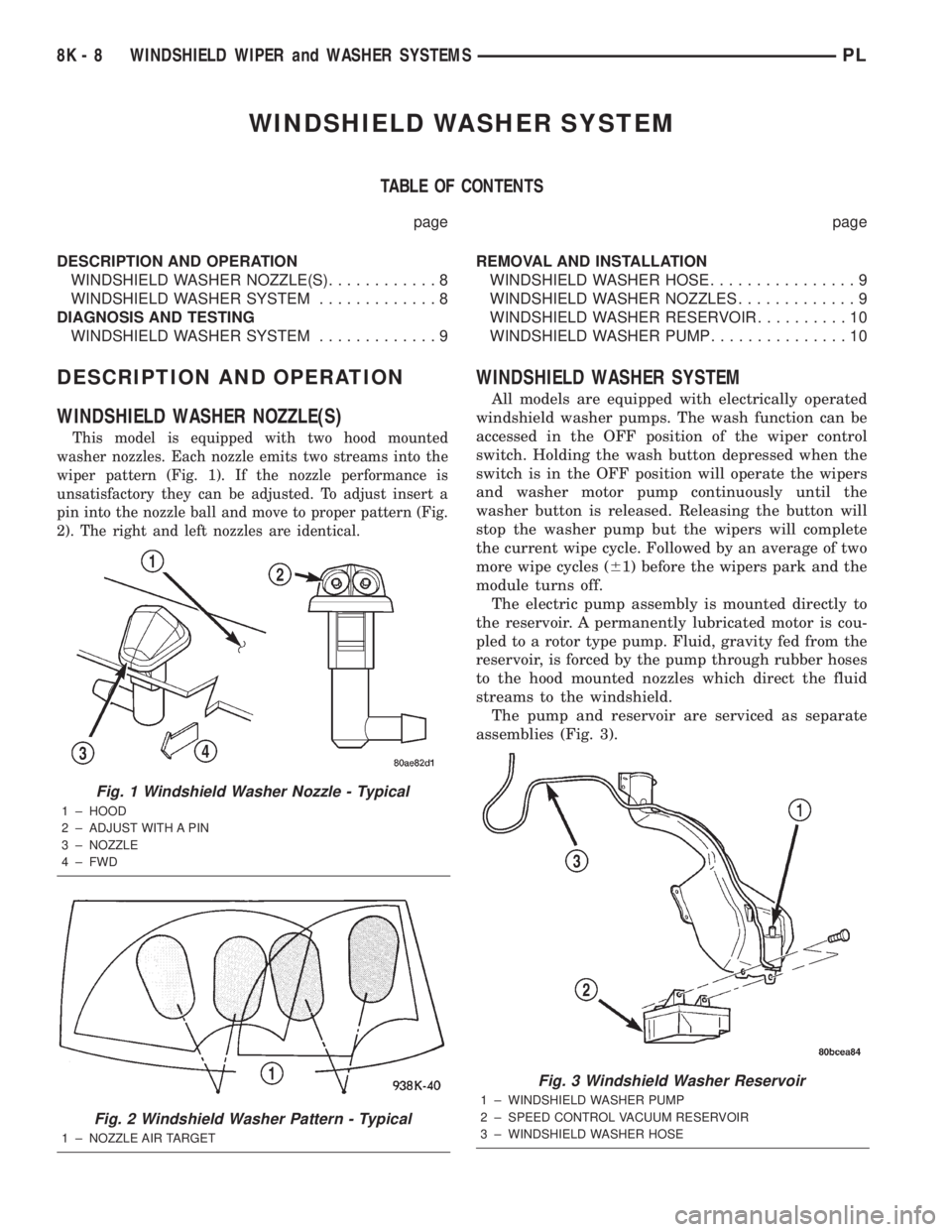
This model is equipped with two hood mounted
washer nozzles. Each nozzle emits two streams into the
wiper pattern (Fig. 1). If the nozzle performance is
unsatisfactory they can be adjusted. To adjust insert a
pin into the nozzle ball and move to proper pattern (Fig.
2). The right and left nozzles are identical.
WINDSHIELD WASHER SYSTEM
All models are equipped with electrically operated
windshield washer pumps. The wash function can be
accessed in the OFF position of the wiper control
switch. Holding the wash button depressed when the
switch is in the OFF position will operate the wipers
and washer motor pump continuously until the
washer button is released. Releasing the button will
stop the washer pump but the wipers will complete
the current wipe cycle. Followed by an average of two
more wipe cycles (61) before the wipers park and the
module turns off.
The electric pump assembly is mounted directly to
the reservoir. A permanently lubricated motor is cou-
pled to a rotor type pump. Fluid, gravity fed from the
reservoir, is forced by the pump through rubber hoses
to the hood mounted nozzles which direct the fluid
streams to the windshield.
The pump and reservoir are serviced as separate
assemblies (Fig. 3).
Fig. 1 Windshield Washer Nozzle - Typical
1 ± HOOD
2 ± ADJUST WITH A PIN
3 ± NOZZLE
4 ± FWD
Fig. 2 Windshield Washer Pattern - Typical
1 ± NOZZLE AIR TARGET
Fig. 3 Windshield Washer Reservoir
1 ± WINDSHIELD WASHER PUMP
2 ± SPEED CONTROL VACUUM RESERVOIR
3 ± WINDSHIELD WASHER HOSE
8K - 8 WINDSHIELD WIPER and WASHER SYSTEMSPL
Page 307 of 1285
WINDSHIELD WASHER RESERVOIR
REMOVAL
(1) Raise vehicle on hoist.
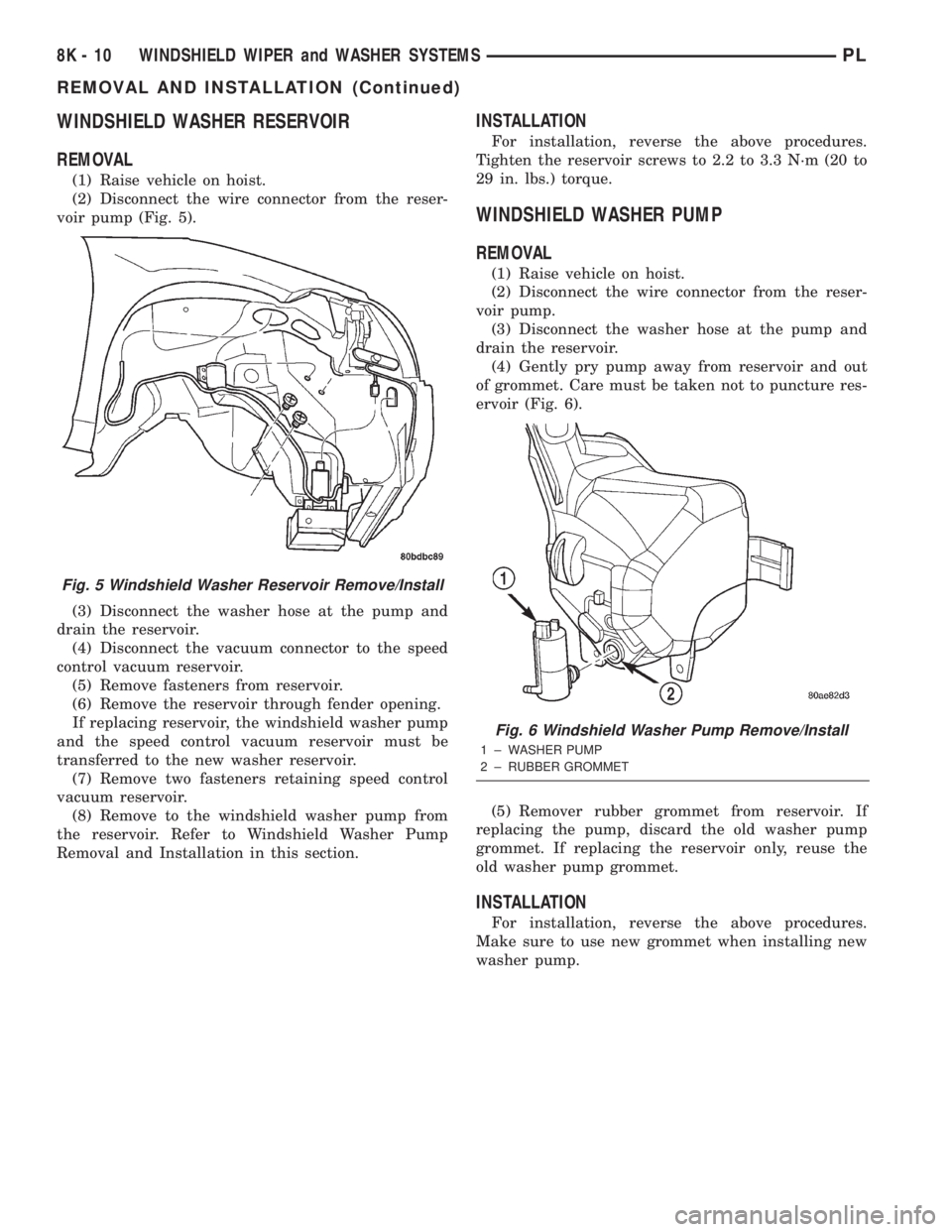
(2) Disconnect the wire connector from the reser-
voir pump (Fig. 5).
(3) Disconnect the washer hose at the pump and
drain the reservoir.
(4) Disconnect the vacuum connector to the speed
control vacuum reservoir.
(5) Remove fasteners from reservoir.
(6) Remove the reservoir through fender opening.
If replacing reservoir, the windshield washer pump
and the speed control vacuum reservoir must be
transferred to the new washer reservoir.
(7) Remove two fasteners retaining speed control
vacuum reservoir.
(8) Remove to the windshield washer pump from
the reservoir. Refer to Windshield Washer Pump
Removal and Installation in this section.
INSTALLATION
For installation, reverse the above procedures.
Tighten the reservoir screws to 2.2 to 3.3 N´m (20 to
29 in. lbs.) torque.
WINDSHIELD WASHER PUMP
REMOVAL
(1) Raise vehicle on hoist.
(2) Disconnect the wire connector from the reser-
voir pump.
(3) Disconnect the washer hose at the pump and
drain the reservoir.
(4) Gently pry pump away from reservoir and out
of grommet. Care must be taken not to puncture res-
ervoir (Fig. 6).
(5) Remover rubber grommet from reservoir. If
replacing the pump, discard the old washer pump
grommet. If replacing the reservoir only, reuse the
old washer pump grommet.
INSTALLATION
For installation, reverse the above procedures.
Make sure to use new grommet when installing new
washer pump.
Fig. 5 Windshield Washer Reservoir Remove/Install
Fig. 6 Windshield Washer Pump Remove/Install
1 ± WASHER PUMP
2 ± RUBBER GROMMET
8K - 10 WINDSHIELD WIPER and WASHER SYSTEMSPL
REMOVAL AND INSTALLATION (Continued)
Page 348 of 1285
DIAGNOSIS AND TESTING
AIRBAG SYSTEM
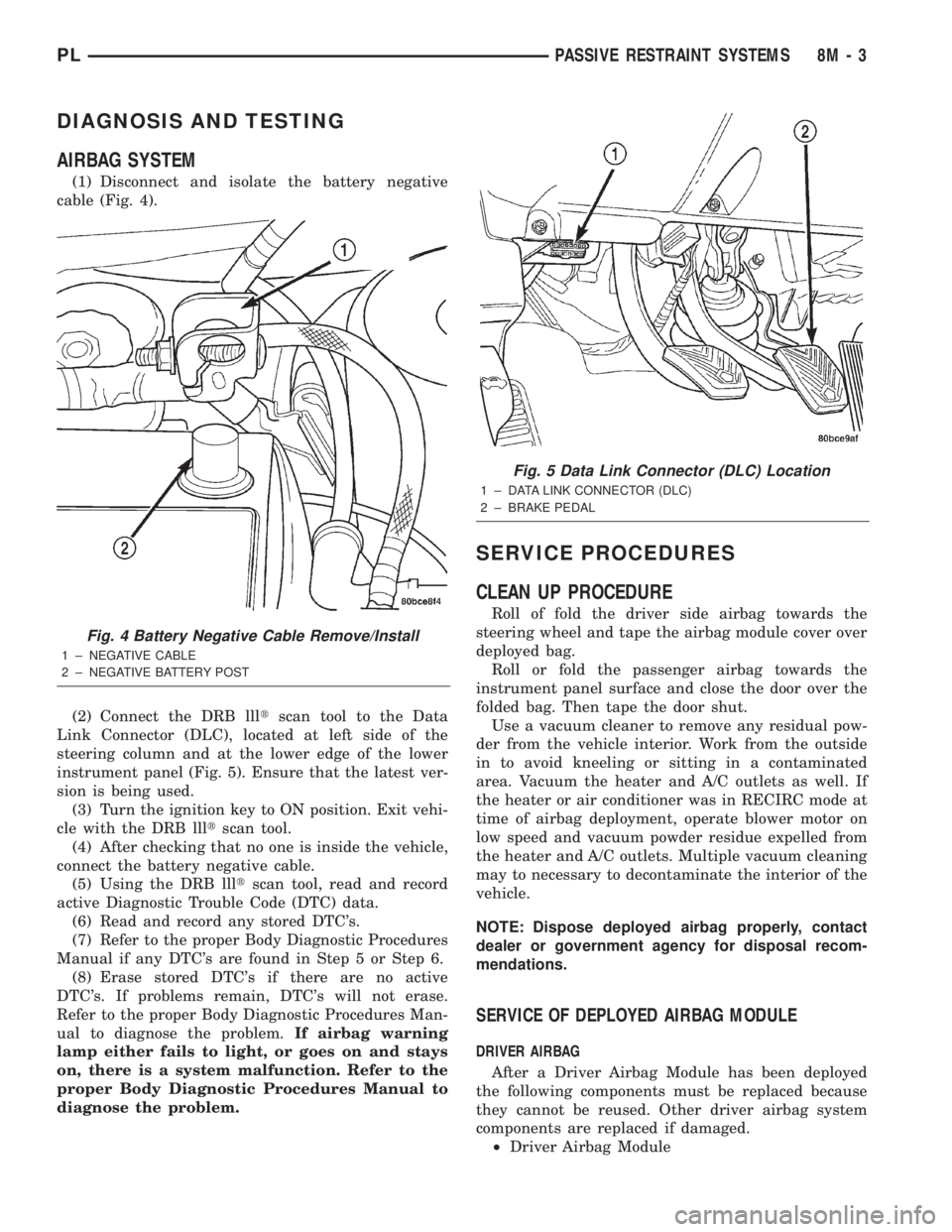
(1) Disconnect and isolate the battery negative
cable (Fig. 4).
(2) Connect the DRB llltscan tool to the Data
Link Connector (DLC), located at left side of the
steering column and at the lower edge of the lower
instrument panel (Fig. 5). Ensure that the latest ver-
sion is being used.
(3) Turn the ignition key to ON position. Exit vehi-
cle with the DRB llltscan tool.
(4) After checking that no one is inside the vehicle,
connect the battery negative cable.
(5) Using the DRB llltscan tool, read and record
active Diagnostic Trouble Code (DTC) data.
(6) Read and record any stored DTC's.
(7) Refer to the proper Body Diagnostic Procedures
Manual if any DTC's are found in Step 5 or Step 6.
(8) Erase stored DTC's if there are no active
DTC's. If problems remain, DTC's will not erase.
Refer to the proper Body Diagnostic Procedures Man-
ual to diagnose the problem.If airbag warning
lamp either fails to light, or goes on and stays
on, there is a system malfunction. Refer to the
proper Body Diagnostic Procedures Manual to
diagnose the problem.
SERVICE PROCEDURES
CLEAN UP PROCEDURE
Roll of fold the driver side airbag towards the
steering wheel and tape the airbag module cover over
deployed bag.
Roll or fold the passenger airbag towards the
instrument panel surface and close the door over the
folded bag. Then tape the door shut.
Use a vacuum cleaner to remove any residual pow-
der from the vehicle interior. Work from the outside
in to avoid kneeling or sitting in a contaminated
area. Vacuum the heater and A/C outlets as well. If
the heater or air conditioner was in RECIRC mode at
time of airbag deployment, operate blower motor on
low speed and vacuum powder residue expelled from
the heater and A/C outlets. Multiple vacuum cleaning
may to necessary to decontaminate the interior of the
vehicle.
NOTE: Dispose deployed airbag properly, contact
dealer or government agency for disposal recom-
mendations.
SERVICE OF DEPLOYED AIRBAG MODULE
DRIVER AIRBAG
After a Driver Airbag Module has been deployed
the following components must be replaced because
they cannot be reused. Other driver airbag system
components are replaced if damaged.
²Driver Airbag Module
Fig. 4 Battery Negative Cable Remove/Install
1 ± NEGATIVE CABLE
2 ± NEGATIVE BATTERY POST
Fig. 5 Data Link Connector (DLC) Location
1 ± DATA LINK CONNECTOR (DLC)
2 ± BRAKE PEDAL
PLPASSIVE RESTRAINT SYSTEMS 8M - 3
Page 485 of 1285

C2415C156C280C2MODULE CONTROL
POWERTRAIN
SPEED
CONTROL
SWITCH
SIGNAL
V37
20
RD/LG
V37
20
RD/LG
43
V32
20
YL/RD
V32
20
YL/RD
5C102
3
412
V36
20
TN/RDV35
20
LG/RD
V30
20
DB/RD
SERVO CONTROL
SPEED
VEHICLE
Z1
20
BK
Z1
18
BK
S112
3 2 140
VEHICLE
SPEED
CONTROL
SWITCH CLOCKSPRING
6
CLOCKSPRING
7
DUMP
SOLENOID SPEED
CONTROL
VENT
SOLENOID
CONTROL CONTROLSOLENOIDVACUUM CONTROLSPEED
BRAKE
LAMP
SWITCH
0 OFF
1 CANCEL
2 SET/COAST
3 RES/ACCEL
4 ON
C15C10415
VENT
SOLENOIDVACUUM
SOLENOID
G101G201
SUPPLYPOWER CONTROLSPEED
Z10
20
BK/TN
Z9
14
BK
S210(8W-15-3)(8W-30-13)
(8W-15-3)(8W-15-8) (8W-33-3)
(8W-33-3)(8W-33-3)
(8W-33-3)
(8W-15-8)
8W - 30 - 12 8W-30 FUEL/IGNITION SYSTEMPL
008W-10PLI03012
Page 647 of 1285

POWERTRAIN
CONTROL
MODULE - C2
61 K6 18VT/WT 5V SUPPLY
62 K29 20WT/PK BRAKE LAMP SWITCH SENSE
63 - -
64 C28 18DB/OR A/C COMPRESSOR CLUTCH RELAY CONTROL
65 D21 20PK SCI TRANSMIT
66 G7 20WT/OR VEHICLE SPEED SENSOR SIGNAL
67 K51 18DB/YL AUTOMATIC SHUT DOWN RELAY CONTROL
68 K52 20PK/BK PROPORTIONAL EVAP/PURGE SOLENOID CONTROL
69 - -
70
71
72 K107 18YL LEAK DETECTION PUMP SWITCH SENSE
73
74 K31 18BR FUEL PUMP RELAY CONTROL
75 D20 20LG SCI RECIEVE
76 CLUTCH INTERLOCK SWITCH SENSE
77 K106 18WT/DG LEAK DETECTION PUMP SOLENOID CONTROL
78
79K54 18OR/BK TORQUE CONVERTOR CLUTCH SOLENOID CONTROL
80 V35 20LG/RD SPEED CONTROL VENT SOLENOID CONTROL
BLACK
71 8061 7051 6041 50
- - 60 59
20VT K59 58
IDLE AIR CONTROL NO. 1 DRIVER 20GY/RD K39 57
SPEED CONTROL VACUUM SOLENOID CONTROL 20TN/RD V36 56
55
- - 54
- - 53
INLET AIR TEMPERATURE SENSOR SIGNAL 20VT/LG G31 52
OXYGEN SENSOR 1/2 SIGNAL 20TN/WT K141 51
GROUND 20BK/TN Z12 50
20YL/BK K60 49
IDLE AIR CONTROL NO. 3 DRIVER 20BR/WT K40 48
GROUND 18BK/WT Z11 47
FUSED B(+) 18RD/WT A14 46
POWER STEERING PRESSURE SWITCH SENSE 20WT K10 45
8V SUPPLY 20OR K7 44
SENSOR GROUND 20BK/LB K4 43
- - 42
SPEED CONTROL SWITCH SIGNAL 20RD/LG V37 41
FUNCTION CIRCUIT CAV
IDLE AIR CONTROL NO. 2 DRIVER
IDLE AIR CONTROL NO. 4 DRIVER C27 18DB/PK RADIATOR FAN RELAY CONTROL
D25 20VT/YL
PCI BUS
K108 20DB EVAPORATIVE EMISSION SOLENOID SENSE
G9 18GY/BK RED BRAKE WARNING INDICATOR DRIVER
--
-- 76 T41 18BR/YL PARK/NEUTRAL POSITION SWITCH SENSE
20YL/RD T141
SPEED CONTROLEXCEPT BUILT-UP-EXPORT
MTX
ATX
8W - 80 - 38 8W-80 CONNECTOR PIN-OUTSPL
J008W-10PLI08038