1999 SUBARU LEGACY stop start
[x] Cancel search: stop startPage 868 of 1456

Fluid leaking area Possible cause Corrective action
Leakage from connecting portions of
pipes and hoses, numbered with (1) thru
(9) in figureInsufficient tightening of flare nut, catch-
ing dirt or the like, damage to flare or
flare nutLoosen and retighten, if ineffective,
replace.
Poor insertion of hose, poor clamping Retighten or replace clamp.
Damaged O-ring Replace O-ring pipe or hose with new
one, if ineffective, replace gearbox also.
Leakage from hose (10) and (11) in fig-
ureCrack or damage in hose Replace with a new one.
Crack or damage in hose hardware Replace with a new one.
Leakage from surrounding of cast iron
portion of oil pump (12) and (13) in fig-
ureDamaged O-ring Replace O-ring.
Damaged gasket Replace gasket.
Leakage from oil tank, (14) and (15) in
figureCrack in oil tank, (14) Replace oil tank.
Damaged O-ring, (15) Replace O-ring.
Leakage from filler neck (16) Damaged cap packing Replace cap.
Crack in root of filler neck Replace oil tank.
High fluid level *1 Adjust fluid level.
Leakage from surrounding of power cyl-
inder of gearbox, (17) in figureDamaged oil seal Replace oil seal.
Leakage from control valve of gearbox,
(18) and (19) in figureDamaged packing or oil seal Replace problem parts.
Damage in control valve Replace control valve.
*1 Fluid level is specified at optimum position (range) for ordinary use. Accordingly, if the vehicle is used often under hard
conditions such as on very rough roads or in mountainous areas, fluid may bleed out from cap air vent hole. This is not
a problem. If a customer complains strongly and is not likely to be satisfied with the leakage, lower the fluid level to the
extent that fluid will not bleed out under the conditions described, and have the customer check the fluid level and its
quality more frequency than usual.
E: NOISE AND VIBRATION
CAUTION:
Don't keep the relief valve operated over 5 sec-
onds at any time or inner parts of the oil pump
may be damaged due to rapid increase of fluid
temperature.
NOTE:
IGrinding noise may be heard immediately after
the engine start in extremely cold condition. In this
case, if the noise goes off during warm-up there is
no abnormal function in the system. This is due to
the fluid characteristic in extremely cold condition.
IOil pump makes whine or growl noise slightly
due to its mechanism. Even if the noise can be
heard when steering wheel is turned at stand still
there is no abnormal function in the system pro-
vided that the noise eliminates when the vehicle is
running.
IWhen stopping with service brake and/or park-
ing brake applied, power steering can be operated
easily due to its light steering effort. If doing so, thedisk rotates slightly and makes creaking noise. The
noise is generated by creaking between the disk
and pads. If the noise goes off when the brake is
released, there is no abnormal function in the sys-
tem.
IThere may be a little vibration around the steer-
ing devices when turning steering wheel at
standstill, even though the component parts are
properly adjusted and have no defects.
Hydraulic systems are likely to generate this kind
of vibration as well as working noise and fluid noise
because of combined conditions, i.e., road surface
and tire surface, engine speed and turning speed
of steering wheel, fluid temperature and braking
condition.
This phenomena does not indicate there is some
abnormal function in the system.
The vibration can be known when steering wheel
is turned repeatedly at various speeds from slow to
rapid step by step with parking brake applied on
concrete road and in ªDº range for automatic trans-
mission vehicle.
Trouble Possible cause Corrective action
Hiss noise (continuous)
While engine is running.Relief valve emits operating sound when steering wheel is
completely turned in either direction. (Don't keep this condition
over 5 seconds.)Normal
Relief valve emits operating sound when steering wheel is not
turned. This means that the relief valve is faulty.Defective
Replace oil pump.
74
4-3[K1E0]DIAGNOSTICS
1. Power Steering
Page 914 of 1456
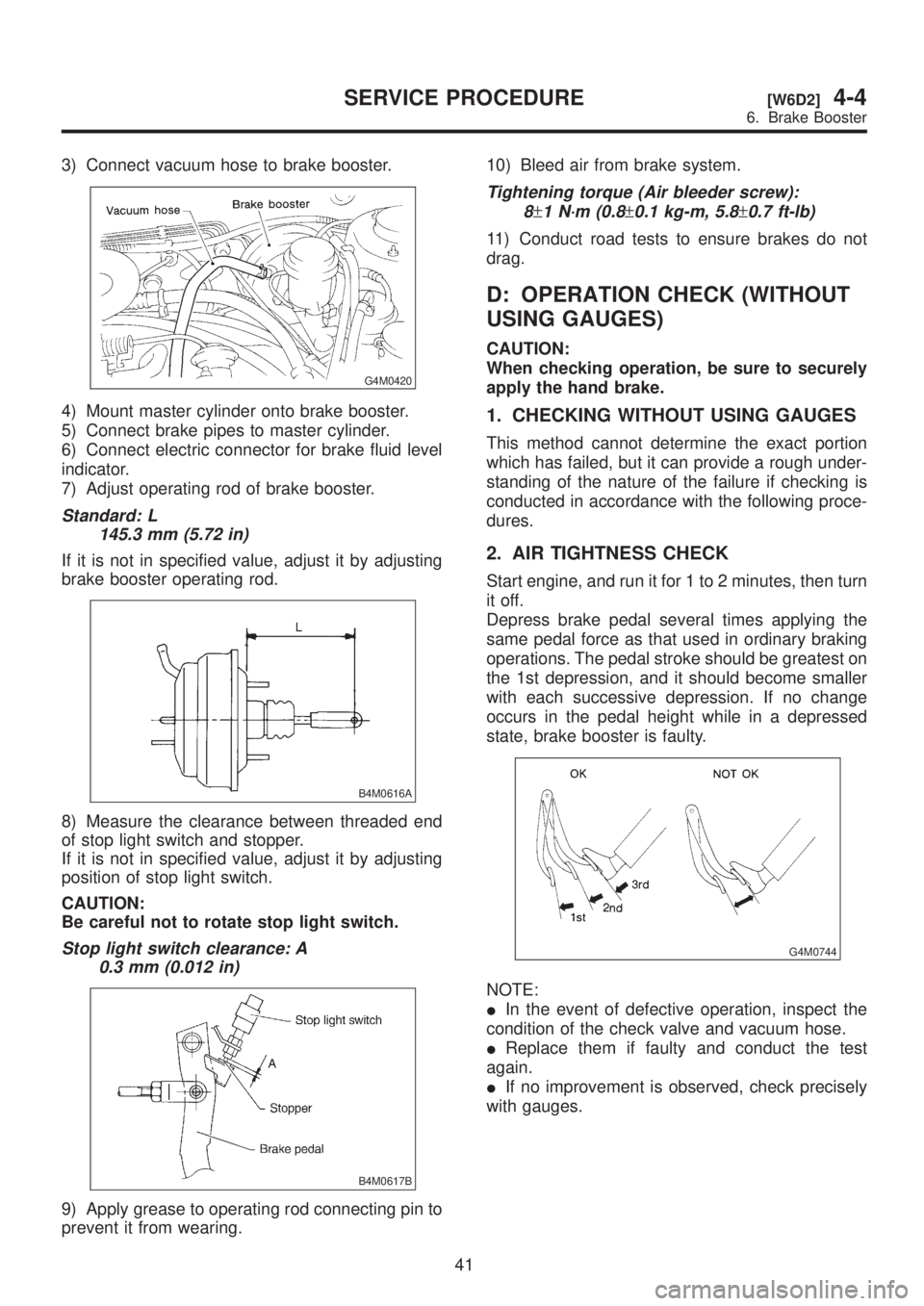
3) Connect vacuum hose to brake booster.
G4M0420
4) Mount master cylinder onto brake booster.
5) Connect brake pipes to master cylinder.
6) Connect electric connector for brake fluid level
indicator.
7) Adjust operating rod of brake booster.
Standard: L
145.3 mm (5.72 in)
If it is not in specified value, adjust it by adjusting
brake booster operating rod.
B4M0616A
8) Measure the clearance between threaded end
of stop light switch and stopper.
If it is not in specified value, adjust it by adjusting
position of stop light switch.
CAUTION:
Be careful not to rotate stop light switch.
Stop light switch clearance: A
0.3 mm (0.012 in)
B4M0617B
9) Apply grease to operating rod connecting pin to
prevent it from wearing.10) Bleed air from brake system.
Tightening torque (Air bleeder screw):
8
±1 N´m (0.8±0.1 kg-m, 5.8±0.7 ft-lb)
11) Conduct road tests to ensure brakes do not
drag.
D: OPERATION CHECK (WITHOUT
USING GAUGES)
CAUTION:
When checking operation, be sure to securely
apply the hand brake.
1. CHECKING WITHOUT USING GAUGES
This method cannot determine the exact portion
which has failed, but it can provide a rough under-
standing of the nature of the failure if checking is
conducted in accordance with the following proce-
dures.
2. AIR TIGHTNESS CHECK
Start engine, and run it for 1 to 2 minutes, then turn
it off.
Depress brake pedal several times applying the
same pedal force as that used in ordinary braking
operations. The pedal stroke should be greatest on
the 1st depression, and it should become smaller
with each successive depression. If no change
occurs in the pedal height while in a depressed
state, brake booster is faulty.
G4M0744
NOTE:
IIn the event of defective operation, inspect the
condition of the check valve and vacuum hose.
IReplace them if faulty and conduct the test
again.
IIf no improvement is observed, check precisely
with gauges.
41
[W6D2]4-4SERVICE PROCEDURE
6. Brake Booster
Page 915 of 1456
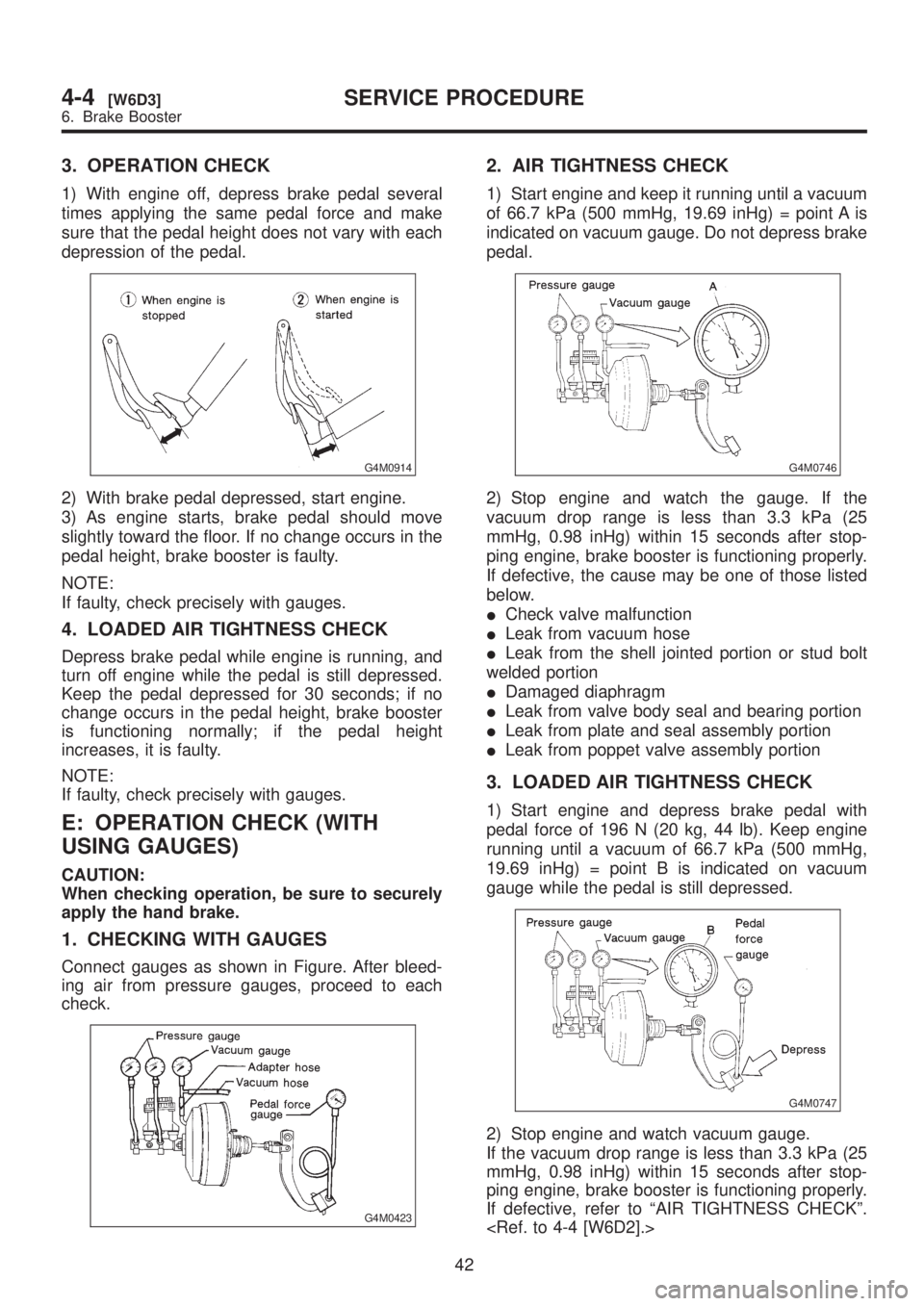
3. OPERATION CHECK
1) With engine off, depress brake pedal several
times applying the same pedal force and make
sure that the pedal height does not vary with each
depression of the pedal.
G4M0914
2) With brake pedal depressed, start engine.
3) As engine starts, brake pedal should move
slightly toward the floor. If no change occurs in the
pedal height, brake booster is faulty.
NOTE:
If faulty, check precisely with gauges.
4. LOADED AIR TIGHTNESS CHECK
Depress brake pedal while engine is running, and
turn off engine while the pedal is still depressed.
Keep the pedal depressed for 30 seconds; if no
change occurs in the pedal height, brake booster
is functioning normally; if the pedal height
increases, it is faulty.
NOTE:
If faulty, check precisely with gauges.
E: OPERATION CHECK (WITH
USING GAUGES)
CAUTION:
When checking operation, be sure to securely
apply the hand brake.
1. CHECKING WITH GAUGES
Connect gauges as shown in Figure. After bleed-
ing air from pressure gauges, proceed to each
check.
G4M0423
2. AIR TIGHTNESS CHECK
1) Start engine and keep it running until a vacuum
of 66.7 kPa (500 mmHg, 19.69 inHg) = point A is
indicated on vacuum gauge. Do not depress brake
pedal.
G4M0746
2) Stop engine and watch the gauge. If the
vacuum drop range is less than 3.3 kPa (25
mmHg, 0.98 inHg) within 15 seconds after stop-
ping engine, brake booster is functioning properly.
If defective, the cause may be one of those listed
below.
ICheck valve malfunction
ILeak from vacuum hose
ILeak from the shell jointed portion or stud bolt
welded portion
IDamaged diaphragm
ILeak from valve body seal and bearing portion
ILeak from plate and seal assembly portion
ILeak from poppet valve assembly portion
3. LOADED AIR TIGHTNESS CHECK
1) Start engine and depress brake pedal with
pedal force of 196 N (20 kg, 44 lb). Keep engine
running until a vacuum of 66.7 kPa (500 mmHg,
19.69 inHg) = point B is indicated on vacuum
gauge while the pedal is still depressed.
G4M0747
2) Stop engine and watch vacuum gauge.
If the vacuum drop range is less than 3.3 kPa (25
mmHg, 0.98 inHg) within 15 seconds after stop-
ping engine, brake booster is functioning properly.
If defective, refer to ªAIR TIGHTNESS CHECKº.
42
4-4[W6D3]SERVICE PROCEDURE
6. Brake Booster
Page 920 of 1456
Tightening torque:
18
±5 N´m (1.8±0.5 kg-m, 13.0±3.6 ft-lb)
2) Connect brake pipes to PHV.
Tightening torque:
15+3/þ2N´m (1.5+0.3/þ0.2kg-m, 10.8+2.2/þ1.4ft-lb)
CAUTION:
Confirm that brake pipes are not deformed
and/or damaged. Replace them with new ones
if necessary.
3) Install PHV cable to PHV stay.
CAUTION:
If cable clamp (and clips) is damaged, replace
it with a new one.
4) Connect PHV cable with clips.
NOTE:
Avoid sharp bending of PHV cable as it may cause
breakage.
5) Install PHV cable onto cable bracket on engine.
6) Apply grease to the following points.
IHook portion of return spring
ICable end portion of lever
Grease:
SUNLIGHT 2 (Part No. 003602010)
7) Be sure to bleed air from the system.
CAUTION:
After replacing PHV cable or clutch cable with
new one, operate clutch pedal about 30 times
as a running-in operation prior to adjustment.
D: ADJUSTMENTS
Confirm stopping and starting performances by
activating hill holder on an uphill road of 3É or
higher inclination.
1) If vehicle does not stop;
Tighten adjusting nut of PHV cable.
2) If vehicle does not start properly;
ICase A Ð When hill holder is released later than
engagement of clutch pedal (Engine tends to
stall.):
Loosen adjusting nut gradually until smooth start-
ing is enabled.
ICase B Ð When hill holder is released earlier
than engagement of clutch pedal (Vehicle slips
down slightly.):
Tighten adjusting nut so that hill holder is released
later than engagement of clutch pedal (status in
Case A). Then make adjustment the same as in
Case A.NOTE:
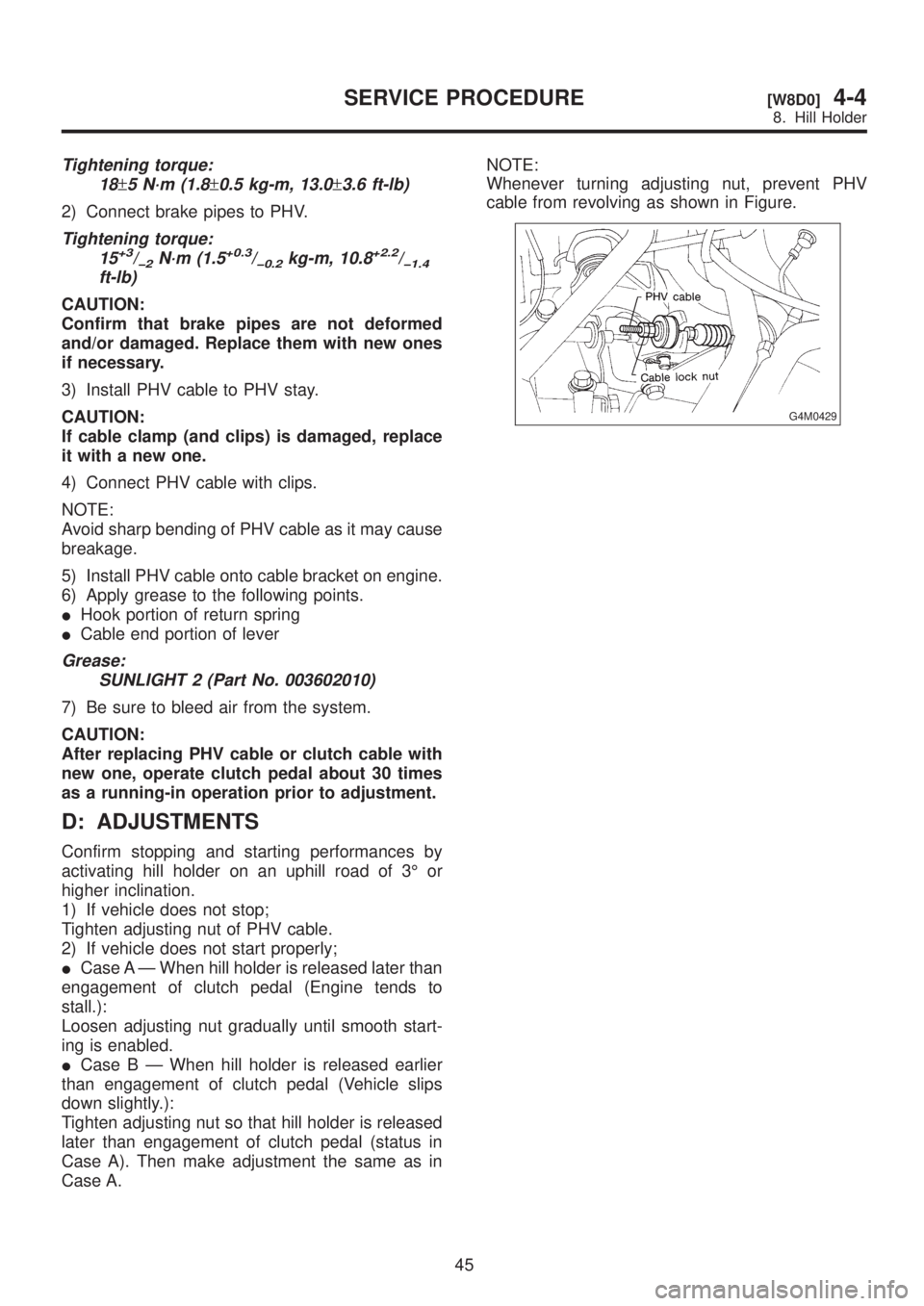
Whenever turning adjusting nut, prevent PHV
cable from revolving as shown in Figure.
G4M0429
45
[W8D0]4-4SERVICE PROCEDURE
8. Hill Holder
Page 935 of 1456
4) Within 0.5 seconds after the ABS warning light
goes out, depress the brake pedal and hold it
immediately after ignition switch is turned to ON.
CAUTION:
Do not depress the clutch pedal.
NOTE:
IWhen the ignition switch is set to on, the brake
pedal must not be depressed.
IEngine must not operate.
5) After completion of ABS sequence control, turn
ignition switch OFF.
2. OPERATIONAL GUIDELINES OF THE
ABS SEQUENCE CONTROL WITH
SELECT MONITOR
NOTE:
IIn the event of any trouble, the sequence con-
trol may not be operative. In such a case, activate
the sequence control, referring to ªOPERATIONAL
GUIDELINES OF THE ABS SEQUENCE CON-
TROL WITH DIAGNOSIS CONNECTORº.
IWhen the diagnosis terminal is connected to the
diagnosis connector, the sequence control will not
operate.
1) Connect select monitor to data link connector
beside driver's seat instrument panel lower cover.
2) Turn ignition switch ON.
3) Turn select monitor switch ON.
4) Put select monitor to {ABS/TCS} mode.
5) When {Function check sequence} is selected,
`ABS sequence control' will start.
6) The message `Press Brake Pedal Firmly' is dis-
played as follows:
(1) When using the brake tester, depress brake
pedal with braking force of 981 N (100 kg, 221
lb).
(2) When using the pressure gauge, depress
brake pedal so as to make the pressure gauge
indicate 3,432 kPa (35 kg/cm
2, 498 psi).
CAUTION:
Do not depress the clutch pedal.
7) When the message ªPress YESº is displayed,
press YES key.
8) Operation points will be displayed on select
monitor.
3. CONDITIONS FOR COMPLETION OF
ABS SEQUENCE CONTROL
When the following conditions develop, the ABS
sequence control stops and ABS operation is
returned to the normal control mode.
1) When the speed of at least one wheel reaches
10 km/h (6 MPH).
2) When terminal No. 3 or No. 6 are separated
from diagnosis terminals. (When select monitor is
not used.)
3) When the brake pedal is released during
sequence control and the braking lamp switch is
set to off.
4) When brake pedal is depressed after ignition
key is turned to ON, and before ABS warning light
goes out. (When select monitor is not used.)
5) When brake pedal is not depressed after igni-
tion key is turned to ON, and within 0.5 seconds
after ABS warning light goes out. (When select
monitor is not used.)
6) After completion of the sequence control.
7) When malfunction is detected. (When select
monitor is used.)
58
4-4[W15D2]SERVICE PROCEDURE
15. ABS Control Module and Hydraulic Control Unit (ABSCM&H/U)
Page 944 of 1456

Trouble and possible cause Corrective action
In the case of the disc brake:
(1) Excessively worn pad or the support Replace the pad or the support.
In the case of the drum brake:
(1) Excessively worn shoe ridge Replace the back plate.
(2) Lack of oil on the shoe ridge surface and anchor Add more grease.
2. Hill Holder
CAUTION:
IDescription in parentheses is a characteris-
tic of hill holder and does not indicate abnor-
mality.
Depressing force required for clutch pedal
equipped to hill holder specifications is 20 to
29 N (2 to 3 kg, 4 to 7 lb) larger than the con-
ventional specifications, which does not con-
stitute abnormality.IWhen vehicle cannot travel (brake cannot be
released) because return spring is broken,
remove adjusting nut, disconnect clutch and
PHV, and then return PHV lever to release the
brake. (Be sure to apply the parking brake
before starting this operation.)
IThe hill holder may not be activated on a
slope of an extremely small inclination.
Trouble and possible cause Corrective action
1. Counterforce of clutch pedal is too strong.
(1) PHV cable is damaged or does not operate properly. Repair or replace.
(2) Lever of PHV is defective. Replace entire PHV assembly.
(3) Clutch system is anomalous. Refer to ªClutch and pedal cable systemº.
2. Vehicle does not stop on uphill road of 3É or higher inclination.
(1) Front side of vehicle is lowered. Refer to ªSuspensionº.
(2) PHV cable is broken. Replace.
(3) Play of clutch is excessive. Adjust.
(4) PHV cable is elongated. Adjust.
(5) Sealing of PHV is poor. Replace entire PHV assembly.
3. Shock is felt when starting.
(1) Poor adjustment of starting performance: Adjust.
(2) When depressing the brake pedal strongly:(The stronger brake pedal depressing force, the later hill
holder releases.)
(3) When starting on flat road after stopping reverse move-
ment:(Because hill holder is activated.)
4. Vehicle slips down when starting.
(1) PHV cable is elongated. Adjust.
(2) Clutch facing is worn out. Adjust or replace.
(3) Bracket (cable) or stay (PHV) is deformed. Repair or replace.
5. Vehicle cannot start after stoppage.
(1) Return spring is fatigued or broken. Replace.
(2) PHV lever won't return. Replace entire PHV assembly.
(3) When intentionally depressing brake pedal strongly:[When the brake pedal is depressed by a force of 1,177 N
(120 kg, 265 lb) or more.]
6. Abnormal sound is generated upon releasing brake pedal when stopping.
(1) Rotor and pad matched with each other due to inadequate
depressing force to brake pedal.(Abnormal sound is not generated when depressing brake
pedal a little stronger.)
7. Abnormal sound is generated when operating clutch pedal.
(1) Grease is inadequate for the hook of return spring and
sliding portion of PHV cable end.Apply grease.
(2) When releasing after maintaining high fluid pressure: (Flowing sound of fluid when releasing high fluid pressure.)
(3) Clutch system is anomalous. Refer to ªClutch and pedal cable systemº.
65
[K200]4-4DIAGNOSTICS
2. Hill Holder
Page 945 of 1456
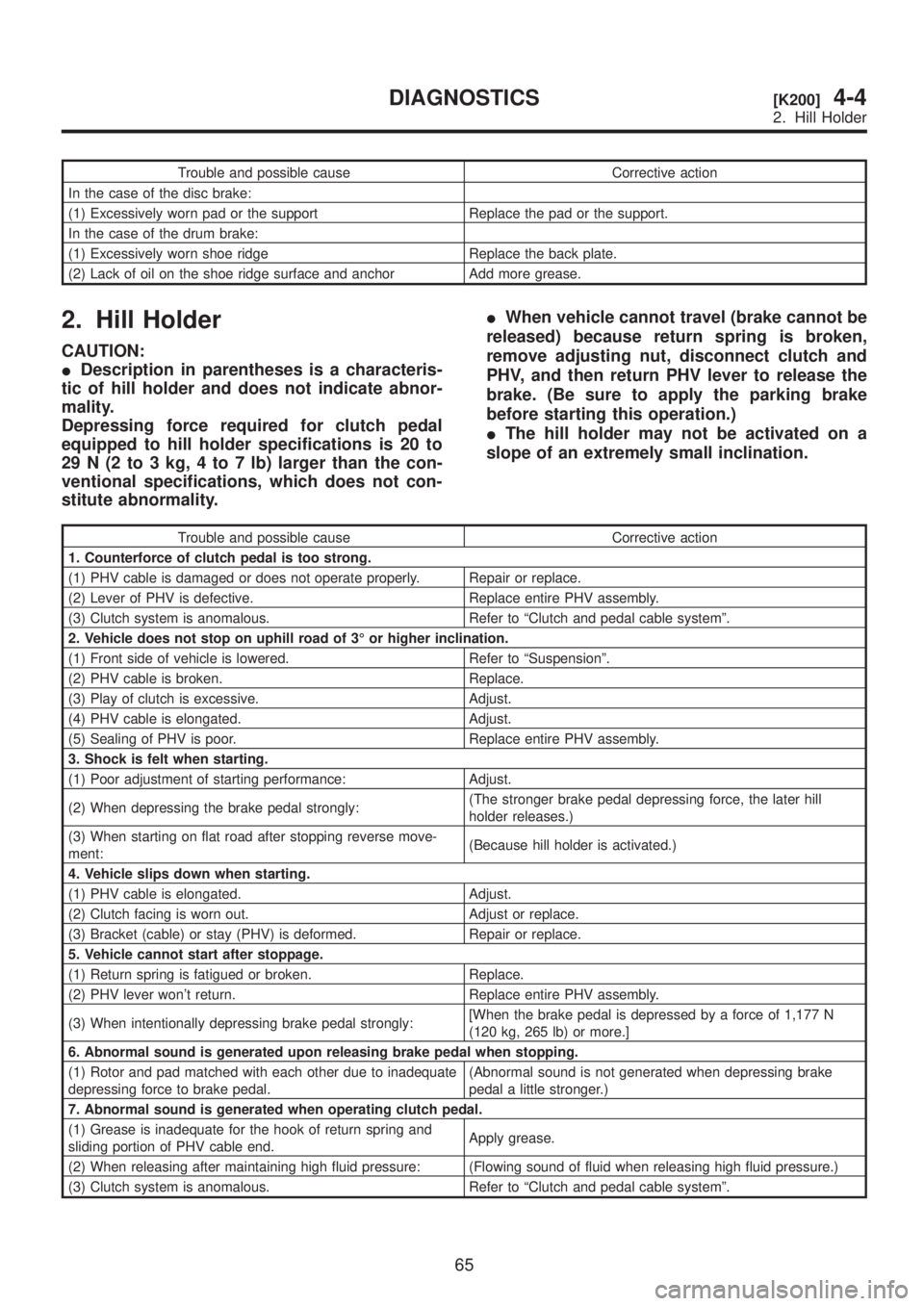
Trouble and possible cause Corrective action
In the case of the disc brake:
(1) Excessively worn pad or the support Replace the pad or the support.
In the case of the drum brake:
(1) Excessively worn shoe ridge Replace the back plate.
(2) Lack of oil on the shoe ridge surface and anchor Add more grease.
2. Hill Holder
CAUTION:
IDescription in parentheses is a characteris-
tic of hill holder and does not indicate abnor-
mality.
Depressing force required for clutch pedal
equipped to hill holder specifications is 20 to
29 N (2 to 3 kg, 4 to 7 lb) larger than the con-
ventional specifications, which does not con-
stitute abnormality.IWhen vehicle cannot travel (brake cannot be
released) because return spring is broken,
remove adjusting nut, disconnect clutch and
PHV, and then return PHV lever to release the
brake. (Be sure to apply the parking brake
before starting this operation.)
IThe hill holder may not be activated on a
slope of an extremely small inclination.
Trouble and possible cause Corrective action
1. Counterforce of clutch pedal is too strong.
(1) PHV cable is damaged or does not operate properly. Repair or replace.
(2) Lever of PHV is defective. Replace entire PHV assembly.
(3) Clutch system is anomalous. Refer to ªClutch and pedal cable systemº.
2. Vehicle does not stop on uphill road of 3É or higher inclination.
(1) Front side of vehicle is lowered. Refer to ªSuspensionº.
(2) PHV cable is broken. Replace.
(3) Play of clutch is excessive. Adjust.
(4) PHV cable is elongated. Adjust.
(5) Sealing of PHV is poor. Replace entire PHV assembly.
3. Shock is felt when starting.
(1) Poor adjustment of starting performance: Adjust.
(2) When depressing the brake pedal strongly:(The stronger brake pedal depressing force, the later hill
holder releases.)
(3) When starting on flat road after stopping reverse move-
ment:(Because hill holder is activated.)
4. Vehicle slips down when starting.
(1) PHV cable is elongated. Adjust.
(2) Clutch facing is worn out. Adjust or replace.
(3) Bracket (cable) or stay (PHV) is deformed. Repair or replace.
5. Vehicle cannot start after stoppage.
(1) Return spring is fatigued or broken. Replace.
(2) PHV lever won't return. Replace entire PHV assembly.
(3) When intentionally depressing brake pedal strongly:[When the brake pedal is depressed by a force of 1,177 N
(120 kg, 265 lb) or more.]
6. Abnormal sound is generated upon releasing brake pedal when stopping.
(1) Rotor and pad matched with each other due to inadequate
depressing force to brake pedal.(Abnormal sound is not generated when depressing brake
pedal a little stronger.)
7. Abnormal sound is generated when operating clutch pedal.
(1) Grease is inadequate for the hook of return spring and
sliding portion of PHV cable end.Apply grease.
(2) When releasing after maintaining high fluid pressure: (Flowing sound of fluid when releasing high fluid pressure.)
(3) Clutch system is anomalous. Refer to ªClutch and pedal cable systemº.
65
[K200]4-4DIAGNOSTICS
2. Hill Holder
Page 948 of 1456
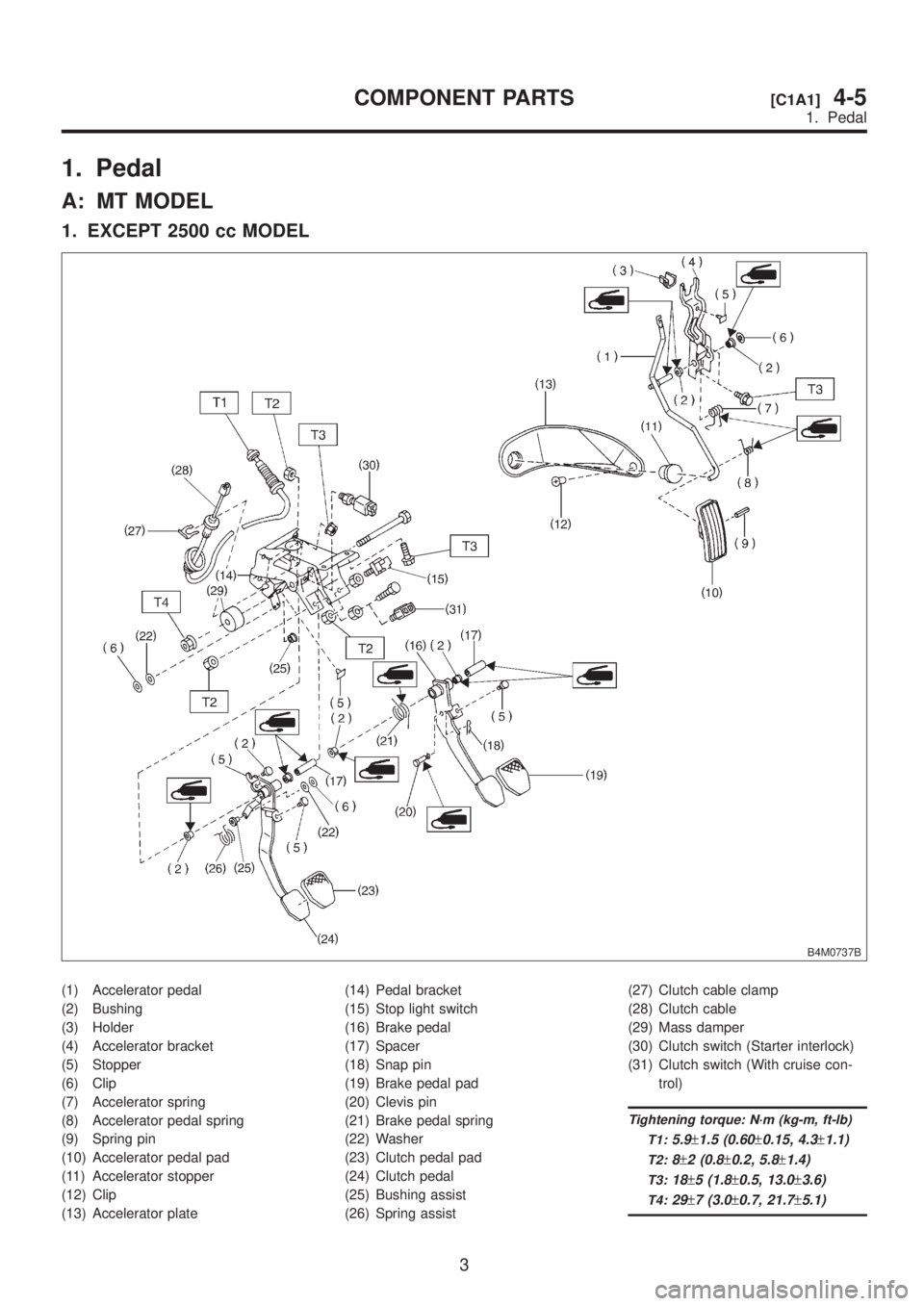
1. Pedal
A: MT MODEL
1. EXCEPT 2500 cc MODEL
B4M0737B
(1) Accelerator pedal
(2) Bushing
(3) Holder
(4) Accelerator bracket
(5) Stopper
(6) Clip
(7) Accelerator spring
(8) Accelerator pedal spring
(9) Spring pin
(10) Accelerator pedal pad
(11) Accelerator stopper
(12) Clip
(13) Accelerator plate(14) Pedal bracket
(15) Stop light switch
(16) Brake pedal
(17) Spacer
(18) Snap pin
(19) Brake pedal pad
(20) Clevis pin
(21) Brake pedal spring
(22) Washer
(23) Clutch pedal pad
(24) Clutch pedal
(25) Bushing assist
(26) Spring assist(27) Clutch cable clamp
(28) Clutch cable
(29) Mass damper
(30) Clutch switch (Starter interlock)
(31) Clutch switch (With cruise con-
trol)
Tightening torque: N´m (kg-m, ft-lb)
T1:
5.9±1.5 (0.60±0.15, 4.3±1.1)
T2:8±2 (0.8±0.2, 5.8±1.4)
T3:18±5 (1.8±0.5, 13.0±3.6)
T4:29±7 (3.0±0.7, 21.7±5.1)
3
[C1A1]4-5COMPONENT PARTS
1. Pedal