1999 SUBARU LEGACY replacement
[x] Cancel search: replacementPage 837 of 1456
5) If cylinder edge is deformed in a convex shape,
repair using an oil stone.
G4M0889
C: REPLACEMENT OF SEAL AND
PACKING
1. VALVE HOUSING OIL SEAL
Specified steering grease:
VALIANT GREASE M2 (Part No.
003608001)
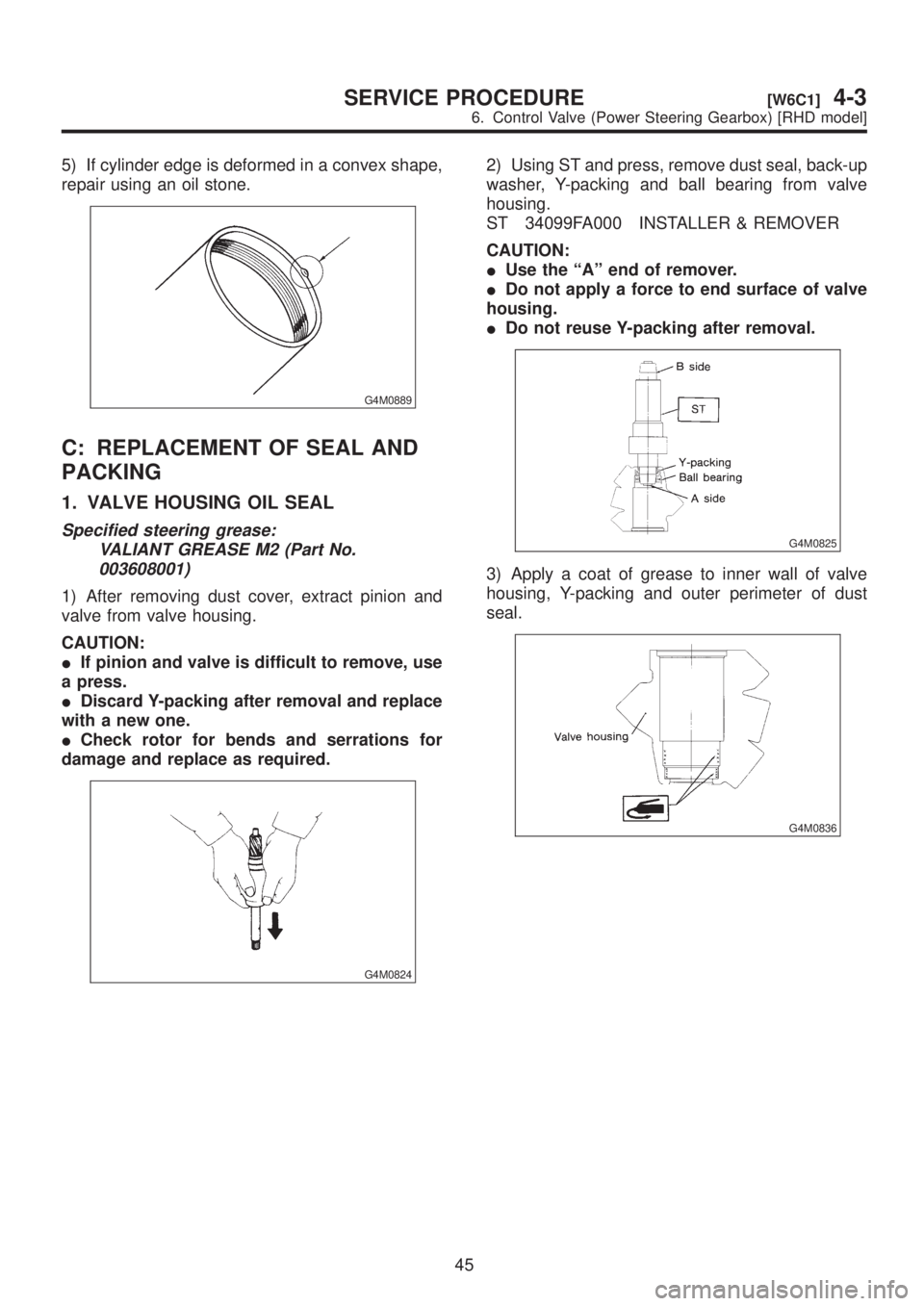
1) After removing dust cover, extract pinion and
valve from valve housing.
CAUTION:
IIf pinion and valve is difficult to remove, use
a press.
IDiscard Y-packing after removal and replace
with a new one.
ICheck rotor for bends and serrations for
damage and replace as required.
G4M0824
2) Using ST and press, remove dust seal, back-up
washer, Y-packing and ball bearing from valve
housing.
ST 34099FA000 INSTALLER & REMOVER
CAUTION:
IUse the ªAº end of remover.
IDo not apply a force to end surface of valve
housing.
IDo not reuse Y-packing after removal.
G4M0825
3) Apply a coat of grease to inner wall of valve
housing, Y-packing and outer perimeter of dust
seal.
G4M0836
45
[W6C1]4-3SERVICE PROCEDURE
6. Control Valve (Power Steering Gearbox) [RHD model]
Page 853 of 1456
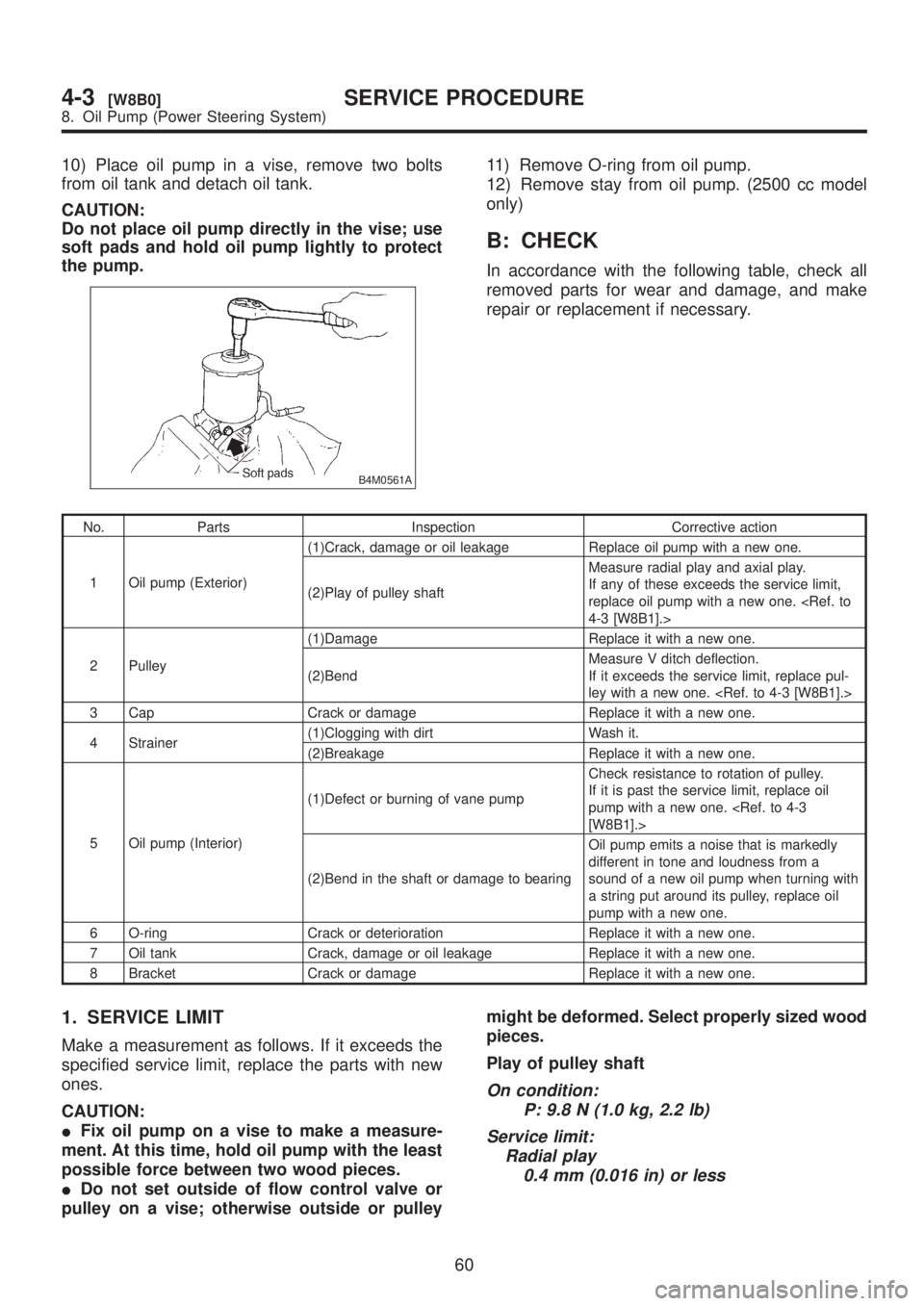
10) Place oil pump in a vise, remove two bolts
from oil tank and detach oil tank.
CAUTION:
Do not place oil pump directly in the vise; use
soft pads and hold oil pump lightly to protect
the pump.
B4M0561A
11) Remove O-ring from oil pump.
12) Remove stay from oil pump. (2500 cc model
only)
B: CHECK
In accordance with the following table, check all
removed parts for wear and damage, and make
repair or replacement if necessary.
No. Parts Inspection Corrective action
1 Oil pump (Exterior)(1)Crack, damage or oil leakage Replace oil pump with a new one.
(2)Play of pulley shaftMeasure radial play and axial play.
If any of these exceeds the service limit,
replace oil pump with a new one.
2 Pulley(1)Damage Replace it with a new one.
(2)BendMeasure V ditch deflection.
If it exceeds the service limit, replace pul-
ley with a new one.
3 Cap Crack or damage Replace it with a new one.
4 Strainer(1)Clogging with dirt Wash it.
(2)Breakage Replace it with a new one.
5 Oil pump (Interior)(1)Defect or burning of vane pumpCheck resistance to rotation of pulley.
If it is past the service limit, replace oil
pump with a new one.
(2)Bend in the shaft or damage to bearingOil pump emits a noise that is markedly
different in tone and loudness from a
sound of a new oil pump when turning with
a string put around its pulley, replace oil
pump with a new one.
6 O-ring Crack or deterioration Replace it with a new one.
7 Oil tank Crack, damage or oil leakage Replace it with a new one.
8 Bracket Crack or damage Replace it with a new one.
1. SERVICE LIMIT
Make a measurement as follows. If it exceeds the
specified service limit, replace the parts with new
ones.
CAUTION:
IFix oil pump on a vise to make a measure-
ment. At this time, hold oil pump with the least
possible force between two wood pieces.
IDo not set outside of flow control valve or
pulley on a vise; otherwise outside or pulleymight be deformed. Select properly sized wood
pieces.
Play of pulley shaft
On condition:
P: 9.8 N (1.0 kg, 2.2 lb)
Service limit:
Radial play
0.4 mm (0.016 in) or less
60
4-3[W8B0]SERVICE PROCEDURE
8. Oil Pump (Power Steering System)
Page 889 of 1456

1. Front Disc Brake
A: ON-CAR SERVICE
1. PAD
1) Remove lock pin.
2) Raise caliper body.
3) Remove pad.
B4M1167
4) Check pad thickness A.
B4M1168A
Pad thickness
(including back metal)
mm (in)Standard value 17 (0.67)
Wear limit 7.5 (0.295)
CAUTION:
IAlways replace the pads for both the left and
right wheels at the same time. Also replace pad
clips if they are twisted or worn.
IA wear indicator is provided on the inner
disc brake pad. If the pad wears down to such
an extent that the end of the wear indicator
contacts the disc rotor, a squeaking sound is
produced as the wheel rotates. If this sound is
heard, replace the pad.
IReplace pad if there is oil or grease on it.5) Apply thin coat of PBC GREASE (Part No.
003607000) to the frictional portion between pad
and pad clip.
B4M1169A
6) Install pads on support.
7) Install caliper body on support.
NOTE:
If it is difficult to push piston during pad
replacement, loosen air bleeder to facilitate work.
2. DISC ROTOR
1) Install disc rotor by tightening the five wheel
nuts.
2) Set a dial gauge on the disc rotor. Turn disc
rotor to check runout.
G4M0364
NOTE:
Make sure that dial gauge is set 5 mm (0.20 in)
inward of rotor outer perimeter.
Disc rotor runout limit:
0.075 mm (0.0030 in)
18
4-4[W1A1]SERVICE PROCEDURE
1. Front Disc Brake
Page 898 of 1456
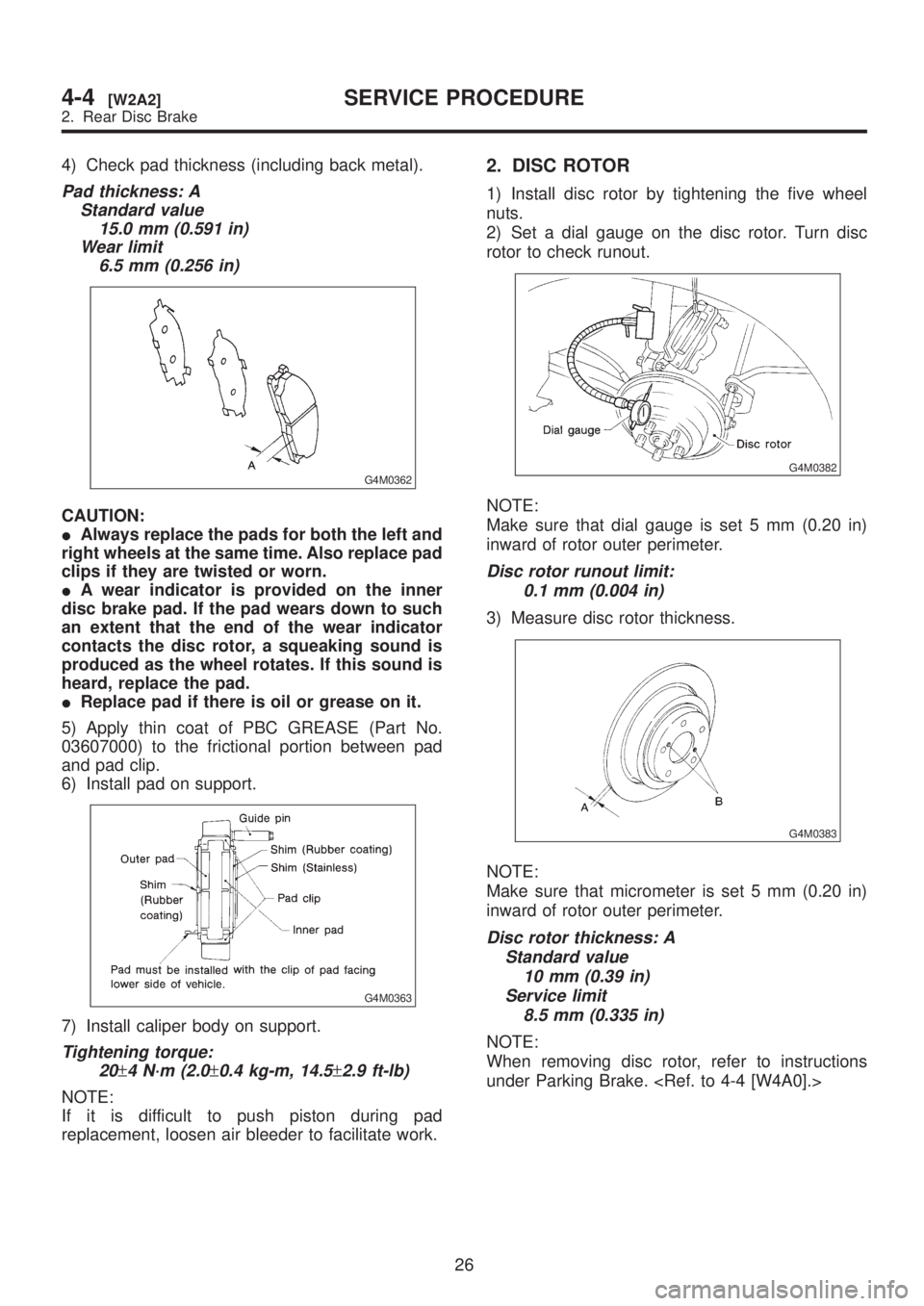
4) Check pad thickness (including back metal).
Pad thickness: A
Standard value
15.0 mm (0.591 in)
Wear limit
6.5 mm (0.256 in)
G4M0362
CAUTION:
IAlways replace the pads for both the left and
right wheels at the same time. Also replace pad
clips if they are twisted or worn.
IA wear indicator is provided on the inner
disc brake pad. If the pad wears down to such
an extent that the end of the wear indicator
contacts the disc rotor, a squeaking sound is
produced as the wheel rotates. If this sound is
heard, replace the pad.
IReplace pad if there is oil or grease on it.
5) Apply thin coat of PBC GREASE (Part No.
03607000) to the frictional portion between pad
and pad clip.
6) Install pad on support.
G4M0363
7) Install caliper body on support.
Tightening torque:
20
±4 N´m (2.0±0.4 kg-m, 14.5±2.9 ft-lb)
NOTE:
If it is difficult to push piston during pad
replacement, loosen air bleeder to facilitate work.
2. DISC ROTOR
1) Install disc rotor by tightening the five wheel
nuts.
2) Set a dial gauge on the disc rotor. Turn disc
rotor to check runout.
G4M0382
NOTE:
Make sure that dial gauge is set 5 mm (0.20 in)
inward of rotor outer perimeter.
Disc rotor runout limit:
0.1 mm (0.004 in)
3) Measure disc rotor thickness.
G4M0383
NOTE:
Make sure that micrometer is set 5 mm (0.20 in)
inward of rotor outer perimeter.
Disc rotor thickness: A
Standard value
10 mm (0.39 in)
Service limit
8.5 mm (0.335 in)
NOTE:
When removing disc rotor, refer to instructions
under Parking Brake.
26
4-4[W2A2]SERVICE PROCEDURE
2. Rear Disc Brake
Page 921 of 1456
9. Parking Brake Lever
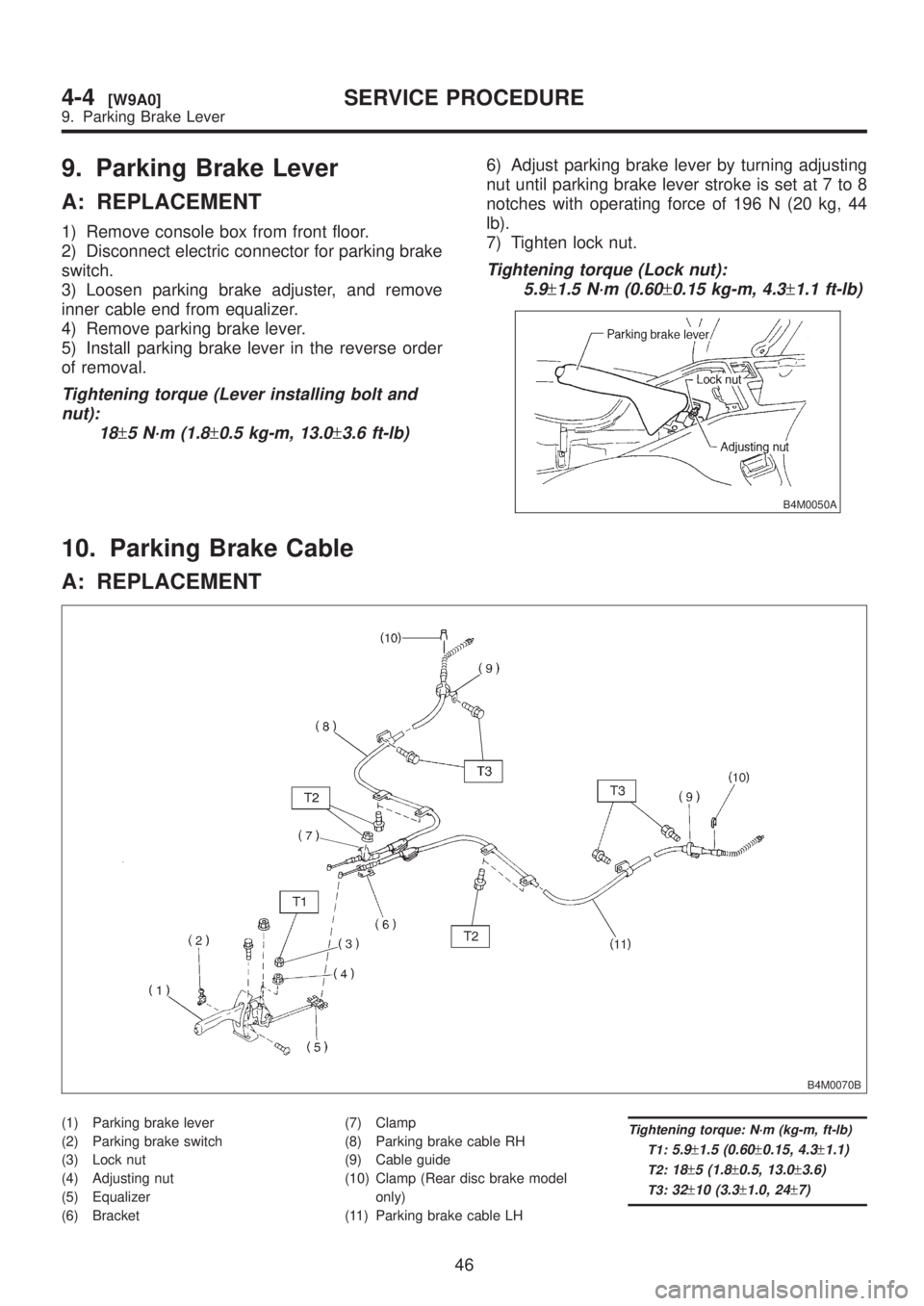
A: REPLACEMENT
1) Remove console box from front floor.
2) Disconnect electric connector for parking brake
switch.
3) Loosen parking brake adjuster, and remove
inner cable end from equalizer.
4) Remove parking brake lever.
5) Install parking brake lever in the reverse order
of removal.
Tightening torque (Lever installing bolt and
nut):
18
±5 N´m (1.8±0.5 kg-m, 13.0±3.6 ft-lb)
6) Adjust parking brake lever by turning adjusting
nut until parking brake lever stroke is set at 7 to 8
notches with operating force of 196 N (20 kg, 44
lb).
7) Tighten lock nut.
Tightening torque (Lock nut):
5.9
±1.5 N´m (0.60±0.15 kg-m, 4.3±1.1 ft-lb)
B4M0050A
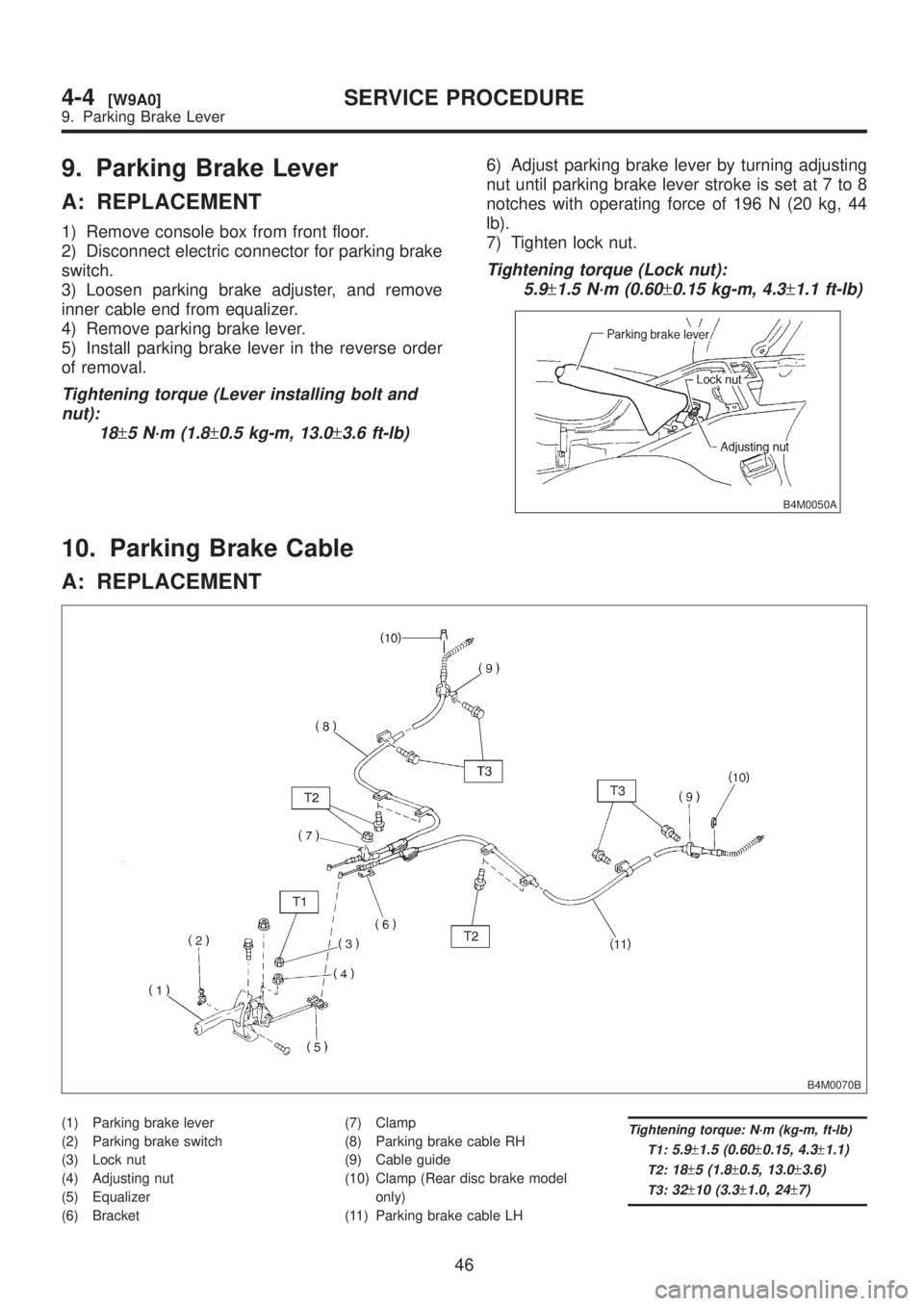
10. Parking Brake Cable
A: REPLACEMENT
B4M0070B
(1) Parking brake lever
(2) Parking brake switch
(3) Lock nut
(4) Adjusting nut
(5) Equalizer
(6) Bracket(7) Clamp
(8) Parking brake cable RH
(9) Cable guide
(10) Clamp (Rear disc brake model
only)
(11) Parking brake cable LHTightening torque: N´m (kg-m, ft-lb)
T1:
5.9±1.5 (0.60±0.15, 4.3±1.1)
T2:18±5 (1.8±0.5, 13.0±3.6)
T3:32±10 (3.3±1.0, 24±7)
46
4-4[W9A0]SERVICE PROCEDURE
9. Parking Brake Lever
Page 922 of 1456
9. Parking Brake Lever
A: REPLACEMENT
1) Remove console box from front floor.
2) Disconnect electric connector for parking brake
switch.
3) Loosen parking brake adjuster, and remove
inner cable end from equalizer.
4) Remove parking brake lever.
5) Install parking brake lever in the reverse order
of removal.
Tightening torque (Lever installing bolt and
nut):
18
±5 N´m (1.8±0.5 kg-m, 13.0±3.6 ft-lb)
6) Adjust parking brake lever by turning adjusting
nut until parking brake lever stroke is set at 7 to 8
notches with operating force of 196 N (20 kg, 44
lb).
7) Tighten lock nut.
Tightening torque (Lock nut):
5.9
±1.5 N´m (0.60±0.15 kg-m, 4.3±1.1 ft-lb)
B4M0050A
10. Parking Brake Cable
A: REPLACEMENT
B4M0070B
(1) Parking brake lever
(2) Parking brake switch
(3) Lock nut
(4) Adjusting nut
(5) Equalizer
(6) Bracket(7) Clamp
(8) Parking brake cable RH
(9) Cable guide
(10) Clamp (Rear disc brake model
only)
(11) Parking brake cable LHTightening torque: N´m (kg-m, ft-lb)
T1:
5.9±1.5 (0.60±0.15, 4.3±1.1)
T2:18±5 (1.8±0.5, 13.0±3.6)
T3:32±10 (3.3±1.0, 24±7)
46
4-4[W9A0]SERVICE PROCEDURE
9. Parking Brake Lever
Page 925 of 1456
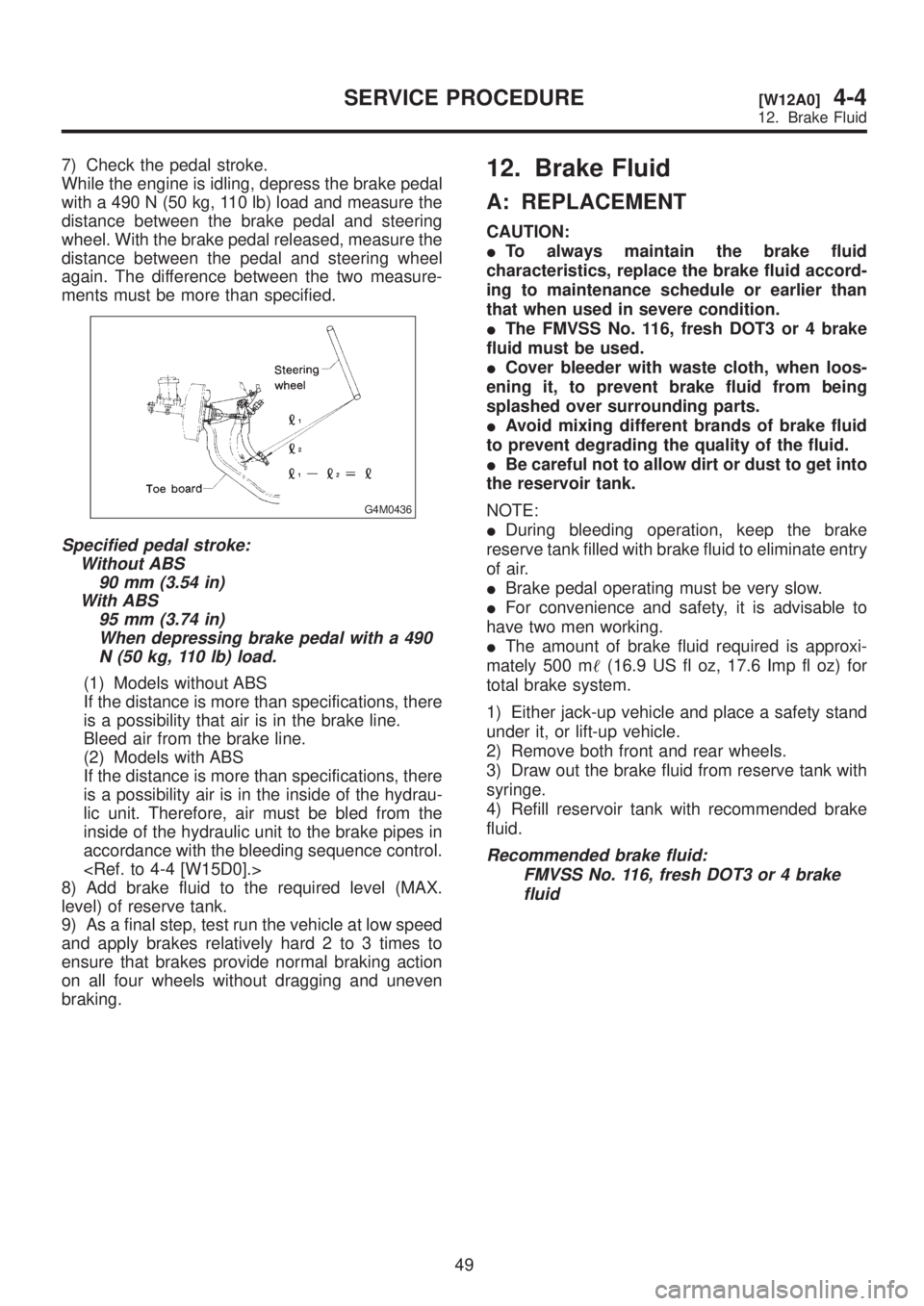
7) Check the pedal stroke.
While the engine is idling, depress the brake pedal
with a 490 N (50 kg, 110 lb) load and measure the
distance between the brake pedal and steering
wheel. With the brake pedal released, measure the
distance between the pedal and steering wheel
again. The difference between the two measure-
ments must be more than specified.
G4M0436
Specified pedal stroke:
Without ABS
90 mm (3.54 in)
With ABS
95 mm (3.74 in)
When depressing brake pedal with a 490
N (50 kg, 110 lb) load.
(1) Models without ABS
If the distance is more than specifications, there
is a possibility that air is in the brake line.
Bleed air from the brake line.
(2) Models with ABS
If the distance is more than specifications, there
is a possibility air is in the inside of the hydrau-
lic unit. Therefore, air must be bled from the
inside of the hydraulic unit to the brake pipes in
accordance with the bleeding sequence control.
8) Add brake fluid to the required level (MAX.
level) of reserve tank.
9) As a final step, test run the vehicle at low speed
and apply brakes relatively hard 2 to 3 times to
ensure that brakes provide normal braking action
on all four wheels without dragging and uneven
braking.
12. Brake Fluid
A: REPLACEMENT
CAUTION:
ITo always maintain the brake fluid
characteristics, replace the brake fluid accord-
ing to maintenance schedule or earlier than
that when used in severe condition.
IThe FMVSS No. 116, fresh DOT3 or 4 brake
fluid must be used.
ICover bleeder with waste cloth, when loos-
ening it, to prevent brake fluid from being
splashed over surrounding parts.
IAvoid mixing different brands of brake fluid
to prevent degrading the quality of the fluid.
IBe careful not to allow dirt or dust to get into
the reservoir tank.
NOTE:
IDuring bleeding operation, keep the brake
reserve tank filled with brake fluid to eliminate entry
of air.
IBrake pedal operating must be very slow.
IFor convenience and safety, it is advisable to
have two men working.
IThe amount of brake fluid required is approxi-
mately 500 m(16.9 US fl oz, 17.6 Imp fl oz) for
total brake system.
1) Either jack-up vehicle and place a safety stand
under it, or lift-up vehicle.
2) Remove both front and rear wheels.
3) Draw out the brake fluid from reserve tank with
syringe.
4) Refill reservoir tank with recommended brake
fluid.
Recommended brake fluid:
FMVSS No. 116, fresh DOT3 or 4 brake
fluid
49
[W12A0]4-4SERVICE PROCEDURE
12. Brake Fluid
Page 926 of 1456
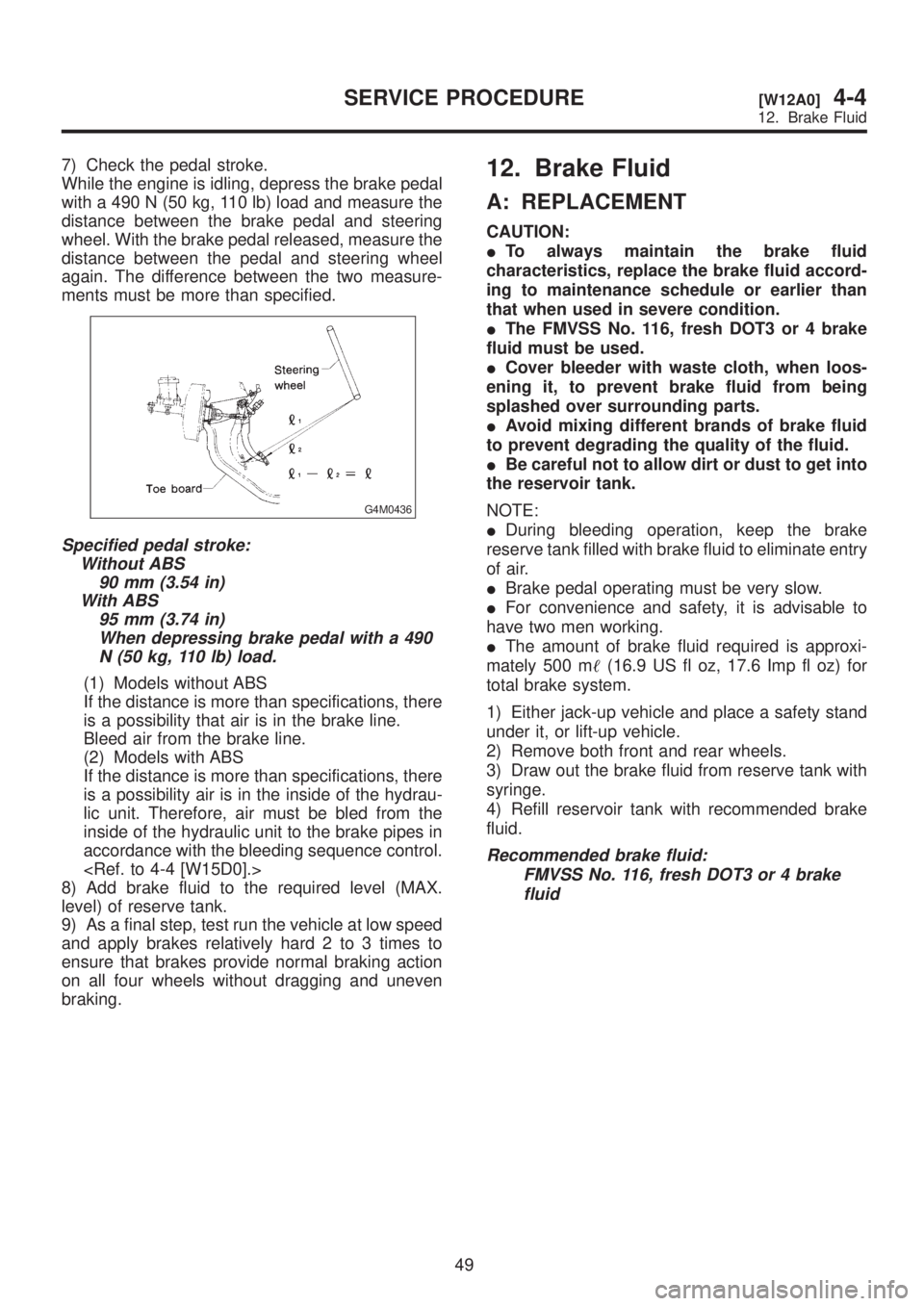
7) Check the pedal stroke.
While the engine is idling, depress the brake pedal
with a 490 N (50 kg, 110 lb) load and measure the
distance between the brake pedal and steering
wheel. With the brake pedal released, measure the
distance between the pedal and steering wheel
again. The difference between the two measure-
ments must be more than specified.
G4M0436
Specified pedal stroke:
Without ABS
90 mm (3.54 in)
With ABS
95 mm (3.74 in)
When depressing brake pedal with a 490
N (50 kg, 110 lb) load.
(1) Models without ABS
If the distance is more than specifications, there
is a possibility that air is in the brake line.
Bleed air from the brake line.
(2) Models with ABS
If the distance is more than specifications, there
is a possibility air is in the inside of the hydrau-
lic unit. Therefore, air must be bled from the
inside of the hydraulic unit to the brake pipes in
accordance with the bleeding sequence control.
8) Add brake fluid to the required level (MAX.
level) of reserve tank.
9) As a final step, test run the vehicle at low speed
and apply brakes relatively hard 2 to 3 times to
ensure that brakes provide normal braking action
on all four wheels without dragging and uneven
braking.
12. Brake Fluid
A: REPLACEMENT
CAUTION:
ITo always maintain the brake fluid
characteristics, replace the brake fluid accord-
ing to maintenance schedule or earlier than
that when used in severe condition.
IThe FMVSS No. 116, fresh DOT3 or 4 brake
fluid must be used.
ICover bleeder with waste cloth, when loos-
ening it, to prevent brake fluid from being
splashed over surrounding parts.
IAvoid mixing different brands of brake fluid
to prevent degrading the quality of the fluid.
IBe careful not to allow dirt or dust to get into
the reservoir tank.
NOTE:
IDuring bleeding operation, keep the brake
reserve tank filled with brake fluid to eliminate entry
of air.
IBrake pedal operating must be very slow.
IFor convenience and safety, it is advisable to
have two men working.
IThe amount of brake fluid required is approxi-
mately 500 m(16.9 US fl oz, 17.6 Imp fl oz) for
total brake system.
1) Either jack-up vehicle and place a safety stand
under it, or lift-up vehicle.
2) Remove both front and rear wheels.
3) Draw out the brake fluid from reserve tank with
syringe.
4) Refill reservoir tank with recommended brake
fluid.
Recommended brake fluid:
FMVSS No. 116, fresh DOT3 or 4 brake
fluid
49
[W12A0]4-4SERVICE PROCEDURE
12. Brake Fluid