1999 HONDA ODYSSEY ESP
[x] Cancel search: ESPPage 215 of 343

Towing a Trailer
Towing Equipment and
Accessories
Towing can require a variety of equipment, depending on the size of
your trailer, how it will be used, and how much load you are towing.
Discuss your needs with your trailersales or rental agency, and follow the
guidelines in the rest of this section.
Also make sure that all equipment is properly installed and that it meets
federal, state, province, and local
regulations.
Hitches
Any hitch used on your vehicle must
be properly bolted to the underbody, using the six threaded holes
provided. A hitch designed especially
for your Odyssey can be obtained
from your Honda dealer.
Weight Distributing Hitch
If the total trailer weight is more
than 2,000 Ibs (900 kg), you must also use a weight distributing hitch.
This device transfers weight from the vehicle's rear wheels to the front
wheels, and to the trailer's wheels. Carefully follow the hitch maker's
instructions for proper installation
and adjustment.
Safety Chain
Always use a safety chain. Make sure that it is secured to both the
trailer and hitch, and that it crosses under the tongue so it can catch the
trailer if it becomes unhitched.
Leave enough slack to allow the
trailer to turn corners easily, but do not let the chain drag on the ground. Sway Control
If the total trailer weight exceeds 2,000 Ibs (900 kg), you should install
a sway control device to minimize
swaying that can occur in crosswinds
and in normal and emergency
driving maneuvers. Your trailer
maker can tell you what kind of sway
control you need and how to install it.
Transmission Fluid Cooler
If the total trailer weight is more
than 2,000 Ibs (900 kg), you must
also have a transmission fluid cooler
installed. This device will help
prevent transmission overheating,
which could cause serious damage.
A transmission fluid cooler designed for your Odyssey can be obtainedfrom your Honda dealer.
DrivingProCarManuals.comMain Menu Table of Contents s t
Page 240 of 343
Cooling System
Replacing Engine Coolant
The cooling system should be completely drained and refilled with
new coolant according to the timeand distance recommendations in
the maintenance schedule. Only use Genuine Honda Antifreeze/Coolant.
Draining the coolant requires access
to the underside of the vehicle. Unless you have the tools and
knowledge, you should have this maintenance done by a skilled
mechanic.
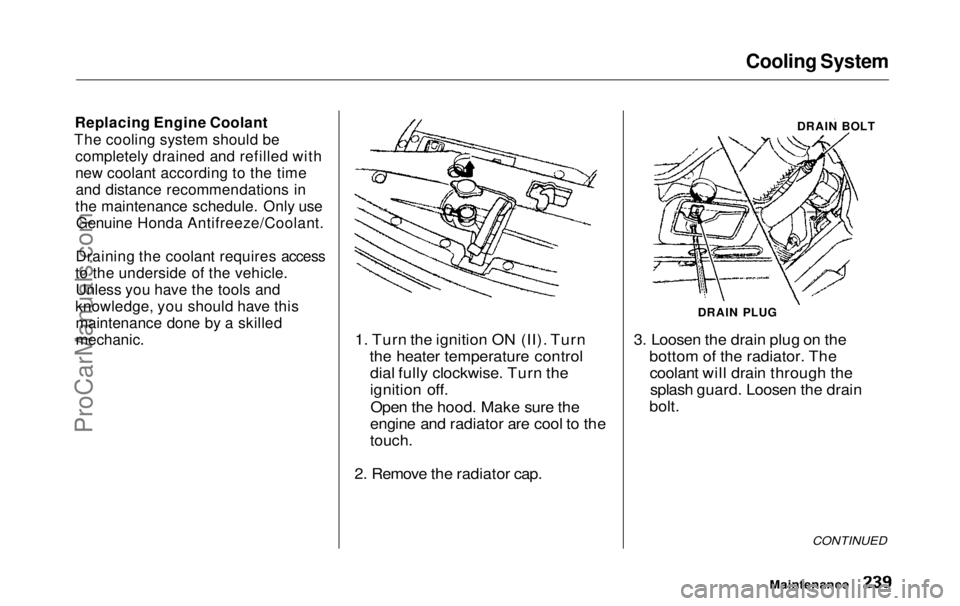
1. Turn the ignition ON (II). Turn
the heater temperature controldial fully clockwise. Turn the
ignition off.
Open the hood. Make sure the
engine and radiator are cool to the
touch.
2. Remove the radiator cap. 3. Loosen the drain plug on the
bottom of the radiator. Thecoolant will drain through thesplash guard. Loosen the drain
bolt.
CONTINUED
Maintenance
DRAIN BOLT
DRAIN PLUGProCarManuals.comMain Menu Table of Contents s t
Page 278 of 343
Exterior Care
Washing
Frequent washing helps preserve
your vehicle's beauty. Dirt and grit can scratch the paint, while tree sap
and bird droppings can permanently
ruin the finish.
Wash your vehicle in a shady area, not in direct sunlight. If the vehicle is
parked in the sun, move it into theshade and let the exterior cool down
before you start.
Only use the solvents and cleaners
recommended in this Owner's
Manual.
Chemical solvents and strong cleaners
can damage the paint, metal, and
plastic on your vehicle. Rinse the vehicle thoroughly with
cool water to remove loose dirt.
Fill a bucket with cool water. Mix
in a mild detergent, such as
dishwashing liquid or a product
made especially for car washing.
Wash the vehicle using the water and detergent solution and a soft-
bristle brush, sponge, or soft cloth. Start at the top and work your waydown. Rinse frequently.
Check the body for road tar, treesap, etc. Remove these stains with
tar remover or turpentine. Rinse it
off immediately so it does not
harm the finish. Remember to re-
wax these areas, even if the rest of the vehicle does not need waxing. When you have washed and rinsed
the whole exterior, dry it with a
chamois or soft towel. Letting itair-dry will cause dulling and water
spots.
As you dry the vehicle, inspect it for chips and scratches that could allow
corrosion to start. Repair them with
touch-up paint (see page 279).
The radio antenna on your vehicle does
not need to be removed when you use a
"drive-through'' car wash. However, if
you remove the antenna, make sure to
reinstall it and tighten it securely using
an appropriate tool.
Appearance Care
NOTICE
NOTICEProCarManuals.comMain Menu Table of Contents s t
Page 282 of 343

Corrosion Protection
Two factors normally contribute to causing corrosion in your vehicle:
1. Moisture trapped in body cavities. Dirt and road salt that collects in
hollows on the underside of the
vehicle stays damp, promoting corrosion in that area.
2. Removal of paint and protective coatings from the exterior and
underside of the vehicle. Many corrosion-preventive measures
are built into your Honda. You can
help keep your vehicle from corroding by performing some
simple periodic maintenance: Repair chips and scratches in the
paint as soon as you discover them. Inspect and clean out the drain
holes in the bottom of the doors
and body. Check the floor coverings for
dampness. Carpeting and floor
mats may remain damp for a long
time, especially in winter. This dampness can eventually cause
the floor panels to corrode. Use a high-pressure spray to clean
the underside of your vehicle. This is especially important in areas
that use road salt in winter. It is also a good idea in humid climates
and areas subject to salt air. Be
careful of the ABS wheel sensors
and wiring at each wheel. Have the corrosion-preventive
coatings on the underside of your
vehicle inspected and repaired periodically.
Appearance CareProCarManuals.comMain Menu Table of Contents s t
Page 285 of 343
Compact Spare Tire
Your vehicle has a compact spare tire that takes up less space. Use thisspare tire as a temporary replace-
ment only. Get your regular tire
repaired or replaced and put back on
your vehicle as soon as you can.
Check the inflation pressure of the
compact spare tire every time you
check the other tires. It should be
inflated to: 60 psi (420 kPa , 4.2 kgf/cm2)
Follow these precautions whenever
you are using the compact spare tire: Do not exceed 50 mph (80 km/h)
under any circumstances. This tire gives a harsher ride and
less traction on some road sur-
faces than the regular tire. Use
greater caution while driving on this tire. Do not mount snow chains on the
compact spare.
Do not use the compact spare tire
if you are towing a trailer. The wheel of the compact spare
tire is designed especially to fit
your vehicle. Do not use your spare tire on another vehicle
unless it is the same make and
model.
On EX model
Turn off the Traction Control
System (see page 207 ). Driving
with the compact spare tire may activate the TCS.
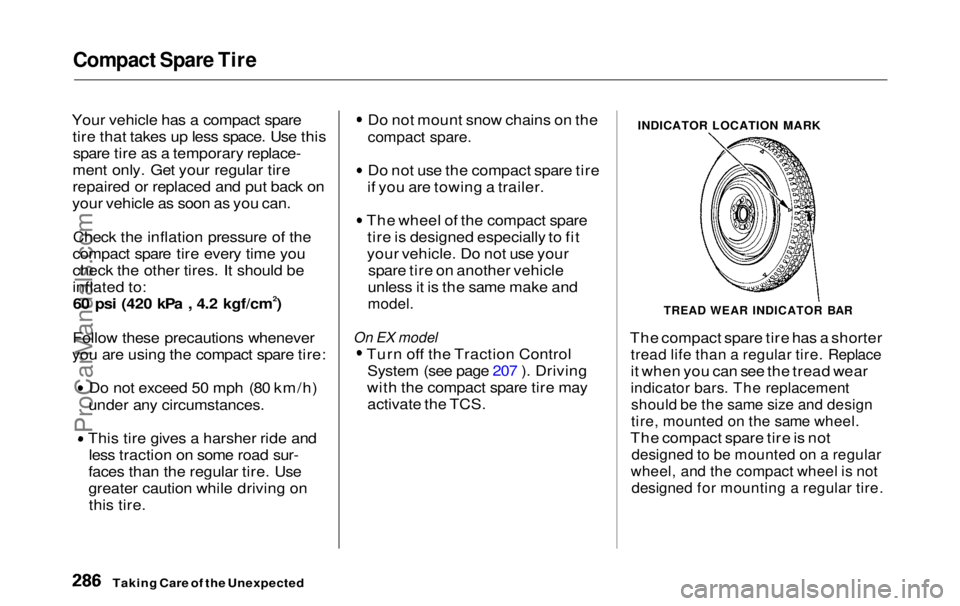
INDICATOR LOCATION MARK
TREAD WEAR INDICATOR BAR
The compact spare tire has a shorter
tread life than a regular tire. Replace
it when you can see the tread wear
indicator bars. The replacement
should be the same size and design
tire, mounted on the same wheel.
The compact spare tire is not
designed to be mounted on a regular
wheel, and the compact wheel is not
designed for mounting a regular tire.
Taking Care of the UnexpectedProCarManuals.comMain Menu Table of Contents s t
Page 310 of 343
Emergency Towing
If your vehicle needs to be towed,
call a professional towing service or,
if you belong to one, an organization
that provides roadside assistance.
Never tow your vehicle behind another vehicle with just, a rope or
chain. It is very dangerous.
There are three popular types of professional equipment.
Flat-bed Equipment — The operator
loads your vehicle on the back of a
truck. This is the best way to trans-
port your Honda.
Wheel-Lift Equipment — The tow
truck uses two pivoting arms that go under the tires (front or rear) and lift
them off the ground. The other two
tires remain on the ground. This is an acceptable way to tow your
Honda.
Sling-type Equipment — The tow
truck uses metal cables with hooks on the ends. These hooks go around
parts of the frame or suspension and
the cables lift that end of the vehicle off the ground. Your vehicle's sus-
pension and body can be seriously damaged. This method of towing
is unacceptable.
If your Honda cannot be transported
by flat-bed, it should be towed by
wheel-lift equipment with the front
wheels off the ground. If, due to damage, your vehicle must be towed
with the front wheels on the ground, do the following.
Release the parking brake.
Start the engine.
Shift to D 4, then to N.
Turn off the engine.
Improper towing preparation will
damage the transmission. Follow the
above procedure exactly. If you cannot
shift the transmission or start the
engine, your vehicle must he trans-
ported with the front wheels off the
ground.
With the front wheels on the ground, it is best to tow the vehicle no farther
than 50 miles (80 km), and keep thespeed below 35 mph (55 km/h).
CONTINUED
Taking Care of the Unexpected
NOTICEProCarManuals.comMain Menu Table of Contents s t
Page 317 of 343
Tire Information
Tire Size Designation
A tire's sidewall is marked with a tire
size designation. You will need this
information when selecting replace-
ment tires for your vehicle. The
following explains what the letters and numbers in the tire size
designation mean.
(Example tire size designation)
P215/65R16 96T
P — Applicable vehicle type (tires
marked with the prefix "P" are
intended for use on passenger
vehicles; however, not all tires have this marking).
215 — Tire width in millimeters.
65 — Aspect ratio. The tire's section
height as a percentage of its width.
R — Tire construction code (Radial).
16 — Rim diameter in inches. 96 — Load Index, a numerical code
associated with the maximum load
the tire can carry.
T — Speed Symbol. See the speed rating chart in this section for
additional information.
Wheel Size Designation
Wheels are also marked with important information that you need
if you ever have to replace one. The
following explains what the letters and numbers in the wheel sizedesignation mean.
(Example wheel size designation)
16
x 6-1/2 JJ
16 — Rim diameter in inches.
6-1/2 — Rim width in inches.
JJ — Rim contour designation.
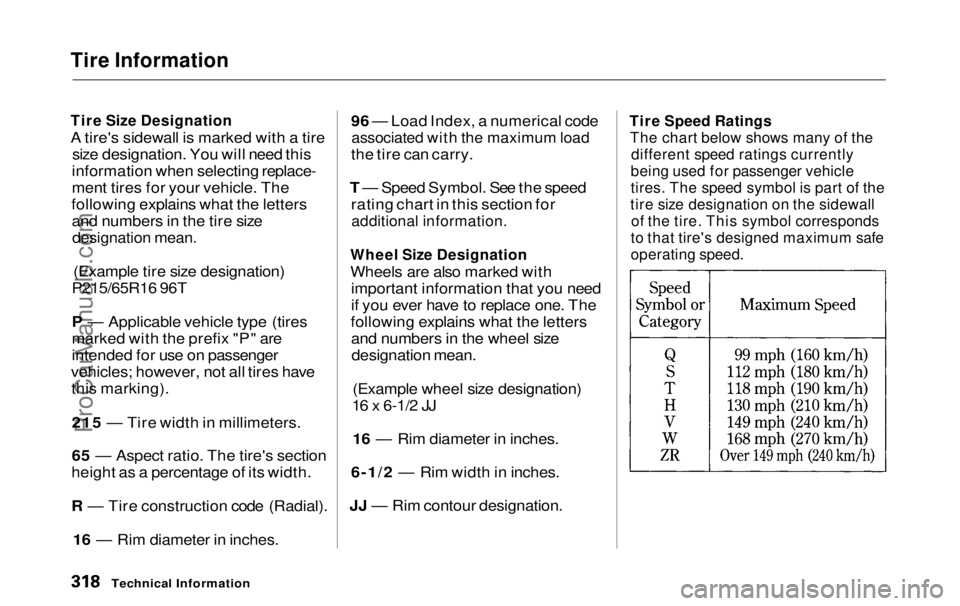
Tire Speed Ratings
The chart below shows many of the
different speed ratings currently
being used for passenger vehicle
tires. The speed symbol is part of the
tire size designation on the sidewall
of the tire. This symbol corresponds
to that tire's designed maximum safe
operating speed.
Technical InformationProCarManuals.comMain Menu Table of Contents s t
Page 319 of 343

Tire Information
Temperature
The temperature grades are A (the highest), B, and C, representing the
tire's resistance to the generation of
heat and its ability to dissipate heat
when tested under controlledconditions on a specified indoor
laboratory test wheel. Sustained high
temperature can cause the material of the tire to degenerate and reduce
tire life, and excessive temperature can lead to sudden tire failure. The
grade C corresponds to a level of
performance which all passenger car
tires must meet under the Federal Motor Vehicle Safety Standard No. 109. Grades B and A represent
higher levels of performance on the laboratory test wheel than the
minimum required by law. Warning: The temperature grade for
this tire is established for a tire thatis properly inflated and not over-
loaded. Excessive speed, underinfla-
tion, or excessive loading either separately or in combination, can
cause heat build-up and possible tire
failure.
Technical InformationProCarManuals.comMain Menu Table of Contents s t