1999 DODGE NEON key
[x] Cancel search: keyPage 656 of 1200
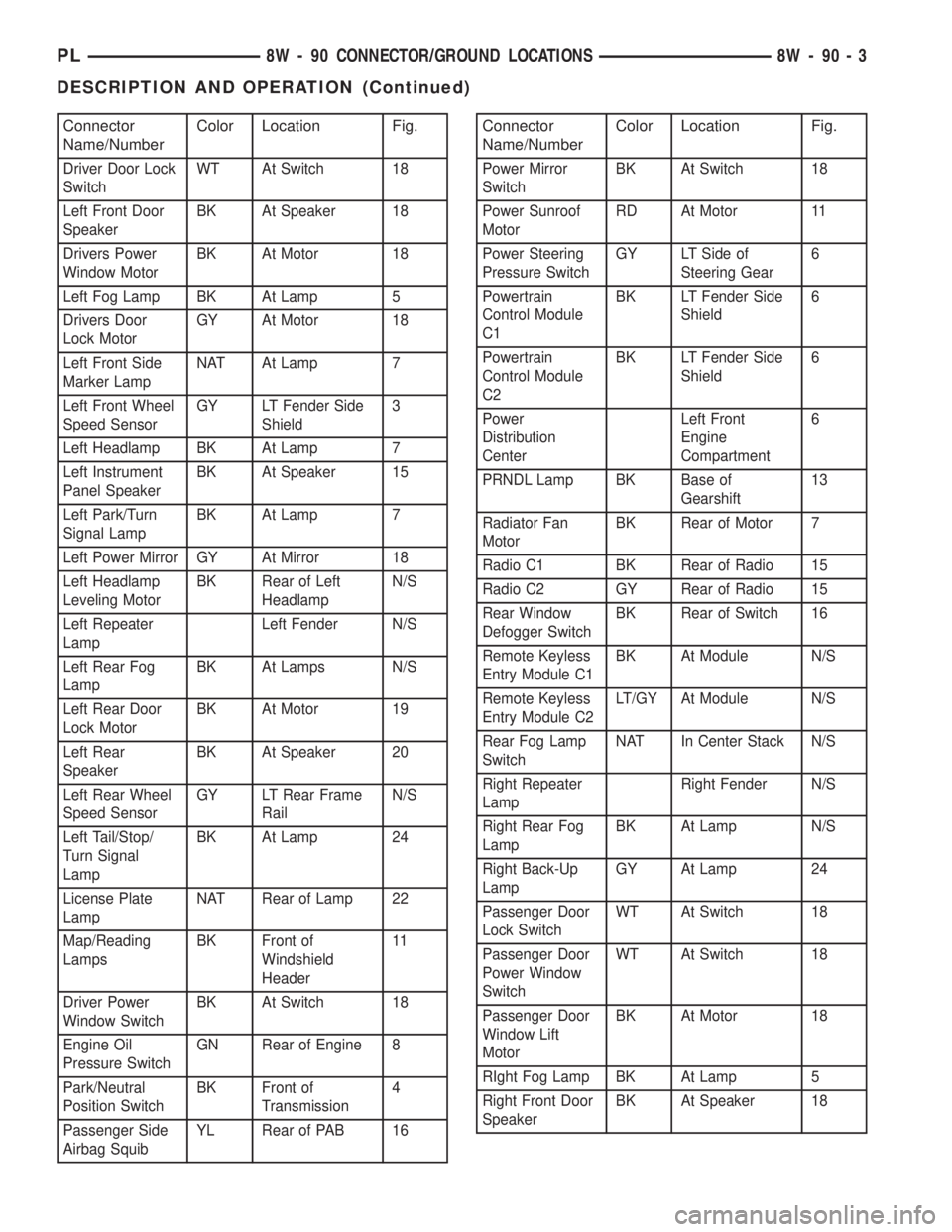
Connector
Name/NumberColor Location Fig.
Driver Door Lock
SwitchWT At Switch 18
Left Front Door
SpeakerBK At Speaker 18
Drivers Power
Window MotorBK At Motor 18
Left Fog Lamp BK At Lamp 5
Drivers Door
Lock MotorGY At Motor 18
Left Front Side
Marker LampNAT At Lamp 7
Left Front Wheel
Speed SensorGY LT Fender Side
Shield3
Left Headlamp BK At Lamp 7
Left Instrument
Panel SpeakerBK At Speaker 15
Left Park/Turn
Signal LampBK At Lamp 7
Left Power Mirror GY At Mirror 18
Left Headlamp
Leveling MotorBK Rear of Left
HeadlampN/S
Left Repeater
LampLeft Fender N/S
Left Rear Fog
LampBK At Lamps N/S
Left Rear Door
Lock MotorBK At Motor 19
Left Rear
SpeakerBK At Speaker 20
Left Rear Wheel
Speed SensorGY LT Rear Frame
RailN/S
Left Tail/Stop/
Turn Signal
LampBK At Lamp 24
License Plate
LampNAT Rear of Lamp 22
Map/Reading
LampsBK Front of
Windshield
Header11
Driver Power
Window SwitchBK At Switch 18
Engine Oil
Pressure SwitchGN Rear of Engine 8
Park/Neutral
Position SwitchBK Front of
Transmission4
Passenger Side
Airbag SquibYL Rear of PAB 16
Connector
Name/NumberColor Location Fig.
Power Mirror
SwitchBK At Switch 18
Power Sunroof
MotorRD At Motor 11
Power Steering
Pressure SwitchGY LT Side of
Steering Gear6
Powertrain
Control Module
C1BK LT Fender Side
Shield6
Powertrain
Control Module
C2BK LT Fender Side
Shield6
Power
Distribution
CenterLeft Front
Engine
Compartment6
PRNDL Lamp BK Base of
Gearshift13
Radiator Fan
MotorBK Rear of Motor 7
Radio C1 BK Rear of Radio 15
Radio C2 GY Rear of Radio 15
Rear Window
Defogger SwitchBK Rear of Switch 16
Remote Keyless
Entry Module C1BK At Module N/S
Remote Keyless
Entry Module C2LT/GY At Module N/S
Rear Fog Lamp
SwitchNAT In Center Stack N/S
Right Repeater
LampRight Fender N/S
Right Rear Fog
LampBK At Lamp N/S
Right Back-Up
LampGY At Lamp 24
Passenger Door
Lock SwitchWT At Switch 18
Passenger Door
Power Window
SwitchWT At Switch 18
Passenger Door
Window Lift
MotorBK At Motor 18
RIght Fog Lamp BK At Lamp 5
Right Front Door
SpeakerBK At Speaker 18
PL8W - 90 CONNECTOR/GROUND LOCATIONS 8W - 90 - 3
DESCRIPTION AND OPERATION (Continued)
Page 677 of 1200
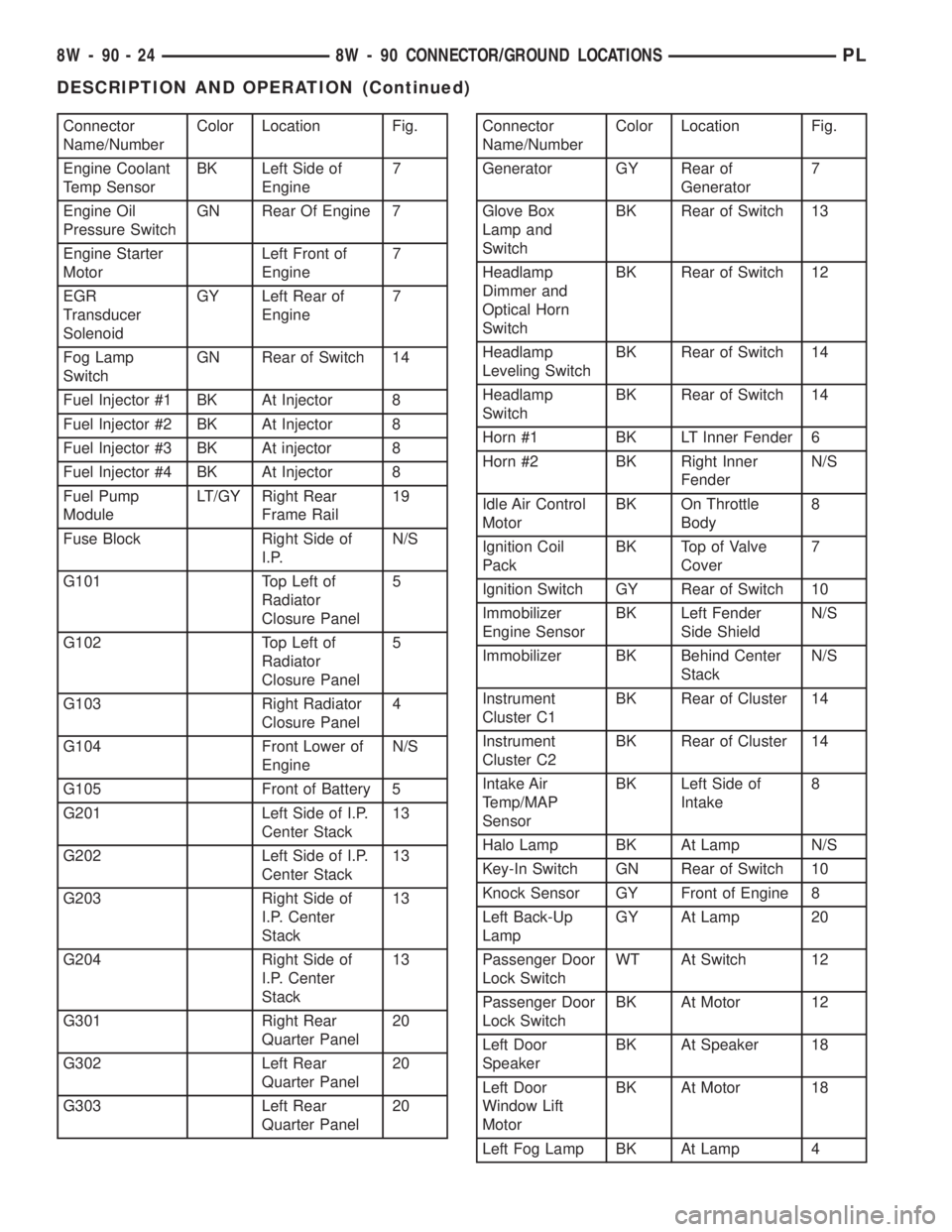
Connector
Name/NumberColor Location Fig.
Engine Coolant
Temp SensorBK Left Side of
Engine7
Engine Oil
Pressure SwitchGN Rear Of Engine 7
Engine Starter
MotorLeft Front of
Engine7
EGR
Transducer
SolenoidGY Left Rear of
Engine7
Fog Lamp
SwitchGN Rear of Switch 14
Fuel Injector #1 BK At Injector 8
Fuel Injector #2 BK At Injector 8
Fuel Injector #3 BK At injector 8
Fuel Injector #4 BK At Injector 8
Fuel Pump
ModuleLT/GY Right Rear
Frame Rail19
Fuse Block Right Side of
I.P.N/S
G101 Top Left of
Radiator
Closure Panel5
G102 Top Left of
Radiator
Closure Panel5
G103 Right Radiator
Closure Panel4
G104 Front Lower of
EngineN/S
G105 Front of Battery 5
G201 Left Side of I.P.
Center Stack13
G202 Left Side of I.P.
Center Stack13
G203 Right Side of
I.P. Center
Stack13
G204 Right Side of
I.P. Center
Stack13
G301 Right Rear
Quarter Panel20
G302 Left Rear
Quarter Panel20
G303 Left Rear
Quarter Panel20Connector
Name/NumberColor Location Fig.
Generator GY Rear of
Generator7
Glove Box
Lamp and
SwitchBK Rear of Switch 13
Headlamp
Dimmer and
Optical Horn
SwitchBK Rear of Switch 12
Headlamp
Leveling SwitchBK Rear of Switch 14
Headlamp
SwitchBK Rear of Switch 14
Horn #1 BK LT Inner Fender 6
Horn #2 BK Right Inner
FenderN/S
Idle Air Control
MotorBK On Throttle
Body8
Ignition Coil
PackBK Top of Valve
Cover7
Ignition Switch GY Rear of Switch 10
Immobilizer
Engine SensorBK Left Fender
Side ShieldN/S
Immobilizer BK Behind Center
StackN/S
Instrument
Cluster C1BK Rear of Cluster 14
Instrument
Cluster C2BK Rear of Cluster 14
Intake Air
Temp/MAP
SensorBK Left Side of
Intake8
Halo Lamp BK At Lamp N/S
Key-In Switch GN Rear of Switch 10
Knock Sensor GY Front of Engine 8
Left Back-Up
LampGY At Lamp 20
Passenger Door
Lock SwitchWT At Switch 12
Passenger Door
Lock SwitchBK At Motor 12
Left Door
SpeakerBK At Speaker 18
Left Door
Window Lift
MotorBK At Motor 18
Left Fog Lamp BK At Lamp 4
8W - 90 - 24 8W - 90 CONNECTOR/GROUND LOCATIONSPL
DESCRIPTION AND OPERATION (Continued)
Page 678 of 1200
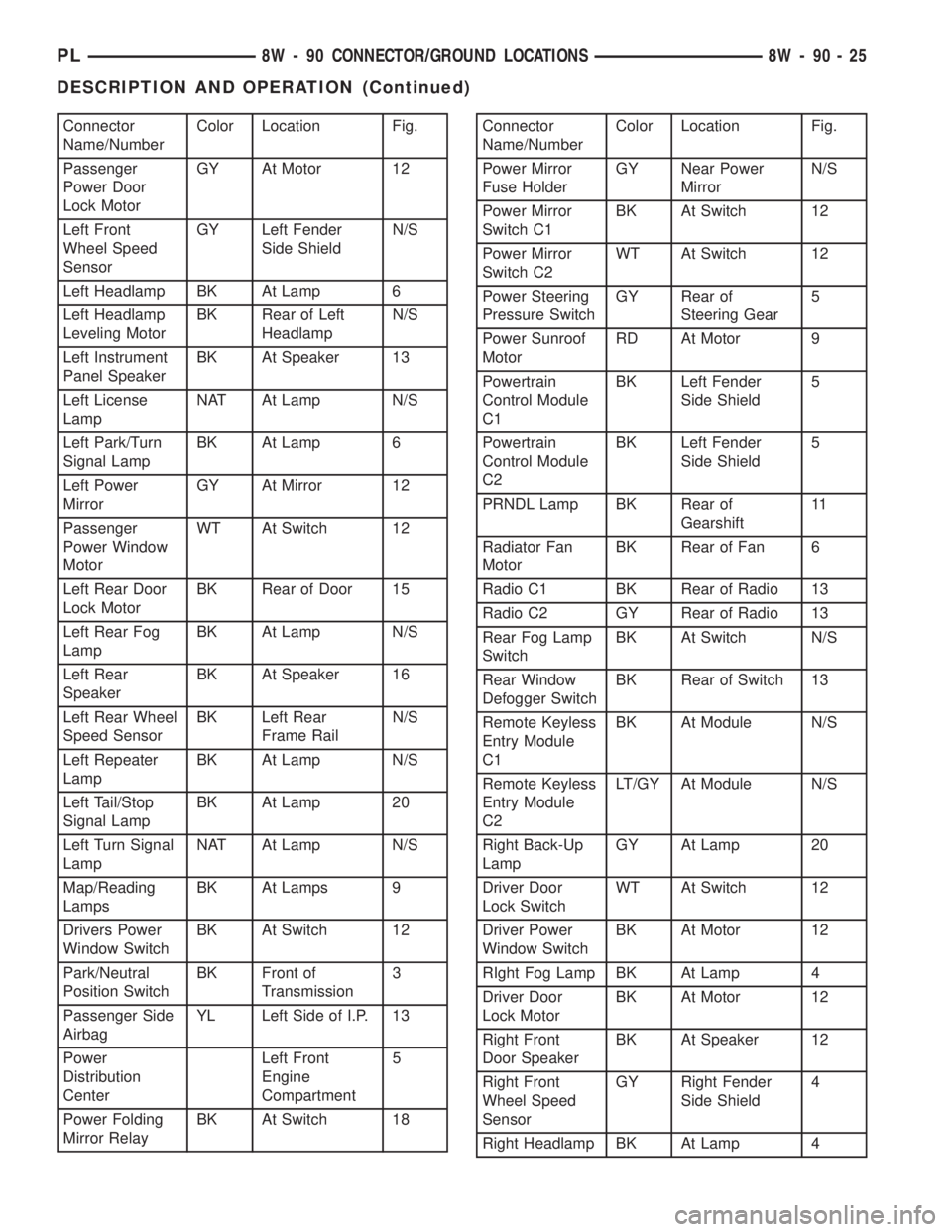
Connector
Name/NumberColor Location Fig.
Passenger
Power Door
Lock MotorGY At Motor 12
Left Front
Wheel Speed
SensorGY Left Fender
Side ShieldN/S
Left Headlamp BK At Lamp 6
Left Headlamp
Leveling MotorBK Rear of Left
HeadlampN/S
Left Instrument
Panel SpeakerBK At Speaker 13
Left License
LampNAT At Lamp N/S
Left Park/Turn
Signal LampBK At Lamp 6
Left Power
MirrorGY At Mirror 12
Passenger
Power Window
MotorWT At Switch 12
Left Rear Door
Lock MotorBK Rear of Door 15
Left Rear Fog
LampBK At Lamp N/S
Left Rear
SpeakerBK At Speaker 16
Left Rear Wheel
Speed SensorBK Left Rear
Frame RailN/S
Left Repeater
LampBK At Lamp N/S
Left Tail/Stop
Signal LampBK At Lamp 20
Left Turn Signal
LampNAT At Lamp N/S
Map/Reading
LampsBK At Lamps 9
Drivers Power
Window SwitchBK At Switch 12
Park/Neutral
Position SwitchBK Front of
Transmission3
Passenger Side
AirbagYL Left Side of I.P. 13
Power
Distribution
CenterLeft Front
Engine
Compartment5
Power Folding
Mirror RelayBK At Switch 18Connector
Name/NumberColor Location Fig.
Power Mirror
Fuse HolderGY Near Power
MirrorN/S
Power Mirror
Switch C1BK At Switch 12
Power Mirror
Switch C2WT At Switch 12
Power Steering
Pressure SwitchGY Rear of
Steering Gear5
Power Sunroof
MotorRD At Motor 9
Powertrain
Control Module
C1BK Left Fender
Side Shield5
Powertrain
Control Module
C2BK Left Fender
Side Shield5
PRNDL Lamp BK Rear of
Gearshift11
Radiator Fan
MotorBK Rear of Fan 6
Radio C1 BK Rear of Radio 13
Radio C2 GY Rear of Radio 13
Rear Fog Lamp
SwitchBK At Switch N/S
Rear Window
Defogger SwitchBK Rear of Switch 13
Remote Keyless
Entry Module
C1BK At Module N/S
Remote Keyless
Entry Module
C2LT/GY At Module N/S
Right Back-Up
LampGY At Lamp 20
Driver Door
Lock SwitchWT At Switch 12
Driver Power
Window SwitchBK At Motor 12
RIght Fog Lamp BK At Lamp 4
Driver Door
Lock MotorBK At Motor 12
Right Front
Door SpeakerBK At Speaker 12
Right Front
Wheel Speed
SensorGY Right Fender
Side Shield4
Right Headlamp BK At Lamp 4
PL8W - 90 CONNECTOR/GROUND LOCATIONS 8W - 90 - 25
DESCRIPTION AND OPERATION (Continued)
Page 847 of 1200
DIAGNOSIS AND TESTING
FUEL PUMP PRESSURE TEST
The fuel system operates at approximately 338 kPa
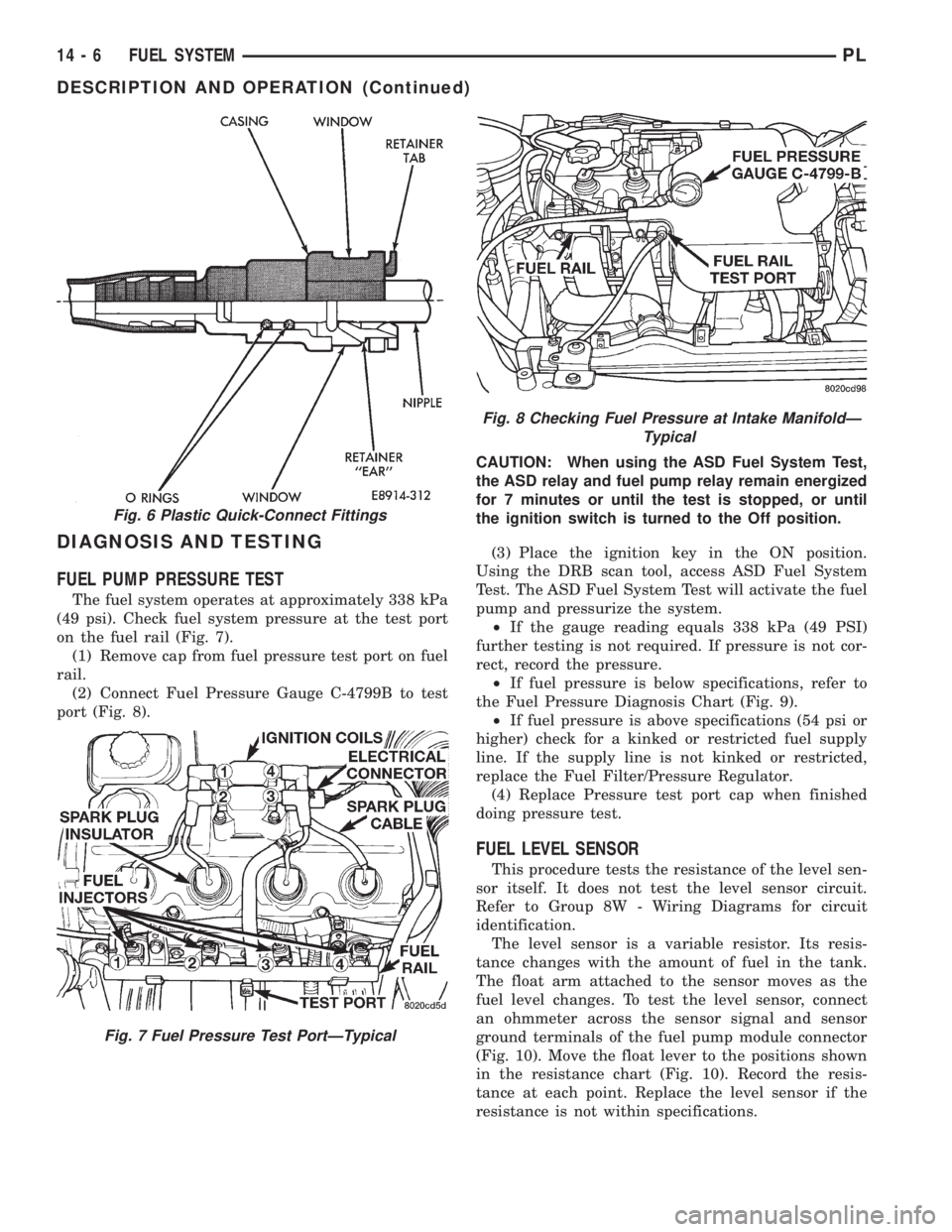
(49 psi). Check fuel system pressure at the test port
on the fuel rail (Fig. 7).
(1) Remove cap from fuel pressure test port on fuel
rail.
(2) Connect Fuel Pressure Gauge C-4799B to test
port (Fig. 8).CAUTION: When using the ASD Fuel System Test,
the ASD relay and fuel pump relay remain energized
for 7 minutes or until the test is stopped, or until
the ignition switch is turned to the Off position.
(3) Place the ignition key in the ON position.
Using the DRB scan tool, access ASD Fuel System
Test. The ASD Fuel System Test will activate the fuel
pump and pressurize the system.
²If the gauge reading equals 338 kPa (49 PSI)
further testing is not required. If pressure is not cor-
rect, record the pressure.
²If fuel pressure is below specifications, refer to
the Fuel Pressure Diagnosis Chart (Fig. 9).
²If fuel pressure is above specifications (54 psi or
higher) check for a kinked or restricted fuel supply
line. If the supply line is not kinked or restricted,
replace the Fuel Filter/Pressure Regulator.
(4) Replace Pressure test port cap when finished
doing pressure test.
FUEL LEVEL SENSOR
This procedure tests the resistance of the level sen-
sor itself. It does not test the level sensor circuit.
Refer to Group 8W - Wiring Diagrams for circuit
identification.
The level sensor is a variable resistor. Its resis-
tance changes with the amount of fuel in the tank.
The float arm attached to the sensor moves as the
fuel level changes. To test the level sensor, connect
an ohmmeter across the sensor signal and sensor
ground terminals of the fuel pump module connector
(Fig. 10). Move the float lever to the positions shown
in the resistance chart (Fig. 10). Record the resis-
tance at each point. Replace the level sensor if the
resistance is not within specifications.
Fig. 8 Checking Fuel Pressure at Intake ManifoldÐ
Typical
Fig. 6 Plastic Quick-Connect Fittings
Fig. 7 Fuel Pressure Test PortÐTypical
14 - 6 FUEL SYSTEMPL
DESCRIPTION AND OPERATION (Continued)
Page 862 of 1200

GENERAL INFORMATION
INTRODUCTION
All engines used in this section have a sequential
Multi-Port Electronic Fuel Injection system. The MPI
system is computer regulated and provides precise
air/fuel ratios for all driving conditions. The Power-
train Control Module (PCM) operates the fuel injec-
tion system.
The PCM regulates:
²Ignition timing
²Air/fuel ratio
²Emission control devices
²Cooling fan
²Charging system
²Idle speed
²Vehicle speed control
Various sensors provide the inputs necessary for
the PCM to correctly operate these systems. In addi-
tion to the sensors, various switches also provide
inputs to the PCM.
All inputs to the PCM are converted into signals.
The PCM can adapt its programming to meet chang-
ing operating conditions.
Fuel is injected into the intake port above the
intake valve in precise metered amounts through
electrically operated injectors. The PCM fires the
injectors in a specific sequence. Under most operat-
ing conditions, the PCM maintains an air fuel ratio
of 14.7 parts air to 1 part fuel by constantly adjust-
ing injector pulse width. Injector pulse width is the
length of time the injector is open.
The PCM adjusts injector pulse width by opening
and closing the ground path to the injector. Engine
RPM (speed) and manifold absolute pressure (air
density) are the primary inputs that determine injec-
tor pulse width.
MODES OF OPERATION
As input signals to the PCM change, the PCM
adjusts its response to output devices. For example,
the PCM must calculate a different injector pulse
width and ignition timing for idle than it does for
Wide Open Throttle (WOT). There are several differ-
ent modes of operation that determine how the PCM
responds to the various input signals.
There are two different areas of operation, OPEN
LOOP and CLOSED LOOP.
During OPEN LOOP modes the PCM receives
input signals and responds according to preset PCM
programming. Inputs from the upstream and down-
stream heated oxygen sensors are not monitored dur-
ing OPEN LOOP modes, except for heated oxygen
sensor diagnostics (they are checked for shorted con-
ditions at all times).During CLOSED LOOP modes the PCM monitors
the inputs from the upstream and downstream
heated oxygen sensors. The upstream heated oxygen
sensor input tells the PCM if the calculated injector
pulse width resulted in the ideal air-fuel ratio of 14.7
to one. By monitoring the exhaust oxygen content
through the upstream heated oxygen sensor, the
PCM can fine tune injector pulse width. Fine tuning
injector pulse width allows the PCM to achieve opti-
mum fuel economy combined with low emissions.
For the PCM to enter CLOSED LOOP operation,
the following must occur:
(1) Engine coolant temperature must be over 35ÉF.
²If the coolant is over 35É the PCM will wait 44
seconds.
²If the coolant is over 50ÉF the PCM will wait 38
seconds.
²If the coolant is over 167ÉF the PCM will wait
11 seconds.
(2) For other temperatures the PCM will interpo-
late the correct waiting time.
(3) O2 sensor must read either greater than .745
volts or less than .1 volt.
(4) The multi-port fuel injection systems has the
following modes of operation:
²Ignition switch ON (Zero RPM)
²Engine start-up
²Engine warm-up
²Cruise
²Idle
²Acceleration
²Deceleration
²Wide Open Throttle
²Ignition switch OFF
(5) The engine start-up (crank), engine warm-up,
deceleration with fuel shutoff and wide open throttle
modes are OPEN LOOP modes. Under most operat-
ing conditions, the acceleration, deceleration (with
A/C on), idle and cruise modes,with the engine at
operating temperatureare CLOSED LOOP modes.
IGNITION SWITCH ON (ZERO RPM) MODE
When the ignition switch activates the fuel injec-
tion system, the following actions occur:
²The PCM monitors the engine coolant tempera-
ture sensor and throttle position sensor input. The
PCM determines basic fuel injector pulse width from
this input.
²The PCM determines atmospheric air pressure
from the MAP sensor input to modify injector pulse
width.
When the key is in the ON position and the engine
is not running (zero rpm), the Auto Shutdown (ASD)
and fuel pump relays de-energize after approximately
1 second. Therefore, battery voltage is not supplied to
the fuel pump, ignition coil, fuel injectors and heated
oxygen sensors.
PLFUEL SYSTEM 14 - 21
Page 870 of 1200
As Intake Air temperature varies the Intake Air
Temperature sensors resistance changes resulting in
a different input voltage to the PCM.
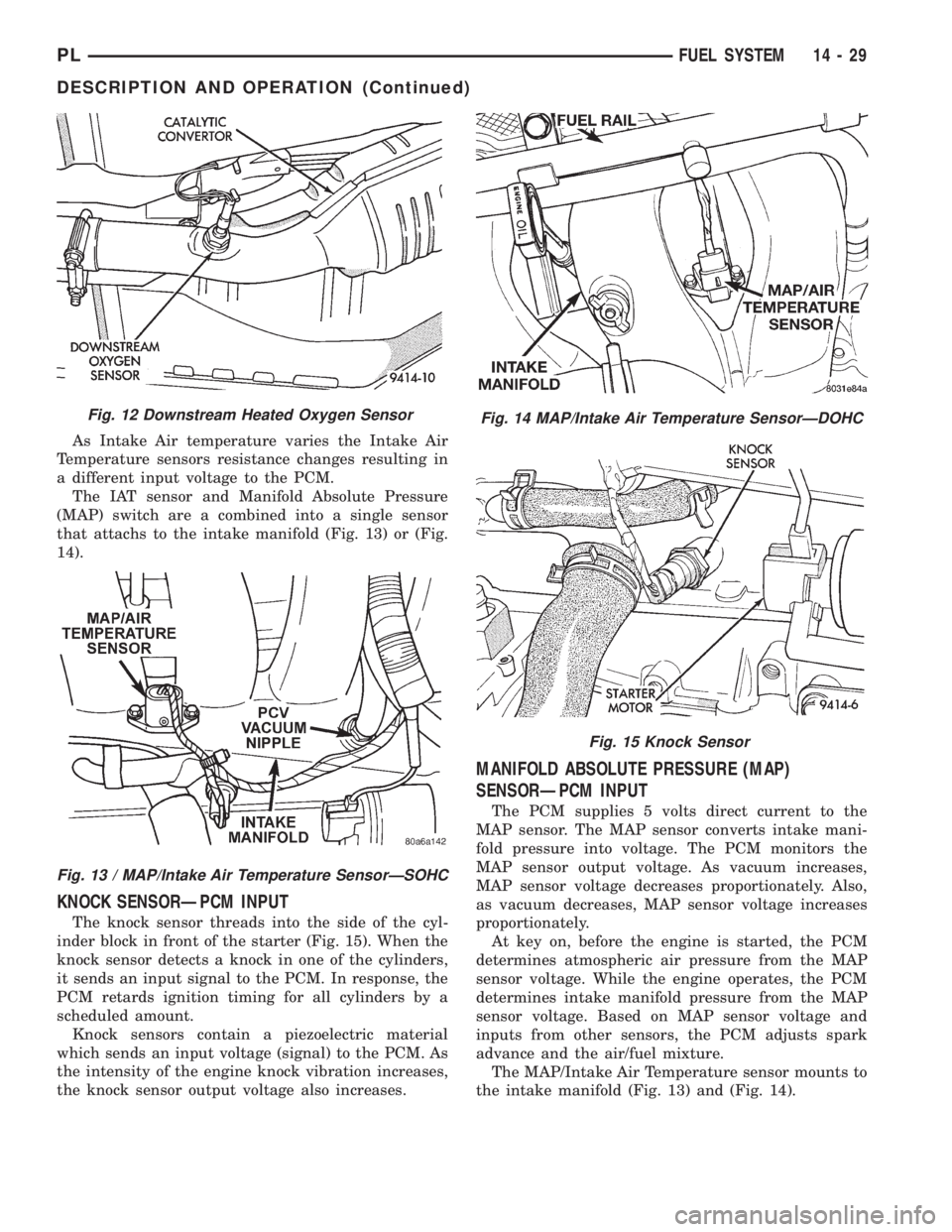
The IAT sensor and Manifold Absolute Pressure
(MAP) switch are a combined into a single sensor
that attachs to the intake manifold (Fig. 13) or (Fig.
14).
KNOCK SENSORÐPCM INPUT
The knock sensor threads into the side of the cyl-
inder block in front of the starter (Fig. 15). When the
knock sensor detects a knock in one of the cylinders,
it sends an input signal to the PCM. In response, the
PCM retards ignition timing for all cylinders by a
scheduled amount.
Knock sensors contain a piezoelectric material
which sends an input voltage (signal) to the PCM. As
the intensity of the engine knock vibration increases,
the knock sensor output voltage also increases.
MANIFOLD ABSOLUTE PRESSURE (MAP)
SENSORÐPCM INPUT
The PCM supplies 5 volts direct current to the
MAP sensor. The MAP sensor converts intake mani-
fold pressure into voltage. The PCM monitors the
MAP sensor output voltage. As vacuum increases,
MAP sensor voltage decreases proportionately. Also,
as vacuum decreases, MAP sensor voltage increases
proportionately.
At key on, before the engine is started, the PCM
determines atmospheric air pressure from the MAP
sensor voltage. While the engine operates, the PCM
determines intake manifold pressure from the MAP
sensor voltage. Based on MAP sensor voltage and
inputs from other sensors, the PCM adjusts spark
advance and the air/fuel mixture.
The MAP/Intake Air Temperature sensor mounts to
the intake manifold (Fig. 13) and (Fig. 14).
Fig. 12 Downstream Heated Oxygen Sensor
Fig. 13 / MAP/Intake Air Temperature SensorÐSOHC
Fig. 14 MAP/Intake Air Temperature SensorÐDOHC
Fig. 15 Knock Sensor
PLFUEL SYSTEM 14 - 29
DESCRIPTION AND OPERATION (Continued)
Page 875 of 1200
FUEL INJECTORSÐPCM OUTPUT
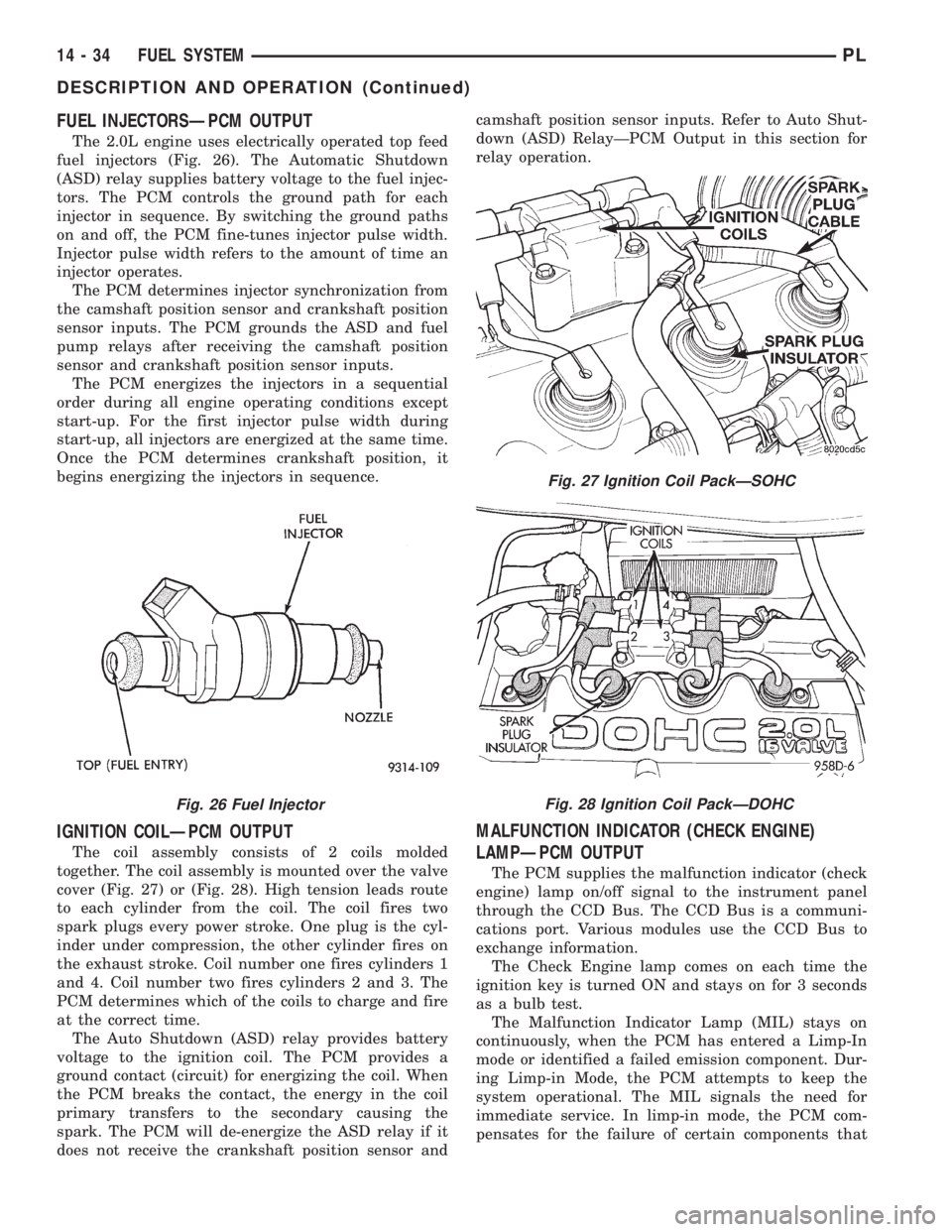
The 2.0L engine uses electrically operated top feed
fuel injectors (Fig. 26). The Automatic Shutdown
(ASD) relay supplies battery voltage to the fuel injec-
tors. The PCM controls the ground path for each
injector in sequence. By switching the ground paths
on and off, the PCM fine-tunes injector pulse width.
Injector pulse width refers to the amount of time an
injector operates.
The PCM determines injector synchronization from
the camshaft position sensor and crankshaft position
sensor inputs. The PCM grounds the ASD and fuel
pump relays after receiving the camshaft position
sensor and crankshaft position sensor inputs.
The PCM energizes the injectors in a sequential
order during all engine operating conditions except
start-up. For the first injector pulse width during
start-up, all injectors are energized at the same time.
Once the PCM determines crankshaft position, it
begins energizing the injectors in sequence.
IGNITION COILÐPCM OUTPUT
The coil assembly consists of 2 coils molded
together. The coil assembly is mounted over the valve
cover (Fig. 27) or (Fig. 28). High tension leads route
to each cylinder from the coil. The coil fires two
spark plugs every power stroke. One plug is the cyl-
inder under compression, the other cylinder fires on
the exhaust stroke. Coil number one fires cylinders 1
and 4. Coil number two fires cylinders 2 and 3. The
PCM determines which of the coils to charge and fire
at the correct time.
The Auto Shutdown (ASD) relay provides battery
voltage to the ignition coil. The PCM provides a
ground contact (circuit) for energizing the coil. When
the PCM breaks the contact, the energy in the coil
primary transfers to the secondary causing the
spark. The PCM will de-energize the ASD relay if it
does not receive the crankshaft position sensor andcamshaft position sensor inputs. Refer to Auto Shut-
down (ASD) RelayÐPCM Output in this section for
relay operation.
MALFUNCTION INDICATOR (CHECK ENGINE)
LAMPÐPCM OUTPUT
The PCM supplies the malfunction indicator (check
engine) lamp on/off signal to the instrument panel
through the CCD Bus. The CCD Bus is a communi-
cations port. Various modules use the CCD Bus to
exchange information.
The Check Engine lamp comes on each time the
ignition key is turned ON and stays on for 3 seconds
as a bulb test.
The Malfunction Indicator Lamp (MIL) stays on
continuously, when the PCM has entered a Limp-In
mode or identified a failed emission component. Dur-
ing Limp-in Mode, the PCM attempts to keep the
system operational. The MIL signals the need for
immediate service. In limp-in mode, the PCM com-
pensates for the failure of certain components that
Fig. 26 Fuel Injector
Fig. 27 Ignition Coil PackÐSOHC
Fig. 28 Ignition Coil PackÐDOHC
14 - 34 FUEL SYSTEMPL
DESCRIPTION AND OPERATION (Continued)
Page 888 of 1200

(7) Attach the other end of the jumper wire to
relay terminal 86. This activates the relay. The ohm-
meter should now show continuity between relay ter-
minals 87 and 30. The ohmmeter should not show
continuity between relay terminals 87A and 30.
(8) Disconnect jumper wires.
(9) Replace the relay if it did not pass the continu-
ity and resistance tests. If the relay passed the tests,
it operates properly. Check the remainder of the ASD
and fuel pump relay circuits. Refer to group 8W, Wir-
ing Diagrams.
CAMSHAFT AND CRANKSHAFT POSITION SENSOR
Refer to Group 8D, Ignition for Diagnosis and Test-
ing of Camshaft and Crankshaft Sensors.
ENGINE COOLANT TEMPERATURE SENSOR
(1) With the key off, disconnect wire harness con-
nector from coolant temperature sensor (Fig. 79) or
(Fig. 80).(2) Connect a high input impedance (digital) volt-
ohmmeter to terminals A and B (Fig. 81). The ohm-
meter should read as follows:
²Engine/Sensor at normal operating temperature
around 200ÉF should read approximately 700 to
1,000 ohms.
²Engine/Sensor at room temperature around 70ÉF
ohmmeter should read approximately 7,000 to 13,000
ohms.
(3) T
est the resistance of the wire harness between
the PCM 60-way connector terminal 28 and the sensor
harness connector. Also check for continuity between
PCM 60-way connector terminal 51 and the sensor har-
ness connector. Refer to Group 8W, Wiring diagrams for
circuit information. If the resistance is greater than 1
ohm, repair the wire harness as necessary.
HEATED OXYGEN SENSOR
Use an ohmmeter to test the heating element of
the oxygen sensors. Disconnect the electrical connec-
tor from each oxygen sensor. The white wires in the
sensor connector are the power and ground circuits
for the heater. Connect the ohmmeter test leads to
terminals of the white wires in the heated oxygen
sensor connector. Replace the heated oxygen sensor if
the resistance is not between 4 and 7 ohms.
IDLE AIR CONTROL (IAC) MOTOR TEST
To preform a complete test of IAC motor and its
circuitry, refer to DRB scan tool and the appropriate
Powertrain Diagnostics Procedures manual.
KNOCK SENSOR
The engine knock sensor is affected by a number of
factors. A few of these are: ignition timing, cylinder
pressure, fuel octane, etc. The knock sensor generates
an AC voltage whose amplitude increases with the
increase of engine knock. The knock sensor can be
tested with a digital voltmeter. The RMS voltage starts
Fig. 79 Engine Coolant Temperature Sensor
LocationÐSOHC
Fig. 80 Engine Coolant Temperature Sensor
LocationÐDOHC
Fig. 81 Engine Coolant Temperature Sensor
PLFUEL SYSTEM 14 - 47
DIAGNOSIS AND TESTING (Continued)