Page 880 of 1200
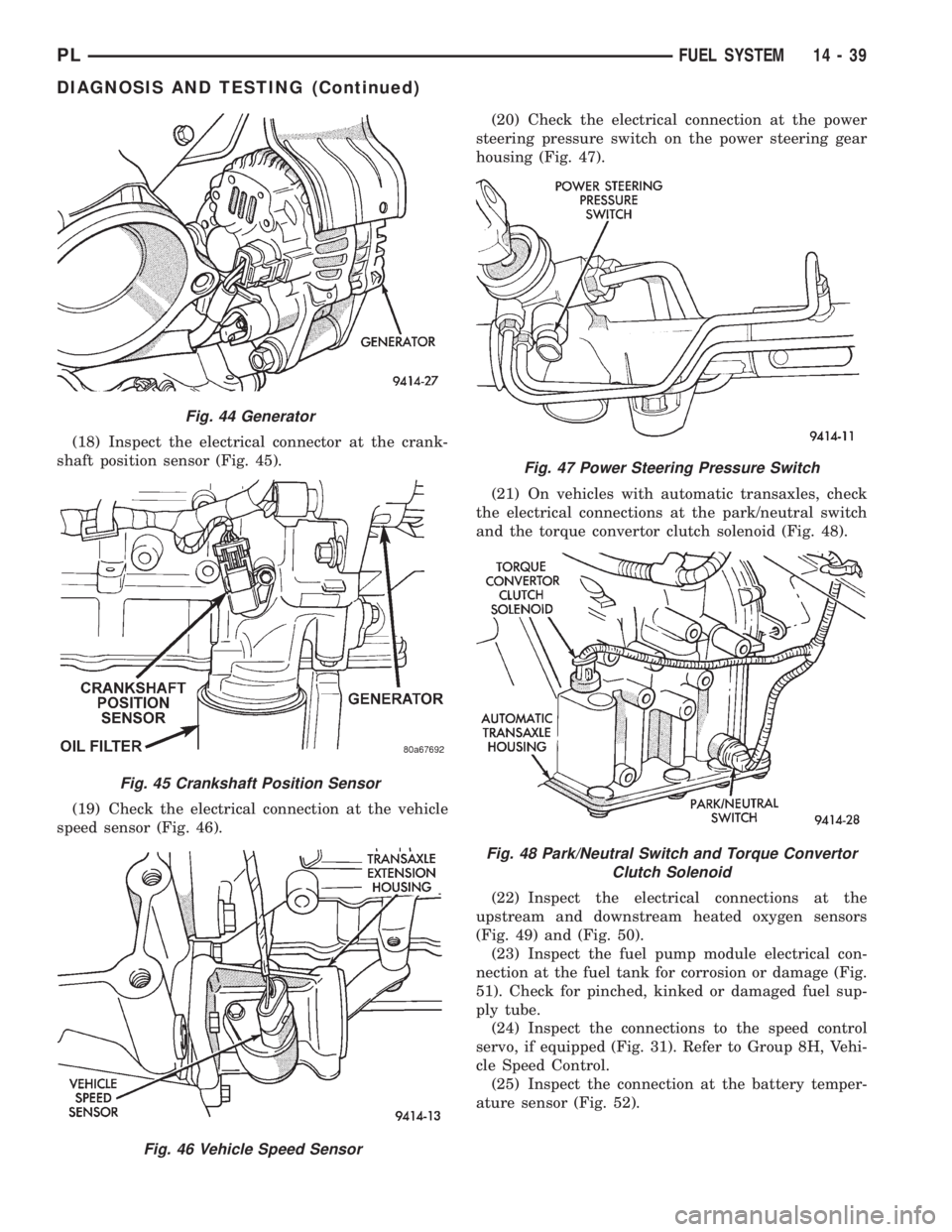
(18) Inspect the electrical connector at the crank-
shaft position sensor (Fig. 45).
(19) Check the electrical connection at the vehicle
speed sensor (Fig. 46).(20) Check the electrical connection at the power
steering pressure switch on the power steering gear
housing (Fig. 47).
(21) On vehicles with automatic transaxles, check
the electrical connections at the park/neutral switch
and the torque convertor clutch solenoid (Fig. 48).
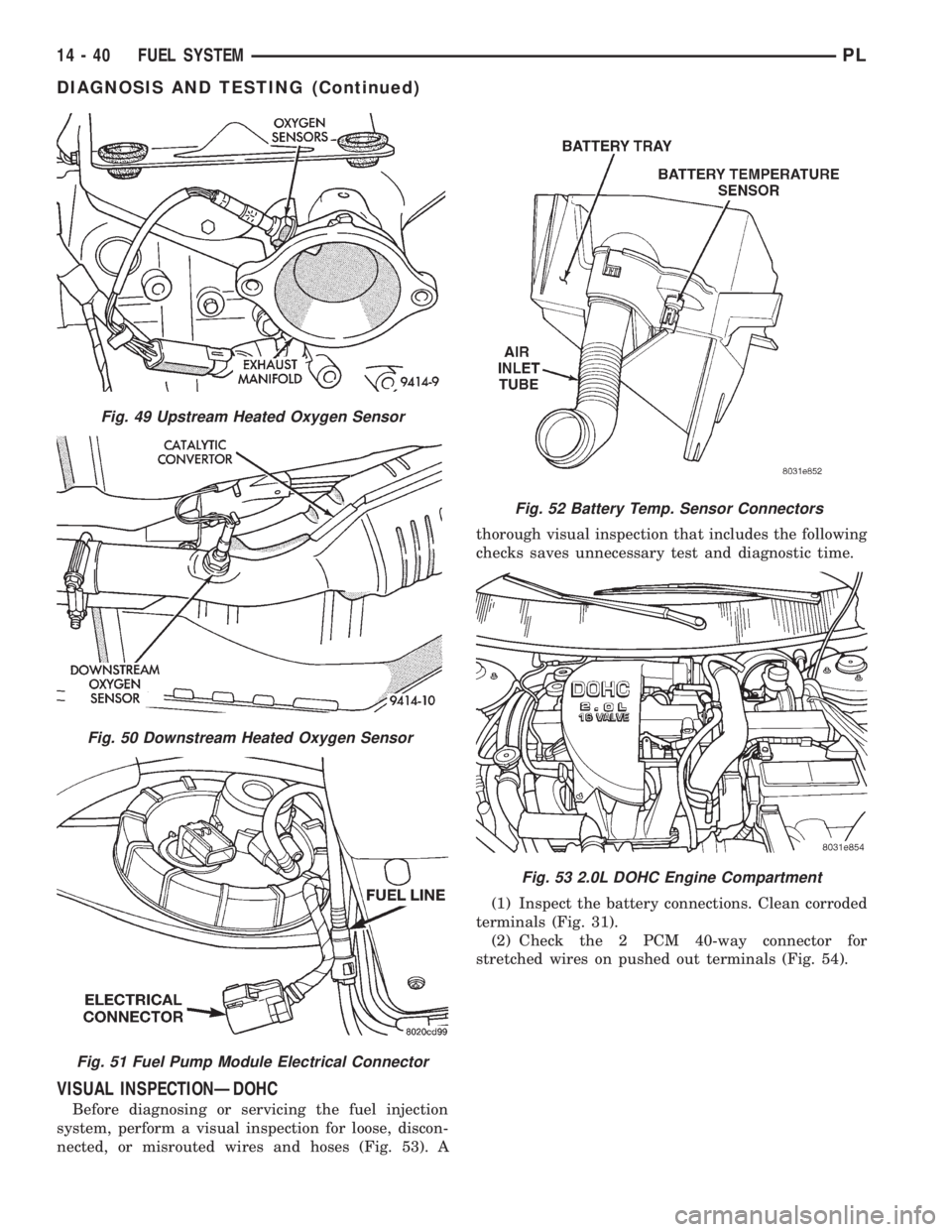
(22) Inspect the electrical connections at the
upstream and downstream heated oxygen sensors
(Fig. 49) and (Fig. 50).
(23) Inspect the fuel pump module electrical con-
nection at the fuel tank for corrosion or damage (Fig.
51). Check for pinched, kinked or damaged fuel sup-
ply tube.
(24) Inspect the connections to the speed control
servo, if equipped (Fig. 31). Refer to Group 8H, Vehi-
cle Speed Control.
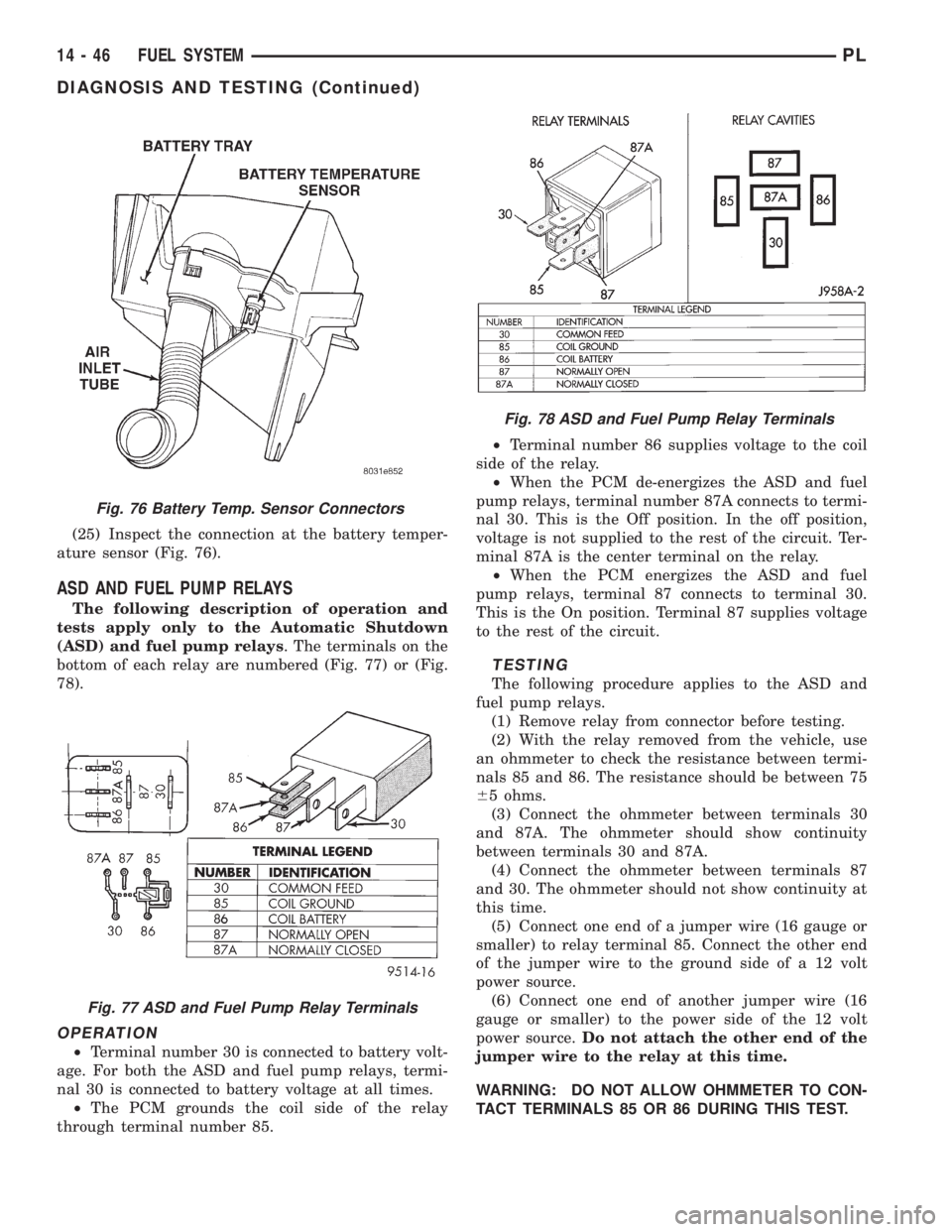
(25) Inspect the connection at the battery temper-
ature sensor (Fig. 52).
Fig. 44 Generator
Fig. 45 Crankshaft Position Sensor
Fig. 46 Vehicle Speed Sensor
Fig. 47 Power Steering Pressure Switch
Fig. 48 Park/Neutral Switch and Torque Convertor
Clutch Solenoid
PLFUEL SYSTEM 14 - 39
DIAGNOSIS AND TESTING (Continued)
Page 881 of 1200
VISUAL INSPECTIONÐDOHC
Before diagnosing or servicing the fuel injection
system, perform a visual inspection for loose, discon-
nected, or misrouted wires and hoses (Fig. 53). Athorough visual inspection that includes the following
checks saves unnecessary test and diagnostic time.
(1) Inspect the battery connections. Clean corroded
terminals (Fig. 31).
(2) Check the 2 PCM 40-way connector for
stretched wires on pushed out terminals (Fig. 54).
Fig. 49 Upstream Heated Oxygen Sensor
Fig. 50 Downstream Heated Oxygen Sensor
Fig. 51 Fuel Pump Module Electrical Connector
Fig. 52 Battery Temp. Sensor Connectors
Fig. 53 2.0L DOHC Engine Compartment
14 - 40 FUEL SYSTEMPL
DIAGNOSIS AND TESTING (Continued)
Page 882 of 1200
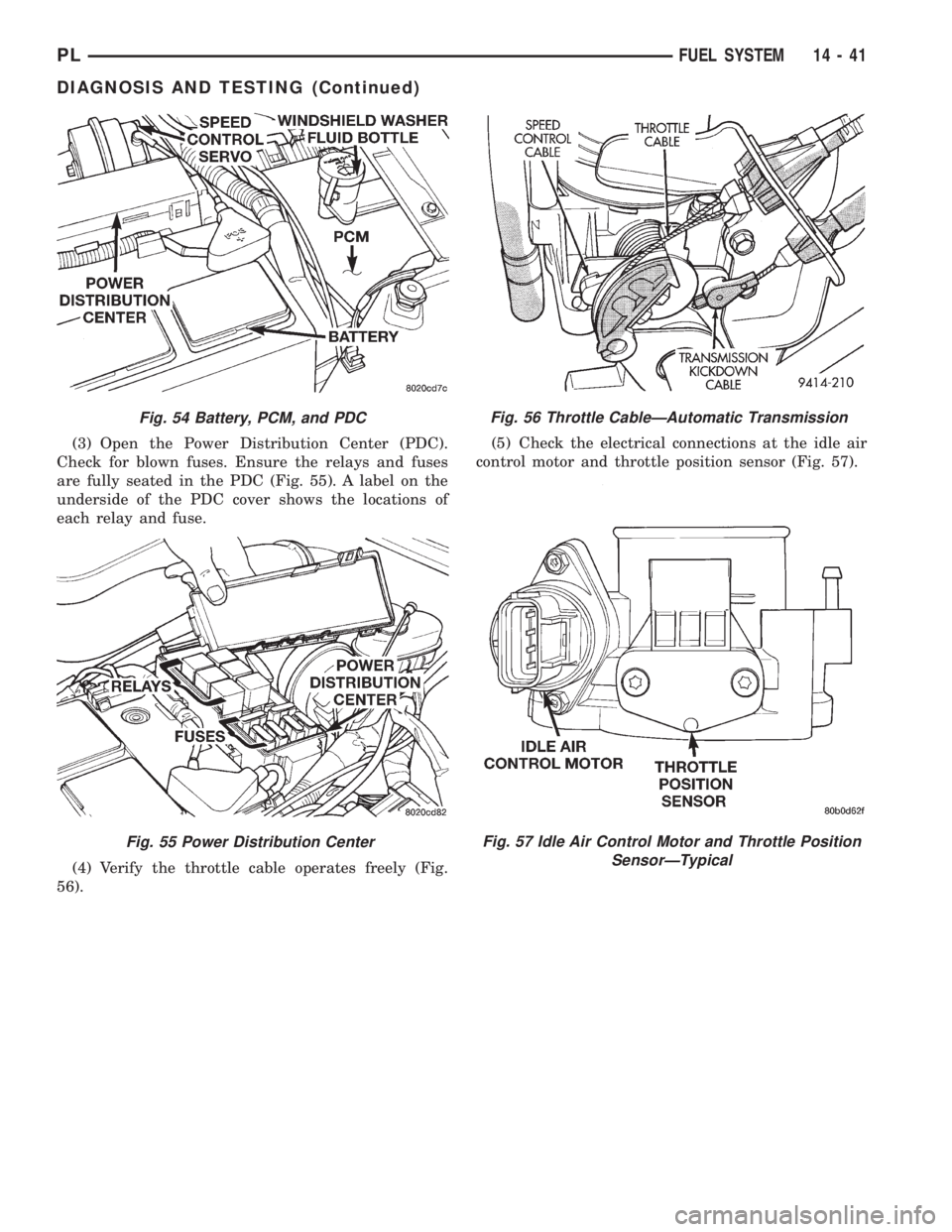
(3) Open the Power Distribution Center (PDC).
Check for blown fuses. Ensure the relays and fuses
are fully seated in the PDC (Fig. 55). A label on the
underside of the PDC cover shows the locations of
each relay and fuse.
(4) Verify the throttle cable operates freely (Fig.
56).(5) Check the electrical connections at the idle air
control motor and throttle position sensor (Fig. 57).
Fig. 54 Battery, PCM, and PDC
Fig. 55 Power Distribution Center
Fig. 56 Throttle CableÐAutomatic Transmission
Fig. 57 Idle Air Control Motor and Throttle Position
SensorÐTypical
PLFUEL SYSTEM 14 - 41
DIAGNOSIS AND TESTING (Continued)
Page 883 of 1200
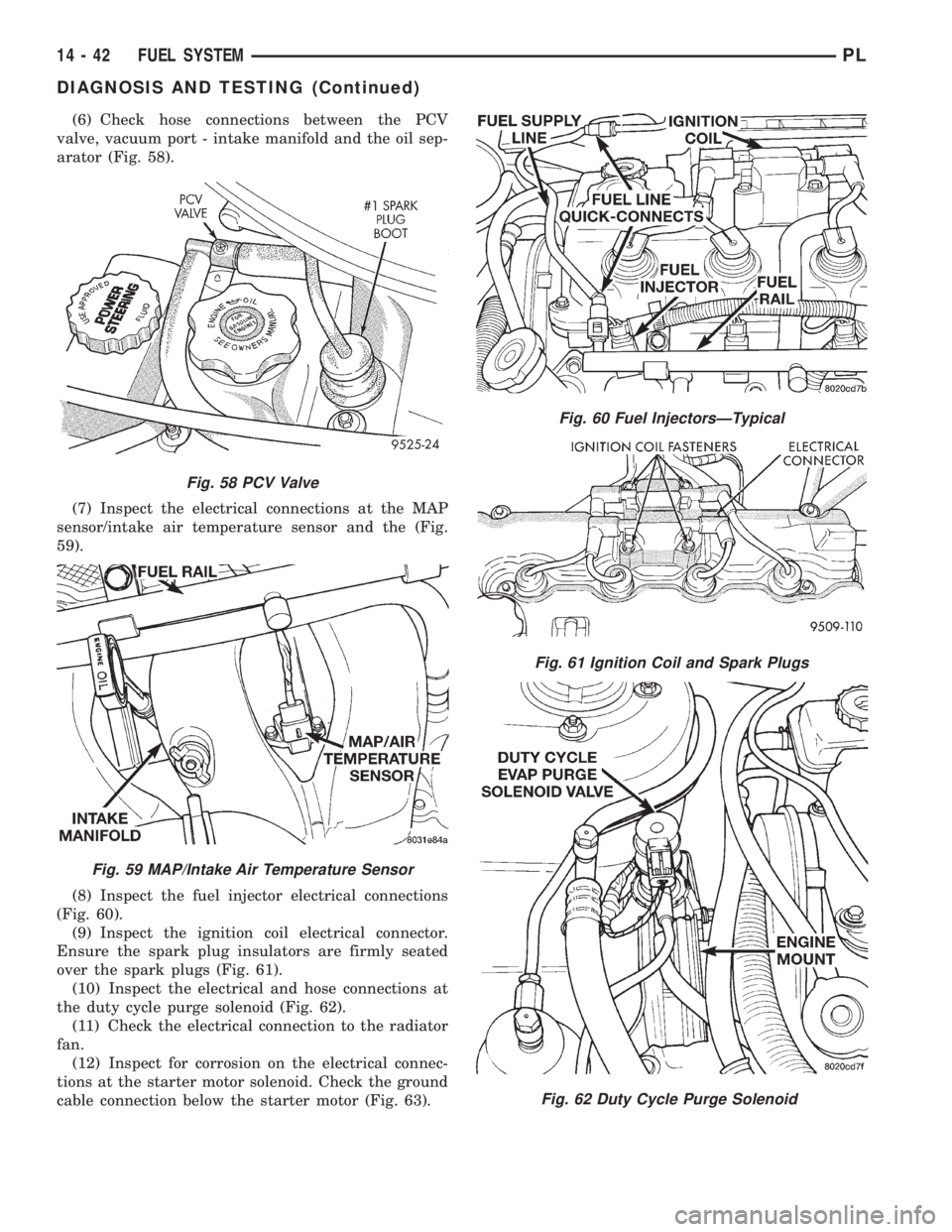
(6) Check hose connections between the PCV
valve, vacuum port - intake manifold and the oil sep-
arator (Fig. 58).
(7) Inspect the electrical connections at the MAP
sensor/intake air temperature sensor and the (Fig.
59).
(8) Inspect the fuel injector electrical connections
(Fig. 60).
(9) Inspect the ignition coil electrical connector.
Ensure the spark plug insulators are firmly seated
over the spark plugs (Fig. 61).
(10) Inspect the electrical and hose connections at
the duty cycle purge solenoid (Fig. 62).
(11) Check the electrical connection to the radiator
fan.
(12) Inspect for corrosion on the electrical connec-
tions at the starter motor solenoid. Check the ground
cable connection below the starter motor (Fig. 63).
Fig. 58 PCV Valve
Fig. 59 MAP/Intake Air Temperature Sensor
Fig. 60 Fuel InjectorsÐTypical
Fig. 61 Ignition Coil and Spark Plugs
Fig. 62 Duty Cycle Purge Solenoid
14 - 42 FUEL SYSTEMPL
DIAGNOSIS AND TESTING (Continued)
Page 884 of 1200
(13) Inspect the air cleaner filter element. Replace
as necessary. Check the air induction system for
restrictions.
(14) Check the electrical connection at the knock
sensor (Fig. 64).
(15) Check the electrical connections at the cam-
shaft position sensor (Fig. 65) and engine coolant
temperature sensor (Fig. 66).
(16) Check the electrical connector at the Elec-
tronic EGR Transducer. Inspect the vacuum and back
pressure hoses at the solenoid and transducer for
leaks (Fig. 67).
(17) Inspect the electrical connections at the gen-
erator (Fig. 68). Check the generator belt for glazing
or damage.
Fig. 63 Starter Motor and Ground Strap
Fig. 64 Knock Sensor
Fig. 65 Camshaft Position Sensor
Fig. 66 Engine Coolant Temperature Sensor
Fig. 67 Electronic EGR Transducer
PLFUEL SYSTEM 14 - 43
DIAGNOSIS AND TESTING (Continued)
Page 885 of 1200
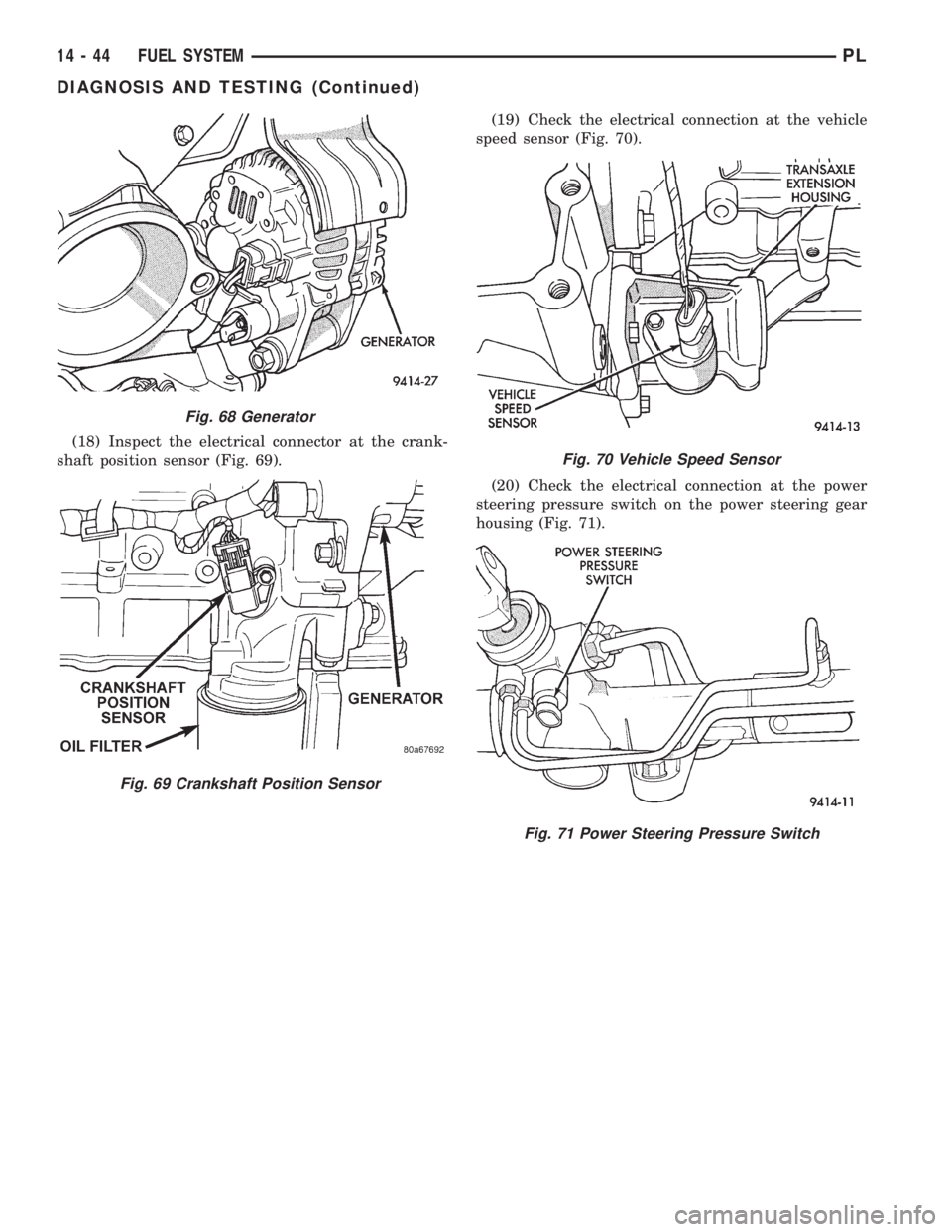
(18) Inspect the electrical connector at the crank-
shaft position sensor (Fig. 69).(19) Check the electrical connection at the vehicle
speed sensor (Fig. 70).
(20) Check the electrical connection at the power
steering pressure switch on the power steering gear
housing (Fig. 71).
Fig. 68 Generator
Fig. 69 Crankshaft Position Sensor
Fig. 70 Vehicle Speed Sensor
Fig. 71 Power Steering Pressure Switch
14 - 44 FUEL SYSTEMPL
DIAGNOSIS AND TESTING (Continued)
Page 886 of 1200
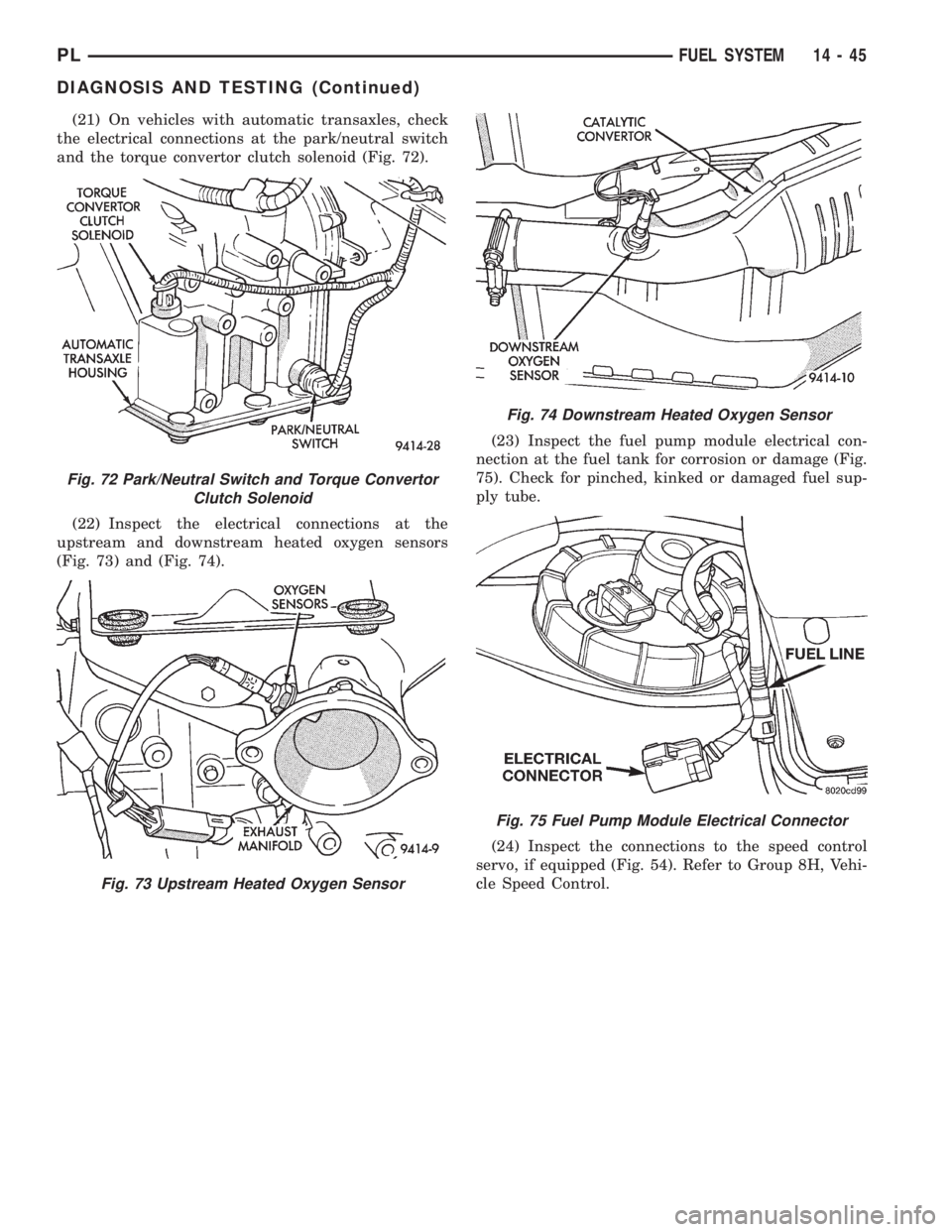
(21) On vehicles with automatic transaxles, check
the electrical connections at the park/neutral switch
and the torque convertor clutch solenoid (Fig. 72).
(22) Inspect the electrical connections at the
upstream and downstream heated oxygen sensors
(Fig. 73) and (Fig. 74).(23) Inspect the fuel pump module electrical con-
nection at the fuel tank for corrosion or damage (Fig.
75). Check for pinched, kinked or damaged fuel sup-
ply tube.
(24) Inspect the connections to the speed control
servo, if equipped (Fig. 54). Refer to Group 8H, Vehi-
cle Speed Control.
Fig. 72 Park/Neutral Switch and Torque Convertor
Clutch Solenoid
Fig. 73 Upstream Heated Oxygen Sensor
Fig. 74 Downstream Heated Oxygen Sensor
Fig. 75 Fuel Pump Module Electrical Connector
PLFUEL SYSTEM 14 - 45
DIAGNOSIS AND TESTING (Continued)
Page 887 of 1200
(25) Inspect the connection at the battery temper-
ature sensor (Fig. 76).
ASD AND FUEL PUMP RELAYS
The following description of operation and
tests apply only to the Automatic Shutdown
(ASD) and fuel pump relays. The terminals on the
bottom of each relay are numbered (Fig. 77) or (Fig.
78).
OPERATION
²Terminal number 30 is connected to battery volt-
age. For both the ASD and fuel pump relays, termi-
nal 30 is connected to battery voltage at all times.
²The PCM grounds the coil side of the relay
through terminal number 85.²Terminal number 86 supplies voltage to the coil
side of the relay.
²When the PCM de-energizes the ASD and fuel
pump relays, terminal number 87A connects to termi-
nal 30. This is the Off position. In the off position,
voltage is not supplied to the rest of the circuit. Ter-
minal 87A is the center terminal on the relay.
²When the PCM energizes the ASD and fuel
pump relays, terminal 87 connects to terminal 30.
This is the On position. Terminal 87 supplies voltage
to the rest of the circuit.
TESTING
The following procedure applies to the ASD and
fuel pump relays.
(1) Remove relay from connector before testing.
(2) With the relay removed from the vehicle, use
an ohmmeter to check the resistance between termi-
nals 85 and 86. The resistance should be between 75
65 ohms.
(3) Connect the ohmmeter between terminals 30
and 87A. The ohmmeter should show continuity
between terminals 30 and 87A.
(4) Connect the ohmmeter between terminals 87
and 30. The ohmmeter should not show continuity at
this time.
(5) Connect one end of a jumper wire (16 gauge or
smaller) to relay terminal 85. Connect the other end
of the jumper wire to the ground side of a 12 volt
power source.
(6) Connect one end of another jumper wire (16
gauge or smaller) to the power side of the 12 volt
power source.Do not attach the other end of the
jumper wire to the relay at this time.
WARNING: DO NOT ALLOW OHMMETER TO CON-
TACT TERMINALS 85 OR 86 DURING THIS TEST.
Fig. 76 Battery Temp. Sensor Connectors
Fig. 77 ASD and Fuel Pump Relay Terminals
Fig. 78 ASD and Fuel Pump Relay Terminals
14 - 46 FUEL SYSTEMPL
DIAGNOSIS AND TESTING (Continued)