Page 186 of 328
yellowblue
5-26
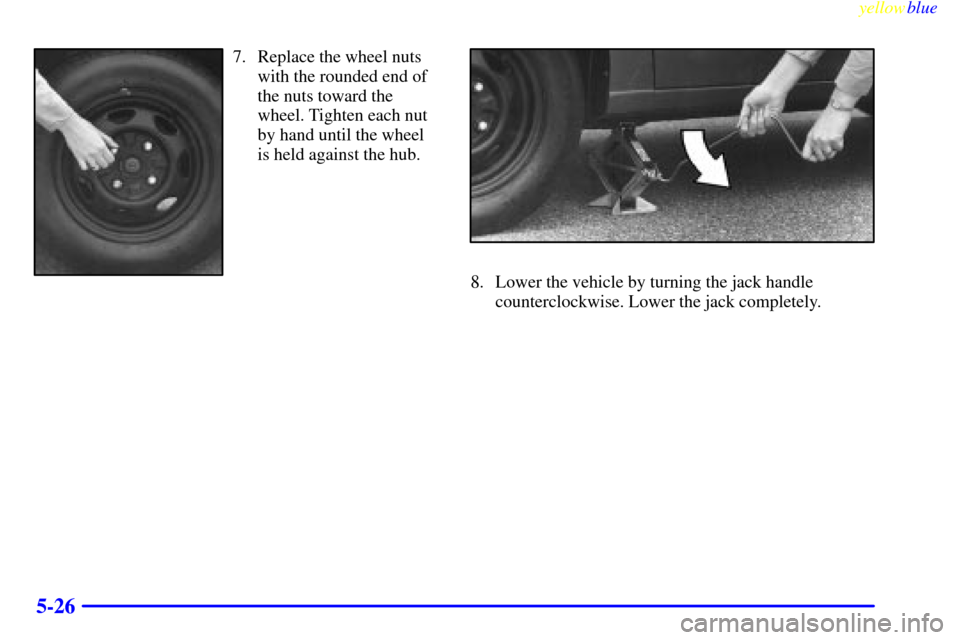
7. Replace the wheel nuts
with the rounded end of
the nuts toward the
wheel. Tighten each nut
by hand until the wheel
is held against the hub.
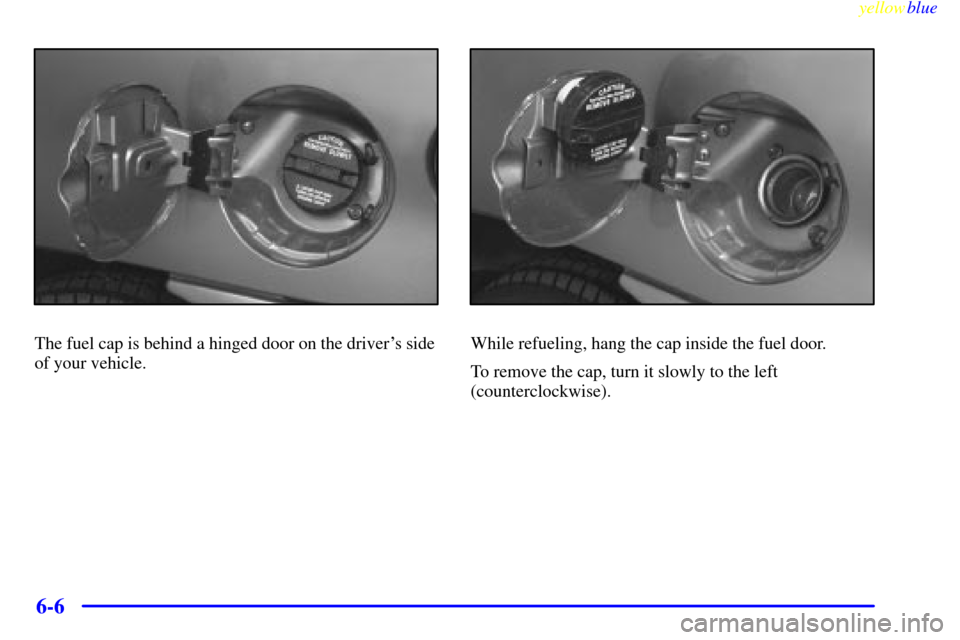
8. Lower the vehicle by turning the jack handle
counterclockwise. Lower the jack completely.
Page 198 of 328
yellowblue
6-6
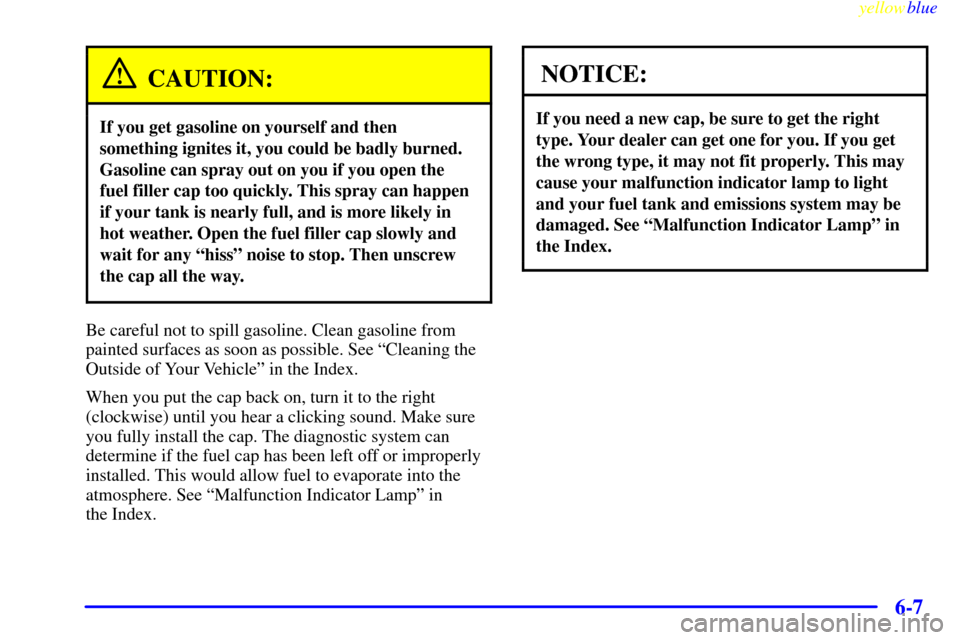
The fuel cap is behind a hinged door on the driver's side
of your vehicle.While refueling, hang the cap inside the fuel door.
To remove the cap, turn it slowly to the left
(counterclockwise).
Page 199 of 328
yellowblue
6-7
CAUTION:
If you get gasoline on yourself and then
something ignites it, you could be badly burned.
Gasoline can spray out on you if you open the
fuel filler cap too quickly. This spray can happen
if your tank is nearly full, and is more likely in
hot weather. Open the fuel filler cap slowly and
wait for any ªhissº noise to stop. Then unscrew
the cap all the way.
Be careful not to spill gasoline. Clean gasoline from
painted surfaces as soon as possible. See ªCleaning the
Outside of Your Vehicleº in the Index.
When you put the cap back on, turn it to the right
(clockwise) until you hear a clicking sound. Make sure
you fully install the cap. The diagnostic system can
determine if the fuel cap has been left off or improperly
installed. This would allow fuel to evaporate into the
atmosphere. See ªMalfunction Indicator Lampº in
the Index.
NOTICE:
If you need a new cap, be sure to get the right
type. Your dealer can get one for you. If you get
the wrong type, it may not fit properly. This may
cause your malfunction indicator lamp to light
and your fuel tank and emissions system may be
damaged. See ªMalfunction Indicator Lampº in
the Index.
Page 227 of 328
yellowblue
6-35
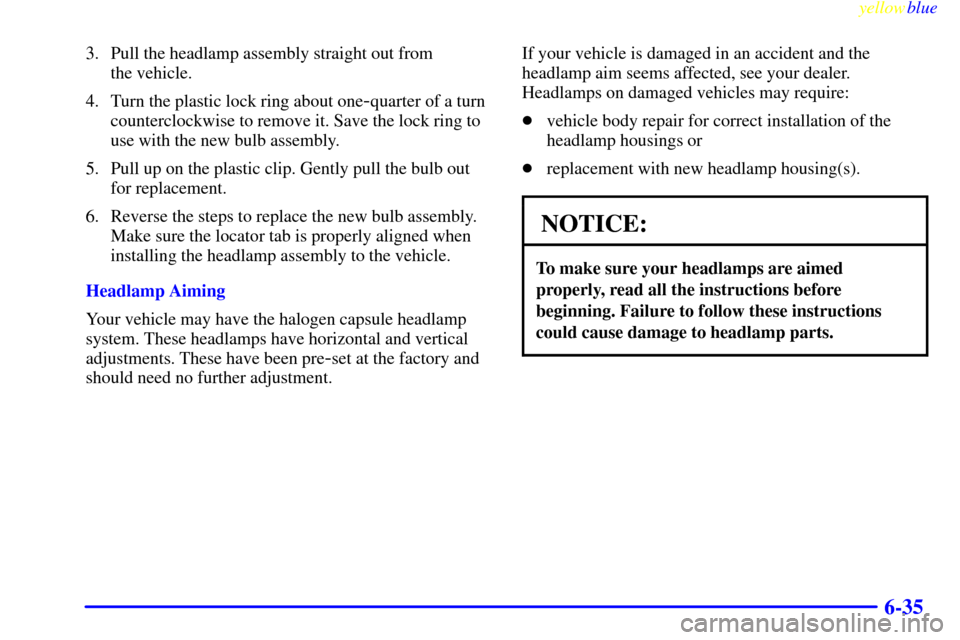
3. Pull the headlamp assembly straight out from
the vehicle.
4. Turn the plastic lock ring about one
-quarter of a turn
counterclockwise to remove it. Save the lock ring to
use with the new bulb assembly.
5. Pull up on the plastic clip. Gently pull the bulb out
for replacement.
6. Reverse the steps to replace the new bulb assembly.
Make sure the locator tab is properly aligned when
installing the headlamp assembly to the vehicle.
Headlamp Aiming
Your vehicle may have the halogen capsule headlamp
system. These headlamps have horizontal and vertical
adjustments. These have been pre
-set at the factory and
should need no further adjustment.If your vehicle is damaged in an accident and the
headlamp aim seems affected, see your dealer.
Headlamps on damaged vehicles may require:
�vehicle body repair for correct installation of the
headlamp housings or
�replacement with new headlamp housing(s).
NOTICE:
To make sure your headlamps are aimed
properly, read all the instructions before
beginning. Failure to follow these instructions
could cause damage to headlamp parts.
Page 230 of 328
yellowblue
6-38
4. Turn the turn signal bulb or sidemarker socket
counterclockwise and pull it out.
5. Pull the old bulb straight up to remove it.
6. Reverse the steps with the new bulb.
Rear Combination Lamps
To remove the rear combination bulbs:
1. Remove the two screws from the combination lamps
on the outside of the vehicle.
2. Pull back the cover on the inside of the trunk and use
a 10 mm wrench to remove the nut.
3. Pull the assembly out far enough to reach the
bulb socket.
4. Turn the socket counterclockwise and pull it out.
5. Disconnect the bulb from its socket by twisting and
then pulling the bulb out.
6. Reverse the steps to install a new bulb.
Page 233 of 328
yellowblue
6-41 Inflation -- Tire Pressure
The Tire-Loading Information label, which is on the
driver's door lock pillar, shows the correct inflation
pressures for your tires when they're cold. ªColdº
means your vehicle has been sitting for at least three
hours or driven no more than 1 mile (1.6 km).
NOTICE:
Don't let anyone tell you that underinflation or
overinflation is all right. It's not. If your tires
don't have enough air (underinflation), you can
get the following:
�Too much flexing
�Too much heat
�Tire overloading
�Bad wear
�Bad handling
�Bad fuel economy.
NOTICE: (Continued)
NOTICE: (Continued)
If your tires have too much air (overinflation),
you can get the following:
�Unusual wear
�Bad handling
�Rough ride
�Needless damage from road hazards.
When to Check
Check your tires once a month or more.
Don't forget your compact spare tire. It should be at
60 psi (420 kPa).
How to Check
Use a good quality pocket
-type gage to check tire
pressure. You can't tell if your tires are properly inflated
simply by looking at them. Radial tires may look
properly inflated even when they're underinflated.
Be sure to put the valve caps back on the valve stems.
They help prevent leaks by keeping out dirt
and moisture.
Page 249 of 328

yellowblue
6-57
Electrical System
Add-On Electrical Equipment
NOTICE:
Don't add anything electrical to your vehicle
unless you check with your dealer first. Some
electrical equipment can damage your vehicle
and the damage wouldn't be covered by your
warranty. Some add
-on electrical equipment can
keep other components from working as
they should.
Your vehicle has an air bag system. Before attempting to
add anything electrical to your vehicle, see ªServicing
Your Air Bag
-Equipped Vehicleº in the Index.
Windshield Wiper Fuses
The windshield wiper motor is protected by a circuit
breaker and a fuse. If the motor overheats due to heavy
snow, etc., the wiper will stop until the motor cools. If
the overload is caused by some electrical problem and
not snow, etc., be sure to get it fixed.
Fuses and Circuit Breakers
The wiring circuits in your vehicle are protected from
short circuits by fuses, circuit breakers and thermal links
in the wiring itself. This greatly reduces the chance of
fires caused by electrical problems.
Look at the silver
-colored band inside the fuse. If the
band is broken or melted, replace the fuse. Be sure you
replace a bad fuse with a new one of the correct size.
If you ever have a problem on the road and don't have a
spare fuse, you can borrow one. Just pick some feature
of your vehicle that you can get along without
-- like the
radio or cigarette lighter
-- and use its fuse, if it is the
size you need. Replace it as soon as you can. Before
replacing a fuse, turn every vehicle electrical switch off.
There are two fuse blocks in your vehicle: the engine
compartment fuse block and the instrument panel
fuse block.
Instrument Panel Fuse Block
This fuse box is under the left side of the instrument
panel. To open it, squeeze the short sides and pull off the
cover. The fuses here protect each separate circuit
including headlamps. If you have electrical failure,
check here first.
Page 250 of 328
yellowblue
6-58
Fuse Useage
1 Left Headlamp,
High
-Beam Indicator
2 Right Headlamp
3 Parking Lamps, Sidemarker
Lamps, License Plate Lamps,
Instrument Cluster LightsFuse Useage
4 Door Lock System (If Equipped)
5 Hazard Lamps, Horn
6 Ignition System, Gages, Warning
and Indicator Lights, Automatic
Transaxle Speed Sensor
7 Heater, Air Conditioning
(If Equipped)
8 Stoplamps
9 Lighter, Radio
10 Back
-Up Lamps,
Turn Signal Lamps
11 Rear Defogger (If Equipped)
12 Front and Rear Wiper/Washer