Page 155 of 328
yellowblue
4-31
NOTICE:
The front wheels transmit shocks during towing.
The steering column may not be strong enough to
withstand the shocks. Always unlock the steering
wheel before towing.
NOTICE:
Make sure that the towing speed does not exceed
55 mph (90 km/h), or your vehicle could be
badly damaged.
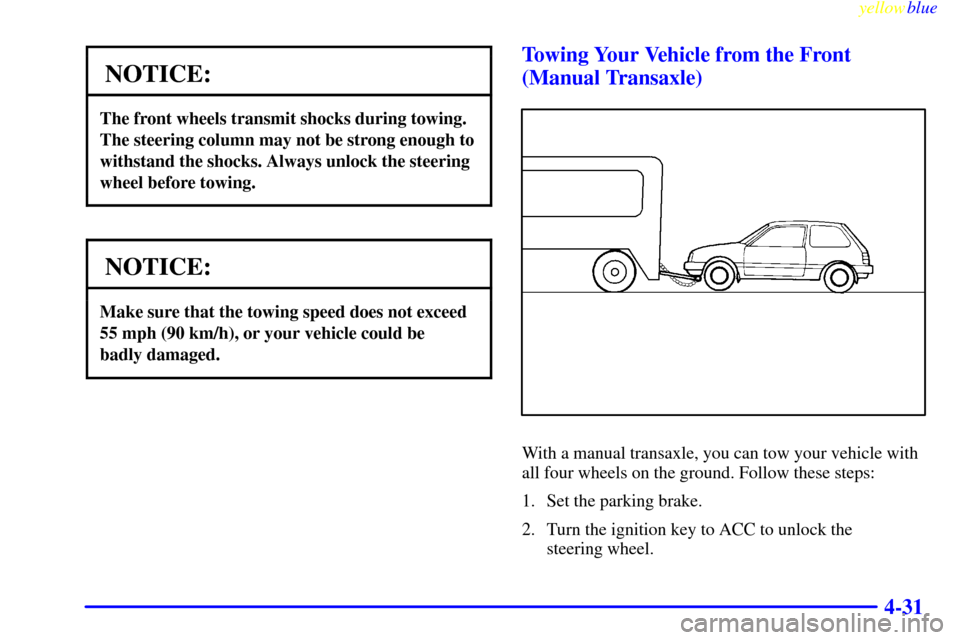
Towing Your Vehicle from the Front
(Manual Transaxle)
With a manual transaxle, you can tow your vehicle with
all four wheels on the ground. Follow these steps:
1. Set the parking brake.
2. Turn the ignition key to ACC to unlock the
steering wheel.
Page 156 of 328
yellowblue
4-32
3. Shift your manual transaxle to NEUTRAL (N).
4. Release the parking brake.
NOTICE:
The front wheels transmit shocks during towing.
The steering column may not be strong enough to
withstand the shocks. Always unlock the steering
wheel before towing.
NOTICE:
Make sure that the towing speed does not exceed
55 mph (90 km/h), or your vehicle could be
badly damaged.
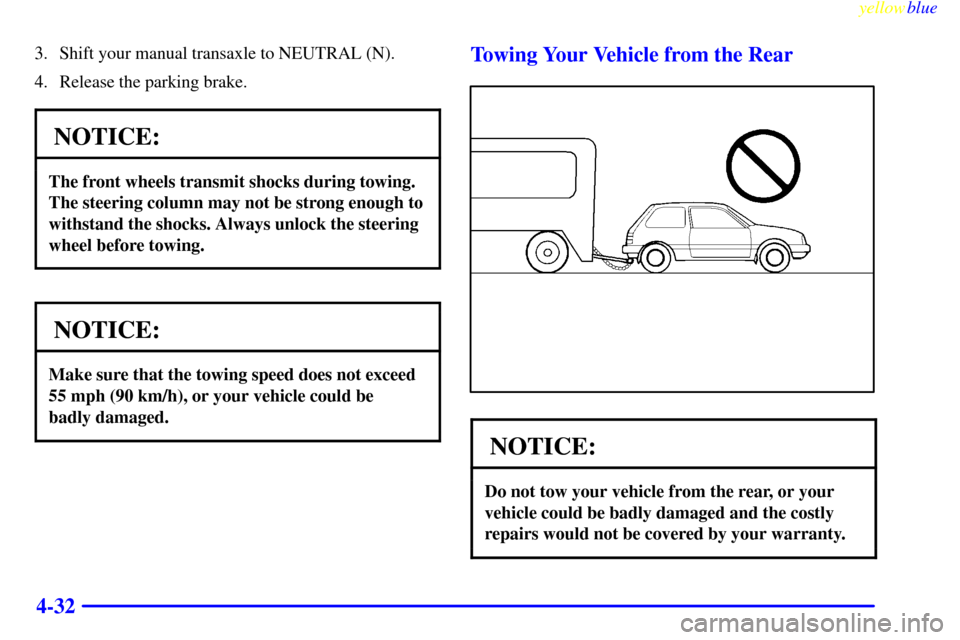
Towing Your Vehicle from the Rear
NOTICE:
Do not tow your vehicle from the rear, or your
vehicle could be badly damaged and the costly
repairs would not be covered by your warranty.
Page 157 of 328
yellowblue
4-33
Loading Your Vehicle
Two labels on your vehicle show how much weight it
may properly carry. The Tire
-Loading Information label
found on the driver's door lock pillar tells you the
proper size, speed rating and recommended inflation
pressures for the tires on your vehicle. It also gives you
important information about the number of people that
can be in your vehicle and the total weight that you can
carry. This weight is called the Vehicle Capacity Weight
and includes the weight of all occupants, cargo, and all
nonfactory
-installed options.
The other label is the Certification label, also found on
the driver's door lock pillar. It tells you the gross weight
capacity of your vehicle, called the Gross Vehicle
Weight Rating (GVWR). The GVWR includes the
weight of the vehicle, all occupants, fuel and cargo.
Never exceed the GVWR for your vehicle, or the Gross
Axle Weight Rating (GAWR) for either the front or
rear axle.
Page 176 of 328
yellowblue
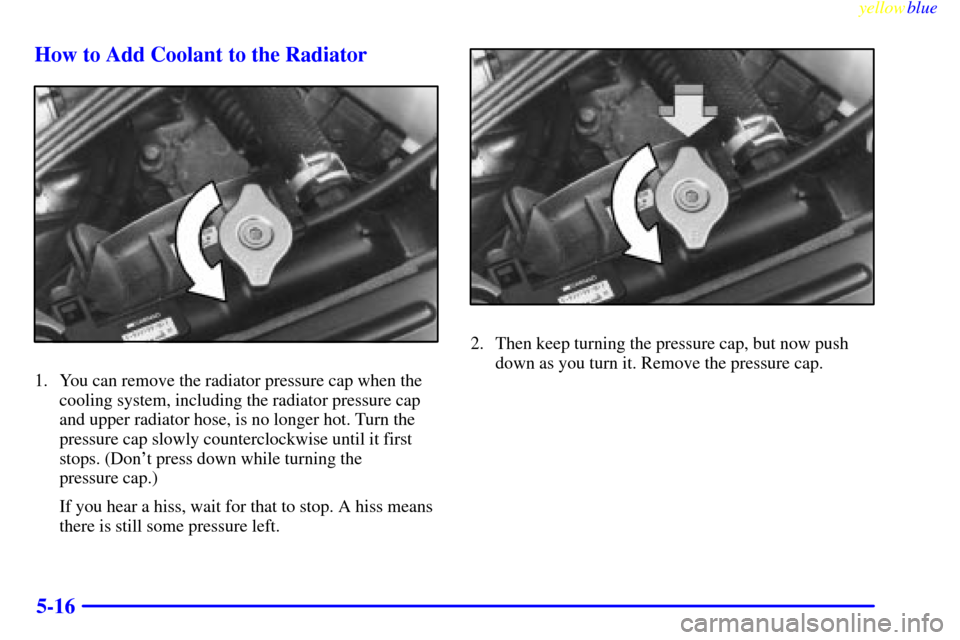
5-16 How to Add Coolant to the Radiator
1. You can remove the radiator pressure cap when the
cooling system, including the radiator pressure cap
and upper radiator hose, is no longer hot. Turn the
pressure cap slowly counterclockwise until it first
stops. (Don't press down while turning the
pressure cap.)
If you hear a hiss, wait for that to stop. A hiss means
there is still some pressure left.
2. Then keep turning the pressure cap, but now push
down as you turn it. Remove the pressure cap.
Page 179 of 328
yellowblue
5-19
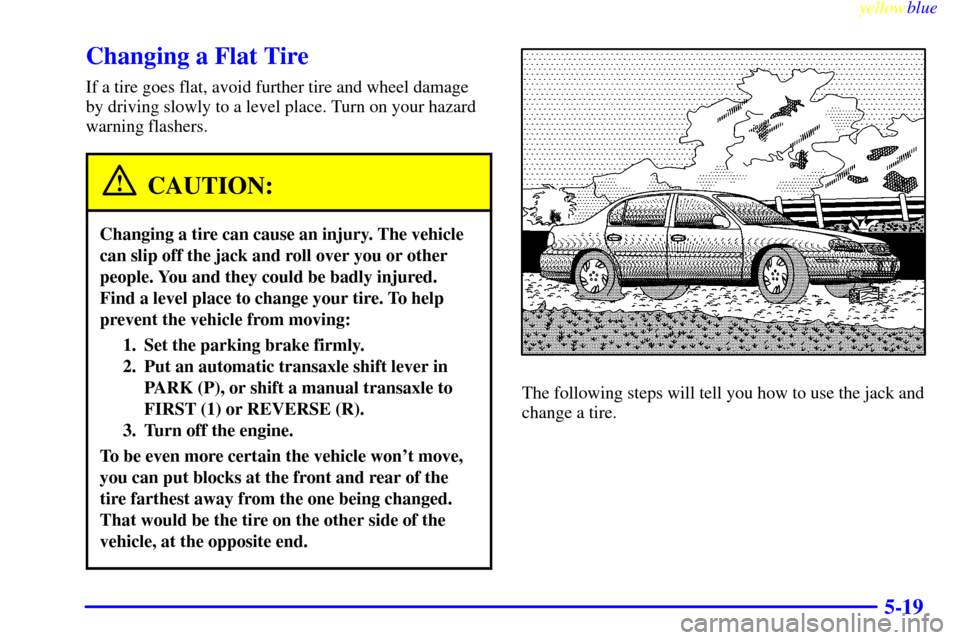
Changing a Flat Tire
If a tire goes flat, avoid further tire and wheel damage
by driving slowly to a level place. Turn on your hazard
warning flashers.
CAUTION:
Changing a tire can cause an injury. The vehicle
can slip off the jack and roll over you or other
people. You and they could be badly injured.
Find a level place to change your tire. To help
prevent the vehicle from moving:
1. Set the parking brake firmly.
2. Put an automatic transaxle shift lever in
PARK (P), or shift a manual transaxle to
FIRST (1) or REVERSE (R).
3. Turn off the engine.
To be even more certain the vehicle won't move,
you can put blocks at the front and rear of the
tire farthest away from the one being changed.
That would be the tire on the other side of the
vehicle, at the opposite end.
The following steps will tell you how to use the jack and
change a tire.
Page 180 of 328
yellowblue
5-20 Removing the Spare Tire and Tools
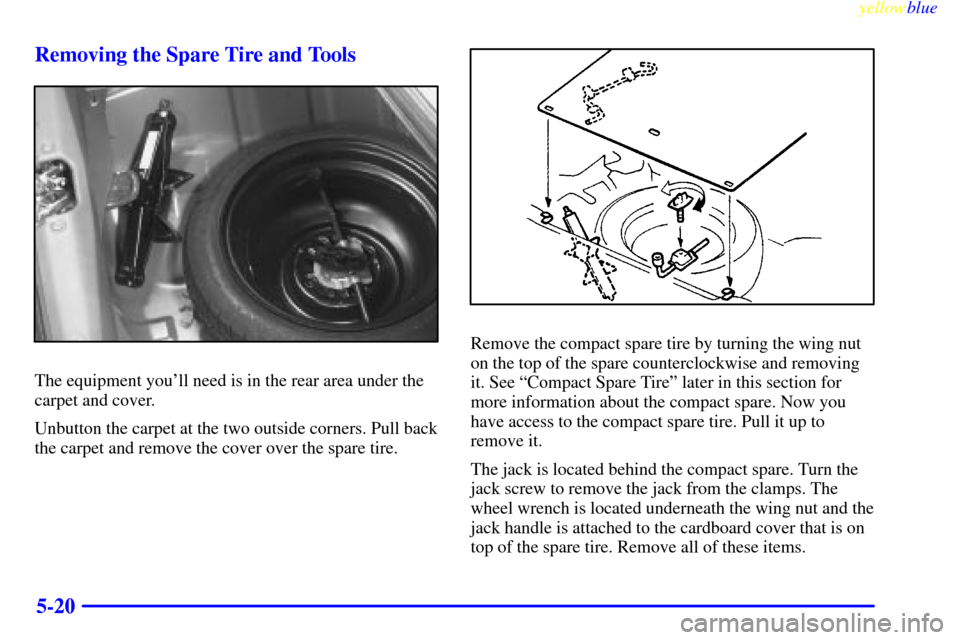
The equipment you'll need is in the rear area under the
carpet and cover.
Unbutton the carpet at the two outside corners. Pull back
the carpet and remove the cover over the spare tire.
Remove the compact spare tire by turning the wing nut
on the top of the spare counterclockwise and removing
it. See ªCompact Spare Tireº later in this section for
more information about the compact spare. Now you
have access to the compact spare tire. Pull it up to
remove it.
The jack is located behind the compact spare. Turn the
jack screw to remove the jack from the clamps. The
wheel wrench is located underneath the wing nut and the
jack handle is attached to the cardboard cover that is on
top of the spare tire. Remove all of these items.
Page 181 of 328
yellowblue
5-21
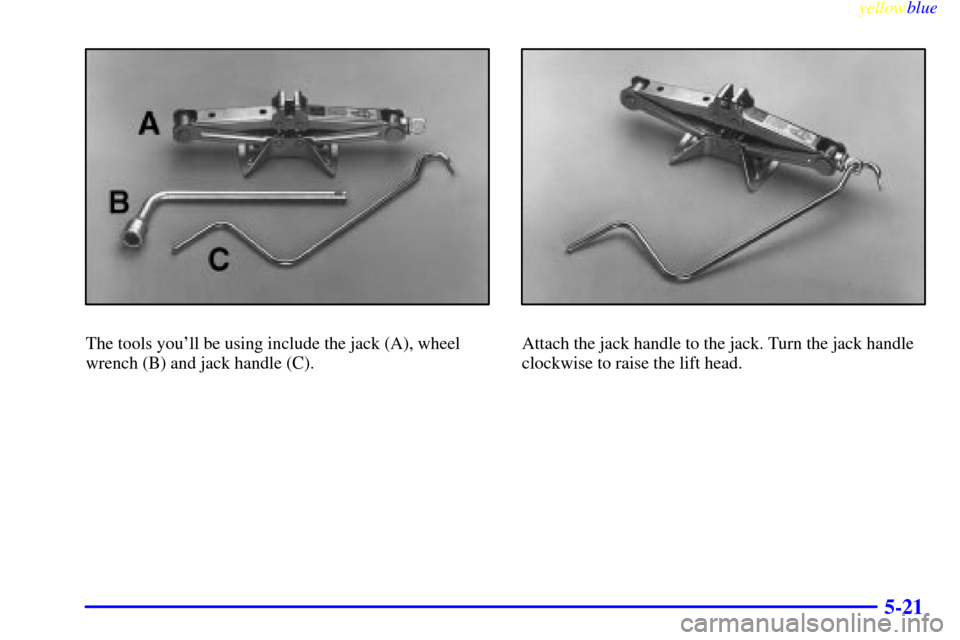
The tools you'll be using include the jack (A), wheel
wrench (B) and jack handle (C).Attach the jack handle to the jack. Turn the jack handle
clockwise to raise the lift head.
Page 184 of 328
yellowblue
5-24
CAUTION:
Getting under a vehicle when it is jacked up is
dangerous. If the vehicle slips off the jack, you
could be badly injured or killed. Never get under
a vehicle when it is supported only by a jack.
CAUTION:
Raising your vehicle with the jack improperly
positioned can damage the vehicle and even make
the vehicle fall. To help avoid personal injury and
vehicle damage, be sure to fit the jack lift head
into the proper location before raising
the vehicle.
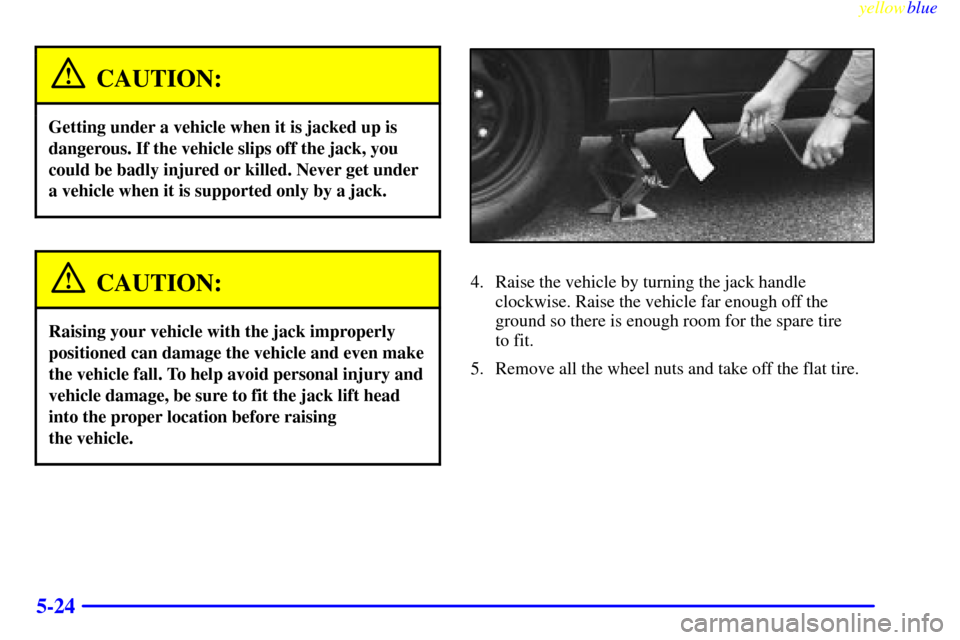
4. Raise the vehicle by turning the jack handle
clockwise. Raise the vehicle far enough off the
ground so there is enough room for the spare tire
to fit.
5. Remove all the wheel nuts and take off the flat tire.