1998 OPEL FRONTERA mileage
[x] Cancel search: mileagePage 1316 of 6000
6E–199 ENGINE DRIVEABILITY AND EMISSIONS
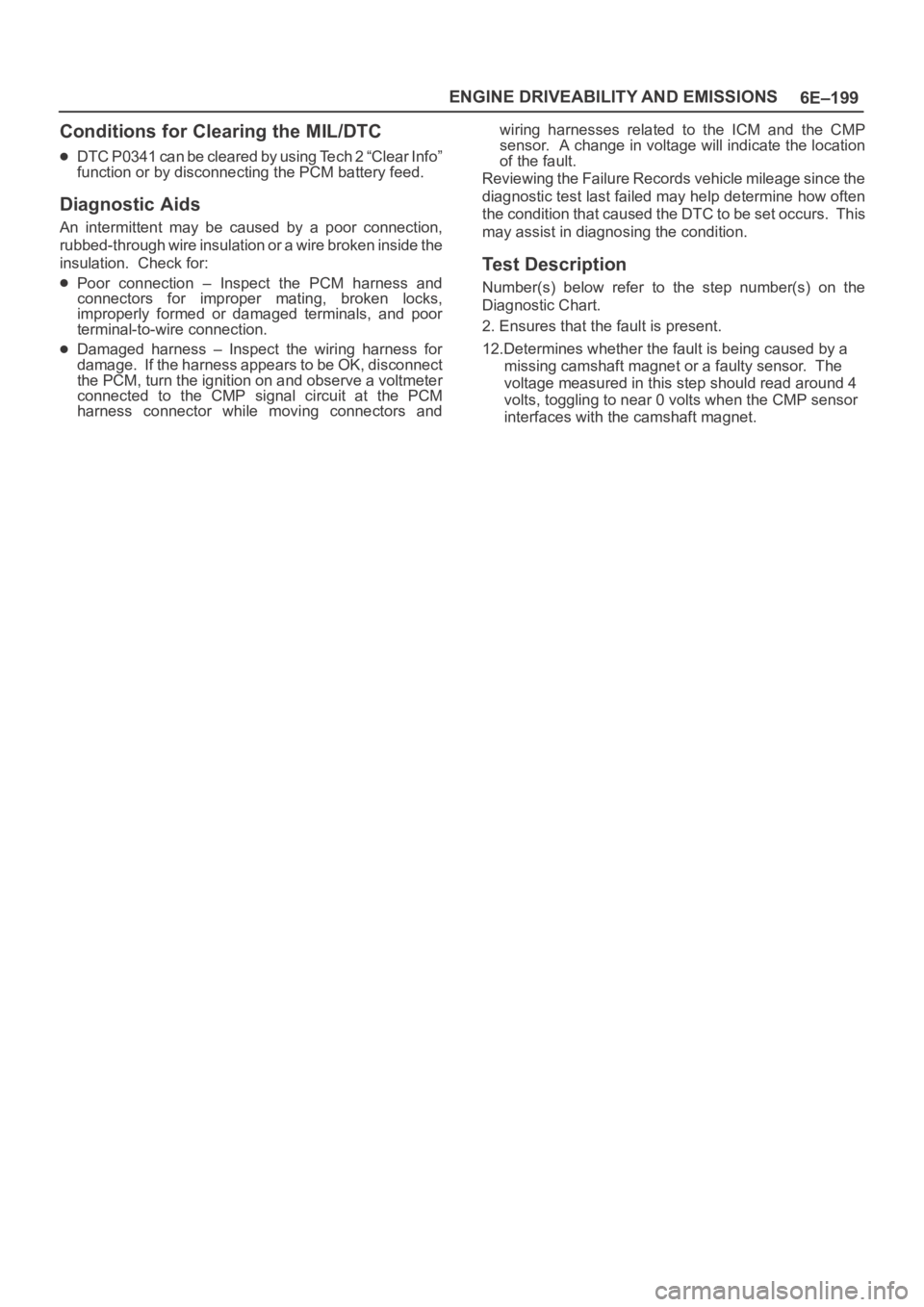
Conditions for Clearing the MIL/DTC
DTC P0341 can be cleared by using Tech 2 “Clear Info”
function or by disconnecting the PCM battery feed.
Diagnostic Aids
An intermittent may be caused by a poor connection,
rubbed-through wire insulation or a wire broken inside the
insulation. Check for:
Poor connection – Inspect the PCM harness and
connectors for improper mating, broken locks,
improperly formed or damaged terminals, and poor
terminal-to-wire connection.
Damaged harness – Inspect the wiring harness for
damage. If the harness appears to be OK, disconnect
the PCM, turn the ignition on and observe a voltmeter
connected to the CMP signal circuit at the PCM
harness connector while moving connectors andwiring harnesses related to the ICM and the CMP
sensor. A change in voltage will indicate the location
of the fault.
Reviewing the Failure Records vehicle mileage since the
diagnostic test last failed may help determine how often
the condition that caused the DTC to be set occurs. This
may assist in diagnosing the condition.
Test Description
Number(s) below refer to the step number(s) on the
Diagnostic Chart.
2. Ensures that the fault is present.
12.Determines whether the fault is being caused by a
missing camshaft magnet or a faulty sensor. The
voltage measured in this step should read around 4
volts, toggling to near 0 volts when the CMP sensor
interfaces with the camshaft magnet.
Page 1324 of 6000
6E–207 ENGINE DRIVEABILITY AND EMISSIONS
Poor connection at PCM – Inspect the harness
connectors for backed-out terminals, improper mating,
broken locks, improperly formed or damaged
terminals, and poor terminal-to-wire connections.
Damaged harness – Inspect the wiring harness for
damage. If the harness appears to be OK, observe
Tech 2 display related to DTC P0351 while moving theconnector and wiring related to the ignition system. A
change in the display will indicate the location of the
fault.
Reviewing the Failure Records vehicle mileage since the
diagnostic test last failed may help determine how often
the condition that caused the DTC to be set occurs. This
may assist in diagnosing the condition.
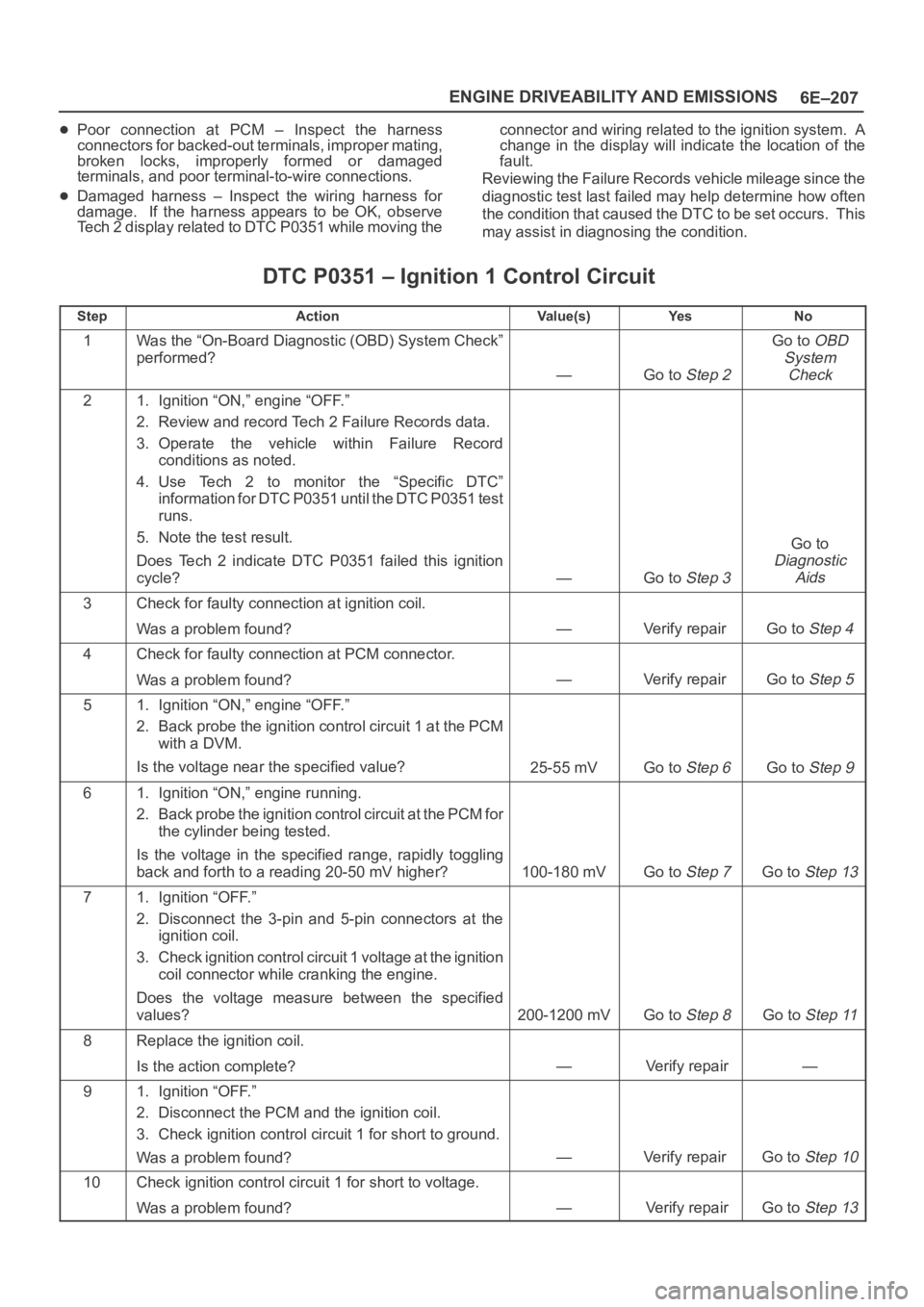
DTC P0351 – Ignition 1 Control Circuit
StepActionVa l u e ( s )Ye sNo
1Was the “On-Board Diagnostic (OBD) System Check”
performed?
—Go to Step 2
Go to OBD
System
Check
21. Ignition “ON,” engine “OFF.”
2. Review and record Tech 2 Failure Records data.
3. Operate the vehicle within Failure Record
conditions as noted.
4. Use Tech 2 to monitor the “Specific DTC”
information for DTC P0351 until the DTC P0351 test
runs.
5. Note the test result.
Does Tech 2 indicate DTC P0351 failed this ignition
cycle?
—Go to Step 3
Go to
Diagnostic
Aids
3Check for faulty connection at ignition coil.
Was a problem found?
—Verify repair Go to Step 4
4Check for faulty connection at PCM connector.
Was a problem found?
—Verify repair Go to Step 5
51. Ignition “ON,” engine “OFF.”
2. Back probe the ignition control circuit 1 at the PCM
with a DVM.
Is the voltage near the specified value?
25-55 mVGo to Step 6Go to Step 9
61. Ignition “ON,” engine running.
2. Back probe the ignition control circuit at the PCM for
the cylinder being tested.
Is the voltage in the specified range, rapidly toggling
back and forth to a reading 20-50 mV higher?
100-180 mVGo to Step 7Go to Step 13
71. Ignition “OFF.”
2. Disconnect the 3-pin and 5-pin connectors at the
ignition coil.
3. Check ignition control circuit 1 voltage at the ignition
coil connector while cranking the engine.
Does the voltage measure between the specified
values?
200-1200 mVGo to Step 8Go to Step 11
8Replace the ignition coil.
Is the action complete?
—Verify repair—
91. Ignition “OFF.”
2. Disconnect the PCM and the ignition coil.
3. Check ignition control circuit 1 for short to ground.
Was a problem found?
—Verify repair Go to Step 10
10Check ignition control circuit 1 for short to voltage.
Was a problem found?
—Verify repairGo to Step 13
Page 1327 of 6000
6E–210
ENGINE DRIVEABILITY AND EMISSIONS
Poor connection at PCM – Inspect the harness
connectors for backed-out terminals, improper mating,
broken locks, improperly formed or damaged
terminals, and poor terminal-to-wire connections.
Damaged harness – Inspect the wiring harness for
damage. If the harness appears to be OK, observe the
Tech 2 display related to DTC P0352 while moving theconnector and wiring related to the ignition system. A
change in the display will indicate the location of the
fault.
Reviewing the Failure Records vehicle mileage since the
diagnostic test last failed may help determine how often
the condition that caused the DTC to be set occurs. This
may assist in diagnosing the condition.
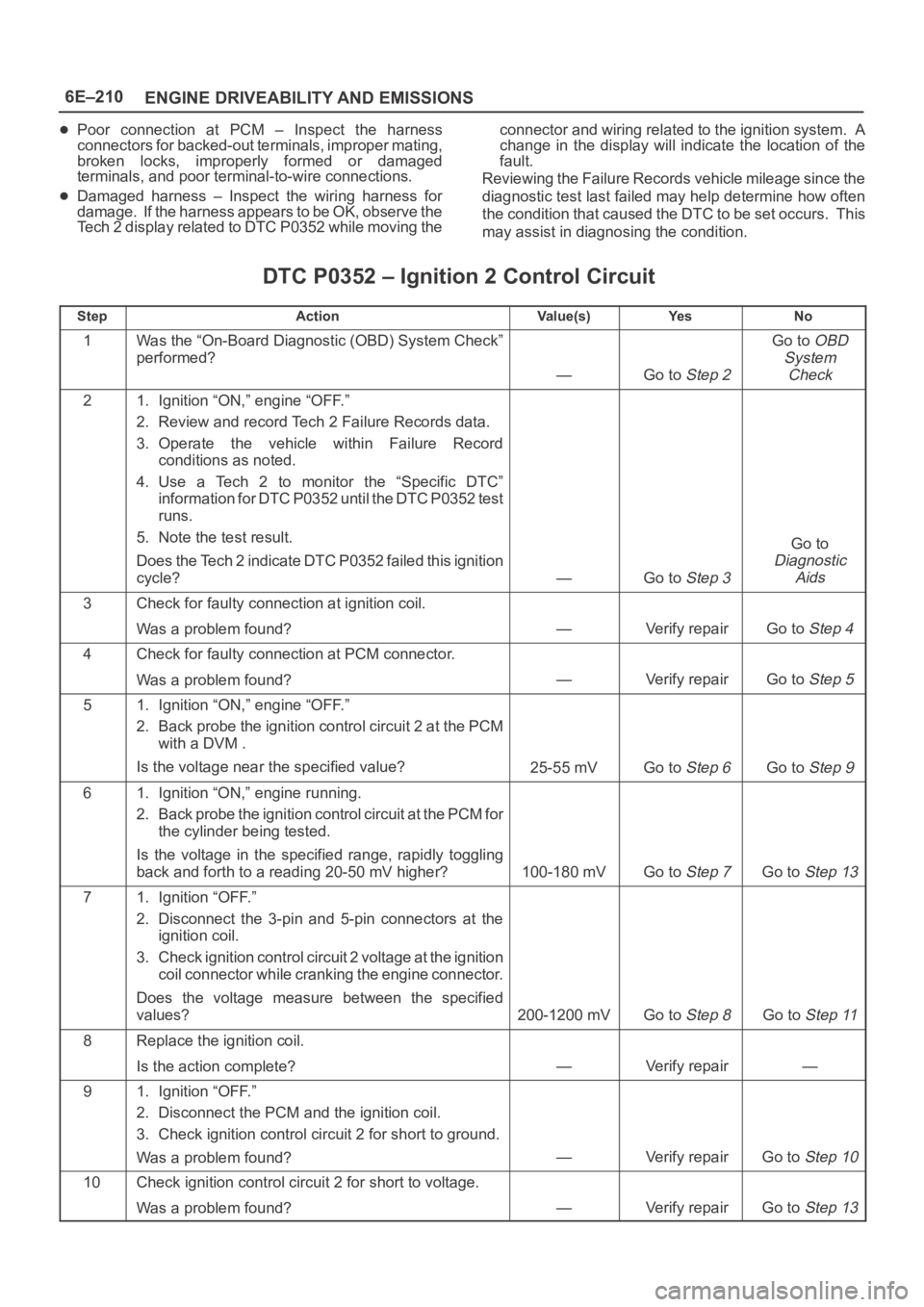
DTC P0352 – Ignition 2 Control Circuit
StepActionVa l u e ( s )Ye sNo
1Was the “On-Board Diagnostic (OBD) System Check”
performed?
—Go to Step 2
Go to OBD
System
Check
21. Ignition “ON,” engine “OFF.”
2. Review and record Tech 2 Failure Records data.
3. Operate the vehicle within Failure Record
conditions as noted.
4. Use a Tech 2 to monitor the “Specific DTC”
information for DTC P0352 until the DTC P0352 test
runs.
5. Note the test result.
Does the Tech 2 indicate DTC P0352 failed this ignition
cycle?
—Go to Step 3
Go to
Diagnostic
Aids
3Check for faulty connection at ignition coil.
Was a problem found?
—Verify repairGo to Step 4
4Check for faulty connection at PCM connector.
Was a problem found?
—Verify repairGo to Step 5
51. Ignition “ON,” engine “OFF.”
2. Back probe the ignition control circuit 2 at the PCM
with a DVM .
Is the voltage near the specified value?
25-55 mVGo to Step 6Go to Step 9
61. Ignition “ON,” engine running.
2. Back probe the ignition control circuit at the PCM for
the cylinder being tested.
Is the voltage in the specified range, rapidly toggling
back and forth to a reading 20-50 mV higher?
100-180 mVGo to Step 7Go to Step 13
71. Ignition “OFF.”
2. Disconnect the 3-pin and 5-pin connectors at the
ignition coil.
3. Check ignition control circuit 2 voltage at the ignition
coil connector while cranking the engine connector.
Does the voltage measure between the specified
values?
200-1200 mVGo to Step 8Go to Step 11
8Replace the ignition coil.
Is the action complete?
—Verify repair—
91. Ignition “OFF.”
2. Disconnect the PCM and the ignition coil.
3. Check ignition control circuit 2 for short to ground.
Was a problem found?
—Verify repairGo to Step 10
10Check ignition control circuit 2 for short to voltage.
Was a problem found?
—Verify repairGo to Step 13
Page 1330 of 6000
6E–213 ENGINE DRIVEABILITY AND EMISSIONS
Poor connection at PCM – Inspect the harness
connectors for backed-out terminals, improper mating,
broken locks, improperly formed or damaged
terminals, and poor terminal-to-wire connections.
Damaged harness – Inspect the wiring harness for
damage. If the harness appears to be OK, observe the
Tech 2 display related to DTC P0353 while moving theconnector and wiring related to the ignition system. A
change in the display will indicate the location of the
fault.
Reviewing the Failure Records vehicle mileage since the
diagnostic test last failed may help determine how often
the condition that caused the DTC to be set occurs. This
may assist in diagnosing the condition.
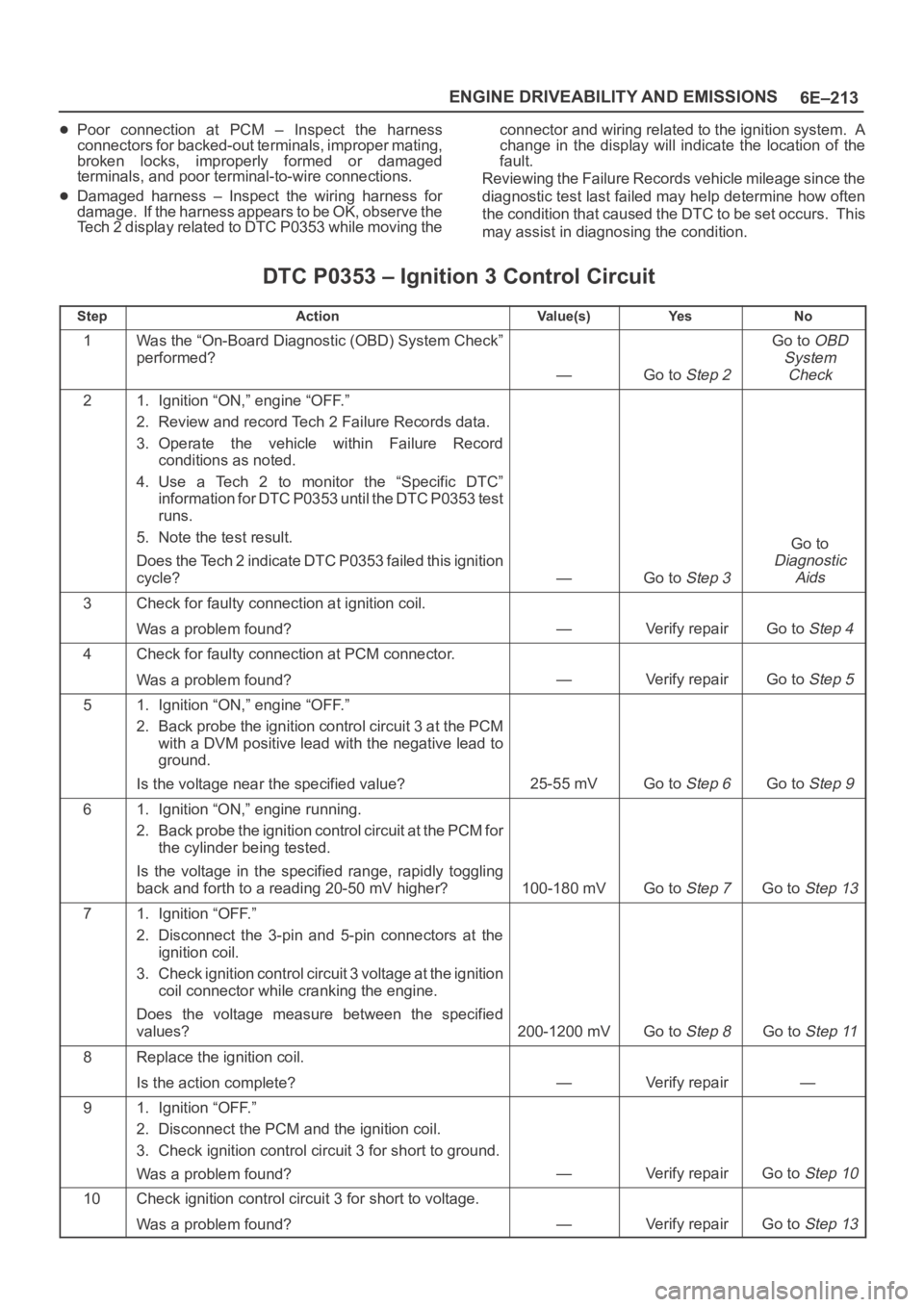
DTC P0353 – Ignition 3 Control Circuit
StepActionVa l u e ( s )Ye sNo
1Was the “On-Board Diagnostic (OBD) System Check”
performed?
—Go to Step 2
Go to OBD
System
Check
21. Ignition “ON,” engine “OFF.”
2. Review and record Tech 2 Failure Records data.
3. Operate the vehicle within Failure Record
conditions as noted.
4. Use a Tech 2 to monitor the “Specific DTC”
information for DTC P0353 until the DTC P0353 test
runs.
5. Note the test result.
Does the Tech 2 indicate DTC P0353 failed this ignition
cycle?
—Go to Step 3
Go to
Diagnostic
Aids
3Check for faulty connection at ignition coil.
Was a problem found?
—Verify repairGo to Step 4
4Check for faulty connection at PCM connector.
Was a problem found?
—Verify repairGo to Step 5
51. Ignition “ON,” engine “OFF.”
2. Back probe the ignition control circuit 3 at the PCM
with a DVM positive lead with the negative lead to
ground.
Is the voltage near the specified value?
25-55 mVGo to Step 6Go to Step 9
61. Ignition “ON,” engine running.
2. Back probe the ignition control circuit at the PCM for
the cylinder being tested.
Is the voltage in the specified range, rapidly toggling
back and forth to a reading 20-50 mV higher?
100-180 mVGo to Step 7Go to Step 13
71. Ignition “OFF.”
2. Disconnect the 3-pin and 5-pin connectors at the
ignition coil.
3. Check ignition control circuit 3 voltage at the ignition
coil connector while cranking the engine.
Does the voltage measure between the specified
values?
200-1200 mVGo to Step 8Go to Step 11
8Replace the ignition coil.
Is the action complete?
—Verify repair—
91. Ignition “OFF.”
2. Disconnect the PCM and the ignition coil.
3. Check ignition control circuit 3 for short to ground.
Was a problem found?
—Verify repairGo to Step 10
10Check ignition control circuit 3 for short to voltage.
Was a problem found?
—Verify repairGo to Step 13
Page 1333 of 6000
6E–216
ENGINE DRIVEABILITY AND EMISSIONS
Poor connection at PCM – Inspect the harness
connectors for backed-out terminals, improper mating,
broken locks, improperly formed or damaged
terminals, and poor terminal-to-wire connections.
Damaged harness – Inspect the wiring harness for
damage. If the harness appears to be OK, observe the
Tech 2 display related to DTC P0354 while moving theconnector and wiring related to the ignition system. A
change in the display will indicate the location of the
fault.
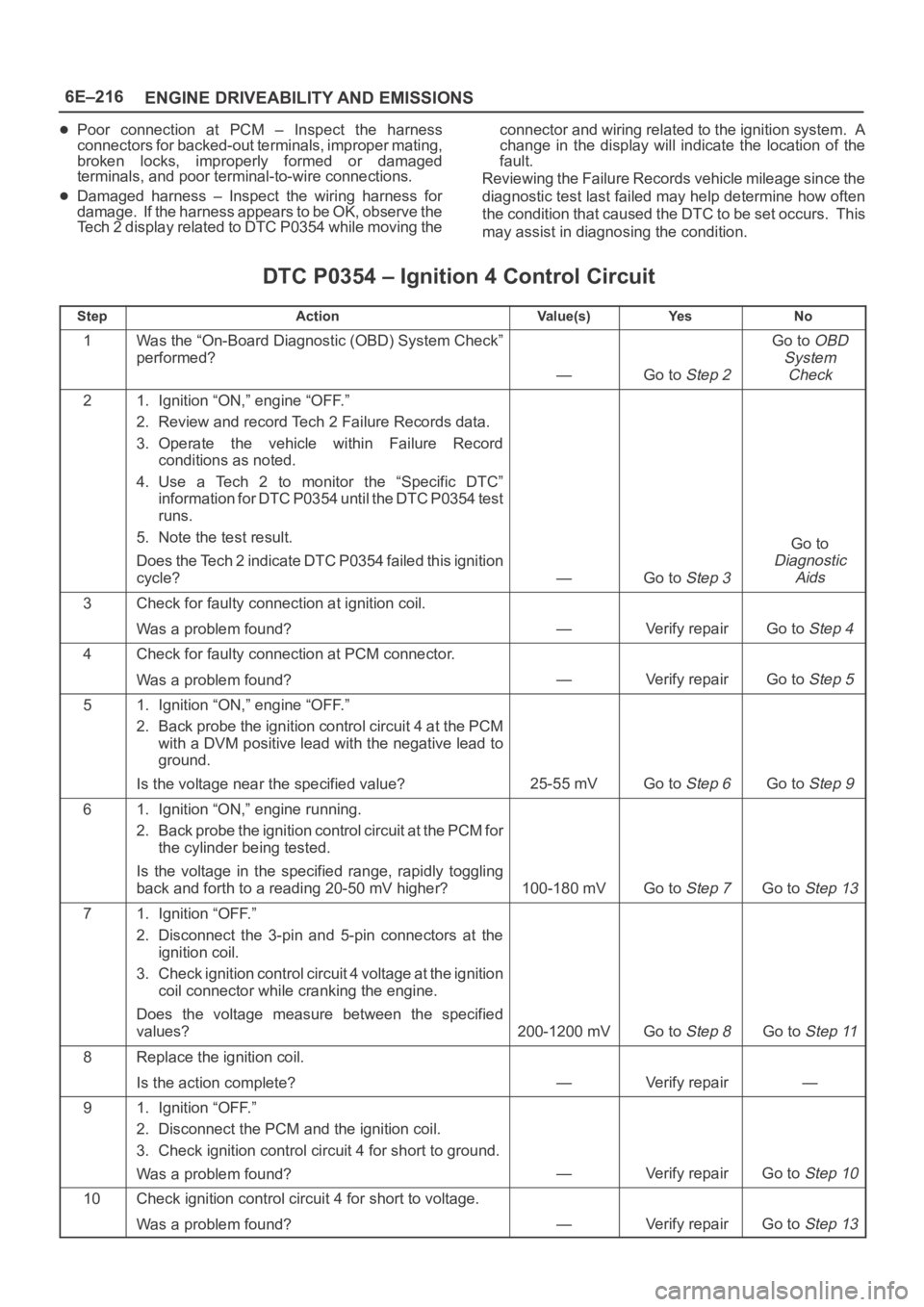
Reviewing the Failure Records vehicle mileage since the
diagnostic test last failed may help determine how often
the condition that caused the DTC to be set occurs. This
may assist in diagnosing the condition.
DTC P0354 – Ignition 4 Control Circuit
StepActionVa l u e ( s )Ye sNo
1Was the “On-Board Diagnostic (OBD) System Check”
performed?
—Go to Step 2
Go to OBD
System
Check
21. Ignition “ON,” engine “OFF.”
2. Review and record Tech 2 Failure Records data.
3. Operate the vehicle within Failure Record
conditions as noted.
4. Use a Tech 2 to monitor the “Specific DTC”
information for DTC P0354 until the DTC P0354 test
runs.
5. Note the test result.
Does the Tech 2 indicate DTC P0354 failed this ignition
cycle?
—Go to Step 3
Go to
Diagnostic
Aids
3Check for faulty connection at ignition coil.
Was a problem found?
—Verify repairGo to Step 4
4Check for faulty connection at PCM connector.
Was a problem found?
—Verify repairGo to Step 5
51. Ignition “ON,” engine “OFF.”
2. Back probe the ignition control circuit 4 at the PCM
with a DVM positive lead with the negative lead to
ground.
Is the voltage near the specified value?
25-55 mVGo to Step 6Go to Step 9
61. Ignition “ON,” engine running.
2. Back probe the ignition control circuit at the PCM for
the cylinder being tested.
Is the voltage in the specified range, rapidly toggling
back and forth to a reading 20-50 mV higher?
100-180 mVGo to Step 7Go to Step 13
71. Ignition “OFF.”
2. Disconnect the 3-pin and 5-pin connectors at the
ignition coil.
3. Check ignition control circuit 4 voltage at the ignition
coil connector while cranking the engine.
Does the voltage measure between the specified
values?
200-1200 mVGo to Step 8Go to Step 11
8Replace the ignition coil.
Is the action complete?
—Verify repair—
91. Ignition “OFF.”
2. Disconnect the PCM and the ignition coil.
3. Check ignition control circuit 4 for short to ground.
Was a problem found?
—Verify repairGo to Step 10
10Check ignition control circuit 4 for short to voltage.
Was a problem found?
—Verify repairGo to Step 13
Page 1336 of 6000
6E–219 ENGINE DRIVEABILITY AND EMISSIONS
Poor connection at PCM – Inspect the harness
connectors for backed-out terminals, improper mating,
broken locks, improperly formed or damaged
terminals, and poor terminal-to-wire connections.
Damaged harness – Inspect the wiring harness for
damage. If the harness appears to be OK, observe the
Tech 2 display related to DTC P0355 while moving theconnector and wiring related to the ignition system. A
change in the display will indicate the location of the
fault.
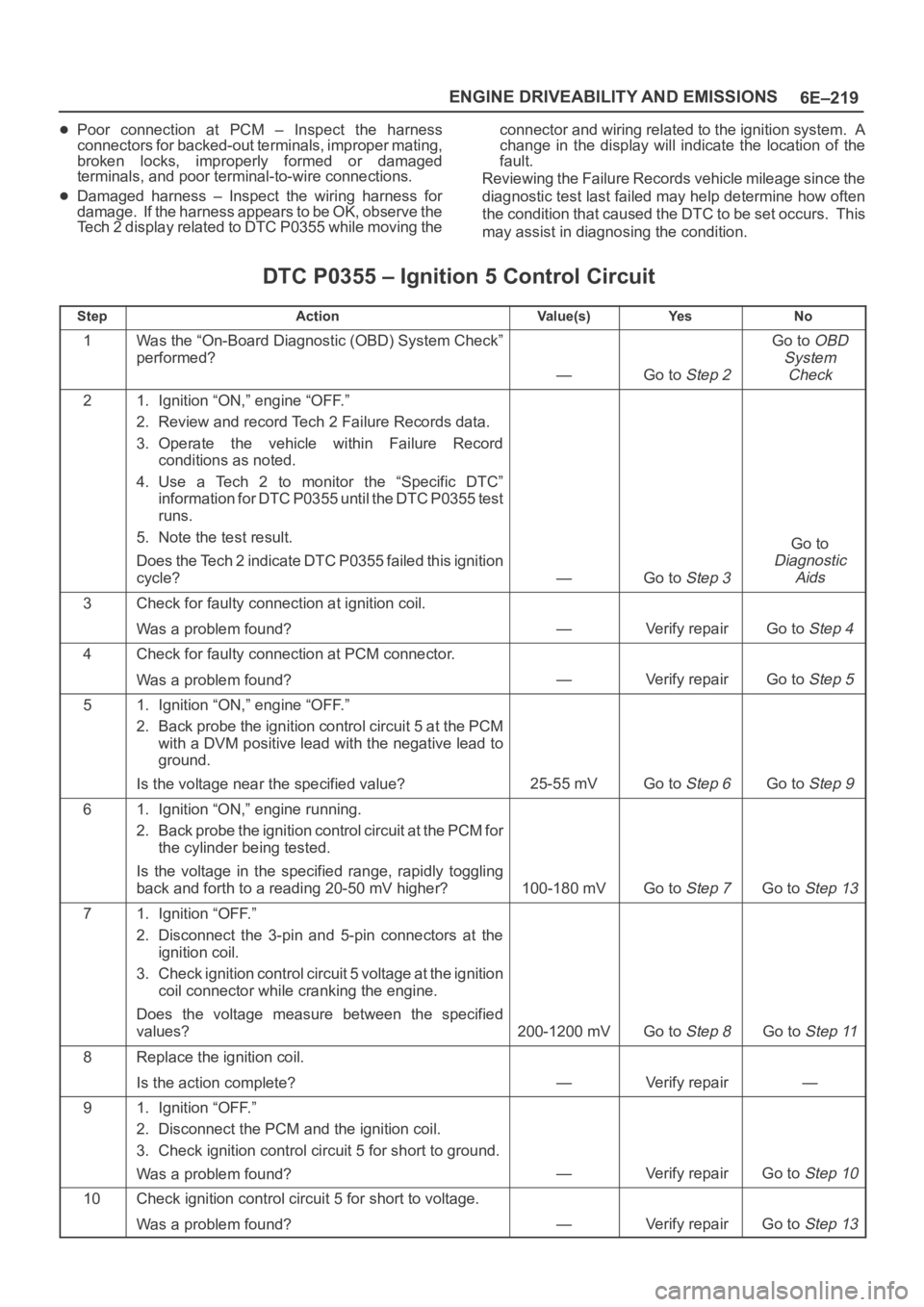
Reviewing the Failure Records vehicle mileage since the
diagnostic test last failed may help determine how often
the condition that caused the DTC to be set occurs. This
may assist in diagnosing the condition.
DTC P0355 – Ignition 5 Control Circuit
StepActionVa l u e ( s )Ye sNo
1Was the “On-Board Diagnostic (OBD) System Check”
performed?
—Go to Step 2
Go to OBD
System
Check
21. Ignition “ON,” engine “OFF.”
2. Review and record Tech 2 Failure Records data.
3. Operate the vehicle within Failure Record
conditions as noted.
4. Use a Tech 2 to monitor the “Specific DTC”
information for DTC P0355 until the DTC P0355 test
runs.
5. Note the test result.
Does the Tech 2 indicate DTC P0355 failed this ignition
cycle?
—Go to Step 3
Go to
Diagnostic
Aids
3Check for faulty connection at ignition coil.
Was a problem found?
—Verify repairGo to Step 4
4Check for faulty connection at PCM connector.
Was a problem found?
—Verify repairGo to Step 5
51. Ignition “ON,” engine “OFF.”
2. Back probe the ignition control circuit 5 at the PCM
with a DVM positive lead with the negative lead to
ground.
Is the voltage near the specified value?
25-55 mVGo to Step 6Go to Step 9
61. Ignition “ON,” engine running.
2. Back probe the ignition control circuit at the PCM for
the cylinder being tested.
Is the voltage in the specified range, rapidly toggling
back and forth to a reading 20-50 mV higher?
100-180 mVGo to Step 7Go to Step 13
71. Ignition “OFF.”
2. Disconnect the 3-pin and 5-pin connectors at the
ignition coil.
3. Check ignition control circuit 5 voltage at the ignition
coil connector while cranking the engine.
Does the voltage measure between the specified
values?
200-1200 mVGo to Step 8Go to Step 11
8Replace the ignition coil.
Is the action complete?
—Verify repair—
91. Ignition “OFF.”
2. Disconnect the PCM and the ignition coil.
3. Check ignition control circuit 5 for short to ground.
Was a problem found?
—Verify repairGo to Step 10
10Check ignition control circuit 5 for short to voltage.
Was a problem found?
—Verify repairGo to Step 13
Page 1339 of 6000
6E–222
ENGINE DRIVEABILITY AND EMISSIONS
Poor connection at PCM – Inspect the harness
connectors for backed-out terminals, improper mating,
broken locks, improperly formed or damaged
terminals, and poor terminal-to-wire connections.
Damaged harness – Inspect the wiring harness for
damage. If the harness appears to be OK, observe the
Tech 2 display related to DTC P0356 while moving theconnector and wiring related to the ignition system. A
change in the display will indicate the location of the
fault.
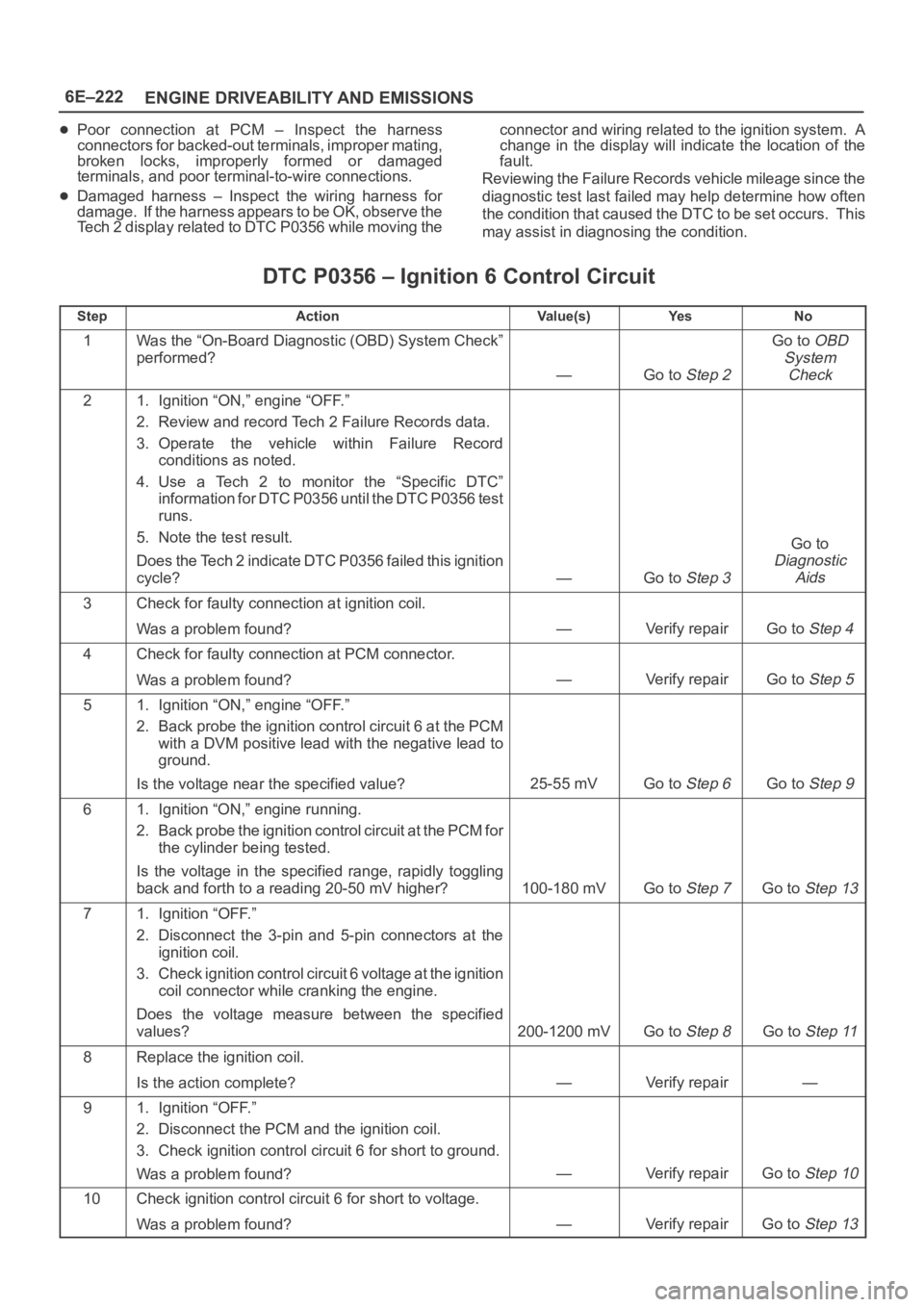
Reviewing the Failure Records vehicle mileage since the
diagnostic test last failed may help determine how often
the condition that caused the DTC to be set occurs. This
may assist in diagnosing the condition.
DTC P0356 – Ignition 6 Control Circuit
StepActionVa l u e ( s )Ye sNo
1Was the “On-Board Diagnostic (OBD) System Check”
performed?
—Go to Step 2
Go to OBD
System
Check
21. Ignition “ON,” engine “OFF.”
2. Review and record Tech 2 Failure Records data.
3. Operate the vehicle within Failure Record
conditions as noted.
4. Use a Tech 2 to monitor the “Specific DTC”
information for DTC P0356 until the DTC P0356 test
runs.
5. Note the test result.
Does the Tech 2 indicate DTC P0356 failed this ignition
cycle?
—Go to Step 3
Go to
Diagnostic
Aids
3Check for faulty connection at ignition coil.
Was a problem found?
—Verify repairGo to Step 4
4Check for faulty connection at PCM connector.
Was a problem found?
—Verify repairGo to Step 5
51. Ignition “ON,” engine “OFF.”
2. Back probe the ignition control circuit 6 at the PCM
with a DVM positive lead with the negative lead to
ground.
Is the voltage near the specified value?
25-55 mVGo to Step 6Go to Step 9
61. Ignition “ON,” engine running.
2. Back probe the ignition control circuit at the PCM for
the cylinder being tested.
Is the voltage in the specified range, rapidly toggling
back and forth to a reading 20-50 mV higher?
100-180 mVGo to Step 7Go to Step 13
71. Ignition “OFF.”
2. Disconnect the 3-pin and 5-pin connectors at the
ignition coil.
3. Check ignition control circuit 6 voltage at the ignition
coil connector while cranking the engine.
Does the voltage measure between the specified
values?
200-1200 mVGo to Step 8Go to Step 11
8Replace the ignition coil.
Is the action complete?
—Verify repair—
91. Ignition “OFF.”
2. Disconnect the PCM and the ignition coil.
3. Check ignition control circuit 6 for short to ground.
Was a problem found?
—Verify repairGo to Step 10
10Check ignition control circuit 6 for short to voltage.
Was a problem found?
—Verify repairGo to Step 13
Page 1358 of 6000
6E–241 ENGINE DRIVEABILITY AND EMISSIONS
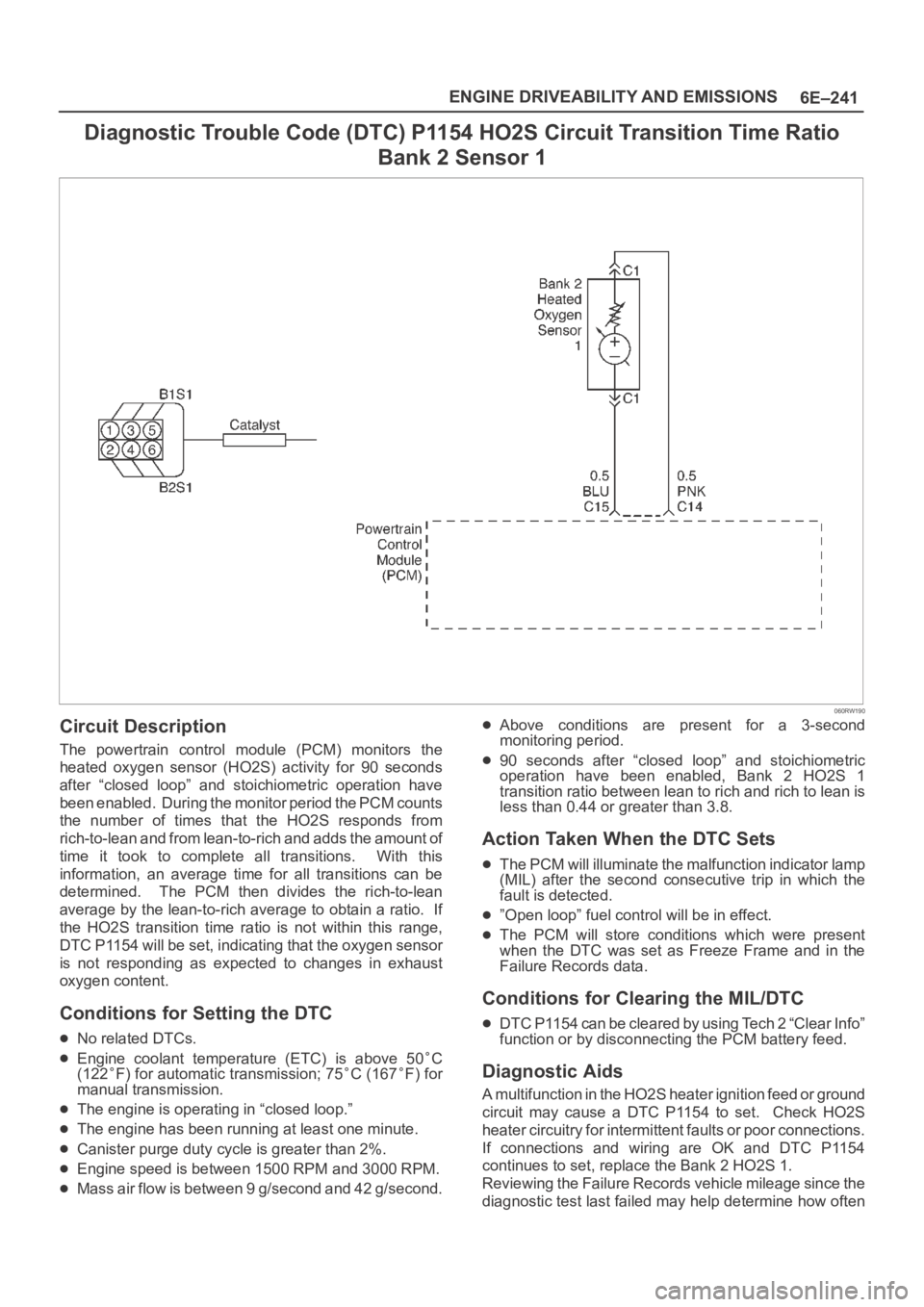
Diagnostic Trouble Code (DTC) P1154 HO2S Circuit Transition Time Ratio
Bank 2 Sensor 1
060RW190
Circuit Description
The powertrain control module (PCM) monitors the
heated oxygen sensor (HO2S) activity for 90 seconds
after “closed loop” and stoichiometric operation have
been enabled. During the monitor period the PCM counts
the number of times that the HO2S responds from
rich-to-lean and from lean-to-rich and adds the amount of
time it took to complete all transitions. With this
information, an average time for all transitions can be
determined. The PCM then divides the rich-to-lean
average by the lean-to-rich average to obtain a ratio. If
the HO2S transition time ratio is not within this range,
DTC P1154 will be set, indicating that the oxygen sensor
is not responding as expected to changes in exhaust
oxygen content.
Conditions for Setting the DTC
No related DTCs.
Engine coolant temperature (ETC) is above 50C
(122F) for automatic transmission; 75C (167F) for
manual transmission.
The engine is operating in “closed loop.”
The engine has been running at least one minute.
Canister purge duty cycle is greater than 2%.
Engine speed is between 1500 RPM and 3000 RPM.
Mass air flow is between 9 g/second and 42 g/second.
Above conditions are present for a 3-second
monitoring period.
90 seconds after “closed loop” and stoichiometric
operation have been enabled, Bank 2 HO2S 1
transition ratio between lean to rich and rich to lean is
less than 0.44 or greater than 3.8.
Action Taken When the DTC Sets
The PCM will illuminate the malfunction indicator lamp
(MIL) after the second consecutive trip in which the
fault is detected.
”Open loop” fuel control will be in effect.
The PCM will store conditions which were present
when the DTC was set as Freeze Frame and in the
Failure Records data.
Conditions for Clearing the MIL/DTC
DTC P1154 can be cleared by using Tech 2 “Clear Info”
function or by disconnecting the PCM battery feed.
Diagnostic Aids
A multifunction in the HO2S heater ignition feed or ground
circuit may cause a DTC P1154 to set. Check HO2S
heater circuitry for intermittent faults or poor connections.
If connections and wiring are OK and DTC P1154
continues to set, replace the Bank 2 HO2S 1.
Reviewing the Failure Records vehicle mileage since the
diagnostic test last failed may help determine how often