1998 OPEL FRONTERA mileage
[x] Cancel search: mileagePage 1272 of 6000
6E–155 ENGINE DRIVEABILITY AND EMISSIONS
Mass air flow is between 2 g/second and 200 g/second.
Ignition voltage is above 9.5 volts.
Fuel system is in “closed loop.”
Action Taken When the DTC Sets
The PCM will illuminate the malfunction indicator lamp
(MIL) after the second consecutive trip in which the
fault is detected.
The PCM will store conditions which were present
when the DTC was set as Freeze Frame and in the
Failure Records data.
Conditions for Clearing the MIL/DTC
DTC P0171 can be cleared by using the Tech 2 “Clear
Info” function or by disconnecting the PCM battery
feed.
Diagnostic Aids
Check for the following conditions:
Poor connection at PCM – Inspect harness connectors
for backed-out terminals, improper mating, broken
locks, improperly formed or damaged terminals, and
poor terminal-to-wire connection.
Damaged harness – Inspect the wiring harness for
damage. If the harness appears to be OK, observe the
Bank 1 HO2S 1 display on the Tech 2 while moving
connectors and wiring harnesses related to the engine
harness. A change in the display will indicate the
location of the fault.
Reviewing the Failure Records vehicle mileage since the
diagnostic test last failed may help determine how often
the condition that caused the DTC to be set occurs. This
may assist in diagnosing the condition.
Test Description
Number(s) below refer to the step number(s) on the
Diagnostic Chart.
2. DTCs other than P0171 and P0174 may indicate a
condition present which may cause a lean condition.
If this is the case, repairing the condition which
caused the other DTC will most likely correct the
DTC P0171/P0174.
4. If the DTC P0171 test passes while the Failure
Records conditions are being duplicated, the lean
condition is intermittent. Refer to
Diagnostic Aids or
Symptoms for additional information on diagnosing
intermittent problems.
Page 1276 of 6000
6E–159 ENGINE DRIVEABILITY AND EMISSIONS
Vehicle speed is below 136 km/h (85 mph).
Engine speed is between 400 and 6,000 RPM.
Barometric pressure is greater than 72.5 kPa.
Mass air flow is between 2 g/second and 200 g/second.
Ignition voltage is above 9.5 volts.
Fuel system is in “closed loop.”
Action Taken When the DTC Sets
The PCM will illuminate the malfunction indicator lamp
(MIL) after the second consecutive trip in which the
fault is detected.
The PCM will store conditions which were present
when the DTC was set as Freeze Frame and in the
Failure Records data.
Conditions for Clearing the MIL/DTC
DTC P0172 can be cleared by using the Tech 2 “Clear
Info” function or by disconnecting the PCM battery
feed.
Diagnostic Aids
Check for the following conditions:
Poor connection at PCM – Inspect harness connectors
for backed-out terminals, improper mating, broken
locks, improperly formed or damaged terminals, and
poor terminal-to-wire connection.
Damaged harness – Inspect the wiring harness for
damage. If the harness appears to be OK, observe the
Bank 1 HO2S 1 display on the Tech 2 while moving
connectors and wiring harnesses related to the engine
harness. A change in the display will indicate the
location of the fault.
Reviewing the Failure Records vehicle mileage since the
diagnostic test last failed may help determine how often
the condition that caused the DTC to be set occurs. This
may assist in diagnosing the condition.
Test Description
Number(s) below refer to the step number(s) on the
Diagnostic Chart.
2. DTCs other than P0172 and P0175 may indicate a
condition present which may cause a lean condition.
If this is the case, repairing the condition which
caused the other DTC will most likely correct the
DTC P0172/P0175.
4. If the DTC P0172 test passes while the Failure
Records conditions are being duplicated, the rich
condition is intermittent. Refer to
Diagnostic Aids or
Symptoms for additional information on diagnosing
intermittent problems.
Page 1280 of 6000
6E–163 ENGINE DRIVEABILITY AND EMISSIONS
Ignition voltage is above 9.5 volts.
Fuel system is in “closed loop.”
Action Taken When the DTC Sets
The PCM will illuminate the malfunction indicator lamp
(MIL) after the second consecutive trip in which the
failure is detected.
The PCM will store conditions which were present
when the DTC was set as Freeze Frame and in the
Failure Records data.
Conditions for Clearing the MIL/DTC
DTC P0174 can be cleared by using the Tech 2 “Clear
Info” function or by disconnecting the PCM battery
feed.
Diagnostic Aids
Check for the following conditions:
Poor connection at PCM – Inspect harness connectors
for backed-out terminals, improper mating, broken
locks, improperly formed or damaged terminals, and
poor terminal-to-wire connection.
Damaged harness – Inspect the wiring harness for
damage. If the harness appears to be OK, observe theBank 2 HO2S 1 display on the Tech 2 while moving
connectors and wiring harnesses related to the engine
harness. A change in the display will indicate the
location of the fault.
Reviewing the Failure Records vehicle mileage since the
diagnostic test last failed may help determine how often
the condition that caused the DTC to be set occurs. This
may assist in diagnosing the condition.
Test Description
Number(s) below refer to the step number(s) on the
Diagnostic Chart.
2. DTCs other than P0171 and P0174 may indicate a
condition present which may cause a lean condition.
If this is the case, repairing the condition which
caused the other DTC will most likely correct the
DTC P0171/P0174.
4. If the DTC P0174 test passes while the Failure
Records conditions are being duplicated, the lean
condition is intermittent. Refer to
Diagnostic Aids or
Symptoms for additional information on diagnosing
intermittent problems.
Page 1284 of 6000
6E–167 ENGINE DRIVEABILITY AND EMISSIONS
Barometric pressure is greater than 72.5 kPa.
Mass air flow is between 2 g/second and 200 g/second.
Ignition voltage is above 9.5 volts.
Fuel system is in “closed loop.”
Action Taken When the DTC Sets
The PCM will illuminate the malfunction indicator lamp
(MIL) after the second consecutive trip in which the
failure is detected.
The PCM will store conditions which were present
when the DTC was set as Freeze Frame and in the
Failure Records data.
Conditions for Clearing the MIL/DTC
DTC P0175 can be cleared by using the Tech 2 “Clear
Info” function or by disconnecting the PCM battery
feed.
Diagnostic Aids
Check for the following conditions:
Poor connection at PCM – Inspect harness connectors
for backed -out terminals, improper mating, broken
locks, improperly formed or damaged terminals, and
poor terminal-to-wire connection.
Damaged harness – Inspect the wiring harness for
damage. If the harness appears to be OK, observe the
Bank 2 HO2S 1 display on the Tech 2 while moving
connectors and wiring harnesses related to the engine
harness. A change in the display will indicate the
location of the fault.
Reviewing the Failure Records Vehicle mileage since the
diagnostic test last failed may help determine how often
the condition that caused the DTC to be set occurs. This
may assist in diagnosing the condition.
Test Description
Number(s) below refer to the step number(s) on the
Diagnostic Chart.
2. DTCs other than P0172 and P0175 may indicate a
condition present which may cause a lean condition.
If this is the case, repairing the condition which
caused the other DTC will most likely correct the
DTC P0172/P0175.
4. If the DTC P0175 test passes while the Failure
Records conditions are being duplicated, the rich
condition is intermittent. Refer to
Diagnostic Aids or
Symptoms for additional information on diagnosing
intermittent problems.
Page 1305 of 6000
6E–188
ENGINE DRIVEABILITY AND EMISSIONS
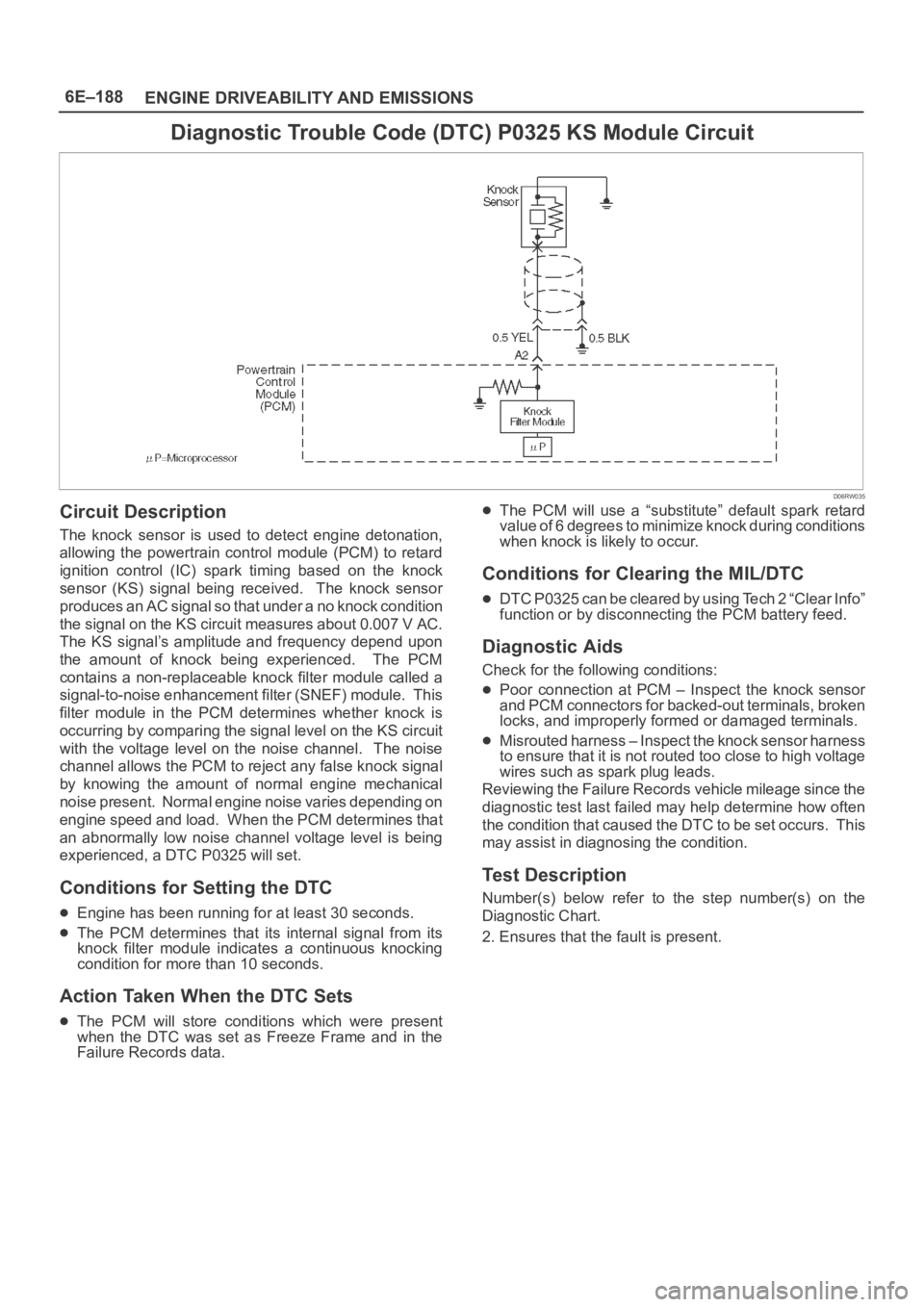
Diagnostic Trouble Code (DTC) P0325 KS Module Circuit
D06RW035
Circuit Description
The knock sensor is used to detect engine detonation,
allowing the powertrain control module (PCM) to retard
ignition control (IC) spark timing based on the knock
sensor (KS) signal being received. The knock sensor
produces an AC signal so that under a no knock condition
the signal on the KS circuit measures about 0.007 V AC.
The KS signal’s amplitude and frequency depend upon
the amount of knock being experienced. The PCM
contains a non-replaceable knock filter module called a
signal-to-noise enhancement filter (SNEF) module. This
filter module in the PCM determines whether knock is
occurring by comparing the signal level on the KS circuit
with the voltage level on the noise channel. The noise
channel allows the PCM to reject any false knock signal
by knowing the amount of normal engine mechanical
noise present. Normal engine noise varies depending on
engine speed and load. When the PCM determines that
an abnormally low noise channel voltage level is being
experienced, a DTC P0325 will set.
Conditions for Setting the DTC
Engine has been running for at least 30 seconds.
The PCM determines that its internal signal from its
knock filter module indicates a continuous knocking
condition for more than 10 seconds.
Action Taken When the DTC Sets
The PCM will store conditions which were present
when the DTC was set as Freeze Frame and in the
Failure Records data.
The PCM will use a “substitute” default spark retard
value of 6 degrees to minimize knock during conditions
when knock is likely to occur.
Conditions for Clearing the MIL/DTC
DTC P0325 can be cleared by using Tech 2 “Clear Info”
function or by disconnecting the PCM battery feed.
Diagnostic Aids
Check for the following conditions:
Poor connection at PCM – Inspect the knock sensor
and PCM connectors for backed-out terminals, broken
locks, and improperly formed or damaged terminals.
Misrouted harness – Inspect the knock sensor harness
to ensure that it is not routed too close to high voltage
wires such as spark plug leads.
Reviewing the Failure Records vehicle mileage since the
diagnostic test last failed may help determine how often
the condition that caused the DTC to be set occurs. This
may assist in diagnosing the condition.
Test Description
Number(s) below refer to the step number(s) on the
Diagnostic Chart.
2. Ensures that the fault is present.
Page 1307 of 6000
6E–190
ENGINE DRIVEABILITY AND EMISSIONS
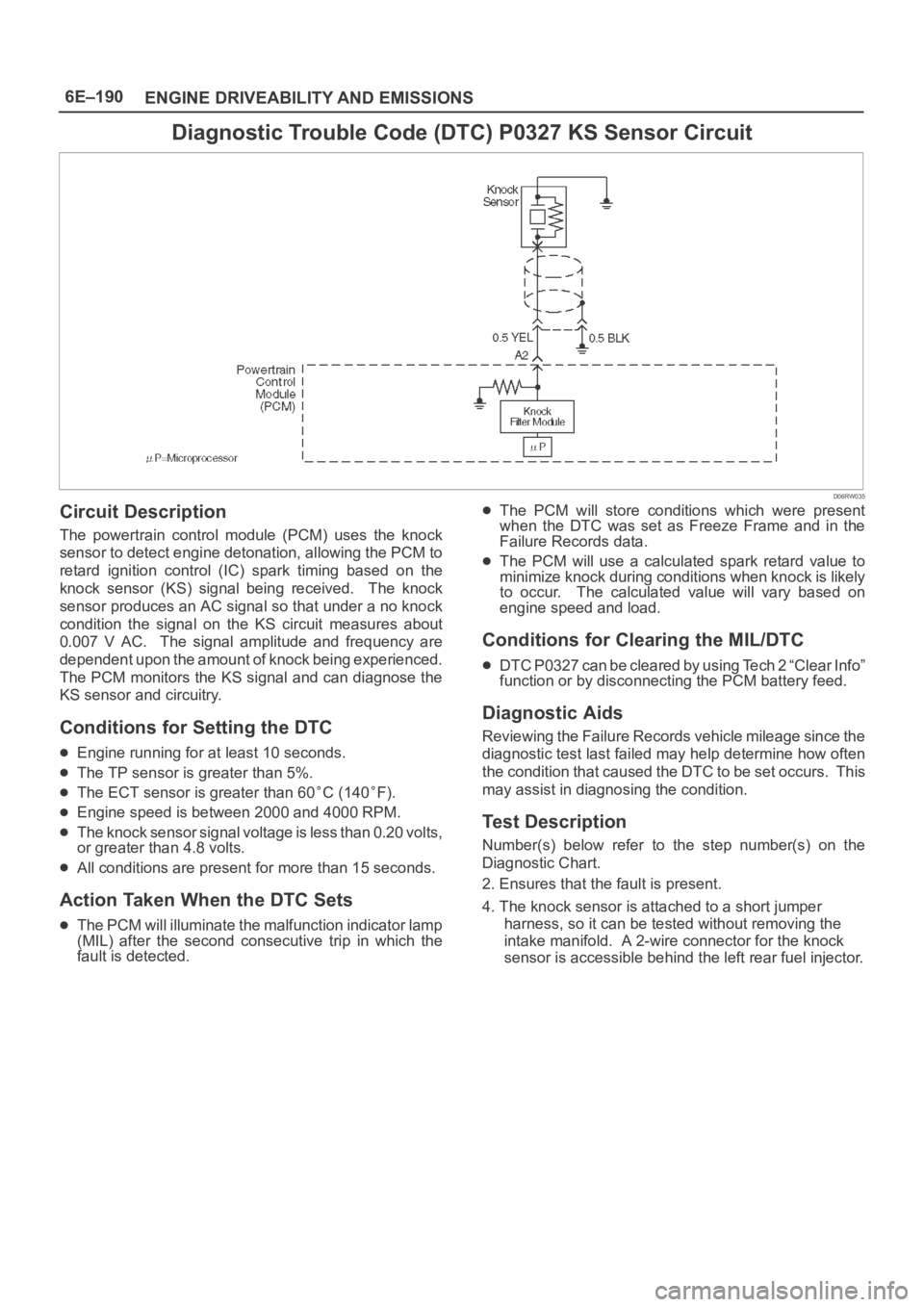
Diagnostic Trouble Code (DTC) P0327 KS Sensor Circuit
D06RW035
Circuit Description
The powertrain control module (PCM) uses the knock
sensor to detect engine detonation, allowing the PCM to
retard ignition control (IC) spark timing based on the
knock sensor (KS) signal being received. The knock
sensor produces an AC signal so that under a no knock
condition the signal on the KS circuit measures about
0.007 V AC. The signal amplitude and frequency are
dependent upon the amount of knock being experienced.
The PCM monitors the KS signal and can diagnose the
KS sensor and circuitry.
Conditions for Setting the DTC
Engine running for at least 10 seconds.
The TP sensor is greater than 5%.
The ECT sensor is greater than 60C (140F).
Engine speed is between 2000 and 4000 RPM.
The knock sensor signal voltage is less than 0.20 volts,
or greater than 4.8 volts.
All conditions are present for more than 15 seconds.
Action Taken When the DTC Sets
The PCM will illuminate the malfunction indicator lamp
(MIL) after the second consecutive trip in which the
fault is detected.
The PCM will store conditions which were present
when the DTC was set as Freeze Frame and in the
Failure Records data.
The PCM will use a calculated spark retard value to
minimize knock during conditions when knock is likely
to occur. The calculated value will vary based on
engine speed and load.
Conditions for Clearing the MIL/DTC
DTC P0327 can be cleared by using Tech 2 “Clear Info”
function or by disconnecting the PCM battery feed.
Diagnostic Aids
Reviewing the Failure Records vehicle mileage since the
diagnostic test last failed may help determine how often
the condition that caused the DTC to be set occurs. This
may assist in diagnosing the condition.
Test Description
Number(s) below refer to the step number(s) on the
Diagnostic Chart.
2. Ensures that the fault is present.
4. The knock sensor is attached to a short jumper
harness, so it can be tested without removing the
intake manifold. A 2-wire connector for the knock
sensor is accessible behind the left rear fuel injector.
Page 1311 of 6000
6E–194
ENGINE DRIVEABILITY AND EMISSIONS
Damaged harness – Inspect the wiring harness for
damage. If the harness appears to be OK, disconnect
the PCM, turn the ignition on and observe a voltmeter
connected to the 58X reference circuit at the PCM
harness connector while moving connectors and
wiring harnesses related to the ICM. A change in
voltage will indicate the location of the fault.Reviewing the Failure Records vehicle mileage since the
diagnostic test last failed may help determine how often
the condition that caused the DTC to be set occurs. This
may assist in diagnosing the condition.
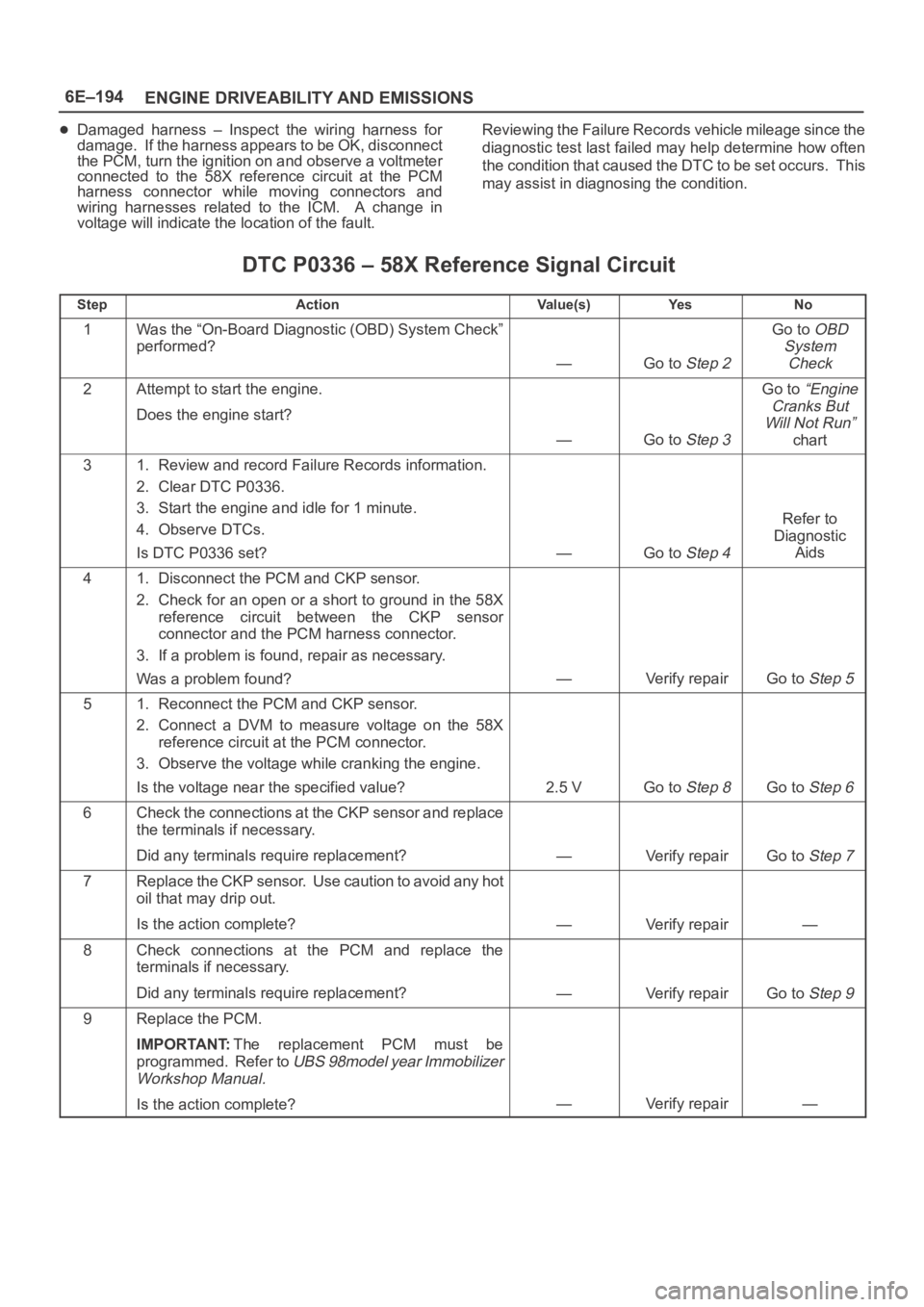
DTC P0336 – 58X Reference Signal Circuit
StepActionVa l u e ( s )Ye sNo
1Was the “On-Board Diagnostic (OBD) System Check”
performed?
—Go to Step 2
Go to OBD
System
Check
2Attempt to start the engine.
Does the engine start?
—Go to Step 3
Go to “Engine
Cranks But
Will Not Run”
chart
31. Review and record Failure Records information.
2. Clear DTC P0336.
3. Start the engine and idle for 1 minute.
4. Observe DTCs.
Is DTC P0336 set?
—Go to Step 4
Refer to
Diagnostic
Aids
41. Disconnect the PCM and CKP sensor.
2. Check for an open or a short to ground in the 58X
reference circuit between the CKP sensor
connector and the PCM harness connector.
3. If a problem is found, repair as necessary.
Was a problem found?
—Verify repairGo to Step 5
51. Reconnect the PCM and CKP sensor.
2. Connect a DVM to measure voltage on the 58X
reference circuit at the PCM connector.
3. Observe the voltage while cranking the engine.
Is the voltage near the specified value?
2.5 VGo to Step 8Go to Step 6
6Check the connections at the CKP sensor and replace
the terminals if necessary.
Did any terminals require replacement?
—Verify repairGo to Step 7
7Replace the CKP sensor. Use caution to avoid any hot
oil that may drip out.
Is the action complete?
—Verify repair—
8Check connections at the PCM and replace the
terminals if necessary.
Did any terminals require replacement?
—Verify repairGo to Step 9
9Replace the PCM.
IMPORTANT:The replacement PCM must be
programmed. Refer to
UBS 98model year Immobilizer
Workshop Manual.
Is the action complete?—Verify repair—
Page 1313 of 6000
6E–196
ENGINE DRIVEABILITY AND EMISSIONS
Damaged harness – Inspect the wiring harness for
damage. If the harness appears to be OK, disconnect
the PCM, turn the ignition on and observe a voltmeter
connected to the 58X reference circuit at the PCM
harness connector while moving connectors and
wiring harnesses related to the ICM. A change in
voltage will indicate the location of the fault.Reviewing the Failure Records vehicle mileage since the
diagnostic test last failed may help determine how often
the condition that caused the DTC to be set occurs. This
may assist in diagnosing the condition.
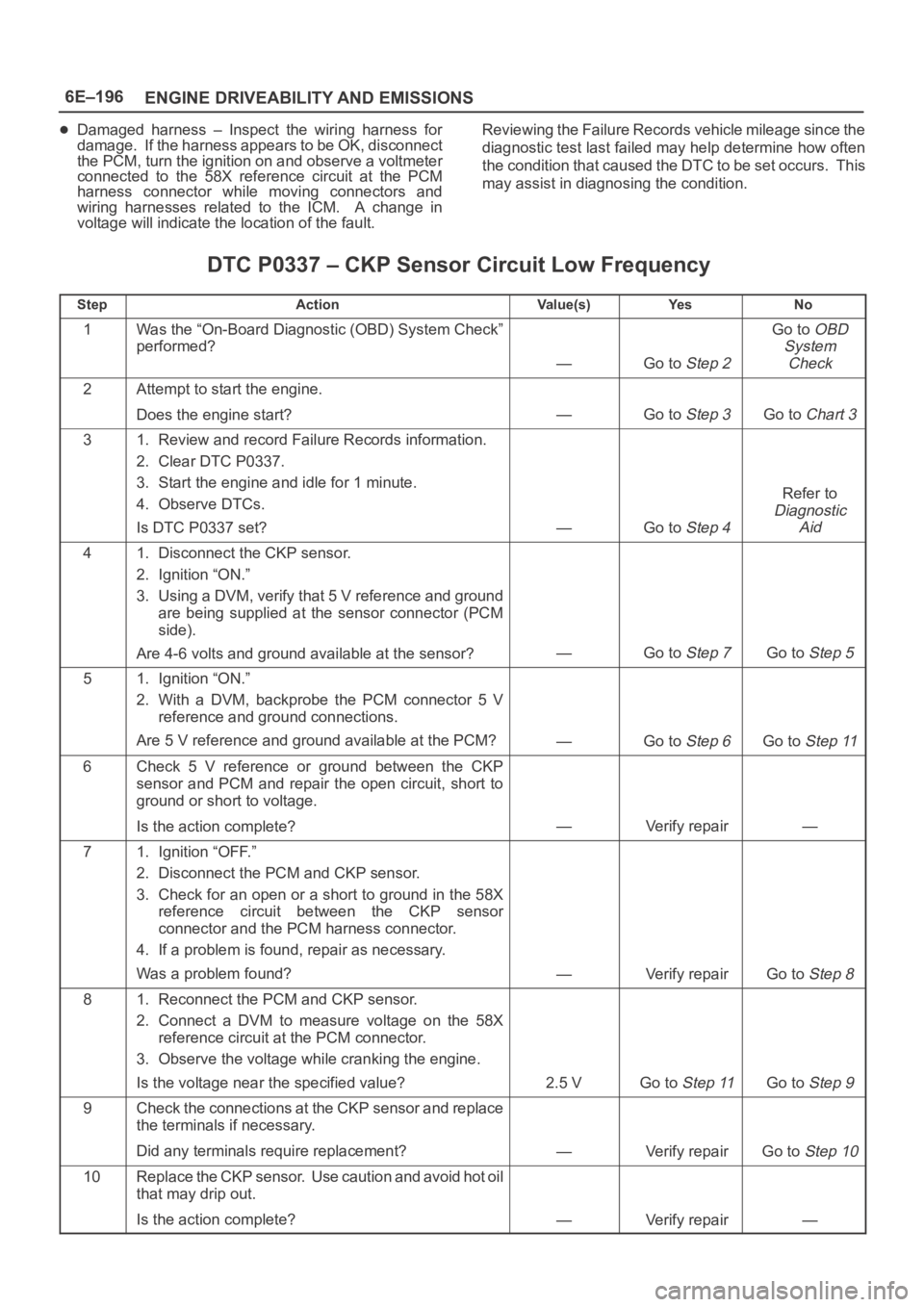
DTC P0337 – CKP Sensor Circuit Low Frequency
StepActionVa l u e ( s )Ye sNo
1Was the “On-Board Diagnostic (OBD) System Check”
performed?
—Go to Step 2
Go to OBD
System
Check
2Attempt to start the engine.
Does the engine start?
—Go to Step 3Go to Chart 3
31. Review and record Failure Records information.
2. Clear DTC P0337.
3. Start the engine and idle for 1 minute.
4. Observe DTCs.
Is DTC P0337 set?
—Go to Step 4
Refer to
Diagnostic
Aid
41. Disconnect the CKP sensor.
2. Ignition “ON.”
3. Using a DVM, verify that 5 V reference and ground
are being supplied at the sensor connector (PCM
side).
Are 4-6 volts and ground available at the sensor?
—Go to Step 7Go to Step 5
51. Ignition “ON.”
2. With a DVM, backprobe the PCM connector 5 V
reference and ground connections.
Are 5 V reference and ground available at the PCM?
—Go to Step 6Go to Step 11
6Check 5 V reference or ground between the CKP
sensor and PCM and repair the open circuit, short to
ground or short to voltage.
Is the action complete?
—Verify repair—
71. Ignition “OFF.”
2. Disconnect the PCM and CKP sensor.
3. Check for an open or a short to ground in the 58X
reference circuit between the CKP sensor
connector and the PCM harness connector.
4. If a problem is found, repair as necessary.
Was a problem found?
—Verify repairGo to Step 8
81. Reconnect the PCM and CKP sensor.
2. Connect a DVM to measure voltage on the 58X
reference circuit at the PCM connector.
3. Observe the voltage while cranking the engine.
Is the voltage near the specified value?
2.5 VGo to Step 11Go to Step 9
9Check the connections at the CKP sensor and replace
the terminals if necessary.
Did any terminals require replacement?
—Verify repairGo to Step 10
10Replace the CKP sensor. Use caution and avoid hot oil
that may drip out.
Is the action complete?
—Verify repair—