1998 OPEL FRONTERA wiring
[x] Cancel search: wiringPage 2287 of 6000
7A1–42
TRANSMISSION CONTROL SYSTEM (4L30–E)
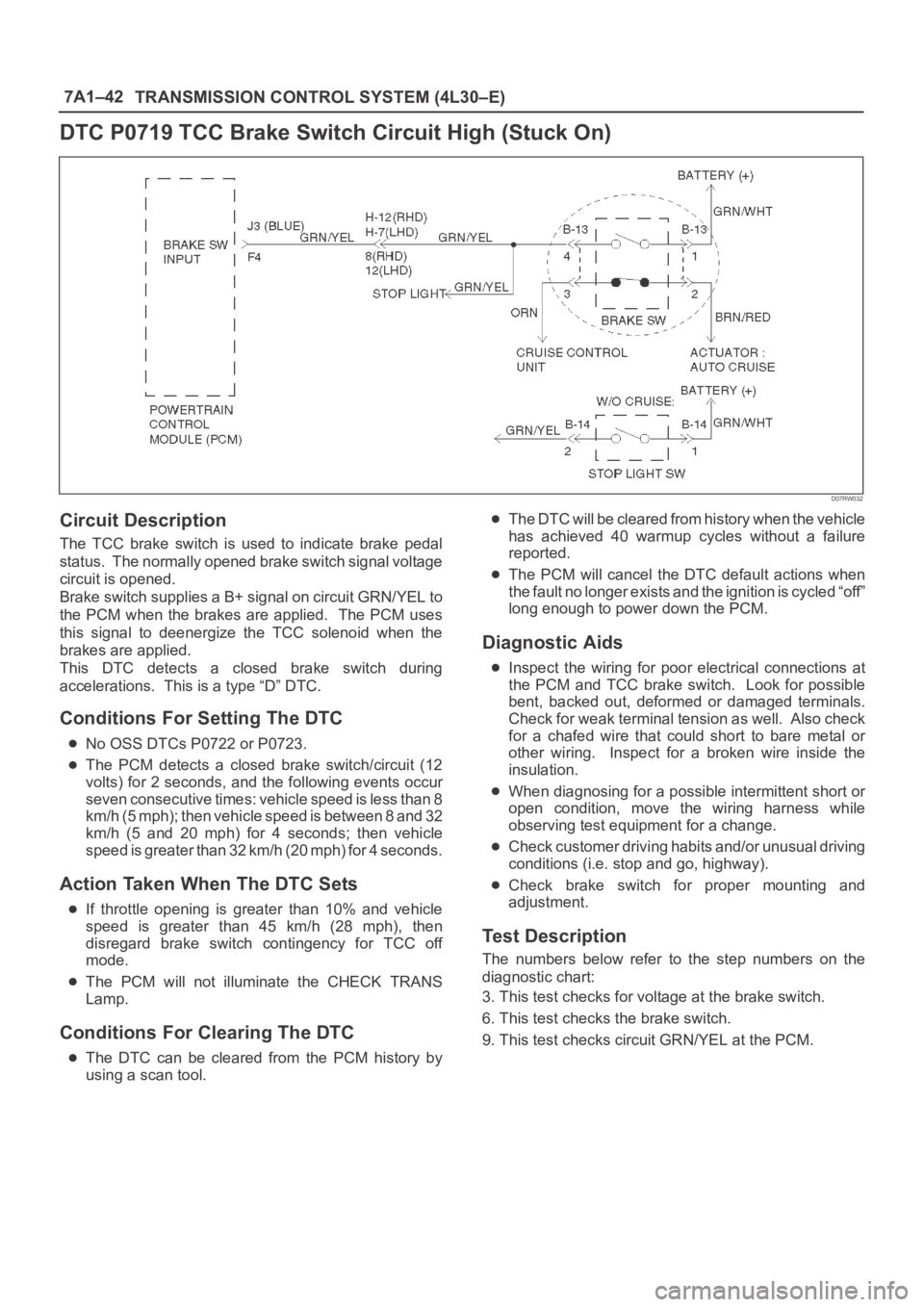
DTC P0719 TCC Brake Switch Circuit High (Stuck On)
D07RW032
Circuit Description
The TCC brake switch is used to indicate brake pedal
status. The normally opened brake switch signal voltage
circuit is opened.
Brake switch supplies a B+ signal on circuit GRN/YEL to
the PCM when the brakes are applied. The PCM uses
this signal to deenergize the TCC solenoid when the
brakes are applied.
This DTC detects a closed brake switch during
accelerations. This is a type “D” DTC.
Conditions For Setting The DTC
No OSS DTCs P0722 or P0723.
The PCM detects a closed brake switch/circuit (12
volts) for 2 seconds, and the following events occur
seven consecutive times: vehicle speed is less than 8
km/h (5 mph); then vehicle speed is between 8 and 32
km/h (5 and 20 mph) for 4 seconds; then vehicle
speed is greater than 32 km/h (20 mph) for 4 seconds.
Action Taken When The DTC Sets
If throttle opening is greater than 10% and vehicle
speed is greater than 45 km/h (28 mph), then
disregard brake switch contingency for TCC off
mode.
The PCM will not illuminate the CHECK TRANS
Lamp.
Conditions For Clearing The DTC
The DTC can be cleared from the PCM history by
using a scan tool.
The DTC will be cleared from history when the vehicle
has achieved 40 warmup cycles without a failure
reported.
The PCM will cancel the DTC default actions when
the fault no longer exists and the ignition is cycled “off”
long enough to power down the PCM.
Diagnostic Aids
Inspect the wiring for poor electrical connections at
the PCM and TCC brake switch. Look for possible
bent, backed out, deformed or damaged terminals.
Check for weak terminal tension as well. Also check
for a chafed wire that could short to bare metal or
other wiring. Inspect for a broken wire inside the
insulation.
When diagnosing for a possible intermittent short or
open condition, move the wiring harness while
observing test equipment for a change.
Check customer driving habits and/or unusual driving
conditions (i.e. stop and go, highway).
Check brake switch for proper mounting and
adjustment.
Test Description
The numbers below refer to the step numbers on the
diagnostic chart:
3. This test checks for voltage at the brake switch.
6. This test checks the brake switch.
9. This test checks circuit GRN/YEL at the PCM.
Page 2290 of 6000
TRANSMISSION CONTROL SYSTEM (4L30–E)7A1–45
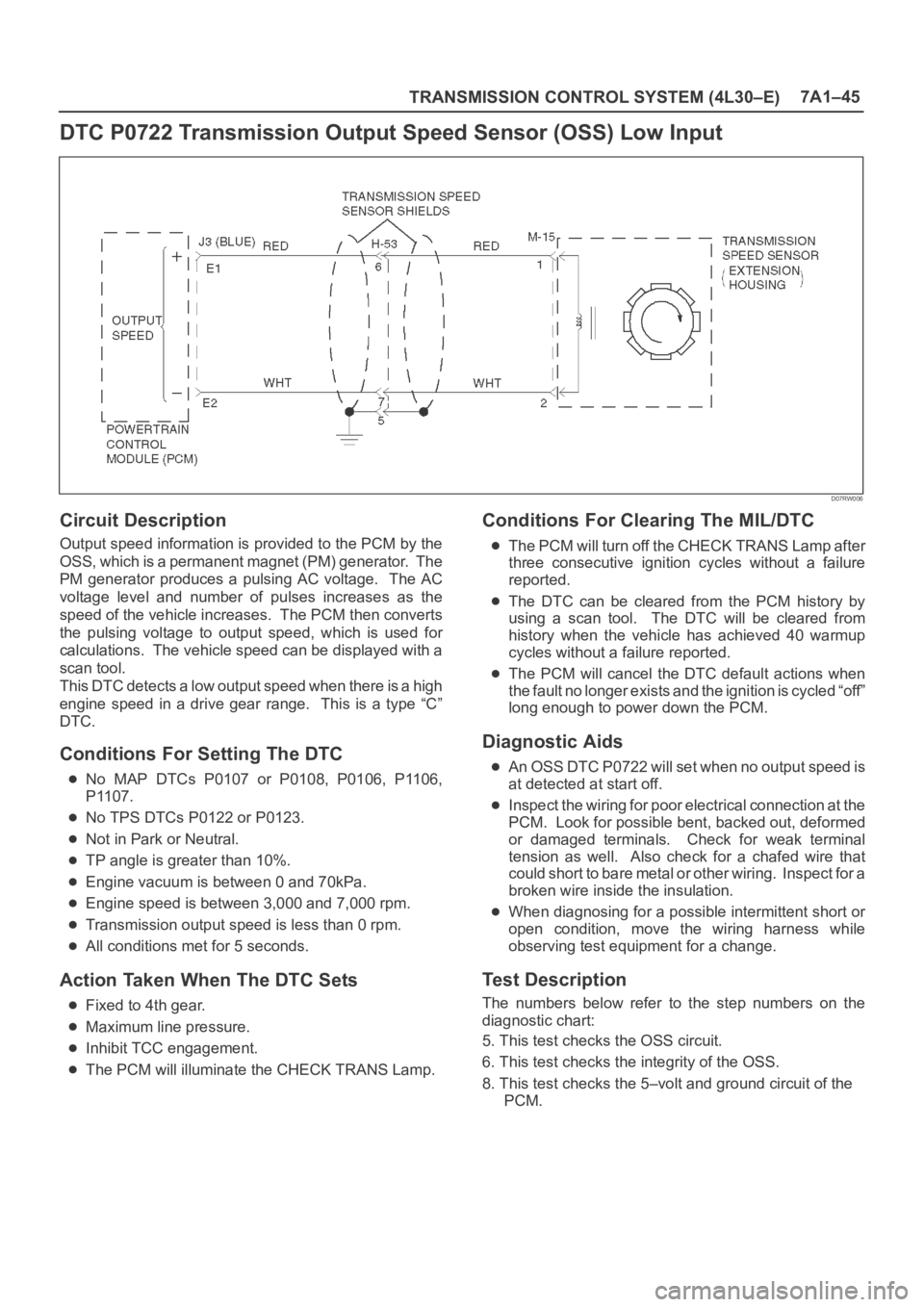
DTC P0722 Transmission Output Speed Sensor (OSS) Low Input
D07RW006
Circuit Description
Output speed information is provided to the PCM by the
OSS, which is a permanent magnet (PM) generator. The
PM generator produces a pulsing AC voltage. The AC
voltage level and number of pulses increases as the
speed of the vehicle increases. The PCM then converts
the pulsing voltage to output speed, which is used for
calculations. The vehicle speed can be displayed with a
scan tool.
This DTC detects a low output speed when there is a high
engine speed in a drive gear range. This is a type “C”
DTC.
Conditions For Setting The DTC
No MAP DTCs P0107 or P0108, P0106, P1106,
P1107.
No TPS DTCs P0122 or P0123.
Not in Park or Neutral.
TP angle is greater than 10%.
Engine vacuum is between 0 and 70kPa.
Engine speed is between 3,000 and 7,000 rpm.
Transmission output speed is less than 0 rpm.
All conditions met for 5 seconds.
Action Taken When The DTC Sets
Fixed to 4th gear.
Maximum line pressure.
Inhibit TCC engagement.
The PCM will illuminate the CHECK TRANS Lamp.
Conditions For Clearing The MIL/DTC
The PCM will turn off the CHECK TRANS Lamp after
three consecutive ignition cycles without a failure
reported.
The DTC can be cleared from the PCM history by
using a scan tool. The DTC will be cleared from
history when the vehicle has achieved 40 warmup
cycles without a failure reported.
The PCM will cancel the DTC default actions when
the fault no longer exists and the ignition is cycled “off”
long enough to power down the PCM.
Diagnostic Aids
An OSS DTC P0722 will set when no output speed is
at detected at start off.
Inspect the wiring for poor electrical connection at the
PCM. Look for possible bent, backed out, deformed
or damaged terminals. Check for weak terminal
tension as well. Also check for a chafed wire that
could short to bare metal or other wiring. Inspect for a
broken wire inside the insulation.
When diagnosing for a possible intermittent short or
open condition, move the wiring harness while
observing test equipment for a change.
Test Description
The numbers below refer to the step numbers on the
diagnostic chart:
5. This test checks the OSS circuit.
6. This test checks the integrity of the OSS.
8. This test checks the 5–volt and ground circuit of the
PCM.
Page 2293 of 6000
7A1–48
TRANSMISSION CONTROL SYSTEM (4L30–E)
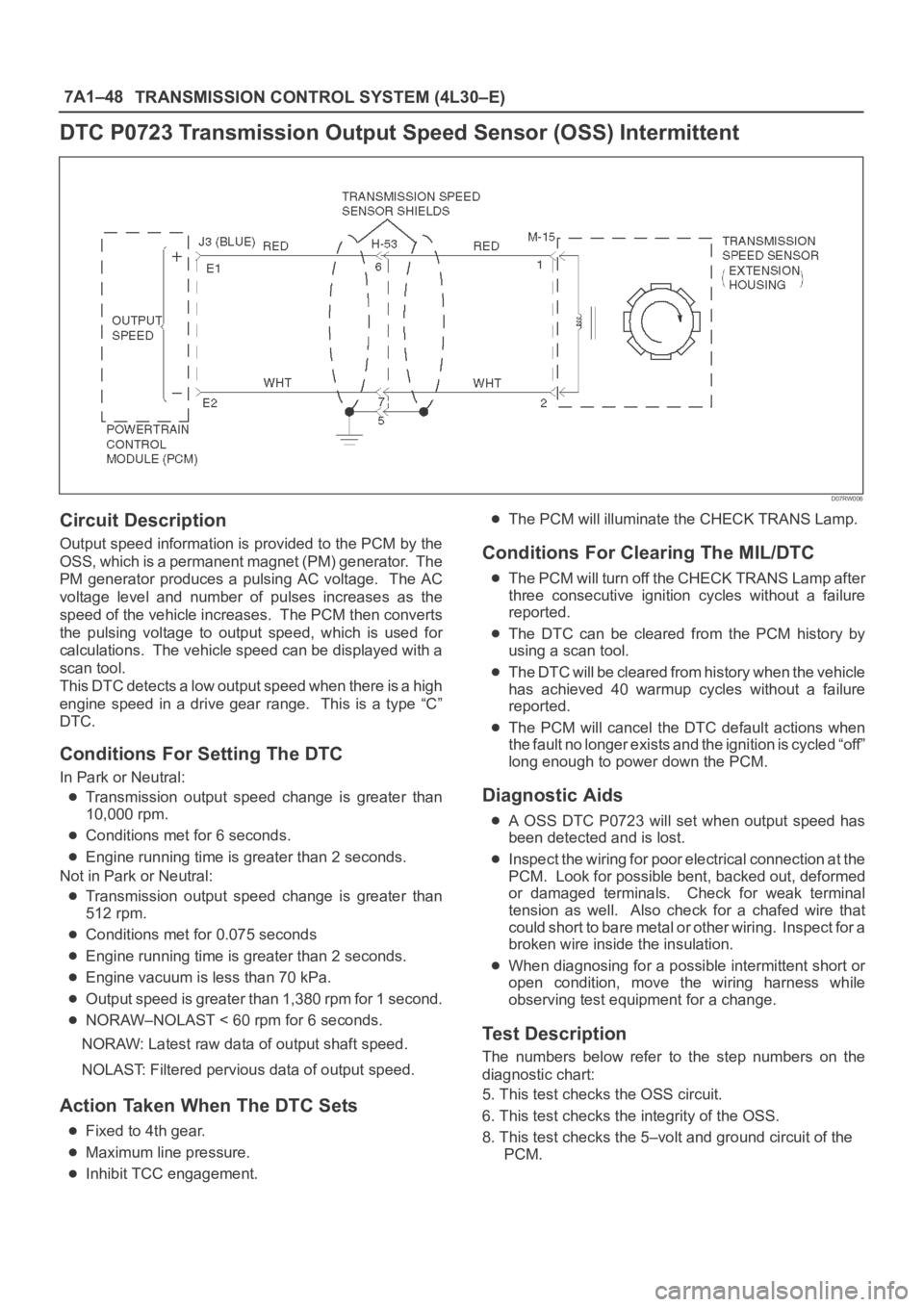
DTC P0723 Transmission Output Speed Sensor (OSS) Intermittent
D07RW006
Circuit Description
Output speed information is provided to the PCM by the
OSS, which is a permanent magnet (PM) generator. The
PM generator produces a pulsing AC voltage. The AC
voltage level and number of pulses increases as the
speed of the vehicle increases. The PCM then converts
the pulsing voltage to output speed, which is used for
calculations. The vehicle speed can be displayed with a
scan tool.
This DTC detects a low output speed when there is a high
engine speed in a drive gear range. This is a type “C”
DTC.
Conditions For Setting The DTC
In Park or Neutral:
Transmission output speed change is greater than
10,000 rpm.
Conditions met for 6 seconds.
Engine running time is greater than 2 seconds.
Not in Park or Neutral:
Transmission output speed change is greater than
512 rpm.
Conditions met for 0.075 seconds
Engine running time is greater than 2 seconds.
Engine vacuum is less than 70 kPa.
Output speed is greater than 1,380 rpm for 1 second.
NORAW–NOLAST < 60 rpm for 6 seconds.
NORAW: Latest raw data of output shaft speed.
NOLAST: Filtered pervious data of output speed.
Action Taken When The DTC Sets
Fixed to 4th gear.
Maximum line pressure.
Inhibit TCC engagement.
The PCM will illuminate the CHECK TRANS Lamp.
Conditions For Clearing The MIL/DTC
The PCM will turn off the CHECK TRANS Lamp after
three consecutive ignition cycles without a failure
reported.
The DTC can be cleared from the PCM history by
using a scan tool.
The DTC will be cleared from history when the vehicle
has achieved 40 warmup cycles without a failure
reported.
The PCM will cancel the DTC default actions when
the fault no longer exists and the ignition is cycled “off”
long enough to power down the PCM.
Diagnostic Aids
A OSS DTC P0723 will set when output speed has
been detected and is lost.
Inspect the wiring for poor electrical connection at the
PCM. Look for possible bent, backed out, deformed
or damaged terminals. Check for weak terminal
tension as well. Also check for a chafed wire that
could short to bare metal or other wiring. Inspect for a
broken wire inside the insulation.
When diagnosing for a possible intermittent short or
open condition, move the wiring harness while
observing test equipment for a change.
Test Description
The numbers below refer to the step numbers on the
diagnostic chart:
5. This test checks the OSS circuit.
6. This test checks the integrity of the OSS.
8. This test checks the 5–volt and ground circuit of the
PCM.
Page 2299 of 6000
7A1–54
TRANSMISSION CONTROL SYSTEM (4L30–E)
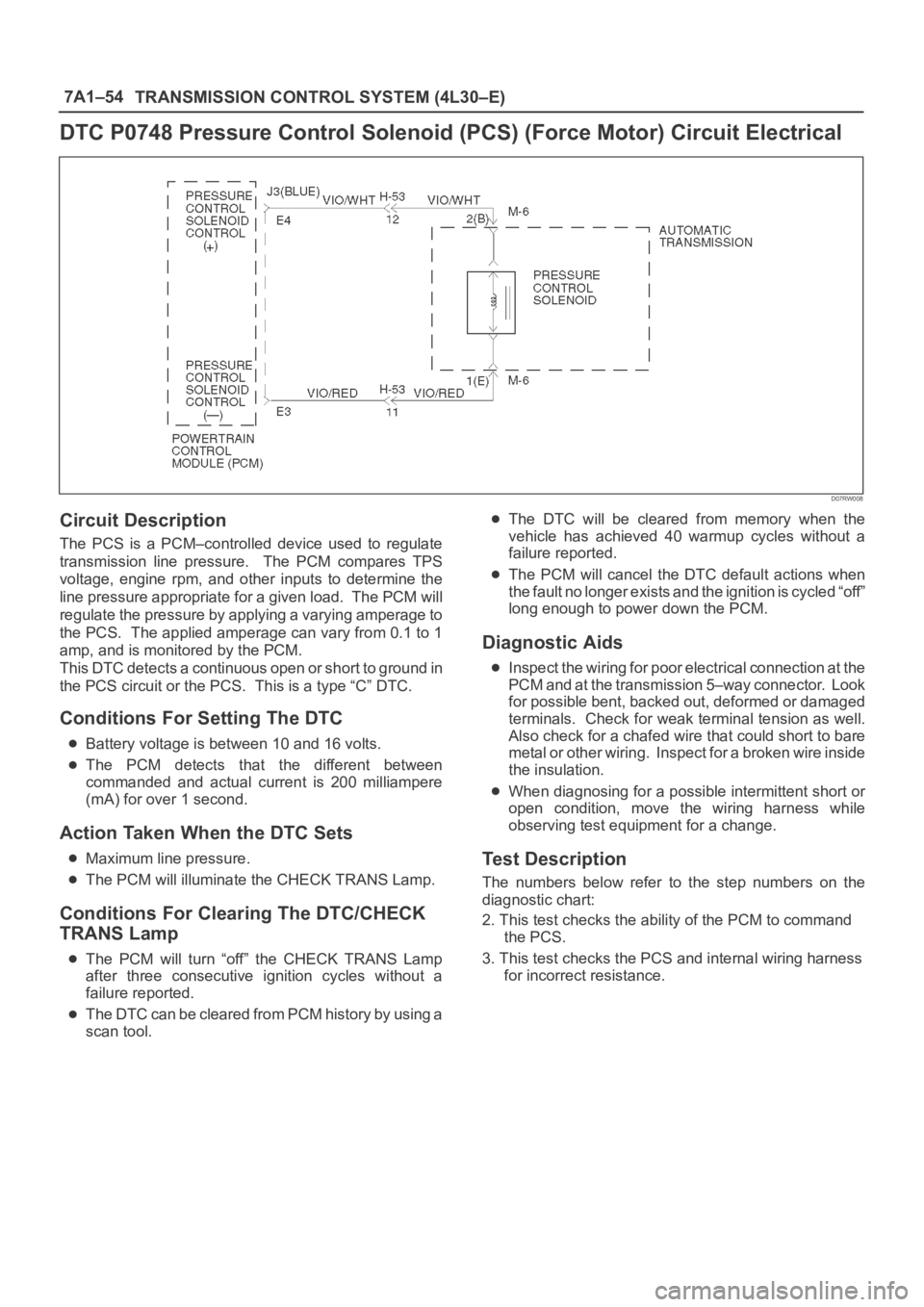
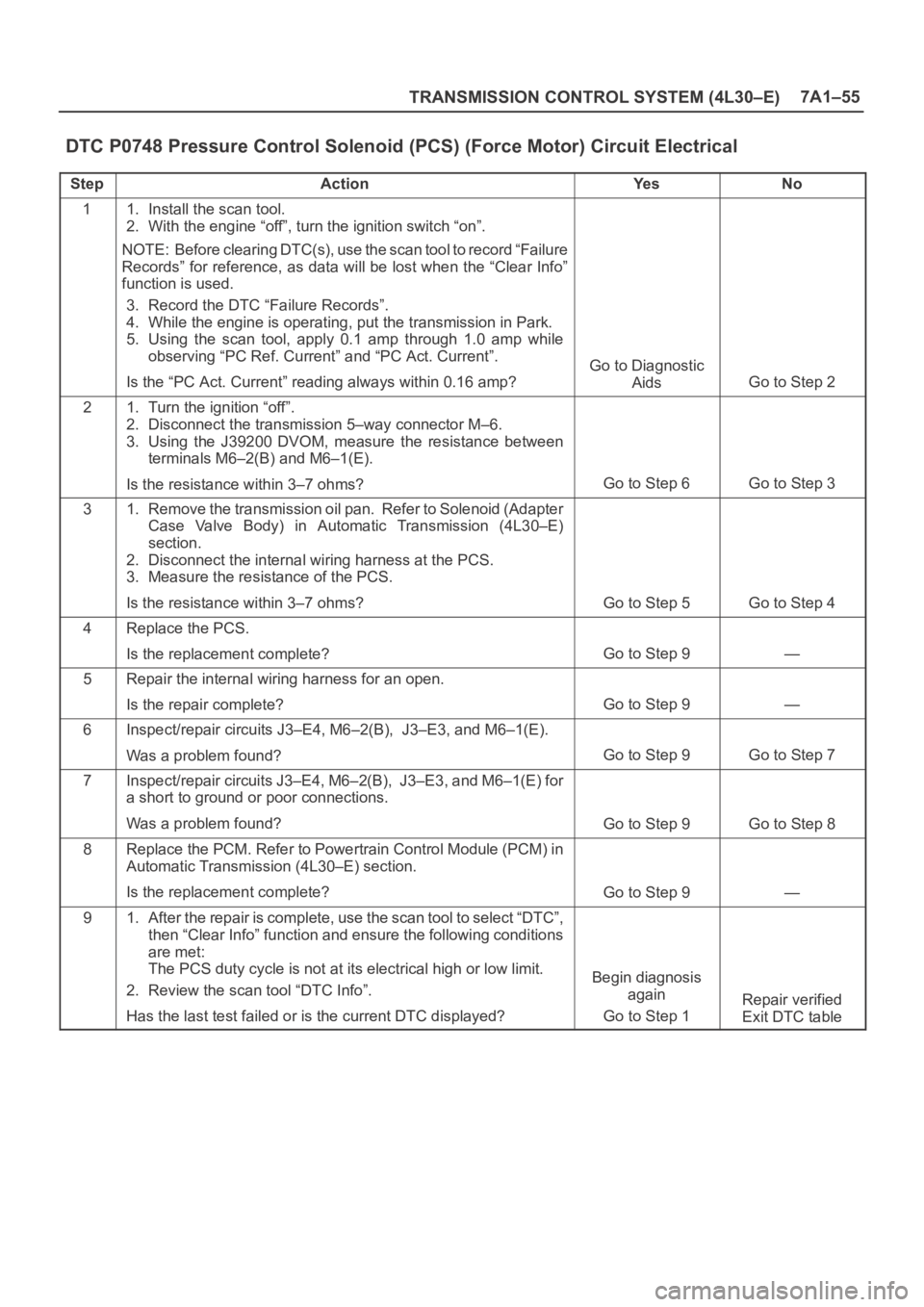
DTC P0748 Pressure Control Solenoid (PCS) (Force Motor) Circuit Electrical
D07RW008
Circuit Description
The PCS is a PCM–controlled device used to regulate
transmission line pressure. The PCM compares TPS
voltage, engine rpm, and other inputs to determine the
line pressure appropriate for a given load. The PCM will
regulate the pressure by applying a varying amperage to
the PCS. The applied amperage can vary from 0.1 to 1
amp, and is monitored by the PCM.
This DTC detects a continuous open or short to ground in
the PCS circuit or the PCS. This is a type “C” DTC.
Conditions For Setting The DTC
Battery voltage is between 10 and 16 volts.
The PCM detects that the different between
commanded and actual current is 200 milliampere
(mA) for over 1 second.
Action Taken When the DTC Sets
Maximum line pressure.
The PCM will illuminate the CHECK TRANS Lamp.
Conditions For Clearing The DTC/CHECK
TRANS Lamp
The PCM will turn “off” the CHECK TRANS Lamp
after three consecutive ignition cycles without a
failure reported.
The DTC can be cleared from PCM history by using a
scan tool.
The DTC will be cleared from memory when the
vehicle has achieved 40 warmup cycles without a
failure reported.
The PCM will cancel the DTC default actions when
the fault no longer exists and the ignition is cycled “off”
long enough to power down the PCM.
Diagnostic Aids
Inspect the wiring for poor electrical connection at the
PCM and at the transmission 5–way connector. Look
for possible bent, backed out, deformed or damaged
terminals. Check for weak terminal tension as well.
Also check for a chafed wire that could short to bare
m e t a l o r o t h e r w i r i n g . I n s p e c t f o r a b r o k e n w i r e i n s i d e
the insulation.
When diagnosing for a possible intermittent short or
open condition, move the wiring harness while
observing test equipment for a change.
Test Description
The numbers below refer to the step numbers on the
diagnostic chart:
2. This test checks the ability of the PCM to command
the PCS.
3. This test checks the PCS and internal wiring harness
for incorrect resistance.
Page 2300 of 6000
TRANSMISSION CONTROL SYSTEM (4L30–E)7A1–55
DTC P0748 Pressure Control Solenoid (PCS) (Force Motor) Circuit Electrical
StepActionYe sNo
11. Install the scan tool.
2. With the engine “off”, turn the ignition switch “on”.
NOTE: Before clearing DTC(s), use the scan tool to record “Failure
Records” for reference, as data will be lost when the “Clear Info”
function is used.
3. Record the DTC “Failure Records”.
4. While the engine is operating, put the transmission in Park.
5. Using the scan tool, apply 0.1 amp through 1.0 amp while
observing “PC Ref. Current” and “PC Act. Current”.
Is the “PC Act. Current” reading always within 0.16 amp?
Go to Diagnostic
Aids
Go to Step 2
21. Turn the ignition “off”.
2. Disconnect the transmission 5–way connector M–6.
3. Using the J39200 DVOM, measure the resistance between
terminals M6–2(B) and M6–1(E).
Is the resistance within 3–7 ohms?
Go to Step 6Go to Step 3
31. Remove the transmission oil pan. Refer to Solenoid (Adapter
Case Valve Body) in Automatic Transmission (4L30–E)
section.
2. Disconnect the internal wiring harness at the PCS.
3. Measure the resistance of the PCS.
Is the resistance within 3–7 ohms?
Go to Step 5Go to Step 4
4Replace the PCS.
Is the replacement complete?
Go to Step 9—
5Repair the internal wiring harness for an open.
Is the repair complete?
Go to Step 9—
6Inspect/repair circuits J3–E4, M6–2(B), J3–E3, and M6–1(E).
Was a problem found?
Go to Step 9Go to Step 7
7Inspect/repair circuits J3–E4, M6–2(B), J3–E3, and M6–1(E) for
a short to ground or poor connections.
Was a problem found?
Go to Step 9Go to Step 8
8Replace the PCM. Refer to Powertrain Control Module (PCM) in
Automatic Transmission (4L30–E) section.
Is the replacement complete?
Go to Step 9—
91. After the repair is complete, use the scan tool to select “DTC”,
then “Clear Info” function and ensure the following conditions
are met:
The PCS duty cycle is not at its electrical high or low limit.
2. Review the scan tool “DTC Info”.
Has the last test failed or is the current DTC displayed?
Begin diagnosis
again
Go to Step 1
Repair verified
Exit DTC table
Page 2301 of 6000
7A1–56
TRANSMISSION CONTROL SYSTEM (4L30–E)
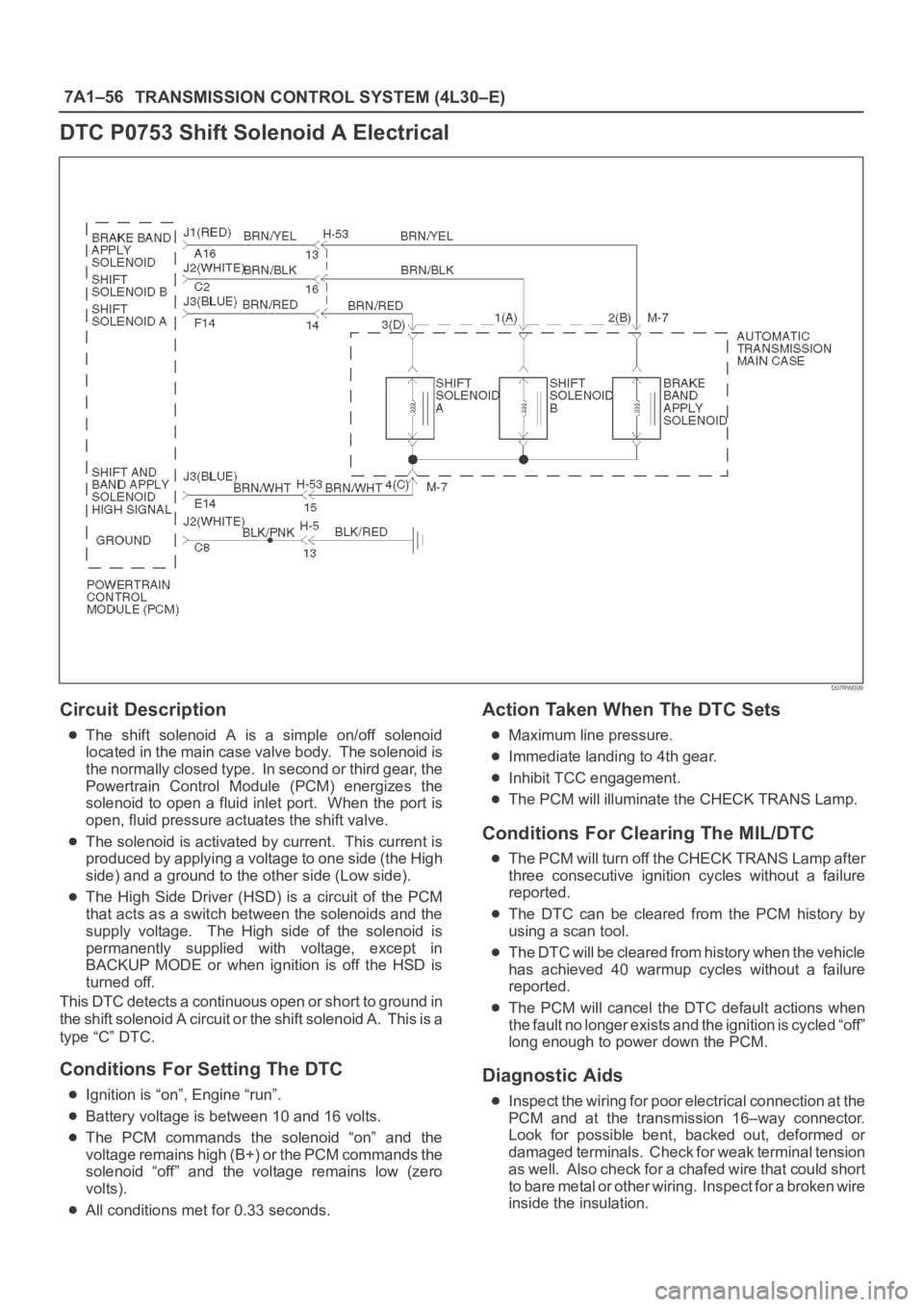
DTC P0753 Shift Solenoid A Electrical
D07RW009
Circuit Description
The shift solenoid A is a simple on/off solenoid
located in the main case valve body. The solenoid is
the normally closed type. In second or third gear, the
Powertrain Control Module (PCM) energizes the
solenoid to open a fluid inlet port. When the port is
open, fluid pressure actuates the shift valve.
The solenoid is activated by current. This current is
produced by applying a voltage to one side (the High
side) and a ground to the other side (Low side).
The High Side Driver (HSD) is a circuit of the PCM
that acts as a switch between the solenoids and the
supply voltage. The High side of the solenoid is
permanently supplied with voltage, except in
BACKUP MODE or when ignition is off the HSD is
turned off.
This DTC detects a continuous open or short to ground in
the shift solenoid A circuit or the shift solenoid A. This is a
type “C” DTC.
Conditions For Setting The DTC
Ignition is “on”, Engine “run”.
Battery voltage is between 10 and 16 volts.
The PCM commands the solenoid “on” and the
voltage remains high (B+) or the PCM commands the
solenoid “off” and the voltage remains low (zero
volts).
All conditions met for 0.33 seconds.
Action Taken When The DTC Sets
Maximum line pressure.
Immediate landing to 4th gear.
Inhibit TCC engagement.
The PCM will illuminate the CHECK TRANS Lamp.
Conditions For Clearing The MIL/DTC
The PCM will turn off the CHECK TRANS Lamp after
three consecutive ignition cycles without a failure
reported.
The DTC can be cleared from the PCM history by
using a scan tool.
The DTC will be cleared from history when the vehicle
has achieved 40 warmup cycles without a failure
reported.
The PCM will cancel the DTC default actions when
the fault no longer exists and the ignition is cycled “off”
long enough to power down the PCM.
Diagnostic Aids
Inspect the wiring for poor electrical connection at the
PCM and at the transmission 16–way connector.
Look for possible bent, backed out, deformed or
damaged terminals. Check for weak terminal tension
as we ll. A lso ch eck fo r a ch af e d w ire th at cou l d s ho r t
to bare metal or other wiring. Inspect for a broken wire
inside the insulation.
Page 2302 of 6000
TRANSMISSION CONTROL SYSTEM (4L30–E)7A1–57
When diagnosing for a possible intermittent short or
open condition, move the wiring harness while
observing test equipment for a change.
An open ignition feed circuit can cause multiple DTCs
to set.
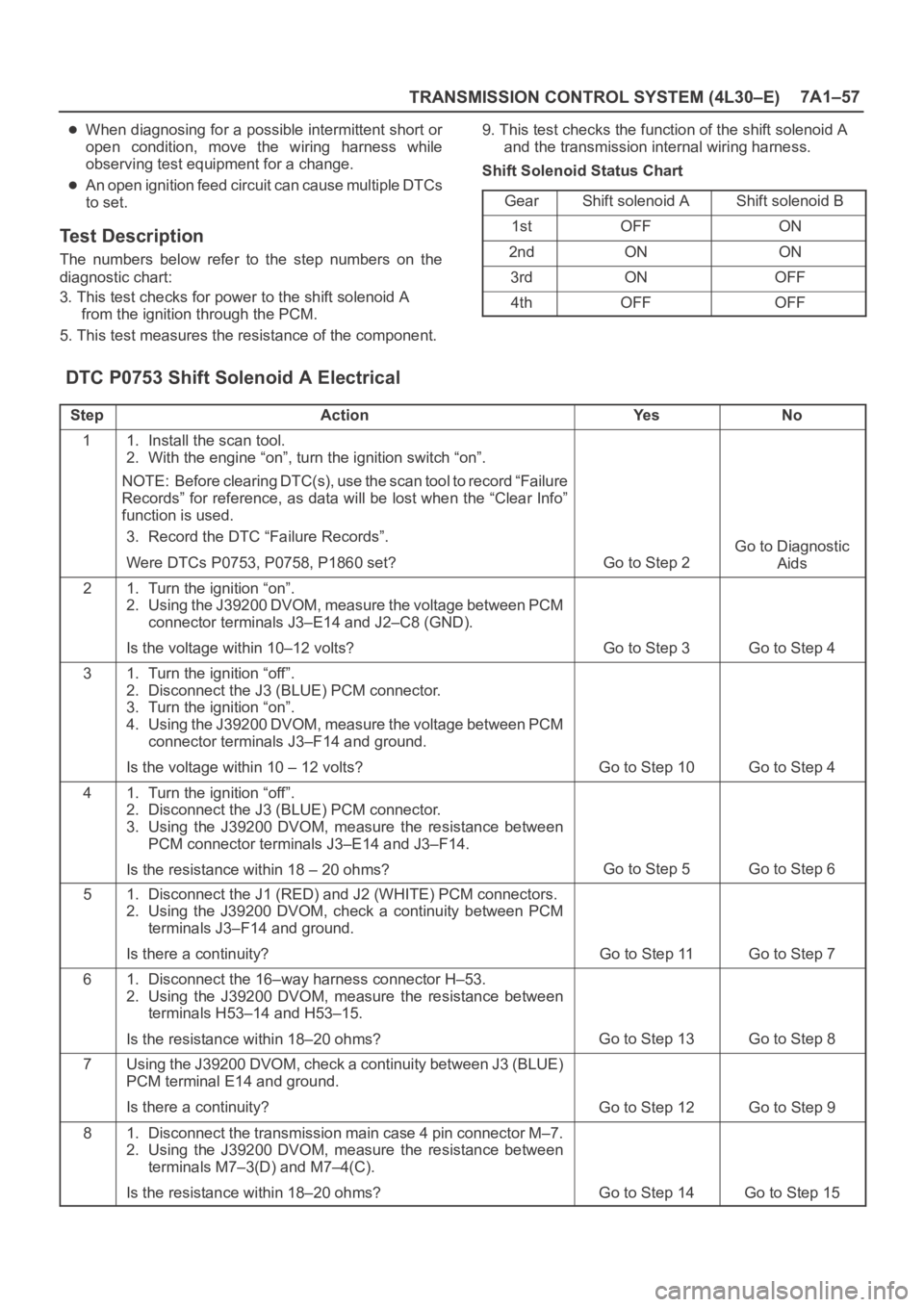
Test Description
The numbers below refer to the step numbers on the
diagnostic chart:
3. This test checks for power to the shift solenoid A
from the ignition through the PCM.
5. This test measures the resistance of the component.9. This test checks the function of the shift solenoid A
and the transmission internal wiring harness.
Shift Solenoid Status Chart
Gear
Shift solenoid AShift solenoid B
1stOFFON
2ndONON
3rdONOFF
4thOFFOFF
DTC P0753 Shift Solenoid A Electrical
StepActionYe sNo
11. Install the scan tool.
2. With the engine “on”, turn the ignition switch “on”.
NOTE: Before clearing DTC(s), use the scan tool to record “Failure
Records” for reference, as data will be lost when the “Clear Info”
function is used.
3. Record the DTC “Failure Records”.
Were DTCs P0753, P0758, P1860 set?
Go to Step 2
Go to Diagnostic
Aids
21. Turn the ignition “on”.
2. Using the J39200 DVOM, measure the voltage between PCM
connector terminals J3–E14 and J2–C8 (GND).
Is the voltage within 10–12 volts?
Go to Step 3Go to Step 4
31. Turn the ignition “off”.
2. Disconnect the J3 (BLUE) PCM connector.
3. Turn the ignition “on”.
4. Using the J39200 DVOM, measure the voltage between PCM
connector terminals J3–F14 and ground.
Is the voltage within 10 – 12 volts?
Go to Step 10Go to Step 4
41. Turn the ignition “off”.
2. Disconnect the J3 (BLUE) PCM connector.
3. Using the J39200 DVOM, measure the resistance between
PCM connector terminals J3–E14 and J3–F14.
Is the resistance within 18 – 20 ohms?
Go to Step 5Go to Step 6
51. Disconnect the J1 (RED) and J2 (WHITE) PCM connectors.
2. Using the J39200 DVOM, check a continuity between PCM
terminals J3–F14 and ground.
Is there a continuity?
Go to Step 11Go to Step 7
61. Disconnect the 16–way harness connector H–53.
2. Using the J39200 DVOM, measure the resistance between
terminals H53–14 and H53–15.
Is the resistance within 18–20 ohms?
Go to Step 13Go to Step 8
7Using the J39200 DVOM, check a continuity between J3 (BLUE)
PCM terminal E14 and ground.
Is there a continuity?
Go to Step 12Go to Step 9
81. Disconnect the transmission main case 4 pin connector M–7.
2. Using the J39200 DVOM, measure the resistance between
terminals M7–3(D) and M7–4(C).
Is the resistance within 18–20 ohms?
Go to Step 14Go to Step 15
Page 2303 of 6000
7A1–58
TRANSMISSION CONTROL SYSTEM (4L30–E)
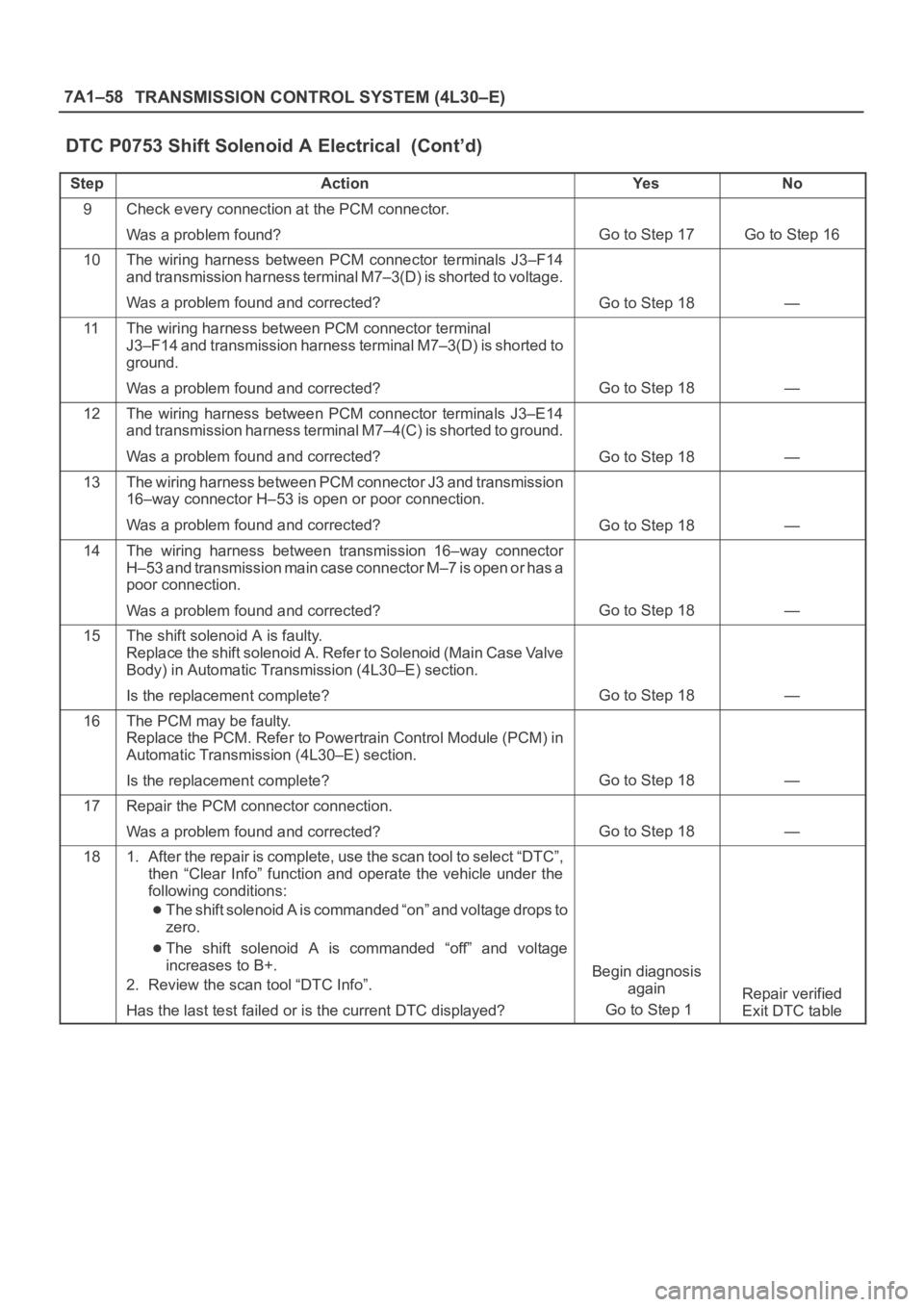
DTC P0753 Shift Solenoid A Electrical (Cont’d)
StepNo Ye s Action
9Check every connection at the PCM connector.
Was a problem found?
Go to Step 17Go to Step 16
10The wiring harness between PCM connector terminals J3–F14
and transmission harness terminal M7–3(D) is shorted to voltage.
Was a problem found and corrected?
Go to Step 18—
11The wiring harness between PCM connector terminal
J3–F14 and transmission harness terminal M7–3(D) is shorted to
ground.
Was a problem found and corrected?
Go to Step 18—
12The wiring harness between PCM connector terminals J3–E14
and transmission harness terminal M7–4(C) is shorted to ground.
Was a problem found and corrected?
Go to Step 18—
13The wiring harness between PCM connector J3 and transmission
16–way connector H–53 is open or poor connection.
Was a problem found and corrected?
Go to Step 18—
14The wiring harness between transmission 16–way connector
H–53 and transmission main case connector M–7 is open or has a
poor connection.
Was a problem found and corrected?
Go to Step 18—
15The shift solenoid A is faulty.
Replace the shift solenoid A. Refer to Solenoid (Main Case Valve
Body) in Automatic Transmission (4L30–E) section.
Is the replacement complete?
Go to Step 18—
16The PCM may be faulty.
Replace the PCM. Refer to Powertrain Control Module (PCM) in
Automatic Transmission (4L30–E) section.
Is the replacement complete?
Go to Step 18—
17Repair the PCM connector connection.
Was a problem found and corrected?
Go to Step 18—
181. After the repair is complete, use the scan tool to select “DTC”,
then “Clear Info” function and operate the vehicle under the
following conditions:
The shift solenoid A is commanded “on” and voltage drops to
zero.
The shift solenoid A is commanded “off” and voltage
increases to B+.
2. Review the scan tool “DTC Info”.
Has the last test failed or is the current DTC displayed?
Begin diagnosis
again
Go to Step 1
Repair verified
Exit DTC table