1998 OPEL FRONTERA manual transmission
[x] Cancel search: manual transmissionPage 1137 of 6000
6E–20
ENGINE DRIVEABILITY AND EMISSIONS
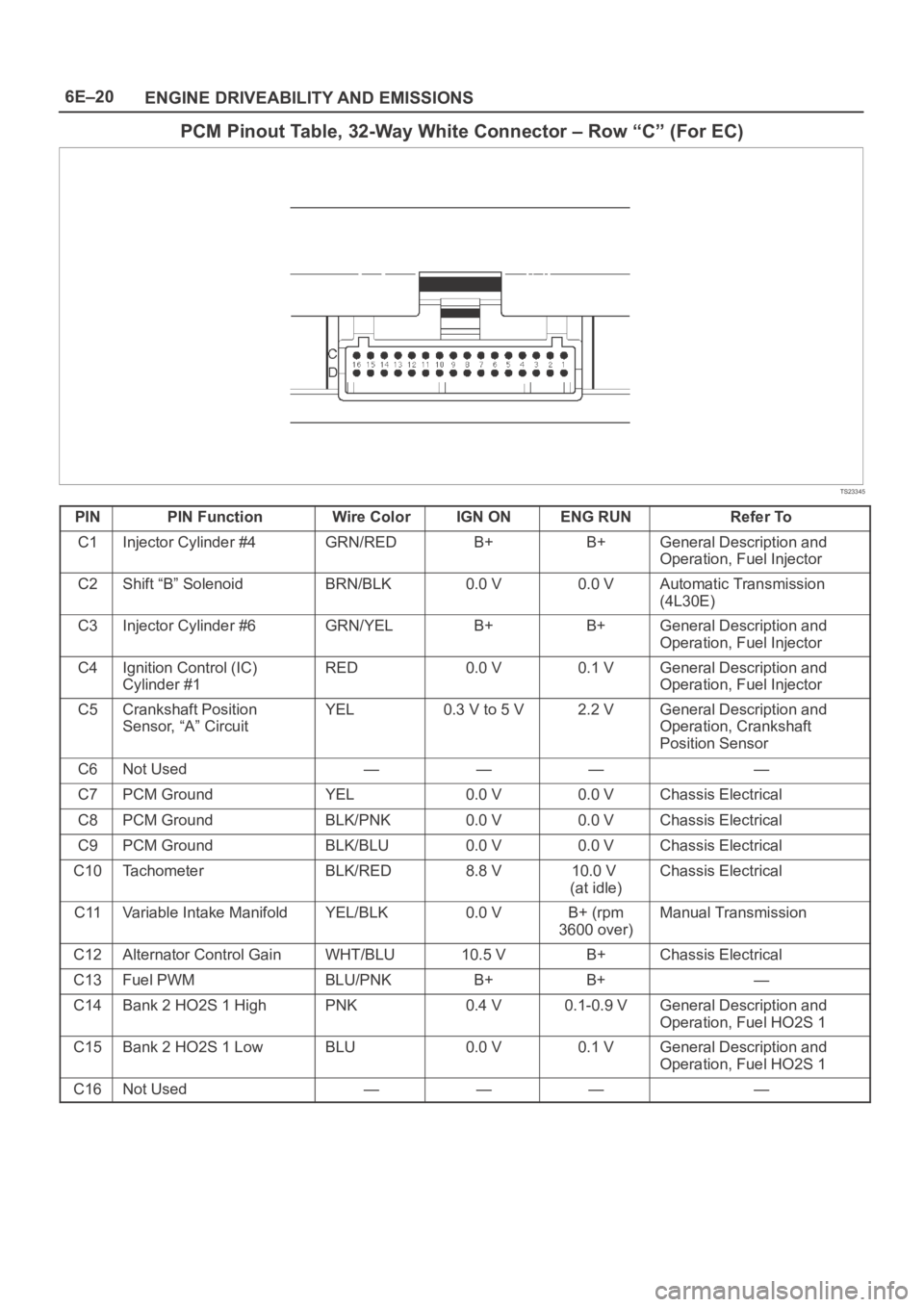
PCM Pinout Table, 32-Way White Connector – Row “C” (For EC)
TS23345
PINPIN FunctionWire ColorIGN ONENG RUNRefer To
C1Injector Cylinder #4GRN/REDB+B+General Description and
Operation, Fuel Injector
C2Shift “B” SolenoidBRN/BLK0.0 V0.0 VAutomatic Transmission
(4L30E)
C3Injector Cylinder #6GRN/YELB+B+General Description and
Operation, Fuel Injector
C4Ignition Control (IC)
Cylinder #1RED0.0 V0.1 VGeneral Description and
Operation, Fuel Injector
C5Crankshaft Position
Sensor, “A” CircuitYEL0.3 V to 5 V2.2 VGeneral Description and
Operation, Crankshaft
Position Sensor
C6Not Used————
C7PCM GroundYEL0.0 V0.0 VChassis Electrical
C8PCM GroundBLK/PNK0.0 V0.0 VChassis Electrical
C9PCM GroundBLK/BLU0.0 V0.0 VChassis Electrical
C10TachometerBLK/RED8.8 V10.0 V
(at idle)Chassis Electrical
C11Variable Intake ManifoldYEL/BLK0.0 VB+ (rpm
3600 over)Manual Transmission
C12Alternator Control GainWHT/BLU10.5 VB+Chassis Electrical
C13Fuel PWMBLU/PNKB+B+—
C14Bank 2 HO2S 1 HighPNK0.4 V0.1-0.9 VGeneral Description and
Operation, Fuel HO2S 1
C15Bank 2 HO2S 1 LowBLU0.0 V0.1 VGeneral Description and
Operation, Fuel HO2S 1
C16Not Used————
Page 1138 of 6000
6E–21 ENGINE DRIVEABILITY AND EMISSIONS
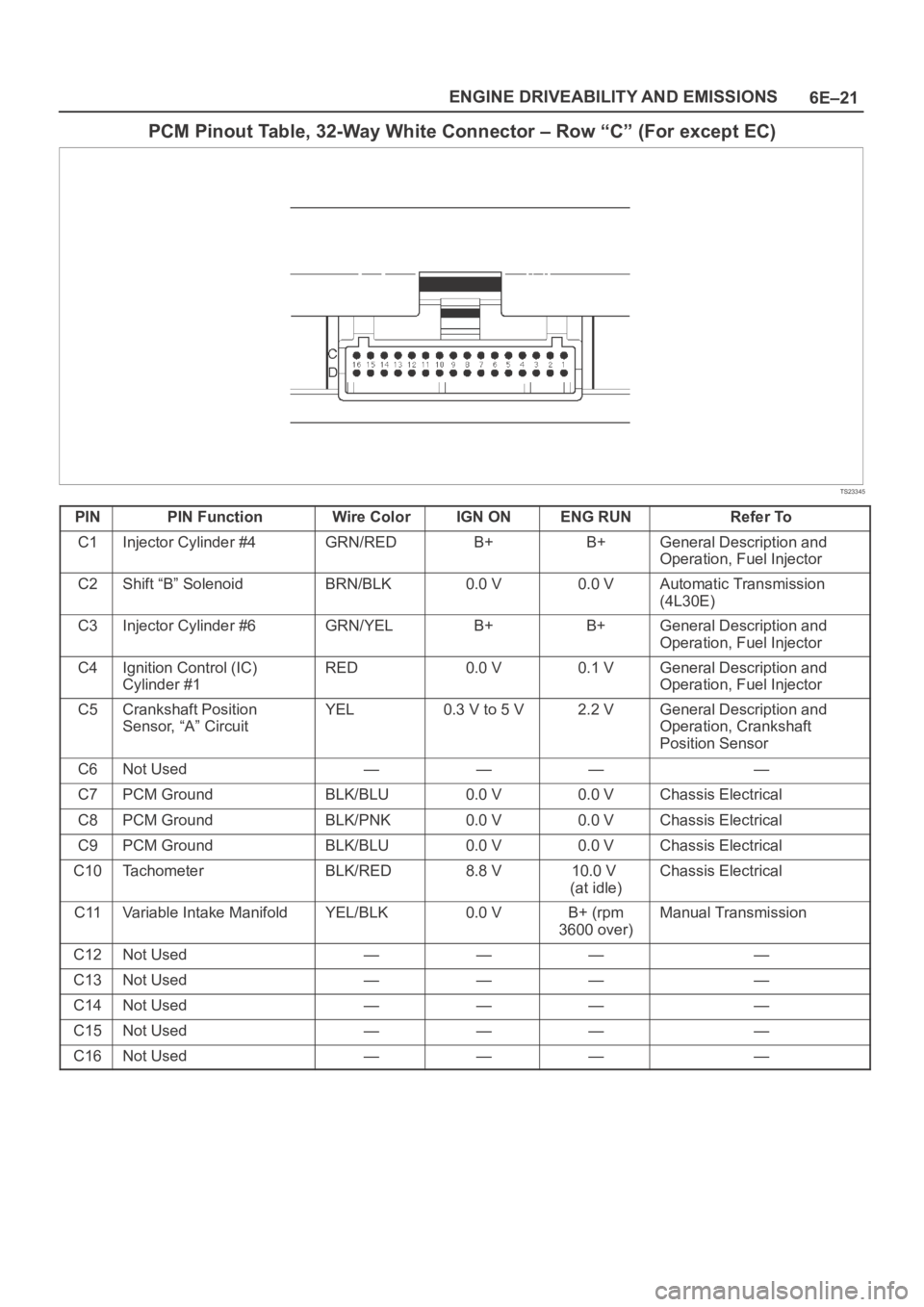
PCM Pinout Table, 32-Way White Connector – Row “C” (For except EC)
TS23345
PINPIN FunctionWire ColorIGN ONENG RUNRefer To
C1Injector Cylinder #4GRN/REDB+B+General Description and
Operation, Fuel Injector
C2Shift “B” SolenoidBRN/BLK0.0 V0.0 VAutomatic Transmission
(4L30E)
C3Injector Cylinder #6GRN/YELB+B+General Description and
Operation, Fuel Injector
C4Ignition Control (IC)
Cylinder #1RED0.0 V0.1 VGeneral Description and
Operation, Fuel Injector
C5Crankshaft Position
Sensor, “A” CircuitYEL0.3 V to 5 V2.2 VGeneral Description and
Operation, Crankshaft
Position Sensor
C6Not Used————
C7PCM GroundBLK/BLU0.0 V0.0 VChassis Electrical
C8PCM GroundBLK/PNK0.0 V0.0 VChassis Electrical
C9PCM GroundBLK/BLU0.0 V0.0 VChassis Electrical
C10TachometerBLK/RED8.8 V10.0 V
(at idle)Chassis Electrical
C11Variable Intake ManifoldYEL/BLK0.0 VB+ (rpm
3600 over)Manual Transmission
C12Not Used————
C13Not Used————
C14Not Used————
C15Not Used————
C16Not Used————
Page 1150 of 6000
6E–33 ENGINE DRIVEABILITY AND EMISSIONS
Undercarriage Component Locator Table (Manual Transmission)
Number
NameLocation
1Fuel Pump AssemblyInstalled in the top of the fuel tank
2Fuel Gauge UnitInstalled in the front edge of the right frame
rail, ahead of the rear axle
3Fuel FilterLocated along the inside of the right frame rail,
ahead of the rear axle
4Vehicle Speed Sensor (VSS)2WD: Protrudes from the transmission
housing, just ahead of the propeller shaft.
4WD: Protrudes from the rear output shaft
housing of the transfer case.
5Heated Oxygen Sensor (Bank 1, HO2S 1)Threaded into the exhaust pipe ahead of the
right-hand catalytic converter
6Heated Oxygen Sensor (Bank 2, HO2S 1)Threaded into the exhaust pipe ahead of the
left-hand catalytic converter
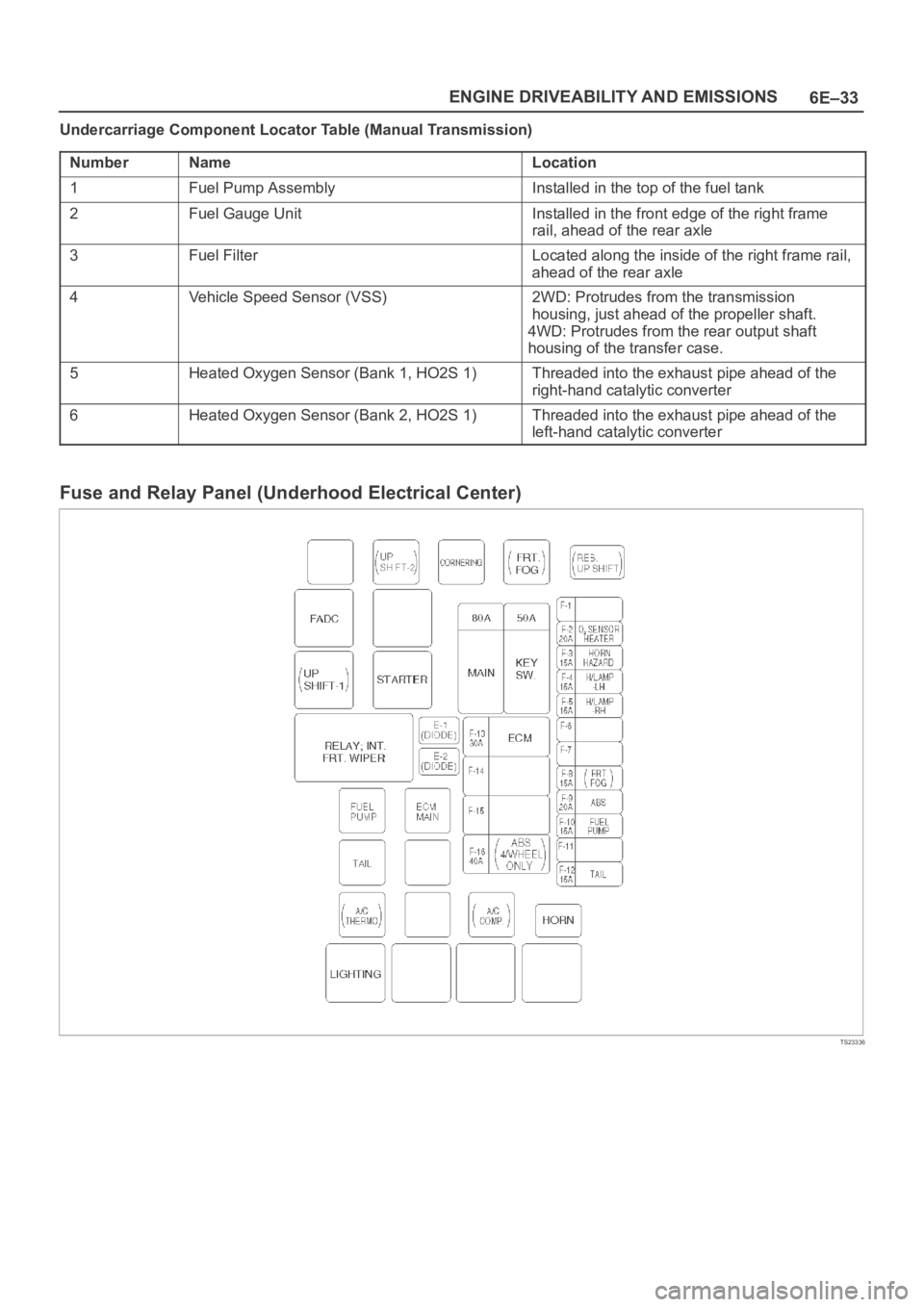
Fuse and Relay Panel (Underhood Electrical Center)
TS23336
Page 1182 of 6000
6E–65 ENGINE DRIVEABILITY AND EMISSIONS
Knock Sensor Diagnosis
The Tech 2 has two data displays available for diagnosing
the knock sensor (KS) system. The two displays are
described as follows:
“Knock Retard” indicates the number of degrees that
the spark timing is being retarded due to a knock
condition.
“KS Noise Channel” indicates the current voltage level
being monitored on the noise channel.
DTCs P0325 and P0327 are designed to diagnose the KS
module, the knock sensor, and the related wiring. The
problems encountered with the KS system should set a
DTC. However, if no DTC was set but the KS system is
suspect because of a detonation complaint, refer to
Detonation/Spark Knock in Symptoms.
Powertrain Control Module (PCM)
Diagnosis
To read and clear diagnostic trouble codes, use a Tech 2.
IMPORTANT:Use of a Tech 2 is recommended to clear
diagnostic trouble codes from the PCM memory.
Diagnostic trouble codes can also be cleared by turning
the ignition “OFF” and disconnecting the battery power
from the PCM for 30 seconds. Turning off the ignition and
disconnecting the battery power from the PCM will cause
all diagnostic information in the PCM memory to be
cleared. Therefore, all the diagnostic tests will have to be
re-run.
Since the PCM can have a failure which may affect only
one circuit, following the diagnostic procedures in this
section will determine which circuit has a problem and
where it is.
If a diagnostic chart indicates that the PCM connections
or the PCM is the cause of a problem, and the PCM is
replaced, but this does not correct the problem, one of the
following may be the reason:
There is a problem with the PCM terminal connections.
The terminals may have to be removed from the
connector in order to check them properly.
The problem is intermittent. This means that the
problem is not present at the time the system is being
checked. In this case, refer to the
Symptoms p o r t i o n o f
the manual and make a careful physical inspection of
all component and wiring associated with the affected
system.
There is a shorted solenoid, relay coil, or harness.
S o l e n o i d s a n d r e l a y s a r e t u r n e d “ O N ” a n d “ O F F ” b y t h e
PCM using internal electronic switches called drivers.
A shorted solenoid, relay coil, or harness will not
damage the PCM but will cause the solenoid or relay to
be inoperative.
Multiple PCM Information Sensor
DTCS Set
Circuit Description
The powertrain control module (PCM) monitors various
sensors to determine the engine operating conditions.
The PCM controls fuel delivery, spark advance,
transmission operation, and emission control device
operation based on the sensor inputs.The PCM provides a sensor ground to all of the sensors.
The PCM applies 5 volts through a pull-up resistor, and
determines the status of the following sensors by
monitoring the voltage present between the 5-volt supply
and the resistor:
The engine coolant temperature (ETC) sensor
The intake air temperature (IAT) sensor
The transmission fluid temperature (TFT) sensor
The PCM provides the following sensors with a 5-volt
reference and a sensor ground signal:
The exhaust gas recirculating (EGR) pintle position
sensor
The throttle position (TP) sensor
The manifold absolute pressure (MAP) sensor
The PCM monitors the separate feedback signals from
these sensors in order to determine their operating
status.
Diagnostic Aids
IMPORTANT:Be sure to inspect PCM and engine
grounds for being secure and clean.
A short to voltage in one of the sensor input circuits may
cause one or more of the following DTCs to be set:
P0108
P0113
P0118
P0123
P0560
P0712
P0406
IMPORTANT:If a sensor input circuit has been shorted
to voltage, ensure that the sensor is not damaged. A
damaged sensor will continue to indicate a high or low
voltage after the affected circuit has been repaired. If the
sensor has been damaged, replace it.
An open in the sensor ground circuit between the PCM
and the splice will cause one or more of the following
DTCs to be set:
P0108
P0113
P0118
P0123
P0712
P0406
A short to ground in the 5-volt reference A or B circuit will
cause one or more of the following DTCs to be set:
P0107
P0122
In the 5-volt reference circuit A, between the PCM and the
splice, will cause one or more of the following DTCs to be
set:
P0122
In the 5-volt reference circuit B, between the PCM and the
splice, will cause one or more of the following DTCs to be
set:
P0107
Check for the following conditions:
Page 1187 of 6000
6E–70
ENGINE DRIVEABILITY AND EMISSIONS
SPARK — Tech 2 Range –64 to 64 —
Displays the amount of spark advance being commanded
by the PCM on the IC circuit.
START-UP ECT — Tech 2 Range –40
C to 151C
(–40
F to 304F) —
Indicates the engine coolant temperature at the time that
the vehicle was started. Used by the HO2S diagnostic to
determine if the last start-up was a cold start.
START-UP IAT — Tech 2 Range –40
C to 151C
(–40
F to 304F) —
Indicates the intake air temperature at the time that the
vehicle was started. Used by the HO2S diagnostic to
determine if the last start-up was a cold start.
TP — Tech 2 Range 0%-100% —
TP (throttle position) angle is computed by the PCM from
the TP sensor voltage. TP angle should display “0%” at
idle and “100%” at wide open throttle.
TP SENSOR — Tech 2 Range 0.00-5.00 Volts —
The voltage being monitored by the PCM on the TP
sensor signal circuit.
CATALYST PROTECTION MODE — Tech 2 Displays
YES or NO —
“YES” displayed indicates that the PCM has detected
conditions appropriate to operate in TWC protection
mode. The PCM will decrease the air/fuel ratio to a value
that depends on mass air flow (higher mass air flow =
lower air/fuel ratio).
UPSHIFT LAMP (MANUAL TRANSMISSION)
VEHICLE SPEED — Tech 2 Range 0-255 km/h
(0-155 mph) —
The vehicle speed sensor signal is converted into km/h
and mph for display.
WEAK CYLINDER — Tech 2 Displays Cylinder
Number —
This indicates that the PCM has detected crankshaft
speed variations that indicate 2% or more cylinder firing
events are misfires.
Typical Scan Data Values
Use the Typical Scan Data Values Table only after the
On-Board Diagnostic System Check has been
completed, no DTC(s) were noted, and you have
determined that the on-board diagnostics are functioning
properly. Tech 2 values from a properly-running engine
may be used for comparison with the engine you are
diagnosing. The typical scan data values represent
values that would be seen on a normally-running engine.
NOTE: A Tech 2 that displays faulty data should not be
used, and the problem should be reported to the Tech 2
manufacturer. Use of a faulty Tech 2 can result in
misdiagnosis and unnecessary replacement of parts.
Only the parameters listed below are referred to in this
service manual for use in diagnosis. For further
information on using the Tech 2 to diagnose the PCM and
related sensors, refer to the applicable reference section
listed below. If all values are within the typical range
described below, refer to the
Symptoms section for
diagnosis.
Test Conditions
Engine running, lower radiator hose hot, transmission in
park or neutral, closed loop, accessaries off, brake not
applied and air conditioning off.
Page 1271 of 6000
6E–154
ENGINE DRIVEABILITY AND EMISSIONS
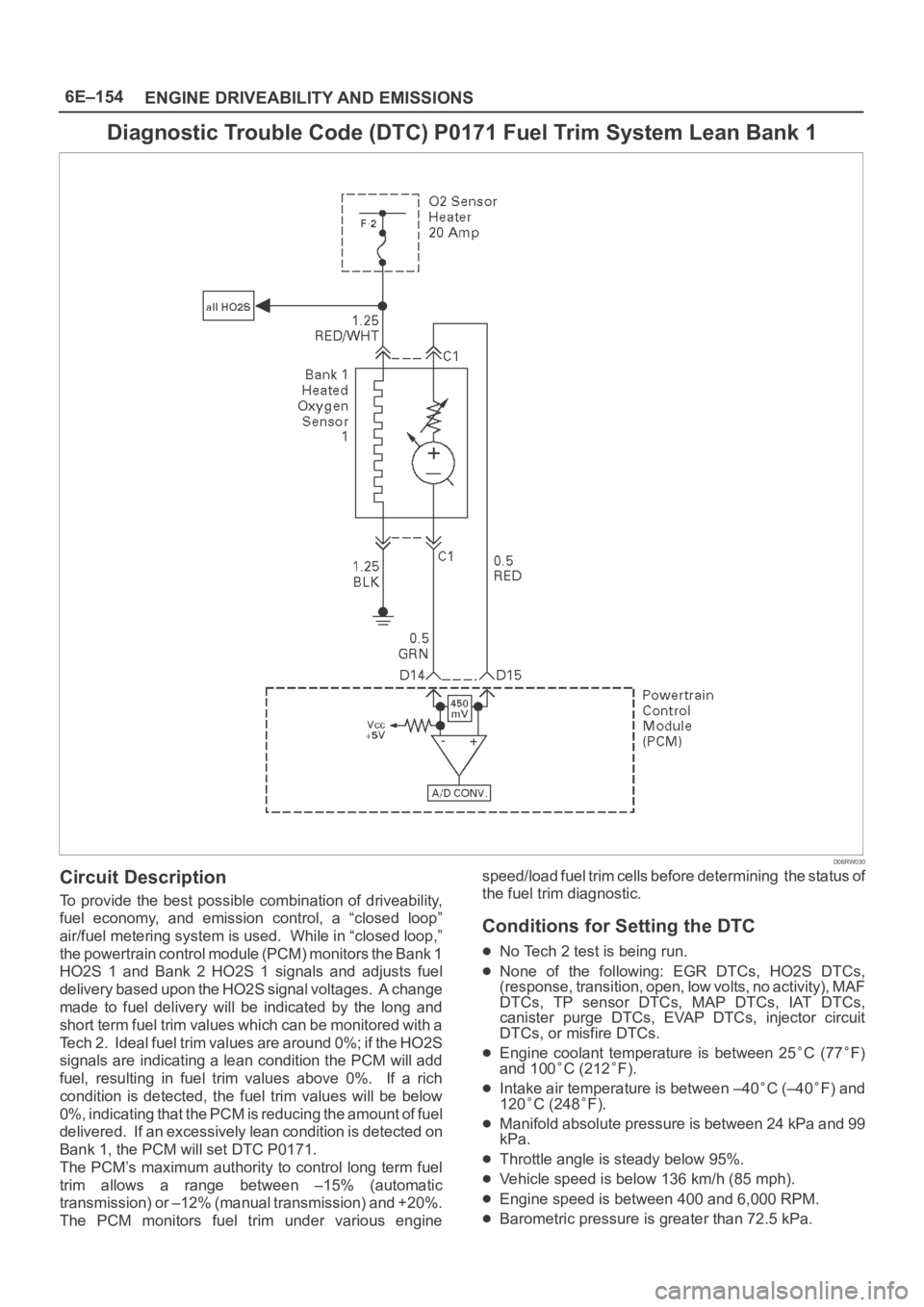
Diagnostic Trouble Code (DTC) P0171 Fuel Trim System Lean Bank 1
D06RW030
Circuit Description
To provide the best possible combination of driveability,
fuel economy, and emission control, a “closed loop”
air/fuel metering system is used. While in “closed loop,”
the powertrain control module (PCM) monitors the Bank 1
HO2S 1 and Bank 2 HO2S 1 signals and adjusts fuel
delivery based upon the HO2S signal voltages. A change
made to fuel delivery will be indicated by the long and
short term fuel trim values which can be monitored with a
Tech 2. Ideal fuel trim values are around 0%; if the HO2S
signals are indicating a lean condition the PCM will add
fuel, resulting in fuel trim values above 0%. If a rich
condition is detected, the fuel trim values will be below
0%, indicating that the PCM is reducing the amount of fuel
delivered. If an excessively lean condition is detected on
Bank 1, the PCM will set DTC P0171.
The PCM’s maximum authority to control long term fuel
trim allows a range between –15% (automatic
transmission) or –12% (manual transmission) and +20%.
The PCM monitors fuel trim under various enginespeed/load fuel trim cells before determining the status of
the fuel trim diagnostic.
Conditions for Setting the DTC
No Tech 2 test is being run.
None of the following: EGR DTCs, HO2S DTCs,
(response, transition, open, low volts, no activity), MAF
DTCs, TP sensor DTCs, MAP DTCs, IAT DTCs,
canister purge DTCs, EVAP DTCs, injector circuit
DTCs, or misfire DTCs.
Engine coolant temperature is between 25C (77F)
and 100C (212F).
Intake air temperature is between –40C (–40F) and
120C (248F).
Manifold absolute pressure is between 24 kPa and 99
kPa.
Throttle angle is steady below 95%.
Vehicle speed is below 136 km/h (85 mph).
Engine speed is between 400 and 6,000 RPM.
Barometric pressure is greater than 72.5 kPa.
Page 1275 of 6000
6E–158
ENGINE DRIVEABILITY AND EMISSIONS
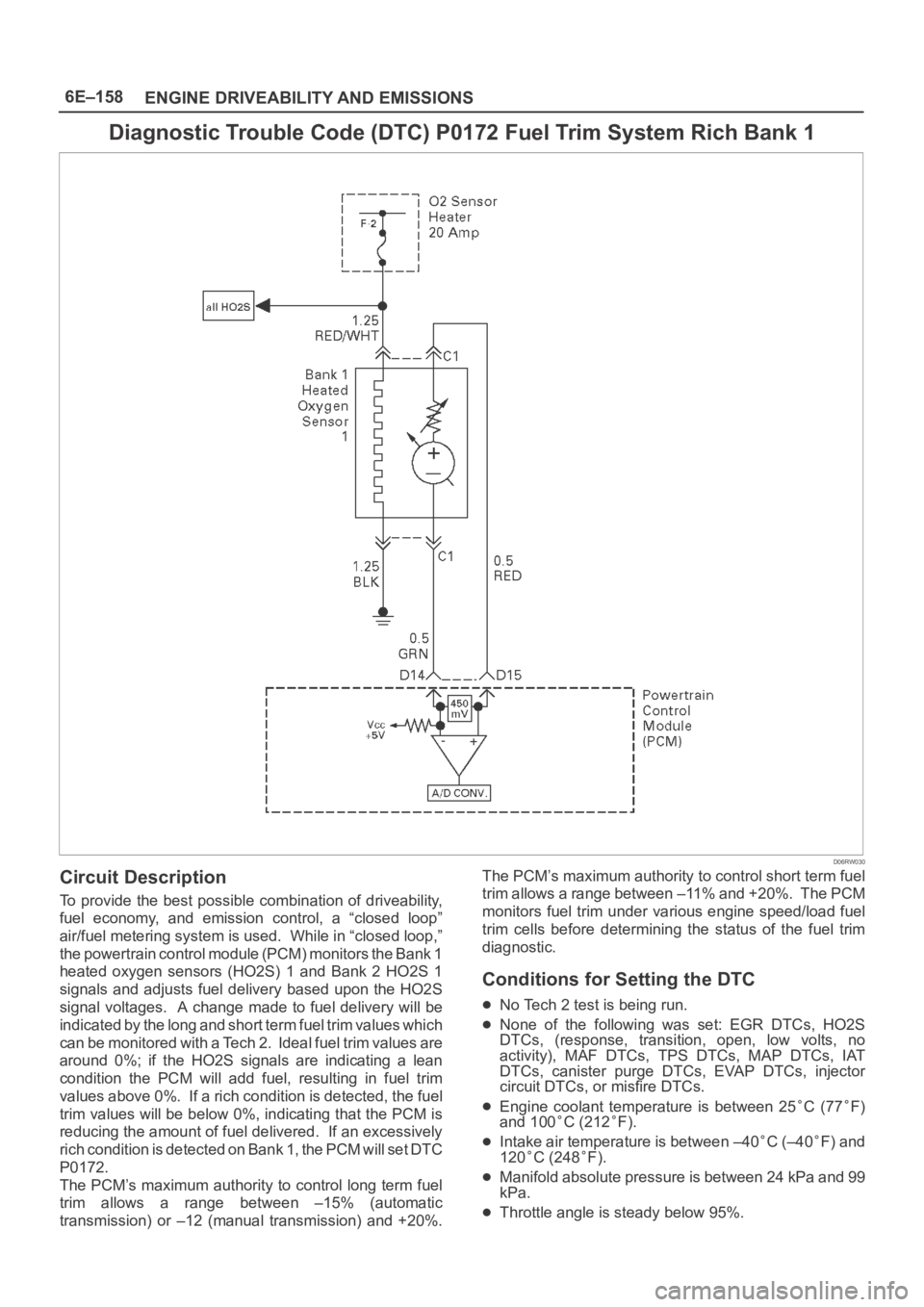
Diagnostic Trouble Code (DTC) P0172 Fuel Trim System Rich Bank 1
D06RW030
Circuit Description
To provide the best possible combination of driveability,
fuel economy, and emission control, a “closed loop”
air/fuel metering system is used. While in “closed loop,”
the powertrain control module (PCM) monitors the Bank 1
heated oxygen sensors (HO2S) 1 and Bank 2 HO2S 1
signals and adjusts fuel delivery based upon the HO2S
signal voltages. A change made to fuel delivery will be
indicated by the long and short term fuel trim values which
can be monitored with a Tech 2. Ideal fuel trim values are
around 0%; if the HO2S signals are indicating a lean
condition the PCM will add fuel, resulting in fuel trim
values above 0%. If a rich condition is detected, the fuel
trim values will be below 0%, indicating that the PCM is
reducing the amount of fuel delivered. If an excessively
rich condition is detected on Bank 1, the PCM will set DTC
P0172.
The PCM’s maximum authority to control long term fuel
trim allows a range between –15% (automatic
transmission) or –12 (manual transmission) and +20%.The PCM’s maximum authority to control short term fuel
trim allows a range between –11% and +20%. The PCM
monitors fuel trim under various engine speed/load fuel
trim cells before determining the status of the fuel trim
diagnostic.
Conditions for Setting the DTC
No Tech 2 test is being run.
None of the following was set: EGR DTCs, HO2S
DTCs, (response, transition, open, low volts, no
activity), MAF DTCs, TPS DTCs, MAP DTCs, IAT
DTCs, canister purge DTCs, EVAP DTCs, injector
circuit DTCs, or misfire DTCs.
Engine coolant temperature is between 25C (77F)
and 100C (212F).
Intake air temperature is between –40C (–40F) and
120
C (248F).
Manifold absolute pressure is between 24 kPa and 99
kPa.
Throttle angle is steady below 95%.
Page 1279 of 6000
6E–162
ENGINE DRIVEABILITY AND EMISSIONS
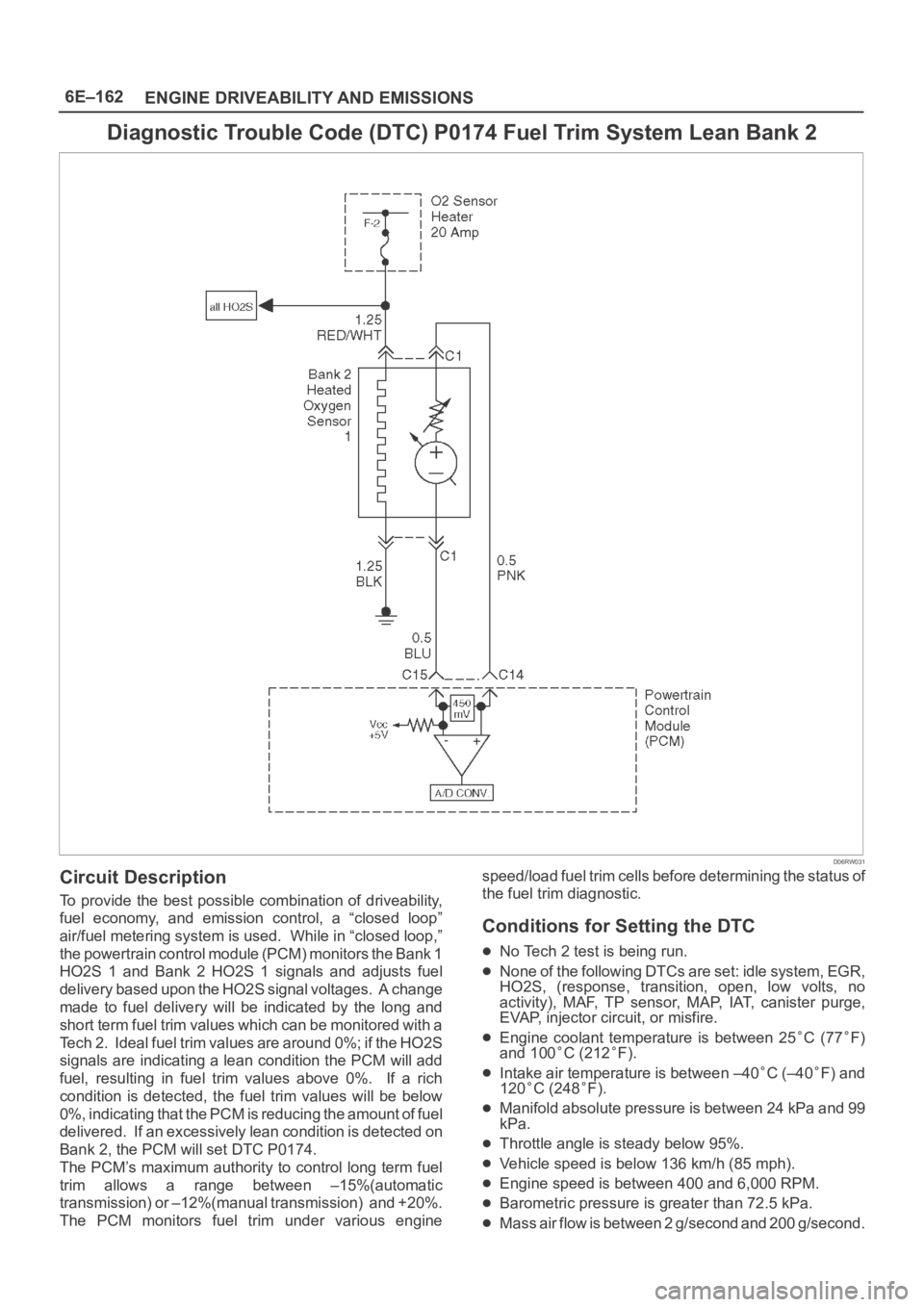
Diagnostic Trouble Code (DTC) P0174 Fuel Trim System Lean Bank 2
D06RW031
Circuit Description
To provide the best possible combination of driveability,
fuel economy, and emission control, a “closed loop”
air/fuel metering system is used. While in “closed loop,”
the powertrain control module (PCM) monitors the Bank 1
HO2S 1 and Bank 2 HO2S 1 signals and adjusts fuel
delivery based upon the HO2S signal voltages. A change
made to fuel delivery will be indicated by the long and
short term fuel trim values which can be monitored with a
Tech 2. Ideal fuel trim values are around 0%; if the HO2S
signals are indicating a lean condition the PCM will add
fuel, resulting in fuel trim values above 0%. If a rich
condition is detected, the fuel trim values will be below
0%, indicating that the PCM is reducing the amount of fuel
delivered. If an excessively lean condition is detected on
Bank 2, the PCM will set DTC P0174.
The PCM’s maximum authority to control long term fuel
trim allows a range between –15%(automatic
transmission) or –12%(manual transmission) and +20%.
The PCM monitors fuel trim under various enginespeed/load fuel trim cells before determining the status of
the fuel trim diagnostic.
Conditions for Setting the DTC
No Tech 2 test is being run.
None of the following DTCs are set: idle system, EGR,
HO2S, (response, transition, open, low volts, no
activity), MAF, TP sensor, MAP, IAT, canister purge,
EVAP, injector circuit, or misfire.
Engine coolant temperature is between 25C (77F)
and 100C (212F).
Intake air temperature is between –40C (–40F) and
120C (248F).
Manifold absolute pressure is between 24 kPa and 99
kPa.
Throttle angle is steady below 95%.
Vehicle speed is below 136 km/h (85 mph).
Engine speed is between 400 and 6,000 RPM.
Barometric pressure is greater than 72.5 kPa.
Mass air flow is between 2 g/second and 200 g/second.