Page 1710 of 3573
6D3 Ð 4 CHARGING SYSTEM
DIAGNOSIS
GENERAL ON-VEHICLE INSPECTION
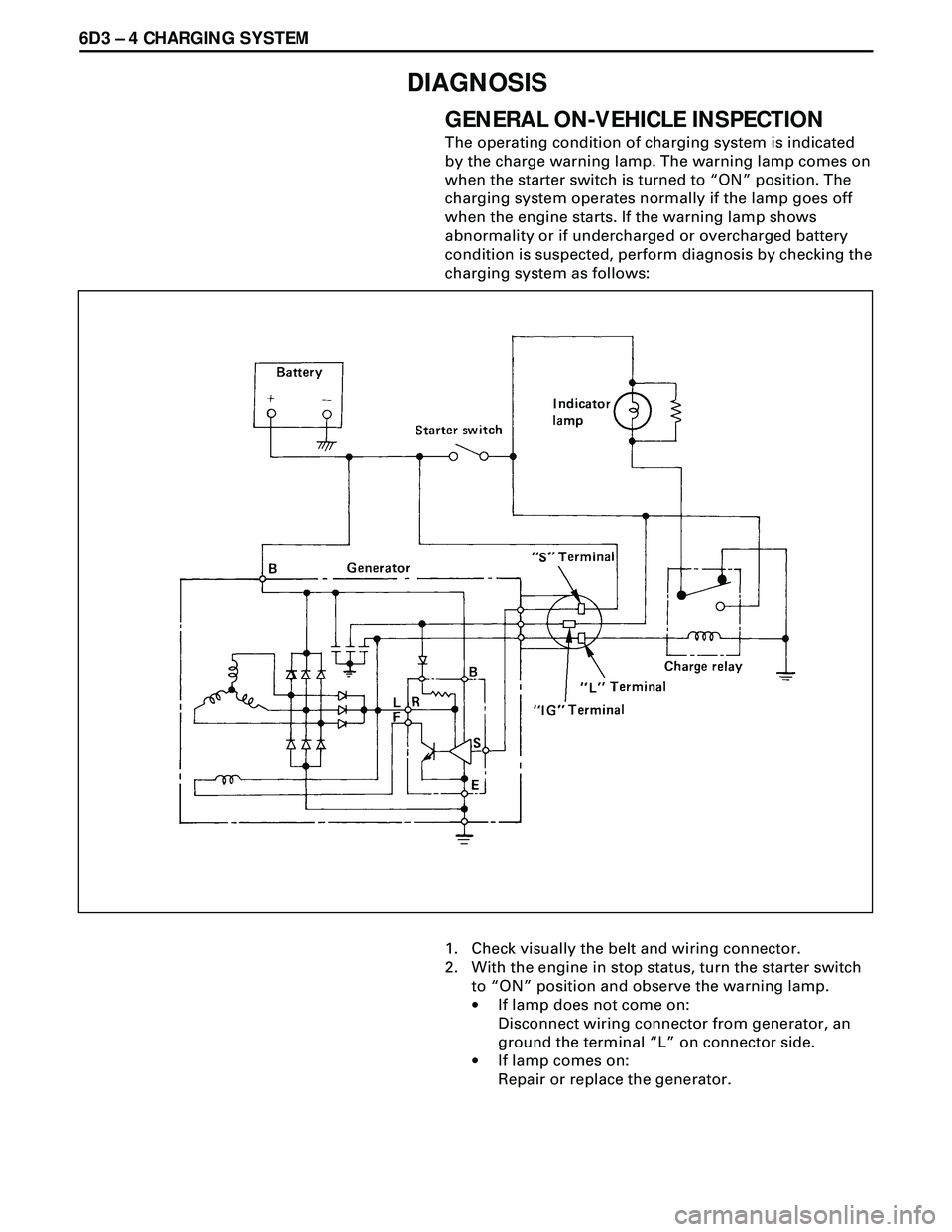
The operating condition of charging system is indicated
by the charge warning lamp. The warning lamp comes on
when the starter switch is turned to ÒONÓ position. The
charging system operates normally if the lamp goes off
when the engine starts. If the warning lamp shows
abnormality or if undercharged or overcharged battery
condition is suspected, perform diagnosis by checking the
charging system as follows:
1. Check visually the belt and wiring connector.
2. With the engine in stop status, turn the starter switch
to ÒONÓ position and observe the warning lamp.
·If lamp does not come on:
Disconnect wiring connector from generator, an
ground the terminal ÒLÓ on connector side.
·If lamp comes on:
Repair or replace the generator.
Page 1717 of 3573
CHARGING SYSTEM 6D3 Ð 11
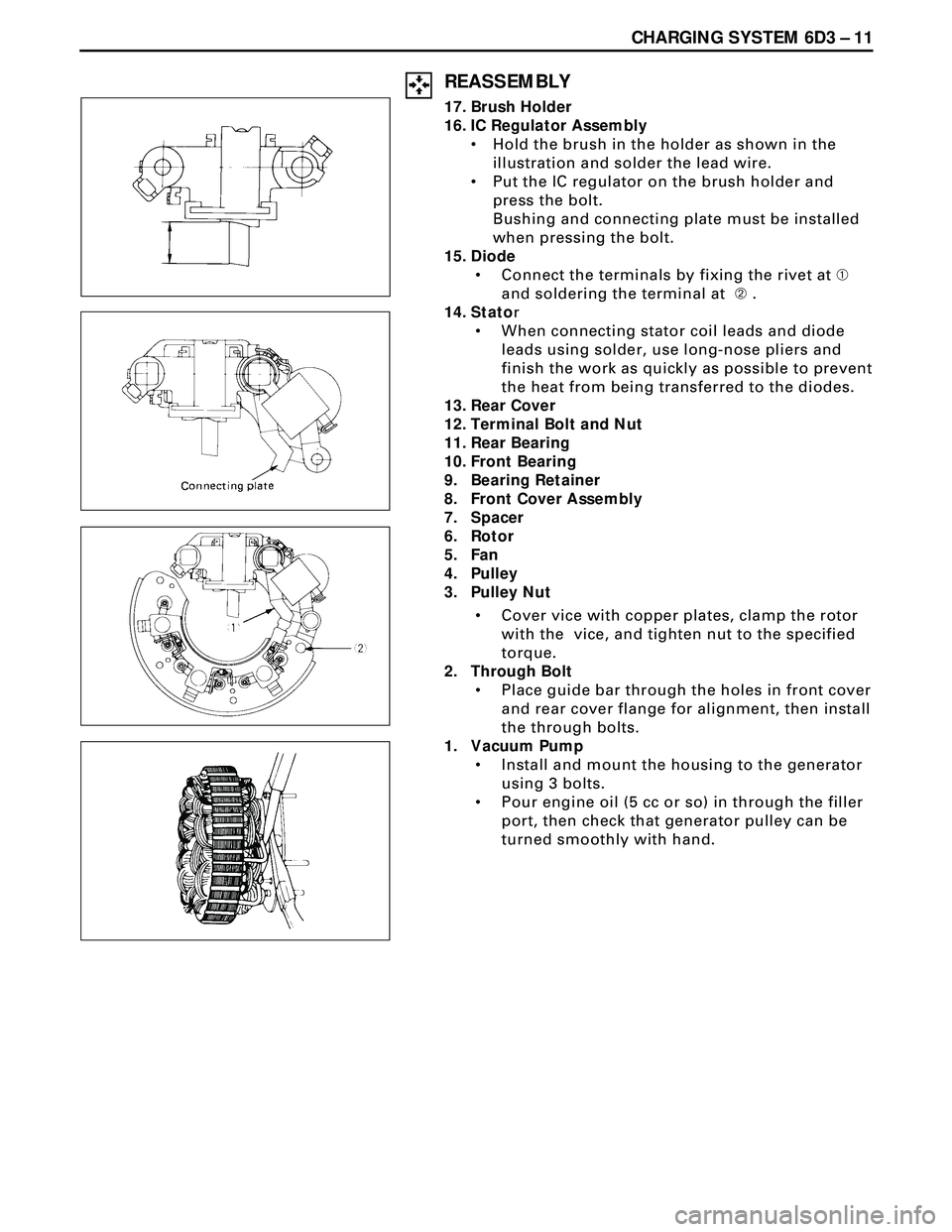
REASSEMBLY
17. Brush Holder
16. IC Regulator Assembly
¥ Hold the brush in the holder as shown in the
illustration and solder the lead wire.
¥ Put the IC regulator on the brush holder and
press the bolt.
Bushing and connecting plate must be installed
when pressing the bolt.
15. Diode
¥ Connect the terminals by fixing the rivet at À
and soldering the terminal at Á .
14. Stator
¥ When connecting stator coil leads and diode
leads using solder, use long-nose pliers and
finish the work as quickly as possible to prevent
the heat from being transferred to the diodes.
13. Rear Cover
12. Terminal Bolt and Nut
11. Rear Bearing
10. Front Bearing
9. Bearing Retainer
8. Front Cover Assembly
7. Spacer
6. Rotor
5. Fan
4. Pulley
3. Pulley Nut
¥ Cover vice with copper plates, clamp the rotor
with the vice, and tighten nut to the specified
torque.
2. Through Bolt
¥ Place guide bar through the holes in front cover
and rear cover flange for alignment, then install
the through bolts.
1. Vacuum Pump
¥ Install and mount the housing to the generator
using 3 bolts.
¥ Pour engine oil (5 cc or so) in through the filler
port, then check that generator pulley can be
turned smoothly with hand.
Page 1726 of 3573
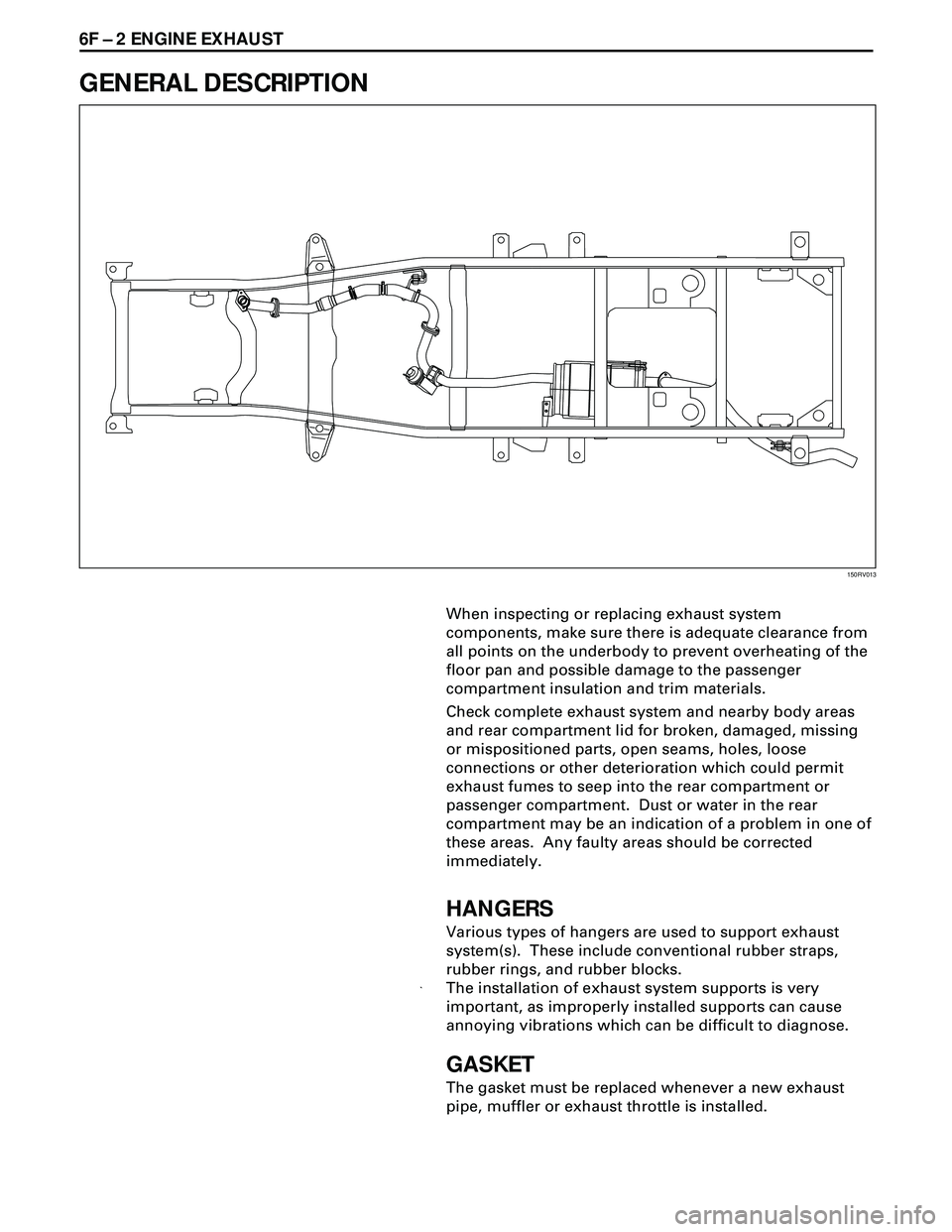
6F Ð 2 ENGINE EXHAUST
GENERAL DESCRIPTION
150RV013
When inspecting or replacing exhaust system
components, make sure there is adequate clearance from
all points on the underbody to prevent overheating of the
floor pan and possible damage to the passenger
compartment insulation and trim materials.
Check complete exhaust system and nearby body areas
and rear compartment lid for broken, damaged, missing
or mispositioned parts, open seams, holes, loose
connections or other deterioration which could permit
exhaust fumes to seep into the rear compartment or
passenger compartment. Dust or water in the rear
compartment may be an indication of a problem in one of
these areas. Any faulty areas should be corrected
immediately.
HANGERS
Various types of hangers are used to support exhaust
system(s). These include conventional rubber straps,
rubber rings, and rubber blocks.
The installation of exhaust system supports is very
important, as improperly installed supports can cause
annoying vibrations which can be difficult to diagnose.
GASKET
The gasket must be replaced whenever a new exhaust
pipe, muffler or exhaust throttle is installed.
Page 1727 of 3573
ENGINE EXHAUST 6F Ð 3
ON-VEHICLE SERVICE
Rattles and noise vibrations in the exhaust system
are usually caused by misalignment of parts. When
aligning the system, leave all bolts or nuts loose
until all parts are properly aligned; then tighten,
working from front to rear.
1. Check connections for looseness or damage,
especially for exhaust gas leakage.2. Check clamps and rubbers for weakness, cracks
or damage.
3. If any part of the converter heat shield is
damaged or dented to the extent that it contacts
the catalyst, repair or replace.
4. Check for dents or damage and for any holes or
cracks caused by corrosion.
REMOVAL
Preparation:
¥ Disconnect battery negative cable.
¥ Raise the vehicle and support with suitable safety
stands.
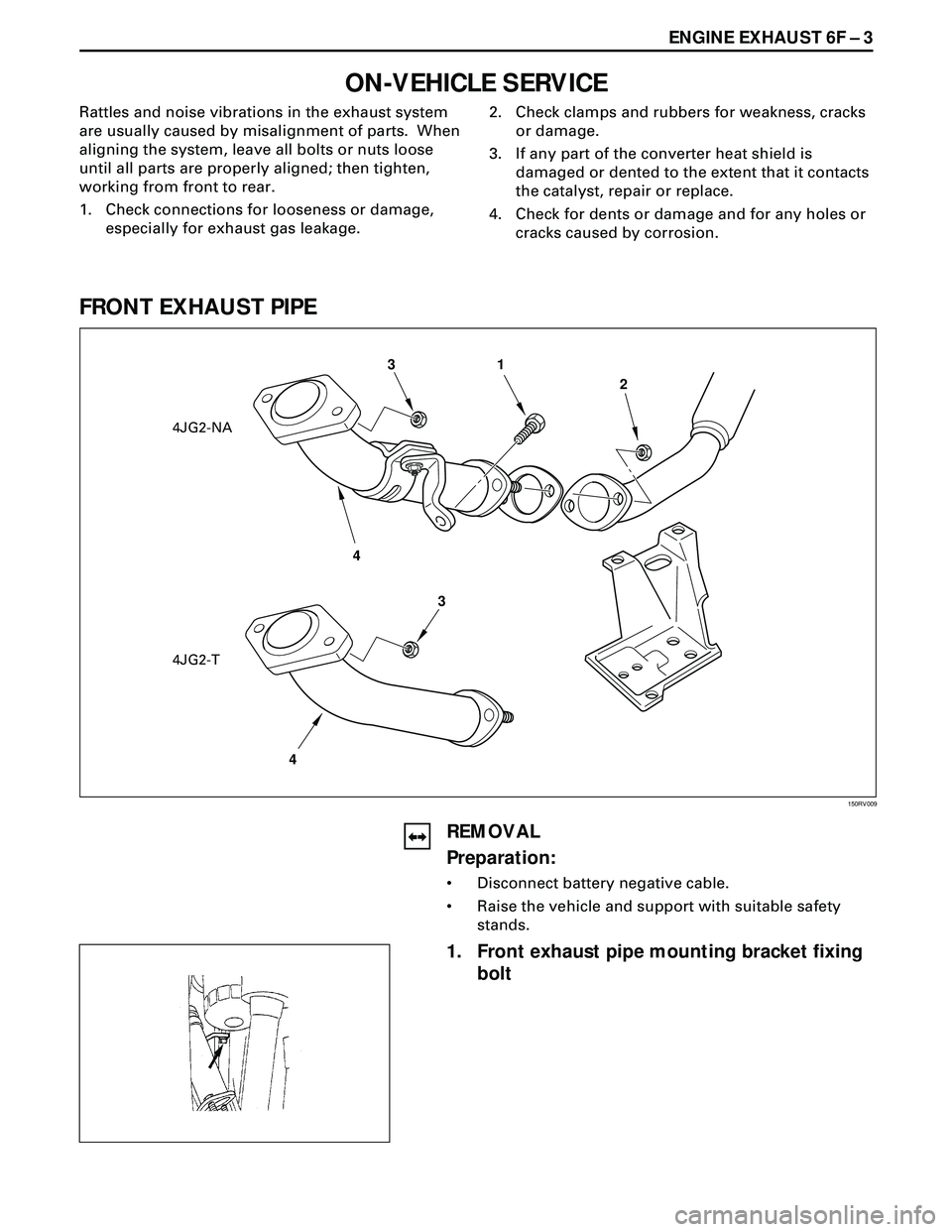
1. Front exhaust pipe mounting bracket fixing
bolt
150RV009
FRONT EXHAUST PIPE
4JG2-NA
4JG2-T3
31
4
42
Page 1736 of 3573
ENGINE MECHANICAL 6A – 3
SERVICE INFORMATION
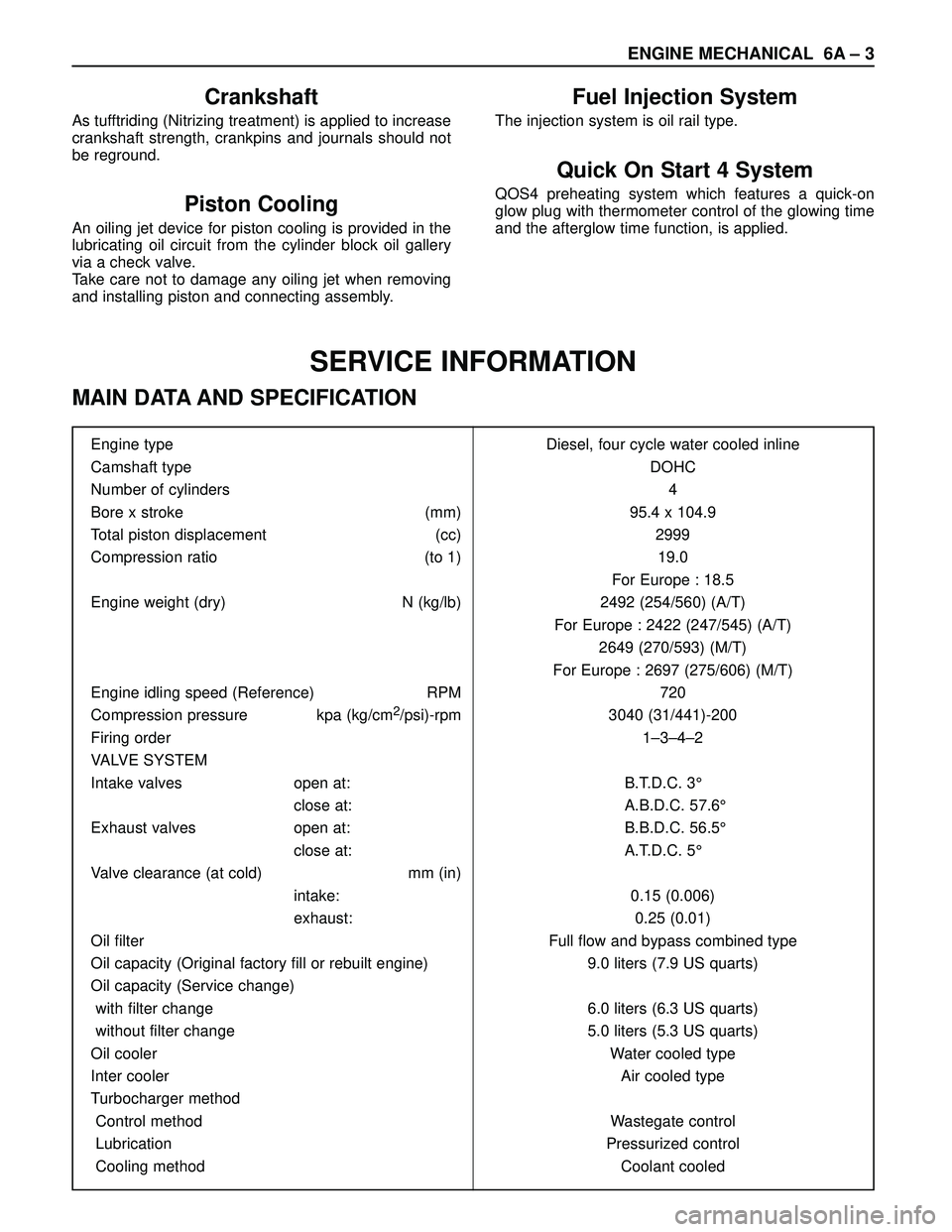
MAIN DATA AND SPECIFICATION
Engine type Diesel, four cycle water cooled inline
Camshaft type DOHC
Number of cylinders 4
Bore x stroke (mm) 95.4 x 104.9
Total piston displacement (cc) 2999
Compression ratio (to 1) 19.0
For Europe : 18.5
Engine weight (dry) N (kg/lb) 2492 (254/560) (A/T)
For Europe : 2422 (247/545) (A/T)
2649 (270/593) (M/T)
For Europe : 2697 (275/606) (M/T)
Engine idling speed (Reference) RPM 720
Compression pressure kpa (kg/cm
2/psi)-rpm 3040 (31/441)-200
Firing order 1–3–4–2
VALVE SYSTEM
Intake valves open at: B.T.D.C. 3°
close at: A.B.D.C. 57.6°
Exhaust valves open at: B.B.D.C. 56.5°
close at: A.T.D.C. 5°
Valve clearance (at cold) mm (in)
intake: 0.15 (0.006)
exhaust: 0.25 (0.01)
Oil filter Full flow and bypass combined type
Oil capacity (Original factory fill or rebuilt engine) 9.0 liters (7.9 US quarts)
Oil capacity (Service change)
with filter change 6.0 liters (6.3 US quarts)
without filter change 5.0 liters (5.3 US quarts)
Oil cooler Water cooled type
Inter cooler Air cooled type
Turbocharger method
Control method Wastegate control
Lubrication Pressurized control
Cooling method Coolant cooled
Crankshaft
As tufftriding (Nitrizing treatment) is applied to increase
crankshaft strength, crankpins and journals should not
be reground.
Piston Cooling
An oiling jet device for piston cooling is provided in the
lubricating oil circuit from the cylinder block oil gallery
via a check valve.
Take care not to damage any oiling jet when removing
and installing piston and connecting assembly.
Fuel Injection System
The injection system is oil rail type.
Quick On Start 4 System
QOS4 preheating system which features a quick-on
glow plug with thermometer control of the glowing time
and the afterglow time function, is applied.
Page 1743 of 3573
6A – 10 ENGINE MECHANICAL
8. Check the engine oil level and replenish to the
specified level if required.
9. Start the engine and check for oil leakage from the
main oil filter.
FUEL SYSTEM
Fuel filter
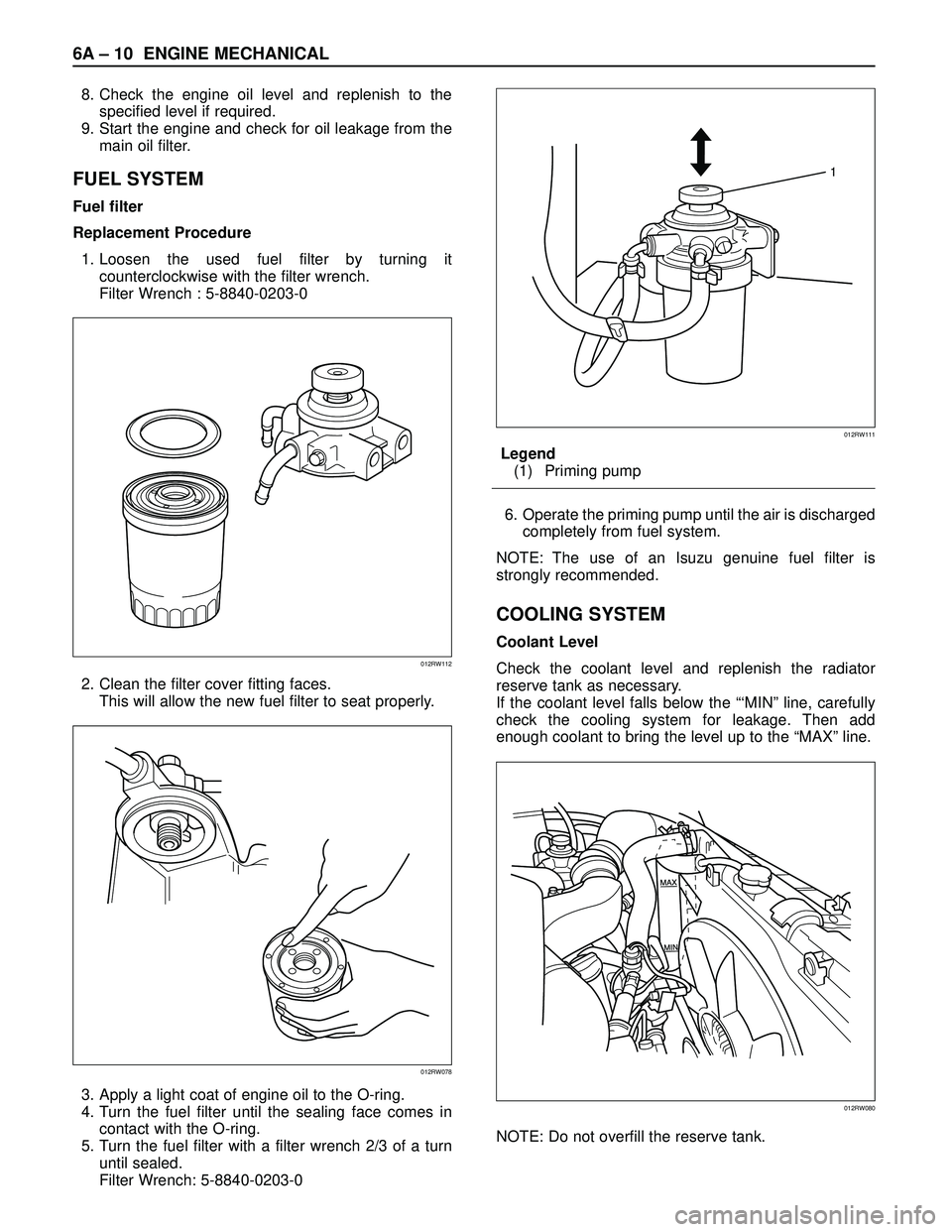
Replacement Procedure
1. Loosen the used fuel filter by turning it
counterclockwise with the filter wrench.
Filter Wrench : 5-8840-0203-0
2. Clean the filter cover fitting faces.
This will allow the new fuel filter to seat properly.
3. Apply a light coat of engine oil to the O-ring.
4. Turn the fuel filter until the sealing face comes in
contact with the O-ring.
5. Turn the fuel filter with a filter wrench 2/3 of a turn
until sealed.
Filter Wrench: 5-8840-0203-0Legend
(1) Priming pump
6. Operate the priming pump until the air is discharged
completely from fuel system.
NOTE: The use of an Isuzu genuine fuel filter is
strongly recommended.
COOLING SYSTEM
Coolant Level
Check the coolant level and replenish the radiator
reserve tank as necessary.
If the coolant level falls below the “‘MIN” line, carefully
check the cooling system for leakage. Then add
enough coolant to bring the level up to the “MAX” line.
NOTE: Do not overfill the reserve tank.
012RW112
012RW078
1
012RW111
012RW080
Page 1744 of 3573
ENGINE MECHANICAL 6A – 11
Remove the radiator filler cap only when absolutely
necessary.
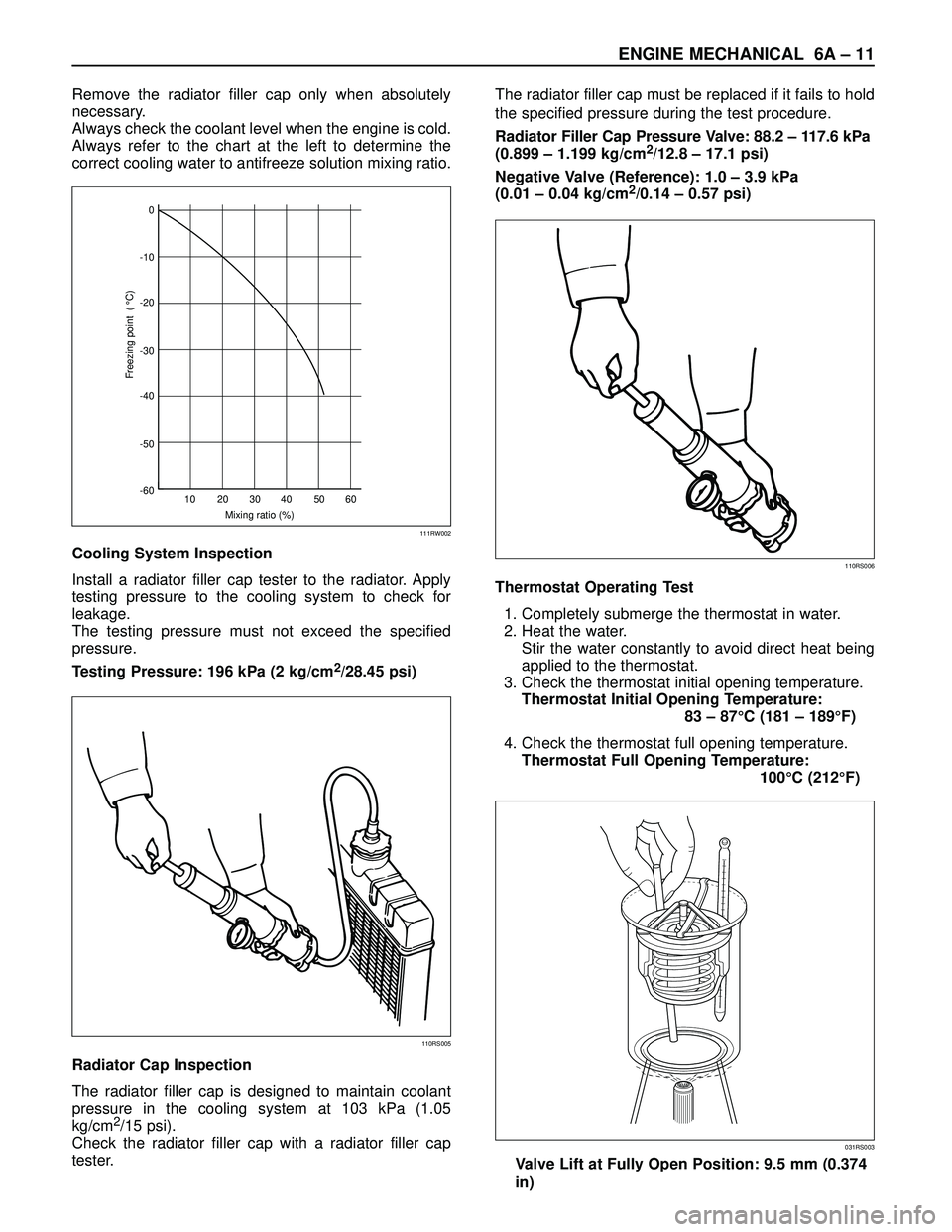
Always check the coolant level when the engine is cold.
Always refer to the chart at the left to determine the
correct cooling water to antifreeze solution mixing ratio.
Cooling System Inspection
Install a radiator filler cap tester to the radiator. Apply
testing pressure to the cooling system to check for
leakage.
The testing pressure must not exceed the specified
pressure.
Testing Pressure: 196 kPa (2 kg/cm
2/28.45 psi)
Radiator Cap Inspection
The radiator filler cap is designed to maintain coolant
pressure in the cooling system at 103 kPa (1.05
kg/cm
2/15 psi).
Check the radiator filler cap with a radiator filler cap
tester.The radiator filler cap must be replaced if it fails to hold
the specified pressure during the test procedure.
Radiator Filler Cap Pressure Valve: 88.2 – 117.6 kPa
(0.899 – 1.199 kg/cm
2/12.8 – 17.1 psi)
Negative Valve (Reference): 1.0 – 3.9 kPa
(0.01 – 0.04 kg/cm
2/0.14 – 0.57 psi)
Thermostat Operating Test
1. Completely submerge the thermostat in water.
2. Heat the water.
Stir the water constantly to avoid direct heat being
applied to the thermostat.
3. Check the thermostat initial opening temperature.
Thermostat Initial Opening Temperature:
83 – 87°C (181 – 189°F)
4. Check the thermostat full opening temperature.
Thermostat Full Opening Temperature:
100°C (212°F)
Valve Lift at Fully Open Position: 9.5 mm (0.374
in)0
-10
-20
-30
-40
-50
-60
10 20 30
Mixing ratio (%)
Freezing point ( °C)
40 50 60
111RW002
110RS005
110RS006
031RS003
Page 1745 of 3573
6A – 12 ENGINE MECHANICAL
Drive Belt Adjustment
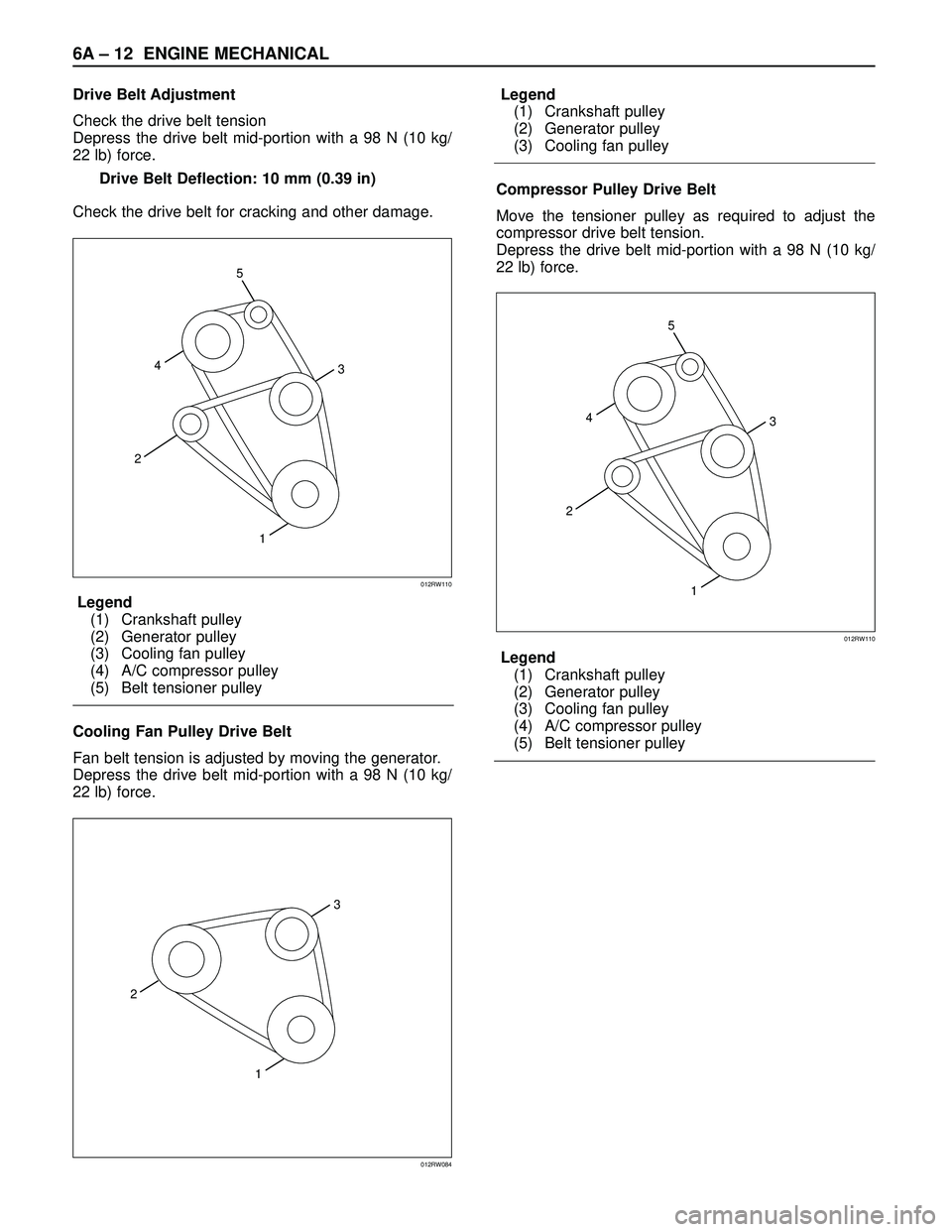
Check the drive belt tension
Depress the drive belt mid-portion with a 98 N (10 kg/
22 lb) force.
Drive Belt Deflection: 10 mm (0.39 in)
Check the drive belt for cracking and other damage.
Legend
(1) Crankshaft pulley
(2) Generator pulley
(3) Cooling fan pulley
(4) A/C compressor pulley
(5) Belt tensioner pulley
Cooling Fan Pulley Drive Belt
Fan belt tension is adjusted by moving the generator.
Depress the drive belt mid-portion with a 98 N (10 kg/
22 lb) force.Legend
(1) Crankshaft pulley
(2) Generator pulley
(3) Cooling fan pulley
Compressor Pulley Drive Belt
Move the tensioner pulley as required to adjust the
compressor drive belt tension.
Depress the drive belt mid-portion with a 98 N (10 kg/
22 lb) force.
Legend
(1) Crankshaft pulley
(2) Generator pulley
(3) Cooling fan pulley
(4) A/C compressor pulley
(5) Belt tensioner pulley
5
3
24
1
012RW110
3
2
1
012RW084
5
3
24
1
012RW110