1998 CHEVROLET VENTURE brakes
[x] Cancel search: brakesPage 361 of 474
Brakes
Brake Fluid
0
0
0
When using concentrated washer fluid,
follow the manufacturer’s instructions for
adding water.
Don’t
mix water with ready-to-use washer
fluid. Water can cause the solution to freeze
and damage your washer fluid tank and
other parts of the washer system. Also,
water doesn’t clean
as well as washer fluid.
Fill your washer fluid tank only
three-quarters full when it’s very cold. This
allows for expansion
if freezing occurs.
which could damage the tank
if it is
completely full.
Don’t use engine coolant (antifreeze) in
your windshield washer.
It can damage
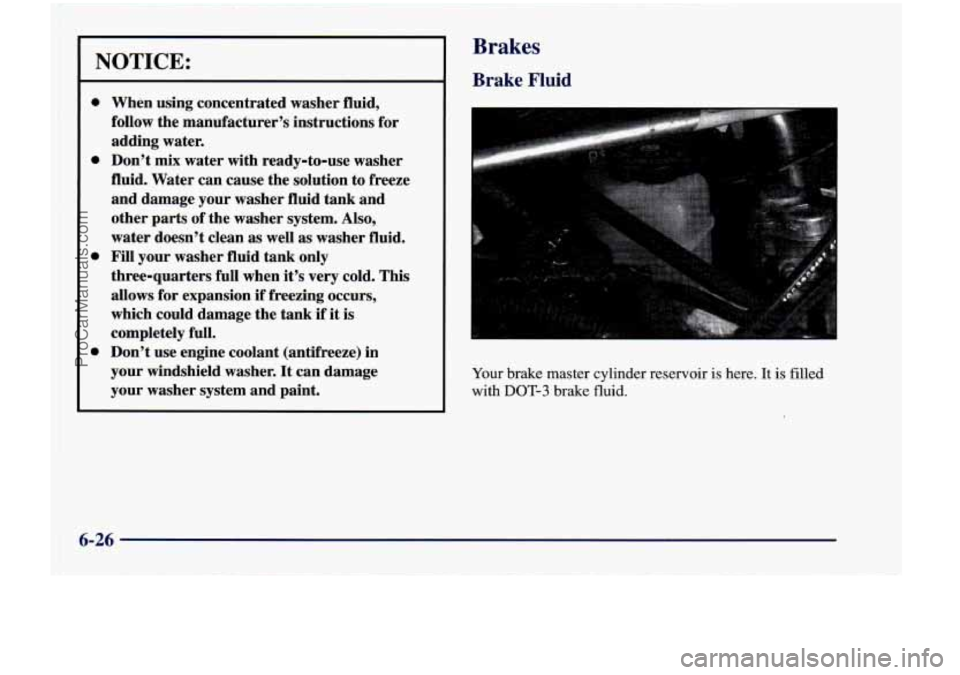
your washer system and paint. Your brake master cylinder reservoir
is here. It is filled
with DOT-3 brake fluid.
6-26
ProCarManuals.com
Page 362 of 474
There are only two reasons why the brake fluid level
in the reservoir might
go down. The first is that the
brake fluid goes down to
an acceptable level during
normal brake lining wear. When new linings are put
in,
the fluid level goes back up. The other reason is that
fluid is leaking out of the brake system. If it is, you
should have your brake system fixed, since a leak means
that sooner or later your brakes won’t work well, or
won’t work at all.
So, it isn’t a good idea to “top off’ your brake fluid.
Adding brake fluid won’t correct a leak. If you add fluid
when your linings are worn, then you’ll have too much
fluid when you get new brake linings. You should add
(or remove) brake fluid, as necessary, only when work
is
done on the brake hydraulic system.
I A CAUTAN:
If you have too much brake fluid, it can spill
on the engine. The fluid will burn
if the engine
is hot enough.
You or others could be burned,
and your vehicle
could be damaged. Add brake
fluid only when work
is done on the brake
hydraulic system.
BRAKE
United States Canadian
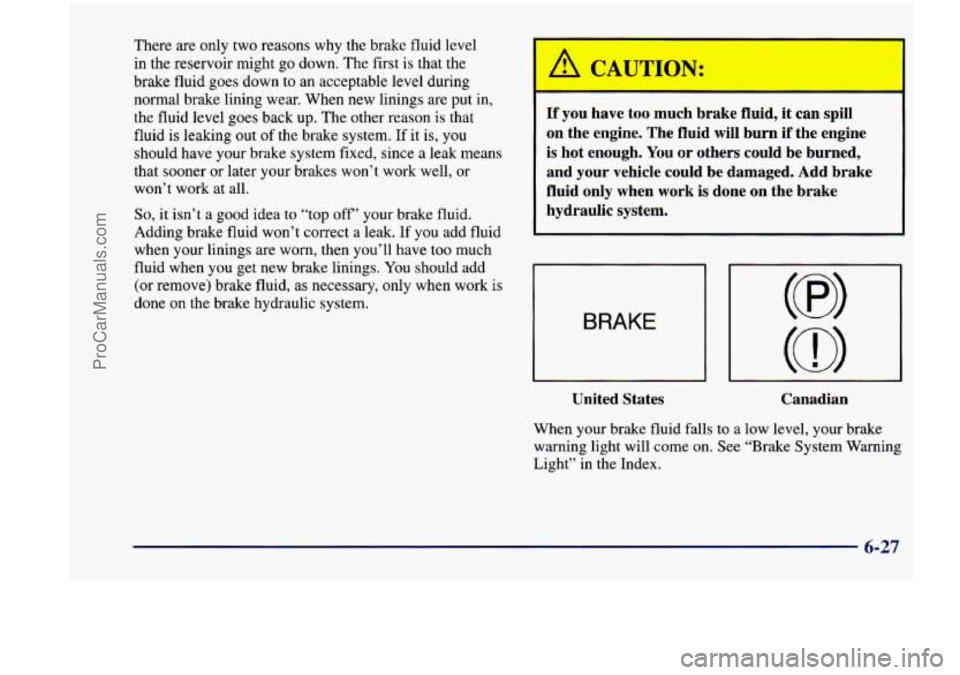
When your brake fluid falls to a low level, your brake
warning light will come on. See “Brake System Warning
Light” in the Index.
6-27
ProCarManuals.com
Page 363 of 474
What to Add
When you do need brake fluid, use only
DOT-3 brake
fluid
-- such as Delco Supreme 11 (GM Part
No. 12377967). Use new brake fluid from a sealed
container only.
Always clean the brake fluid reservoir
cap and the area
around the cap before removing it. This will help keep
dirt from entering the reservoir.
With the wrong kind
of fluid in your brake
system, your brakes may not work well, or they
may not even work at all. This could cause
a
crash. Always use the proper brake fluid.
NOTICE:
0
0
Using the wrong fluid can badly damage
brake system parts. For example, just a few
drops
of mineral-based oil, such as engine
oil, in your brake system can damage brake
system parts
so badly that they’ll have to be
replaced. Don’t let someone put in the
wrong kind
of fluid.
If you spill brake fluid on your vehicle’s
painted surfaces, the paint finish can be
damaged. Be careful not
to spill brake fluid
on your vehicle. If you do, wash it off
immediately. See “Appearance Care” in
the Index.
6-28
ProCarManuals.com
Page 364 of 474
Brake Wear
Your vehicle has front disc brakes and rear drum brakes.
Disc brake pads have built-in wear indicators that
make a high-pitched warning sound when the brake
pads are
worn and new pads are needed. The sound
may come and
go or be heard all the time your vehicle
is moving (except when you are pushing on the brake
pedal firmly).
A CAUTION:
The brake wear warning sound means that soon
your brakes won’t work well. That could lead to
an accident. When you hear the brake wear
warning sound, have your vehicle serviced.
NOTICE:
Continuing to drive with worn-out brake pads
could result in costly brake repair.
Some driving conditions or climates may cause a
brake squeal when the brakes are first applied or lightly
applied. This does not mean something is wrong with
your brakes.
Properly torqued wheel nuts are necessary
to help
prevent brake pulsation. When tires are rotated, inspect
brake pads for wear and evenly torque wheel nuts
in the
proper sequence
to GM specifications.
Your rear drum brakes don’t have wear indicators, but
if you ever hear a rear brake rubbing noise, have the
rear brake linings inspected immediately. Also, the rear
brake drums should be removed and inspected each time
the tires are removed
for rotation or changing. When
you have the front brake pads replaced, have the rear
brakes inspected,
too.
Brake linings should always be replaced as complete
axle sets.
See “Brake System Inspection” in Section 7 of this
manual under
Part C “Periodic Maintenance
Inspections.”
6-29
ProCarManuals.com
Page 365 of 474
Brake Pedal Travel
See your dealer if the brake pedal does not return to
normal height, or
if there is a rapid increase in pedal
travel. This could be a sign of brake trouble.
Brake Adjustment
Every time you apply the brakes, with or without the
vehicle moving, your brakes adjust for wear.
Replacing Brake System Parts
The braking system on a modern vehicle is complex.
Its many parts have to be of top quality and work well
together if the vehicle is to have really good bralung.
Your vehicle was designed and tested with top-quality
GM brake parts. When you replace parts of your braking
system
-- for example, when your brake linings wear
down and you have to have new ones put in
-- be sure
you get new approved GM replacement parts. If you
don’t, your brakes may no longer work properly. For
example, if someone puts
in brake linings that are wrong
for your vehicle, the balance between your front and
rear brakes can change
-- for the worse. The braking
performance you’ve come to expect can change in many
other ways
if someone puts in the wrong replacement
brake parts.
Battery
Every new Chevrolet has an ACDelco Freedom@
battery. You never have to add water to one
of these.
When it’s time for a new battery, we recommend an ACDelco Freedom battery. Get one that has
the replacement number shown on the original
battery’s label.
Vehicle Storage
If you’re not going to drive your vehicle for 25 days
or more, remove the black, negative
(-) cable from
the battery. This will help keep your battery from
running down.
b I
1 Ihl CAUTIO -
Batteries have acid that can burn you and gas
that can explode. You can be badly hurt if
you
aren’t careful. See “Jump Starting” in the Index
for tips on working around a battery without getting hurt.
Contact your dealer to learn how to prepare your vehicle
for longer storage periods.
I
6-30
ProCarManuals.com
Page 410 of 474
Short Trip/City Maintenance Schedule
The services shown in this schedule up to 100,000 miles
(166 000 km) should be performed after 100,000 miles
(166 000 km) at the same intervals. The services shown
at
150,000 miles (240 000 km) should be performed at
the same interval after
150,000 miles (240 000 km).
See “Owner Checks and Services” and “Periodic
Maintenance Inspections” following.
Footnotes
The U.S. Environmental Protection Agency or the
California Air Resources Board has determined that the
failure to perform this maintenance item will not nullify
the emission warranty or limit recall liability prior to the
completion of the vehicle’s useful life. We, however,
urge that all recommended maintenance services be
performed at the indicated intervals and the maintenance
be recorded.
# Lubricate the suspension, steering linkage, transaxle
shift linkage, parking brake cable guides and the
underbody contact points and linkage.
+ A good time to check your brakes is during tire
rotation. See “Brake System Inspection” under “Periodic
Maintenance Inspections’’ in Part C of this schedule.
7-7
ProCarManuals.com
Page 424 of 474
Long Tripmighway Maintenance Schedule
The services shown in this schedule up to 100,000 miles
(166 000 km) should be performed after 100,000 miles
(166 000 lun) at the same intervals. The services shown
at
150,000 miles (240 000 km) should be performed at
the same interval after
150,000 miles (240 000 km).
See “Owner Checks and Services” and “Periodic
Maintenance Inspections” following.
Footnotes
? The U.S. Environmental Protection Agency or the
California Air Resources Board has determined that the
failure to perform this maintenance item will not nullify
the emission warranty or limit recall liability prior to the
completion
of the vehicle’s useful life. We, however,
urge that all recommended maintenance services be
performed at the indicated intervals and the maintenance
be recorded.
# Lubricate the suspension, steering linkage, transaxle
shift linkage, parking brake cable guides and the
underbody contact points and linkage.
+ A good time to check your brakes is during tire
rotation. See “Brake System Inspection” under “Periodic
Maintenance Inspections” in Part C of this schedule.
7-21
ProCarManuals.com
Page 435 of 474
Ignition Transaxle Lock Check
While parked, and with the parking brake set, try to turn
the ignition key to
LOCK in each shift lever position.
The key should turn to LOCK only when the shift
The key should come out only in LOCK.
Parking Brake and Automatic Transaxle PARK (P)
Me -:-anism Check
lever is in PARK (P).
A CAUTION:
When you are doing this check, your vehicle
could begin
to move. You or others could be
injured and property could be damaged. Make
sure there
is room in front of your vehicle in case
it begins to roll. Be ready to apply the regular
brake at once should the vehicle begin
to move.
Park on a fairly steep hill, with the vehicle facing
downhill. Keeping your foot on the regular brake,
set the
parking brake.
To check the parking brake’s holding ability: With
the engine running and transaxle in
NEUTRAL (N),
slowly remove foot pressure from the regular brake
pedal.
Do this until the vehicle is held by the parking
brake only.
0 To check the PARK (P) mechanism’s holding ability:
With the engine running, shift to PARK (P). Then release all brakes.
Underbody Flushing Service
At least every spring, use plain water to flush any
corrosive materials
from the underbody. Take care to
clean thoroughly any areas where mud and other debris
can collect.
7-32
ProCarManuals.com