1998 CHEVROLET VENTURE brakes
[x] Cancel search: brakesPage 13 of 474
Vehicle Symbols
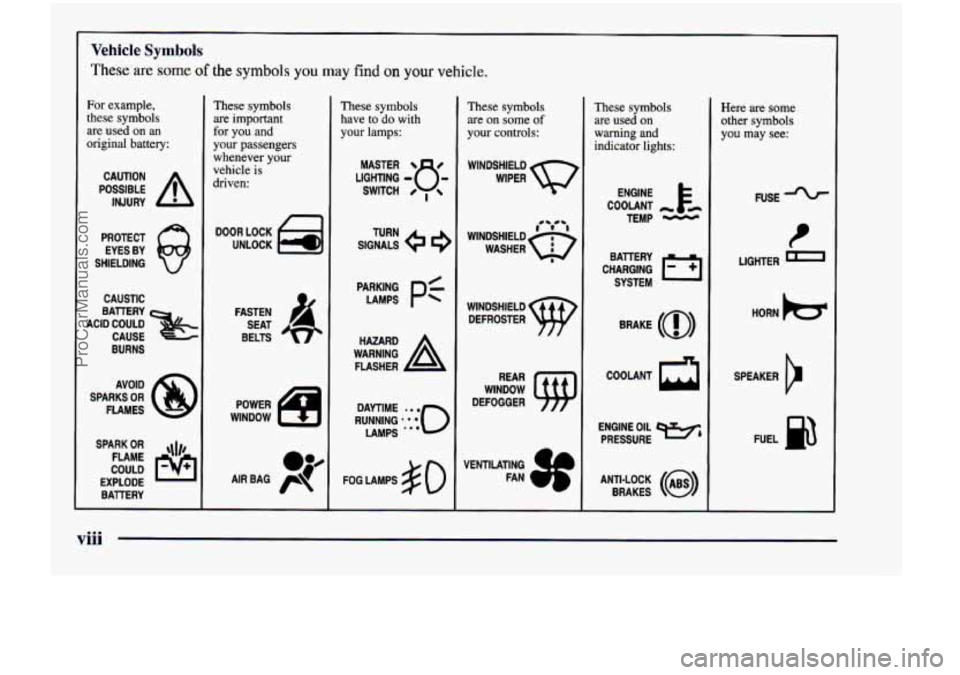
These are some of the symbols you may find on your vehicle.
For example,
these symbols
are used on an
original battery:
POSSIBLE A
CAUTION
INJURY
PROTECT EYES BY
SHIELDING
Q
CAUSTIC
BURNS AVOID
SPARKS
OR
FLAMES
SPARK
OR ,\I/,
COULD FLAME
EXPLODE BA'ITERY
These symbols
are important
for you and
your passengers
whenever your
vehicle is
driven:
DOOR LOCK
UNLOCK
FASTEN SEAT
BELTS
POWER
WlNDOW
These symbols
have to do with
your lamps:
SIGNALS e
TURN
FOG LAMPS
& 0
These symbols
are on some of
your controls:
WINDSHIELD WIPER
WINDSHIELD DEFROSTER
WINDOW
DEFOGGER
VENTILATING FAN
These symbols
are used on
warning and
indicator lights:
COOLANT -
TEMP -
CHARGING I-1
BAllERY
SYSTEM
BRAKE
(0)
COOLANT
a
ENGINE OIL e,
PRESSURE
ANTI-LOCK
(@)
BRAKES
Here are some
other symbols
you may see:
FUSE
LIGHTER m
HORN b
SPEAKER
cr
FUEL B
viii
ProCarManuals.com
Page 147 of 474
Automatic Transaxle Operation
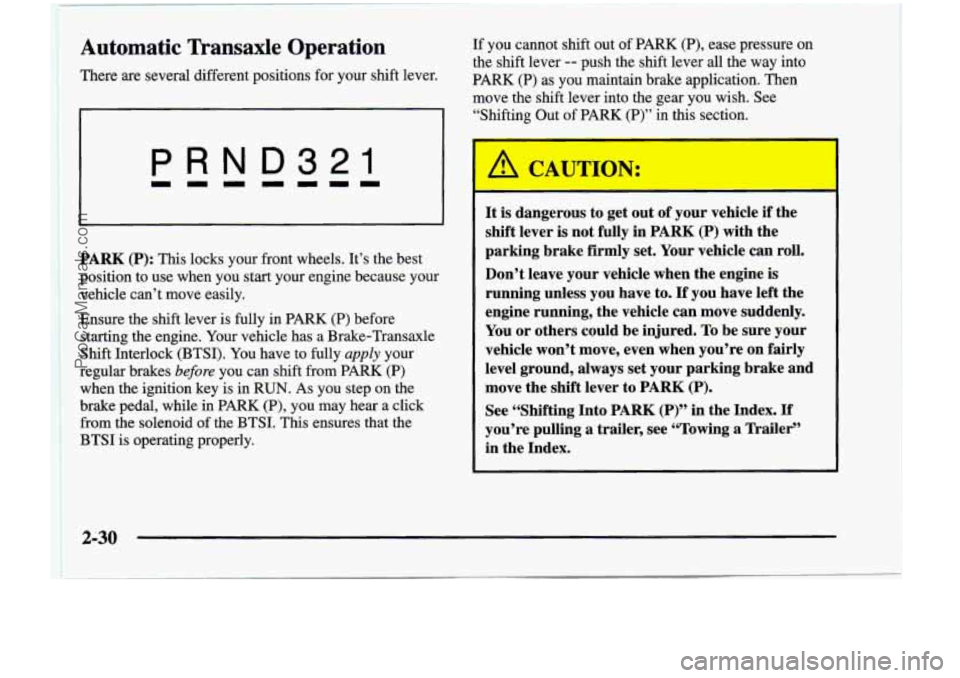
There are several different positions for your shift lever. If you
cannot shift out of PARK (P), ease pressure on
the shift lever
-- push the shift lever all the way into
PARK
(P) as you maintain brake application. Then
move the shift lever into the gear you wish. See
I( “Shifting Out of PARK (P)” in this section.
I
PRND321
PARK (P): This locks your front wheels. It’s the best
position to use when you start your engine because your
vehicle can’t move easily.
Ensure the shift lever is fully in PARK (P) before
starting the engine. Your vehicle has
a Brake-Transaxle
Shift Interlock (BTSI). You have to fully
apply your
regular brakes
before you can shift from PARK (P)
when the ignition key is in RUN. As you step on the
brake pedal, while in PARK
(P), you may hear a click
from the solenoid of the BTSI. This ensures that the
BTSI is operating properly.
I
It is dangerous to get out of your vehicle if the
shift lever is not fully in
PARK (P) with the
parking brake firmly
set. Your vehicle can roll.
Don’t leave your vehicle when the engine
is
running unless you have to. If you have left the
engine running, the vehicle can move suddenly.
You or others could be injured. To be sure your
vehicle won’t move, even when you’re
on fairly
level ground, always set your parking brake and
move the shift lever to
PARK (P).
See “Shifting Into PARK (P)” in the Index. If
you’re pulling a trailer, see “Towing a Trailer‘’
in the Index.
ProCarManuals.com
Page 149 of 474
I
AUTOMATIC OVERDRIW (D): This position is
for normal driving. If you need more power for passing,
and you’re:
Going less than 35 mph (55 km/h), push your
Going about 35 mph (55 km/h) or more, push the
You’ll shift down to the next gear and have more power.
THIRD (3): This position is also used for normal
driving, but
it offers more power and lower fuel
economy than AUTOMATIC OVERDRIVE
(D).
Here are some times you might choose THIRD (3)
instead
of AUTOMATIC OVERDRIVE (D):
When driving on hilly, winding roads.
When towing a trailer (so there is less shifting
When going down a steep hill. accelerator pedal
about halfway down.
accelerator all the way down.
between gears).
SECOND (2): This position gives you more power, but
lower fuel economy.
You can use SECOND (2) on hills.
It can help control your speed as you go down steep
mountain roads, but then you would also want to use
your brakes
off and on.
I NOTICE:
Don’t drive in SECOND (2) for more than 25 miles
(40 km), or at speeds over 55 mph (90 km/h), or
you can damage your transaxle. Use THIRD (3) or
AUTOMATIC OVERDRIVE (D) as much as
possible. Don’t shift into SECOND (2) unless you
are going slower than 65 mph (105 km/h) or you
can damage your engine.
2-32
ProCarManuals.com
Page 150 of 474

NOTICE:
If your vehicle seems to start up rather slowly,
or
if it seems not to shift gears as you go faster,
something may be wrong with a transaxle system
sensor.
If you drive very far that way, your
vehicle can be damaged.
So, if this happens,
have your vehicle serviced right away. Until then,
you can use
SECOND (2) when you are driving
less than
35 mph (55 km/h) and THIRD (3) for
higher speeds. FIRST
(1): This position gives
you even more power
(but lower fuel economy) than
SECOND (2). You can
use it on very steep hills, or in deep snow or mud.
If
the selector lever is put in FIRST (l), the transaxle
won’t downshift into fist gear until the vehicle
is
going slow enough.
NOTICE:
If your front wheels can’t rotate, don’t try to
drive. This might happen
if you were stuck in
very deep sand or mud or were up against
a
solid object. You could damage your transaxle.
Also, if you stop when going uphill, don’t hold
your vehicle there with only the accelerator
pedal. This could overheat and damage the
transaxle. Use your brakes or shift into
PARK (P)
to hold your vehicle in position on a hill.
2-33
ProCarManuals.com
Page 151 of 474
Parking Brake
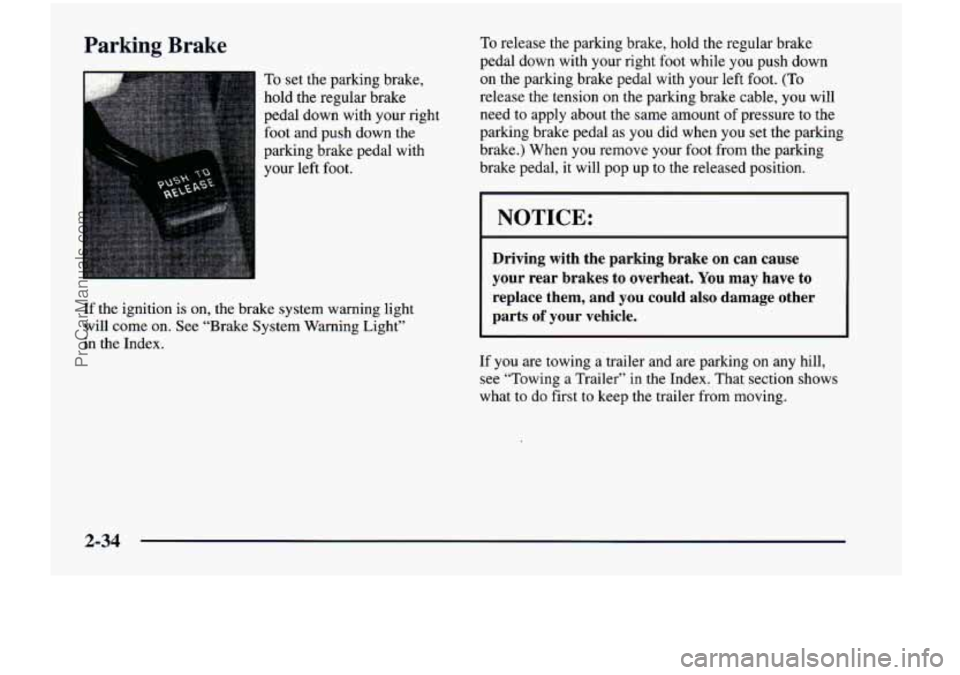
*:>: To set the parking brake,
hold the regular brake
pedal down with your right
foot and push down the
parking brake pedal with
your left foot.
If
the ignition is on, the brake system warning light
will come on. See “Brake System Warning Light”
in the Index.
To release the parking brake, hold the regular brake
pedal down with your right foot while you push down
on the parking brake pedal with your left foot. (To
release the tension on the parking brake cable, you will
need to apply about the same amount
of pressure to the
parking brake pedal as you did when you set the parking
brake.) When
you remove your foot from the parking
brake pedal, it will pop up
to the released position.
NOTICE:
Driving with the parking brake on can cause
your rear brakes
to overheat. You may have to
replace them, and you could also damage other
parts
of your vehicle.
If you are towing a trailer and are parking on any hill,
see “Towing a Trailer”
in the Index. That section shows
what
to do first to keep the trailer from moving.
2-34
ProCarManuals.com
Page 154 of 474
Torque Lock Shifting Out of PARK (P)
If you are parking on a hill and you don’t shift your
transaxle into PARK (P) properly, the weight of the
vehicle may put
too much force on the parking pawl in
the transaxle. You may find it difficult to pull the shift
lever out
of PARK (P). This is called “torque lock.” To
prevent torque lock, set the parking brake and then shift
into PARK
(P) properly before you leave the driver’s
seat.
To find out how, see “Shifting Into PARK (P)” in
the Index.
When you are ready to drive, move the shift lever out
of PARK
(P) before you release the parking brake.
If torque lock does occur, you may need to have another
vehicle push yours a little uphill
to take some of the
pressure
from the parking pawl in the transaxle, so
you can pull the shift lever out of PARK (P). Your
vehicle has a Brake-Transaxle Shift Interlock
(BTSI). You have to fully apply your regular brakes
before you can shift from PARK (P) when the ignition
is in
RUN.
As you step on the brake pedal, while in PARK (P),
you may hear a click from the solenoid of the BTSI.
This ensures that the BTSI is operating properly. See
“Automatic Transaxle Operation” in the Index.
If you cannot shift out
of PARK (P), ease pressure
on the shift lever
-- push the shift lever all the way
into PARK
(P) as you maintain brake application. Then
move the shift lever into the gear you want. If you ever
hold the brake pedal down but still can’t shift out of
PARK
(P), try this:
1. Turn the ignition key to OFF.
2. Apply and hold the brake until the end of Step 4.
3. Shift to NEUTRAL (N).
4. Start the engine and then shift to the drive gear
you want.
5. Have the vehicle fixed as soon as you can.
2-37
ProCarManuals.com
Page 173 of 474
Rear Window Washer/ Wiper
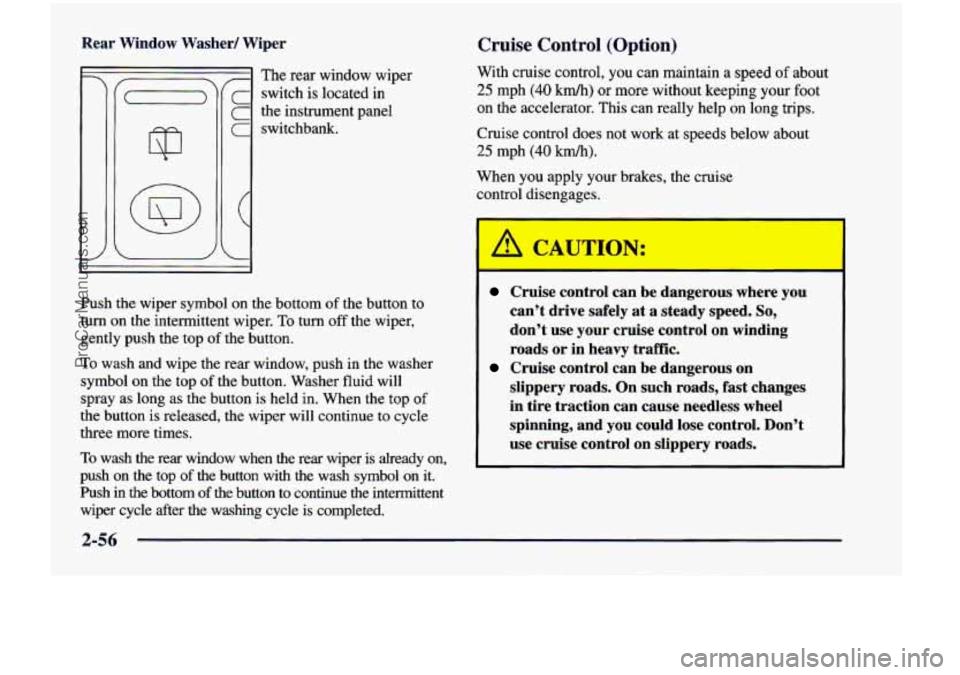
! The rear window wiper
- switch is located in
the instrument panel
1 switchbank.
Cruise Control (Option)
With cruise control, you can maintain a speed of about
25 mph (40 km/h) or more without keeping your foot
on the accelerator. This can really help on long trips.
Cruise control does not work at speeds below about
25 mph (40 km/h).
When you apply your brakes, the cruise
control disengages.
Push
the wiper symbol on the bottom of the button to
turn on the intermittent wiper. To
turn off the wiper,
gently push the top
of the button.
To wash and wipe the rear window, push in the washer
symbol on the top
of the button. Washer fluid will
spray as long as the button is held in. When the top
of
the button is released, the wiper will continue to cycle
three more times.
To wash the rear window when the rear wiper is already on,
push on the top
of the button with the wash symbol on it.
Push in the bottom
of the button to continue the intermittent
wiper cycle after the washing cycle is completed.
Cruise control can be dangerous where you
can’t drive safely at a steady speed.
So,
don’t use your cruise control on winding
roads or in heavy
traffic.
slippery roads. On such roads, fast changes
in tire traction can cause needless wheel
spinning, and
you could lose control. Don’t
use cruise control on slippery roads.
Cruise control can be dangerous on
ProCarManuals.com
Page 206 of 474
Ani- ?ck Brake System Warning Light
With the anti-lock brake
system, this light will
come on when you start
your engine and it will
stay on for three seconds.
That’s normal.
If the light flashes when you’re driving, you don’t have
anti-lock brakes and there could be a problem with your
regular brakes. Pull
off the road and stop carefully. You
may notice that the pedal is harder to push. Or, the pedal
may
go closer to the floor. It may take longer to stop.
Have the vehicle towed for service. (See “Towing Your
Vehicle” in the Index.)
A CAUTION:
Your regular brake system may not be working
properly if the anti-lock brake system warning
light is flashing. Driving with the anti-lock
brake system warning light flashing can lead
to an accident. After you’ve pulled off the road
and stopped carefully, have the vehicle towed
for service.
If the anti-lock brake system warning light stays on
longer than normal after you’ve started your engine, turn
the ignition off. Or, if the light comes on and stays on
when you’re driving, stop as soon as possible and turn
the ignition
off. Then start the engine again to reset the
system. If the light still stays on, or comes on again
while you’re driving, your vehicle needs service. If the
light is on but not flashing and the regular brake system
warning light isn’t on,
you still have brakes, but you
don’t have anti-lock brakes.
The anti-lock brake system warning light should come
on briefly when you turn the ignition key to
RUN. If the
light doesn’t
come on then, have it fixed so it will be
ready to warn you if there is a problem.
2-89
ProCarManuals.com