1998 CHEVROLET VENTURE torque
[x] Cancel search: torquePage 154 of 474
Torque Lock Shifting Out of PARK (P)
If you are parking on a hill and you don’t shift your
transaxle into PARK (P) properly, the weight of the
vehicle may put
too much force on the parking pawl in
the transaxle. You may find it difficult to pull the shift
lever out
of PARK (P). This is called “torque lock.” To
prevent torque lock, set the parking brake and then shift
into PARK
(P) properly before you leave the driver’s
seat.
To find out how, see “Shifting Into PARK (P)” in
the Index.
When you are ready to drive, move the shift lever out
of PARK
(P) before you release the parking brake.
If torque lock does occur, you may need to have another
vehicle push yours a little uphill
to take some of the
pressure
from the parking pawl in the transaxle, so
you can pull the shift lever out of PARK (P). Your
vehicle has a Brake-Transaxle Shift Interlock
(BTSI). You have to fully apply your regular brakes
before you can shift from PARK (P) when the ignition
is in
RUN.
As you step on the brake pedal, while in PARK (P),
you may hear a click from the solenoid of the BTSI.
This ensures that the BTSI is operating properly. See
“Automatic Transaxle Operation” in the Index.
If you cannot shift out
of PARK (P), ease pressure
on the shift lever
-- push the shift lever all the way
into PARK
(P) as you maintain brake application. Then
move the shift lever into the gear you want. If you ever
hold the brake pedal down but still can’t shift out of
PARK
(P), try this:
1. Turn the ignition key to OFF.
2. Apply and hold the brake until the end of Step 4.
3. Shift to NEUTRAL (N).
4. Start the engine and then shift to the drive gear
you want.
5. Have the vehicle fixed as soon as you can.
2-37
ProCarManuals.com
Page 329 of 474
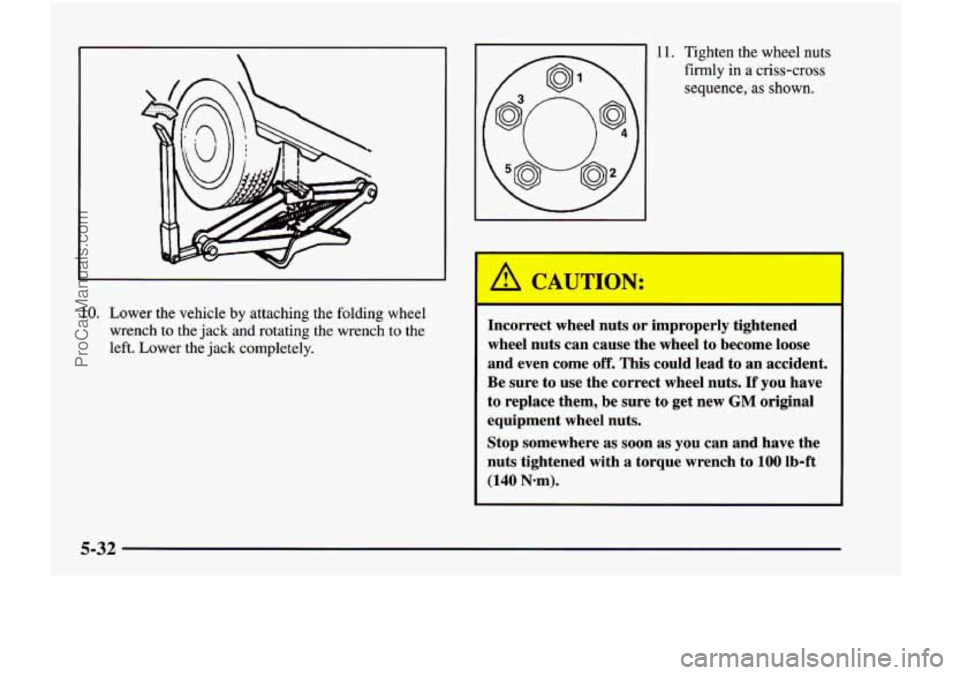
10. Lower the vehicle by attaching the folding wheel
wrench
to the jack and rotating the wrench to the
left. Lower the jack completely.
L
a CAUTION:
11. Tighten the wheel nuts
firmly in a criss-cross
sequence,
as shown.
Incorrect wheel nuts or improperly tightened
wheel nuts can cause the wheel to become loose
and even come off. This could lead to an accident.
Be sure to use the correct wheel nuts.
If you have
to replace them, be sure to get new
GM original
equipment wheel nuts.
Stop somewhere as
soon as you can and have the
nuts tightened with a torque wrench to
100 lb-ft
(140 Nom).
ProCarManuals.com
Page 330 of 474
NOTICE:
Improperly tightened wheel nuts can lead to
brake pulsation and rotor damage.
To avoid
expensive brake repairs, evenly tighten the wheel
nuts in the proper sequence and to the proper
torque specification.
Don’t try to put a wheel cover
on the compact spare tire.
It won’t fit. Store the wheel cover securely in the rear
of
the vehicle until you have the flat tire repaired or
replaced.
I NOTICE:
Wheel covers won’t fit on your compact spare. If
you try to put a wheel cover on your compact
spare, you could damage the cover or the spare.
Storing a Flat or 5are Tire and Tools
A CAUTION:
Storing a jack, a tire or other equipment in the
passenger compartment
of the vehicle could
cause injury.
In a sudden stop or collision, loose
equipment could strike someone. Store all these
in the proper place.
Lay
the tire near the rear of the vehicle with the valve
stem down. Slide the cable retainer through the center
of
the wheel and start to raise the tire. When the tire is
almost in the stored position, turn the tire so the valve is
towards the rear
of the vehicle. This will help when you
check and maintain tire pressure in the spare.
Keep raising the wheel until you hear the hoist
mechanism click twice. This means the wheel
is firmly
stored against the underside
of the vehicle. Push
against the wheel to be sure
it does not move and is
stored securely.
5-33
ProCarManuals.com
Page 364 of 474
Brake Wear
Your vehicle has front disc brakes and rear drum brakes.
Disc brake pads have built-in wear indicators that
make a high-pitched warning sound when the brake
pads are
worn and new pads are needed. The sound
may come and
go or be heard all the time your vehicle
is moving (except when you are pushing on the brake
pedal firmly).
A CAUTION:
The brake wear warning sound means that soon
your brakes won’t work well. That could lead to
an accident. When you hear the brake wear
warning sound, have your vehicle serviced.
NOTICE:
Continuing to drive with worn-out brake pads
could result in costly brake repair.
Some driving conditions or climates may cause a
brake squeal when the brakes are first applied or lightly
applied. This does not mean something is wrong with
your brakes.
Properly torqued wheel nuts are necessary
to help
prevent brake pulsation. When tires are rotated, inspect
brake pads for wear and evenly torque wheel nuts
in the
proper sequence
to GM specifications.
Your rear drum brakes don’t have wear indicators, but
if you ever hear a rear brake rubbing noise, have the
rear brake linings inspected immediately. Also, the rear
brake drums should be removed and inspected each time
the tires are removed
for rotation or changing. When
you have the front brake pads replaced, have the rear
brakes inspected,
too.
Brake linings should always be replaced as complete
axle sets.
See “Brake System Inspection” in Section 7 of this
manual under
Part C “Periodic Maintenance
Inspections.”
6-29
ProCarManuals.com
Page 377 of 474
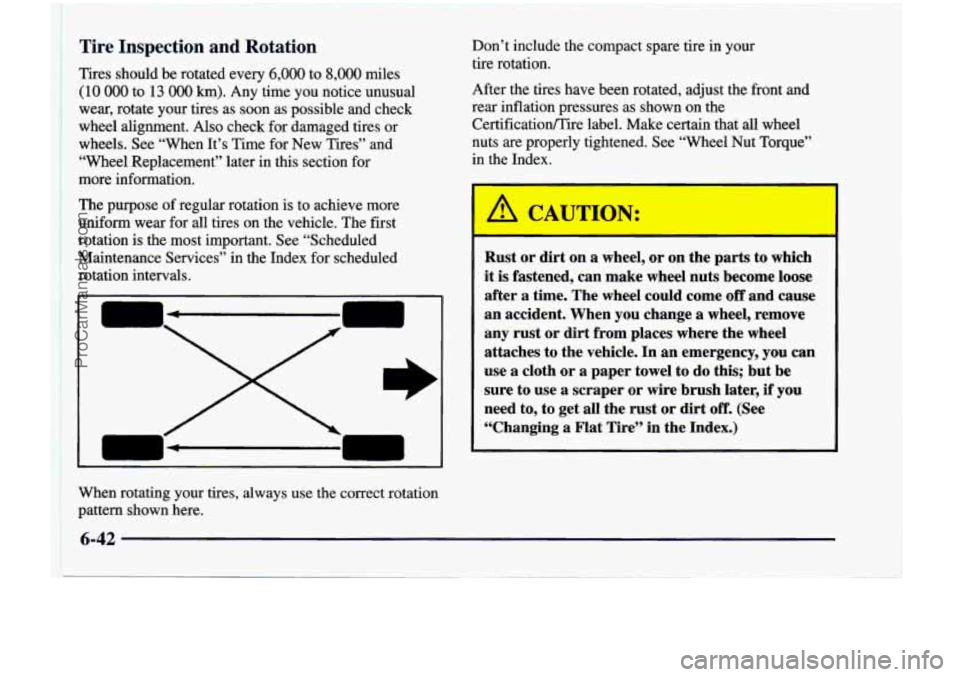
Tire Inspection and Rotation
Tires should be rotated every 6,000 to 8,000 miles
(10 000 to 13 000 Ism). Any time you notice unusual
wear, rotate your tires as soon as possible and check
wheel alignment. Also check for damaged tires or
wheels. See “When It’s Time for New Tires” and
“Wheel Replacement” later in this section for
more information.
The purpose
of regular rotation is to achieve more
uniform wear for
all tires on the vehicle. The first
rotation is the most important. See “Scheduled Maintenance Services” in the Index for scheduled
rotation intervals. Don’t include the compact spare tire
in your
tire rotation.
After the tires have been rotated, adjust the front and rear inflation pressures as shown on the
Certificatioflire label. Make certain that all wheel
nuts are properly tightened. See “Wheel Nut Torque”
in the Index.
I
Rust or dirt on a wheel, or on the parts to which
it is fastened, can make wheel nuts become loose
after a time. The wheel could come
off and cause
an accident. When you change
a wheel, remove
1 any rust or dirt from places where the wheel
attaches to the vehicle. In an emergency, you can
use
a cloth or a paper towel to do this; but be
sure to use
a scraper or wire brush later, if you
need to, to get all the rust or dirt
off. (See
“Changing a Flat Tire” in the Index.)
When rotating your tires, always use
the correct rotation
pattern shown here.
I 6-42
ProCarManuals.com
Page 395 of 474

Fuses
RR HVAC
SWC ACCY
HAZARD
RR PWR SCKT
DRL
LH TLP
RR DEFOG
FRT PWR SCKT
SIR
FRT HVAC
LOWMED BLWR
MALL/RADIO/DIC Rear Blower Motor,
Rear
Heater-NC
Control,
and Temperature Door
Actuator (Rear)
Steering Wheel Radio
Control Switches
Turn Signal Switch
Rear Electric Accessory
Plug Housing
DRL Control Module
Not Used
Rear Window Defogger Relay
Front Electric Accessory
Plug Housing
Inflatable Restraint
Control Module
Heater-A/C Control
BCM, Driver Information
Display, Radio
and Radio Rear
Speaker Amplifier
Fuses
STOP LAMP
ABS MOD BATT
CAN VENT
SOL
ELC
CTSY LAMP
IGN 1
SUNROOF
Stoplamp Switch to Stoplamps
Electronic Brake Control
ModuleElectronic Brake
Traction Control Module
(EBCMEBTCM)
Evaporative Emissions (EVAP)
Canister Vent Solonoid Valve
Electronic Level Control (ELC)
Air Compressor and ELC
Relay, Trailer Harness
BCM
ALC Sensor, BCM, Electronic
Brake Control Indicator Lamp
Driver Module, Instrument
Panel Cluster, Rear Window
Wipermasher and
Multifunction Switch (Fog Lamp SwitcWTraction Control Switch) and Stoplamp/Torque
Converter Clutch (TCC) Switch
Sunroof Control Module
6-60
ProCarManuals.com
Page 399 of 474
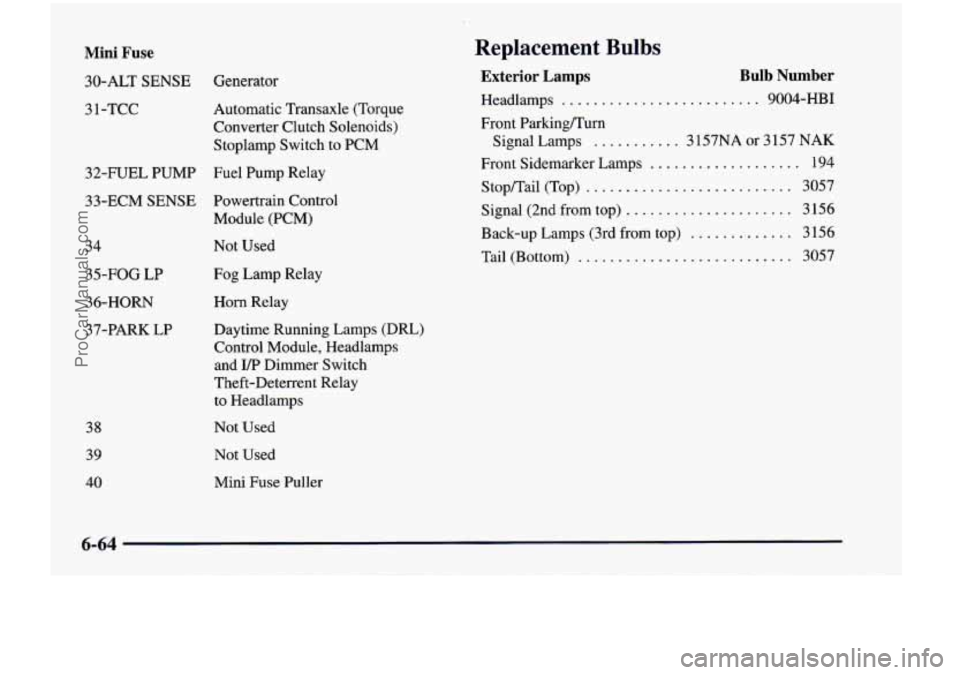
Mini Fuse
30-ALT SENSE
3 1 -TCC Generator
Automatic
Transaxle (Torque
Converter Clutch Solenoids)
Stoplamp Switch
to PCM
32-FUEL PUMP Fuel Pump Relay
33-ECM SENSE Powertrain Control
Module (PCM)
34
35-FOG LP
36-HORN
37-PARK
LP
38
39
40
Not Used
Fog Lamp Relay
Horn Relay
Daytime Running Lamps (DRL)
Control Module, Headlamps
and
I/P Dimmer Switch
Theft-Deterrent Relay to Headlamps
Not Used
Not Used
Mini Fuse Puller
Replacement Bulbs
Exterior Lamps Bulb Number
Headlamps ......................... 9004-HBI
Front ParkingRurn Signal Lamps
........... 3157NA or 3157 NAK
Front Sidemarker Lamps ................... 194
Stop/Tail (Top) .......................... 3057
Signal (2nd from top) ..................... 3156
Back-up Lamps (3rd from top)
............. 3156
Tail (Bottom)
........................... 3057
ProCarManuals.com
Page 400 of 474
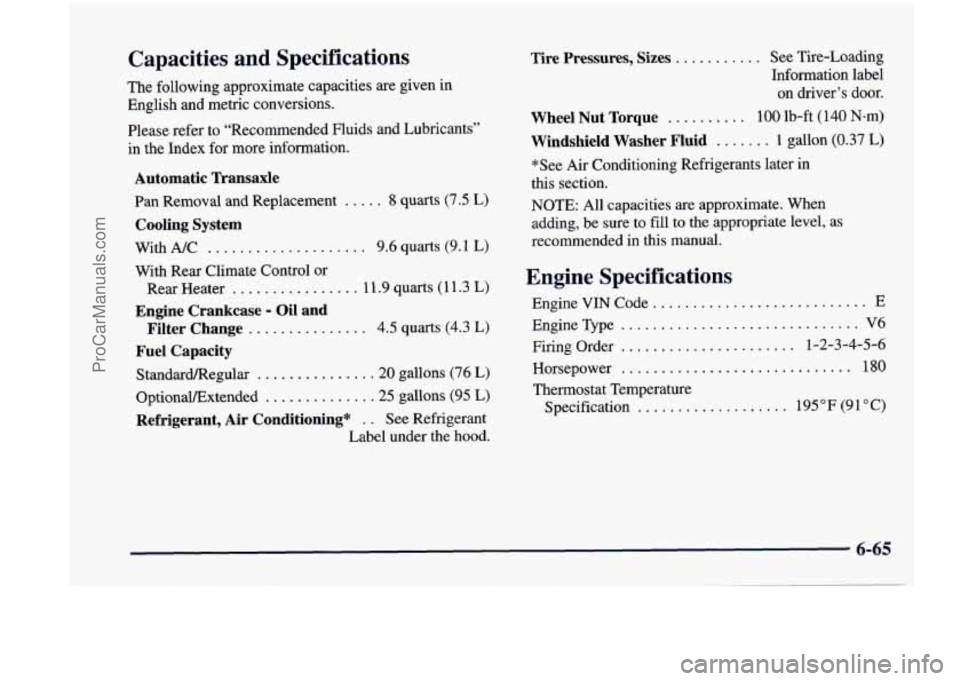
Capacities and Specifications
The following approximate capacities are given in
English and metric conversions.
Please refer to “Recommended Fluids and Lubricants”
in the Index for more information.
Automatic Transaxle
Pan Removal and Replacement ..... 8 quarts (7.5 L)
Cooling System
With A/C .................... 9.6 quarts (9.1 L)
With Rear Climate Control or
Engine Crankcase - Oil and
Fuel Capacity
Rear Heater ................ 11.9 quarts (11.3 L)
Filter Change ............... 4.5 quarts (4.3 L)
StandardRegular .............. .20 gallons (76 L)
OptionaVExtended ............. .25 gallons (95 L)
Refrigerant, Air Conditioning* . . See Refrigerant
Label under the hood.
Tire Pressures, Sizes ........... See Tire-Loading
Information label
on driver’s door.
Wheel Nut Torque .......... 100 lb-ft (140 N-m)
Windshield Washer Fluid ....... 1 gallon (0.37 L)
*See Air Conditioning Refrigerants later in
this section.
NOTE: All capacities are approximate. When
adding,
be sure to fill to the appropriate level, as
recommended in
this manual.
Engine Specifications
Engine VIN Code ........................... E
Firing Order ...................... 1-2-3-4-5-6
EngineType
.............................. V6
Horsepower ............................. 180
Thermostat
Temperature
Specification
................... 195 “F (91 “C)
6-65
ProCarManuals.com