1998 CHEVROLET VENTURE heating
[x] Cancel search: heatingPage 138 of 474
NOTICE:
Be sure there are no overhead obstructions, such
as
a garage door, before you open the liftgate.
You could slam the liftgate into something and
break the glass.
I
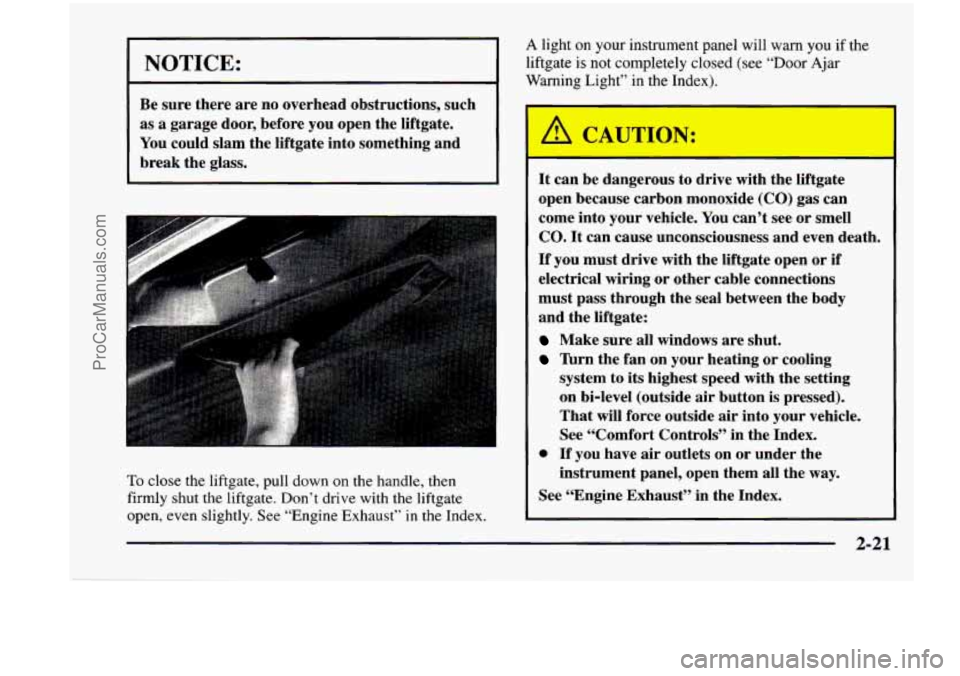
To close the liftgate, pull down on the handle, then
firmly shut the liftgate. Don’t drive with the liftgate
open, even slightly. See “Engine Exhaust” in the Index.
A light on your instrument panel will warn you if the
liftgate is not completely closed (see “Door Ajar
Warning Light” in the Index).
It can be dangerous to drive with the liftgate
open because carbon monoxide (CO) gas can
come into your vehicle. You can’t see or smell
CO. It can cause unconsciousness and even death.
If you must drive with the liftgate open or if
electrical wiring or other cable connections
must pass through the seal between the body
and the liftgate:
Make sure all windows are shut.
lbrn the fan on your heating or cooling
system to
its highest speed with the setting
on bi-level (outside air button is pressed).
That will force outside air into your vehicle.
See “Comfort Controls” in the Index.
0 If you have air outlets on or under the
instrument panel, open them all the way.
See “Engine Exhaust’’ in the Index.
2-21
ProCarManuals.com
Page 194 of 474
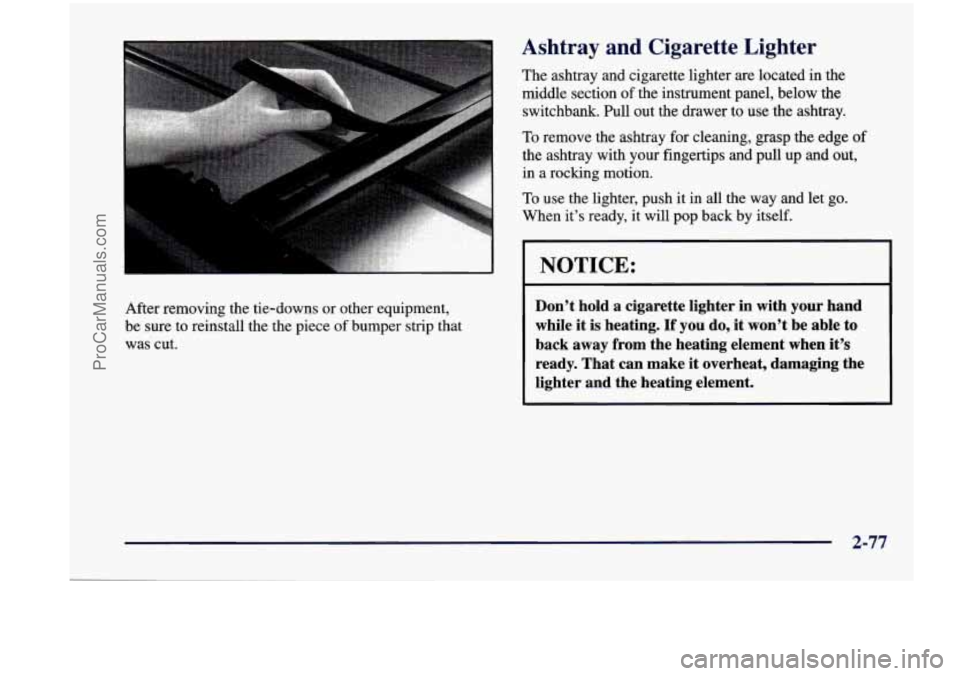
After removing the tie-downs or other equipment,
be sure to reinstall the the piece
of bumper strip that
was cut.
Ashtray and Cigarette Lighter
The ashtray and cigarette lighter are located in the
middle section of the instrument panel, below the
switchbank. Pull out the drawer to use the ashtray.
To remove the ashtray for cleaning, grasp the edge of
the ashtray with your fingertips and pull up and out,
in a rocking motion.
To use the lighter, push it in
all the way and let go.
When it’s ready, it will pop back
by itself.
NOTICE:
Don’t hold a cigarette lighter in with your hand
while it is heating. If you do, it won’t be able to
back away from the heating element when it’s ready. That can make it overheat, damaging the
lighter and the heating element.
2-77
ProCarManuals.com
Page 208 of 474
Low Traction Light (Option)
LOW
TRACTION
If your vehicle has the
traction control system,
there will be a LOW
TRACTION light on
the instrument panel.
When your anti-lock system
is adjusting brake pressure
to help avoid
a braking skid, or when your traction
control system is limiting wheel spin, the LOW
TRACTION light will come on. Slippery road
conditions may exist if this light comes
on, so adjust
your driving accordingly. The light will come on and
stay on for four seconds when your anti-lock system
adjusts brake pressure for less than four seconds or
when your traction control system limits wheel spin
for less than four seconds. Otherwise, the light will
go
out as soon as the anti-lock system stops adjusting
brake pressure or the traction control system stops
limiting wheel spin.
The
LOW TRACTION light also comes on briefly,
as a bulb check, when the engine is started. If the light
doesn’t come on then, have it fixed
so it will be there to
tell you when the system is active.
Engine Coolant Temperature Gage
C
%
125
%
United States
I
Canadian
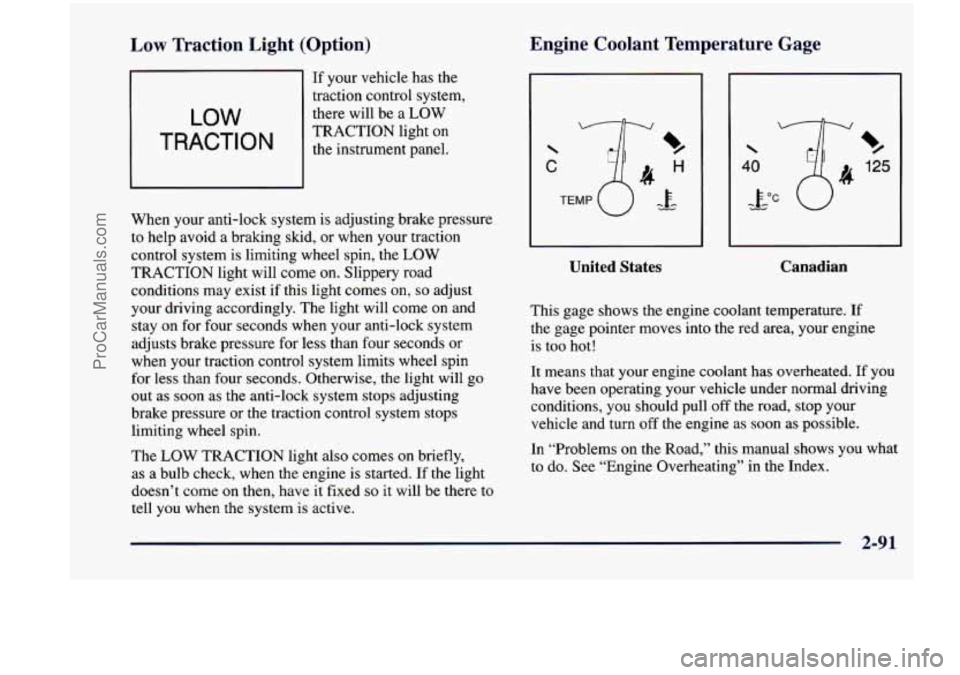
This gage shows the engine coolant temperature. If
the gage pointer moves into the red area, your engine
is too hot!
It means that your engine coolant has overheated. If you
have been operating your vehicle under normal driving
conditions, you should pull off the road, stop your vehicle and turn
off the engine as soon as possible.
In “Problems on the Road,” this manual shows you what
to do. See “Engine Overheating” in the Index.
.. .
ProCarManuals.com
Page 209 of 474
Engine Temperature Warning Light
This light will come on
when your engine gets
too hot.
Low Coolant Light
If this light comes on,
your system is low on
coolant and the engine
may overheat.
If this light comes on, it means that your engine coolant
has overheated. If you have been operating your vehicle
under normal driving conditions, you should pull
off the
road, stop your vehicle and turn off the engine as soon
as possible. See
“Engine Coolant” in the Index and have your
vehicle serviced as soon as possible.
In “Problems on the Road,” this manual shows what to
do. See “Engine Overheating” in the Index.
2-92
ProCarManuals.com
Page 220 of 474
0 Section 3 Comfort Controls and Audio Systems
In this section, you’ll find out how to operate the comfort control and audio systems offered with your vehicle. Be
sure to read about the particular systems supplied with your vehicle.
3-2 3-3
3-4
3-4
3-5
3-6
3-8
3-9
3-9 3- 10 3-12 Comfort
Controls
Air Conditioning
Heating Defogging and Defrosting
Rear Window Defogger (If Equipped)
Rear Climate Control (If Equipped)
Ventilation System
Setting the Clock for Systems without
Automatic Tone Control
Setting the Clock for Systems with Automatic
Tone Control
AM-FM Stereo
AM-FM Stereo with Cassette Tape Player
(If Equipped) 3-15
3- 19 3-23 3-25
3
-26
3-29
3-39
3-30
3-3 1
3-32
3-32
AM-FM Stereo with Cassette Tape Player and
Automatic Tone Control (If Equipped)
AM-FM Stereo with Compact Disc Player and
Automatic Tone Control
(If Equipped)
Rear Seat Audio
(If Equipped)
Remote Compact Disc Player (If Equipped)
Theft-Deterrent Feature
(If Equipped)
Understanding Radio Reception
Tips About Your Audio System
Care of Your Cassette Tape Player
Care
of Your Compact Discs
Care
of Your Compact Disc Player
Integrated Windshield Antenna
3-1
ProCarManuals.com
Page 221 of 474
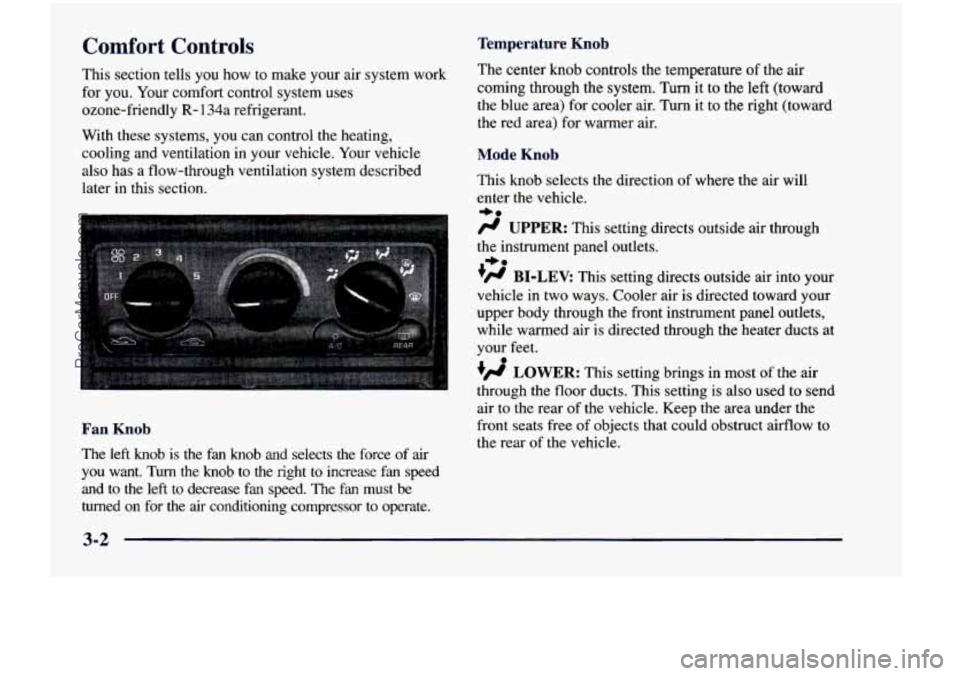
Temperature Knob Comfort Controls
This section tells you how to make your air system work
for
you. Your comfort control system uses
ozone-friendly
R- 134a refrigerant.
With these systems,
you can control the heating,
cooling and ventilation
in your vehicle. Your vehicle
also has a flow-through ventilation system described
later
in this section. The
center
knob controls the temperature of the air
coming through the system. Turn it to the left (toward
the blue area) for cooler air. Turn it to the right (toward\
the red area) for warmer air.
Mode Knob
This knob selects the direction of where the air will
enter the vehicle.
-be
fl UPPER: This setting directs outside air through
the instrument panel outlets.
+fl BI-LEV: This setting directs outside air into your
vehicle in two ways. Cooler air
is directed toward your
upper body through the front instrument panel outlets,
while warmed air
is directed through the heater ducts at
your feet.
+e
0
+fl LOWER: This setting brings in most of the air
air to the rear of the vehicle. Keep the area under the
the rear of the vehicle.
- through the floor ducts. This setting is also used to send
Fan Knob front seats free of objects that could obstruct airflow to
The left knob is the fan knob and selects the force of air
you want. Turn the knob to the right to increase fan speed
and to the left to decrease
fan speed. The fan must be
turned on for the
air conditioning compressor to operate.
3-2
ProCarManuals.com
Page 223 of 474
Heating Defogging and Defrosting
Turn the temperature knob to the right (toward the red
area)
to warm the air.
In the LOWER mode, outside
air will be brought in and
sent through the floor outlets. The heater works best
if
you keep your windows closed while using it.
The BI-LEV setting is designed for use on sunny days
when the air is only moderately warm or cool. On days
like these, the sun may adequately warm your upper
body, but your lower body may not be warm enough.
For the best results,
turn the temperature control knob to
the middle position, and then adjust it for comfort.
If you have the optional engine coolant heater and use it
during cold weather,
0°F (- 18 O C) or lower, your heating
system will provide heat more quickly because the
engine coolant is already warmed. See “Engine Coolant
Heater” in the Index, To
rapidly defrost the windshield, turn the temperature
control knob all the way
to the right (to the red area) and
turn the mode knob
to DEFROST.
Adjust the fan to the highest speed.
To keep the windshield clear and bring in heated air
through the heater ducts, turn the mode knob
to
DEFOG.
When the temperature outside is above freezing, the air
conditioner compressor will
run in these settings to help
remove moisture from the air.
Your vehicle is equipped with side window defogger
vents located on the top of the instrument panel. For
additional side window defogging, turn the mode knob
to the
BI-LEVEL setting and adjust the fan to the
highest speed. Aim the side vents on the instrument
panel toward the side windows. For increased airflow to
the side vents, close the center vents.
3-4
ProCarManuals.com
Page 290 of 474
Safety Chains
You should always attach chains between your vehicle
and your trailer. Cross the safety chains under the tongue
of the trailer
so that the tongue wdl not drop to the road
if it becomes separated from the hitch. Instructions
about safety chains may be provided by the hitch
manufacturer or by the trailer manufacturer. Follow the
manufacturer’s recommendation for attaching safety
chains and
do not attach them to the bumper. Always
leave just enough slack
so you can turn with your rig.
And, never allow safety chains to drag on the ground.
Driving with a Trailer
Trailer Brakes
If your trailer weighs more than 1,000 lbs. (450 kg)
loaded, then it needs its own brakes
-- and they must be
adequate. Be sure to read and
follow the instructions for
the trailer brakes
so you’ll be able to install, adjust and
maintain them properly.
Because you have anti-lock brakes, do not
try to tap into
your vehicle’s brake system.
If you do, both brake
systems won’t
work well, or at all.
A CAUTION:
If you have a rearmost window open and you
pull a trailer with your vehicle, carbon monoxide
(CO) could come into your vehicle. You can’t see
or smell CO. It can cause unconsciousness or
death.
(See “Engine Exhaust” in the Index.) To
maximize your safety when towing a trailer:
Have your exhaust system inspected for
leaks, and make necessary repairs before
starting on your trip.
0 Keep the rearmost windows closed.
0 If exhaust does come into your vehicle
through a window in the rear or another
opening, drive
with your front, main
heating or cooling system on and with the
fan on any speed. This
will bring fresh,
outside
air into your vehicle. Do not use
RECIRC because
it only recirculates the
air inside your vehicle. (See “Comfort
Controls’’ in the Index.)
4-37
ProCarManuals.com