1998 CHEVROLET CORVETTE wheel
[x] Cancel search: wheelPage 293 of 378
Downloaded from www.Manualslib.com manuals search engine Temperature -- A, B, C
The temperature grades are A (the highest), B, and C,
representing the tire’s resistance to the generation of
heat and its ability to dissipate heat when tested under
controlled conditions on a specified indoor laboratory
test wheel. Sustained high temperature can cause the
material of the tire to degenerate and reduce tire life, and
excessive temperature can lead to sudden tire failure.
The grade C corresponds to a level of performance
which all passenger car tires must meet under the
Federal Motor Vehicle Safety Standard
No. 109.
Grades B and A represent higher levels of performance
on the laboratory test wheel than the minimum required
by law.
Warning: The temperature grade for this tire is
established for a tire that
is properly inflated and not
overloaded. Excessive speed, underinflation,
or
excessive loading, either separately or in combination,
can cause heat buildup and possible tire failure.
Wheel Alignment and Tire Balance
The wheels on your vehicle were aligned and balanced
carefully at the factory to give you the longest tire life
and best overall performance. Scheduled wheel alignment and wheel balancing are not
needed. However,
if you notice unusual tire wear or
your vehicle pulling one
way or the other, the alignment
may need to be reset.
If you notice your vehicle
vibrating when driving on
a smooth road, your wheels
may need to be rebalanced.
Wheel Replacement
Replace any wheel that is bent, cracked, or badly rusted or corroded. If wheel nuts keep coming loose, the wheel,
wheel bolts and wheel nuts should be replaced. If the
wheel leaks air, replace it (except some aluminum
wheels, which can sometimes be repaired). See your
dealer if any of these conditions exist.
Your dealer will know the kind of wheel you need.
Each new wheel should have the same load-carrying
capacity, diameter, width, offset and be mounted the
same way as the one it replaces.
If you need to replace any of your wheels, wheel bolts or wheel nuts, replace them only with new
GM original
equipment parts. This way, you will be sure to have the
right wheel, wheel bolts and wheel nuts for your Corvette model.
6-48,
Page 294 of 378
Downloaded from www.Manualslib.com manuals search engine A CAUTION:
Using the wrong replacement wheels, wheel bolts
or wheel nuts on your vehicle can be dangerous.
It could affect the braking and handling of your
vehicle, make your tires lose air and make you
lose control. You could have a collision in which
you or others could be injured. Always use the
correct wheel, wheel bolts and wheel nuts
for replacement.
I NOTICE:
The wrong wheel can also cause problems with
bearing life, brake cooling, speedometer or
odometer calibration, headlamp aim, bumper
height, vehicle ground clearance and tire
clearance to the body and chassis.
A CAUTION:
Rust or dirt on the wheel, or on the parts to
which
it is fastened, can make the wheel nuts
become loose after a time. The wheel could come
off and cause an accident. When you change a
wheel, remove any rust or dirt from the places
where the wheel attaches to the vehicle. In an
emergency, you can use a cloth or paper towel to
do this; but be sure to use a scraper or wire brush
later,
if you need to, to get all the rust or dirt off.
I A CAUTION:
I
Never use oil or grease on studs or nuts. If you
do, the nuts might come loose. Your wheel could
fall off, causing a serious accident.
6-49
Page 295 of 378
Downloaded from www.Manualslib.com manuals search engine I~~rrect wheel nuts or improperly tightened
wheel nuts can cause the wheel to become loose
and even come
off. This could lead to an accident.
Be sure to use the correct wheel nuts.
If you have
to replace them, be sure to get new
GM original
equipment wheel nuts.
NOTICE:
Improperly tightened wheel nuts can lead to
brake pulsation and rotor damage. To avoid
expensive brake repairs, evenly tighten the wheel
nuts in the proper sequence and to the proper
torque specification. Used Replacement Wheels
Putting a used wheel
on your vehicle is
dangerous.
You can’t know how it’s been used or
how far it’s been driven. It could fail suddenly
and cause an accident.
If you have to replace a
wheel, use
a new GM original equipment wheel.
Using the Wheel Lock Key
The wheel lock key sits in a small depression in
the
trunk rail directly under the left-hand rear
compartment cover.
Your vehicle’s wheel lock key has a unique registration
number. The registration number is printed on a card
included in your lock nut package.
Also, on this card, is
lost key replacement information. This number is not
recorded by
GM or your dealer, so be sure not to lose
this card.
You will need the information if you ever lose
your wheel lock key.
Page 296 of 378
Downloaded from www.Manualslib.com manuals search engine If you or someone else is going to remove the wheels on
your vehicle, make sure that the special wheel nut socket
and wheel lock key
are being used.
NOTICE:
Your wheels could be damaged if the wheel nut
socket
is not used to remove your vehicle’s wheels.
The wheel nut socket can be used with an air wrench or
a torque wrench. The wheel lock key can be used with a
torque wrench, but not with an air or impact wrench.
I NOTICE:
Your wheel lock key or lock nuts could be
damaged if an
air or impact wrench is used with
this key.
Tire Chains
NOTICE:
Don’t use tire chains. They can damage your
vehicle because there’s not enough clearance.
Use another type of traction device only
if its
manufacturer recommends it for use on your
vehicle and tire size combination and road
conditions. Follow that manufacturer’s
instructions.
To help avoid damage to your
vehicle, drive slowly, readjust or remove the
device
if it’s contacting your vehicle, and don’t
spin your wheels.
If you do find traction devices that will fit, install
them on the rear tires.
6-51
Page 303 of 378
Downloaded from www.Manualslib.com manuals search engine Cleaning Aluminum Wheels
Keep your wheels clean using a soft clean cloth with
mild soap and water. Rinse with clean water. After
rinsing thoroughly, dry with a soft clean towel.
A wax
may then be applied.
The surface of these wheels is similar to the painted
surface
of your vehicle. Don’t use strong soaps,
chemicals, abrasive polishes, abrasive cleaners or
abrasive cleaning brushes on them because you could
damage the surface.
Don’t take your vehicle through an automatic car wash
that has silicon carbide tire cleaning brushes. These
brushes can also damage the surface
of these wheels.
Cleaning Tires
To clean your tires, use a stiff brush with a tire cleaner.
I NOTICE:
When applying a tire dressing always take care to
wipe
off any overspray or splash from all painted
surfaces on the body or wheels of the vehicle.
Petroleum-based products may damage the paint
finish.
Page 304 of 378
Downloaded from www.Manualslib.com manuals search engine Finish Damage
Any stone chips, fractures or deep scratches in the finish
should be repaired right away.
Minor chips and scratches can be repaired with touch-up
materials available from your dealer or other service
outlets. Larger areas
of finish damage can be corrected
in your dealer’s body and paint shop.
Magnesium Wheel Finish
NOTICE:
Improper paint repair or refinishing can cause
corrosion damage to a magnesium wheel. See
your dealer if a magnesium wheel needs paint
repair or refinishing.
Underbody Maintenance
Chemicals used for ice and snow removal and dust control
can collect on the underbody.
If these are not removed,
accelerated corrosion (rust) can occur on the underbody
parts such
as fuel lines, frame, floor pan and exhaust
system even though they have corrosion protection.
At least every spring, flush these materials from the
underbody with plain water. Clean any areas where mud
and other debris can collect. Dirt packed in closed areas
of the frame should
be loosened before being flushed.
Your dealer or an underbody car washing system can do
this for you.
6-59
Page 306 of 378
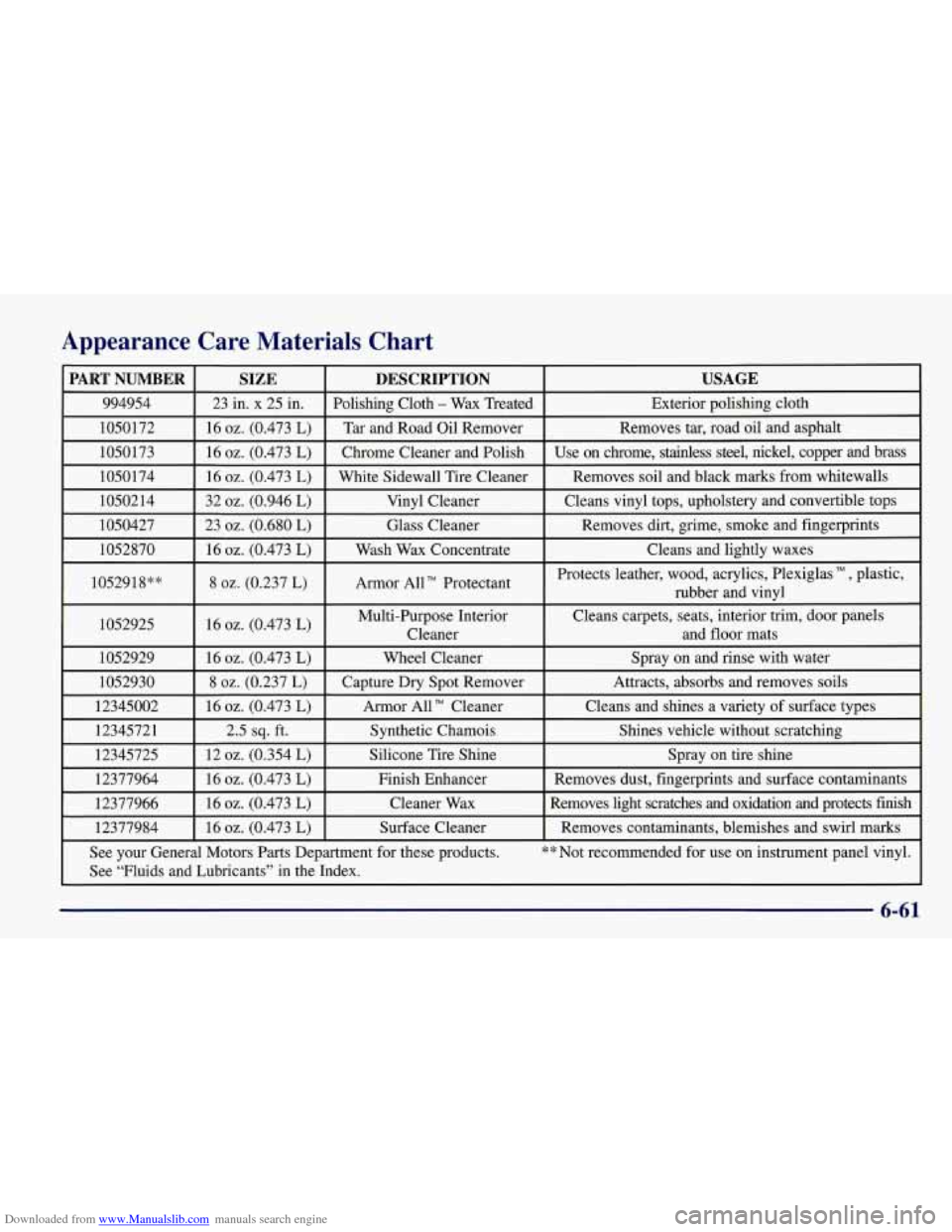
Downloaded from www.Manualslib.com manuals search engine Appearance Care Materials Chart
PART NUMBER USAGE DESCRIPTION
SIZE
994954
Exterior polishing cloth
Polishing Cloth - Wax
Treated
23 in. x 25 in.
1050172
Use on chrome, stainless steel, nickel, copper and brass
Chrome Cleaner and Polish 16
02. (0.473 L) 1050173 Removes
tar, road oil and asphalt
Tar and Road Oil Remover
16 02. (0.473 L)
1050174
I 16 oz. (0.473 L) I White Sidewall Tire Cleaner I Removes soil and black marks from whitewalls
1050214
I 32 oz. (0.946 L) I Vinyl Cleaner I Cleans vinyl tops, upholstery and convertible tops I
1050427 I 23 02. (0.680 L) I Glass Cleaner I Removes dirt, grime, smoke and fingerprints
1052870
I 16 02. (0.473 L) I Wash Wax Concentrate I Cleans and lightly waxes
1052918**
I 8 02. (0.237 L) I Armor AUT’ Protectant I
Protects leather, wood, acrylics, Plexiglas , plastic,
rubber and vinyl
1052925
I 16 02. (0.473 L) I Multi-Purpose Interior Cleans carpets,
seats, interior trim, door panels
I Cleaner and floor mats
1052929
I 16 oz. (0.473 L) I Wheel Cleaner I Spray on and rinse with water
1052930
Shines vehicle without scratching Synthetic Chamois
2.5 sq. ft.
12345721 Cleans and
shines a variety
of surface types Armor
All TM Cleaner
16 oz. (0.473 L)
12345002 Attracts, absorbs and
removes soils
Capture
Dry Spot Remover 8 02. (0.237 L)
12345725
See your General Motors Parts Department for these products.
** Not recommended for use on instrument panel vinyl.
Removes
contaminants, blemishes and swirl marks Surface Cleaner
16
oz. (0.473 L) 12377984 Removes light scratches and oxidation and protects finish Cleane\
r
Wax 16 02. (0.473 L)
12377966 Removes
dust, fingerprints and surface contaminants
Finish Enhancer
16
02. (0.473 L)
12377964 Spray
on tire shine Silicone
Tire Shine 12 02. (0.354 L)
See “Fluids and Lubricants” in the Index.
6-61
Page 316 of 378
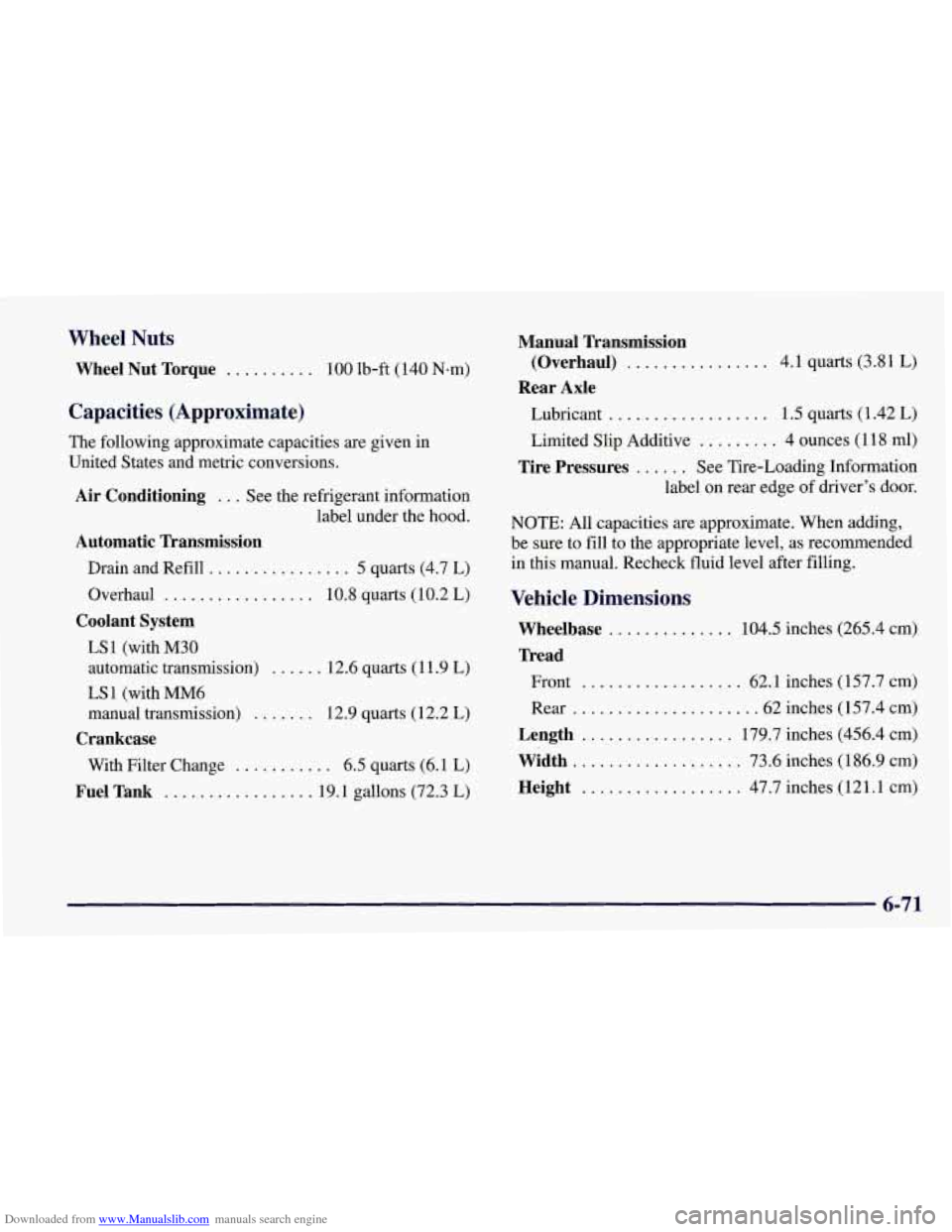
Downloaded from www.Manualslib.com manuals search engine Wheel Nuts
Wheel Nut Torque .......... 100 lb-ft (140 N-m)
Capacities (Approximate)
The following approximate capacities are given in
United States and metric conversions.
Air Conditioning ... See the refrigerant information
label under the hood.
Automatic Transmission
Drain and Refill ................ 5 quarts (4.7 L)
Overhaul
................. 10.8 quarts (10.2 L)
Coolant System
LS 1 (with M30
automatic transmission)
...... 12.6 quarts (1 1.9 L)
LS 1 (with "6
manual transmission)
....... 12.9 quarts ( 12.2 L)
Crankcase
With Filter Change ........... 6.5 quarts (6.1 L)
Fuel Tank ................. 19.1 gallons (72.3 L)
Manual Transmission
Rear Axle (Overhaul)
................ 4.1
quarts (3.8 1 L)
Lubricant
.................. 1.5 quarts (1 -42 L)
Limited Slip Additive ......... 4 ounces (1 18 ml)
Tire Pressures ...... See Tire-Loading Information
label on rear edge of driver's door.
NOTE: All capacities are approximate. When adding,
be sure to fill to the appropriate level, as recommended
in this manual. Recheck fluid level after filling.
Vehicle Dimensions
Wheelbase .............. 104.5 inches (265.4 cm)
Tread
Front .................. 62.1 inches (157.7 cm)
Rear
.................... .62 inches (157.4 cm)
Length ................. 179.7 inches (456.4 cm)
Width ................... 73.6 inches (1 86.9 cm)
Height .................. 47.7 inches (1 21.1 cm)
6-71