Page 79 of 378
Downloaded from www.Manualslib.com manuals search engine Automatic Transmission Operation
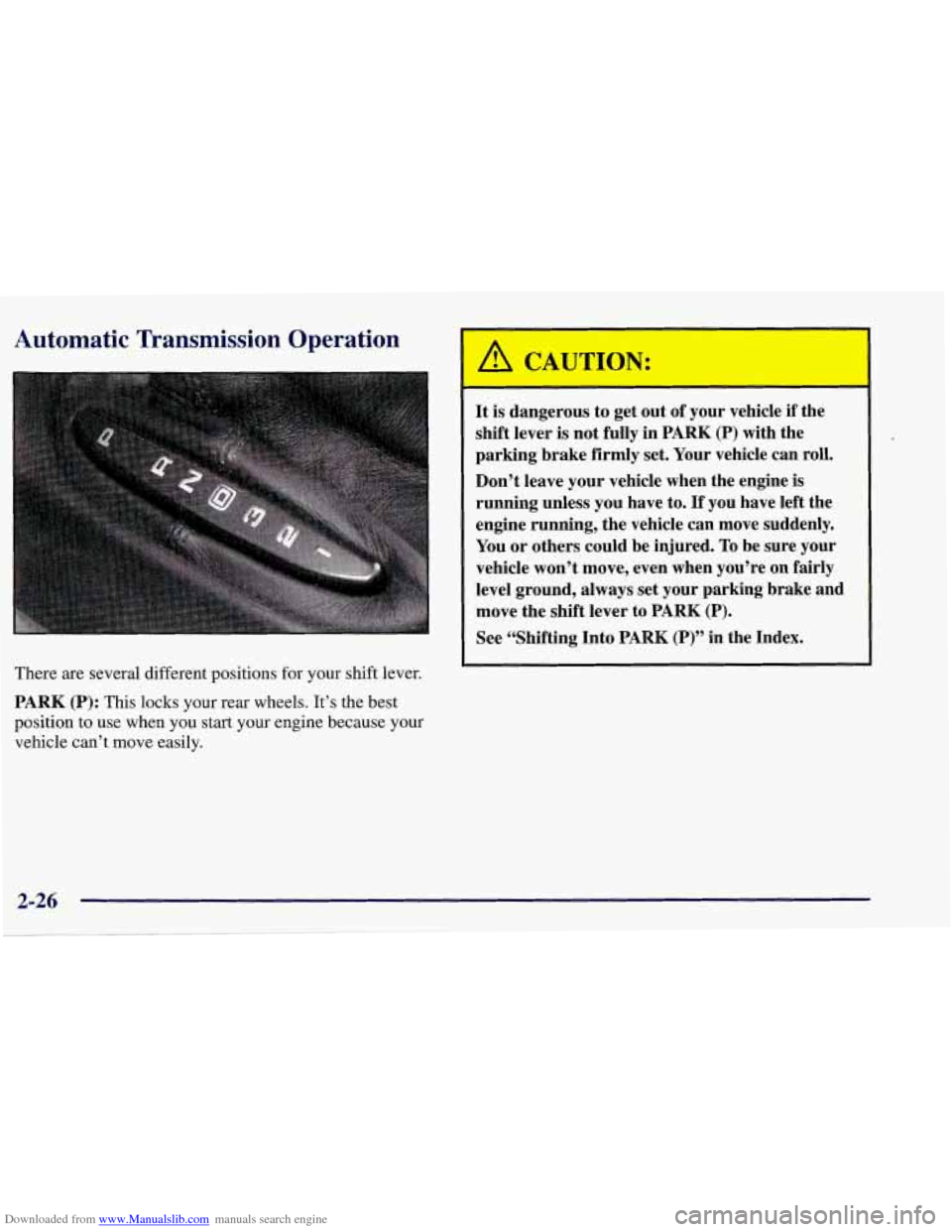
There are several different positions for your shift lever.
PARK (P): This locks your rear wheels. It’s the best
position to use when you
start your engine because your
vehicle can’t move easily.
c I
It is dangerous to get out of your vehicle if the
shift lever is not fully in
PARK (P) with the
parking brake firmly set. Your vehicle can roll.
Don’t leave your vehicle when the engine is
running unless you have to.
If you have left the
engine running, the vehicle can move suddenly.
You or others could be injured.
To be sure your
vehicle won’t move, even when you’re on fairly
level ground, always set your parking brake and
move the shift lever to
PARK (P).
See “Shifting Into PARK (P)” in the Index.
Page 80 of 378
Downloaded from www.Manualslib.com manuals search engine Be sure the shift lever is fully in PARK (P) range
before starting the engine. Your vehicle has a
brake-transmission shift interlock. You have to fully
apply your regular brakes before you can shift from
PARK
(P) when the ignition key is in the ON position. If
you cannot shift out of PARK (P), ease pressure on the
shift lever
-- push the shift lever all the way into
PARK
(P) and release the shift lever button as you
maintain brake application. Then press the shift lever
button and move the shift lever into the gear you wish.
(If you do not apply the brake after
15 seconds once the
ignition is turned on, you will receive a
PRESS BRAKE
BEFORE SHIFT message in the Driver Information
Center.) See “Shifting Out
of PARK (P)” in the Index.
REVERSE (R): Use this gear to back up.
I 1
I NOTICE:
r
Shifting to REVERSE (R) while your vehicle
is moving forward could damage your
transmission. Shift to REVERSE (R) only
after your vehicle is stopped.
To rock your vehicle back and forth to get out of snow,
ice or sand without damaging your transmission,
see
“Stuck: In Sand, Mud, Ice or Snow” in the Index.
NEUTRAL (N): In this position, your engine
doesn’t connect with the wheels. To restart when you’re
already moving, use NEUTRAL
(N) only. Also, use
NEUTRAL
(N) when your vehicle is being towed.
Shifting out of PARK (P) or NEUTRAL (N) while
your engine is “racing” (running at high speed)
is
dangerous. Unless your foot is firmly on the
brake pedal, your vehicle could move very
rapidly. You could lose control and hit people or
objects. Don’t shift out
of PARK (P) or
NEUTRAL
(N) while your engine is racing.
2-27
Page 81 of 378
Downloaded from www.Manualslib.com manuals search engine NOTICE:
Damage to your transmission caused by shifting
out
of PARK (P) or NEUTRAL (N) with the
engine racing isn’t covered by your warranty.
1
AUTOMATIC OVERDRIVE (0): This position is for
normal driving.
THIRD (3): This position is also used for normal
driving, however, it offers more power and lower fuel
economy
than AUTOMATIC OVERDRIVE (0).
Here are some times you might choose THIRD (3)
instead of AUTOMATIC OVERDRIVE (a):
0 When driving on hilly, winding roads.
0 When going down a steep hill.
SECOND (2): This position gives you more power but
lower fuel economy. You can use SECOND
(2) on hills.
It can help control your speed as you go down steep
mountain roads, but then you would also want to use
your brakes off and on.
FIRST (1): This position gives you even more power
(but lower fuel economy) than SECOND
(2). You can
use it on very steep hills, or in deep snow
or mud. If the
selector lever is put in FIRST
(l), the transmission
won’t shift into first gear until the vehicle is going
slowly enough.
NOTICE:
If your rear wheels can’t rotate, don’t try to
drive. This might happen if you were stuck in
very deep sand
or mud or were up against a solid
object.
You could damage your transmission.
Also,
if you stop when going uphill, don’t hold
your vehicle there with only the accelerator
pedal. This could overheat and damage the
transmission. Use your brakes or shift into
PARK (P) to hold your vehicle in position on
a hill.
Maximum engine speed is limited to protect driveline
components from improper operation.
Page 92 of 378
Downloaded from www.Manualslib.com manuals search engine Limited-Slip Rear Axle
Your limited-slip rear axle can give you additional
traction on snow, mud, ice, sand or gravel. It works like
a standard axle most of the time, but when one of the
rear wheels has no traction and the other does, this
feature will allow the wheel with traction to move
the vehicle.
Selective Real Time Damping
(Option)
You may have a ride control system on your vehicle
called Selective Real Time Damping (SRTD). The
system provides the following performance benefits:
0 Reduced impact harshness
0 Improved road isolation
0 Improved high-speed stability
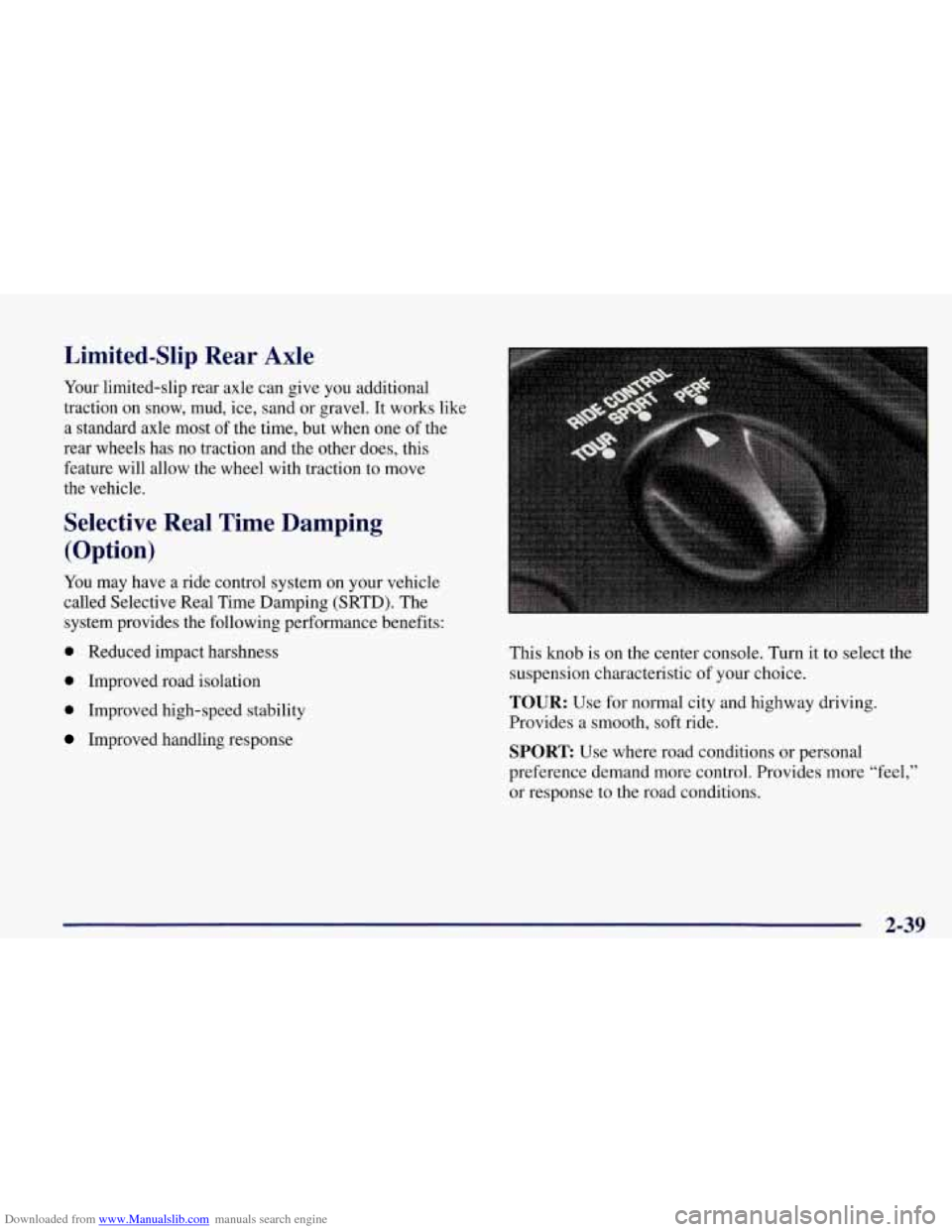
Improved handling response This knob is on the center console. Turn
it to select the
suspension characteristic of your choice.
TOUR: Use for normal city and highway driving.
Provides a smooth, soft ride.
SPORT Use where road conditions or personal
preference demand more control. Provides more
“feel,”
or response to the road conditions.
2-39
Page 93 of 378
Downloaded from www.Manualslib.com manuals search engine PERF: Use for performance driving. Provides a tight,
firm ride and precise response to road conditions.
You can select a setting at any time. Based on road
conditions, steering wheel angle and your vehicle speed,
the system automatically adjusts to provide the best ride
and handling. Select a new setting whenever driving
conditions change.
There
are three Driver Information Center messages that
are displayed when a malfunction occurs with the SRTD
system. Refer to “Driver Information Center Warnings
and Messages’’ in the Index.
Windows
Power Windows
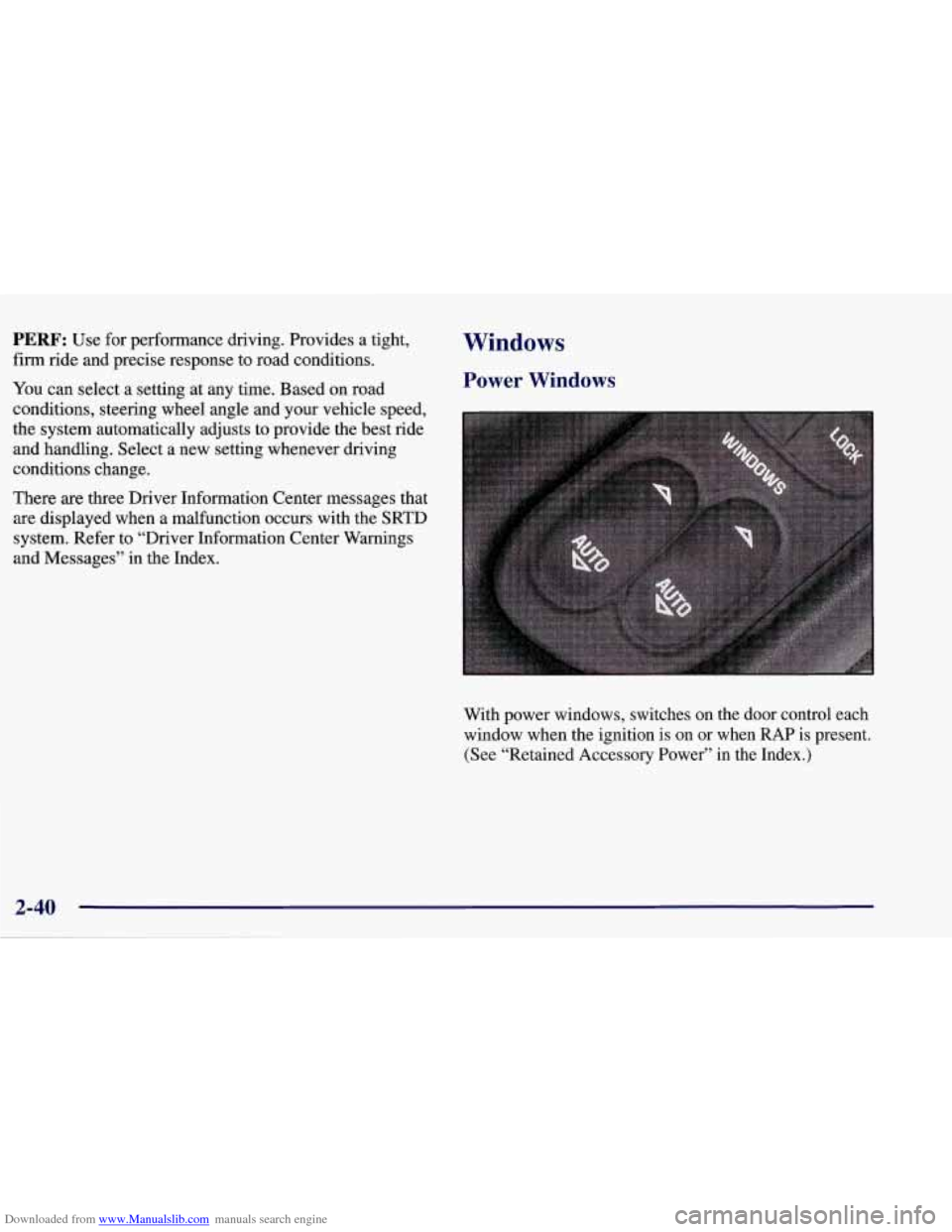
With power windows, switches on the door control each
window when the ignition
is on or when RAP is present.
(See “Retained Accessory Power” in the Index.)
Page 94 of 378
Downloaded from www.Manualslib.com manuals search engine Express-Down Window
Both the driver’s and passenger’s window switches have
an express-down feature. Press AUTO and hold for less
than one-third of a second and release. The window will
lower completely. To stop express-down feature from
the lowering the window completely, simply press the
switch again.
You can also open the window any amount by pressing
and releasing the switch.
Horn
To sound the horn, press either horn symbol on your
steering wheel.
Tilt Wheel
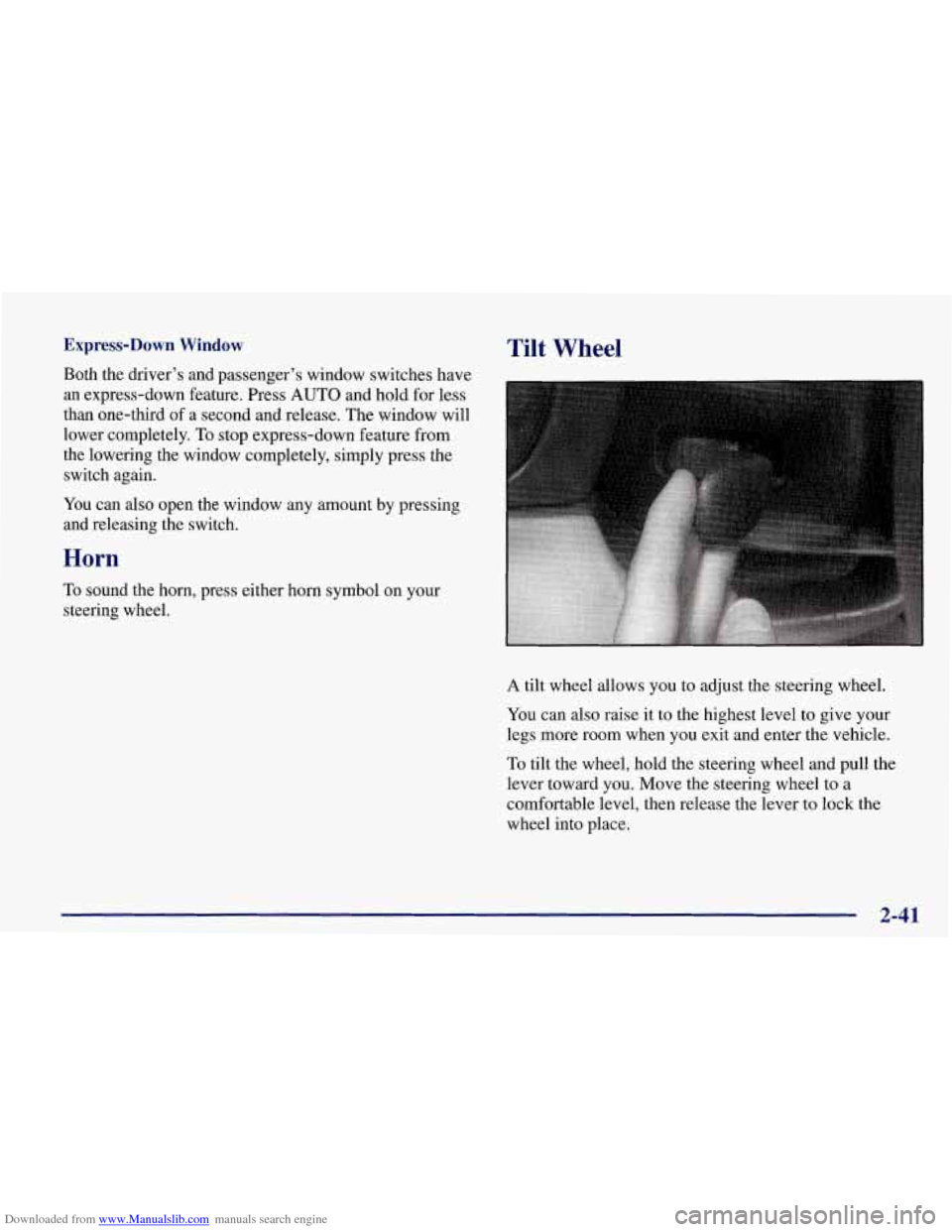
A tilt wheel allows you to adjust the steering wheel.
You can also raise it to the highest level to give your
legs more room when you exit and enter the vehicle.
To tilt the wheel, hold the steering wheel and pull the
lever toward you. Move the steering wheel to a
comfortable level, then release the lever to lock the
wheel into place.
2-41
Page 100 of 378
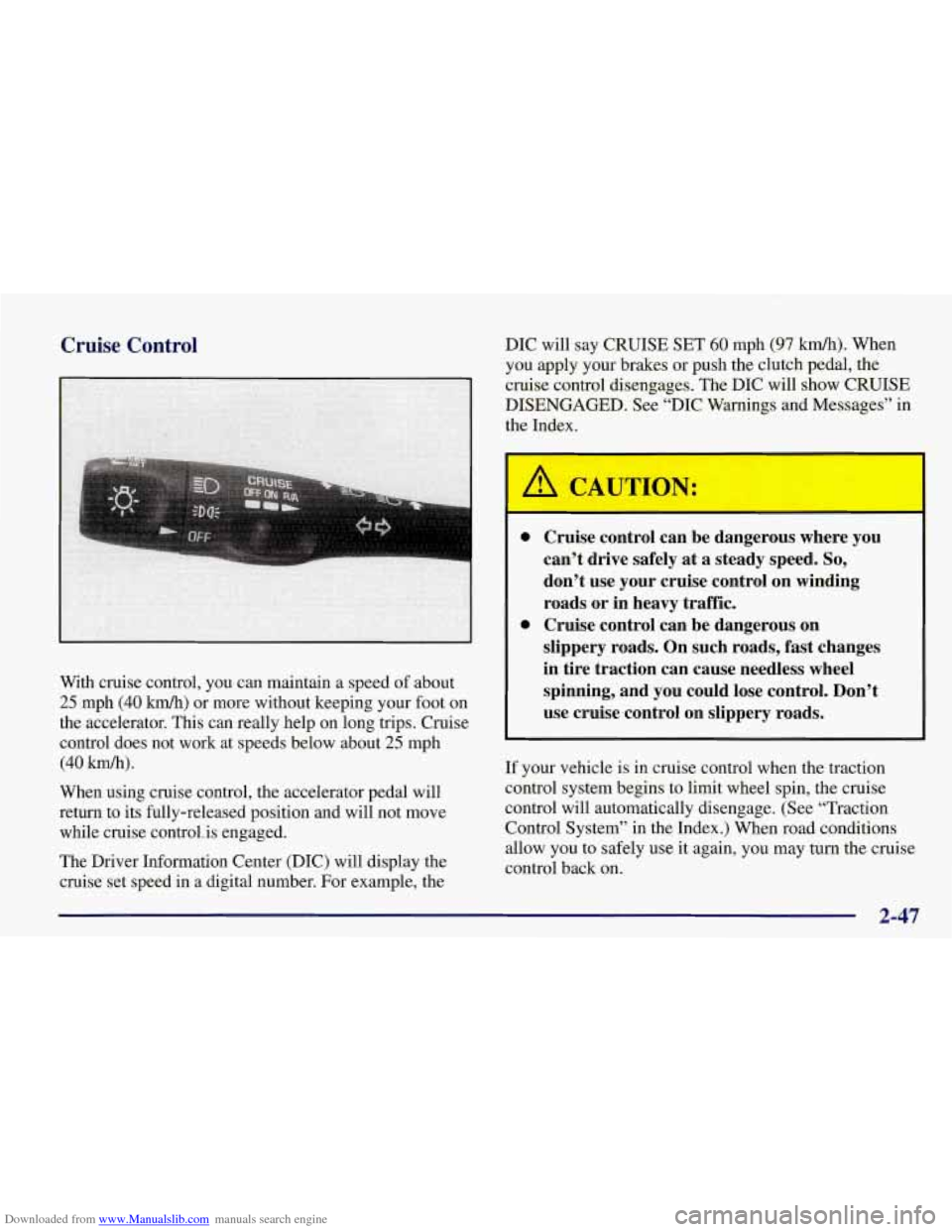
Downloaded from www.Manualslib.com manuals search engine Cruise Control
With cruise control, you can maintain a speed of about
25 mph (40 km/h) or more without keeping your foot on
the accelerator. This can really help on long trips. Cruise
control does not work at speeds below about
25 mph
(40 km/h).
When using cruise control, the accelerator pedal will
return to its fully-released position and will not move
while cruise control. is engaged.
The Driver Information Center (DIC) will display the
cruise set speed in
a digital number. For example, the DIC will
say CRUISE SET
60 mph (97 km/h). When
you apply your brakes or push the clutch pedal, the
cruise control disengages. The DIC will show CRUISE
DISENGAGED. See “DIC Warnings and Messages” in
the Index.
Cruise control can be dangerous where you
can’t drive safely
at a steady speed. So,
don’t use your cruise control on winding
roads or in heavy traffic.
Cruise control can be dangerous on
slippery roads. On such roads, fast changes
in tire traction can cause needless wheel
spinning, and you could lose control. Don’t
use cruise control on slippery roads.
If your vehicle is in cruise control when the traction
control system begins to limit wheel spin, the cruise
control will automatically disengage. (See “Traction
Control System” in the Index.) When road conditions
allow you to safely use it again, you may turn the cruise
control back
on.
2-47
Page 134 of 378
Downloaded from www.Manualslib.com manuals search engine Traction Control System (TCS) Light
Engine Coolant Temperature Gage
I
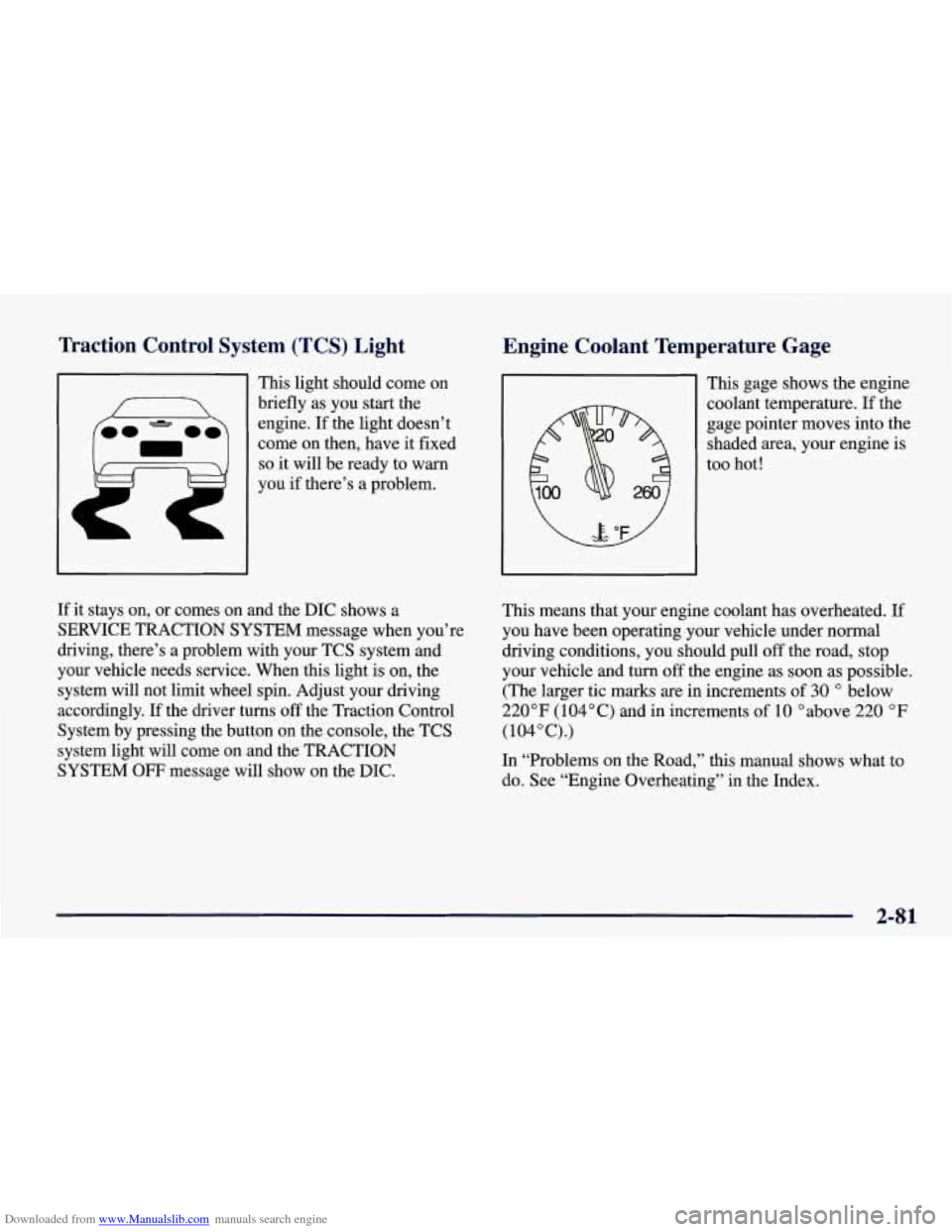
This light should come on
briefly as you start the
engine. If the light doesn’t
come on then, have it fixed
so it will be ready to warn
you if there’s a problem. This gage shows
the engine
coolant temperature. If the
gage pointer moves into the
shaded area, your engine is
too hot!
If it stays on, or comes on and the DIC shows a
SERVICE TRACTION SYSTEM message when you’re
driving, there’s a problem with your TCS system and
your vehicle needs service. When this light is on, the
system will not limit wheel spin. Adjust your driving
accordingly. If the driver
turns off the Traction Control
System by pressing the button on the console, the TCS
system light will come on and the TRACTION
SYSTEM
OFF message will show on the DIC. This means that your engine coolant has overheated.
If
you have been operating your vehicle under normal
driving conditions, you should pull
off the road, stop
your vehicle and turn
off the engine as soon as possible.
(The larger tic marks are in increments
of 30 O below
220°F (104°C) and in increments of 10 Oabove 220 OF
(104”C).)
In “Problems on the Road,” this manual shows what to do. See “Engine Overheating’’ in the Index.
2-81