Page 207 of 404

A CAUTION:
Do not load your vehicle any heavier than the
GVWR, or either the maximum front or rear
GAWR.
If you do, parts on your vehicle can
break, or it can change the way your vehicle
handles. These could cause you to lose control.
Also, overloading can shorten the life of
your vehicle.
I NOTICE:
Your warranty does not cover parts or
components that
fail because of overloading.
A CAUTION:
Things you put inside your vehicle can strike and
injure people in
a sudden stop or turn, or in
a crash.
Put things in the trunk of your vehicle. In a
trunk, put them as far forward as you can.
Try to spread the weight evenly.
Never stack heavier things, like suitcases,
inside the vehicle
so that some of them are
above the tops
of the seats.
Don’t leave an unsecured child restraint in
your vehicle.
When you carry something inside the
vehicle, secure it whenever you can.
If you put things inside your vehicle- like suitcases,
tools, packages,
or anything else ~ they will go as fast
as the vehicle goes.
If you have to stop or turn quickly,
or if there is a crash, they’ll keep going.
Electronic Level Control
This feature keeps the rear of your vehicle level as the
load changes. It
is automatic -- you don’t need to
adjust anything.
Page 212 of 404

Trailer Brakes
Does your trailer have its own brakes?
Be sure to read and follow the instructions for the trailer
brakes
so you’ll be able to install, adjust and maintain
them properly.
Because you have anti-lock brakes, do not try
to tap into
your vehicle’s brake system. If you do, both brake
systems won’t work well, or at all.
Driving with a Trailer
Towing a trailer requires a certain amount of experience.
Before setting out for the open road, you’ll want to get
to know your rig. Acquaint yourself with the feel of
handling and braking with the added weight of the
trailer. And always keep in mind that the vehicle you are
driving is now a good deal longer and not nearly as
responsive as your vehicle is by itself.
Before you start, check the trailer hitch and platform
(and attachments), safety chains, electrical connector,
lamps, tires and mirror adjustment. If the trailer has
electric brakes, start your vehicle and trailer moving and
then apply the trailer brake controller by hand
to be sure
the brakes are working. This lets
you check your
electrical connection at the same time. During your trip, check occasionally
to be sure that the
load is secure, and that the lamps and any trailer brakes
are still working.
Following Distance
Stay at least twice as far behind the vehicle ahead as you
would when driving your vehicle without a trailer. This
can help you avoid situations that require heavy braking
and sudden turns.
You’ll need more passing distance up ahead when
you’re towing a trailer. And, because you’re a good deal
longer, you’ll need to go much farther beyond the
passed vehicle before you can return to your lane.
Backing Up
Hold the bottom of the steenng wheel with one hand.
Then, to move the trailer to the left, just move that hand
to the left. To move the trailer to the right, move your
hand to the right. Always back up slowly and, if
possible, have someone guide you.
4-36
Page 225 of 404
To help avoid injury to you or others:
Never let passengers ride in a vehicle that is
Never tow faster than safe or posted speeds.
Never tow with damaged parts not
fully secured.
Never get under your vehicle after it has
been lifted
by the tow truck.
Always secure the vehicle on each side with
separate safety chains when towing it.
Never use J-hooks. Use T-hooks instead.
being towed.
5-9
Page 226 of 404

A vehicle can fall from a car carrier if it isn’t
adequately secured. This can cause
a collision,
serious personal injury and vehicle damage. The
vehicle should be tightly secured with chains or
steel cables before it is transported.
Don’t use substitutes (ropes, leather straps,
canvas webbing, etc.) that can be cut by sharp
edges underneath the towed vehicle. Always use
T-hooks inserted in the T-hook slots. Never use
J-hooks. They will damage drivetrain and
suspension components. When
your vehicle
is being towed, have the ignition key
turned to
OFF. The steering wheel should be clamped in
a straight-ahead position, with a clamping device
designed for towing service. Do not use the vehicle’s
steering column lock for this. The transaxle should be in
NEUTRAL (N) and the parking brake released.
Don’t have your vehicle towed on the drive wheels, unless you must.
If the vehicle must be towed on the
drive wheels, be sure to follow the speed and distance
restrictions later in this section or your transaxle will be
damaged.
If these limitations must be exceeded, then the
drive wheels have
to be supported on a dolly.
5-10
Page 228 of 404
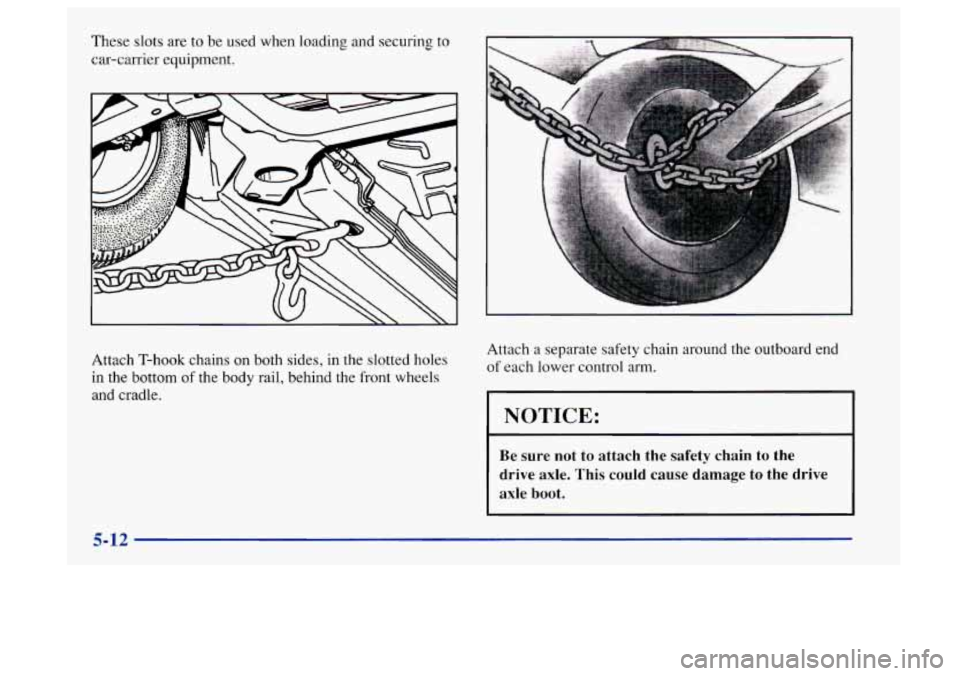
These slots are to be used when loading and securing to
car-carrier equipment.
Attach T-hook chains on both sides, in the slotted holes
in the bottom of the body rail, behind the front wheels
and cradle. Attach
a separate safety chain around
the outboard end
of each lower control arm.
NOTICE:
Be sure not to attach the safety chain to the
drive axle. This could cause damage to the drive
axle boot.
--
5-12
Page 243 of 404
Removing the Flat Tire and Installing the Spare Tire
1. Position the wheel wrench securely over the wheel
nuts to loosen, but don’t remove them.
2. Attach the wheel wrench to the bolt on the end of the
jack to create a jack handle.
3. Turn the wheel wrench clockwise by hand to raise
the jack head a few inches.
5-27
Page 258 of 404
The fuel door can be opened
manually in case
of an
electrical power failure. To
do
so, first open the trunk.
The release mechanism
is
on the driver’s side of the
vehicle, at the top of
the
trunk compartment. Pull the
tab toward you to release
the fuel door.
I NOTICE:
Prying on a locked fuel filler door could damage
it. Use the remote fuel
door manual release
located in the trunk.
While refueling, hang the cap inside the fuel door. Twist
it clockwise to secure
it, if necessary.
To take
off the cap, turn it slowly to the left
(counterclockwise).
6-6
Page 284 of 404

Battery
Every new Aurora has a Delco Freedom@ battery. You
never have to add water to one
of these. When it’s time
for a new battery, we recommend a Delco Freedom
battery. Get one that has the replacement number shown
on the original battery’s label.
The battery
is located under the rear seat cushion. To
access the battery,’ see “Removing the Rear Seat
Cushion”
in the Index. You don’t need to access the
battery to jump start your vehicle. See “Jump Starting”
in the Index.
A battery that isn’t properly vented can let sulfuric
acid fumes into the
area under the rear seat
cushion. These fumes can damage your rear seat
safety belt systems. You may not be able to see
this
damage, and the safety belts might not provide the
protection needed in
a crash. If a replacement
battery
is ever needed, it must be vented in the
same manner
as the original battery. Always make
sure that the vent hose
is properly reattached
before reinstalling the seat cushion.
To be sure the vent hose (A) is properly attached, the
vent hose connectors
(B) must be securely reattached to
the vent outlets
(C) on each side of the battery, and the
vent assembly grommet
(D) must be secured to the floor
pan
(E).
6-32