Page 118 of 1600

FRONT WHEEL DRIVE 4C1-55
Important Operations
1. Bolt
Shift the transfer lever to the “2H” position and move the
vehicle forward and rearward about one meter.
Remove the 14 mm hex bolts.
8. Hub Nut
Wrench : 5-8840-2117-0
(J-36827)
Refer to Section 5 “Brake” for disc brake
caliper removal procedure9. Hub and Disc Assembly
Before disassembly, remove the disc brake caliper assembly
and hang it on the frame with wires.
10.Outer Bearing and Outer Race
12.Inner Bearing and Outer Race
(1) Remove the outer bearing from the hub with fingers. The
inner bearing will remain in the hub and may be removed
after prying out the inner bearing lip seal assembly.
(2) Remove the outer race by driving out the race from the hub
with a brass drift inserted behind the race in the notches in
the hubs.
If necessary, replace the wheel pin in the following manner.
13.Bolt
(1) Apply a scribe mark to disc to hub.
(2) Clamp the hub and disc assembly in a vise using protective
pads and remove the 6 disc to hub retaining bolts.
Page 125 of 1600
4C1-62 FRONT WHEEL DRIVE
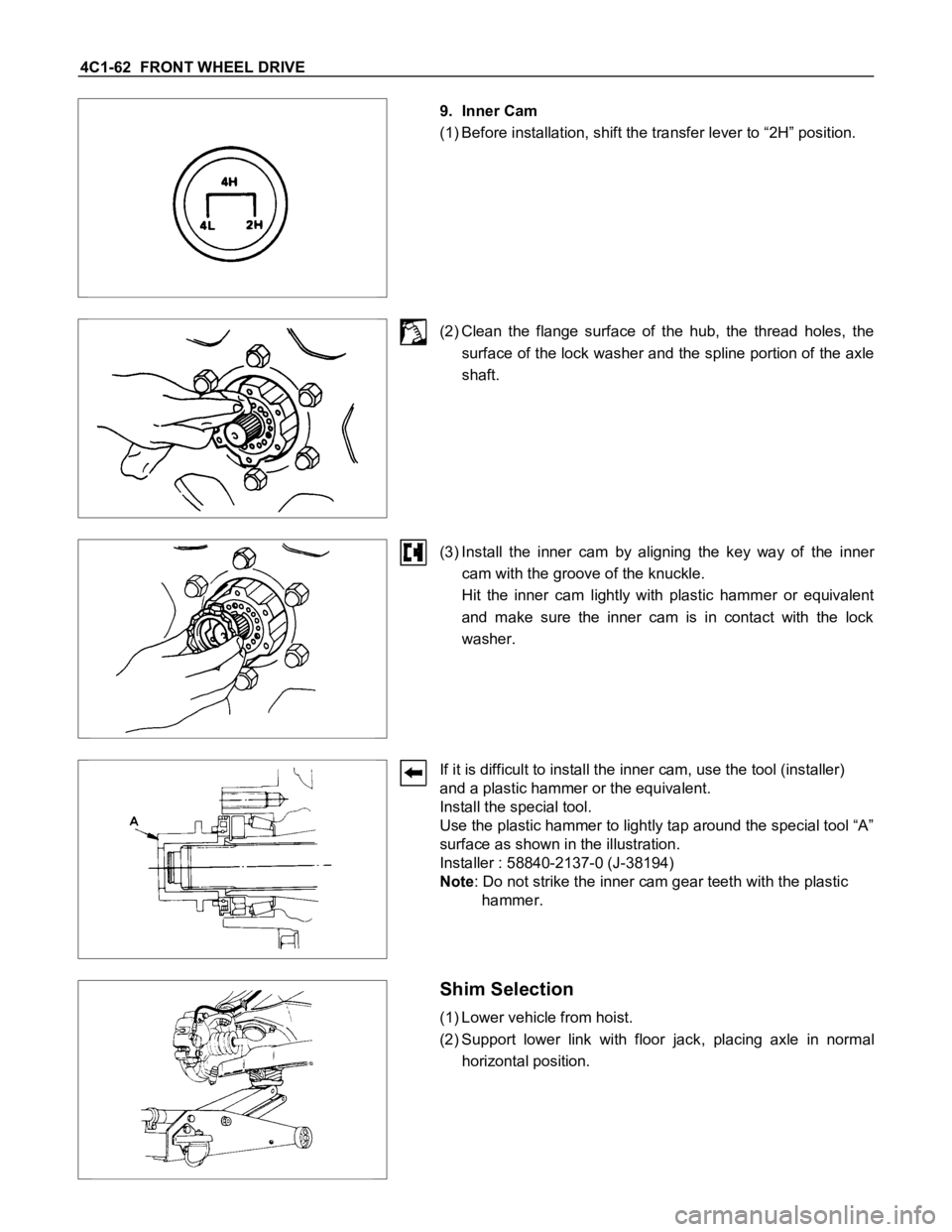
9. Inner Cam
(1) Before installation, shift the transfer lever to “2H” position.
(2) Clean the flange surface of the hub, the thread holes, the
surface of the lock washer and the spline portion of the axle
shaft.
(3) Install the inner cam by aligning the key way of the inner
cam with the groove of the knuckle.
Hit the inner cam lightly with plastic hammer or equivalent
and make sure the inner cam is in contact with the lock
washer.
If it is difficult to install the inner cam, use the tool (installer)
and a plastic hammer or the equivalent.
Install the special tool.
Use the plastic hammer to lightly tap around the special tool “A”
surface as shown in the illustration.
Installer : 58840-2137-0 (J-38194)
Note: Do not strike the inner cam gear teeth with the plastic
hammer.
Shim Selection
(1) Lower vehicle from hoist.
(2) Support lower link with floor jack, placing axle in normal
horizontal position.
Page 130 of 1600
FRONT WHEEL DRIVE 4C1-67
Important Operations
1. Bolt
Before removal, shift transfer lever into “2H” position and set
free wheeling hub knob into “FREE” position.
6. Hub Nut
Wrench : 5-8840-2117-0
(J-36827)
Refer to Section 5 “Brake” for disc brake
caliper removal procedure.7. Hub and Disc Assembly
Before disassembly, remove the disc brake caliper assembly
and hang it on the frame with wires.
11.Clutch Assembly
While pushing follower knob, turn clutch assembly clockwise
and then remove clutch assembly from knob.
16.Retaining Spring
Remove retaining spring from clutch assembly by turning it
counterclockwise.
Page 150 of 1600
FRONT WHEEL DRIVE 4C1-87
7. AUTOMATIC LOCKING FREE WHEEL HUB
(1) DOES NOT LOCK OR LOCKS ONLY ON ONE SIDE
Note :
1. Stop the vehicle
2. Shift the transfer lever to 4H or 4L
3. Now start driving the vehicle and the
hubs will lock automatically.
4. Once the hubs are locked, they will
remain locked, even if the transfer lever
is shifted from 4L or 4H into 2H, as long
as the vehicle travels in a same
direction.
Checkpoint Trouble Cause Countermeasure
ReplaceStill will not lock NGTry locking procedure once
more
(2) DOES NOT FREEWHEEL OR FREEWHEELS ONLY TO ONE SIDE
Note :
Freewheel operation
1. Stop the vehicle
2. Shift the transfer lever to 2H
3. Back up the vehicle for three or four feet;
this will disengage the front differential.
Checkpoint Trouble Cause Countermeasure
ReplaceStill will not freewheel
Driver the vehicle for five
minutes and then try the
freewheel procedure again
Still will not freewheel NGTry freewheel procedure once
more
Page 151 of 1600
4C1-88 FRONT WHEEL DRIVE
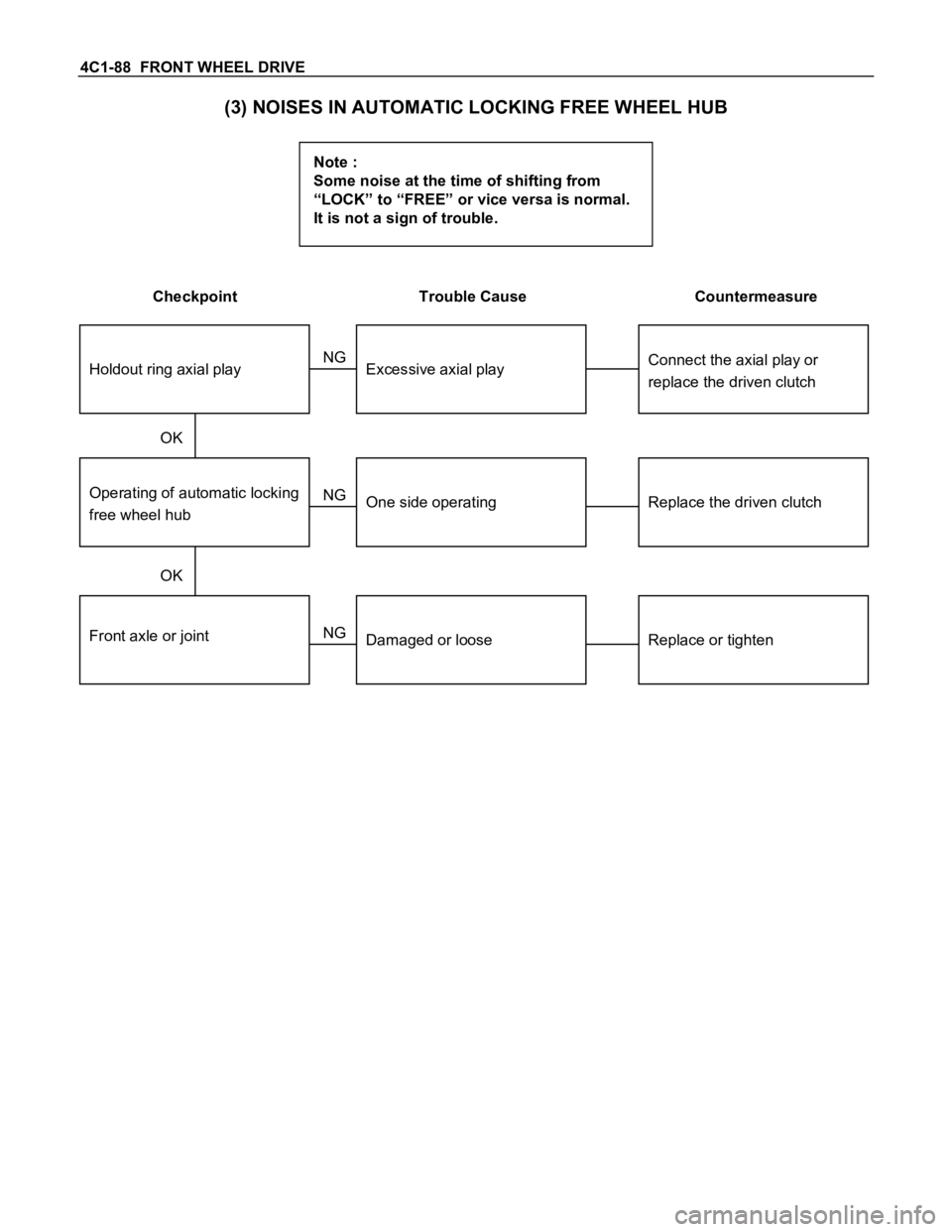
(3) NOISES IN AUTOMATIC LOCKING FREE WHEEL HUB
Note :
Some noise at the time of shifting from
“LOCK” to “FREE” or vice versa is normal.
It is not a sign of trouble.
Checkpoint Trouble Cause Countermeasure
Operating of automatic locking
free wheel hubReplace the driven clutchOne side operating
Connect the axial play or
replace the driven clutchExcessive axial play
NG NG
OKHoldout ring axial play
Front axle or jointReplace or tightenDamaged or loose NG OK
Page 481 of 1600
CAB 10-27
Important Operations
1. Center Console Assembly
Remove shift knob and 2 fixing screws (front side).
Open the grommet and remove 2 fixing screws (rear
side).
2. ECM cover
3. Glove Box
Remove 2 fixing screws and pulling the handle.
4. Glove Box Cover
Remove 4 fixing screws and pull the cover toward you
and remove the clips at 2 positions.
5. Instrument Panel Passenger Lower Cover Assembly
Remove 3 fixing screws and 1 clip.
6. Instrument Panel Driver Lower Cover Assembly
Remove the engine hood opener 2 fixing screws and 6
fixing screws.
Disconnect the connector of the illumination.
7. Lower Cluster Assembly
Remove 3 fixing clips.
8. Meter Cluster Assembly
Remove 3 fixing screws, 7 clips and switch connectors.
9. Instrument Panel Lower Center Cover Assembly
Remove 7 fixing screws and disconnect the connector of
the cigarette lighter.
Page 524 of 1600
CAB 10-27
Important Operations
1. Center Console Assembly
Remove shift knob and 2 fixing screws (front side).
Open the grommet and remove 2 fixing screws (rear
side).
2. ECM cover
3. Glove Box
Remove 2 fixing screws and pulling the handle.
4. Glove Box Cover
Remove 4 fixing screws and pull the cover toward you
and remove the clips at 2 positions.
5. Instrument Panel Passenger Lower Cover Assembly
Remove 3 fixing screws and 1 clip.
6. Instrument Panel Driver Lower Cover Assembly
Remove the engine hood opener 2 fixing screws and 6
fixing screws.
Disconnect the connector of the illumination.
7. Lower Cluster Assembly
Remove 3 fixing clips.
8. Meter Cluster Assembly
Remove 3 fixing screws, 7 clips and switch connectors.
9. Instrument Panel Lower Center Cover Assembly
Remove 7 fixing screws and disconnect the connector of
the cigarette lighter.
Page 543 of 1600

CLUTCH 7C-3
GENERAL DESCRIPTION
HYDRAULIC CONTROL TYPE
HEC Engine Series4J Engine Series
6VD1
The clutch assembly consists of the pressure plate, the clutch cover, the diaphragm spring pivot pin and the driven
plate assembly.
The clutch pedal is connected to the shift block through the clutch shaft and the shift fork.
The driven plate assembly is installed between the flywheel and the pressure plate.
Diaphragm spring pressure holds the driven plate against flywheel and the pressure plate to provide the friction
necessary to engage the clutch.
Depressing the clutch pedal moves the shift fork against the shift block.
The shift block forces the release bearing against the diaphragm to overcome the force of the diaphragm spring and
separate the driven plate from the flywheel and pressure plate to disengage the clutch.
Except 6VD1 (3.2L) engine model, the conventional push-type clutch is used.
For 6VD1 (3.2L) engine model, the pull-type clutch is employed. The pull-type clutch is disengaged by pulling the
release lever (release bearing) to disengage the pressure plate.