Page 545 of 1600
CLUTCH 7C-5
SLAVE CYLINDER
MUA Series
MSG Series
4J Engine Series
6VD1 Engine Series
The slave cylinder converts hydraulic energy into mechanical energy.
Hydraulic fluid supplied by the master cylinder moves the slave cylinder piston to actuate the shift fork.
The mechanical energy produced by the slave cylinder is directly proportional to the diameters of the master
cylinder and the slave cylinder.
A bleeder screw is provided to bleed the slave cylinder.
Page 555 of 1600
CLUTCH 7C-15
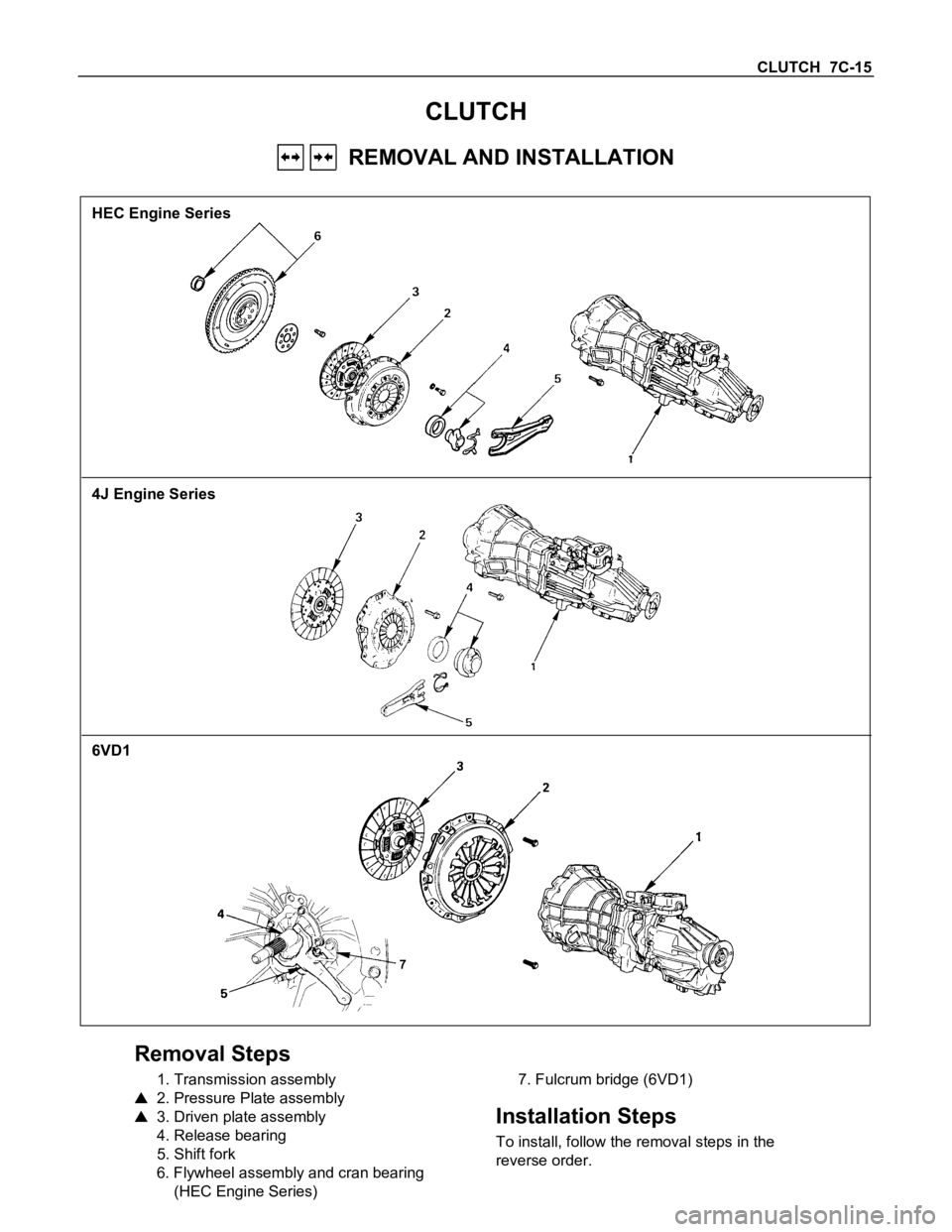
CLUTCH
REMOVAL AND INSTALLATION
HEC Engine Series
4J Engine Series
6VD1
Removal Steps
1. Transmission assembly
2. Pressure Plate assembly
3. Driven plate assembly
4. Release bearing
5. Shift fork
6. Flywheel assembly and cran bearing
(HEC Engine Series)7. Fulcrum bridge (6VD1)Installation Steps
To install, follow the removal steps in the
reverse order.
Page 557 of 1600

CLUTCH 7C-17
6VD15. Shift Fork (6VD1)
(1) Remove the snap pin.
(2) Remove the shift fork pin and shift fork from the fulcrum
bridge.
6VD17. Fulcrum Bridge (6VD1)
(1) Remove the fulcrum bridge bolts.
(2) Remove the fulcrum bridge from the transmission case.
Important Operations - Installation
Follow the removal procedure in reverse order to perform the
installation procedure.
Pay careful attention to the important points during the
installation procedure.
3. Driven plate Assembly (HEC Engine Series)
2. Clutch Pressure Plate Assembly (HEC Engine Series)
(1) Clean the flywheel surface.
(2) Clean the facing surface.
(3) Use the clutch pilot aligner
1 to install the driven plate
assembly
2 to the flywheel
3.
Clutch Pilot Aligner : 5-8840-2634-0
(4) Clean the pressure plate surfaces.
(5) Align the pressure plate assembly
4 with the flywheel
knock pin
5.
(6) Install the pressure plate assembly to the flywheel.
(7) Tighten the clutch cover bolts a little at a time in the
numerical order shown in the illustration.
Clutch Cover Bolt Torque N
m (kgfm/lbft)
17.6
4.9 (1.8 0.5/13.0 3.6)
Page 558 of 1600
7C-18 CLUTCH
8. Remove the clutch pilot aligner.
Note:
Do not strike the clutch pilot aligner with a hammer to
remove it.
6VD17. Fulcrum Bridge (6VD1)
(1) Install the fulcrum bridge to the transmission case.
(2) Tighten three fulcrum bridge bolts to the specified torque.
Fulcrum Bridge Bolt Torque N
m (kgm/lbft)
39 (3.9/28)
6VD15. Shift Fork (6VD1)
(1) Apply molybdenum disulfide contained type grease to the
pin hole inner circumferences and thrust surfaces.
(2) Attach the shift fork to the fulcrum bridge and insert the pin
from below of the fulcrum bridge.
(3) Install the washer and snap pin.
6VD14. Release Bearing (6VD1)
(1) Apply molybdenum disulfide contained type grease to the
areas shown in illustration.
Page 563 of 1600
CLUTCH 7C-23
Release Bearing Replacement
Removal (Except 6VD1)
Use the bearing puller and the adapter to remove the release
bearing.
Bearing Puller : 5-8840-0013-0 (J-22888)
Adapter : 5-8840-0124-0 (J-2241-11)
Release Bearing Installation (Except 6VD1)
1. Set the release bearing to the shift block bearing fitting
surfaces.
The release bearing must be perfectly horizontal.
2. Use a bench press to fit the release bearing to the shift
block.
Install the parts as illustrated after applying wheel bearing
grease or multi-purpose type grease (NLGI No.2 or No.3).
6VD1Release Bearing (6VD1)
1. Visually check the release bearing for excessive play, noise
and breakage.
If any of these conditions are discovered, the release
bearing must be replaced.
6VD1NOTE:
When replacing the release bearing, replace both the
wedge collar and wire ring at the same time.
Page 564 of 1600

7C-24 CLUTCH
Wedge Collar (6VD1)
1. Visually check the surfaces of the wedge collar making
contact with the release bearing for excessive wear and
damage.
2. Replace any exhibiting excessive wear damage.
Shift Fork (Except 6VD1)
1. Visually inspect the surfaces of the shift fork making contact
with the shift block for excessive wear and damage.
2. Remove any minor stepping or abrasion from the shift block
with an oil stone.
Replace any exhibiting excessive wear or damage.
3. Apply multi-purpose type grease (NLGI No.2 or No.3) to
area.
6VD1Shift Fork (6VD1)
1. Visually check the surfaces of the shift fork making contact
with the release bearing for excessive wear and damage.
2. Remove any minor stepping or abrasion from shift fork with
an oil stone.
Replace any exhibiting excessive wear of damage.
DRIVEN PLATE ASSEMBLY
1. Visually inspect the torsion spring
1 for looseness,
breakage, and weakening.
If any of these conditions are discovered, the driven plate
assembly must be replaced.
2. Visually inspect the facing surfaces
2 for cracking and
excessive scorching.
Visually inspect the facing surfaces for the presence of oil or
grease.
If any of these conditions are discovered, the facing must be
cleaned or replaced.
Page 582 of 1600
7C-42 CLUTCH
1. CLUTCH SLIPPAGE
Checkpoint Trouble Cause Countermeasure
Adjust the push rod playNo push rod play in the master
cylinder NG
Clean the related parts and/or
replace the facing
Replace the transmission front
cover oil seal
Clean the related parts and/or
replace the facing
Repair or replace the
transmission front cover
Adjust the push rod play
Defective transmission front
cover oil seal
Continued on the next page
Grease or oil adhering to the
facingToo much grease
Transmission front cover
unevenly worn
No push rod play in the slave
cylinder
Clean and grease the shift
blockShift blockInsufficient grease on the front
cover contact surfaces
NG NG NG NG NG
OK
OK
Clutch pedal free play
OK