1997 GMC SIERRA stop start
[x] Cancel search: stop startPage 198 of 436
0
0
0
0
Ease up on your speed as you approach the top of
the hill.
Attach a flag
to the vehicle to make you more visible
to approaching traffic on trails or hills.
Sound the horn as you approach the top of
the hill to
let opposing traffic know you’re there.
Use your headlamps even during the day. They make
you more visible
to oncoming traffic.
J
Driving to the top (crest) of a hill at full speed can
cause an accident. There could be a drop-off,
embankment,
cliff, or even another vehicle. You
could be seriously injured or killed.
As you near
the top
of a hill, slow down and stay alert.
@ What should I do if my vehicle stalls, or is about
A: If this happens, there are some things you should
to stall, and I can’t make it up the hill?
do, and there are some things you must not do.
First, here’s what you
should do:
Push the brake pedal to stop the vehicle and keep it
from rolling backwards. Also, apply
the parking brake.
0 If your engine is still running, shift the transmission
to REVERSE
(R), release the parking brake, and
slowly back down the
hill in REVERSE (R).
If your engine has stopped running, you’ll need to
restart it.
With the brake pedal depressed and the
parking brake still applied, shift the transmission
to
PARK (P) (or, shift to NEUTRAL (N) if your
vehicle has a manual transmission) and restart
the
engine. Then, shift to REVERSE (R), release the
parking brake,
and slowly back down the hill as
straight as possible in REVERSE
(R).
4-20
ProCarManuals.com
Page 201 of 436
Am I likely to stall when going downhill?
A: It’s much more likely to happen going uphill. But if
it happens going downhill, here’s what to do.
Stop your vehicle by applying the regular brakes.
Apply the parking brake.
Shift to PARK (P) (or to NEUTRAL (N) with the manual
transmission) and, while still braking, restart
the engine.
Shift back to a low gear, release the parking brake,
and drive straight down.
e If the engine won’t start, get out and get help.
Driving Across an Incline
Sooner or later, an off-road trail will probably go across
the incline of a hill. If this happens, you have to decide
whether to try to drive across the incl.ine. Here are some
things to consider:
A hill that can be driven straight up or down may
be too steep to drive across. When you go straight
up or down
a hill, the length of the wheel base (the
distance from the front wheels to the rear wheels)
reduces
the likelihood the vehicle will tumble end
over end. But when you drive across an incline, the
much more narrow track width (the distance between
the left and right wheels) may not prevent the vehicle
from tilting and rolling over. Also, driving across
an
e
e
incline puts more weight on the downhill wheels.
This could cause a downhill slide or
a rollover.
Surface conditions can be a problem
when you drive
across
a hill. Loose gravel, muddy spots, or even wet
grass can cause your tires
to slip sideways, downhill.
If the vehicle slips sideways, it can hit something
that will trip it (a rock, a rut, etc.) and roll over.
Hidden obstacles can make the steepness of
the
incline even worse. If you drive across a rock with
the uphill wheels, or if the downhill wheels drop into
a
rut or depression, your vehicle can tilt even more.
For reasons like these, you need to decide carefully
whether
to try to drive across an incline. Just because the
trail
goes across the incline doesn’t mean you have to
drive it. The last vehicle to
try it might have rolled over.
Driving across an incline that’s too steep will
make your vehicle roll over.
You could be
seriously injured or killed.
If you have any doubt
about the steepness
of the incline, don’t drive
across it. Find another route instead.
ProCarManuals.com
Page 202 of 436
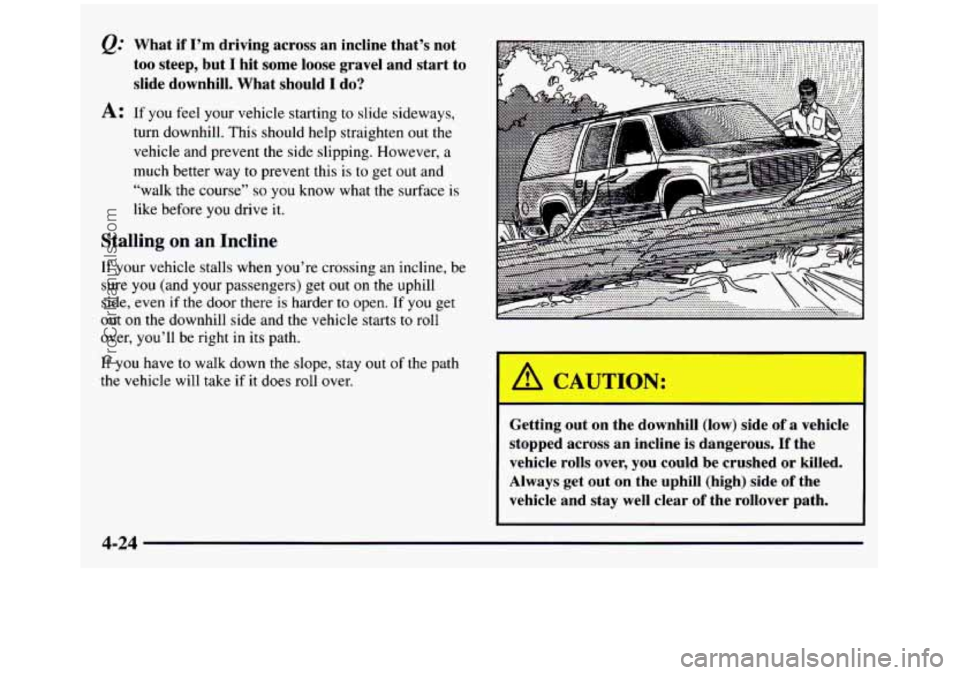
Qt What if I’m driving across an incline that’s not
too steep, but I hit some loose gravel and start to
slide downhill. What should I do?
A: If you feel your vehicle starting to slide sideways,
turn downhill. This should help straighten
out the
vehicle and prevent the side slipping. However,
a
much better way to prevent this is to get out and
“walk the course”
so you know what the surface is
like before you drive it.
Stalling on an Incline
If your vehicle stalls when you’re crossing an incline, be
sure
you (and your passengers) get out on the uphill
side, even
if the door there is harder to open. If you get
out on the downhill side and the vehicle starts to roll
over, you’ll be right in its path.
If you have to walk down the slope, stay
out of the path
the vehicle will take if it does roll over.
Getting out on the downhill (low) side of
a vehicle
stopped across an incline
is dangerous. If the
vehicle rolls over,
you could be crushed or killed.
Always get out on the uphill (high) side of the
vehicle and stay well clear of the rollover path.
ProCarManuals.com
Page 204 of 436
If the water isn’t too deep, then drive through it slowly.
At fast speeds, water splashes on your ignition system
and your vehicle can stall. Stalling can also occur
if you
get your tailpipe under water. And, as long as your
tailpipe is under water, you’ll never be able
to start your
engine. When you go through water, remember that when
your brakes get wet, it may
take you longer to stop.
ki CAU IN:
Driving through rushing water can be dangerous.
Deep water can sweep your vehicle downstream
and you and your passengers could drown.
If it’s
only shallow water, it can still wash away the
ground from under your tires, and
you could lose
traction and roll the vehicle
over. Don’t drive
through rushing water.
After Off-Road Driving
Remove any brush or debris that has collected on
the underbody, chassis or under the hood. These
accumulations can be
a fire hazard.
After operation
in mud or sand, have the brake linings
cleaned and checked. These substances can cause
glazing and
uneven braking. Check the body structure,
steering, suspension, wheels, tires and exhaust system
for damage. Also, check
the fuel lines and cooling
system for any leakage.
Your vehicle will require more frequent service due to
off-road use. Refer to the Maintenance Schedule for
additional information.
See “Driving Through Water”
in the Index for more
information on driving through water.
4-26
ProCarManuals.com
Page 207 of 436
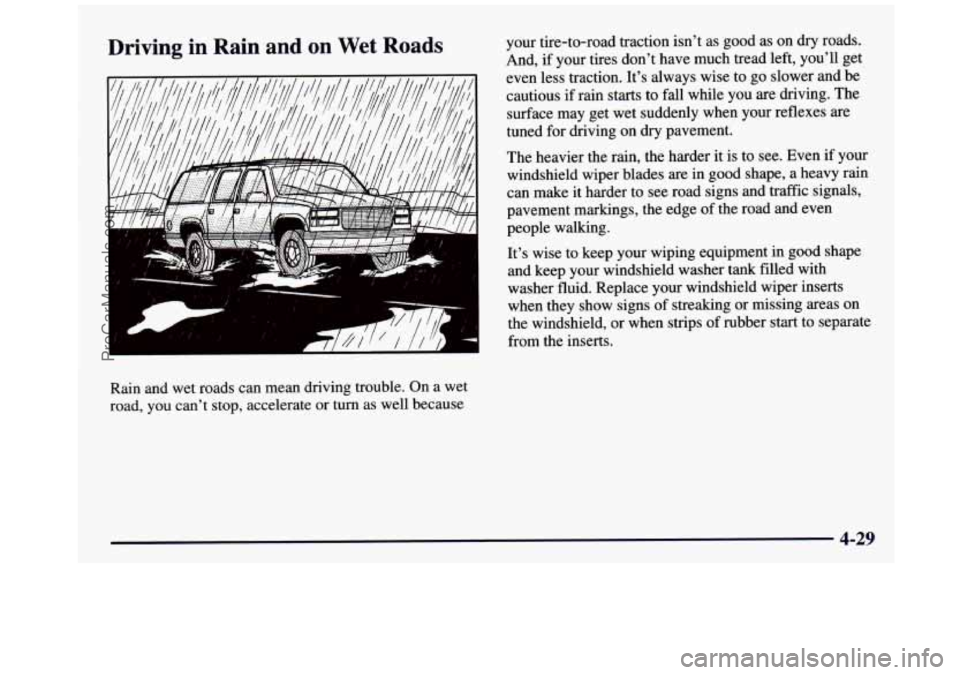
Driving in Rain and on Wet Roads
4
4 I- -
your tire-to-road traction isn’t as good as on dry roads.
And,
if your tires don’t have much tread left, you’ll get
even less traction. It’s always wise to go slower and be
cautious
if rain starts to fall while you are driving. The
surface may get wet suddenly when your reflexes
are
tuned for driving on dry pavement.
The heavier the rain, the harder
it is to see. Even if your
windshield wiper blades are in good shape, a heavy rain
can make it harder to see road signs and traffic signals,
pavement markings, the edge of the road and even
people walking.
It’s wise to keep your wiping equipment in good shape
and keep your windshield washer tank filled with
washer fluid. Replace your windshield wiper inserts
when they show signs of streaking or missing areas on
the windshield,
or when strips of rubber start to separate
from the inserts.
Rain and wet roads can mean driving trouble. On a wet
road, you can’t stop, accelerate or turn as well because
4-29
ProCarManuals.com
Page 212 of 436
When you want to leave the freeway, move to the proper
lane well in advance. If you miss your exit, do not,
under any circumstances,
stop and back up. Drive on
to the next exit.
The exit ramp can be curved, sometimes quite sharply.
The exit speed is usually posted.
Reduce your speed according to your speedometer, not
to your sense of motion. After driving for any distance
at higher speeds,
you may tend to think you are going
slower than you actually are.
Before Leaving on a Long Trip
Make sure you’re ready. Try to be well rested. If you
must
start when you’re not fresh -- such as after a day’s
work
-- don’t plan to make too many miles that first part
of the journey. Wear comfortable clothing and shoes you
can easily drive in.
Is your vehicle ready for a long trip?
If you keep it
serviced and maintained, it’s ready to go. If it needs
service, have
it done before starting out. Of course,
you’ll find experienced and able service experts in
GM
dealerships all across North America. They’ll be ready
and willing to help
if you need it.
Here are some things you can check before a trip:
0
0
0
0
a
Windshield Washer Fluid: Is the reservoir full?
Are all windows clean inside and outside?
Wiper Blades: Are they in good shape?
Fuel, Engine Oil, Other Fluids: Have you checked
all levels?
Lamps: Are they all working? Are the lenses clean?
Tires: They are vitally important to a safe,
trouble-free trip. Is the tread good enough for
long-distance driving? Are the tires all inflated to the
recommended pressure?
Weather Forecasts: What’s the weather outlook
along your route? Should you delay your trip a short
time to avoid
a major storm system?
Maps: Do you have up-to-date maps?
ProCarManuals.com
Page 234 of 436
Turn Signals When Towing a Trailer
The arrows on your instrument panel will flash
whenever you signal a turn or lane change. Properly
hooked up, the trailer lamps will also flash, telling other
drivers you’re about to turn, change lanes or stop.
When towing a trailer, the arrows on your instrument
panel will flash for turns even if the bulbs
on the trailer
are burned out. Thus, you may think drivers behind you
are seeing your signal when they are not. It’s important
to check occasionally to be sure the trailer bulbs are
still working.
Driving On Grades
Reduce speed and shift to a lower gear before you start
down a long or steep downgrade. If you don’t shift
down,
you might have to use your brakes so much that
they would get hot and no longer work well.
On
a long uphill grade, shift down and reduce your
speed
to around 45 mph (70 km/h) to reduce the
possibility of engine and transmission overheating. If you have an automatic transmission, you can tow
in
AUTOMATIC OVERDRIVE (a). You
may want to
shift the transmission to THIRD
(3) or, if necessary, a
lower gear selection if the transmission shifts too often
(e.g., under heavy loads and/or hilly conditions).
If you have a manual transmission and you are towing a
trailer, it’s better not to use
FIFTH (5) gear. Just drive in
FOURTH
(4) gear (or, as you need to, a lower gear).
When towing at high altitude on steep uphill grades,
consider the following: Engine coolant will boil at a
lower temperature than at normal altitudes. If
you turn
your engine off immediately after towing at high altitude
on steep uphill grades, your vehicle may show signs
similar to engine overheating.
To avoid this, let the
engine run while parked (preferably on level ground)
with the automatic transmission in
PARK (P) (or the
manual transmission out of gear and the parking brake
applied) for a few minutes before turning the engine
off.
If you do get the overheat warning, see “Engine
Overheating”
in the Index.
4-56
ProCarManuals.com
Page 236 of 436
When You Are Ready to Leave After
Parkine
on a Hill
1. Apply your regular brakes and hold the pedal down
while you:
Start your engine;
Shift into a gear; and
Release the parking brake.
2. Let up on the brake pedal.
3. Drive slowly until the trailer is clear of the chocks.
4. Stop and have someone pick up and store the chocks.
Maintenance When Trailer Towing
Your vehicle will need service more often when you’re
pulling a trailer. See the Maintenance Schedule for more
on this. Things that are especially important
in trailer
operation are automatic transmission fluid (don’t
overfill), engine oil, axle lubricant, belt, cooling system
and brake adjustment. Each
of these is covered in this
manual, and
the Index will help you find them quickly.
If you’re trailering, it’s a good idea to review these
sections before you start your trip.
Trailer Wiring Harness
A seven-wire harness is stored under the rear end of
your vehicle, between
the frame rails. An electrical
connector will need to be installed at the trailer end of
the harness, by a qualified electrical technician. For
additional trailer wiring and towing information please
consult your
GM dealer. Securely attach the harness to
the trailer, then tape or strap
it to your vehicle’s frame
rail. Be sure you leave it loose enough
so the wiring
won’t bind or break when turning with the trailer, but
not
so loose that it drags on the ground. Store the
harness in its original position. Wrap the harness
together and tie
it neatly so it won’t be damaged. If you
tow
a trailer, your Center High-Mounted Stoplamp
(CHMSL) may not be properly visible from behind.
You
should select a trailer with a CHMSL on it or, if one is
not available, have one installed. See your
GM dealer
about how to connect your vehicle’s wiring
to a
trailer CHMSL.
Check periodically to see that all hitch nuts and bolts
are tight.
4-58
ProCarManuals.com