1997 CHEVROLET CORVETTE fuel type
[x] Cancel search: fuel typePage 239 of 356
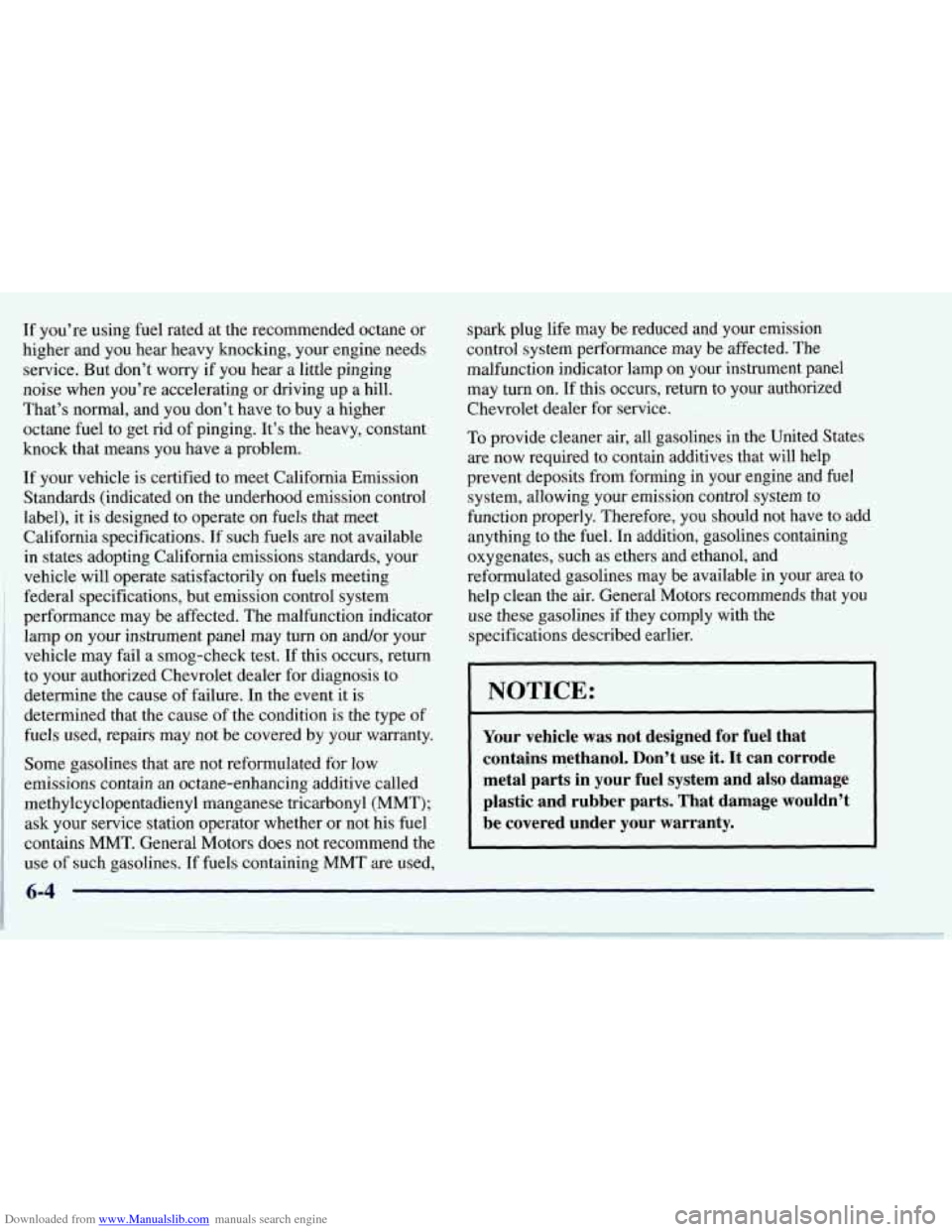
Downloaded from www.Manualslib.com manuals search engine If you’re using fuel rated at the recommended octane or
higher and you hear heavy knocking, your engine needs
service. But don’t worry if you hear a little pinging
noise when you’re accelerating or driving up a hill.
That’s normal, and you don’t have to buy a higher
octane fuel to get rid
of pinging. It’s the heavy, constant
knock that means you have a problem.
If your vehicle is certified to meet California Emission
Standards (indicated on the underhood emission control
label), it is designed to operate on fuels that meet
California specifications. If such fuels are not available
in states adopting California emissions standards, your
vehicle will operate satisfactorily on fuels meeting
federal specifications, but emission control system
performance may be affected. The malfunction indicator
lamp on your instrument panel may turn on and/or your
vehicle may fail a smog-check test.
If this occurs, return
to your authorized Chevrolet dealer for diagnosis to
determine the cause of failure.
In the event it is
determined that the cause
of the condition is the type of
fuels used, repairs may not be covered by your warranty.
Some gasolines that are not reformulated for low
emissions contain an octane-enhancing additive called
methylcyclopentadienyl manganese tricarbonyl (MMT);
ask your service station operator whether or not his fuel
contains MMT. General Motors does not recommend the
use of such gasolines.
If fuels containing MMT are used, spark
plug life may be reduced and your emission
control system performance may be affected. The
malfunction indicator lamp on your instrument panel
may turn on. If this occurs, return to your authorized
Chevrolet dealer for service.
To provide cleaner air, all gasolines in the United States
are now required to contain additives that will help
prevent deposits from forming in your engine and fuel
system, allowing your emission control system to
function properly. Therefore, you should
not have to add
anything to the fuel. In addition, gasolines containing
oxygenates, such as ethers and ethanol, and
reformulated gasolines may be available in your area to
help clean the air. General Motors recommends
that you
use these gasolines if they comply with the
specifications described earlier.
NOTICE:
Your vehicle was not designed for fuel that
I contains methanol. Don’t use it. It can corrode
~ metal parts in your fuel system and also damage
I plastic and rubber parts. That damage wouldn’t
1 be covered under your warranty.
6-4
Page 242 of 356
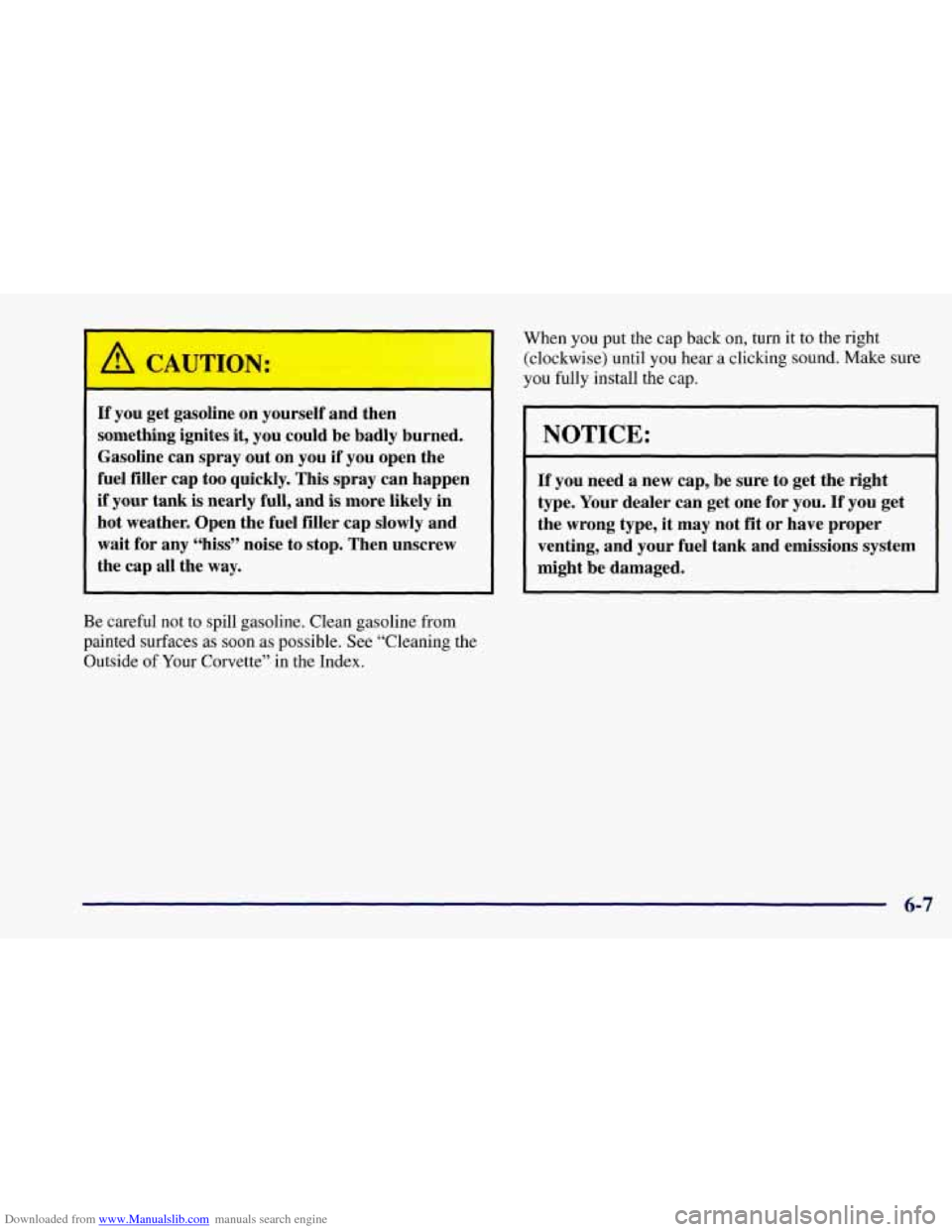
Downloaded from www.Manualslib.com manuals search engine If you get gasoline on yourself and then
something ignites
it, you could be badly burned.
Gasoline can spray out on you
if you open the
fuel filler cap too quickly. This spray can happen
if your tank is nearly full, and is more likely in
hot weather. Open the fuel filler cap slowly and
wait for any “hiss” noise to stop. Then unscrew
the cap all the way.
Be careful not to spill gasoline. Clean gasoline from
painted surfaces as soon as possible.
See “Cleaning the
Outside of Your Corvette” in the Index. When
you put
the cap back on, turn it to the right
(clockwise) until you hear a clicking sound. Make sure
you fully install the cap.
NOTICE:
If you need a new cap, be sure to get the right
type. Your dealer can get one for you.
If you get
the wrong type, it may not
fit or have proper
venting, and your fuel tank and emissions system
might be damaged.
6-7
Page 279 of 356
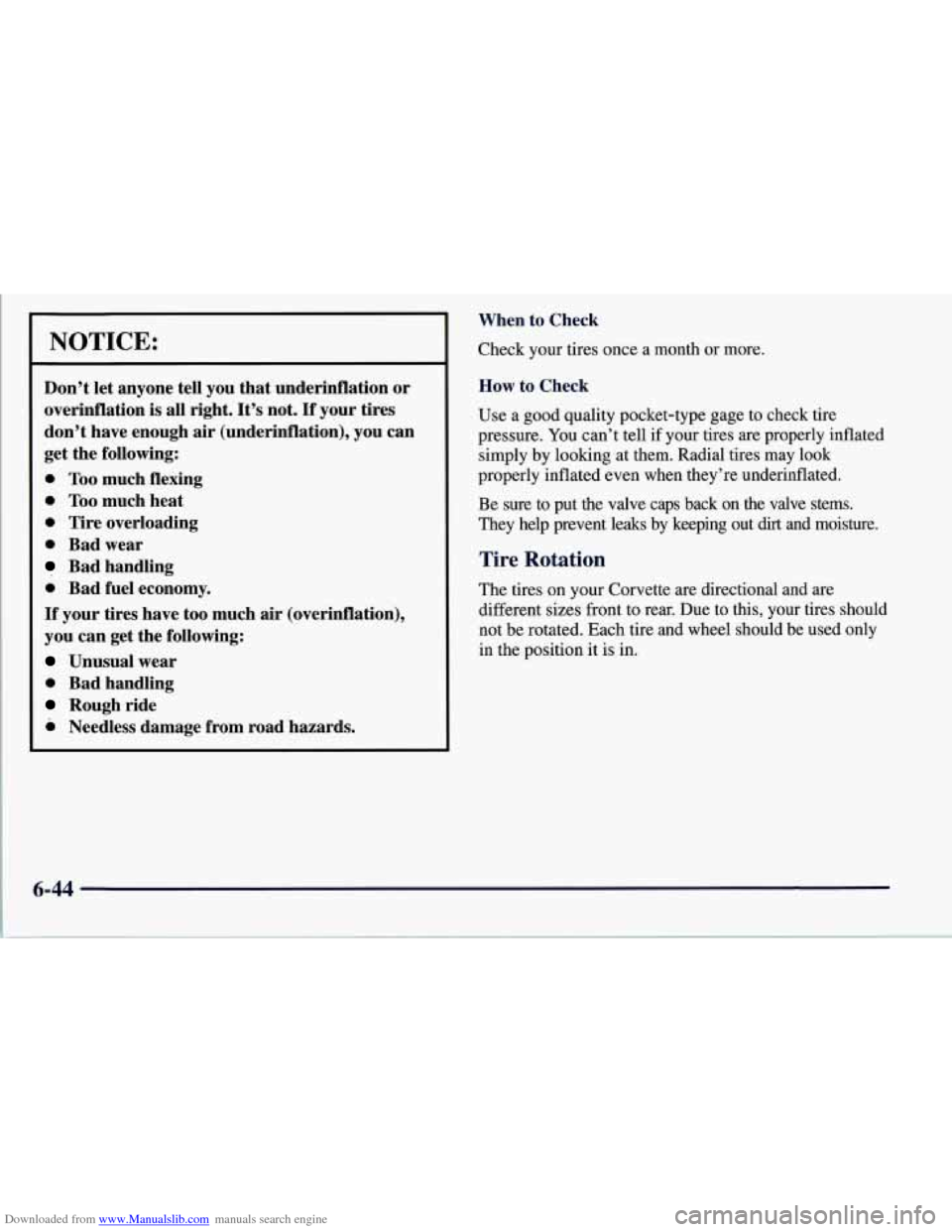
Downloaded from www.Manualslib.com manuals search engine NOTICE:
Don’t let anyone tell you that underinflation or
overinflation
is all right. It’s not. If your tires
don’t have enough air (underinflation), you can
get the following:
0 Too much flexing
0 Too much heat
0 Tire overloading
0 Bad wear
Bad handling
0 Bad fuel economy.
If your tires have too much air (overinflation),
you can get the following:
Unusual wear
0 Bad handling
Rough ride
0 Needless damage from road hazards. When to Check
Check your tires
once a month or more.
How to Check
Use a good quality pocket-type gage to check tire
pressure.
You can’t tell if your tires are properly inflated
simply by looking at them. Radial tires may look
properly inflated even when they’re underinflated.
Be sure
to put the valve caps back on the valve stems.
They help prevent leaks by keeping out
dirt and moisture.
Tire Rotation
The tires on your Corvette are directional and are
different sizes front to rear. Due to this, your tires should
not be rotated. Each tire and wheel should be used only
in the position it is in.
6-44
Page 304 of 356
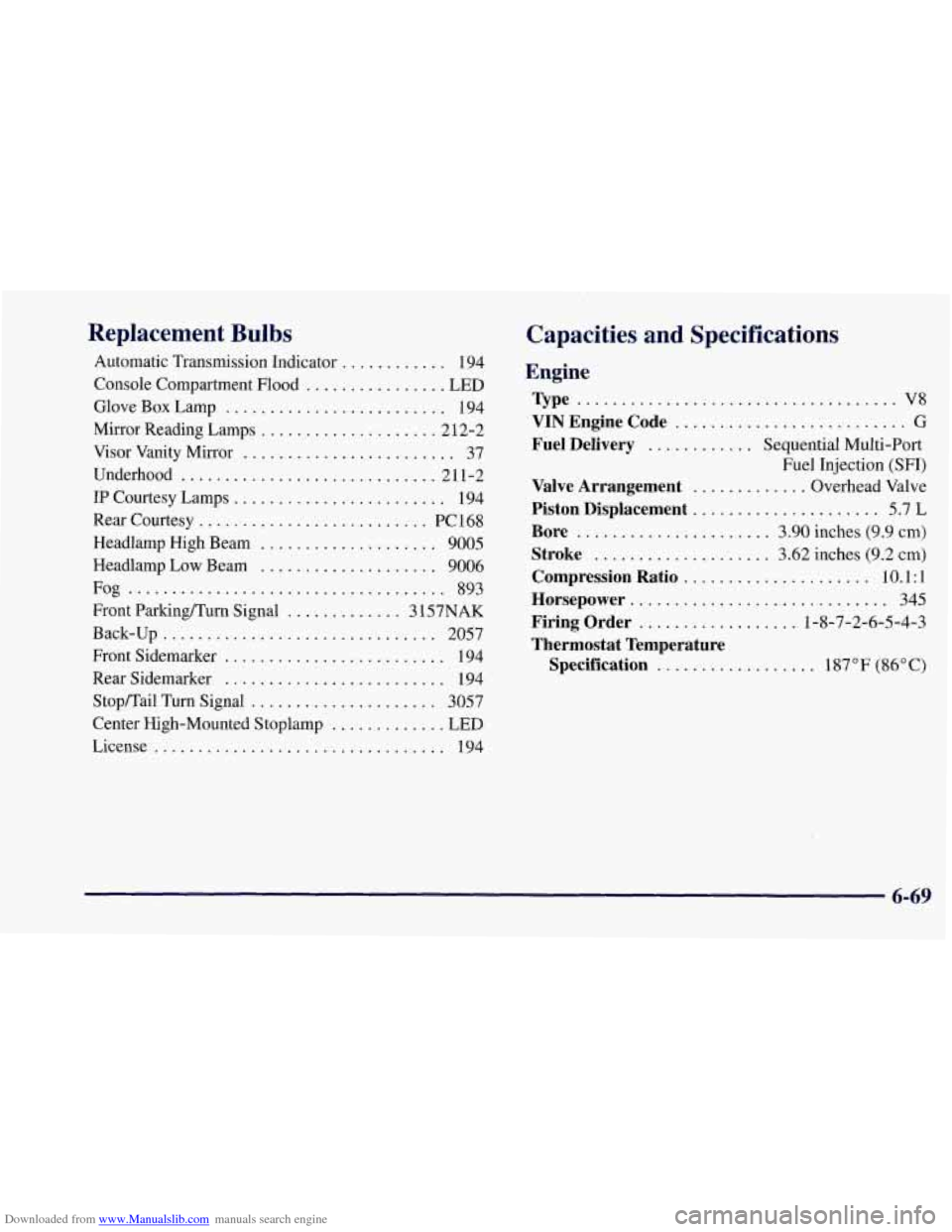
Downloaded from www.Manualslib.com manuals search engine Replacement Bulbs
Automatic Transmission Indicator ............ 194
Console Compartment Flood
................ LED
Glove Box Lamp ......................... 194
Mirror Reading Lamps
.................... 212-2
Visor Vanity Mirror
........................ 37
Underhood
............................. 211-2
IP Courtesy Lamps
........................ 194
Headlamp High Beam
.................... 9005
Headlamp Low Beam .................... 9006
Fog .................................... 893
Rear Courtesy .......................... PC168
Front ParlunglTurn Signal
............. 3 157NAK
Back-up
............................... 2057
Front Sidemarker
......................... 194
Rear Sidemarker
......................... 194
Stopflail Turn Signal
..................... 3057
Center High-Mounted Stoplamp
............. LED
License
................................. 194
Capacities and Specifications
Engine
Type .................................... V8
Fuel Delivery ............ Sequential Multi-Port
VIN Engine Code .......................... G
Fuel Injection (SFI)
Valve Arrangement ............. Overhead Valve
Piston Displacement ..................... 5.7 L
Bore ...................... 3.90 inches (9.9 cm)
Stroke .................... 3.62 inches (9.2 cm)
Compression Ratio ..................... 10.1 : 1
Horsepower ............................. 345
Firing Order .................. 1-8-7-2-6-5-4-3
Thermostat Temperature
Specification
.................. 1 87 O F (86 O C)
6-69
Page 305 of 356
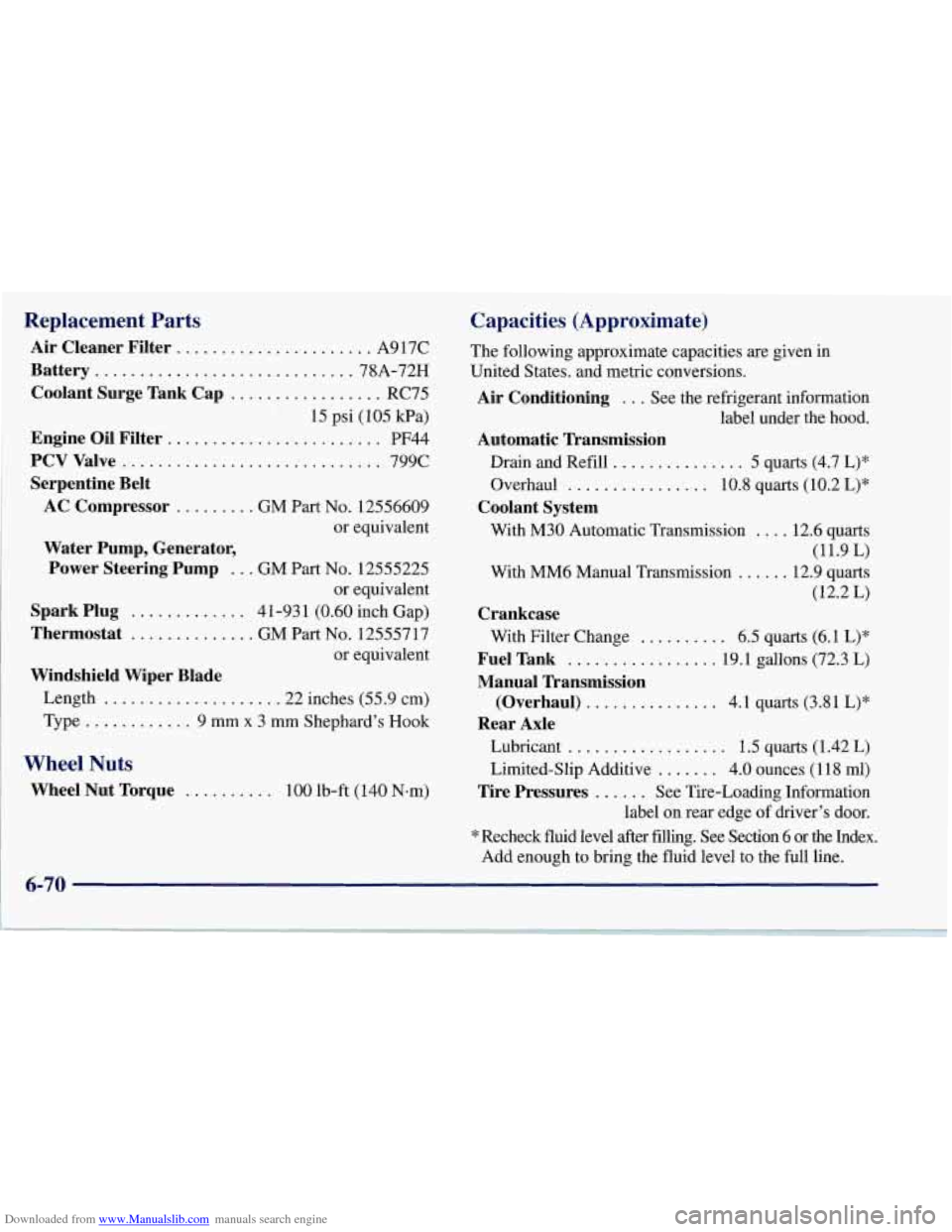
Downloaded from www.Manualslib.com manuals search engine Replacement Parts
Air Cleaner Filter ...................... A917C
Battery ............................. 78A-72H
Coolant Surge Tank Cap ................. RC75
Engine Oil Filter ........................ PF44
15
psi (105
kPa)
PCV Valve ............................. 799C
Serpentine Belt
AC Compressor
......... GM Part No. 12556609
or equivalent
Water Pump, Generator, Power Steering Pump
... GM Part No. 12555225
or equivalent
Thermostat .............. GM Part No. 125557 17
or equivalent
Windshield Wiper Blade Spark Plug
............. 4 1-93 1 (0.60 inch Gap)
Length
................... .22 inches (55.9 cm)
Type
............ 9 mm x 3 mm Shephard’s Hook
Wheel Nuts
Wheel Nut Torque .......... 100 lb-ft (140 Nsm)
Capacities (Approximate)
The following approximate capacities are given in
United States. and metric conversions.
Air Conditioning ... See the refrigerant information
label under the hood.
Automatic Transmission
Drain and Refill ............... 5 quarts (4.7 L)*
Overhaul
................ 10.8 quarts (10.2 L)*
With M30 Automatic Transmission
.... 12.6 quarts
With MM6 Manual Transmission
...... 12.9 quarts
(12.2 L)
With Filter Change
.......... 6.5 quarts (6.1 L)*
Fuel Tank ................. 19.1 gallons (72.3 L)
Coolant System
(11.9 L)
Crankcase
Manual Transmission Rear Axle (Overhaul)
................ 4.1 quarts
(3.81 L)*
Lubricant
.................. 1.5 quarts (1.42 L)
Limited-Slip Additive
....... 4.0 ounces (1 18 ml)
Tire Pressures ...... See Tire-Loading Information
label on rear edge of driver’s door.
*Recheck fluid level after filling. See Section
6 or the Index.
Add enough to bring the fluid level to the full line.