1997 CHEVROLET CORVETTE tow
[x] Cancel search: towPage 222 of 356
Downloaded from www.Manualslib.com manuals search engine Rear Towing
NOTICE:
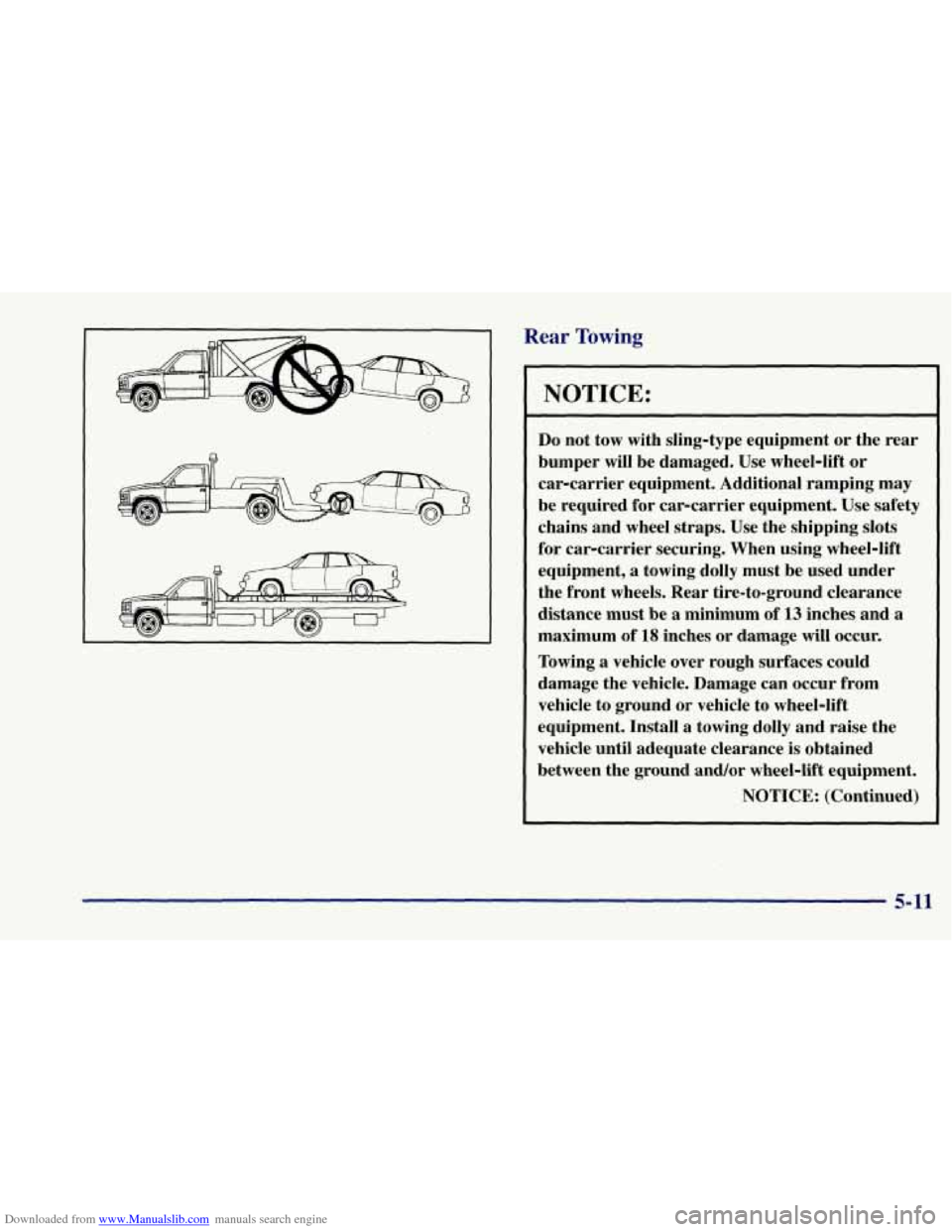
Do not tow with sling-type equipment or the rear
bumper will be damaged. Use wheel-lift or
car-carrier equipment. Additional ramping may
be required for car-carrier equipment. Use safety
chains and wheel straps. Use the shipping slots
for car-carrier securing. When using wheel-lift
equipment, a towing dolly must be used under
the front wheels. Rear tire-to-ground clearance
distance must be a minimum of
13 inches and a
maximum of
18 inches or damage will occur.
Towing
a vehicle over rough surfaces could
damage the vehicle. Damage can occur from
vehicle to ground or vehicle to wheel-lift
equipment. Install a towing dolly and raise the
vehicle until adequate clearance is obtained
between the ground and/or wheel-lift equipment.
NOTICE: (Continued)
5-11
Page 234 of 356
Downloaded from www.Manualslib.com manuals search engine NOTICE:
Spinning your wheels can destroy parts of your
vehicle
as well as the tires. If you spin the wheels
too fast while shifting your transmission back
and forth, you can destroy your transmission.
For information about using tire chains on your vehicle,
see “Tire Chains” in the Index.
Rocking Your Vehicle To Get It Out
First, turn your steering wheel left and right. That will
clear the area around your front wheels. You should
turn your TCS
off. (See “Traction Control System”
in the Index.) Then shift back and forth between
REVERSE (R) and a forward gear, spinning the wheels
as little as possible. For a manual transmission, shift
slowly between either FIRST
(1) or SECOND (2) and
REVERSE (R), allowing the wheels to stop before
shifting into gear. Release the accelerator pedal while
you shift, and press lightly
on the accelerator pedal
when the transmission is in gear.
If that doesn’t get you
out after a few tries, you may need to be towed out.
If you do need to be towed out, see “Towing Your
Vehicle”
in the Index.
5-23
Page 247 of 356
Downloaded from www.Manualslib.com manuals search engine Checking Engine Oil
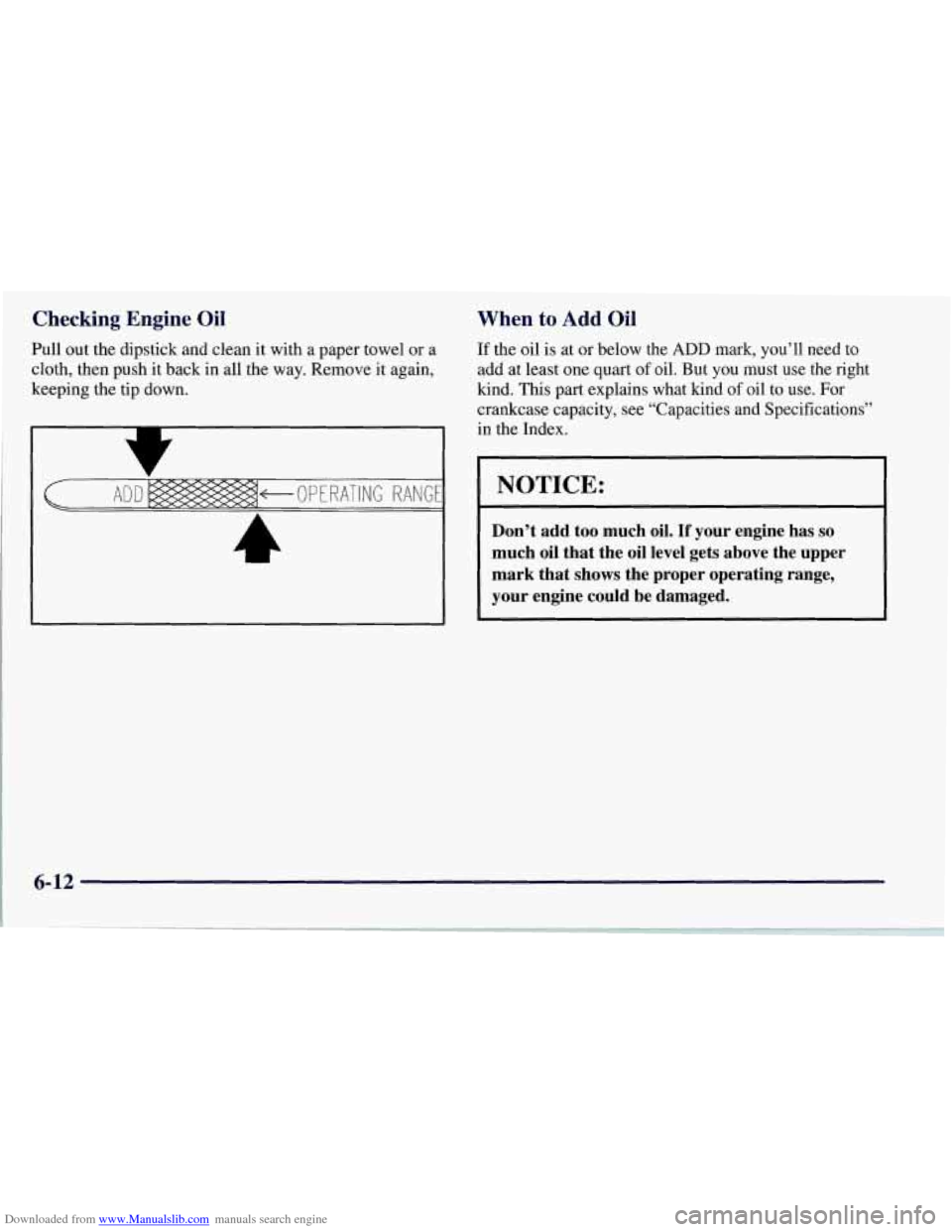
Pull out the dipstick and clean it with a paper towel or a
cloth, then push it back in all the way. Remove it again,
keeping the tip down.
When to Add Oil
If the oil is at or below the ADD mark, you’ll need to
add at least one quart
of oil. But you must use the right
kind.
This part explains what kind of oil to‘use. For
crankcase capacity, see “Capacities and Specifications”
in the Index.
NOTICE:
Don’t add too much oil. If your engine has so
much oil that the oil level gets above the upper
mark that
shows the proper operating range,
your engine could be damaged.
6-12
Page 284 of 356
Downloaded from www.Manualslib.com manuals search engine A CAUTION:
I
Rust or dirt on the wheel, or on the parts to
which it is fastened, can make the wheel nuts
become loose after
a time. The wheel could come
off and cause an accident. When you change
a
wheel, remove any rust or dirt from the places
where the wheel attaches to the vehicle. In an
emergency, you can use
a cloth or paper towel to
do this; but be sure to use
a scraper or wire brush
later, if you need to, to get all the rust or dirt off.
Never use oil or grease on studs or nuts.
If you
do, the nuts might come loose. Your wheel could
fall off, causing a serious accident.
~
A CAUTION:
Incorrect wheel nuts or improperly tightened
wheel nuts can cause the wheel to become loose
and even come off. This could lead to an accident.
Be sure to use the correct wheel nuts. If you have
to replace them, be sure to get new
GM original
equipment wheel nuts.
NOTICE:
Improperly tightened wheel nuts can lead to
brake pulsation and rotor damage. To avoid
expensive brake repairs, evenly tighten the wheel
nuts in the proper sequence and to the proper torque specification.
6-49
Page 288 of 356
Downloaded from www.Manualslib.com manuals search engine Cleaning Coated Moldings
These moldings are around the hatch opening in your
Corvette’s rear area.
0 When lightly soiled, wipe with a sponge or soft
When heavily soiled, use warm soapy water.
lint-free cloth dampened with
water.
You can remove scratches from a coated molding by
wiping briskly with the solvent-type cleaner described
earlier. If a ring forms, repeat the procedure over a larger
area, wiping toward the center of the ring. If the ring
still remains, wipe the whole molding.
Cleaning Leather
Use a soft cloth with lukewarm water and a mild soap or
saddle soap and wipe dry with a soft cloth. Then, let the
leather dry naturally.
Do not use heat to dry.
0 For stubborn stains, use a leather cleaner. See your
Never use oils, varnishes, solvent-based or abrasive
dealer
for this product.
cleaners, furniture polish or shoe polish on leather.
immediately. If dirt
is allowed to work into the
finish, it can harm the leather.
Soiled or stained leather should be cleaned
Cleaning the Top of the Instrument Panel
Use only mild soap and water to clean the top surfaces
of the instrument panel. Sprays containing silicones or
waxes may cause annoying reflections in the windshield
and even make it difficult to see through the windshield
under certain conditions.
Cleaning Soft-Touch Paint Surfaces
Use only mild soap and water to clean the Soft-Touch
paint surfaces
in your Corvette.
Cleaning the Security Shade and
Convenience Net
Wash with warm water and mild detergent, rinse with
cold water and tumble dry on low.
Do not use chlorine
bleach.
6-53
Page 290 of 356
Downloaded from www.Manualslib.com manuals search engine Weatherstrips
Silicone grease on weatherstrips will make them last
longer, seal better, and not stick or squeak. Apply
silicone grease with a clean cloth at least every six
months. During very cold, damp weather more frequent
application may be required. (See “Recommended
Fluids and Lubricants” in the Index.)
Cleaning a Removable Roof Panel
Special care is necessary when cleaning, removing
and/or storing the roof panel.
0 Flush with water to remove dust and dirt, then dry
the panel.
0 Clean the panel with GM Glass Cleaner. Leave the
cleaner on the panel for one minute, then wipe the
panel with a soft, lint-free cloth.
Don’t use abrasive cleaning materials.
If water drops are frequently allowed to dry on the roof
panel, impurities in the water will adhere to the top.
These impurities may destroy the finish. When the panel
gets wet, you should dry it off.
I NOTICE:
Do not use a glass treatment or conditioner
containing ethyl alcohol or ethyl sulfate on
the roof panel. These products may damage the panel.
Cleaning the Outside of Your Corvette
The paint finish on your vehicle provides beauty, depth
of color, gloss retention and durability.
Washing Your Vehicle
The best way to preserve your vehicle’s finish is to keep it
clean by washing it often with lukewarm or cold water.
Don’t wash your vehicle in the direct rays of the sun.
Don’t use strong soaps or chemical detergents. Use
liquid hand, dish or car washing (mild detergent) soaps.
Don’t use cleaning agents that are petroleum based,
or
that contain acid or abrasives. All cleaning agents
should be flushed promptly and not allowed to dry on
the surface, or they could stain.
Dry the finish with a
soft, clean chamois or an all-cotton towel
to avoid
surface scratches and water spotting.
6-55
Page 292 of 356
Downloaded from www.Manualslib.com manuals search engine Cleaning Aluminum Wheels
Keep your wheels clean using a soft clean cloth with
mild soap and water. Rinse with clean water. After
rinsing thoroughly, dry with a soft clean towel. A wax
may then be applied.
The surface of these wheels is similar to the painted
surface
of your vehicle. Don’t use strong soaps,
chemicals, abrasive polishes, abrasive cleaners or
abrasive cleaning brushes on them because you could
damage the surface.
Don’t take your vehicle through an automatic car wash
that has silicon carbide tire cleaning brushes. These
brushes can also damage the surface of these wheels.
Cleaning Tires
To clean your tires, use a stiff brush with a tire cleaner.
NOTICE:
When applying a tire dressing always take care to
wipe off any overspray or splash from all painted
surfaces on the body or wheels of the vehicle.
Petroleum-based products may damage the
paint finish.
Finish Damage
Any stone chips, fractures or deep scratches in the finish
should be repaired right away.
Minor chips and scratches can be repaired with touch-up
materials available from your dealer or other service
outlets. Larger areas of finish damage can be corrected
in your dealer’s body and paint shop.
Underbody Maintenance
Chemicals used for ice and snow removal and dust
control can collect
on the underbody. If these are not
removed, accelerated corrosion (rust) can occur on
the underbody parts such as fuel lines, frame, floor
pan and exhaust system even though they have
corrosion protection.
At least every spring, flush these materials from the
underbody with plain water. Clean any areas where mud
and other debris can collect. Dirt packed in closed areas
of the frame should be loosened before being flushed.
Your dealer or an underbody car washing system can do
this for
you.
6-57
Page 334 of 356
Downloaded from www.Manualslib.com manuals search engine ChevroletIGeo Roadside
Assistance Program
To enhance Chevrolet’s strong commitment to customer
satisfaction, Chevrolet is excited to announce the
establishment of the Chevrolet/Geo Roadside Assistance
Center. As the owner of a
1997 ChevroletlGeo,
membership in Roadside Assistance is free. Roadside Assistance is available 24 hours
a day,
365 days a year, by calling 1-800-CHEV-USA
(1 -800-243-8872). This toll-free number will provide
you over-the-phone roadside assistance with minor
mechanical problems. If your problem cannot be
resolved over the phone, our advisors have access to a
nationwide network of dealer recommended service
providers. Roadside membership is free, however some
services may incur costs.
Roadside offers two levels of service to the customer,
Basic Care and Courtesy’” Care:
Toll-free number, 1 -800-CHEV-USA
0 Free towing for warranty repairs
0 Basic over-the-phone technical advice
Available dealer services at reasonable costs (ie.,
wrecker services, locksmithkey service, glass
repair, etc.)
8-5